Quotulatiousness

December 13, 2019

We won’t have the Milk Dud to kick around any more … eventually

Filed under: Cancon, Politics — Tags: , , — Nicholas @ 05:00

News of the moment in Canada is the sudden resignation of “Conservative” party leader Andrew “The Milk Dud” Scheer:

Andrew Scheer, paid tool of Big Dairy, chugs some milk during a Press Gallery speech in 2017. I’ve called him the “Milk Dud” ever since.
Screencapture from a CTV video uploaded to YouTube.

Andrew Scheer used money from the Conservative Party to pay costs of private schooling for his children, according to sources in contact with Global News. Some are suggesting this story might have ultimately let to Scheer’s resignation.

Scheer has since stepped down as leader of the Conservative Party, but he will not fully resign until the party has a replacement to fill the position.

According to some senior Conservative members, Scheer’s use of the Conservative Party of Canada funds was improper.

While in the House of Commons, Scheer said, “I just informed my colleagues in the Conservative caucus that I will be resigning as the leader of the Conservative Party of Canada and I will be asking the Conservative Party national council to immediately begin the process of organizing a leadership contest.”

“In order to chart the course ahead in the direction this party is heading, the party needs someone who can give 100 percent.”

Dustin van Vugt, the Executive Director of the Conservative Party of Canada wrote a statement saying, “All proper procedures were followed and signed off on by the appropriate people.”

Van Vugt talked about the party covering some of Scheer’s costs in the statement saying, “As is the normal practice for political parties, the Party offered to reimburse some of the costs associated with being a national leader and re-locating the family to Ottawa.”

Where, oh where will the “Conservatives” find a leader of Scheer’s “stature” to fill his dainty little shoes? Maybe Justin can spare one of his cast-offs…

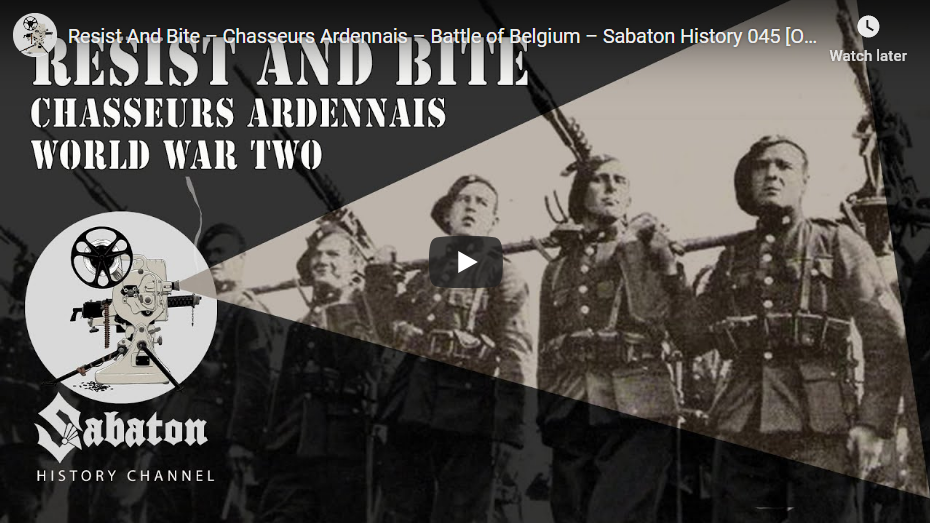
“Resist And Bite” – Chasseurs Ardennais – Battle of Belgium – Sabaton History 045 [Official]

Filed under: Europe, Germany, History, Media, Military, WW2 — Tags: , , , , , — Nicholas @ 04:00

Sabaton History
Published 12 Dec 2019

As Germany invades France and the Benelux countries in May 1940, the main bulk of their panzers are heading towards the Ardennes and the Meuse River in an effort to cut the Allied forces in half. However, two small units of Belgian infantry are standing in their way. They are the Chasseurs Ardennais and have one objective: To delay the Germans by every means necessary…

Support Sabaton History on Patreon: https://www.patreon.com/sabatonhistory

Listen to Heroes (where “Resist And Bite” is featured):
CD: http://bit.ly/HeroesStore
Spotify: http://bit.ly/HeroesSpotify
Apple Music: http://bit.ly/HeroesAppleMusic
iTunes: http://bit.ly/HeroesiTunes
Amazon: http://bit.ly/HeroesAmz
Google Play: http://bit.ly/HeroesGoogleP

Watch the official lyric video of “Resist And Bite” here:
https://www.youtube.com/watch?v=iGtEH…

Listen to Sabaton on Spotify: http://smarturl.it/SabatonSpotify
Official Sabaton Merchandise Shop: http://bit.ly/SabatonOfficialShop

Hosted by: Indy Neidell
Written by: Markus Linke and Indy Neidell
Directed by: Astrid Deinhard and Wieke Kapteijns
Produced by: Pär Sundström, Astrid Deinhard and Spartacus Olsson
Creative Producer: Joram Appel
Executive Producers: Pär Sundström, Joakim Broden, Tomas Sunmo, Indy Neidell, Astrid Deinhard, and Spartacus Olsson
Post-Production Director: Wieke Kapteijns
Production Intern: Rune Væver Hartvig
Edited by: Iryna Dulka
Sound Editing by: Marek Kaminski
Maps by: Eastory – https://www.youtube.com/c/eastory

Archive by: Reuters/Screenocean https://www.screenocean.com
Music by Sabaton.

Colorizations:
– Julius Jääskeläinen – https://www.facebook.com/JJcolorization/
– Olga Shirnina, a.k.a. Klimbim – https://klimbim2014.wordpress.com/

An OnLion Entertainment GmbH and Raging Beaver Publishing AB co-Production.

© Raging Beaver Publishing AB, 2019 – all rights reserved.

From the comments:

Sabaton History
2 days ago (edited)
Today we again turn towards the Second World War — to be more specific the 1940 German invasion of France and the Benelux. Here two small Belgian units bravely attempted to delay the advance of the Wehrmacht. We hope you all appreciate this video! And much like the Chasseur Ardennais supported the war effort of the Belgians, our awesome Patrons support the war effort of us, the Sabaton History team! So if you haven’t, you most certainly should consider supporting us on https://www.patreon.com/sabatonhistory.

Oh and if you’re interested in World War Two, you should definitely check out Indy’s World War Two Channel (http://www.youtube.com/c/worldwartwo) where he covers WW2 Week-by-week. Last May, he covered the invasion of the Benelux and France, which you can check out right here: https://youtu.be/DLN8NHXiMy0

Cheers, the Sabaton History team!

Further adventures of the “Basic College Girl”

Filed under: Bureaucracy, Education, Humour, USA — Tags: , , , — Nicholas @ 03:00

Severian has another tale of his university teaching career to share:

University College, University of Toronto, 31 July, 2008. (Not the educational institution in the story…)
Photo by “SurlyDuff” via Wikimedia Commons.

The Basic College Girl is so dumb, lazy, and entitled, she makes Hillary Clinton look like a criminal mastermind. I caught one recycling a term paper from another class because she’d forgotten to take the other professor’s name off the header. Hell, I caught one copy-pasting straight off Wikipedia because she’d left the hyperlinks embedded in the text.

And these were not Hail Marys. Just copy-pasting something, anything, Cuttlefish-style makes sense if you haven’t done a lick of work and it’s due in five minutes. It’s a one-in-a-million shot, sure, but since it took you all of 45 seconds and you’re going to fail anyway, you might as well try to shoot the moon. No, these were papers turned in with plenty of time to spare (I always had my term papers due at least a week before final exams).

Think about that for a second: Instead of coming to my office hours with a sob story, or trying to talk the registrar into an incomplete, or faking her own death, or doing literally anything else, more than a few BCGs turned in visible-from-space plagiarism and skipped on down to Starbucks for a triple foam half-caff venti soy chai pumpkin spice latte. YOLO!

That’s not the worst part, though. The worst part is the BCG’s reaction when you catch them. When you point out that no, I’m not Professor Jones and this isn’t Spring 2014, the BCG’s universal, invariable reaction is … anger. At YOU.

At the time I was simply too pissed to think about it rationally (I trust you’ll believe me when I say that in the semesters just before I retired, my biggest challenge was keeping a look of utter contempt off my face). Looking back on it after some years, though, it makes sense. BCGs are all grandiose narcissists with Borderline Personality Disorder. Of course they’re just so wonderful that anything they deign to turn in should be given an A+, sight unseen. What other purpose could I, the professor, possibly serve, other than to mark it down for record-keeping? Now she’s forced to take the time to email me, or come down to my office hours, or what have you, just to set my dumb ass straight. It’s a real inconvenience!

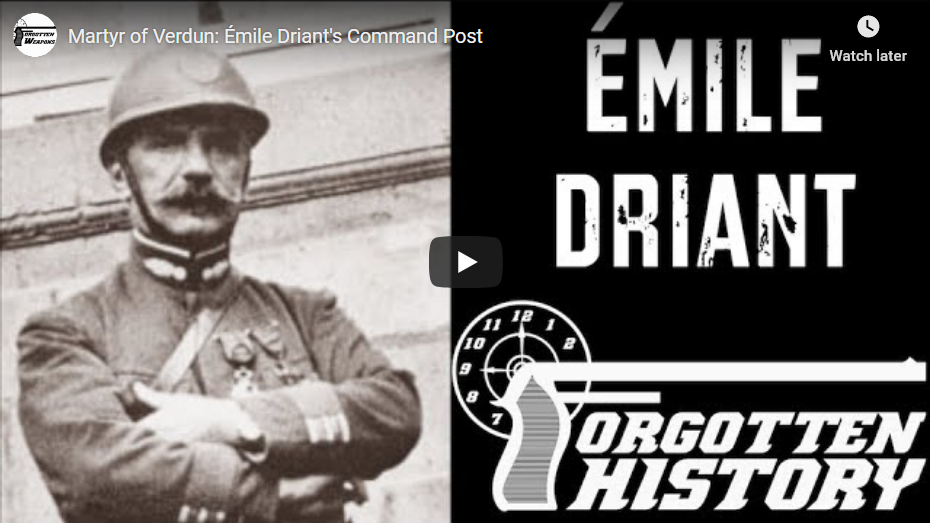
Martyr of Verdun: Émile Driant’s Command Post

Filed under: France, History, Military, WW1 — Tags: , , — Nicholas @ 02:00

Forgotten Weapons
Published 22 Oct 2019

http://www.patreon.com/ForgottenWeapons

Cool Forgotten Weapons merch! http://shop.bbtv.com/collections/forg…

Émile Driant was a French army officer who served originally as an aide to General Boulanger (and married his daughter). This connection would tarnish his career when politics forced Boulanger to resign (and shortly afterward commit suicide). It became clear that he would never rise much in rank, and in 1905 he resigned his commission. In 1910 he was elected to the French National Assembly, where he was still serving when war erupted in 1914. Driant was focused on French military readiness his entire life, and wrote extensively about potential future wars.

In 1914, he was recalled to military service, although he retained his Assembly position. He was given command of a reserve unit of Chausseurs (infantry) in the quiet backwater Verdun sector, where he couldn’t cause too much trouble to the military establishment. Through 1915 he watched Joffre remove men and guns from the forts around Verdun to reinforce more active areas of the front. He was intensely concerned that this was leaving Verdun a weak point ripe for German attack. As an officer, there was not much he could do about this except complain to his own commander — but as an active member of the National Assembly, he was able to bypass the military chain of command and take his concerns directly to the civilian government. This did nothing to endear him to Joffre, but the attention he brought did result in more defensive preparations being made in and around Verdun.

On February 21st, 1916 Driant’s warnings were proven true when the Germans launched the Battle of Verdun, which would become one of the most significant operations of the war for France. Driant and his 1200 Chausseurs were stationed in the Bois de Caures forest, right in the middle of the German offensive. His men fought valiantly to hold back the attack in their sector, but were reduced to less than 200 men combat-effective by the 22nd. Driant ordered a withdrawal that morning, and was killed by a gunshot while aiding a wounded trooper.

He was buried with military honors by the Germans, but later re-interred by the French where he had fallen. Today his command post remains just a few hundred yards from his gravesite, and a memorial marks the spot. Driant quickly became recognized as one of the heroes of Verdun, for his efforts before the battle and his front-line leadership during the initial attack.

Contact:
Forgotten Weapons
6281 N. Oracle #36270
Tucson, AZ 85704

QotD: Labelling matters a lot in political discussions

Filed under: Economics, Politics, Quotations — Tags: — Nicholas @ 01:00

If a nice name comes to be attached to a nefarious policy, even those people who are harmed by that policy can be misled into mistaking that policy as being one that works in their favor – or as being at least a policy that is admirably motivated or that achieves commendable outcomes for the public at large. Who, after all, dares oppose trade that’s “fair”? Who can object to “level” playing fields? Who would not want the government to prevent its citizens from being “dumped” on by foreigners? Who would applaud prices that are “too” low? These labels sneak in the false conclusion both that what is so labeled really exists as such, and that the accompanying policies actually achieve the results implied by their labels.

Don Boudreaux, “Quotation of the Day…”, Café Hayek, 2017-11-09.

December 12, 2019

Quick woodworking with the ultra-fast nailed rabbet joint.

Filed under: Tools, Woodworking — Tags: , , — Nicholas @ 06:00

Rex Krueger
Published 11 Dec 2019

Learn to make fast and durable projects with this traditional joint.
More video and exclusive content: http://www.patreon.com/rexkrueger
Get the Plans: https://www.rexkrueger.com/store/plan…
Get the FREE Tip Sheet: https://www.rexkrueger.com/articles/2…
(more…)

“Socialism” and “Capitalism” in the United States

Filed under: Economics, Government, Politics, USA — Tags: , , , , , , — Nicholas @ 05:00

Antony Davies and James R. Harrigan look at the supposed conflict between sharing, caring socialism and raw, heartless capitalism in the context of the American political theatre:

These terms were once very clearly defined. Socialism is state control of the means of production. The intent is that these means are to be used for the public good. By contrast, capitalism is simply private ownership of the means of production. The intent is that these means are to be used to advance the interests of those who own them, which will in turn create conditions of general prosperity that can be enjoyed by all.

When polled, Americans express relatively well-defined views on both. And while nowhere near a majority of the American electorate favors a completely socialist system, a recent Gallup poll indicates that more than four in ten Americans think “some form of socialism” is a good thing. But what is “some form of socialism?” A society is either socialist or it isn’t. The state either owns the means of production or it doesn’t. There is no middle ground. Even our openly socialist politicians rarely advocate anything near as drastic as government control of the means of production.

[…]

And just as transferism is not actually socialism, the system against which transferists rail isn’t capitalism, either. When they think of “capitalism,” transferists imagine a monied class that defrauds customers, pollutes the environment, and maintains monopoly power, all because the monied class is in bed with government. But capitalism is simply the private ownership of the means of production. What people are actually describing is something more appropriately called “cronyism,” which can manifest in a socialist system as easily as in a capitalist one. Cronyism isn’t a byproduct of the economic system at all; it is a byproduct of politics.

For current examples, one need look no further than North Korea, Cuba, and Venezuela. Socialists say these aren’t examples of “real socialism,” and they’re not. There was a time when these countries were indeed socialist, just as there was a time when the United States was capitalist. But cronyism has overtaken these countries’ economic systems, just as it did in humanity’s grandest socialist experiment: the Soviet Union. Life was simply different for inner-party members than it was for workers. This is the real danger that all countries face, regardless of the animating principles of their economic and political structures.

[…]

We need to answer the core question: how much transferism do we want?

In order to figure this out, we need to come to terms with the fact that any transfer is a confiscation of wealth from the people who created it. That confiscation will decrease wealth creation in the long term by decreasing an important incentive to take the risks necessary for creating wealth. Second, we have to recognize that transferism is addictive. No matter how much we transfer, people will always want more. The United States’ $23 trillion debt, the largest debt the world has ever seen, has come about because of American voters’ voracious appetite for transfers combined with politicians’ obvious incentive to provide them.

The solution politicians have found is to pass off the cost of the transfers to taxpayers who haven’t yet been born by borrowing the money, thereby leaving to the next generation the problem of repaying the debt or enduring unending interest payments. It’s a house of cards to be sure, but from their perspective, it will be someone else’s house of cards.

In the end, we have polluted our political discourse with two words that no longer have much meaning: socialism and capitalism. In the process, we don’t call the animating principle of modern American politics what it actually is: transferism. The only winners have been the politicians who manage to gather votes by keeping the electorate in a near-constant state of friction. And they keep winning if people keep thinking in categories that ceased to have any real meaning years ago.

The Few Who Opposed Hitler – German Resistance in 1940 – WW2 – War Against Humanity 006

Filed under: Germany, History, Military, WW2 — Tags: , , , , — Nicholas @ 04:00

World War Two
Published 11 Dec 2019

Where all German faithful Nazis? Not by a stretch, but a resounding majority approved of the Nazis, especially before the war, and again after the victory in France. Anyone that actively opposed Hitler and his gang were not only risking their life, but faced an uphill battle against public opinion. And yet … some people did.

Join us on Patreon: https://www.patreon.com/TimeGhostHistory
Or join The TimeGhost Army directly at: https://timeghost.tv

Follow WW2 day by day on Instagram @World_war_two_realtime https://www.instagram.com/world_war_t…
Join our Discord Server: https://discord.gg/D6D2aYN.
Source list: http://bit.ly/WW2sources

Hosted by: Spartacus Olsson
Written by: Spartacus Olsson and Joram Appel
Produced and Directed by: Spartacus Olsson and Astrid Deinhard
Executive Producers: Bodo Rittenauer, Astrid Deinhard, Indy Neidell, Spartacus Olsson
Creative Producer: Joram Appel
Post-Production Director: Wieke Kapteijns
Research by: Joram Appel and Spartacus Olsson
Edited by: Mikołaj Cackowski
Map animations: Eastory (https://www.youtube.com/c/eastory)

Colorizations by:
Cassowary Colorizations – https://www.flickr.com/photos/cassowa…
Julius Jääskeläinen – https://www.facebook.com/JJcolorization/
Dememorabilia – https://www.instagram.com/dememorabilia/
Norman Stewart – https://oldtimesincolor.blogspot.com/

Sources:
Archive of I. M. Bondarenko
Archive by Screenocean/Reuters https://www.screenocean.com.

A TimeGhost chronological documentary produced by OnLion Entertainment GmbH.

From the comments:

World War Two
5 hours ago
This is the first episode of five War Against Humanity videos that will focus on Resistance in 1940. In this episode we look at Germany, then France, after that the Benelux countries and Scandinavia, then Poland and finally China. The first two episodes will come out before Christmas and the next will follow at the beginning of the new year. These episodes are all introductions to a recurring coverage of the war behind the lines. Resistance and collaboration with the occupying enemy was an essential component of WW2, but because it was clandestine, often private enterprises, the records are less detailed than the ones of the official war machines of the belligerents. Thus, resistance is not always as easy to organize on a weekly time line. Therefore we will return irregularly to the events behind each frontline to look at the developments over a somewhat longer timespan. We will do our best to follow the individuals who played a central part in the events and machinations. We hope that in this way we can give you more insight into WW2 events that are often overlooked, or covered in a less cohesive way.

Explaining the decline in library usage

Filed under: Books, Britain, Economics, Government — Tags: , , — Nicholas @ 03:00

At the Continental Telegraph, Tim Worstall refutes the claims that it’s the evil right wingers (in this specific case, British Tories) that are driving the library out of business:

“Nottingham central library” by JuliaC2006 is licensed under CC BY 2.0

Despite spending more money, library use, measured in terms of at least one visit per year, fell from 48.2% of adults to 39.7% of adults. I make that as roughly 1/5th of the adults that were using them not doing so in 5 years. 17% sounds slightly on the conservative side.

And if this was about “austerity”, you’d expect visits to be rising, rather than falling from 39.7% to 32.9% since the Conservatives/Lib Dems took over. Because the thing with libraries is that they suit the time rich and cash poor. If you’ve not got much else to do, you can spend time walking to a library, getting a book, walking home and easily finding time in the fortnight to read it. And 9-5 hours don’t bother you. There’s areas of the country, like Weston-Super-Mare, stuffed full of retired people and libraries are popular.

If you’re working all week you have to get to a library in your day, park your car, pay for parking, same on return, and make sure to set aside the time to do the reading, you might decide libraries aren’t that convenient.

The decline of libraries is a success story for us. We created them because books were very expensive once. Owning a giant library was the mark of a rich man. Paper was expensive, printing was expensive, binding was expensive. Over the decades, we figured out how to do this cheaper. Then we figured out how to do retailing cheaper. And then we got e-books which take production costs to near zero. Books are cheap. Cheap enough that most of us don’t want the faff of libraries. So, close some of them.

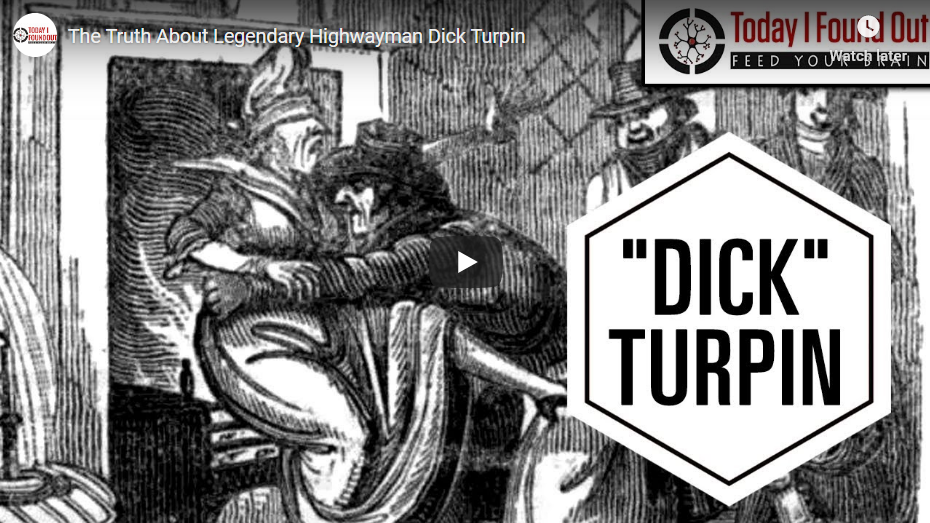
The Truth About Legendary Highwayman Dick Turpin

Filed under: Britain, History, Law — Tags: , , — Nicholas @ 02:00

Today I Found Out
Published 8 Feb 2018

If you happen to like our videos and have a few bucks to spare to support our efforts, check out our Patreon page where we’ve got a variety of perks for our Patrons, including Simon’s voice on your GPS and the ever requested Simon Whistler whistling package: https://www.patreon.com/TodayIFoundOut

Never run out of things to say at the water cooler with TodayIFoundOut! Brand new videos 7 days a week!

In this video:

Richard Turpin, better known by his nickname, Dick, was a legendary highwayman who stalked the English countryside. A century or so after his death by hanging in 1739, Turpin was idealised as a dashing rogue or gentleman thief type in a multitude of supposedly factual stories purportedly based on his life.

Want the text version?: http://www.todayifoundout.com/index.p…

QotD: Economic sophistication in ancient Greece

Filed under: Economics, Europe, Greece, History, Quotations — Tags: , , , — Nicholas @ 01:00

Let us take the case of Thales of Miletus (c620-c546 BC), one of the earliest of Greek philosophers. This story is told of him by Aristotle:

    There is the anecdote of Thales the Milesian and his financial device, which involves a principle of universal application, but is attributed to him on account of his reputation for wisdom. He was reproached for his poverty, which was supposed to show that philosophy was of no use. According to the story, he knew by his skill in the stars while it was yet winter that there would be a great harvest of olives in the coming year; so, having a little money, he gave deposits for the use of all the olive-presses in Chios and Miletus, which he hired at a low price because no one bid against him. When the harvest-time came, and many were wanted all at once and of a sudden, he let them out at any rate which he pleased, and made a quantity of money.

Whether this is a true story about Thales, or even of market conditions in Miletus, is of no importance. What is important is the unvoiced background to the story. It cannot easily be taken as an instance of the predatory capitalism that Polanyi and Finley are willing to grant to the ancient world. Thales decided that there would be a good olive crop. He did not buy olive presses. Instead, he took out options on them. He and those who dealt with him, seem to have understood the nature of the deal made. When it turned out that Thales had predicted right, he seems to have had no trouble enforcing his contracts. This assumes a familiarity of the courts with such contracts, and a commercial state of mind either among the peoples of Chios and Miletus, or — assuming the story is apocryphal — among Aristotle’s Athenian audience.

Many of the Greek city states were considerable trading centres. They lack any detailed commercial histories. Certainly, no ancient writer thought it consistent with the dignity of history to describe their economic structure and the causes of their commercial greatness. But this casual anecdote must stand in place of the unwritten histories as evidence for thriving and sophisticated financial economies.

Sean Gabb, “Market Behaviour in the Ancient World: An Overview of the Debate”, 2008-05.

December 11, 2019

6 Simple Woodworking Christmas Projects | Paul Sellers

Filed under: Tools, Woodworking — Tags: , — Nicholas @ 04:00

Paul Sellers
Published 10 Dec 2019

Paul has put together his favourite simple woodworking projects to make as gifts. Make someone special a handmade Christmas gift they’ll treasure for years to come!

All these projects are available to view with a free membership on Woodworking Masterclasses, see the link to each project below:

00:26 Cutting Board – http://bit.ly/359UL79
1:10 Soup Spoon – http://bit.ly/2E9PsIZ
2:00 Wooden Coasters – http://bit.ly/35876bX
2:42 Dovetail Caddy – http://bit.ly/38rp8bd
3:29 Dovetail Boxes – http://bit.ly/2LHyNke
4:34 Wooden Tray – http://bit.ly/38sOJ3U

——————–

Want to learn more about woodworking?

Go to Woodworking Masterclasses for weekly project episodes: http://bit.ly/2JeH3a9

Go to Common Woodworking for step-by-step beginner guides and courses: http://bit.ly/35VQV2o

http://bit.ly/2BXmuei for Paul’s latest ventures on his blog

Toward a working definition of “social justice”

David Thompson hacks through the jungle of misinformation to craft an initial working definition that appears to hit all the high points quite nicely:

“Social justice” entails treating people not as individuals but as mascots and categories. And judging a person and their actions based on which Designated Victim Group they supposedly belong to and then assigning various exemptions and indulgences depending on that notional group identity and whatever presumptuous baggage can be attached to it, with varying degrees of perversity. And conversely, assigning imaginary sins and “privilege” to someone else based on whatever Designated Oppressor Group they can be said to belong to, however fatuously, and regardless of the particulars of the actual person.

Which is to say, “social justice” is largely about judging people tribally, cartoonishly, and by different and contradictory standards, based on some supposed group identity, which apparently — and conveniently — overrides all else. It’s glib, question-begging and pernicious. Cargo-cult morality. Viewed with a cool eye, it’s something close to the opposite of justice. And yet, among our self-imagined betters, it’s the latest must-have.

In much the same way, “diversity” seems to be the belief that the less we have in common, and feel we have in common, the happier we will be. An unobvious proposition, to say the least. And then there’s “equity” — another word favoured by both educators and campus activists — and which is defined, if at all, only in the woolliest and most evasive of terms. And which, when used by those same educators and activists, seems to mean something like “equality of outcome regardless of inputs.” Inputs including diligence and punctuality. And that isn’t fair either.

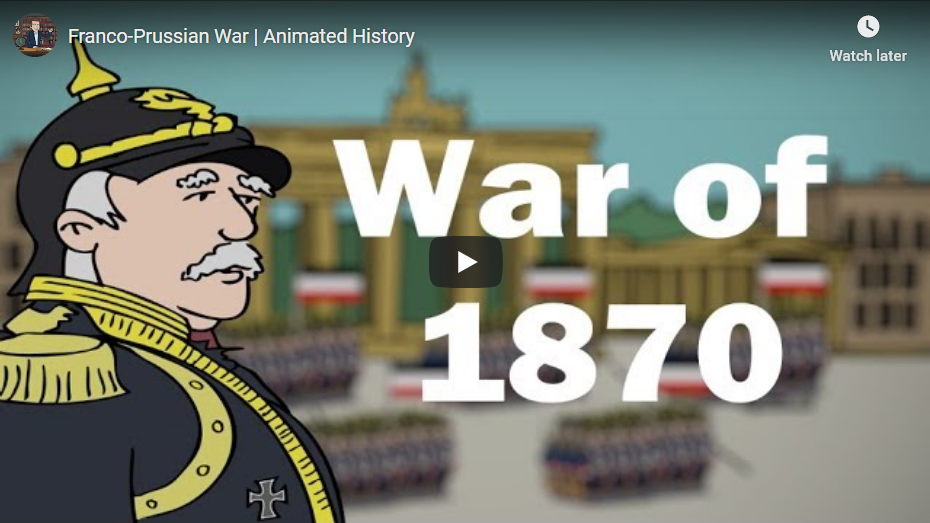
Franco-Prussian War | Animated History

Filed under: France, Germany, History, Military — Tags: , , , , , , — Nicholas @ 02:00

The Armchair Historian
Published 4 Feb 2018

What was the Franco Prussian War?

Our Website: https://www.thearmchairhistorian.com/

Our Twitter:
@ArmchairHist

Our Discord:
https://discord.gg/Ppb2cUd

Sources:
https://www.britannica.com/event/Fran…
http://francoprussianwar.com/
http://history-world.org/franco_pruss…
http://www.newworldencyclopedia.org/e…
https://www.warhistoryonline.com/hist…
http://geacron.com/home-en/?v=m&lang=…

Music: Music: Antonio Salieri: “Twenty six variations on La Folia de Spagna

QotD: Charles I and the Civil War

With the ascension of Charles I to the throne we come at last to the Central Period of English History (not to be confused with the Middle Ages, of course), consisting in the utterly memorable Struggle between the Cavaliers (Wrong but Wromantic) and the Roundheads (Right and Repulsive).

Charles I was a Cavalier King and therefore had a small pointed beard, long flowing curls, a large, flat, flowing hat, and gay attire. The Roundheads, on the other hand, were clean-shaven and wore tall, conical hats, white ties, and sombre garments. Under these circumstances a Civil War was inevitable.

The Roundheads, of course, were so called because Cromwell had all their heads made perfectly round, in order that they should present a uniform appearance when drawn up in line.

Besides this, if any man lost his head in action, it could be used as a cannon-ball by the artillery (which was done at the Siege of Worcester).

For a long time before the Civil War, however, Charles had been quarrelling with the Roundheads about what was right. Charles explained that there was a doctrine called the Divine Right of Kings, which said that:

    (a) He was King, and that was right.

    (b) Kings were divine, and that was right.

    (c) Kings were right, and that was right.

    (d) Everything was all right.

But so determined were the Roundheads that all this was all wrong that they drew up a Petition called the Petition of Right to show in more detail which things were wrong. This Petition said:

    (a) That it was wrong for anyone to be put to death more than once for the same offence.

    (b) Habeas Corpus, which meant that it was wrong if people were put in prison except for some reason, and that people who had been mutilated by the King, such as Prynne, who had often had his ears cut off, should always be allowed to keep their bodies.

    (c) That Charles’s memorable methods of getting money, such as Rummage and Scroungeage, were wrong. But the most important cause of the Civil War was Ship Money

Charles I said that any money which was Ship Money belonged to him; but while the Roundheads declared that Ship Money could be found only in the Cinq Ports, Charles maintained that no one but the King could guess right which was Ship Money and which wasn’t. This was, of course, part of his Divine Right. The climax came when a villager called Hampden (memorable for his dauntless breast) advised the King to divine again. This so upset Charles that he went back to Westminster, and after cinquing several ports burst into the House of Commons and asked in a very royal way for some birds which he said were in there. The Parliament, who were mostly Puritans, were so shocked that they began making solemn Leagues and Countenances. Charles therefore became very angry and complaining that the birds had flown raised his standard at Nottingham and declared war against Hampden and the Roundheads.

The War

At first the King was successful owing to Prince Rupert of Hentzau, his famous cavalry leader, who was very dashing in all directions. After this, many indecisive battles were fought at such places as Newbury, Edgehill, Newbury, Chalgrove Field, Newbury, etc., in all of which the Cavaliers were rather victorious.

The Roundheads therefore made a new plan in order to win the war after all. This was called the SelfDenying Ordnance and said that everyone had to deny everything he had done up to that date, and that nobody was allowed to admit who he was: thus the war could be started again from the beginning. When the Roundheads had done this they were called the New Moral Army and were dressed up as Ironclads and put under the command of Oliver Cromwell, whose Christian name was Oliver and who was therefore affectionately known as `Old Nick’. Cromwell was not only moral and completely round in the head but had a large (round) wart on the nose. He was consequently victorious in all the remaining battles such as Newbury, Marston Moor, Edgehill (change for Chalgrove), Naseby, Newbury, etc.

Blood and Ironclads

When Charles I had been defeated he was brought to trial by the Rump Parliament so-called because it had been sitting for such a long time and was found guilty of being defeated in a war against himself, which was, of course, a form of High Treason. He was therefore ordered by Cromwell to go and have his head cut off (it was, the Roundheads pointed out, the wrong shape, anyway). So romantic was Charles, however, that this made little difference to him and it is very memorable that he walked and talked Half an hour after his Head was cut off.

On seeing this, Cromwell was so angry that he picked up the mace (the new and terrible Instrument of Government which he had invented) and, pointing it at the Head, shouted: “Take away that Marble,” and announced that his policy in future would be just Blood and Ironclads.

W.C. Sellar & R.J. Yeatman, 1066 And All That, 1930.

« Newer PostsOlder Posts »

Powered by WordPress