
“So how does it feel to be a human being now?” That wasn’t the question I expected to get from my aunt, the first time I saw her after my oldest kid was born. For starters she was a feminist, a prominent academic1 with several books to her name, and somebody who’d always struck me as mercilessly unsentimental. “Do you get it now?” she pressed on. “Before this your life was in shadow, it was fake. Now you’re in the sunlight, now it means something.”
She had kids, so despite having some ideological resistance to getting it, she got it. I got it too. It’s hard to describe what “it” is if you haven’t gotten it, but I’ll try to explain. The moment I first held my child, I had a vision of every human being who had ever done the same. I stood paralyzed, rooted to the spot while before my eyes a whole field of ancestors stretched back into the forgotten past, each cradling a baby just like I was doing. What was I without them? Nothing at all. A cosmic joke, a fluke, or a random collection of atoms. But with them, I was one stage of a process, a chapter of a story.
And not only that, but I was also no longer alone. It had always seemed to me that the problem of intersubjectivity could never be conquered, that between minds there yawned an unbridgeable epistemic chasm. Yet here was an experience that I shared with countless others from the most varied places and times, an experience I shared with emperors and with slaves. André Maurois once said: “Without a family, man, alone in the world, trembles with the cold”. I had always thought he meant this in a practical, or perhaps an emotional sense, but I now realized it was even truer cosmically. I had, as my aunt said, become a human being.
I didn’t just see the past. In that moment, the future also resolved itself into dreadful clarity. I had always known intellectually that someday I would die, and that the world would continue mostly as it had, but I never really believed it. Anything beyond the horizon delimited by my lifetime had been hazy and indistinct. Not anymore. Now I regarded the newborn squirming in my arms, and knew with absolute certainty that if things went well this child would bury me, and then continue living. Suddenly the far-future mattered, I had skin in the game now. I was no longer a temporal provincial, past and future both had an immediate and urgent reality, and I knew that I would never think the same way about them again.
John Psmith, “REVIEW: The Children of Men by P.D. James”, Mr. and Mrs. Psmith’s Bookshelf, 2023-04-17.
1. This was in the days before cancellation, I’ve often wondered since then whether she would have allowed herself to think the thought today.
2. It also caused me to wonder whether people without living descendants should be permitted any political representation at all.
March 29, 2025
QotD: Becoming a human being
March 28, 2025
Mistaking popular fiction for real life
At Postcards from Barsoom, John Carter recounts an odd but revealing experience with a young progressive entity:
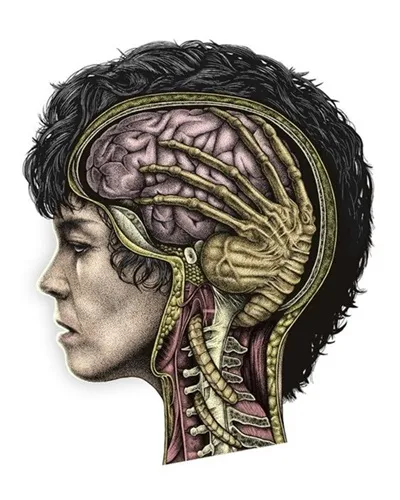
Image by Paul Jackson
Some years ago I was provided a fascinating psychological experience in the form of a young graduate student in the English literature program, whom I encountered because they (you heard me) was (God that’s grammatically awkward) married to a colleague. She (I’m not doing this anymore) specialized in the study of propaganda, by which of course she meant everything her backwards conservative parents in Nowhere, Nebrahoma believed, and not anything she believed. One evening, after enthusiastically explaining the symbolism of the inverted pentagram tattooed on her shoulder, she informed me with invincible confidence that not only was gender an arbitrary social construction, but that even the idea of biological sex was nothing more than convention. Her reasoning, which I presume she’d gleaned from a seminar on radically liberatory queer theory, was that testosterone levels fluctuated during the day, so “males” changed their degree of “maleness” all the time, and how can something that’s constantly changing be used as the basis for a hard binary distinction?
“But that’s not how biological sex is defined,” I replied. “Testosterone is just a hormone. It’s only present in vertebrates. Insects don’t have it, and neither do plants, but they still have biological sex. Sex is defined according to whether an organism produces mobile gametes or sessile gametes, which is basically universal across multicellular life forms.”
“I don’t understand what that means,” she chirped, still thinking we were playing language games. “Like I don’t know what a ‘sessile gamete’ is.”
“Oh,” I responded helpfully, “A gamete is just a reproductive cell. Sessile means it doesn’t move. So –”
The horrible reality of what I was saying dawned upon her. “I just realized that this isn’t a conversation I should be having,” she cut me off, and walked away.
It was remarkable. The mindworm parasitizing her consciousness had detected a threat to its structural integrity, and ordered its host to remove herself from the interaction before she consumed a malinformative infohazard. She didn’t even pretend that this wasn’t what she was doing. I’d never before seen something quite like it.
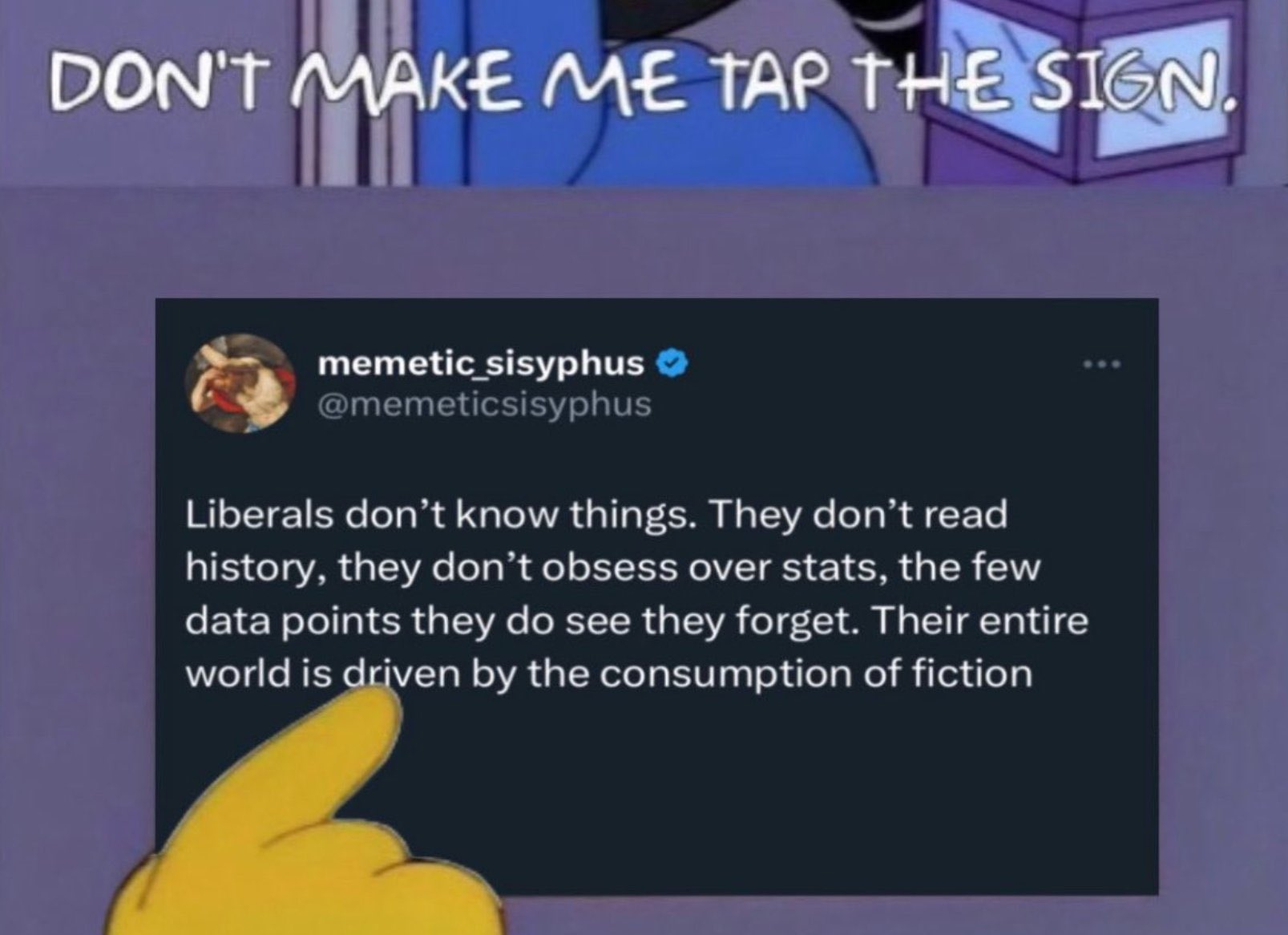
There’s a long-standing joke that liberals don’t know things, that their entire worldview seems to be formed by the ersatz experiences of visual entertainment. When they discuss the war in Ukraine, they express it in terms of Marvel comic book movies or Star Wars; when thinking of President Trump, in terms of Harry Potter. Black people are all wise and benevolent and great dancers because this is what Fresh Prince and Morgan Freeman told them; white men are all inbred stupid Klansmen because of Mississippi Burning and Roots; girls are just as strong as boys (stronger, actually) because Black Widow kicks butt; and so on. Even their favourite point of historical reference – World War Two, the Nazis, Hitler – seems to be almost entirely a palimpsest of Steven Spielberg movies like Saving Private Ryan and Schindler’s List.
It isn’t just that they use fictional references as metaphors or allusions. That’s a very human thing to do, and the right is certainly no stranger to Tolkien analogies. But liberals seem to do this a lot, with only the most tenuous connection back to reality. Their inner world is a series of self-referential fantasies. The right uses fictional references as metaphors to explain facts; the left substitutes fictional metaphors for facts, and then forgets that it does this.
The recent Netflix drama Adolescence is a striking case in point. It portrays the fictional story of a 13-year-old white boy who stabs a female classmate to death because his brain was twisted into a pretzel by exposure to the incel subculture over social media. Following its premier, the British government has been using it to gin up a moral panic, with calls to censor social media to tackle the urgent problem of toxic masculinity.
The Man Hitler Needs for Civil War, Ernst Röhm, Returns!
World War Two
Published 27 Mar 2025January 1931 starts with violence, economic collapse, and Nazi upheaval in Germany. Hitler secretly meets with army chief Kurt von Hammerstein-Equord, while Ernst Röhm returns to take command of the Nazi paramilitary SA. As hundreds of thousands of miners face mass layoffs and brutal crackdowns, the republic’s future hangs in the balance — how long can democracy hold on?
(more…)
The argument to keep the F-35 for the RCAF, despite Trump’s tariff war
About a week ago, I linked to Alex McColl’s argument for splitting the Royal Canadian Air Force’s new fighter program into a small tranche of F-35s (because we’d already paid for the first 16 of an 88-plane order) and a much larger number of Swedish Gripen fighters from Saab, which on paper would give the RCAF enough aircraft to simultaneously meet our NATO and NORAD commitments. In the National Post, Andrew Richter makes the case to stick with the original plan, pointing to Canada’s truly horrifying history of cancelled military equipment and the costs of running two completely different fighter aircraft:

Canada does not have a very good track record when it comes to cancelling military contracts. About 30 years ago, the Liberal government of Prime Minister Jean Chrétien decided to cancel a contract that the Mulroney government had negotiated to purchase helicopters from a European consortium. Chrétien likened the new aircraft to a “Cadillac”, and maintained that our existing helicopters, the venerable Sea Kings, were still airworthy (despite their advancing age).
So the contract was torn up and the Canadian government paid a total of $500 million in cancellation fees. It would be another decade before a replacement helicopter was finally purchased (the American-made CH-148 Cyclones), and it was only in 2018 that the last Sea King was retired from service. The whole episode has been described by more than one observer as the worst defence procurement project in history. Which brings us to the tortured history of the F-35 purchase.
There is no need here to review the astonishing array of twists and turns that have taken place over the past few decades with regards to it. Suffice to note that when the F-35 contract was signed a few years ago, numerous defence analysts were in disbelief; many had long since concluded that it would never happen, and that Canada would continue flying our CF-18s until they literally could not fly anymore.
Any decision at this point to overturn the contract and go with the second-place finisher in the fighter jet competition — the Swedish Gripen — would have serious consequences. First, as with the helicopter cancellation decades ago, there will likely be financial penalties to pay, although so far the government has not commented on this.
In addition, a decision to buy the Gripen would mean that our Armed Forces would operate two fighter jets moving forward, because the first tranche of 16 F-35s is already bought and paid for. This would necessitate a wide range of additional costs, including training, maintenance and storage. Over decades, these costs would add billions (likely tens of billions) to the defence budget.
There are also issues of bilateral military co-operation, potential loss of affiliated contracts and force inter-operability to consider. The Canadian military has been primarily buying American military equipment for decades. This has been done both because our military generally prefers U.S. equipment and because it helps strengthen defence ties between our two countries. Deciding to buy a foreign aircraft would jeopardize these ties.
The First Sturmgewehr: The MKb42(H)
Forgotten Weapons
Published 27 Nov 2024The first iteration of the iconic German Sturmgewehr was developed by Haenel starting in 1938. It was a select-fire rifle chambered for the short 8x33mm cartridge, developed by the Polte company. It used a long-stroke gas piston and a tilting bolt patterned after the Czech ZB-26 light machine gun. What makes the MKb42(H) stand out from the later Sturmgewehr models is that it was an open-bolt design. The original design spec was concerned about preventing cook-offs, and so it required firing from an open bolt. This means a very simple fire control system, but it also made the rifle difficult to shoot accurately in semiautomatic.
The first MKb42(H) prototype was finished in 1941, with 50 sample guns produced by late March 1942. A major trial was held in April 1942, in which Hitler rejected the design (mostly, he disliked the smaller cartridge). Development was continued anyway, with a move to a closed-bolt system that would become the MP43/1 which was ready for its first testing in November 1942. The open-bolt 42(H) was put into production anyway, as a stopgap measure to provide some much-needed individual firepower to troops on the Eastern front. Serial production began in January 1943, and continued until September 1943. In total, 11,813 of the rifles were manufactured. They saw use in Russia until replaced by newer MP43 models, and represent the first combat use of the assault rifle concept.
(more…)
QotD: Prosopography
Prosopography is vital in the study of Classical Antiquity, especially the Roman Republic. The Romans, as I’m sure you recall, practiced “patronage and clientage” — a man’s clients were often in a very real way more important than his biological family. Prove that Wossname was So-and-So’s client, and you know a lot about Wossname, even if you can’t find it in the archaeological record, and what you do know about him from the record takes on a whole new meaning. For instance, under Gaius Marius (et al.), the patron / client relationship got extended to the army — coteries of officers and NCOs personally loyal to their commanding general, not to the State — and there’s your Fall of the Roman Republic.
Kremlinology required something similar. Since the important levels of the Apparat all went to the same Higher Party Schools in Moscow, the fact that So-and-So was Wossname’s roommate for a few semesters was potentially of much greater importance than anything So-and-So did as the People’s Commissar of Whatever. He might’ve looked like a real up-and-comer based on his early promotion to a prestige post, but based on his prosopography an experience Kremlinologist might deduce that this was just horse-trading — someone high up in the Politburo owed Wossname’s father a favor for something back in the Great Patriotic War, and so this was payback; Wossname wasn’t going any higher than that.
It’s even more important in a completely ideologized society like the USSR. No Roman client would ever go so far as to openly stab his patron in the back — no one in his society would ever trust him again; he’d get shanked the very minute he donned the purple — but a Roman could have a change of heart. He might get religion, of either the philosophical (Epicureanism, Stoicism) or the actual cultic sort. This would significantly change the patron / client relationship. But in a society like the USSR — ostentatiously dedicated to the World Proletarian Revolution — ideology imposed some hard limits …
Severian, “Alt Thread: A Brief Bit of Brandonology”, Founding Questions, 2021-12-01.
March 27, 2025
Ban the swastika? Are you some kind of racist?
In Ontario, the elected council for the Region of Durham has been reacting to a few painted swastika graffiti around the region over the last couple of months. To, as a politician might say, “send a message”, they proposed banning the use of the swastika altogether … failing to remember that it’s not just neo-Nazi wannabes who use it:

Durham council is adjusting the wording of its calls for a national ban on the Nazi swastika, or “Hakenkreuz“.
This follows efforts by religious advocates to distance their own symbols from the genocidal German fascist regime.
Swastikas often appear in Jain, Hindu and Buddhist iconography.
“The word ‘swastika’ means ‘well-being of all’,” explained Vijay Jain, president of Vishwa Jain Sangathan Canada, at Wednesday’s regional council meeting. “It’s a very sacred word. […] We use it extensively in our prayers.”
“Many Jain and Hindi parents give their children the name ‘Swastika’,” he added. “Many Hindi and Jain people, they keep their [business’s] name as ‘Swastika’. If you go to India, you’ll find the ‘Swastika’ name prominently used.”
“We stand in solidarity with the Jewish community and fully support all of the efforts by authorities to address growing antisemitism in Canada,” he said.
Regional council made its initial call for a ban on Nazi swastikas in February, after two separate incidents of the antisemitic symbol being scrawled inside a washroom at the downtown Whitby library.
On Wednesday, councillors voted to revise that motion to replace the word “swastika” with the term “Nazi symbols of hate”.
B’nai Brith Canada has been spearheading a petition campaign to have the Nazi symbol banned across the country.
The group has increasingly opted to refer to it by the alternative names “Nazi Hooked Cross” or “Hakenkreuz“.
On March 20, B’nai Brith put out a joint statement with Vishwa Jain Sangathan and other religious advocacy groups, calling for further differentiation between the symbols.
“These faiths’ sacred symbol (the Swastika) has been wrongfully associated with the Nazi Reich,” wrote Richard Robertson, B’nai Brith Canada’s Director of Research and Advocacy. “We must not allow the continued conflation of this symbol of peace with an icon of hate.”
Uncovered: The CIA’s Secret War That Shook Stalin! – W2W 16 – 1947 Q3
TimeGhost History
Published 26 Mar 2025In 1947, the Cold War intensifies as the Truman and Zhdanov Doctrines divide the world into opposing camps. The CIA is born to counter communist threats, while Stalin’s Cominform tightens its grip across Eastern Europe. From Berlin’s streets crawling with double agents, to covert American election meddling in Italy, espionage becomes the frontline of this global showdown. Welcome to a new age of spies, secret doctrines, and ruthless intelligence wars.
(more…)
Alaska legally required to use LNG ships that don’t exist thanks to the Jones Act of 1920
As J.D. Tuccille reports, Alaska is having to ask the US government for a waiver from the requirements of the 1920 Merchant Marine Act to allow them to legally transport their own liquid natural gas within the state:

“LNG Carrier Alto Acrux” by kenhodge13 is licensed under CC BY 2.0 
 .
.
Alaska is a cold state where residents need energy to keep the chill at bay. Fortunately, the state is blessed with natural resources, including abundant oil and natural gas that can help satisfy that need. Unfortunately, as I’ve written before, a nationalistic, century-old law requires that shipping between American ports be conducted only by U.S.–built and –flagged ships. And there aren’t any liquid natural gas tankers that satisfy the requirement. Now Alaska officials are seeking a waiver so they can use their own resources to resolve a growing energy crunch.
[…]
Over a century ago, Congress passed the Merchant Marine Act of 1920, better known as the Jones Act, mandating that “No merchandise … shall be transported by water…between points in the United States…in any other vessel than a vessel built in and documented under the laws of the United States and owned by persons who are citizens of the United States”. There’s more to it, but the nationalistic law, intended to protect American shipping, effectively barred transporting goods between American ports in foreign-built and foreign-flagged vessels. That means North Slope natural gas can be transported to Alaska’s populated south only in American tankers. If you can find any. You can’t.
“LNG carriers have not been built in the United States since before 1980, and no LNG carriers are currently registered under the U.S. flag,” the U.S. Government Accountability Office (GAO) reported in 2015. And, while you’d think that demand — not just in isolated states like Alaska and Hawaii, but also territories like Puerto Rico — would drive supply, there’s a huge hurdle. “U.S. carriers would cost about two to three times as much as similar carriers built in Korean shipyards and would be more expensive to operate,” the GAO added.
The GAO created its report at a time when Congress was considering extending the Jones Act to require that exports of natural gas be carried only in U.S.-flagged shipping. The GAO concluded that such a law would “increase the cost of transporting LNG from the United States, decrease the competitiveness of U.S. LNG in the world market, and may, in turn, reduce demand for U.S. LNG”.
Congress wisely dropped the idea of extending the Jones Act, but Alaskans are still stuck with the original law, waiting for nonexistent domestically-built LNG tankers to show up with loads of North Slope natural gas. If they don’t wait but instead try to ignore a law with which it’s impossible to comply, they risk millions of dollars in fines, since the federal Department of Justice vigorously enforces the Jones Act.
In 2017, the feds fined an energy company $10 million for transporting a drill rig from the Gulf of Mexico to Alaska’s Cook Inlet in a foreign-flagged vessel. The company planned to bring more natural gas to the resource-rich but energy-starved state.
Twice Baked Potato: Jalapeño Bacon – You Suck at Cooking (episode 175)
You Suck At Cooking
Published 24 Nov 2024Jalapeño Bacon twice baked potatoes not only have great flavor, but also create a pleasant effect when coming into contact with your gustatory cells.
Book: http://yousuckatcooking.com or wherever you get books
Recipe:
Cook potato
Add the things
Cook again
Eat the potato or put it on your mantle as a real show piece
QotD: Did humans domesticate plants, or was it the other way around?
Of course, the cultivation of crops enabled human beings to produce far more calories per unit of territory than foraging ever could. And this enabled the human population to expand exponentially, thus putting even more pressure on the food supply, thus necessitating an even greater emphasis on agriculture. Alongside this deepening spiral there were other unintended consequences as well. As Harari puts it: “Nor did the farmers foresee that in good years their bulging granaries would tempt thieves and enemies, compelling them to start building walls and doing guard duty”.
Giles Fraser, “The Magnificent Seven is a post-liberal idyll”, UnHerd, 2020-04-01.
March 26, 2025
The Korean War Week 040 – MacArthur Sandbags Truman – March 25, 1951
The Korean War by Indy Neidell
Published 25 Mar 2025Harry Truman is moving forward with his plans to somehow end the fight with the Chinese, but Douglas MacArthur takes a hatchet to those plans. Truman is furious, and the question remains, for how long will MacArthur’s defiance be tolerated? In the field, Operations Ripper, Courageous, and Tomahawk are in action, but are all disappointing for the UN forces, as they fail in their mission to destroy the enemy’s war making capacity. They don’t actually do much of that at all.
Chapters
00:00 Intro
00:51 Recap
01:08 Operation Ripper Ends
04:09 Operation Courageous
06:20 Operation Tomahawk
09:44 MacArthur’s Sabotage
13:27 Summary
13:36 Conclusion
(more…)
Rich country foreign aid – threat or menace?
John H. Cochrane on the benefits and harms that aid from rich countries has done to the poor recipient nations around the world:

At half the dinners I go to, someone says, well, yes, a lot of the USAID money was mis-spent, but what about the poor starving children in Africa? If you are in that situation, this is the article for you.
This article is about about the centerpiece of aid: “development” aid, designed to boost economic growth, not about the politicized “nonprofits” that USAID was supporting and their bloated staffs, funneling aid money to political advocacy and employment, promoting American self-loathing around the world, and so forth.
Development spending accounts for almost three-quarters of all aid.
And the enterprise is a colossal failure.
The capital of Malawi, one of the world’s poorest countries, runs on aid. A city built in the 1970s by the World Bank, Lilongwe’s straight streets are filled with charities, development agencies and government offices. Informal villages house cooks and cleaners for foreign officials; the entrance to each is marked with the flag of its national sponsor.
The money is small compared to advanced country GDP, but huge compared to poor country government resources […]
The results of such spending are no better in Malawi than in the US — even if it’s free to the recipient. Add the preference of aid advocates for “sustainable” or “appropriate” and “green” technology, including these days hostility to GMO foods, and social or environmental wrappers, “climate justice” and so on, indeed even the hostility to capitalism, “consumerism” and growth itself and it’s not a surprise this is a rathole. (Again, it’s cheap from our perspective. The problem is that it’s wholly ineffective. If money really could jump start growth, that would be great.)
One of the central conundrums of aid is that it can destroy local industry. Sending food, for example, seems like a no-brainer of mercy. And in a war, crop failure, or other catastrophe it is. But sending food on a regular basis bankrupts local farmers.
Central idea 1: Imagine just how happy the US might be if China decided in its mercy to tax Chinese citizens, buy crops at overvalued prices (which incidentally pleases Chinese farmers), and send bags of rice to the US for free, marked “gift of the CCP”, thereby bankrupting US rice farmers. Or if it decided to send us really cheap electric vehicles to help us speed towards net zero, thereby undermining our own state-supported EV business. Well, you know exactly how our government feels about this sort of thing! And this is exactly what aid does.
Now, a good free market economist welcomes subsidized imports, and a push to leave agriculture and move to export-oriented manufacturing or other higher value industries. But Malawi doesn’t have other higher value industries, and exporting anything to the advanced economies is getting harder and harder. Extending the old proverb, send a man a fish a day forever, and he forgets how to fish.
The article opened my eyes (some more) to the delicate intertwining of economics and politics. We really don’t live in a free market world in the US (note our executives rushing to change ideology and please the new team in Washington), and even less so in poor countries.
Western aid officials often want to prevent local politicians, who control crucial industries, from profiting as a result of their projects, meaning they select obscure sectors for tax breaks, credit and subsidies. With few investors willing to stump up capital, and little interest from local politicians, the businesses duly flop.
Here is a conundrum for you. Without 10% off the top for the big guy, businesses will flounder.
Cooking on the German Home Front During World War 2
Tasting History with Max Miller
Published 12 Nov 2024Casserole made from sliced potatoes, fennel, and caraway served with pickled beets
City/Region: Germany
Time Period: 1941How well people ate in Germany during WWII really depended on who they were, where they were, and how long the war had been going on. This recipe, from 1941, assumes that people will still have access to ingredients like milk and eggs, which would become extremely scarce for most people in later years.
If you like the anise-like flavors of fennel and caraway, this dish is for you. The flavors are very prominent and really take over the whole casserole. If you’re not too concerned about historical accuracy with this one, I think some more milk or the addition of some cream or cheese would be delicious and add some moisture.
Fennel and Potato Casserole
1 kg fennel, 1 kg potatoes, 1/3 L milch, 1 egg, 30 g flour, 2 spoons nutritional yeast, caraway, salt
If necessary, remove the outer leaves from the fennel bulbs and cut off the green ones. Then cut them and the raw peeled potatoes into slices. Layer them in a greased baking dish, alternating with salt and caraway and the finely chopped fennel greens. The top layer is potatoes. Pour the milk whisked with an egg and a tablespoon of yeast flakes over it. Sprinkle with caraway and yeast flakes and bake the casserole for about 1 hour. — Serve with pickled beets or green salad.
— Frauen-Warte, 1941.
QotD: Therapy that works for women doesn’t necessarily work for men
This is completely wrong. Men cope with feeling unloved relatively easily. What destroys them is feeling powerless.
So yeah. Swing a sword. Restore a steam engine. Climb a rock. Do something — anything — that asserts your competence and control over your environment.
For men, this is much better therapy than talking about feelings.
ESR, Twitter, 2024-05-06.


