
It is a sign of age, I fear, but I seem to be the last person to lament the declining quality of our Anarchists. Those of more than a century ago were rugged individualists, to a fault. With one well-placed bomb, they could do what takes the contemporary anarchist a cumbersome bureaucratic organization. They were men of action; and some of the women, too. No one could confuse them with party hacks. You could not coerce them into a party line.
When I was younger and, perhaps, more spunky, I used to read Proudhon and Kropotkin. These were all very well, but the systemizing tendency had infected both. Utopianism also muddled their thinking. Without going back to Zeno of Cilium, let me just say that the posterior tradition in recommending anarchy was more subtle and arch. (Read the Antigone, for instance. Today it’s just the brand name for a Givenchy bag.) Anarchy was an inheritance from Greece and even Rome. It could never have been reduced to an election manifesto.
It is interesting that the first English use of the term, anarchisme, dates back to Henry VIII. Those resisting his Divorce and Reformation were taken to be anarchists. Nobly they defended the ancient liturgical order, in such spontaneous actions as the Pilgrimage of Grace.
Prominent anarchists of our modern age have, at their best (or worst, depending on one’s point-of-view), had dodgy ideological affiliations, but a real appreciation for economy of means. One thinks of e.g. Gavrilo Princip, the ingenious Serbian, able to ignite a Great War with a few gunshots, and bring down the Austro-Hungarian Empire almost as an aside. Or a certain Osama bin Laden, able to drag a superpower into pointless foreign wars, with very limited means. I do not approve of either gentleman, please note, but their efficiency was astounding.
David Warren, “Anarchia”, Essays in Idleness, 2020-07-09.
November 13, 2025
QotD: Anarchists
November 12, 2025
The Jet Age: How War Put Us in the Sky – W2W 052
TimeGhost History
Published 10 Nov 2025From the Wright Brothers’ fragile first flight to supersonic jets that shattered the sound barrier — this is the story of how war turned humanity’s dream of flight into the most powerful force on Earth. In just fifty years, aviation evolved from wooden propellers and canvas wings to turbojet engines and supersonic bombers.
What began as a symbol of wonder became the defining weapon of the 20th century — an arms race in the skies that shaped our modern world.
In this episode of War 2 War, we trace how the Second World War and the Cold War pushed aviation to its limits: how Nazi Germany’s Me 262 and Britain’s Gloster Meteor launched the jet age, how the MiG-15 and F-86 Sabre clashed in the skies over Korea, and how the United States and Soviet Union raced for speed, power, and dominance.
Discover:
• How WW2 research built the first jet fighters
• Why the Me 262 and Meteor changed everything
• The jet dogfights of the Korean War (MiG-15 vs F-86 Sabre)
• The rise of supersonic flight and guided missiles
• How the Jet Age reshaped both war and peace
(more…)
November 11, 2025
How not to solve your housing affordability crisis
On the social media site formerly known as Twitter, Devon Eriksen explains why allowing fifty-year mortgages are not the solution that financial journalists seem to think they are:
Wendy O @CryptoWendyO
I don’t think a 50 year mortgage is bad.
It gives everyone more flexibility financially
You can pay a mortgage off early
Not sure how else to lower home costs in 2025Buyers: “How much will this house cost me?”
Sellers: “What’s your budget?”
Buyers: “Well, it was 500K, but with these new fifty year mortgages, I think it could stretch to million.”
Sellers: “I have an astonishing coincidence to report.”
Look, I don’t know exactly who’s retarded enough to need to hear this, but if you throw money at something, you get more of it.
Which means that if you subsidize demand, you get more demand.
And if you have the same supply, and more demand, price goes up.
This is how the federal Stafford Loan program made college a gateway to permanent debt slavery. Subsidize demand, price goes up.
The reason people don’t understand this is that most people are only smart enough to think about individuals, not populations.
They think if you have more money, you can buy more things, as if things come from the item store in a Japanese console RPG, where the store always has infinity stuff to sell you, and infinity money to buy your loot.
People who are capable of thinking about large groups quickly realize that money is just a way of distributing things.
Like, there’s a limited supply of things, and you’re just choosing who gets them. Having more money doesn’t make more things.
Except … it should, shouldn’t it?
Eventually?
Like, if apples get super expensive, because somebody invented a new kind of apple that’s so delicious that everyone wants them, then the price of those apples goes up, so more people start growing them.
So why doesn’t that work with houses and colleges?
Why don’t the super-inflated prices of those things inspire profit-minded people to make more?
It’s almost as if there were some sort of gatekeeper, whose permission you needed to make a house or a university.
But that’s impossible, because this is a totally capitalist country, so you can just do things, right?
Ian Runkle/Runkle of the Bailey chimes in:
Okay, let’s talk about 50 year mortgages.
First, let’s talk about what sets the price in a market where there’s more demand than supply. It’s set by what people can afford to pay, which means the payment/month.
What that means in practical terms is that the total price isn’t the limiter. It’s the monthly payment.
So, if X house is going for a price that has a 2500/month payment, the market is going to land total prices on a 2500/month payment.
So, increasing the mortgage terms makes things more affordable for about six months before the market adjusts. After that, it stops making it more affordable.
But “affordable” here doesn’t mean inexpensive. In fact, quite the opposite. Extending from a 30 year to a 50 year mortgage is likely to double the cost of credit.
But that’s before the prices adjust upward to “eat” the supposed affordability gains.
This doesn’t make houses more affordable, it makes them more expensive by far.
November 10, 2025
Somalia comes to Minnesota
Ian at The Bugscuffle Gazette provides a useful thumbnail history of modern-day Somalia and how this impacts Minneapolis, Minnesota:
In Africa national borders — and thus nations — are matters of political convenience, if not flat-out arbitrary. Only newbies to Africa even think about nationality, old hands know that tribal affiliation trumps all.
I had forgotten that.
In Somalia the borders were drawn in the late 19th century by Great Britain1 and Italy2. Make a mental note of that in case it comes up in a trivia contest somewhere, but understand that tribes and clans in that misbegotten part of the world are far more important than lines drawn on a map by 19th century British and Italian diplomats.
As a “for instance” let us take a look at a couple of these clans: The Daarood and the Hawiye.
The patriarch of the Daarood showed up in East Africa in the 10th Century3, and founded a clan that has become one of the largest in East Africa, and the second4 largest of the Somali clans actually in Somalia. They were the clan ruling Somalia when folks rebelled and kicked off the Somalian Civil War.5 Their current turf is sort of hourglass-shaped, with a chunk in northern Somalia, and another chunk in southern Somalia.
The Hawiye showed up in the 12th Century6, and have become the largest clan in Somalia. Their turf in Somalia is a chunk of seaside property starting at Mogadishu7 and heading north.
Yes, I know it says “Darod”. It’s properly “Daarood”.
In 1969, a Daarood bugsnipe name of Mohammed Siad Barre found hisself as HMFIC of Somalia following a bloodless8 coup-d’etat, but a whole bunch of folks Had Thoughts regarding his ascension9, and Somalia was pretty much in a constant state of rebellion from 1978 to 1991, when the full-scale Somali Civil War kicked off.

Okay, great. Fascinating even … so what does this have to do with Minneapolis of all places?
In the aftermath of that little dust-up, we imported a lot of Somali refugees. And since the clan most in need of refugee-ing was the Daaroods, we brought in a lot of Daaroods, and — being clannish — they consolidated in a clan-like fashion in Minnesota.
As a “for instance”, Ilhan Abdullahi Omar, the U.S. Representative for the 5th District of Minnesota, is a Daarood.
Things were trundling along the way they always do10 — except we’ve since imported another wave of Somalis … and these aren’t Daaroods. Any guesses as to clan affiliation? Yes! They’re Hawiye.
So. A second-generation dacoit of Daarood descent name of Omar Fateh decides he wants to run Minneapolis as warlord mayor, and he’s got the backing of his clan-mate Ihlan Omar — he’s a shoo-in!
Except a whole bunch of Hawiye in Minneapolis went, “Sod that for a game of soldiers”, and voted for the white guy.
Yay, tribal loyalty! Brings a tear to my eye, it does.
Which is all well and good11, but Omar Fateh, Ihlan Omar, and a whole bunch of Daaroods in Minnesota are capital “P” Pissed, capital “O” Off about the whole thing.
I know full well and certain how … spicy … tribal conflicts can get — and you couldn’t pay me enough to live in Minneapolis for the next few years.
- British Somaliland — actually a protectorate — starting in 1884, Crown Colony starting in 1920, self-governance in 1960.
- Italian Somaliland starting in 1884, then the Italians made the mistake of picking the wrong side during WW2, Brits took over in 1941, passed it off to the UN (whee) in 1950 (with the Italians mucking about), and formally united with British Somaliland in 1960 to form present-day Somalia.
- Maybe 11th — we’re not real sure.
- Or third, depending on whom you ask.
- This is important.
- Damned newcomers.
- We’re getting there.
- Hah! The assassination of the previous boss was insanely thorough.
- The fact that he styled himself “Victorious Leader” and loved himself some Marxism probably didn’t help.
- “Send lawyers, guns, and money …”
- For certain values of “well”, and certain values of “good”.
November 8, 2025
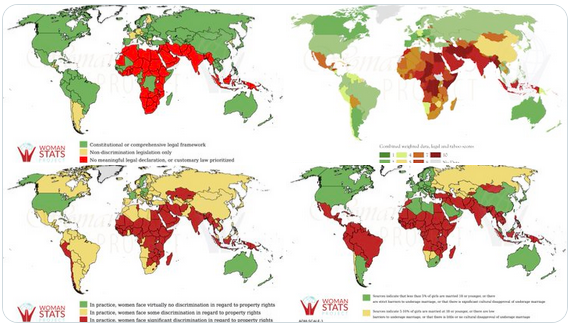
All cultures are not equal, especially when it comes to crimes like rape
On the social media site formerly known as Twitter, Dr. Sydney Watson responds to a post on feminists blaming all men for the actions of some men from other cultures:
Jessica Pin @jess_ann_pin
It bothers me so much when some feminists act like men are just as misogynist and violent everywhere.
That’s not true. Men from some cultures are absolutely worse than others.
I’m not saying there is a genetic difference. But there are definitely cultural differences, and we need to be careful about who we let in.
[Full sized images in the linked post]
I don’t know how to explain this succinctly —
But, ages ago I watched this series about prisons around the world. There were a few episodes that focused on prisons in African countries – how the prisons ran, what people were charged with etc.
What stood out to me was that over 50% of the male prisoners were there for some sort of sex crime – rape, sexual assault, child sexual abuse etc.
What was even worse was that, when asked about why they committed these crimes, a lot of the men said things about how they were “teaching the woman a lesson” or raping her was some sort of “punishment.”
And I couldn’t help but think, “well, that checks out. Given how these men from these places come to Western countries and rape women.”
People might not like hearing that, and the less evolved among us chalk it up to “racism” (lol) but if someone comes from a culture that views rape as a form of punishment for unruly women, then why would that viewpoint suddenly change when their feet hit British/Swedish/Canadian soil?
If, culturally, you view women as barely people, why on earth would you suddenly start because you’re in a new place?
Point being – it’s utterly mad to put women and girls at risk because people don’t want to admit that some cultures are horrible. I’m tried of pretending that all cultures are equal when they’re so obviously not.
Update, 10 November: Welcome, Instapundit readers! Please do have a look around at some of my other posts you may find of interest. I send out a daily summary of posts here through my Substack – https://substack.com/@nicholasrusson that you can subscribe to if you’d like to be informed of new posts in the future.
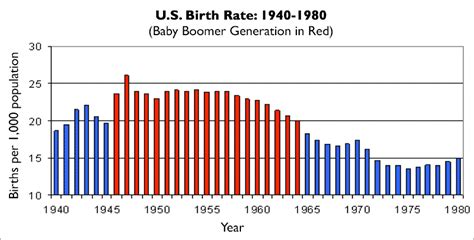
The Boomers didn’t do it, but they could have reversed it
On the social media site formerly known as Twitter, John Carter takes the entire Baby Boom generation out to the woodshed for a well-deserved talking-to:
toking-the-abacus @_toking
It’s amazing how catastrophically bad the current job market is in the US. No one wants to train anyone. They want 5-10 years experience in skills that you don’t get unless someone mentors you in a more junior role. Then you have rampant visa abuse.
Boomers mostly got paid to get trained on the job for their jobs.
Then they turned around and demanded college for everything. At a steep markup.
Then they rugpulled all the college grads by hiring foreigners to do the jobs people went into debt learning how to do.
Whole lotta incensed geriatrics in the replies saying “That wasn’t boomers, that was Griggs v Duke Power! Those judges were silent generation!”
Yes. And that was 1970. 55 years ago.
That’s kind of the point.
You were the largest generation in history, boomers. You could have reversed that insane decision. You could have ended the crazy practice of disparate impact. You could have ended the systemic bigotry of affirmative action, which discriminated not only against you, but against your own sons and, now, your grandsons. You could have used your institutional and electoral power to block DEI.
You could have done a lot of things.
But you didn’t.
At most you grumbled some, but not too loudly, because after all dad fought in the big war and you didn’t want to do a Hitler. A lot of you supported all of it wholeheartedly, because John Lennon had an imagination and MLK had a dream and remember Woodstock, man. Some of you profited from it handsomely. As a generation, as a group, whether by action or inaction, you entrenched it in every aspect of law and institutional culture.
You participated, each in your own way, in redesigning our entire society around women’s feelings, black self esteem, and sabotaging the minds, bodies, spirits, and lives of your white sons.
Don’t run from your part in this.
I’m not saying this to be mean.
I’m saying this because we fucking need you.
We need your votes, because as a direct result of the immigration policies of the last half century – which, again, yes, have their origin with Greatest and Silents, but whose most severe consequences unfolded on YOUR watch – we are absolutely, 100% screwed if we don’t deport an absolutely incredible, historically unprecedented number of people in a very short period of time. If that doesn’t happen it’s game over for America and, frankly, Western civilization. For now, for as long as you’re still breathing and capable of casting a ballot, whites are a bare majority. When you’re gone we’re outnumbered, the third world swallows the first, and it’s over.
We need you to confront the consequences of your actions and your complacency, to really feel what its done to your descendants, and to be filled with rage at the way you were misled by evil and selfish men, and an implacable determination to spend what remains to you of your lives doing whatever you can to reverse enough of the damage you allowed to be done to salvage something from this crumbling wreck of a society.
That is why we bully you.
Because we need you to see.
QotD: Singing in church
Note: I used to have a good singing voice, not quite commercial quality, IMHO, no, but quite good nonetheless. I loved to sing. I still do, the songs I can still handle, too.
Almost nobody sings reliably in my church. Oh, they can, but they generally do not. The exceptions are hymns everybody knows the tunes to, some of the responsorials, ditto, and, notably, last 4 July, “America the Beautiful”. And, at Christmas, the traditional Christmas songs.
So why those and not the others. Well, the typical hymn in the typical modern church was penned by a couple of nuns from the Order of the Discalced Sisters of Sappho, or priests from the Gay Jesuit Alliance, and printed in the hymnal largely as an exercise in flattery.
Okay, that’s not really true … or not entirely anyway. No, the real problem is that, and I cannot emphasize this enough, NOBODY KNOWS THE BLOODY TUNES, SO OF FREAKING COURSE THEY DON’T SING, WHILE THEY CHANGE THE HYMNS SO OFTEN — WEEKLY, AS A MATTER OF FACT — THAT NOBODY EVER HAS THE CHANCE TO LEARN THE TUNES.
So I propose the following: Pick five hymns — among my recommendations, “The Battle Hymn of the Republic”, “We Gather Together”, “Amazing Grace”, “How Great Thou Art”, “Abide with Me”; but I’m not a fanatic about it — and use only those five for however long it takes for 75% of the congregation to sing all of them. Then change ONE and keep at that until 75% will sing that. And keep doing that until you have a repertoire of 20-25 songs everybody knows and most everybody will sing.
“Make a joyful sound unto the Lord” and see if your parish doesn’t grow and if your parishioners aren’t a lot happier in mass.
Tom Kratman, The social media site formerly known as Twitter, 2025-07-03.
November 7, 2025
QotD: The Boomer career path
After that they got bored and became Glam rockers, and then switched to Disco because it had a better beat. They used all their free money from Disco record deals to buy cocaine and Malibu real estate at $3 per acre. In 1980 they decided there was even more money in selling cocaine, so they all moved to Miami and drove around shooting machine guns from their Lamborghini Countachs to Giorgio Morodo synth music.
After Reagan’s re-election the Boomers decided greed was good and they all moved to NY where they became serial killer investment bankers and collected up all the Andy Warhol originals. That’s when all of their real estate holdings made them billionaires which they leveraged to get in on the bottom floor of the Internet bubble in the 90s while taking designer drugs.
Today those same Boomers are all driving around to orgies at The Villages in $500k luxury golf carts waving giant Trump flags, laughing it up while lighting doobies with their Social Security cash and executing Howdy Doody’s Final Plan: the secret Boomer Immortality Pill that will allow them to keep their money away from Millennials and Zoomers FOREVER
David Burge, The social media site formerly known as Twitter, 2025-07-30.
November 6, 2025
Mamdanimentum – NYC gets its very own Justin Trudeau clone
It’s been decades since I last visited New York City, so I don’t know if they really deserve what they’ve just voted for, but I guess we’ll all get to find out over the next few years. On the City Journal substack, Reihan Salam weighs in on the newly elected mayor and what to watch for:

New York State Assemblymember Zohran Mamdani photographed in Assembly District 36, 10 February 2024.
Photo by Kara McCurdy via Wikimedia Commons.
A year ago, not even the most perfervid Astoria leftist would have thought that Zohran Mamdani would soon be elected mayor of New York City. Back then, it was easier to imagine Eric Adams coasting to reelection on the strength of declining crime, or state attorney general Tish James, who came close to running for mayor in 2021, swooping in to unite a fractious Democratic coalition. With Adams badly damaged by a federal indictment and James anxious about what a mayoral bid would mean for her ongoing battle with President Donald Trump, however, the path was seemingly clear for Andrew Cuomo to make a dramatic comeback.
Though it was no secret that Cuomo had real weaknesses, thanks to his polarizing tenure as governor, his name recognition and formidable fundraising machine were enough to freeze out other serious contenders. As a result, the Democratic mayoral field was so bereft of talent that Mamdani — an obscure, hard-left state assemblymember with no legislative or professional accomplishments to speak of — was able to cut through, buoyed by surging anti-Israel sentiment and a series of half-baked pseudo-solutions to the city’s very real affordability crisis.
From one vantage point, then, Mamdani is best understood as an accidental mayor. If federal prosecutors had declined to prosecute Adams, if James had jumped in and Cuomo had stayed out, if Hamas had surrendered its hostages a few months sooner, if moderates and conservatives had consolidated behind a single candidate in the general election, or if any of a number of other possibilities had obtained — the outcome of New York City’s 2025 mayoral race would have been quite different.
In another sense, however, Mamdani’s victory represents the culmination of New York’s larger leftward turn. The shift started in 2018 with the dissolution, at Cuomo’s behest, of the state’s Independent Democratic Conference, an eight-member coalition of centrist Democratic senators who caucused with the Republicans. Their subsequent replacement heralded a broader takeover of Albany by progressives who — again, with Cuomo’s assent — passed a series of ideologically inflected bills: bail reform, the “most aggressive climate change legislation in the nation“, and a major overhaul of tenant protection statutes, to name only a few.
The Mamdani revolution was led by downwardly mobile elites — children of the professional class struggling to make ends meet and entranced by the promises of frozen rent and fare-free buses. They were fired by the same ideas that animated those Albany progressives: that some New Yorkers have been handed the short straw, that soak-the-rich policies can correct these imbalances, and that New York’s private sector was resilient enough to sustain a further ratcheting up of punitive taxation and regulation.
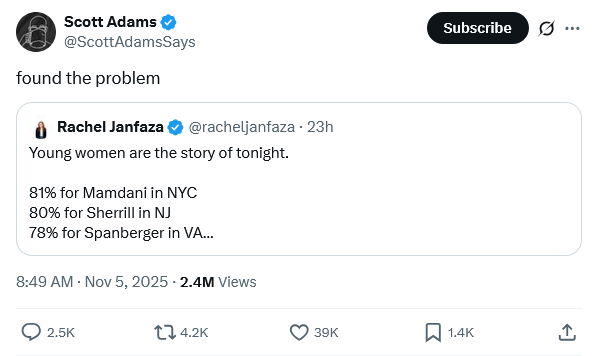
The voters of NYC are not the same demographic distribution as of old … among other things, the Jewish population has shrunk while the Muslim population has grown to nearly the same over the last 25 years, although Jewish women probably voted more similarly to women generally in this election:
Lines of Fire: Operation Market Garden Part 1 of 2 – WW2 in Animated Maps
TimeGhost Cartographic
Published 5 Nov, 2025September, 1944. Soviet forces push ever westwards, slicing their way through Poland en route to Berlin. In the west, the Allies have made great strides after the invasion of Normandy, but now face a winter of relative stagnation as supply issues threaten to undercut their momentum. At this time, British Field Marshal Bernard Montgomery believes has a plan to carve a corridor through occupied Netherlands and get his forces into Germany within days, striking at the heart of the German war economy, and maybe, just maybe, ending this war before 1945 dawns. In Part 1 of 2, we look over the plan, the forces involved, and the colossal effort required to make Monty’s vision a reality.
00:00 Intro
01:12 Background
04:40 Planning
07:07 Disposition of Forces
09:05 Geographic Overview
11:30 Conclusion
(more…)
November 5, 2025
The Korean War Week 72: UN Censors as Communists Speak! – November 4, 1951
The Korean War by Indy Neidell
Published 4 Nov 2025The Panmunjom peace talks continue, but a real sticking point is Kaesong- both sides insist that they must have control of it. Frustration mounts among the Allied journalists, though, as they are allowed less access to what’s going on than their Communist counterparts. Despite the talks, there’s new action in the field this week, as the Chinese attack in force to try and retake Maryang-san, a commanding strategic position.
Chapters
00:00 Intro
00:40 Recap
00:59 The Kaesong Issue
03:24 Voluntary Repatriation
07:14 US Command’s Position
09:15 All For All Repatriation
10:35 UN Censorship
12:29 Maryang-San
13:35 Summary
13:37 Conclusion
14:39 CTA
(more…)
QotD: Progressive anger
As they did so in this case, I could not help but think of the analogy with our present situation. We have a huge fund of very angry people buzzing about in mobs looking for somewhere on which their anger can settle. It seems an epoch ago that it landed on #MeToo and turned all men into Harvey Weinstein. Then, under the direction of little Greta, who somehow managed to combine an autistic manner with hysteria, opposing tendencies reconciled no doubt by the ineffable self-pity of the privileged, global warming provided a temporary resting place. However, with the killing of George Floyd, climate change seems as passé as Mussolini’s spats. (“Too many spats, too many spats!” someone once said of him.) But if no new thing is found after all the statues have been pulled down, the books burned, and the films withdrawn from circulation, climate change could return faute de mieux. On the other hand, free-floating anger is highly inventive as to the reasons for its existence: It can attach itself to almost anything, as flies can walk upside down on ceilings. Being no prophet myself, I have no idea what will be the next object of angry righteousness by people brought up to believe in moral relativism.
Theodore Dalrymple, “Bees With Degrees”, Taki’s Magazine, 2020-07-02.
November 4, 2025
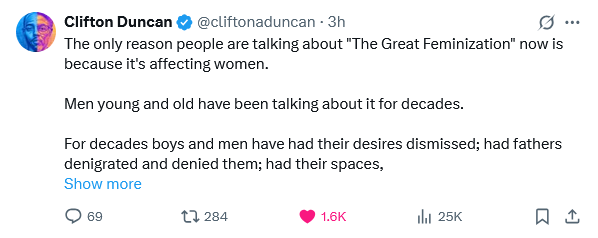
The Great Feminization isn’t catching on in the culture, despite its power in our institutions
Lorenzo Warby provides a bit of hopeful news that despite the ever-expanding march of feminization through our various organizations and institutions, the culture is displaying strong resistance and effective:
Western culture is not feminising. How can I tell? The travails of Disney. Disney spent billions buying male-centric franchises — Star Wars, the Marvel Cinematic Universe, Indiana Jones … It then proceeded to so alienate the fan bases of those franchises that it is now reduced to openly discussing how to appeal to male audiences that it spent billions acquiring and further billions alienating.
If Western culture was feminising, then Disney should have had no trouble with its feminised products. Clearly, it has had problems. Meanwhile, the Top Gun: Maverick sequel to a 1986 movie can do excellent box office ($1.5bn) precisely because it knows what it is about.
The question then becomes, how and why did Disney so alienate those male-dominated fanbases it spent billions acquiring entree to? A simple answer would be that Disney was a Princess-story factory and it turned its new acquisitions into Princess-stories — stories not necessarily with literal princesses, but with female protagonists.
There is certainly a fair bit of that. A recent study found that Disney has tended, over time, to feminise male characters in its animated movies.
For it was not only that the Disney turned those franchises into launch pads for new Princess stories. Yes, Rey in the Star Wars sequels is an obvious example of doing precisely that. Nevertheless, there was rather more going on.
We can tell this from the Mulan live-action remake. The original 1998 Disney animated Mulan — despite controversy at the time of its cinematic release — acquired some popularity in China. It was seen as an engaging adaptation of the original story: a story deeply familiar to Chinese audiences. Worldwide, the film was a box office success.
The 2020 live-action Mulan remake was not a box office success. It was not for many reasons, but it was also emblematic of the problems of what YouTube critic Critical Drinker calls our post-creativity era.
2020 Mulan turned a female-protagonist story into a “woke” great-because-girl female-protagonist story. It turned a story of filial piety — a girl disguising herself as a boy to train and become a soldier in place of her disabled father, and struggling to overcome the limitations inherent in that — into something rather different.
Animated Mulan becomes accepted into the team of soldiers and triumphs through cleverness and teamwork. What makes the story resonate so well is there is nothing special about Mulan. She takes what she has and works hard at becoming better and succeeds in, and through, doing so. There is no hint of great-because-girl: rather it is fine being girl. Being a girl imposes limitations on her that she has to deal with and overcome: which she does — but not without genuine struggles — by sheer persistence and being clever, a problem-solver.
The key difference between a traditional Disney Princess story and contemporary Disney “woke” Princess story is the injection of great-because-girl. Live-action Mulan is a prodigy warrior with extra qi (or chi) who can do what the boys can do, but better. This is a cinematic version of a classic failing of feminism — by taking a blank slate view of humans, turning what men do into the standard for women. Women are great because they can do everything men can do, but even better. Feminist antipathy for stay-at-home mothers expresses this valorisation of matching men.
Live action Mulan is also much more politically conformist, even retrograde, in its denounement of Mulan celebrating service to the Emperor and going off to be a soldier. Animated Mulan rejecting a job as imperial advisor, and returning to her beloved father, is much less deferential to public authority.
The live-action film virtue-signals at the expense of story and understanding. It sacrifices clever cultural engagement for much flatter message-signalling.
If you want to watch a story set in China about women warriors, then the recent Chinese drama (C-drama) hits of Legend of the Female General and Shadow Love are available. These are smart, character-driven stories with the pervasive professionalism and sense of beauty—anchored in the cultural confidence—that one expects from contemporary costumed C-dramas, which are very much not based on trashing cultural heritage or we-know-better disrespect for source material.
Costumed C-dramas regulary have strong female lead characters while also having strong male lead characters. (As it happens, the male lead characters in both the aforementioned dramas are played by Cheng Lei; the female leads by Zhou Ye and Song Yi respectively.)

Update, 5 November: Welcome, Instapundit readers! Please do have a look around at some of my other posts you may find of interest. I send out a daily summary of posts here through my Substack – https://substack.com/@nicholasrusson that you can subscribe to if you’d like to be informed of new posts in the future.
November 3, 2025
Plastic Fantastic: How the Modern World Became Synthetic – W2W 051
TimeGhost History
Published 2 Nov 2025From the miracle material of the 1950s to the global crisis of the 21st century — this is the story of how plastic reshaped our lives, our economies, and our planet.
Born from wartime innovation, plastic promised a future of convenience, color, and endless possibility. From nylon stockings to Tupperware parties, it defined modern life — light, bright, and disposable. But the same durability that made it revolutionary also made it permanent.
In this episode of War 2 War, we trace how postwar optimism turned into an age of overproduction and pollution — how a chemical miracle became the material legacy of the modern world. Join us as we uncover how the postwar dream of “Better Living Through Chemistry” changed everything — forever.
(more…)
November 1, 2025
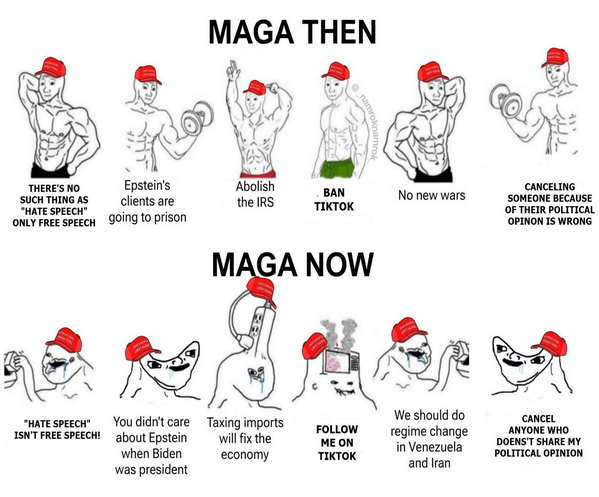
MAGA is not a monolith, thank goodness
In The Line, Alex Muir looks at Canada-US relations (such as they are currently) and why MAGA not being a monolith is something Canadian politicians need to understand to stand any chance of successfully navigating our dealings with President Trump and his administration:
If there’s one thing that we’ve seen in recent days, as Donald Trump plays an endless game of “deal or no deal” with countries around the world, it’s that the current administration is volatile.
Why? One answer to that question is factionalism — to an extent that has enshrined unpredictability as a core operating principle of the second Trump term.
Canadians are particularly exposed to this. From north of the 49th, it looks like American policy is oscillating between nationalist populism, business pragmatism, tech conservatism, and social traditionalism. That is, however, a misreading. Administration policy is remarkably consistent if you focus on the current rather than the waves. First and foremost, the president and his team obsess over visible status, a game you can play through flattery or strength and symbolic gesture — there are winning examples of both.
In concrete policy terms, the Trump administration expects us to help them on missile defence, border control, and maritime security. They expect access to our resource and energy assets, on their terms. And they want our manufacturing sector to relocate to America. They also expect Canada to know its place as a loyal American ally.
Zoom out to the bigger picture and all the daily clutter can be understood as moves to advance, or at least attempt to advance, those broad goals. And that understanding, in turn, can help inform a successful Canadian response to U.S. actions.
[…]
You cannot understand what is happening today if you do not understand what factions hold sway within this new structure. I recommend thinking of the United States as a monarchy wearing a representative democracy’s clothes. Decisions do not rest in the administrative state, or even in a political party (like Hungary), they rest in the attention of a restless and aging president and those known to have his ear, and his trust. How close to the president a decision-maker is, and who else has a voice on any given topic, goes a long way toward explaining outcomes.
The various MAGA factions colonizing D.C. share several important background beliefs on Canada. First, and arguably most important, they don’t notice it much, and care even less. Second, they assume all foreigners want to be Americans, or are somehow defective if they do not. Third, Canadians look and sound so much like Americans that the latter assumption is magnified.
Fourth, there is a wide streak of Manichaeism in several of the factions that make up the administration, and the MAGA movement more generally. This means resistance, or even evasion, is quite likely to be taken as evidence of ill intent — or even outright evil intent — as opposed to the furtherance of legitimate competing interests. All of these are wrapped up in a fairly magnificent degree of self-involvement. America is so big, so rich, and so strong, that all administrations overwhelmingly focus on domestic issues and domestic politics since nothing that happens outside their borders is generally seen as existential. (Whereas American elections and culture wars absolutely are.)
For Canada, this has meant many things, none of them positive. We’ve seen the rapid (and apparently random) escalation of tariffs (so far mostly on specific goods, or things not explicitly covered by USMCA), plus the endlessly repeated threats of higher duties in response to perceived Canadian provocations. There have been threats and intermittent moves to sideline Canada from vital security relationships, including the Five Eyes and NORAD. Canada has committed to some initiatives in order to satisfy American demands, like intensified border enforcement initiatives and committing new resources to national security priorities. It is difficult, however, to get out in front of a rapidly moving target in terms of the administration’s desired outcome.
And that’s the crux of the matter — what do the factions of the administration see when they look at Canada, and what do they want? Answering that question involves understanding what the factions are. The following summary of the factions within MAGA has been condensed from my other work, and should help Canadians understand the complexity of what we must face.


