
“How was the mall?” Mom would ask when you got home.
“Eh, it was dead,” you might say.
“What did you do?”
“Nothing.”
Neither was true. Every trip to the mall had a routine. You’d swing by the sausage and cheese store for samples. You’d go to the record store to leaf through the sheaves of albums, nodding at the rock gods’ pictures on the wall, content in the cocoon of your generation’s culture. Head over to Chess King to see if there was something stylish you could wear on a date, if you ever had one; saunter casually into Spencer Gifts to look at the posters in the back, snicker at the naughty gifts, marvel at some electronic thing that cast colored patterns on the wall. Then you’d find a place, maybe by the fountain in the center, and watch the world go past in that agreeably tranquilized state of mall shopping.
Dead? Hardly. Okay, maybe it was the afternoon, low traffic. No movie you really wanted to see, the same stuff in the stores you saw last week. Of course you’d go back tomorrow, because that’s what you did with your friends. You went to the mall.
A dead mall is something else today: a vast dark cavern strewn with trash, stripped of its glitter, its escalators frozen, waiting for the claws to take it apart. The internet abounds with photos taken by surreptitious spelunkers, documenting the last days of once-prosperous malls. We look at these pictures with fascination and sadness. No one said they’d last forever. But there wasn’t any reason to think they wouldn’t. Hanging out as teens, we never thought we’d outlive the mall.
James Lileks, “The Allure of Ruins”, Discourse, 2023-06-12.
September 14, 2023
QotD: Going to “the mall”
September 13, 2023
Why Do People In Old Movies Talk Weird?
BrainStuff – HowStuffWorks
Published 25 Nov 2014It’s not quite British, and it’s not quite American – so what gives? Why do all those actors of yesteryear have such a distinct and strange accent?
If you’ve ever heard old movies or newsreels from the thirties or forties, then you’ve probably heard that weird old-timey voice.
It sounds a little like a blend between American English and a form of British English. So what is this cadence, exactly?
This type of pronunciation is called the Transatlantic, or Mid-Atlantic, accent. And it isn’t like most other accents – instead of naturally evolving, the Transatlantic accent was acquired. This means that people in the United States were taught to speak in this voice. Historically Transatlantic speech was the hallmark of aristocratic America and theatre. In upper-class boarding schools across New England, students learned the Transatlantic accent as an international norm for communication, similar to the way posh British society used Received Pronunciation – essentially, the way the Queen and aristocrats are taught to speak.
It has several quasi-British elements, such a lack of rhoticity. This means that Mid-Atlantic speakers dropped their “r’s” at the end of words like “winner” or “clear”. They’ll also use softer, British vowels – “dahnce” instead of “dance”, for instance. Another thing that stands out is the emphasis on clipped, sharp t’s. In American English we often pronounce the “t” in words like “writer” and “water” as d’s. Transatlantic speakers will hit that T like it stole something. “Writer”. “Water”.
But, again, this speech pattern isn’t completely British, nor completely American. Instead, it’s a form of English that’s hard to place … and that’s part of why Hollywood loved it.
There’s also a theory that technological constraints helped Mid-Atlantic’s popularity. According to Professor Jay O’Berski, this nasally, clipped pronunciation is a vestige from the early days of radio. Receivers had very little bass technology at the time, and it was very difficult – if not impossible – to hear bass tones on your home device. Now we live in an age where bass technology booms from the trunks of cars across America.
So what happened to this accent? Linguist William Labov notes that Mid-Atlantic speech fell out of favor after World War II, as fewer teachers continued teaching the pronunciation to their students. That’s one of the reasons this speech sounds so “old-timey” to us today: when people learn it, they’re usually learning it for acting purposes, rather than for everyday use. However, we can still hear the effects of Mid-Atlantic speech in recordings of everyone from Katherine Hepburn to Franklin D. Roosevelt and, of course, countless films, newsreels and radio shows from the 30s and 40s.
(more…)
QotD: The social contract
Put simply but not inaccurately, the American Founding was based on Montesquieu, who was based on Locke, who was based on Hobbes, who based his entire political theory around a “thought experiment”, which is also known as “a 3am dorm room bull session”, which is glaringly false, as anyone who has ever solved the world’s problems over a few righteous bong rips with his fellow freshmen knows.
But if I’d just said that, with no prep, I’d sound like a lunatic.
Having established (1) that the “social contract” fails theoretically, I want to argue (2) that it fails practically, too, since it rests on the consent of the governed, which a combination of (a) irreducible complexity, (b) instant communications, and (c) caloric surplus renders moot.
In other words: it would be impossible to know what you’re actually “consenting” to in the first place, even if you could consent, which you can’t.
Severian, “Anticipations and Objections (I)”, Founding Questions, 2020-12-16.B
September 12, 2023
It’s funny how many of those “climate-change-caused” wildfires were actually set by arsonists
Elizabeth Nickson connects the dots on all the “natural” wildfires that have been so much in the news this summer:

Covert geo-engineering has been used for decades and this summer was used to burn down forests and towns including Lahaina to scare people into the extreme behaviour modification required for Agenda 2030 and Net Zero.
How did everyone enjoy their trauma this August? Admit it was thoroughly engaging, a blockbuster, tragic and comic by turns, everyone’s favourite Maui town incinerated and 1,000 children and hundreds of elderly dying in the worst way imaginable. Add in the keystone cops incompetence of administrators, the carelessness, the heartlessness was psychopathic. No, I don’t think that not sounding the siren was a mistake. No, I don’t think One Hawaii’s Smart Water program of shutting off the water on that day, was a mistake. No, I don’t think it was an accident that schools were closed for the day. Yes, I think the firefighters were stood down on purpose. Yes, I think the celebrities hired private fire fighters. Yes, the “winds” were engineered. Yes, Maui has the largest space supercomputing research installation in the world and of course they have Direct Energy Weapons. Yes, I think they only burned the shops and houses of lower income Hawaiians in order to take the town and land and turn it into a ghastly Dubai-like pleasure palace for the rich, heedless and criminal.
That was one motive. The other is the big one. It is to scare enough Karens to force the commodification of carbon, a multi-trillion dollar business and pretty much the only growth industry available to the psychopaths in government and the plutocracy. Make us pay to breathe. De Sade would be proud.
Admit, cap and trade is the ideal globalist organizer. It is government control without borders or limits or even the fiction of democracy. There is zero balance of power. Government is the winner, big energy companies are winners. Why don’t the oil companies fight the climate change nonsense? The science isn’t close to settled, we have had scandal after scandal of misuse and mis-management of climate data. At that level of fraud, especially since it has not had even the wisp of rigorous analysis, it should be thrown out.
These oil companies hedge years down the road. They know they can make more money trading carbon than supplying energy.
The fires will continue until we give up and allow them to sell us carbon credits in order to leave the house. Your washing machine will be turned off mid-use if you use too much energy as now happens in Switzerland.
Why Mark Steyn stopped marking the 9/11 anniversary
His reasoning makes a lot of sense:

For most of the last two decades we have observed the anniversary of 9/11 by re-posting my columns from the first few days of the new era. We ceased to do so after September 11th 2017 when “a president who, on the campaign trail, mocked his predecessor’s inability to use the words ‘radical Islam’ himself eschewed all mention of the I-word” — and a defense secretary laughably hyped as Mad Dog Mattis turned out to be just another dribbler from the Washington Generals and retreated to the madrassah wing of the Pentagon to explain that it was all just a theological misunderstanding.
We shall not resume our anniversary observances today. The war is lost, at home and abroad. On the domestic front, we doubled the rate of Muslim immigration to the west and began assimilating ourselves with Islam’s strictures on freedom of expression and the like. The decade-and-a-half since the Danish Mohammed cartoons has been one long remorseless surrender on core western liberties. When a school teacher gets beheaded in the street, there is no outrage at the act, just a mild regret that he should have been foolish enough to provoke his own fate. Even the milder jests from the immediate post-9/11 era — the cartoon of the woman trying on new burqas in the changing room and wondering, “Does my bomb look big in this?” — would not be published today.
In the broader society, our rulers quickly determined that it was easier to punish us than our enemies. The post-9/11 security state surely helped soften up western populations for the ChiCom-19 lockdowns, in which entire nations have been reduced to TSA-administered airports.
As for the war overseas, it ended with a military that can do everything except win handing the keys to Afghanistan back to the guys who pulled off 9/11 — and apologizing for the two-decade inconvenience by gifting the mullahs with some of the most expensive infrastructure on the planet plus an air force, approximately five assault rifles for every Taliban fighter, and express check-in for the forty-seven per cent of the Afghan population that apparently served as US translators.
The position of the United States is far weaker than it was twenty years ago. Around the planet, the assumption of friends and enemies alike is that the American moment is over and the future belongs elsewhere. They are making their dispositions accordingly. It is not a question of wishing “the post-American world”, but of accepting the known facts.
September 11, 2023
The DOJ versus SpaceX
I was a bit boggled when the US Justice Department announced it was going after Elon Musk’s SpaceX for alleged discriminatory hiring practices:

Image from SpaceX website.
The Justice Department recently filed a lawsuit against SpaceX, the California-based spacecraft manufacturer and satellite communications company founded by Elon Musk.
In its lawsuit, the DOJ accused SpaceX of only hiring U.S. citizens and green-card holders, thereby discriminating against asylees and refugees in hiring, an alleged violation of the Immigration and Nationality Act.
Musk denied the allegations and accused the government of weaponizing “the DOJ for political purposes”.
“SpaceX was told repeatedly that hiring anyone who was not a permanent resident of the United States would violate international arms trafficking law, which would be a criminal offense,” Musk wrote on X, formerly known as Twitter.
It’s uncertain if the DOJ is actually targeting SpaceX (more on that in a minute), but George Mason University economist Alex Tabarrok quickly found a problem with the DOJ’s allegations.
“Do you know who else advertises that only US citizens can apply for a job?” Tabarrok asked. “The DOJ.”
Tabarrok even brought the receipts: a screenshot of the DOJ job website that explicitly states, “U.S. Citizenship is Required.”
So, if Musk is discriminating against non-U.S. citizens in his hiring practices, so is the DOJ.
This makes the lawsuit prima facie absurd on one level. However, one could also argue that there could be good reasons to discriminate in hiring. And as is usually the case, for better or worse, the government gets to decide when it’s OK to discriminate and when it’s not OK.
And that’s where things get hazy.
Musk and others claim that companies such as SpaceX are legally required to hire U.S. citizens because of International Traffic in Arms Regulations, a federal regulatory framework designed to safeguard military-related technologies.
The DOJ disagrees. So who is right? It’s difficult to say, Tabarrok pointed out.
“The distinction, as I understand it, rests on the difference between US Persons and US Citizens,” he wrote on Marginal Revolution, “but [SpaceX is] 100% correct that the DoD frowns on non-citizens working for military related ventures.”
In other words, SpaceX appears to have been trying to comply with Department of Defense regulations by not using non-citizens in military-related work, and in doing so, it may have run afoul of the DOJ.
The tiny town that became a beacon of hope on 9/11
60 Minutes Australia
Published 12 Sept 2021The 20th anniversary of the September 11 attacks is understandably a time of deep sadness as the world remembers an act of evil that’s still hard to believe. But for some it’s also a chance to celebrate the opposite: kindness, compassion and the very best of humanity. In the mayhem of the day that saw terror raining from the skies, American airspace was shut down, and a tiny town in a remote part of north eastern Canada suddenly found itself the destination for commercial passenger aircraft ordered to land immediately. Seven thousand plane people with nowhere else to go were about to discover the delights of the wonderful community of Gander.
(more…)
September 10, 2023
Time for NFL running backs to set up their own union?
It’s been known for a few years, but has been brought into clear focus during this NFL offseason that the position of running back — historically one of the most important positions on the field after the quarterback — has been steadily devalued by NFL teams. Superbowl-hopeful teams no longer centre their game plan around a workhorse running back, with more and more plays being passes to wide receivers and tight ends rather than running the ball. During the 2023 offseason, several big-name running backs went public with their frustrations over new contracts. The NFL Players Association, the union for players to negotiate with the NFL’s owners, has not been as proactive for running back concerns so a break-away RB union is back under discussion:

… running backs — whose job includes receiving handoffs from the quarterback, catching passes, and blocking — are getting pummeled like never before by bigger, stronger, faster NFL players. Which means that when their contracts are up, running backs are more damaged than they used to be.
What’s more, the drama has shifted: running backs used to score a lot, but now the action revolves around quarterbacks and wide receivers.
That explains why team owners are increasingly hiring rookies to be their running backs and, instead of investing in them long-term, replacing those rookies with other rookies at the end of their first contract.
So, running backs — having suffered tons of concussions, ankle sprains, and other injuries — never see the big, second-contract payday other NFL players land. Like the Kansas City Chiefs’ quarterback Patrick Mahomes’ $450 million contract or the $120 million deal wide receiver Tyreek Hill signed with the Miami Dolphins.
All of which explains how Harris has become a leading advocate for a running-backs-only union — and the unlikely face of the new American labor movement.
“I agree with my running back brothers around the NFL — history will show that you need running backs to win — we set the tone every game and run through walls for our team,” Harris tweeted in July, after three of his fellow running backs failed to secure long-term deals with their teams.
The new union, which would be separate from the NFL Players Association, was first proposed in 2019, when the International Brotherhood of Professional Running Backs filed a petition with the National Labor Relations Board.
When Harris was asked in June what he thought of the idea, he said: “I’m open to it.”
He is joined by Tennessee Titans running back Derrick Henry, 29. Known as King Henry, he tweeted in July: “At this point, just take the RB position out the game then. The ones that want to be great & work as hard as they can to give their all to an organization, just seems like it don’t even matter. I’m with every RB that’s fighting to get what they deserve.”
Granted, professional running backs, with an average salary of $1.8 million, make a lot more than nurses, pilots, public school teachers, and everyone else in a union, but the money is declining, and they increasingly feel as though they’re being exploited by management at the same time the NFL is seeing record success. In 2023, the NFL secured $130 billion in new media deals. Of the top 100 network television broadcasts in the country last year, the league accounted for 82, and that figure is going up. On top of all that, game attendance is nearing an all-time high.
Bulgaria at War with Everyone – WW2 – Week 263 – September 9, 1944
World War Two
Published 9 Sep 2023This week the USSR invades Bulgaria … who’ve also declared war on Germany, and who are still at war with the US and Britain, so Bulgaria is briefly technically at war with all four at once. Finland signs a ceasefire, the Germans are pulling out of Greece, the Warsaw and Slovak Uprisings continue, Belgium is mostly liberated, and across the world, the Japanese enter Guangxi, and there are American plans to liberate the Philippines.
(more…)
September 9, 2023
The US military’s recruiting crisis
As I joked earlier this year after one or another of the US services reported falling significantly short of their recruiting goal, “I find this hard to believe now that Uncle Sugar is not only willing to fund your gender transition, but will then guarantee that you won’t be sent into a combat zone.” Kulak has been reading some histories of the 20th century and was surprised to find that the recruiting problem faced by most military organizations in that time was having too many good recruits:
This was after WW1! Millions of young men had just died as part of regiments many little different than this. And yet there was this much demand from young men to be part of the martial world.
This is because the Military and military life was ACTUALLY a good career move, and ACTUALLY formed life long bonds in the early 20th century.
Amidst the population boom of the early 20th century and all the excess young men with little inheritance… the military and militia life was a major vehicle for social mobility and aspiration and forming social connections…
So what changed? Why is it almost completely the opposite in early 21st century America?
These attitudes survived the world wars, even the western front of WW1 …
But they were devoured by Vietnam and the Civil Rights era.
Implicit in a lot of 19th and 20th century militarism was the vision of “Every Soldier a Citizen, Every Citizen a Soldier” this ethos was first expressed during the french revolution … It was aspirational. The subjects divorced from the state and military were now armed and able to participate in civic and military life, they were now citizens … of course by the early 20th century this sounds very menacing… Soldiers must obey orders, every day … if every citizen is a soldier, and bound to obey, on pain of death, that’s Totalitarianism.

You can make a strong case that US military recruiting never fully recovered from the Vietnam era, even through the temporary boost of the post-9/11 patriotic rush.
America has gone from over 1% of the population actively serving at any one time to nearly a third of that.
The “Professionalization” of the US military to an “All Volunteer force” has in effect just been a cover for this collapse in recruiting capacity.
America’s military isn’t significantly structurally different. These aren’t really professionals.
Your average 3 year contract private isn’t making some obscene Yuppie amount of money for his ambitious professional commitment. A private makes under 30k a year. A Second Lieutenant, with a university degree and years of professional development, who may have had to plan out his career from 16 years old getting a Congressman’s letter of recommendation to attend West Point or another service academy … Makes 40-60k a year.
US GDP per capita is 72k. If that Lieutenant had gone to a second tier school and gotten a Computer Science degree he’d be making 6 figures and have vastly more control over his life.
It’s not a good career move, in the 1780s or 1900s and ambitious scion of a decayed noble family desiring to conquer the world might want to become an artillery officer… Today he wants to work on wall street or at Google.
Even if you’re starting out from a very rough place there ar almost certainly a dozen better things you could do to advance yourself faster, for better money, and with less effort than joining the Military.
The only appeal of the US military, for decades now, has been to people who really want to escape their situation, who really felt they needed to hard reboot their life, or who are really drawn to military life out of sheer love of it.
And then the Army went woke.
The long-serving senior officers of every branch of the US military are now locked in to pushing diversity in all its manifold ways, to the point of knowingly discouraging non-diverse service members out of the way to make room for this month’s gender, racial, or other quotas.
So America’s effective recruitment capacity and civic feeling will continue to collapse even as Americans hate each other and their government even more.
You think recruit capacity is bad now? Wait til they imprison Trump.
The Republican race – “There don’t seem to be a lot of takers for ‘pretending this is normal'”
Mark Steyn on the establishment GOP’s attempt to run the 2024 campaign as though nothing has changed other than the calendar:

I mentioned on Monday that on his long-running Radio Derb John Derbyshire drew his listeners’ attention to an observation of yours truly:
I can’t improve on Steyn — nobody can — so I’ll just quote him from that piece.
I always feel Derb thinks I’m a bit of a pantywaist on the hardcore issues, but in today’s America even a reasonably sentient pantywaist should be able to get to the nub of the issue. Here’s the bit Derb quoted:
So two years later the American Right still talks about the justice system and the election campaign as if either term means what it does in functioning societies. As I said above, I don’t intend to comment on this week’s Trump indictment either, nor do I wish to talk about who would make the best president, who has the best platform, who has the skill-set to implement the platform … That would be all well and good if we were in, say, France, but, when the dirty stinking rotten corrupt U.S. justice system is criminalizing political opposition, there’s no point pretending this is a normal situation, right?
“There’s no point pretending this is a normal situation, right?” And yet at least three-quarters of the candidates in that Republican debate insisted on doing just that: This is just a normal quadrennial election in the greatest country in the history of countries where we’re renowned around the planet for our uniquely peaceful “peaceful transfer of power”, etc, etc.
Sorry, I don’t buy that — and evidently nor does the GOP base. Which is why Trump has a forty-point lead over his nearest rival, and Nikki Haley’s alleged triumph on stage in that debate has seen her numbers soar to — stand well back! — 6.1 per cent. The avowedly normal vice-president, senator and three governors nipping at her heels can barely muster ten percent between them. There don’t seem to be a lot of takers for “pretending this is normal”.
John Derbyshire quoted me in the context of the latest sentences on the January 6th “insurrectionists”. Dominic Pezzola broke a window at the Capitol and was given ten years; the government had asked for twenty. Joseph Biggs moved a crowd-control barrier and was sentenced to seventeen years; the government had wanted him banged up for thirty-three.
So the prosecutors and the judges seem to have reached a cozy understanding that, whatever sentence the former demand, the Court will be totally reasonable and cut in half. You want another? The feds demanded thirty years for Zachary Rehl; the judge gave him fifteen. And this is after two-and-a-half years in gaol awaiting their “constitutional right” (don’t wave that constitution at me!) to a speedy trial.
Oops, wait, I spoke too soon. The US Attorney wanted thirty-three years for Proud Boys leader Enrique Tarrio, but this time the judge decided to up it to two-thirds of the feds’ demand: twenty-two years. For a guy who wasn’t in Washington on January 6th.
All this of course in an ugly and violent land where actual career criminals who like to beat up disabled women with their own canes have the run of the playground. And with the connivance and support of the Democrat Party, even when very occasionally it all goes wrong for one of their own.
Oh, well. Mr Tarrio is a Proud Boy. I’m not really a Proud Boys type, if only because their founder, Gavin McInnes, has been a bit of an arse about me re Cockwombling Cary Katz and the CRTV cases. Still, I’m all about first principles — and a decade for breaking a window is not, even by lousy American standards, the verdict of a “justice” system.
September 8, 2023
Johnson M1941 rifle
Forgotten Weapons
Published 8 Dec 2013Melvin Johnson was a gun designer who felt that the M1 Garand rifle had several significant flaws — so he developed his own semiauto .30-06 rifle to supplement the M1. His thought was that if problems arose with the M1 in combat, production of his rifle could provide a continuing supply of arms while problems with the M1 were worked out. The rifle he designed was a short-recoil system with a multi-lug rotating bolt (which was the direct ancestor of the AR bolt design). When the Johnson rifle was tested formally alongside the M1, the two were found to be pretty much evenly matched — which led the Army to dismiss the Johnson. If it wasn’t a significant improvement over the Garand, Ordnance didn’t see the use in siphoning off resources to produce a second rifle.
The Johnson had some interesting features — primarily its magazine design. It used a fixed 10-round rotary magazine, which could be fed by 5-round standard stripper clips or loose individual cartridges. It could also be topped up without interfering with the rifle’s action, unlike the M1. On the other hand, it was not well suited to using a bayonet, since the extra weight on the barrel was liable to cause reliability problems (since the recoil action has to be balanced for a specific reciprocating mass). Johnson thought bayonets were mostly useless, but the Army used the issue as a rationale to dismiss the Johnson from consideration.
However, Johnson was able to make sales of the rifle to the Dutch government, which was in urgent need of arms for the East Indies colonies. This is where the M1941 designation came from — it was the Dutch model name. Only a few of the 30,000 manufactured rifles were delivered before the Japanese overran the Dutch islands, rendering the rest of the shipment moot.
At this point, Johnson was also working to interest the newly-formed Marine Paratroop battalions in a light machine gun version of his rifle. The Paramarines needed an LMG which could be broken down for jumping, light enough for a single man to effectively carry, and quick to reassemble upon landing. The Johnson LMG met these requirements extremely well, and was adopted for the purpose. The Paramarines were being issued Reising folding-stock submachine guns in addition to the Johnson LMGs, and they found the Reisings less than desirable. Someone noticed that thousands of M1941 Johnson rifles (which could also have their barrel quickly and easily removed for compact storage) were effectively sitting abandoned on the docks, and the Para Marines liberated more than a few of them. These rifles were never officially on the US Army books, but they were used on Bougainville and a few other small islands.
September 7, 2023
QotD: Techno-pessimism
The need for skepticism towards change is just as great when the innovation is social or political. For generations, many progressives embraced Marxism and thought its triumph inevitable. Future generations would view us as foolish for resisting it — just like Thoreau and the telegraph. But it turned out that Marxism was a terrible idea, and resisting it an excellent one. It had that in common with virtually every other utopian ideal in the history of social thought. Humans struggle to identify where precisely the arc of history is pointing.
Nicholas Phillips, “The Fallacy of Techno-Optimism”, Quillette, 2019-06-06.
September 6, 2023
Some key planks from Scott Alexander’s presidential platform
I was a bit surprised to find that Scott Alexander has decided to toss his hat into not one, but two party primaries for the 2024 presidential nomination:
The American people deserve a choice. They deserve a candidate who will reject the failed policies of the past and embrace the failed policies of the future. It is my honor to announce I am throwing my hat into both the Democratic and Republican primaries (to double my chances), with the following platform:
Ensure Naval Supremacy And Reduce Wealth Inequality By Bringing Back The Liturgy
The liturgy was a custom of ancient Athens. When the state needed something (usually a new warship) it would ask for volunteers among its richest citizens. Usually one would step up to gain glory or avoid scorn; if nobody did, the courts were allowed to choose the richest person who hadn’t helped out recently. The liturgist would fund the warship and command it as captain for two years, after which his debt to the state was considered discharged and he was given a golden crown. Historians treat the liturgy as a gray area between voluntary service and compulsory taxation; most rich Athenians were eager to serve and gain the relevant honor, but they also knew that if they didn’t, they could be compelled to perform the same service with less benefit to their personal reputation.
Defense analysts warn that America’s naval dominance is declining:
Only 25 per cent of America’s 114 commissioned surface combatants (cruisers, destroyers, and littoral combat ships) are less than a decade old. By comparison more than 80 per cent of China’s 141 destroyers, frigates, and corvettes have been commissioned in the past decade. In the same time period, the United States commissioned 30 surface combatants … The nearly 600-ship Navy of the late 1980s deployed only 15 per cent of the fleet on average. Today, with fewer than 300 ships, the US Navy deploys more than 35 per cent to service its global missions, contributing to a material death spiral.
So America is short on warships. But it is very long on rich people with big egos. An aircraft carrier would cost the richest American billionaires about the same fraction of their wealth as a trireme cost the richest Athenian aristocrats. So I say: bring back the liturgy!
(source)
The American rich already enjoy spending their money on exciting vehicles — yachts for the normies, rockets for the more ambitious, Titanic submersibles for the suicidal. Why not redirect this impulse towards public service? Imagine the fear it would strike into the hearts of the Chinese when the USS Musk enters Ludicrous Mode in the waters off the Taiwan Strait, with Elon himself at the wheel. Imagine how efficiently the USS Jeff Bezos will deliver its payloads! And does anyone doubt that billionaires – usually careful to avoid taxes — will jump at the chance to do this?
The Athenians had a parallel liturgy for rich people who would select and sponsor theater productions, but I think we can skip this one for now.
[…]
Legalize Lying About Your College On Resumes
Colleges trap Americans in a cycle of burdensome loans and act to reinforce class privilege. I have previously advocated making college degree a protected characteristic which it is illegal to ask people about on job applications. But this would be hard to enforce, and people would come up with other ways to communicate their education level.
So let’s think different: let’s make it legal to lie about your college on resumes (it is already not technically illegal to lie on a resume, but companies can ask for slightly different forms of corroboration which it is illegal to lie on). Everyone can just say “Harvard”, and nobody will have any unfair advantage over anyone else.
Start An Internet-Pop-Up Trade War With The European Union
For too long, Americans have groaned under the weight of foreign cookie-related-pop-ups which they and their elected representatives have no control over. It’s time to fight back.
When I am elected, I will mandate that all American websites serve popups to European Union residents explaining why the GDPR is annoying and why it affects even Americans who have no say in it. If the Europeans want to be able to access Google, Facebook, Twitter, or any other US-based site without clicking “I understand” every time they reload it, they’ll have to pressure their government to do something about GDPR.
Appoint Donald Trump Constitutional Monarch
This would require a constitutional amendment, but I’m sure I could convince enough people.
The British experience suggests that the role of a constitutional monarch is to flaunt how rich they are, get 24-7 news coverage regardless of whether or not they do anything interesting, and have scandals. Donald Trump is the best person in the world at all three of these things
Trump wants to be on top, but is not that interested in governing. Meanwhile, American liberals (by revealed preference) want to continue thinking about him every hour of every day forever, but also don’t want him to govern. Constitutional monarchy would satisfy everyone’s preferences. If Trump is destined to destroy democracy — and everyone agrees that he is — let’s make it happen as gently and non-destructively as possible.
Obviously the royal family can’t participate in regular electoral politics, which means no Trump would ever be able to run for office ever again. This is the only way we are ever getting rid of them, you know this is true, please don’t throw away this chance.
I would support reverse primogeniture-based inheritance — ie the youngest son takes the throne — just so we can have a “King Barron”.

“[T]he preemptive hype about [Bottoms] has been fundamentally false, fundamentally dishonest about what constitutes artistic risk and personal risk in 2023″
Freddie deBoer — whose new book just got published — considers the way a new movie is being marketed, as if anything to do with LGBT issues is somehow still “daring” or “risky” or “challenging” to American audiences in the 2020s:
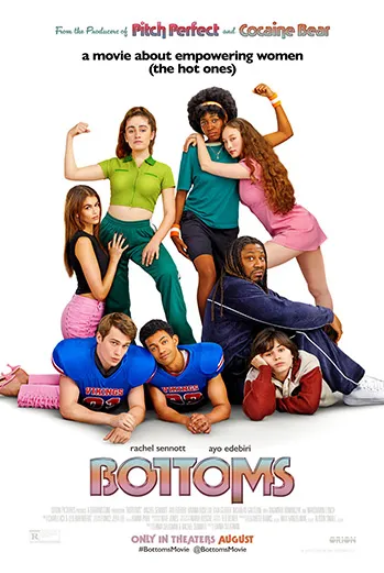
Consider this New York magazine cover story on the new film Bottoms, about a couple of lesbian teenagers (played by 28-year-olds) who start a high school fight club in order to try and get laid. I’m interested in the movie; it looks funny and I’ll watch it with an open mind. Movies that are both within and critiques of the high school movie genre tend to be favorites of mine. But the preemptive hype about it — which of course the creators can’t directly control — has been fundamentally false, fundamentally dishonest about what constitutes artistic risk and personal risk in 2023. The underlying premise of the advance discussion has been that making a high school movie about a lesbian fight club, today, is inherently subversive and very risky. And the thing is … that’s not true. At all. In fact, when I first read the premise of Bottoms I marveled at how perfectly it flatters the interests and worldview of the kind of people who write about movies professionally. As New York‘s Rachel Handler says,
[Bottoms has] had the lesbian Letterboxd crowd, which treats every trailer and teaser release like Gay Christmas, hot and bothered for months. After attending its hit SXSW premiere, comedian Jaboukie Young-White tweeted, “There will be a full reset when this drops.”
And yet to read reviews and thinkpieces and social media, you’d think that Bottoms was emerging into a culture industry where the Moral Majority runs the show. One of the totally bizarre things about contemporary pop culture coverage is that the “lesbian Letterboxd crowd” and subcultures like them — proud and open and loud champions of “diversity” in the HR sense — are prevalent, influential, and powerful, and yet we are constantly to pretend that they don’t exist. To think of Bottoms as inherently subversive, you have to pretend that the cohort that Handler refers to here has no voice, even as its voice is loud enough to influence a New York magazine cover story. This basic dynamic really hasn’t changed in the culture business in a decade, and that’s because the people who make up the profession prefer to think of their artistic and political tastes as permanently marginal even as they write our collective culture.
Essentially the entire world of for-pay movie criticism and news is made up of the kind of people who will stand up and applaud for a movie with that premise regardless of how good the actual movie is. And I suspect that Rachel Handler, the author of that piece, and its editors at New York, and the PR people for the film, and the women who made it, and most of the piece’s readers know that it isn’t brave to release that movie, in this culture, now. And as far as the creators go, that’s all fine; their job isn’t to be brave, it’s to make a good movie! They aren’t obligated to fulfill the expectation that movies and shows about LGBTQ characters are permanently subversive. But the inability of our culture industry to drop that narrative demonstrates the bizarre progressive resistance to recognizing that things change and that liberals in fact control a huge amount of cultural territory.
And here’s the thing: almost everybody in this industry, in media, would understand that narrative to be false, were I to put the case to them this way. This obviously isn’t remotely a big deal — in fact I’ve chosen this piece and topic precisely because it’s not a big deal — and I’m sure most people haven’t thought about it at all. (Why would they?) Still, if I could peel people in professional media off from the pack and lay this case out to them personally, I’m quite certain many of them would agree that this kind of movie is actually guaranteed a great deal of media enthusiasm because of its “representation”, and thus is in fact a very safe movie to release in today’s Hollywood — but they would admit it privately. Because “Anything involving LQBTQ characters or themes is still something that’s inherently risky and daring in the world of entertainment and media, in the year of our lord 2023” is both transparently horseshit and yet socially mandated, in industries in which most people are just trying to hold on and don’t need the hassle.


