
I’ve always had a fascination with “brainwashing”. It turns out that the human mind is, indeed, pretty plastic out on the far edges, and so long as you don’t care about the health and wellbeing of the object of your literal skullfuckery, you can do some interesting things. For instance, a book on every dissident’s shelf should be The Rape of the Mind: The Psychology of Thought Control, Menticide, and Brainwashing, by Joost Meerloo. You’ll need to get it used, or on Kindle (the usual caveats apply). Meerloo was a Dutch (or Flemish or Walloon, I forget) MD who was briefly detained by the Gestapo during the war. They had nothing more than a cordial chat (by Gestapo standards), but they obviously knew what they were doing, and the only reason Meerloo didn’t get Der Prozess for real was that they didn’t feel the need at that time. He escaped, and the experience charted the course of his professional life.
Like Robert Jay Lifton’s Thought Reform and the Psychology of Totalism (another must-read), I read Meerloo years ago, so my recall of the details is fuzzy, but the upshot is obvious: The techniques of “brainwashing” have been known since at least the Middle Ages, and they’re still the same. Suspected witches in the Early Modern period, for instance, got Der Prozess, and though the witch hunters also had recourse to the rack and thumbscrews and all the rest, none of it was really necessary — isolation, starvation, and sleep deprivation work even better, provided you hit that sweet spot when they’re just starting to go insane …
I’m being deliberately flip about a horrible thing, comrades, because as no doubt distasteful as that is to read, the fact is, we’re doing it to ourselves, everywhere, all the time. Not the starvation part, obviously, but we eat such horribly unnatural diets that our minds are indeed grossly affected. Want proof? Go hardcore keto for a week and watch what happens. Or if that’s too much, you can simulate the experience by going cold turkey off caffeine. I promise you, by the end of day two you’d give the NKVD the worst dirt on your own mother if they sat a steaming hot cup of java in front of you.
Severian, “Kickin’ It Old Skool”, Founding Questions, 2021-10-04.
January 20, 2025
QotD: Brainwashing
January 19, 2025
California’s wildfire plight
Theophilus Chilton on the end of California dreamin’:

Southern California has had a REALLY rough week. Wildfires, started by arsonists and driven by the Santa Ana winds, have burned thousands of acres in the city and county of Los Angeles and destroyed over $150 billion worth of property (and counting). As I write this, the fires still burn and largely remain uncontained, even as new blazes break out. It is a disaster of epic proportions, striking one of the richest and most economically and culturally relevant portions of the country.
Never ones to let a crisis go to waste, the Left responded to this disaster by … focusing on climate change. Not empty fire hydrants, not drained reservoirs, not incompetent leadership, but climate change. These fires, we have been breathlessly assured, are the result of ever-worsening climatic conditions in the region, drying it out and making it susceptible to this kind of affliction. Never mind that observers since Spanish times consistently noted the same kind of weather conditions and hazards that we see today, which suggests that maybe things aren’t actually changing all that much. Of course, those who are blaming climate change fail to recognise the fundamentally chaotic, nonlinear nature of the Earth’s biosphere and the interactions of its constituent parts, something governed by complexity (in the chaos/complexity theory sense of the term). As a result, it’s somewhat foolish to try to draw a direct, causal link between two variables (such as atmospheric CO2 content and temperature) which depend upon nonlinear interactions with hundreds of other factors. Thankfully, they don’t seem to be getting much traction with this.
So what did create the conditions that burned down Los Angeles?
First of all, there was the implementation of a number of policies driven by the state’s radical environmentalist lobby. Thanks to the fanatics, common sense policies that would help to mitigate the region’s inherent fire hazard went undone. Regular controlled burns of underbrush are a standard conservation technique in dry areas that help to thin out brush and prevent wildfires from getting out of control. Building a sufficient number of desalination plants is a good way for coastal desert areas to provide themselves with abundant fresh water for things like drinking, watering crops, filling reservoirs, and fighting fires. In fact, filling reservoirs for future needs would make a lot of sense. But all of these things are “unnatural” and might have “negative impacts” on local wildlife and whatnot.
Another contributory issue is the state’s policies towards the chronically homeless and its de facto sanctuary status for illegal aliens. The Reagan-era deinstitutionalisation of the homeless has been a nationwide disaster for years and California’s particular policies have made the situation in their state even worse. For decades, California has regularly seen wildfires caused by untended campfires started by homeless junkies getting out of control, which the state’s liberal approach to its indigent population has only made more prevalent. Likewise, California’s harbouring of illegal aliens has created a situation in which the state is flooded with masses of hostile foreign elements, some of whom have been caught starting fires all around the LA basin and creating the current catastrophe.
Then there is the fact that California has systematically implemented a set of DEI policies for its governmental workers, including its firefighters. As a result, the state’s leadership in the relevant departments is very good at “promoting inclusion,” but not so good at dealing competently with emergencies when they take place. Indeed, Los Angeles’ mayor Karen Bass and LAFD Chief Kristen Crowley presided over budget cuts for the city’s firefighting capabilities while adding layers of “diversity and inclusion” bureaucracy aimed at systematically de-white-maleing the department and depriving it of the demographic most prone to self-sacrifice and overall technical competence. That reflects trends across the board in which the state and the city have regularly spent more on gay choirs and social justice artwork than they have on necessary functions of government.
January 18, 2025
Incentives matter even to “objective” scientists
A 2019 Canadian “study” ideally illustrates that scientists are just as human as anyone else where they are incentivized to provide “desired” outcomes:

“The Beer Store” by Like_the_Grand_Canyon is licensed under CC BY-NC 2.0


Earlier this year, a major Canadian study on alcohol policy provided an excellent illustration of this. As news headlines across the country reported, 16 scientists and researchers at various universities and institutions had, through their Canadian Alcohol Policy Evaluation, shown that provincial governments are “failing to address alcohol problems”.
The scientists evaluated provincial government policies and assigned a grade in the “D” range to seven of Canada’s 13 provinces or territories, while five received an “F”. The policy evaluation, however, was a curious one. Strangely, the policy evaluation did not evaluate whether government policies were beneficial to those who want to buy or sell alcohol.
Instead, provincial governments were evaluated more favorably if they devoted greater efforts toward afflicting buyers and sellers of alcohol through punitive taxes, price controls, heavy restrictions on the sale and marketing of alcoholic beverages, higher minimum legal drinking ages, and so on.
Even in the most restrictive markets, the researchers found that alcohol was too cheap, or that its purchase was too convenient, or that governments did not do enough to discourage or restrict its sale and consumption.
Predictably, and perhaps exemplifying Berlinski’s point on scientists grasping for government funds, the report authored by 16 scientists whose livelihoods involve raising public alarm about alcohol consumption concluded that there ought to be more government funding for public education on the dangers of alcohol consumption.
The report also advocated more government funding for bureaucracies to discourage drinking, more government funding for a lead organization to implement restrictive alcohol policies, more government funding for independent monitoring of such implementation, and more government funding to track and report the harm caused by alcohol consumption.
Like the CEO of a domestic automobile company insisting that tariffs against car imports — which would cause a massive wealth redistribution from consumers’ wallets into his own and those of the company’s shareholders — are in the national interest, the anti-drinking scientists insisted in the name of public health and wellness upon income redistribution from taxpayers and consumers to their own industry.
Is the World Really Running Out of Sand?
Practical Engineering
Published 1 Oct 2024Sand: a treatise …
There’s a lot changing in the construction industry, and a lot of growth in the need for materials like sand and gravel. But I don’t think it’s fair to say the world is running out of those materials. We’re just more aware of all the costs involved in procuring them, and hopefully taking more account for how they affect our future and the environment.
(more…)
January 17, 2025
“… most of them can do simple low-IQ jobs like manual labor, basic retail, or writing for the New York Times“
At Astral Codex Ten, Scott Alexander discusses the highly controversial national IQ estimates of Richard Lynn … I’m sure I don’t need to spell out exactly why they were (and continue to be) controversial:

Lynn’s national IQ estimates (source)
Richard Lynn was a scientist who infamously tried to estimate the average IQ of every country. Typical of his results is this paper, which ranged from 60 (Malawi) to 108 (Singapore).
People obviously objected to this, and Lynn spent his life embroiled in controversy, with activists constantly trying to get him canceled/fired and his papers retracted/condemned. His opponents pointed out both his personal racist opinions/activities and his somewhat opportunistic methodology. Nobody does high-quality IQ tests on the entire population of Malawi; to get his numbers, Lynn would often find some IQ-ish test given to some unrepresentative sample of some group related to Malawians and try his best to extrapolate from there. How well this worked remains hotly debated; the latest volley is Aporia‘s Are Richard Lynn’s National IQ Estimates Flawed? (they say no).
I’ve followed the technical/methodological debate for a while, but I think the strongest emotions here come from two deeper worries people have about the data:
First, isn’t it horribly racist to say that people in sub-Saharan African countries have IQs that would qualify as an intellectual disability anywhere else?
Second, isn’t it preposterous and against common sense to compare sub-Saharan Africans to the intellectually disabled? You can talk to a Malawian person, and talk to a person with Down’s Syndrome, and the former is obviously much brighter and more functional than the latter. Doesn’t that mean that the estimates have to be wrong?
But both of these have simple answers, which IMHO defuse the worrying nature of Lynn’s results. These answers aren’t original to me, but as far as I know, nobody has put them together in one place before. Going over each in turn:
1: Isn’t It Super-Racist To Say That People In Sub-Saharan African Countries Have IQs Equivalent To Intellectually Disabled People?
No. In fact, it would be super-racist not to say this! We shouldn’t conflate advocacy with science. But if we did, Lynn’s position would make better anti-racist advocacy than his detractors’.
The “racist” position is that all IQ differences between groups are genetic. The “anti-racist” position is that they’re a product of environment — things like nutrition, health care, and education.
We know that in the US, where we do give people good IQ tests, whites average IQ 100 and blacks average IQ 85.
If IQ was 100% genetic, we should expect Africans to have an IQ of 85, since American and African blacks have similar genes. This isn’t exactly right — US blacks have some intermixing with whites, and only some of Africa’s staggering diversity reached the US — but it’s close enough.
January 16, 2025
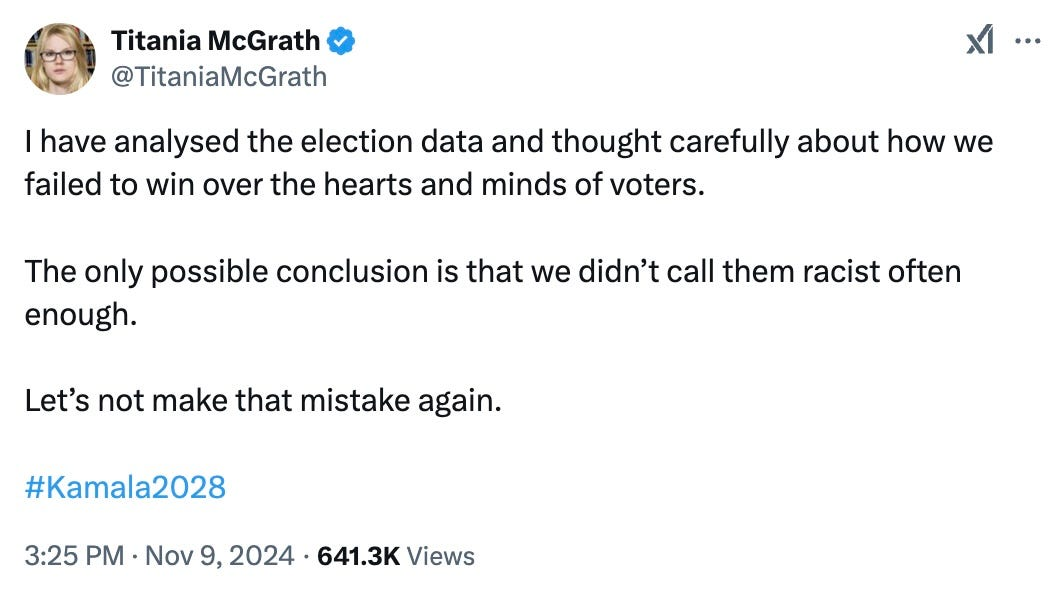
“The only possible conclusion is that we didn’t call them racist often enough”
Apparently there are still a lot of US politicians who think that letting men compete in womens’ sports is not only okay, but praiseworthy:
Of all the absurdities of the culture war, perhaps the most egregious is the normalisation of the idea that men should be able to identify their way into women’s sports. We are living through a period of mania, so we cannot clearly see how this will look to future generations. But I have little doubt that all those photographs of hulking men towering over women on winners’ podiums will be the memes of the future. “Can you believe they let this happen?” they’ll say, scratching their AI-enhanced cyborg heads.
Wherever one stands on Donald Trump, there can be little doubt that his imminent arrival at 1600 Pennsylvania Avenue will act as a corrective to this problem. Yesterday, the House of Representatives passed the Protection of Women and Girls in Sports Act with its goal of preventing males who identify as female from participating in school sports. If passed into law, schools that attempt to defy the ban would have their federal funds withheld. The bill was introduced by Republican representative Greg Steube of Florida, and makes clear that it will be a violation of federal law “for a recipient of Federal financial assistance who operates, sponsors, or facilitates an athletic program or activity to permit a person whose sex is male to participate in an athletic program or activity that is designated for women or girls”.
One of the most astonishing aspects of the passing of this bill was the voting outcome. 216 Republicans and only 2 Democrats (Vicente Gonzales and Henry Cueller) voted for the motion. Is it really that controversial that sex, as the bill puts it, “shall be recognized based solely on a person’s reproductive biology and genetics at birth”? You will recall the outcry back in November when Democratic politician Seth Moulton admitted that he objected to mixed-sex contact sports in schools. “I have two little girls,” he said, “I don’t want them getting run over on a playing field by a male or formerly male athlete. But as a Democrat, I’m supposed to be afraid to say that”. For this he was branded a “transphobe” and a “Nazi cooperator”, because we all know that one of the top priorities of the Third Reich was the preservation of women’s rights.
Moulton failed to retain his backbone for the latest vote (he called the bill “too extreme”), but his previous comment had been striking for its honesty. He was willing to openly state that fear was the key factor in the reticence of Democrats on this issue. It cannot be the case that only two Democratic members of the House take the view that there is no advantage in sports conferred by male puberty. Surely most of them must have glanced at a biology textbook from time to time. The charitable conclusion is that they have been browbeaten into voting ideologically, not that they genuinely don’t know that there exist anatomical differences between men and women.
Disturbingly, this vote would seem to suggest that the Democrats are not learning their lessons from the election, and instead are determined to double down on the very attitude that cost them the White House.
December 31, 2024
Resolutions? Meh.
James Lileks considers the futility of New Year resolutions … for most of us, anyway:

New Year, New You — if you believe that all the cells in your body are replaced every 12 months. So we were told, right? I don’t think that’s the case. The brain, for example, stays constant, which is good, because the idea of the cells handing off memories to the new cells would probably end up like a game of Telegram, and after 15 years you’re convinced your first kiss was not on a boat in the lake on the 4th of July but deep in the Amazon forest on a dugout canoe during a meteor shower.
I don’t think your liver renews itself, alas. It has to sit there and take it. The bones, being the tentpoles for the cellular circus that is You, have to remain solid. No, the New You is entirely a matter of will, of resolutions and revelations undertaken on the First of the Year with solemn gravity, so you can be disappointed with yourself two weeks later.
Resolutions are always matters of self-improvement, and this presents a certain amount of difficulty. I’m at the age where the available options for self-improvement consist of the trivial and the insurmountable. Example: I should resolve to be more patient on the road with drivers who dawdle along a few miles below the speed limit, perhaps giving me adequate time to study the various political and philosophical statements glued to the rear of their auto. Why — why yes, you’re right, you cannot hug your child with nuclear arms. You also cannot defend the continental United States against the threat of ballistic bombardment with maternal limbs. A more pressing issue might be thus: Can we make the green light? No, we’re not going to make the green light.
I would indeed be happier if I could accept with zen detachment the lumbering pace of the car ahead. My impatience, my self-righteous desire to arrive at our destinations before Haley’s Comet arcs anew through the heavens — well, it brings me no joy. But this will not change. What’s the phrase? To thine own self be true. Well, being peeved because the driver ahead of me believes their face will ripple with G-forces if they go 21 MPH is my true self, and I am not about to deny who I am.
December 27, 2024
QotD: Adapting to “permanent” food surpluses
More to the point, this is a testable hypothesis. I’m a history guy, obviously, not a biologist, but you don’t need to be a STEM PhD to see it. All our physical structures still look the same in 2021 as they did in 1901, but our biochemistry is far different. Just to take two obvious — and obviously detrimental — examples, we are awash in insulin and estrogen. Time warp in a laboring man from 1901 and feed him a modern “diet” for a week; the insulinemic effects of all that corn syrup etc. would put him in a coma. Even if he didn’t, the knock-on effect of all that insulin — greatly ramped-up estrogen — would deprive him of a lot of his physical strength, not to mention radically alter his mood, etc.
Severian, “The Experiment”, Founding Questions, 2021-09-25.
December 17, 2024
The rejection-in-advance of Bovaer as a “climate-friendly” “solution” to the “problem” of climate change
At Watts Up With That?, Charles Rotter documents yet another imposed-from-above bright idea that consumers are already eager to reject:

When global elites and bureaucrats decide they must “fix” the world, the results often speak for themselves. Take the latest technocratic debacle: Bovaer, a feed additive designed to reduce methane emissions from cows, marketed as a “climate-friendly” solution. It’s now being shelved by Norwegian dairy producer Q-Meieriene after consumers flatly rejected its so-called “climate milk”.
This is more than a simple story of market rejection. It’s a cautionary tale of what happens when governments, corporations, and globalists push policies and products that tamper with the food supply to address a problem that may not even exist.
The Quest to Solve a “Crisis”
Bovaer, developed by DSM-Firmenich, has been touted as a game-changer in the fight against methane emissions — a major target of climate policies. The additive is said to suppress a key enzyme in the cow’s digestive process, reducing methane emissions by up to 30%. Regulatory bodies in over 68 countries, including the EU, Australia, and the U.S., have approved its use.
But let’s step back for a moment. Why are we targeting cow burps and farts in the first place? Methane is indeed a greenhouse gas, but it’s also a short-lived one that breaks down in the atmosphere within about a decade. Moreover, cows and bison have been emitting methane for millennia without triggering apocalyptic climate shifts. Yet suddenly, livestock emissions are treated as a planetary emergency demanding immediate action.
This myopic focus on cow methane is a prime example of how climate zealotry warps priorities. Rather than addressing real and immediate issues — like the energy crises their own policies create — governments and globalists have decided to micromanage how your milk is produced, all to reduce emissions by an imperceptible fraction of a percentage point.
Consumer Rebellion
The backlash against Bovaer has been swift and fierce. In Norway, Q-Meieriene began using the additive in 2023, branding the resulting product as “climate milk”. The response? Consumers overwhelmingly rejected it, leaving supermarket shelves stocked with unsold cartons while Bovaer-free milk flew off the shelves.
Facing dismal sales, Q-Meieriene recently announced it would discontinue the use of Bovaer, stating:
Demand for Q climate milk has not been high enough to continue production … we phased out the use of methane suppressants in cow feed and are putting this project on pause.
https://www.nettavisen.no/nyheter/ville-redde-klimaet-med-prompe-fri-kumelk-snur/s/5-95-2166980
This is not merely a marketing failure. It reflects a broader consumer revolt against the technocratic imposition of “solutions” no one asked for. People are increasingly skeptical of being told that their daily choices — what they eat, how they travel, how they heat their homes — must be sacrificed on the altar of climate orthodoxy.
QotD: Capitalism is a combination of laziness, stupidity, and greed
Tim Worstall, “Folks Are Copying SpaceX – That’s How Capitalism Works”, It’s all obvious or trivial except …, 2024-09-16.
December 15, 2024
“Outside Sub-Saharan Africa, Homo sapiens are vermin, in the Australian sense — an introduced species with no co-evolved local predators”
You have to admit that Lorenzo Warby has a way with words to introduce a new essay, yes?

Outside Sub-Saharan Africa, Homo sapiens are vermin, in the Australian sense — an introduced species with no co-evolved local predators. That means that their strongest selection pressures — both genetic and cultural — have almost always been about dealing with other humans.
We are the cultural species par excellence. Cultures can be reasonably thought of as collections of life-strategies. Culture tends to be persistent — aspects of culture can be highly persistent.
It is worth keeping in mind that genetic selection can occur surprisingly quickly — i.e., in a relatively short number of generations, depending on the intensity of the selection pressures. A very clear example of this is the evolution of lactase persistence in pastoralist, or agro-pastoralist, populations. (The decades-long experiment in domesticating silver foxes is an extreme example.)
The great advantage of cultural selection is that it is faster than genetic selection but culture still has to show some “stickiness”, some persistence, to be useful. Especially in the evolution of signals, norms and social strategies.
The regions where the local physical environment has been successfully managed longest — or most thoroughly — are Europe, particularly North-West Europe, East Asia and India (especially by high-jati Indians). So, those are the areas where natural and cultural selection has been most focused on selection for dealing usefully with other humans. Those populations have also been the most successful in dealing with the modern world, wherever they go. This hardly seems a coincidence.
The regions where dealing with the local physical environment has been most salient are Sub-Saharan Africa — all those co-evolved parasites, pathogens, predators and mega-herbivores — and Australia — which is full of deserts and spiky things likely to poison you. Much of Africa is also semi-desert forager lands, while the tsetse fly stopped the central African plains generating the equivalent of the connecting — for good or ill — pastoralist cultures of the Eurasian steppes. Both continental-scale regions therefore historically had low human population densities.
The consequence in Africa was that Sub-Saharan Africa has, for millennia, been a region of endemic slavery. Labour was more valuable than land, which led — as it usually did historically — to labour bondage: the violent/coercive extraction of labour’s scarcity value. In this case, the low population density meant that folk were regularly seized and transported, thus requiring the level of domination for folk to be moved at will — i.e., slavery rather than some form of serfdom.
Increased selection to deal with the physical environment meant comparatively less selection to deal with other humans. Sub-Saharan African and Australian Aboriginal populations have been rather less successful at dealing with the modern world than have other populations. (Claims about the success of recent African immigrants seem to be overstated.) The key element of the modern world is domination of social outcomes by human interactions to the greatest extent yet achieved in history. Again, that relative lack of success hardly seems like a coincidence.
Yes, it is true that selection for transportation across the Atlantic as slaves was negative in all sorts of senses. The churn of slavery massively undermined cultural transmission, the selection was for physical robustness and, if anything, against executive functions (which are highly heritable). Nevertheless, with the partial exception of recent African immigrants — who are selected for initiative and education — both populations have been markedly less successful than other groups.
There are certainly factors which affect that either way. Not inflicting on Australian Aborigines the dual metabolic disasters of the farming and processed-food revolutions at the same time would be good. Not under-policing the localities in which folk live is also good.
Nevertheless, there is no reason to think that capacities — which are a genetic, epigenetic and cultural matter — will be evenly distributed across all populations. Indeed, we have very good reasons to think that that will not be the case, due to the variations in selection pressures — whether genetic, environmental or cultural, including interactions between the three. It is not a good idea, for instance, to spend 1400 years marrying your cousins.
Even when means and medians are the same in the distribution of some trait across groups, differences in the size of tails — i.e. the number of extreme outliers — can lead to differences in the distribution of outcomes. Any population with a persistently larger tail of high physical robustness and lower executive functions — which can be an ethno-racial pattern but also a class pattern — will tend to have higher rates of violent crime. Conversely, any population with a smaller tail of lower executive functions — for example, East Asians with a long history of underclass males not breeding but selection for reproductive success through passing examinations and cooperative farming — will tend to have lower rates of violent crime.
Sufficient variance in traits — so having a larger “right tail” of positive-for-human-flourishing characteristics — can be enough on its own to increase a group’s success. Tail effects matter.1
The persistence of gene flows across human populations does undermine any strong notion of human subspecies among Homo sapiens. It does not imply equal distributions of capacities across human populations.
Hence, evolutionary thinking is neither comfortable nor comforting.
1. Given that human males — like males across species — have a flatter distribution of traits — so more positive and negative outliers — having equal numbers of males and females at the top ends of hierarchies suggests some level of discrimination against males. Conversely, having female prison populations begin to approach male populations in size suggests some level of discrimination against, even persecution of, females.
December 13, 2024
The influence of Mesopotamian cultures on ancient Greece
James Pew and Scott Miller begin their series on the history of western education by looking at the way Greek civilization was influenced by the Mesopotamian cultures who used cuneiform writing for three thousand years:

An example of a clay tablet inscribed with cuneiform text (in this case, a portion of the Epic of Gilgamesh)
In the 19th century, three new discoveries began to militate against “the image of pure, self-contained Hellenism”. They were: “the reemergence of the ancient Near East and Egypt through the decipherment of cuneiform and hieroglyphic writing, the unearthing of Mycenaean civilization, and the recognition of an Orientalizing phase in the development of archaic Greek art”.
To sketch the significance of just one of these discoveries, what the discovery of cuneiform writing means for the history of writing and literature, we have with cuneiform not only the first writing system in human history, but also the longest running (it was in use for over 3,000 years); cuneiform texts are, at the same time, the best preserved and most numerous textual records from the ancient world by far (there are hundreds of thousands of cuneiform documents in museum archives today because the signs were inscribed on clay tablets which preserve better across time than other materials used for writing in ancient times). This complex writing system, consisting of thousands of signs, was developed first in Mesopotamia by the Sumerians and, subsequently, it was adopted by the Akkadians, Babylonians and Assyrians in the same area. It emerged c. 3200 B.C. as a response to social and economic complexities generated by the world’s first cities: invariably, the impetus to create a writing system comes down to the need to document and track the transfer of food stuffs, material goods, temple offerings, and so forth, the administration of complex urban society. On the other hand, written literature in the form of myth, poetry and the like, are secondary developments that may follow a long time later (if at all). In centuries to follow, Mesopotamian scribes would begin to write down epic tales telling the exploits of heroic kings, such as Gilgamesh, along with hymns and prayers to the Mesopotamia gods, incantations to ward off demons and diseases, texts containing lists of known phenomena, proverbs, reports of astrological phenomena and their omens, medical and magical texts to be used by the healing expert, and many text types besides.
On the Question of Greek Borrowing from the more ancient East: This series will delve into the work of many of these cutting-edge historical scholars who follow the evidence from Orient to Occident. Academic’s like Albin Lesky, M.L. West, Walter Burkert, Margalit Finkelberg, Harald Haarmann, Daniel Ogden, Mark Griffith, and more.
It is no easy task to establish links between Greece and ancient Near Eastern civilizations, and the difficulty has to do with more than vast expanses of time and space. Typically, modern scholars of classical Greece have a tendency to “transform ‘oriental’ and ‘occidental’ into a polarity, implying antithesis and conflict”. According to Burkert, it was not until the Greeks fought back the Persian Empire that they became aware of their distinct identity (as separate from the orient). In addition, it was not until many years later, during the crusades, that “the concept and the term ‘Orient’ actually enter(ed) the languages of the West”. The reluctance on the part of many scholars to accept a universal conception of cultural development which involved “borrowing”, “loan words”, and “cultural diffusion” amongst the different ancient peoples living in both the Near East and the Aegean regions, is due to intellectual currents that first took shape in Germany over two centuries ago. In Burkert’s words, “Increasing specialization of scholarship converged with ideological protectionism, and both constructed an image of a pure, classical Greece in splendid isolation”.
It was essentially a trio of academic fads that “erected their own boundaries and collectively fractured the Orient-Greece axis”. The first was the breaking apart of theology and philology. Until well into the 18th century, “the Hebrew Bible naturally stood next to the Greek classics, and the existence of cross-connections did not present any problems”. The second was the rise of the ideology of Romantic Nationalism, “which held literature and spiritual culture to be intimately connected with an individual people, tribe, or race. Origins and organic development rather than reciprocal cultural influences became the key to understanding”. And the third was the discovery by linguistic scholars of “Indo-European”, the “common archetype” of most European languages (as well as Persian and Sanskrit).
Ulrich von Wilamowitz-Moellendorff offered a “scornful assessment” indicative of the faddish and far more isolated conception of ancient Greece in 1884: “the peoples and states of the Semites and the Egyptians which had been decaying for centuries and which, in spite of the antiquity of their culture, were unable to contribute anything to the Hellenes [the Greeks] other than a few manual skills, costumes, and implements of bad taste, antiquated ornaments, repulsive fetishes for even more repulsive fake divinities …” A common take at the time which would later prove to be quite incomplete. It should be noted that Romantic Nationalism, coupled with the discovery of Indo-European (which demonstrates no link between European and Semitic languages) seems to have contributed to what gave “anti-Semitism a chance”. Tragically, it was at the point when the Jews were finally being granted full legal equality in Europe when national-romantic consciousness and the rejection of orientalism helped set the stage for the escalation in Jewish persecution that eventually led to the horror of horrors: the Holocaust.
The Mesopotamians would never, as the later Greeks did c. 600 B.C., formulate an abstract concept of “nature” and analyze phenomena as having a natural developmental explanation rather than the traditional explanation (that being, e.g. the gods made it so). Thus, they would never develop philosophy or science as we think of it, and so there are certain categories of analysis and knowledge that are uniquely Greek in the ancient world. However, as the innovators of a form of agrarian society that was productive and sophisticated enough to sustain the world’s first cities, Mesopotamians needed to be able to examine and quantify time (in order to know when to plant) and so they developed the lunar calendar of 12 months, they developed the 12 double-hour day, they gave names to the observable planets and charted the night sky into constellations; They needed to be able to measure physical space and allot pieces of land to land owners, and so they created the world’s earliest form of basic geometry. The types of knowledge just named are the types of knowledge that scholars believe would have been of interest to the Greeks, and, indeed, many suspect that iron age Greeks borrowed these insights from the Babylonians. Whether the Greek story of Heracles could have been influenced by Mesopotamian hero epics such as the Epic of Gilgamesh is a more contentious — though intriguing — topic.
So, how did Greece find itself in a position to receive the baton of civilization and even to carry it further forward? Because of the great work of modern scholars, we know that an informal but early (proto) archetypal version of education (not yet organized education) begins in the Mediterranean, in archaic Greece, before the classical period. Even before this, although it is not exactly clear as to the extent, it has been determined that Bronze Age Greek cultures located around the area of the Aegean sea (also known as Aegean Civilization) – the Mycenaean on mainland Greece, the Minoan on the island of Crete and the Cyclades (also known as the Aegean Islands) – were not only in contact with each other, but also with neighboring civilizations: Egypt, Mesopotamia, Asia Minor, and the Levant.
December 12, 2024
The dispiriting rise of the “kidult”
Freya India explains the need for modern parents to re-embrace some of the more traditional duties of parents in raising children:

It’s pretty much accepted as fact that parents today are overprotective. We worry about helicopter parenting, and the coddling of Gen Z. But I don’t think that’s the full story. Parents aren’t protective enough.
Or at least, what parents are protective about has changed. They are overprotective about physical safety, terrified of accidents and injuries. But are they protective by giving guidance? Involved in their children’s character development? Protective by raising boys to be respectful, by guiding girls away from bad influences? Protective by showing children how to behave, by being an example?
As far as I can see many parents today are overprotective but also strangely permissive. They hesitate to give advice or get involved, afraid of seeming controlling or outdated. They obsess over protecting their children physically, but have little interest in guiding them morally. They care more about their children’s safety than their character. Protective parenting once meant caring about who your daughter dated, the decisions she made, and guiding her in a good direction. Now it just means preventing injury. And so children today are deprived of the most fundamental protection: the passing down of morals, principles, and a framework for life.
One obvious example of this is that adults act like children now. They talk like teenagers. They use the same social media platforms, play the same video games, listen to the same music. Our world moves too rapidly to retain any wisdom, denying parents the chance to pass anything down or be taken seriously, so they try to keep up with kids, who know more about the world than they do. Fathers are “girl dads” who get told what to think. Mothers are best friends to gossip with. The difference between childhood and adulthood is disappearing, and with it, parental protection.
Beyond that, too, there’s this broader cultural message that adults should focus on their own autonomy and self-actualisation. This very modern belief that a good life means maximum freedom, with as little discomfort and constraint as possible, the way children think. Now nothing should hold adults back. They have a right to feel good, at all times. They stopped being role models of responsibility and became vessels of the only culture left, a therapeutic culture, where it’s only acceptable to be protective of one thing, your own mental health and happiness. Listen to the way adults judge decisions now, how they justify themselves. Parents are celebrated for leaving their families because they were vaguely unhappy or felt they needed to find themselves, even at the expense of their children’s security. Adults talk about finding themselves as much as teenagers do. Parents complain online about the “emotional labour” of caring for family, or express regret for even having children because they got in the way of their goals. Once growing up meant sacrificing for family, giving up some of yourself, that was an honour, that was a privilege, and in that sacrifice you found actual fulfilment, broke free from yourself, moved on from adolescent anxieties, and there, then, you became an adult.
But slowly, without thinking, we became suspicious of adulthood. We debunked every marker and milestone, from marriage to children all the way to adulthood itself. Now we aren’t just refusing to grow up but rejecting the very concept of it. Adulthood does not exist, apparently. It’s a scam, a lie, a myth. Adulthood is a marketing ploy, we say, while wearing Harry Potter merch and going to Disneyland. Adulthood is a performance, apparently, that’s going out of style. “There is nothing, there is nobody which/who would really justify the claim ‘you have to grow up’,” seems to be the sentiment. “For whom? for what?”
December 9, 2024
Public wash-house Liverpool (1959) | BFI National Archive
BFI
Published Dec 12, 2017Admire the industriousness of the Liverpool women who transport huge bundles of laundry to and from the local wash-house every week, crammed into old prams or balanced skilfully on their heads. The wash-house doubles as a social hub for the women, with a cafe and creche facilities. At the time of filming, this one in the Pontack Lane area was one of 13 remaining original public wash-houses in the city, although new more modernised buildings were under construction. Liverpool’s last working wash-house closed in 1995.
The peppy documentary not only looks at the modern wash-house, but introduces the story of Kitty Wilkinson, “the Saint of the Slums”, who pioneered the public wash-house movement in Liverpool during the 1832 cholera epidemic. John Abbot Productions, who made the film, specialised in sponsored non-fiction films from the late 1950s to the late 1970s.
(more…)
December 5, 2024
We must always trust the experts, say the experts and their journalistic fart-catchers
Glenn Reynolds (aka the “Instapundit”) welcomes Nate Silver to the expert-doubting party:

Well. I was writing about this stuff long before Nate got hip. Back in 2017, just as Donald Trump began his first term, I wrote “The Suicide of Expertise”, by way of responding to Tom Nichols’ book, The Death of Expertise. Nichols’ thesis was that the experts were expert, but that ignorant, superstitious Americans rejected their advice out of insecurity and an unwillingness to be proven wrong. My response was that the experts’ actual track record wasn’t looking so good:
Well, it’s certainly true that the “experts” don’t have the kind of authority that they possessed in the decade or two following World War II. Back then, the experts had given us vaccines, antibiotics, jet airplanes, nuclear power and space flight. The idea that they might really know best seemed pretty plausible.
But it also seems pretty plausible that Americans might look back on the last 50 years and say, “What have experts done for us lately?” Not only have the experts failed to deliver on the moon bases and flying cars they promised back in the day, but their track record in general is looking a lot spottier than it was in, say, 1965.
It was the experts — characterized in terms of their self-image by David Halberstam in The Best and the Brightest — who brought us the twin debacles of the Vietnam War, which we lost, and the War On Poverty, where we spent trillions and certainly didn’t win. In both cases, confident assertions by highly credentialed authorities foundered upon reality, at a dramatic cost in blood and treasure. Mostly other people’s blood and treasure.
And these are not isolated failures. The history of government nutritional advice from the 1960s to the present is an appalling one: The advice of “experts” was frequently wrong, and sometimes bought-and-paid-for by special interests, but always delivered with an air of unchallengeable certainty …
On Syria, experts in Barack Obama’s administration produced a policy that led to countless deaths, millions of refugees flooding Europe, a new haven for Islamic terrorists, and the upending of established power relations in the mideast. In Libya, the experts urged a war, waged without the approval of Congress, to topple strongman Moammar Gadhafi, only to see — again — countless deaths, huge numbers of refugees and another haven for Islamist terror.
It was experts who brought us the housing bubble and the subprime crisis. It was experts who botched the Obamacare rollout. And, of course, the experts didn’t see Brexit coming, and seem to have responded mostly with injured pride and assaults on the intelligence of the electorate, rather than with constructive solutions.
And this was long before the experts’ ne plus ultra of failure, the bungled, dishonest, and downright self-serving response to the Covid pandemic. The pandemic stemmed from experts’ arrogance, in the form of illegal “gain of function” research funded by the U.S. and laundered through Chinese labs, was met with ass-covering “wet market” lies to try to conceal that origin, and then with public health measures, such as lockdowns and social distancing and masking rules, that were backed by no actual science at all, and that were cheerfully flouted by those propounding them whenever it suited their purposes. The final nail in the experts’ authority-coffin, though, was when, after all the lockdown hysteria, they approved massive public marches by Black Lives Matter because, we were told, racism was a public health problem.
Well, so are STDs, but they weren’t encouraging anyone to march against gonorrhea.
Rather they were (ab)using their position to promote the leftist cause du jour. Everyone saw through it, and their stock collapsed.
So. Welcome to the party, pal. Nate’s noticing just how far things have gone downhill.


