
Tasting History with Max Miller
Published Jul 30, 2024A bowl of the original Corn Flakes made with only corn.
City/Region: Battle Creek, Michigan
Time Period: 1895Dr. John Kellogg was all about health, and when his brother, William (the financial brains of the operation), wanted to add sugar to the very bland original Corn Flakes, he flat out refused. Eventually, William bought the rights to Corn Flakes, changed the recipe, and the rest is history.
I don’t have the industrial rollers that the original recipe for Corn Flakes used, so I made a dough. The flakes turned out nice and crispy, but they are very bland. I would recommend using stone-ground cornmeal and adding some sugar and salt to make the whole process easier and the end product tastier.
Excerpt from Patent No. 558,393 [for] Flaked Cereals and Process of Preparing Same.
First. Soak the grain for some hours — say eight to twelve — in water at a temperature which is either between 40° and 60° Fahrenheit or 110° and 140° Fahrenheit, thus securing a preliminary digestion by aid of cerealin, a starch-digesting organic ferment contained in the hull of the grain or just beneath it. The temperature must be either so low or so high as to prevent actual fermentation while promoting the activity of the ferment. This digestion adds to the sweetness and flavor of the product.
Second. Cook the grain thoroughly. For this purpose it should be boiled in water for about an hour, and if steamed a longer time will be required. My process is distinctive in this step—that is to say, that the cooking is carried to the stage when all the starch is hydrated. If not thus thoroughly cooked, the product is unfit for digestion and practically worthless for immediate consumption.
Third. After steaming the grain is cooled and partially dried, then passed through cold rollers, from which it is removed by means of carefully-adjusted scrapers. The purpose of this process of rolling is to flatten the grain into extremely thin flakes in the shape of translucent films, whereby the bran covering (or the cellulose portions thereof) is disintegrated or broken into small particles, and the constituents of the grain are made readily accessible to the cooking process to which it is to be subsequently subjected and to the action of the digestive fluids when eaten.
Fourth. After rolling the compressed grain or flakes having been received upon suitable trays is subjected to a steaming process, whereby it is thoroughly cooked and is then baked or roasted in an oven until dry and crisp.
— John Harvey Kellogg. United States Patent Office, 1895
December 4, 2024
The Disturbing Origins of Kellogg’s Corn Flakes
December 2, 2024
Mars? Yes, Mars.
At Postcards From Barsoom, John Carter discusses the pros and cons of colonizing Mars:

… we’re on the good timeline now.
Not everyone appreciates the good timeline. A persistent current of discourse holds that we shouldn’t go to Mars, that it is a misbegotten ambition, unrealistic, unprofitable, and even counterproductive. “Antarctica would be easier”, they say, “We should start there if we start anywhere”. Mars is too difficult; the technology doesn’t exist; it’s fantastically expensive, with no conceivable profit to be derived from a frigid desert littered with dead rocks, where the clouds themselves are made of red dust, where the air is too thin and toxic to breathe, where nothing can possibly grow. Therefore, they pronounce, we shouldn’t go. We shouldn’t even try to go. We should use our limited resources to solve our pressing problems down here on Earth – climate change, poverty, racism, the gender pay gap, the refusal of the chuds to use the correct pronouns.
Leave aside that if Europeans had waited to solve Europe’s problems, they never would have left.
Leave aside that “we” aren’t doing anything. Some people will use their resources to try this audacious thing; others will use their resources to do other things. The oft-heard phrasing of “we” presupposes that “our” resources are a collective property, their usage to be decided on the basis of utilitarian calculations carried out, presumably, by panels of self-selected technocratic experts. That collective ownership and central planning has been calamitous every time it has been applied in earnest is no barrier to the appeal of the idea over a great many minds.
Leave aside also the economic case for Martian settlement. That case has been made, and made well, by Devon Eriksen in his essay “The Trillionaires of Mars“.
Briefly, Mars is valuable because its shallow gravity well and proximity to the asteroid belt provides an ideal planetary surface on which to build the industrial infrastructure necessary to refine asteroids into useful metals and finished manufactured products, which can then be sent back to the terrestrial market (or shipped elsewhere in the solar system). As to the comparisons to Antarctica, planetary scientist Peter Hague
has addressed this in detail.As Hague points out, Antarctica’s geography means that it receives a vanishingly small amount of solar radiation (and during the winter, none at all). In contrast, while Mars’ greater distance from the Sun (an average of 1.5 Astronomical Units) means that it only gets about 44% of Earth’s irradiance, this is still a lot more than Antarctica. Growing crops is a lot easier on Mars than it is on Antarctica, where it can only be done hydroponically. Setting up shop on Mars means that we can use this solar energy not only to generate electricity, but also for agriculture. On Mars, in principle, one merely mixes human waste with the regolith (after removing the perchlorates) to turn it into topsoil, puts it in a transparent dome, fills the dome with air, and plants the potatoes.
Mars is certainly the easiest extraterrestrial body in the solar system to settle, occupying a sweet spot with its combination of proximity to the Earth, low gravity, an atmosphere, and abundant local resources. It therefore makes perfect sense that it would be prioritized for colonization. It’s Level 1 in the game of becoming multiplanetary. Other bodies may offer much richer prizes in the long run, but they’re also far more challenging.
Still, pace Devon, it’s unlikely that Mars will be profitable in the short run. Even asteroid mining will, at least initially, be far more useful for in situ space manufacturing than it will be for the terrestrial market. As Eriksen points out, correctly, if you strip-mine a quadrillion-dollar asteroid of nickel, iron, and platinum group metals and ship them back to Earth all at once, you’ll just crash the value of those metals. Supply and demand 101. Then again, as Eriksen also points out, raw materials aren’t just numbers on a commodity exchange: they’re actual, physical stuff that you can use to build things, and when society has more of it, society is wealthier in real terms … something that we often forget in our hypothecated financial economy. This is a point I’ve made myself, in the context of a wider discussion about why we should fix our gaze upon the heavens, and ignore those who demand that we wallow perpetually in the mud.
November 29, 2024
Dr. Jay Bhattacharya nominated as Director of the US National Institutes of Health
From the point of view of the establishment, the barbarians are well and truly inside the gates, as President-elect Donald Trump has nominated Stanford epidemiologist Dr. Jay Bhattacharya as the next director of the National Institutes of Health:

Dr. Jay Bhattacharya, Donald Trump’s nominee as Director of the National Health Institutes.
Photo by Taleed Brown, 2020, via Wikimedia Commons.
Four years ago, Jay Bhattacharya was ostracized by his colleagues at Stanford and censored on social media platforms thanks to a campaign against him by the public-health establishment. The director of the National Institutes of Health, Francis Collins, sent an email to another NIH official, Anthony Fauci, urging a “quick and devastating published takedown” of Bhattacharya and his fellow “fringe epidemiologists”.
Bhattacharya is far from the fringe today. Donald Trump nominated him this week for Collins’s old job, director of the NIH. Assuming the Senate confirms him, it will be a major victory for science and academic freedom — and a serious threat to the universities that suppressed scientific debate and promoted disastrous policies during the pandemic, causing public trust in science to plummet. Academic researchers and administrators have mostly refused to acknowledge their mistakes, much less make amends, but Bhattacharya promised yesterday to “reform American scientific institutions so that they are worthy of trust again”.
As NIH director, he would wield a potent tool to induce reform: money. Stanford and more than a dozen other universities each get more than $500 million annually in grants from the NIH, the world’s largest funder of biomedical research. The NIH grants support not only researchers but also their universities’ bureaucracies, which collect a hefty surcharge to cover supposed overhead costs. The federal largesse has helped finance the administrative bloat at universities, including the expansion of diversity, equity, and inclusion bureaucracies under the Biden administration, which took into account a university’s commitment to DEI principles when deciding whether to award grants from the NIH and other agencies.
Those priorities are about to change. Trump has vowed to rescind immediately Biden’s executive order directing federal agencies to promote DEI. During his first term, Trump threatened to issue an executive order barring universities from receiving federal funds if they suppressed free speech. He didn’t issue that order, but whether or not he does so in his next term, the NIH director will already have the power to consider a university’s commitment to academic freedom in deciding whether or not to award funds.
“For science to thrive and progress, we must be open-minded and allow vigorous and passionate debate,” says Martin Kulldorff, a former professor of medicine at Harvard. “Why should taxpayers subsidize universities that don’t allow that?” Kulldorff, an eminent epidemiologist, lost his job at Harvard after he became an early and outspoken critic of pandemic policies. In 2020, he joined with Bhattacharya and Sunetra Gupta, an epidemiologist at Oxford, to write the Great Barrington Declaration, a critique of lockdowns that was signed by tens of thousands of scientists and physicians.
Bhattacharya, who has a Ph.D. in economics as well as an M.D. from Stanford, hung on to his job as professor of health policy at the latter’s medical school, but his views were taboo on campus. After he and colleagues did a field study at the start of the pandemic showing that the Covid fatality rate was much lower than the doomsday number used to justify lockdowns, they were vilified by academics and journalists, and Stanford subjected them to a two-month inquiry by an outside legal firm. (They were vindicated by the inquiry and also by subsequent research confirming their findings.)
November 27, 2024
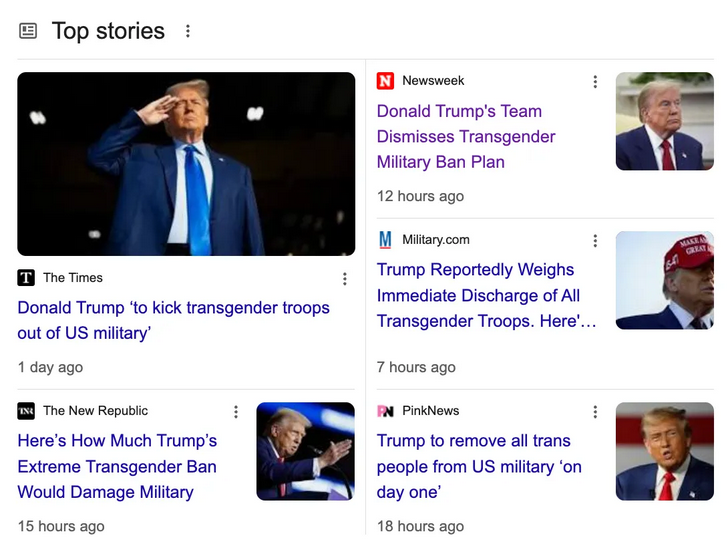
Trump’s plan to dismiss transgender troops will apparently “gut” the US military
As if the US military services hadn’t suffered enough from their own government, it’s now being widely asserted in the media that Trump’s declared plan to get rid of all current transgender service members will be a desperately hard blow to an already over-stressed military structure:
The news media is calmly warning that Donald Trump is planning to ban transgender servicemembers from the American military, which will absolutely gut the armed forces.
Sample claim, from Newsweek, quoting the leader of an LGBT advocacy nonprofit:
Abruptly discharging 15,000-plus service members, especially given that the military’s recruiting targets fell short by 41,000 recruits last year, adds administrative burdens to war fighting units.
There would be a significant financial cost, as well as a loss of experience and leadership that will take possibly 20 years and billions of dollars to replace.
We’ll practically have no military left! It would be like a whole infantry division suddenly just vanishing: 15,000-plus transgendered service members.
You’re going to see this number a lot in the weeks ahead. The New Republic, today: “Donald Trump’s plan to ban transgender people from the military would have a devastating effect: At least 15,000 members would be forced to leave.”
That number comes from a 2018 report by the now-defunct Palm Center, a pro-LGBT independent research institute in California, which reached this conclusion: “Transgender troops make up 0.7% (seven-tenths of one percent) of the military (Active Component and Selected Reserve)”. Their best guess about a total number: 14,707. The media is just rounding that number up to the next thousand.
The Palm Center … extrapolated a lot, let’s say, in good part by multiplying their guess about a percentage, derived from a grossly inadequate survey of a select number of active duty troops, times the total number of servicemembers. Page 4:
Assuming that the distribution of transgender men and women is roughly equivalent in the Active and Selected Reserve Components, it is possible to derive an estimate of the number of transgender troops in the Selected Reserve as follows. The number of transgender women is .0066 x 652,623 = 4,307 and the number of transgender men is .0091 x 156,080 = 1,420. The total number of transgender members of the Selected Reserve is 4,307 + 1,420 = 5,727. And, the total number of transgender troops is 8,980 (active) + 5,727 (reserve) = 14,707.
Assuming the distribution, it is possible to derive an estimate. That’s the basis of the 15,000 number that you’ll see in news stories. Remember that language.
Similarly, a 2016 RAND study offered these findings (among others), and note the remarkable thing that happens between the first and second paragraph:
It is difficult to estimate the number of transgender personnel in the military due to current policies and a lack of empirical data. Applying a range of prevalence estimates, combining data from multiple surveys, and adjusting for the male/female distribution in the military provided a midrange estimate of around 2,450 transgender personnel in the active component (out of a total number of approximately 1.3 million active-component service members) and 1,510 in the Selected Reserve.
Only a subset will seek gender transition–related treatment. Estimates derived from survey data and private health insurance claims data indicate that, each year, between 29 and 129 service members in the active component will seek transition-related care that could disrupt their ability to deploy.
So studies indicate that there are 3,960 transgendered servicemembers, and also that there are 14,707 transgendered servicemembers, and “between 29 and 129 service members in the active component” who will actively seek gender transition services in a typical year.
So it’s definitely somewhere between 29 and 15,000.
Scolianormativity
At FEE, Michael Strong defines the neologism and provides evidence that it has been a long-term harm to children forced into the Prussian-originated school regimentation regime:
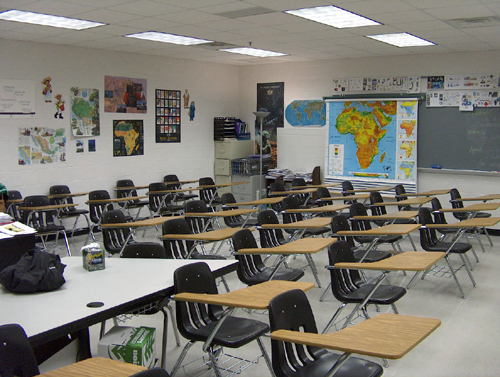
Scolianormative (adj.): The assumption that behaviors defined by institutionalized schooling are “normal”. An assumption that became pervasive in industrialized societies in which institutionalized schooling became the norm that resulted in marginalizing and harming millions of children. Once society began to question scolianormativity, gradually people began to realize that the norms set by institutionalized schooling were perfectly arbitrary. It turned out that it was not necessary to harm children. The institutions that led to such widespread harms were dismantled, and humanity transcended the terrible century of institutionalized schooling.
The conventional educational model, government-enforced and subsidized, is based on 13 years of schooling consisting of state-defined curriculum standards and exams leading to a high school diploma.
Young human beings are judged as either “normal” or not based on the extent to which they are “on track” with respect to grade level exams and test scores. Students who are not making the expected progress may be diagnosed with learning differences (formerly known as disabilities). Students who can’t sit still adequately may be diagnosed with ADD/ADHD. Students who find the experience soul-killing may be diagnosed with depression or anxiety. Students who can’t stand to be told what to do all day may be diagnosed with Oppositional Defiant Disorder (ODD). Students who score higher on certain tests are labeled “gifted”.
Massive amounts of research and institutional authority have been invested in these and other diagnoses. When a child is not progressing appropriately in the system, the child is often sent to specialists who then perform the diagnosis. When appropriate, then the child is given some combination of medication, accommodations, and/or sent to a special program for children with “special needs”.
Many well-intentioned people regard this system as life-saving for the children who might otherwise have “not had their needs met” in the absence of such a diagnosis and intervention. And this is no doubt often true, but our fixation on scolianormativity blinds us to the fact that an entirely different perspective might actually result in better lives for more children.
How could one possibly deny mountains of evidence on behalf of such a life-saving system?
Scolianormativity
The Prussian school model, a state-led model devoted to nationalism, is only about two hundred years old. For much of its first century it was limited to a few hours per day, for a few months per year, for a few years of schooling. It has only gradually grown to encompass most of a child’s waking hours for nine months a year from ages 5 to 18. Indeed, in the U.S., it was only in the 1950s that a majority of children graduated from high school (though laws requiring compulsory attendance through age 16 had been passed in the late 19th and early 20th century). In addition, for most of its first century, it was far more flexible than it has become in its second. The increasing standardization and bureaucratization of childhood is a remarkably recent phenomenon in historical terms.
In his book Seeing Like a State, the political scientist James C. Scott documents how governments work to create societies that are “legible”, that can be perceived and managed by the state to suit the needs of the state’s bureaucrats and political leaders. Public schools are one of the most pervasive of all state institutions. The structure of public schooling has grown to suit the needs of the state bureaucrats who monitor it.
November 23, 2024
Common sense on males in female sports from … checks notes … the United Nations?
Ramesh Thakur summarizes some of the findings from a recent report by the UN Special Rapporteur on violence against women and girls which somehow defies the narrative from most of the legacy media in the Current Year:

Has Hell frozen over? Uncommonly for the UN (think Antonio Guterres with the global warming hyperbole), one of its recent reports is full of common sense. In the last three years, I have been critical of UN performance regarding some high-profile issues, including World Health Organisation failings in responding to the coronavirus pandemic and a power grab for future pandemic management; lawfare against Israel by the world court and International Criminal Court; and UN Women’s betrayal of the raison d’être for its creation and existence with a shamefully delayed acknowledgment of the weaponisation of mass rape, sexual violence, mutilation and public humiliation of Israeli women on October 7th 2023.
Enter Reem Alsalem, the UN Special Rapporteur on violence against women and girls. It’s a relief and a pleasure to acknowledge her positive report “Violence against women and girls in sport“. Published on August 27th, it was presented to the UN General Assembly last month. She notes that until very recently, the need for a separate category for females “to ensure equal, fair and safe opportunities in sports” was a “universally recognised principle”. Maintaining separate-sex sports is a proportional action that corresponds to legitimate aims within international law. Females also have a right to privacy under international law which is forfeited by compelled mixed-sex spaces in intimate facilities. Alsalem explained to Fox News on October 21st that this is primarily a human rights issue, not a cultural or an individual issue.
Biological advantages for males in competitive sports include strength (162% greater punching power on average!), weight, muscle mass, speed, height, reach and endurance. Separate categories for males and females were created to recognise this biological reality and provide equal, fair and safe opportunities for females to win recognition, prize money, fame and career advancement. Allowing biological males into female sports is unfair and amounts to cheating by males who are simply not competitive in male sports (think swimmer Lia Thomas). It steals women’s dreams, aspirations and rewards. Alsalem’s data show that more than 600 female athletes in over 400 competitions have lost nearly 900 medals across 29 different sports. Other reports document instances of injuries from trans-on-females encounters, including teeth knocked out, concussions resulting in neural impairment, broken legs and skull fractures. Thus safety is yet another another concern.
Despite the unfairness, invasion of privacy, opportunity costs and safety risks, many athletes and coaches who object to trans-inclusion policies are silenced or forced to self-censor at the risk of losing sporting opportunities, scholarships and sponsorships. Many who do speak out despite such formidable hurdles are accused of bigotry, suspended, expelled and subjected to unfair disciplinary proceedings. Many (like Moira Deeming) face hostility if they assemble to discuss how to deal with these issues, violating the fundamental human rights to freedom of belief, opinion and expression. Some have quit sport entirely under the cumulative stress. Because “biological sex is central” to women’s “experiences of discrimination and violence”, countries that permit biological men to compete in women’s sports deny women “their femaleness”. To counteract the “worrisome trend”, she recommends the creation of open categories in sports competition and non-invasive and confidential sex screening procedures to ensure fairness, safety and dignity for female athletes alongside inclusive participation for everyone.
The trans-extremist assault on female spaces in the workplace and sporting arenas has been in the thick of the culture wars. Amidst the wreckage of those wars, the DEI (diversity, equity, inclusion) industry has morphed into DIE (division, intolerance, exclusion), promoting resentment, language-policing and unjust outcomes instead of real solutions. Trade-offs are central to public policy decision-making. The last major issue on which this was ignored was the panicked response to Covid and we will be paying for the resulting disasters for many years yet. By putting the spotlight back on the importance of balancing competing and clashing rights through policy trade-offs, this report provides a key to navigating our way out of the wreckage. It’s potentially also helpful in Sall Grover’s appeal in the Giggle v. Tickle case, as is the return of Trump to the White House. Alsalem is right to note that these policies originate from and exist almost entirely in Western countries. Their hold on many parts of the UN system is evidence of the hegemony of Western ideas and practices as the global norm. The adoption of trans and multigender language and the inclusion of trans athletes in international sports is confirmation of cultural imperialism at the cost of women-specific human rights.
November 20, 2024
QotD: The Chads, the Staceys, and the Incels
I have spent some time in the twilight reaches of the manosphere researching a new book, a world of depressing forums, full of hatred and despair, where young men gather to focus on the absence of sex in their lives. There are two broad categories: The Incels hate women because they won’t sleep with them. The Men Go Their Own Way (MGTOW) guys won’t sleep with women because they hate them.
These boys have their own vocabulary and belief systems. Pretty girls (Staceys) all sleep with the same few Alpha men (Chads). The Staceys ride the Cock Carousel, ie, have sex with the same few Chads. All this sluttish behaviour gives the Staceys something called A Thousand Cock Stare.
It is a grim world, in which women are evil and manipulative, and hated both for being sluts and for being virgins. It is a world in which pictures of pretty girls with their pet dogs are unbelievably sinister. These boys choose to live in this bleak world. They are culpable. But, if you tell all young, white boys that they are damned, why should they not behave as if they are damned?
A society which does not allow for people to atone, to be redeemed, and to be judged on their intent and actions is a miserable place. Most people interact with each other without antagonism most of the time. We should start being a bit more forgiving to each other, ditch the Puritanism and learn to cherish the well-meaning stumble towards decency. Even if, sometimes, we fall.
Antonia Senior, “Identity politics is Christianity without the redemption”, UnHerd, 2020-01-20.
November 15, 2024
Lysistrata updated for 2024
Tom Knighton recognizes the right of progressive women to take whatever actions they feel are appropriate to show their dissatisfaction with the election of Donald Trump, but suggests that the Lysistrata strategy may not be the answer for them:

From the moment Donald Trump was declared the victor in the 2024 presidential election, some started trying to figure out not how they could convince people to vote differently in the midterms but to try and punish people who disagreed.
There’s a reason people are cutting off family members right before the holidays, among other things.
But one of the more…interesting things is that it seems progressive women are going on a sex strike.
In response to Donald Trump’s election victory, some women in the US are joining a radical feminist movement that seeks to “decentralize” men in their lives. The movement, called 4B, originated in South Korea about a decade ago in response to broader dissatisfaction with gender discrimination and sexual violence online. Now thousands of Americans are tuning in to the movement on social media as Trump — who appointed the Supreme Court justices who helped overturn national abortion rights, and has been found liable for sexual abuse—prepares to return to office. While the movement has yet to show signs of gaining traction offline, its resurgence reflects a growing sense of frustration among women who fear that Trump’s second term will be characterized by unchecked misogyny and the continued rollback of bodily autonomy in the US.
…
Now the 4B movement appears to be booming on social media in the US: at time of writing, there were over a hundred thousand videos about the movement on TikTok; Google registered a massive surge in the search for “4B” starting on Election Day. “I’ve been waiting for everyone to catch up to speed for a while,” Alexa Vargas, a 4B adherent, said in a TikTok video posted last week. In a less restrictive interpretation of the movement’s tenets, Vargas encouraged women not to engage in “hookup culture” and to wait at least three months before considering having sex with new romantic partners. “Decenter men from your life,” she advised. “Get off the dating apps.” Another TikTok user said that she’d been keeping her participation in the movement private but decided to speak about her experiences publicly after the election: “As somebody who’s been 4B for two years now … at thirty-six years old, it is the best thing I’ve ever done for my mental health,” she said. “We are not alone in this.”
It’s too early to tell whether the movement will have much staying power, but it has already sparked a debate, both online and in more traditional media. Sex strikes are about as old as male-dominated societies: the practice has been an anti-war measure for centuries — it was central to the plot of the Ancient Greek comedy Lysistrata, in which women on both sides of the Peloponnesian War denied their husbands sex as a way of forcing peace talks — and more recently has returned to the discourse in the US following the introduction of a strict anti-abortion measure in Georgia and the repeal of Roe v. Wade. (Lysistrata was also adapted, in late 2015, into Spike Lee’s Chi-Raq.) Such movements “rarely result in widespread support,” Helen Morales, a cultural critic and classicist, told The Guardian in 2022, but they can be a powerful tool for building awareness. “Women tend to protest with their bodies when they don’t have a voice,” Morales added.
Of course, women do have a voice. They can speak freely and petition the government for the redress of grievances. They have full access to every mechanism of free speech men have.
A voice, they don’t lack.
But that said, they’re free to go this route if they want. However, when it doesn’t actually do anything, I’m going to laugh.
First, as was noted above, these kinds of things don’t really go anywhere. Why? Women like sex too. Especially since feminists have said for decades that women being able to be sexual beings is an act of empowerment, only now they seem to want women to turn that off in order to drive a political movement that will do … what?
Convince men that everything they believed was wrong because they want to actually have a relationship with a woman?
I hate to break it to you ladies, but most single men on the right are looking at this right now and thinking, “Thank you, God”.
November 8, 2024
“The Science™, that thing we’re supposed to believe in and obey – is distinctly and increasingly political”
President-elect Donald Trump has a vast array of options to tackle in the traditional first hundred days of his administration. Chris Bray says that one of the very first of these should be the depoliticization of the federal science agencies:
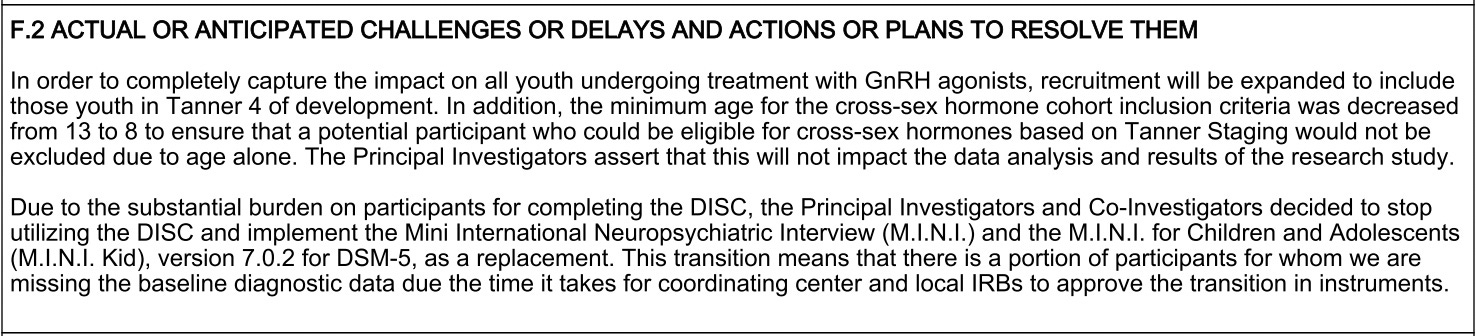
Donald Trump has spoken very clearly about his day-one determination to end the mutilation of children in the service of gender ideology, but let’s look for the roots of that poison tree. Via Billboard Chris, here’s a sample descriptive section from a National Institutes of Health grant given to a pediatric gender physician in Los Angeles, and read this carefully to find the most important sentence:
Dr. Johanna Olson-Kennedy has worked to push gender hormone treatment down to eight year-olds, with research funding from the federal government. Now, big finish: the dates on the NIH grant that Billboard Chris highlighted:
This is a project — gender hormones for eight year-olds — that operated with federal funding during the first Trump administration. Policy expressed in words meets policy expressed in cash. This is what matters, year after year, through Republican and Democratic administrations alike (click to enlarge):
The money, the money, and the money. What you fund is what you’re doing. It may not seem like a big target, but the politicization of federal science funding is a root cause of institutional decay and pathological narrative-making, and cutting the money pipeline to politicized science is the policy action that will matter for decades. Remaking the funding pipeline for federal science grants is a day one priority, because the money will shape policy far more than any declaration of intent.
The problem is everywhere: the NIH, the NSF, NASA, NOAA, and so on. SpaceX is catching rockets; NASA is funding this: “21-EEJ21-0020 ASSESSMENT OF THE GULF COAST ENVIRONMENTAL JUSTICE LANDSCAPE FOR EQUITY.”
And this: “EXPLORING SYNERGISTIC OPPORTUNITIES BETWEEN CHARLOTTE-AREA ENVIRONMENTAL JUSTICE INITIATIVES AND NASA EARTH SCIENCE INFORMATION.”
Pick a federal science grant website and spend some time exploring it. Here’s the National Science Foundation’s funding opportunities page. Sample grant program: “Growing Research Compliance Support and Service Infrastructure for Nationally Transformative Equity and Diversity”.
Today’s funded program for transformative science equity and environmental justice is tomorrow’s new policy measures. This is the pipeline to programs. What you fund today is what you’re going to do in five years.


November 6, 2024
Running out of minerals means we’re all going to dieeeeeeeeee!!
Tim Worstall responds to another pants-wetting panic attack that we’re running out of atoms and that means we’re all going to die unless we do this thing I wanted you to do anyway:

“Artisanal cobalt miners in the Democratic Republic of Congo” by The International Institute for Environment and Development is licensed under CC BY 2.5 
 .
.
There’s a guy working up in Finland who keeps trying to tell us that we’re all about to run out of lovely metals. Therefore — as with the Club of Rome beforehand, Blueprint for Survival and all those guys — we’re all gonna die.
Aiee, eh?
Now it is possible to work through all his assumptions and nip at them in detail. For example, he assumes we need about 20 million tonnes of lithium in order to replace the global internal combustion engine fleet with battery powered. Not a bad assumption. The Tesla Master Plan 3 comes to the same answer. But if we want to have weeks and weeks of battery power for the whole of society we’re going to need much more than that. Which is a problem, mineral resources are only around 90 million tonnes, so, we’re stuffed.
And, well. Here’s the problem. We’re all — including Michaux — using United States Geological Survey Numbers. In 2023 lithium:
Owing to continuing exploration, identified lithium resources have increased substantially worldwide and total about 98 million tons.
Owing to continuing exploration, measured and indicated lithium resources have increased substantially worldwide and total about 105 million tons.
Wait, what? We can get more mineral resources if we go looking for them? Well, if that’s true then the size of mineral resources cannot be the limitation on how much is out there, right?
This then brings us to the basic mistake that has been made here. We’ve been through this here a number of times.
Figures 28 & 29 shows the needed quantity of metal to phase out fossil fuels (assuming all four power storage buffer capacities) is compared against the total metal content in the whole planetary environment, including the deep ocean polymetallic nodules under sea resources (Hein et al. 2020). So, Figure 28 shows reported mineral reserves plus estimated mineral resources on land plus estimated undersea mineral resources. This is the summation of mineral reserves, resources, on land and under the sea, in the planetary environment. Even with this extreme summation of conventional and unconventional sources, there was not enough copper, nickel, lithium, cobalt, or vanadium to manufacture even just the first generation of renewable technology to replace the existing fossil fuel industrial system.
That’s on page 240 and yes, I had to read (OK, speed read/skim) to get to his simple statement of his mistake. You owe me guys, 239 pages worth.
He’s right that mineral resources can be converted into mineral reserves by the application of time and effort — capital, really. But he thinks that mineral resources are the definition of the mineral deposits that exist. Which just ain’t true — mineral resources are mineral deposits that people have applied time and effort — capital really — to defining. That’s how mineral resources, as defined by our common source at USGS, can increase year on year.
QotD: “Colourism”
which reinforce the inherently colonial practice of “colourism” – the discrimination against individuals with a dark skin tone.
It’s not colonial, it’s classist. Dark skin means sun exposure. That is, someone who works for a living outside in the fields. Pale skin means someone rich enough to stay inside. Thus the bits in Jane Austem where the girls worry about their bonnets for they might get freckles.
This also changed, entirely, when work for poor people moved inside and only the rich could afford to get away for a tan. Suddenly, to have a tan – darker skin – became a mark of wealth, not poverty.
A change rather reflected in make up in fact, pre WWII (about, roughly) the aim was to powder or cream the face to be pale, pale, white. Post[-WWII] much foundation make up is to add colour, not take it away.
This also explains the popularity of sunbeds and fake tans, something which a century ago would have been quite literally unthinkable.
Colourism exists, most certainly, but that flip shows that it’s about class, not colonialism.
For the part about it that the colonialism reason cannot explain is why that flip.
That it’s about class also explains why colourism happens in places that never were colonies – Thailand say.
Tim Worstall, “Educashun”, Tim Worstall, 2020-01-12.
November 5, 2024
QotD: “If you want me to treat you nicely, play nice with others”
I’m a biological essentialist about sex — your sex is a given of your chromosomes and organs, and I will never actually believe that you can invert it by choice.
I am, however, conditionally willing not to challenge your weird Gnostic beliefs on this point, and to treat you as the sex you “identify” as anyway. Here are the conditions:
1. You must be good at passing. If you can’t present a convincing pretense, it’s neither in my interest nor anyone else’s to help you prop up an unconvincing one.
2. You must be harmless. Most obviously, you must not use your “identification” to prey on others, whether directly by violence or by using the physical advantage of your sex to overwhelm them in sports, or in any other way. And if you’re told you’re unwelcome in a bathroom or changing room, it’s on you to not impose.
3. You must be modest. Your desire to role-play as M or F does not entitle you to violate prevailing norms about where, and to whom, you expose your genitals. If you aren’t polite enough to refrain from this, I won’t be even a bit polite to you.
4. Children are off-limits. The moment you engage in behavior that seems intended to confuse or indoctrinate them, you enter the category of “predator” and stay there. My response to sexual predation on children only begins with rejection and rudeness.
5. If you try to use the force of law to gain what equal and voluntary negotiation with individuals won’t give you, you also enter the category of “predator” and stay there.
The meta-rule is: the more your behavior imposes costs on others, the less polite and accepting I will be. If you want me to treat you nicely, play nice with others.
Eric S. Raymond, Twitter, 2024-07-28.
November 4, 2024
Violence and sex differences
Lorenzo Warby discusses some basic biological differences between men and women and how those differences account for much of the variance in violent behaviour:
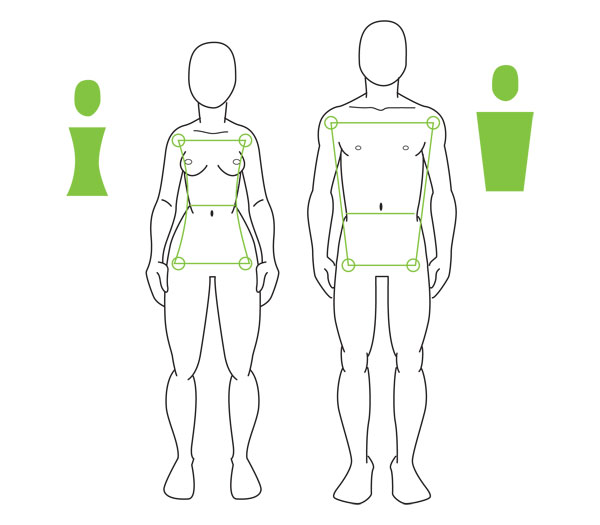
Human anatomy fundamentals: advanced body proportions
design.tutsplus.com
(Note on usage: Sex is biological — i.e., which gametes a body is structured to produce. Sex roles are the behavioural manifestation of sex. Gender is the cultural manifestation of sex.)
Adult human males have, on average, about twice the lean upper body mass of adult human females. This means that adult human females have, on average, 52 per cent of the upper body strength of adult human males.
The consequence of this is that men dominate violence between adults. They dominate victims — another male is far more likely to be a physical threat or obstacle than a woman. Men even more strongly dominate perpetrators.
A Swedish study found that one per cent of the population committed almost two-thirds of all violent crimes. That one per cent was almost entirely male. Four per cent of the population committed all the violent crimes. That four percent was almost 90 per cent male1 and constituted just over seven per cent of the male population.
These patterns of behaviour do not require any “hard wired” differences by sex in human brains. They merely require that men have about twice the upper body strength of women. They represent strategic behaviour within that context.
Indeed, these results are not compatible with sex-differentiation being strongly “hard-wired” in brains by sex. The overwhelming majority of men do not commit any violent crimes, while some of the perpetrators —almost eleven per cent — were female.
What makes it even clearer that these patterns represent strategic behaviour—that is, responses grounded in (biological) constraints and capacities — is that men and women each make up about half the perpetrators of violence against children.
When women are dealing with the physically stronger sex, they are much less likely to use violence than is the physically stronger sex. When they are dealing with a systematically weaker group of Homo sapiens — children — they are as likely to be perpetrators of violence as men.
These patterns represent strategic behaviour. They represents actions responding to constraints and capacities. You get sex-differentiated patterns when the constraints are different between men and women. Our sex-differentiated biology is enough, on its own, to produce sex-differentiated patterns of behaviour.
So, even in (then) peaceful Sweden, one in 14 men are violent. That a significant proportion of men are violent predators informs female behaviour, as the systematically physically weaker sex.
Men dominate sexual violence because they are physically stronger, have penises and cannot get pregnant. That is enough to have men dominate sexual violence without any sex differentiation in the “hard-wiring” of brains at all.
We are embodied agents. How we are embodied makes a difference for our behaviour.
Women have, on average, half the lean upper body mass as men not so much because they are smaller—the average differences in height and weight are nowhere near as large. A much more significant factor is that women have a higher fat content to their body, especially their upper body.
They have a higher fat content because human brains are energy hogs, and women are structured to be able to support not just one, but two or more, energy-hog brains — i.e. babies and toddlers. More fat means more readily-available stored energy. That extra female fat enables us Homo sapiens to be the most body-shape dimorphic of the primates: far more so than any of our ape cousins.
This goes to the other biological constraint that produces sex-differentiated behaviour. Women can get pregnant, men cannot. The risk profile differs for men and women, and not just for the risks of pregnancy and childbirth but also for child-rearing.
1. The text of the paper and the summary table have different numbers for female offenders. As the text states that 10.9 per cent of offenders were females, which agrees with the table but not the figures given in the text, I have corrected accordingly. Fortunately, it does not affect the logic being presented.
November 1, 2024
“[H]er plan will mean the obliteration of your savings, the end of banks and even the destruction of ‘money as we know it'”
It’s astonishing how many highly placed bureaucrats, NGO functionaries, and the very, very wealthy are super gung-ho for reducing the rest of us to the status (and living conditions) of medieval serfs:

This week, VW announced plans to cut tens of thousands of jobs and to close three factories. That is a very big deal, because they have never closed a single German factory before. I try to avoid economic topics, but this story is so much bigger than economics. As Daniel Gräber wrote in Cicero last month, “the VW crisis has become a symbol for the decline of our entire country“.
The Green leftoid establishment are eagerly blaming management for these failures, which is on the one hand not entirely wrong, but on the other hand not nearly an absolution. The German state of Lower Saxony holds a 20% stake in Volkswagen, and so they also manage the company. Recently, in a fit of virtue, they placed a Green politician – Julia Willie Hamburg – on its supervisory board. Hamburg does not even own a car and has used her position to argue that Volkswagen should regard itself not as an automobile manufacturer but as a “mobility services provider” and shift its focus away from “individual transport”.
The absurdly named Julia Willie Hamburg is merely symptomatic of a broader phenomenon. Germany has succumbed to political forces that have nothing but indifference and disdain for the industries that have made us prosperous. Our sitting Economics Minister, Robert Habeck, gave an interview to taz in 2011 in which he said that “fewer cars will not lead to less economic growth, but to new industries”, and attacked “the old growth theory, based on gross domestic product“. And behind Green politicians like Habeck are even more radical forces, like Ulrike Herrmann, the editor of taz, for many years a member of the Green Party and also an open advocate of wide-scale deindustrialisation. Because I am going to quote Herrmann saying some very crazy things, you need to know that she is in no way a fringe figure. She appears regularly on all the respectable evening talkshows and every politically informed person in the Federal Republic knows who she is.
Herrmann has outlined her political views in various books like The End of Capitalism: Why Growth and Climate Protection Are Not Compatible – and How We Will Live in the Future. From these monographs, we learn that Herrmann sees climatism as a means of imposing a centrally planned economy in which we will own nothing and be happy. Happily, Herrmann also talks a lot, and in her various speeches and interviews she states her vision for decarbonising Germany in very radical terms. I am grateful to this twitter user for highlighting typical remarks that Herrmann delivered in April of this year before a sympathetic audience of climate lunatics.
There, Herrmann elaborated on her vision for a future economy in which all major goods would have to be rationed:
Talking about rationing: It’s clear that if we shrink economically, we won’t have to be as poor as the British were in 1939; rather, we’d have to be as rich as the West Germans were in 1978. That is a huge difference, because we can take advantage of all the growth of the post-war period and the entire economic miracle.
The central elements of the economy would have to be rationed. First of all, living space, because cement emits endless amounts of CO2. Actually, new construction would have to be banned outright and living space rationed to 50 square metres per capita. That should actually be enough for everyone. Then meat would have to be rationed, because meat production emits enormous amounts of CO2. You don’t have to become a vegetarian, but you’ll have to eat a lot less meat.
Then train travel has to be rationed. So this idea, which many people also have – “so okay then I don’t have a car but then I always travel on the Intercity Express trains” – that won’t work either, because of course air resistance increases with speed. Yes, it’s all totally insane. Trains won’t be allowed to travel faster than 100 kilometres per hour, but you can still travel around locally quite a lot. This is all in my book, okay? But I didn’t expand on it there because I didn’t want to scare all the readers.
At this point Herrmann begins to cackle manically, ecstatic at the thought that millions of Germans will be stuck riding rationed kilometres on slow local public transit.

QotD: J.D. Vance, a Führer for the rest of us
Expert: JD Vance’s selection as Trump’s running mate marks the end of Republican conservatism
Quoted for the lulz. Ol’ JD, a Führer for the rest of us.
But since we’re here … a fascinating footnote in Jaynes informs us that schizophrenics, who Jaynes thinks might be throwbacks to the “bicameral mind”, have no problem with “diffused identity” or whatever the term was. Jaynes hypothesizes that ancient, preconscious peoples didn’t see images of their gods in cult objects; they saw the actual, physical gods. We unicameral people can’t wrap our heads around it, since there are lots of statues and they can’t ALL be god — even if we grant that the biggest statue in the best temple can be god, or if we allow that the black meteorite or whatever is really god to them, still, god can’t be diffused like that: Either your statue is god or mine is; or neither of them are, but they can’t both be.
Schizophrenics, at least according to Jaynes, would be down with that. He notes that you can put two guys who think they’re Napoleon in the same padded cell, and you don’t get a schizo bum fight, you get complete agreement: They’re both Napoleon, somehow. The law of the excluded middle, personal identity version, simply doesn’t apply.
And since my hypothesis is that smartphones are re-decameralizing (it’s a word) us at Ludicrous Speed, well … here you go. Donald Trump is Hitler, but J.D. Vance is somehow also Hitler. It’s not like the real, historical Hitler lacked for shitty, evil underlings — J.D could easily be Heinrich Himmler or somebody. But no, he’s gotta be Hitler, the same way Trump has to be Hitler, and if that means they’re somehow both Hitler, well … there it is. Bicamerality for the win.
Severian, “Catching Up With the Crazies”, Founding Questions, 2024-07-29.


