Quotulatiousness

January 26, 2025

German democracy under further threat from extremely extreme extreme right

Filed under: Germany, Media, Politics — Tags: , , , , , — Nicholas @ 03:00

German voters seem to be under the misapprehension that their votes should have something to do with the composition of the government. Because the voters increasingly cast their votes for the extreme right, government in Germany finds itself under incredible pressure to actually pay attention to the pestiferous voters:

This is a potentially huge story. It could be the beginning of a sea-change in German politics, that is how big it is. At the same time, it could be also be nothing. We’ll have to wait and see.

For those who don’t want to read my ramblings (this will be a longer post), I offer this TL;DR: The cordon sanitaire against Alternative für Deutschland is showing signs of serious rupture. The centre-right CDU are suddenly – without warning – reconsidering their long-standing tabu against cooperating with the “extreme right” opposition. It is this singular tabu that has kept the traditional German party system frozen in amber despite a massive rightward political shift across the West. Should the cordon sanitaire crack even a little, its days are numbered. The simple arithmetic of parliamentary majorities would sooner or later make the most noxious political fixtures of current-year Germany, like the Green Party, broadly irrelevant at the federal level. The German left would be deprived at once of almost all their power.

I am sceptical that this can really be happening. Yesterday, I would’ve expected a change like this in 2029 at the earliest. Many are saying (justifiably) that the CDU should not be trusted, that they will say anything to get elected and that nothing will come of their promises. All that may well be true. Words, however, matter all by themselves: In 2019, tacit cooperation in Thüringen between the CDU and the AfD unleashed an entire national scandal; the press hyperventilated for weeks. Now the federal leadership of the CDU is openly pledging to pass legislation with AfD votes in the Bundestag, and major CDU-adjacent journalists are writing long opinion pieces about why this is just the right thing to do.

This development arises directly from the pressure of mass migration, and specifically from the four recent deadly migrant attacks I have covered in the past year:

  • On 31 May 2024, an Afghan migrant to Germany named Sulaiman Ataee killed the policeman Rouven Laur and severely wounded five others in a knife attack in Mannheim.
  • On 23 August 2024, at a “Festival of Diversity” in Solingen, a Syrian migrant to Germany named Issa al Hasan killed three people and wounded eight in an apparently Islamist attack for which the Islamic State claimed responsibility.
  • On 20 December 2024, a Saudi migrant to Germany named Taleb al-Abdulmohsen drove a rented BMW through the Christmas Market in Magdeburg, killing 6 people and wounding 299.
  • On 22 January 2025, an Afghan migrant to Germany named Enamullah Omarzai killed two people and wounded three in a knife attack in Aschaffenburg.

Mannheim, Solingen, Magdeburg and now Aschaffenburg: That is the catalogue of migrant terror pounding like remorseless waves on the brittle outdated politics of the Federal Republic.

These attacks have become a symbol for the entire mess migrationism has wrought. The dead and the wounded count for a lot in themselves, but they have also come to represent the dwindling social cohesion, the stretched financial resources and the erosion of domestic security that accepting entire foreign populations into one’s nation entails. All of it is for nothing, nobody has any solutions and there is no end in sight.

In liberal democracies, policies have to be normie-friendly, and mass migrationism was normie-friendly only until enough migrants crossed our borders to make their presence felt socially and culturally. Mass migration isn’t normie-friendly anymore. It’s become a foul political poison.

Mass migration is also a very hard nut to crack. We have outsourced a great part of our border security and migration policy to highly bureaucratised international authorities and a tangle of high-minded humanitarian legislation that leaves us little room to manouevre. Solving mass migration will require a great deal of political resolve and a willingness to pick fights with globaloid EU pencil-pushers. All of this meant that, until Mannheim, Alternative für Deutschland had a near-monopoly on hardline anti-migration politics. The unrelenting series of attacks by people who have no business being in Germany, together with the collapse of the government and the impending early elections in February, have left the centre-right CDU desperate to stake their own claim to this increasingly central political space. That, and perhaps a healthy dash of the Trump Effect, are the forces currently pushing the traditional party system of the Federal Republic to the brink.

January 25, 2025

“How can an active program of ending censorship; of lauding colour blind appointment on merit; … be Fascism redux?”

Filed under: Government, Liberty, Media, Politics, USA — Tags: , , , — Nicholas @ 04:00

As discussed yesterday, one of the many “hitting the ground running” acts of Donald Trump at the beginning of his second term in office has been to issue executive orders to dismantle a lot of progressives’ favourite policies, and many of them are calling it “fascism”:

Trump-the-Presidency 2.0 has already proved to be rather different from the 1.0 version. It is not merely that this time around he won the US popular vote. It is that he has “hit the ground running” with a whole stack of executive orders.

Watching the reaction to this has become — to put it mildly — a somewhat bifurcated experience. Lots of people, who were relieved at his victory, applaud what they see as a return to common sense; a rejection of censorship; a rejection of a politics intrusive into any and all aspects of life.

Conversely, there are also lots of — typically very online — people who see it as Fascism redux, as the equivalent of the end of Weimar Germany being live-streamed. How can an active program of ending censorship; of lauding colour blind appointment on merit; of removing DEI commissars from the US Federal Government; that includes appointment of women and persons of colour to senior positions; be Fascism redux?

The short answer is: it isn’t. The question then becomes, how can it be seen as such? This is where the long-run consequences of anti-discrimination law kicks in.

Anti-discrimination law creates a legal-bureaucratic structure that operates on the basis that the general citizenry is continually hovering on the edge of wrong think (racism) and wrong act (discrimination). The presumption becomes — without all this active effort — racism and discrimination will be unleashed.

This is nonsense. Anglosphere countries have low levels of racism and anti-discrimination norms have become widely accepted. Where there are discrimination issues, they are mostly problems of cultural distance that have a significant element of practicality from differing expectations between groups.

Nevertheless, it is very much in the interests of the legal-bureaucratic structure that anti-discrimination law sets up that propensities to wrong act and wrong think be seen as real, and endemic. Even better, is if the problem is seen as even larger than originally conceived.

So, we get a double expansion. The first expansion is in the range of protected groups. This provides a broadening of the social ambit of the potential wrong thinking (racism, misogyny, homophobia, Islamophobia, transphobia …) and of the potential wrong acting (who might be discriminated against).

As this moral dimension becomes so elevated—not least because there are so much employment involved, but also as considerable social leverage is created by for those who can set what is, or is not, legitimate action and speech—there is expansion of what constitutes wrong think and wrong act. There is large, indeed expanding, ambit for intellectual and other entrepreneurs to identify new sins of discrimination, new sins of unequal consideration, new ways wrong think propagates, and new ways of signalling one’s rejection of such sins.

It is better still if uttering true things becomes a wrong act, expressing wrong think, for people are prone to do that, to notice things. Of course, if you start trying to shun, shame and punish folk for expressing true things, for noticing things, you are likely to generate quite a lot of resentment. This is useful, for such pushback just further “establishes” the propensity to wrong think and wrong act. Hence Transphobia and Islamophobia becoming such markers of wrong think—there are so many true things to not notice.

There is even a term for someone who notices inconvenient patterns — far right. A term that has become the classic thought-terminating cliché in the service of not noticing.

The stabbings will continue until morale improves

Sebastian Wang discusses the stabbing attacks in Southport, Merseyside last year:

On the 29th July 2024, a man went on a stabbing spree in Southport, Merseyside, killing three children and injuring ten others. The attacker, Axel Muganwa Rudakubana, the son of Rwandan immigrants, was arrested at the scene. By all accounts, the attack was shocking not only in its savagery, but in its attendant circumstances. Witnesses report that Mr Rudakubana shouted slogans as he killed that suggested he was an Islamic terrorist. Almost at once, social media was filled with questions and with speculation. Also, protests began in several northern cities – Manchester, Leeds, and Bradford, for example – where demonstrators blamed the Government and the ruling class for immigration policies that had made the killings both possible and likely.

Instead of considering these protests and promising to address the causes of the crime, the British Government and the legacy media focussed on managing the narrative and silencing comment on the immigration policies that had allowed Mr Rudakubana’s family into the country. Keir Starmer, the new Prime Minister, seemed more worried about potential “violence against Muslims” than the actual brutality of Mr Rudakubana’s attack on English people. “For the Muslim community I will take every step possible to keep you safe,” he said in his first public statement on the killings. On the protests he added: “It is not protesting, it is not legitimate, it is crime. We will put a stop to it“. His focus was not on the victims, but on ensuring that no one questioned the system that had allowed this to happen.

In the days after the attack, several men were arrested for spreading what the government called “misinformation” online. Their crime? Posting details about Mr Rudakubana’s background and motivations — details that turned out to be broadly correct. Despite being right, these men were prosecuted and imprisoned under Britain’s hate speech laws. The most recently convicted, Andrew McIntyre, was sentenced earlier this month to seven and a half years in prison for postings on social media. Peter Lynch, a man of 61, was sent to prison last August for two years and eight months for the crime of shouting “scum” and “child killers” at the police. Last October, he hanged himself in prison. I am told he was seriously “mistreated” in prison. British prisons for many years have been overcrowded. Room was found for these prisoners of conscience after the Government began releasing violent criminals.

The injustice of this is glaring. These men were punished not because they lied, but because they spoke approximate truths the government wanted to suppress. Their imprisonment sends a clear message: in modern Britain, it’s better to be wrong on the side of the Government than right and against it.

A Carefully Managed Narrative

The media played its part in the cover up. At first, Mr Rudakubana was described, without name, as “originally from Cardiff“. It took days before we were told he was a child of asylum seekers from Rwanda. Even then, the coverage was carefully balanced by a picture of him as a respectable schoolboy – not at the beast in human form shown by more recent photographs.

Only much later, when the story had faded from the headlines, did the real facts emerge. Mr Rudakubana was not just a troubled individual. His phone contained materials linked to terrorism and genocide, and his actions appeared to have an ideological motivation. Yet by the time these details came out, they barely caused a ripple. The public had been moved on to the next distraction.

It’s hard not to assume that the British media was fully in on gaslighting the public about the accused murderer, when you compare the photo that almost universally was used in the time before the trial and a more recent image:

Mark Steyn:

Say what you like about Axel Rudakubana, the slaughterer of three English girls under ten years old, but — unlike the British Prime Minister, the Home Secretary, the Liverpool Police and most of the court eunuchs in the UK media — he appears to be an honest man:

    It’s a good thing those children are dead … I am so glad … I am so happy.

He has always been entirely upfront about such things, telephoning Britain’s so-called “Childline” and asking them:

    What should I do if I want to kill somebody?

Judging from his many interactions with “the authorities” (including with the laughably misnamed “Prevent” programme), the British state’s response boiled down to: Go right ahead!

It seems likely that the perpetrator of Wednesday’s Diversity Stabbing of the Day — the Afghan “asylum seeker” who killed a two-year-old boy and seriously wounded other infants in the Bavarian town of Aschaffenburg — is also “so happy”. Like Mr Rudakubana, the “asylum seeker” deliberately targeted a gathering of the very young — in this case, a kindergarten group playing in a municipal park. Like Mr Rudakubana, the “asylum seeker” did not just deliver sufficient stab wounds to kill: he plunged his knife into each target dozens and dozens of times. Like Mr Rudakubana, the “asylum seeker” was well known to the authorities: he had been detained for “violence” at least thrice.

Did these guys also enjoy it? From our pal Leilani Dowding:

For the benefit of American readers, being stabbed in Asda, Argus and Sainsbury’s is like being stabbed in Kroger, Costco and Wegman’s. As you may recall, a DC jury awarded climate mullah Michael E Mann a million bucks because someone unknown gave him a mean look in Wegman’s supermarket. No one stabbed in a UK supermarket will get a seven-figure sum: it’s increasingly a routine feature of daily life — per Sir Sadiq Khan, part of what it means to live in a great world city.

Sir Keir Stürmer and every outpost of the corrupt British state have lied to the public about every aspect of the Southport mass murder since the very first statements by the Liverpool chief constable passing off the killer as a “Cardiff man”. Her officers knew within hours that the Welsh boyo who loved male-voice choirs was, back in the real world, an observant Muslim in possession of the Al-Qaeda handbook and enough ricin to kill twelve thousand of his fellow Welshmen. But they did not disclose this information for months — not until freeborn Britons minded to disagree with Keir Stürmer’s Official Lies by suggesting that this seemed pretty obviously merely the umpteenth case of Islamostabbing had been rounded up, fast-tracked through Keir’s kangaroo courts, gaoled for longer than Muslim child rapists, and in at least one case driven to his death. Does Sir Keir feel bad about the late Peter Lynch? Or does he take the same relaxed attitude to his victims as Axel Rudakubana?

    It’s a good thing that that far-right extremist is dead … I am so glad … I am so happy.

Even now, six months on, the organs of the state are still lying — although, with all the previous lies being no longer operative, Stürmer & Co have had the wit to introduce a few new ones. For example:

    ‘A total disgrace’ that Southport killer could buy a knife on Amazon aged 17, says Cooper

That would be Yvette Cooper, the Home Secretary — which is the equivalent of what Continental governments usually call the Minister of the Interior, because that’s where the knives penetrate.

QotD: “Big budget cuts!”

Filed under: Bureaucracy, Government, Media, Politics, Quotations, USA — Tags: , , , — Nicholas @ 01:00

So why is there such a big disconnect in the media? Why are there headlines about cutting and slashing when government is growing by every possible measure?

For the simple reason that the budget process in Washington is pervasively dishonest, as I’ve explained in interviews with John Stossel and Judge Napolitano. Here are the three things you need to know.

  1. The politicians created a system that automatically assumes big increases in annual spending, called a baseline.
  2. When there’s a proposal to have spending grow slower than the baseline, the gap between the proposal and the baseline is called a cut.
  3. It’s like being on a diet and claiming progress because you’re gaining two pounds each month rather than five pounds.

Defenders of this system argue that programs should get built-in increases because of things such as inflation, or because of more old people, which leads to more spending for programs such as Social Security and Medicare.

It’s certainly reasonable for them to argue that budgets should increase for these reasons.

But they should be honest. Be forthright and assert that “Spending should climb X percent because …”

Needless to say, that won’t happen. The pro-spending politicians and interest groups like the current approach because it allows them to scare voters by warning about “savage” and “draconian” spending cuts.

Daniel J. Mitchell, “The Media’s Pervasively Dishonest Coverage of Trump’s New Budget”, International Liberty, 2020-02-10.

January 24, 2025

When the law schools went woke

Filed under: Education, Law, Liberty, Media, Politics, USA — Tags: , , , , , — Nicholas @ 03:00

In the New English Review, Bruce Bawer reviews Ilya Shapiro’s book Lawless: The Miseducation of America’s Elites:

As Donald Trump begins his second term as president with a mandate to undo the damage done to the country by leftist ideology, incompetence, and corruption, one of the many stables that most need cleaning up is academia – which is, of course, the source of virtually all of the most misbegotten ideas that have sent America astray.

To be sure, some parts of academia are more desperately in need of reform than others. As a rule, the elite universities, especially those in the Ivy League, are more poisoned by the new progressivism than most state schools, especially those in the heartland. Humanities and social science departments are worse off than STEM departments. And as Ilya Shapiro points out in his important new book, Lawless: The Miseducation of America’s Elite, the introduction of woke thinking into law schools is singularly damaging.

Yes, writes Shapiro, it’s unfortunate enough if, say, a sociology faculty is selling ideology rather than fact, for it represents “a loss to the richness of life and the accumulation of human knowledge”. But for a law school to head down the same road is far more perilous. For these schools turn out the lawyers, politicians, and judges who will serve as “the gatekeepers of our institutions and of the rules of the game on which American prosperity, liberty, and equality sit”.

And the sad fact, alas, is that in too many American law schools today, a preponderance of students are the products of classrooms in which, as Shapiro puts it, “the classical pedagogical model of legal education” has been abandoned in favor of “the postmodern activist one” – a process that has been underway for decades but that was greatly accelerated during the Covid pandemic and in the wake of the irrational nationwide hysteria over the killing of George Floyd. Hence those students swallow such dangerous notions as critical race theory and its corollary, critical legal theory, and therefore believe that colorblind justice, due process, and freedom of speech aren’t desiderata but tools of white supremacy.

Lawless has its roots in Shapiro’s own hellish encounter with this ideological leviathan. It happened like this: on January 26, 2022, the day that Supreme Court Justice Stephen Breyer announced his retirement, Shapiro tweeted that the “best pick” for a replacement was Sri Srinivasan, who, if appointed by President Biden, would be the “first Asian (Indian) American” on the Court. Yet because Biden had promised to name a black woman, lamented Shapiro, “we’ll get [a] lesser black woman”. After sending off the tweet, Shapiro went to bed – and awoke in the morning to discover that his comment had caused pandemonium in the legal community, where he was being viciously attacked as a racist and a sexist. Shapiro immediately deleted the tweet and issued an apology for expressing his opinion in such an “inartful” manner.

But that wasn’t the end of it. As it happened, Shapiro, who had just left the Cato Institute, was scheduled to take up a new position at Georgetown University’s school of law in five days. And unluckily for him, the dean of the law school, William M. Treanor, was a wimp of the first order, the kind of craven academic administrator who’s quick to cave to the noisiest and most radical elements. On January 27, Treanor issued a statement in which he represented Shapiro as believing that “the best Supreme Court nominee could not be a Black woman”.

This was the height of disingenuity: it was clear that Shapiro simply meant that Biden shouldn’t limit the pool of possible nominees on the basis of sex or race – a view shared by three-quarters of the American public. But as Shapiro would soon discover, under the current dispensation at woke law schools “what matters is not the objective meaning of a given statement or even its intent but its effect – not the facts but the feelings”.

So it was that Treanor ordered an elaborate and expensive “investigation” by a top-dollar law firm into Shapiro’s tweet – yes, an investigation into a tweet. Ludicrously, it took more than four months – during which Shapiro’s new job was put on hold. In the end, the “investigators” concluded that Shapiro had indeed expressed an offensive opinion but permitted him to start work at Georgetown. Wisely, Shapiro decided that, given everything that had happened, Georgetown would not be a comfortable fit for him – at least not with Treanor at the helm – and chose instead to accept a job offer from the Manhattan Institute, where he works today.

January 23, 2025

Do you want an imperial presidency, because this is how you get an imperial presidency

Filed under: Bureaucracy, Government, Law, Liberty, Politics, USA — Tags: , , , — Nicholas @ 03:00

On paper, prime ministers in Westminster parliamentary systems have more power, but the US president has more immediate, practical power to direct government activity using totally non-democratic executive orders. Democrats didn’t mind that when it was Obama wielding the pen, but they’re incandescent now that it’s the Bad Orange Man inking rules into existence. MAGA Republicans hated when Joe Biden’s ventriloquist was writing the orders, but suddenly it’s fine because it’s their president doing it. In neither case is democracy safe:

A quick image search turns up plenty of examples of Presidents proudly showing off freshly signed documents. Usually these will be laws passed by the legislators but sometimes (especially in January 2025) it’s rule-by-decree on steroids.

Well before President Donald Trump returned to office, his supporters boasted that he would start the second term with a flurry of executive actions. The new president exceeded expectations with an avalanche of pardons, orders, and edicts on matters great and small. Some should be welcomed by anybody hoping for more respect for liberty by government employees. Others extend state power in ways that are worrisome or even illegitimate. All continue the troubling trend over the course of decades and administrations from both parties for the president to assume the role of an elected monarch.

From an Interoffice Memo to “Shock and Awe”

“When President Trump takes office next Monday, there is going to be shock and awe with executive orders,” Sen. John Barrasso (R–Wyo.) predicted last week.

The president signed some of those orders as he bantered in the Oval Office with members of the press, engaging in more interaction than we saw from his predecessor over months. Wide-ranging in their scope, Trump’s orders “encompassed sweeping moves to reimagine the country’s relationship with immigration, its economy, global health, the environment and even gender roles,” noted USA Today.

Executive orders, which made up the bulk of Trump’s actions (he also pardoned and commuted the sentences of participants in the January 6 Capitol riot), are basically interoffice memos from the boss to executive branch agencies. “The President of the United States manages the operations of the Executive branch of Government through Executive orders,” according to the Office of the Federal Register of the National Archives and Records Administration.

That doesn’t sound like much — and at first, it wasn’t. Executive orders as we know them evolved into their modern form from notes and directives sent by the president to members of the cabinet and other executive branch officials. Nobody tried to catalog them until 1907.

But because executive branch officials interpret and enforce thickets of laws and administrative rules under which we try to live, guidance from the boss is powerful. Interpreted one way, a rule regulating unfinished gun parts leaves people free to pursue their hobbies; interpreted another, and those owning the parts are suddenly felons. The president can push interpretations either way.

They Can Be Used Correctly, or Abusively

So, some of Trump’s executive orders are very welcome, indeed, for those of us horrified by federal agencies pushing the boundaries of their power.

“The vicious, violent, and unfair weaponization of the Justice Department and our government will end,” Trump said in his inaugural address regarding an order intended to punish politically motivated use of government power. “I also will sign an executive order to immediately stop all government censorship and bring back free speech to America,” he added of another.

January 22, 2025

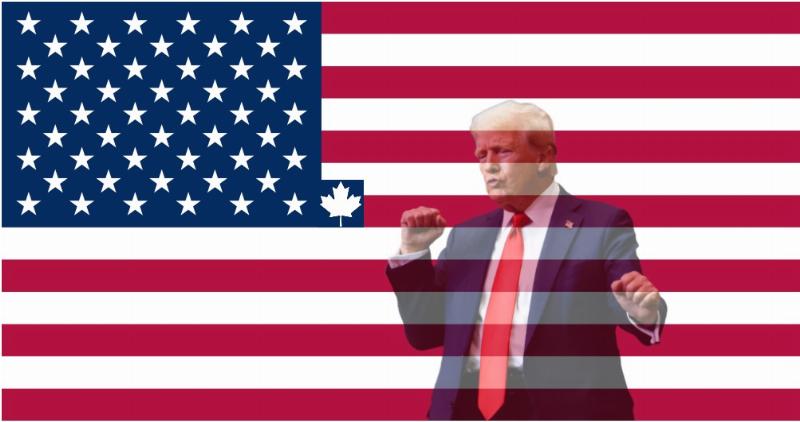
“If this country MAIDs itself in the next 18 months, we at The Line know what slogan belongs on Canada’s epitaph”

The Line‘s editors gathered up the first day’s worth of Donald Trump II – The Trumpening and sifted out the bits particularly relevant to the dysfunctional Dominion to the north:

Donald Trump successfully trolled Canada’s hypersensitive political class about Canada becoming the 51st state of the union. The anguished butthurt still pains them.

What is happening right now was absolutely foreseeable. No one can claim with a straight face that U.S. tariffs could not have been foreseen on January 21, 2025, a full eight years to the day that Donald Trump was inaugurated for the first time. It’s not 2016, anymore. Nobody was blindsided.

Your Line editors wrote plenty of columns over the past decade noting that even if Donald Trump the man were not re-elected, the protectionist and reactionary currents that pushed him to power were still ascendant in America. The Biden admin was a reprieve, an opportunity for Canada to make necessary internal changes to withstand those currents.

And what did this country do with that time?

Jack all.

We at The Line have been scratching our noggins trying to think of single meaningful Canadian reform or improvement to come out of Trump 1. We did nothing to strengthen ourselves internally by an iota. Not a single lesson was learned.

It’s entirely possible that we were inevitably going to be dinged by some U.S. administration and, perhaps, this was not avoidable. No one can fully mitigate all risks. Granted.

But we can certainly do literally anything to address risks that are highly probable. Instead, we have absolutely degraded both our moral and financial capacity to be resilient in the face of economic threats; and that degradation is the direct result of almost ten years of Liberal party priorities, inactions, or choices ranging on files from crime, to market diversification, to being truly useful to our international allies, to failures on interprovincial trade.

This wasn’t unforeseen. We were willfully blind. That’s different.

We ignored the looming threat in part because our government was distracted by COVID. But also also because Canada’s political culture is too immature to make hard decisions, or to have real debates about trade offs or priorities.

Justin Trudeau is the kind of prime minister who would rather run the kind of country that lets him spout off on Jake Tapper about compassion and $10-day-day daycare and dental programs than NATO spending.

What about the scads of taxpayer cash we’ve squandered on things like “superclusters”? What if we had prioritized strategically crucial projects like Northern Gateway or Energy East, instead of letting them die under the mantra of: “no business case”.

Remember when Germany and Japan came asking after our natural gas supplies in the wake of the Russian invasion of Ukraine? What if we had spent oh, say, $13 billion, on fast tracking some kind of natural gas facility to supply our international allies because doing so served a strategic national interest rather than a pure economic one.

We didn’t pull that number from the air, by the way: that’s what Canada subsequently committed to subsidies for EV plants in southern Ontario — something for which there was a scant “business case” before, and virtually none now that Trump has decided to scrap EV subsidies. It’s looking not-great, Bob. Not great at all.

See, that’s the problem with running a low-productivity, highly centralized griftocracy that is more invested in expanding entitlements, symbolic action and emotional gratification than actually doing anything. We are now severely limited in our capacity to respond in the face of serious economic threats. We can talk a good game. We can bluster. We can invest in more symbolic retaliatory action; but we have utterly squandered the internal resilience required to mount a real fight in even a trade war, much less a kinetic one.

And we at The Line can’t help but note the deafening silence from our international allies as well. They think we’ve got it coming, too. Perhaps there’s “no business case” for sticking their necks out on our behalf.

The first time a big new battery plant was subsidized, I thought it was a bad idea. Then it happened again and again. This is exactly why you don’t want your government at any level “picking winners”! Ross McKitrick had a series of tweets discussing this and other noteworthy executive orders issued (thread on Threadreader, but that may not be available for long):

(more…)

“Do not give institutional power to activists” or “moral projects to bureaucrats”, but “Progressivism systematically does both”

Lorenzo Warby on the dangers of enabling totalitarians and suffering the useful idiots in any political system:

The overthrow of Robespierre in the National Convention on 27 July 1794, Max Adamo (1870),
Wikimedia Commons.

Do not give institutional power to activists, as activism — being power without responsibility that readily lauds bad behaviour — attracts manipulative “Cluster B” personalities. Moreover, activism degrades realms of human action by imposing pre-conceived outcomes and constraints on them. We can see this is in all the entertainment franchises whose internal logics of story and canon have been debauched in the service of political messaging.1

Do not give moral projects to bureaucrats, as such projects elevate the authority of the bureaucrats who become moral masters, devaluing the authority of the citizens turned into moral subjects, and so undermines any ethic of service to said citizenry. Such projects also frustrate accountability, as the grand intentions can, and will, be used to shield the bureaucrats from scrutiny. Indeed, moral projects rapidly become moralised projects, whose grand intentions protects, even aggrandise, the self-interest of the bureaucrats.2

Progressivism systematically does both — give institutional power to activists and moral projects to bureaucrats. Hence progressivism has so often proved disastrous for human flourishing. Indeed, it has a powerful tendency to use the grandeur of its moral intentions to free itself from moral constraints: to be moralised, rather than moral.

As various folk “walk away” from what left-progressivism has become, a common sentiment is some version of “this is not the Left I remember” or “this is not what the Left used to stand for”. Yet, one of the striking things about Post-Enlightenment Progressivism (aka “wokery”) within contemporary societies is how thoroughly it is replicating mechanisms of social control familiar to any student of Communism, of Marxist Party-states.

This “not the Left I joined” is typically a notion of “the Left” that does not include Lenin, Stalin, Mao, Pol Pot, Mengistu, Ceausescu … So it is an historically illiterate, “wouldn’t-it-be-nice”, Leftism. Yet it is precisely the Left that does include Lenin, Stalin, Mao, Pol Pot, Mengistu, Ceausescu and so on whose echoes are being played out in our societies.

When we look around our contemporary societies, we have commissars/political officers (aka DEI officers, intimacy consultants, sensitivity readers, bias response teams, etc); Zhdanovism, in the remarkable ideological conformism in the arts, entertainment and gaming (usefully discussed here); Lysenkoism in science journals, especially the genderwoo sex-is-non-binary nonsense, though genetics research and male-female differences also have aspects of it; and censorship that was originally paraded as stopping “hate speech”, now being purveyed as anti-dis/mis/mal-information. Critical Pedagogy — which has become influential in Education Faculties and teacher training — is explicitly about replicating Mao’s Cultural Revolution model of permanent revolution. We have the same, disastrous, patterns of institutional power to activists and moral projects to bureaucrats.


    1. There is a large difference from the “we want to be included, we want a say” activism that abolished first the slave trade and then slavery, that abolished laws against Jews and Catholics, that gave us universal male and then female suffrage — what I have called the Emancipation Sequence. Such political movements included previously excluded folk in freedoms and political processes that already existed. They did not give institutional power to activists nor moral projects to bureaucrats.

    2. The institutional shrinkage of the Church has not abolished the meaning-and-morality role it used to play, it has just shifted it into academe and the welfare state apparat, making both simultaneously more arrogant and less functional.

January 21, 2025

QotD: Raw democracy

Filed under: Government, Politics, Quotations, USA — Tags: — Nicholas @ 01:00

In a democracy, the majority rules and individual rights are irrelevant. If the majority votes that half of your income be confiscated before you can even buy groceries, oh well. If the majority votes that you must educate your children in a certain location because you live on a certain side of an arbitrary line, oh well. If the majority votes that you must be disarmed and defenseless against violent criminals, oh well. If the majority votes that your religion be designated an “outlaw religion” and that you and all other practitioners be committed to mental institutions, oh flipping well.

(And this is what our political, economic and media elites want to export across the globe?)

Doug Newman, “An Understatement: The Founding Fathers Hated Democracy”, The Libertarian Enterprise, 2005-08-14.

January 20, 2025

“You can’t have genuine equality for women while also letting them duck through the trap door of but I didn’t mean it, like children, when their choices have unhappy outcomes”

Filed under: Law, Liberty, Media, Politics, USA — Tags: , , , , , , , — Nicholas @ 04:00

Kat Rosenfield shares her concerns about what the accusations against Neil Gaiman indicate about the problems with allowing women to be legally unreliable narrators:

There’s a moment in the Gaiman exposé where the main accuser, Scarlett Pavlovich, sends him a text message asking him how he’s doing. Gaiman says he’s struggling: he’s heard from people close to him that Pavlovich plans to accuse him of rape. “I thought that we were a good thing and a very consensual thing indeed,” he writes.

“It was consensual (and wonderful)!” she replies.

Except: she doesn’t mean it. We know this because Lila Shapiro, the author of the piece, breaks in to tell us as much:

    Pavlovich remembers her palms sweating, hot coils in her stomach. She was terrified of upsetting Gaiman. “I was disconnected from everybody else at that point in my life,” she tells me. She rushed to reassure him.

But also, we know this because she didn’t mean it is sort of an ongoing theme, here. And that’s what I want to talk about.

By this point in the article we’ve been instructed, explicitly and repeatedly, that you can’t assume a relationship was consensual just because all parties involved gave consent. “Sexual abuse is one of the most confusing forms of violence that a person can experience. The majority of people who have endured it do not immediately recognize it as such; some never do,” Shapiro writes in one section. In another, she explains that it doesn’t matter if the women played along with Gaiman when he asked them to call him “master” or eat their own feces because “BDSM is a culture with a set of long-standing norms” to which Gaiman didn’t strictly adhere (as the meme goes, it’s only BDSM if it comes from the BDSM region of France, otherwise it’s just sparkling feces-eating sadomasochism.)

Shapiro spends a lot of time thumbing the scale like this, and for good reason: without the repeated reminders that sexual abuse is so confusing and hard to recognize, to the point where some victims go their whole lives mistaking a violent act for a consensual one, most readers would look at Pavlovich’s behavior (including the “it was wonderful” text message as well as her repeated and often aggressive sexual overtures toward Gaiman) and conclude that however she felt about the relationship later, her desire for him was genuine at the time — or at least, that Gaiman could be forgiven for thinking it was. To make Pavlovich a more sympathetic protagonist (and Gaiman a more persuasive villain), the article has to assert that her seemingly self-contradictory behavior is not just understandable but reasonable. Normal. Typical. If Pavlovich lied and said a violent act was consensual (and wonderful), that’s just because women do be like that sometimes.

Obviously, this paradigm imposes a very weird, circular trap on men (#BelieveWomen, except the ones who say they want to sleep with you, in which case you should commence a Poirot-style interrogation until she breaks down and confesses that she actually finds you repulsive.) But I’m more interested in what happens to women when they’re cast in this role of society’s unreliable narrators: so vulnerable to coercion, and so socialized to please, that even the slightest hint of pressure causes the instantaneous and irretrievable loss of their agency.

The thing is, if women can’t be trusted to assert their desires or boundaries because they’ll invariably lie about what they want in order to please other people, it’s not just sex they can’t reasonably consent to. It’s medical treatments. Car loans. Nuclear non-proliferation agreements. Our entire social contract operates on the premise that adults are strong enough to choose their choices, no matter the ambient pressure from horny men or sleazy used car salesmen or power-hungry ayatollahs. If half the world’s adult population are actually just smol beans — hapless, helpless, fickle, fragile, and much too tender to perform even the most basic self-advocacy — everything starts to fall apart, including the entire feminist project. You can’t have genuine equality for women while also letting them duck through the trap door of but I didn’t mean it, like children, when their choices have unhappy outcomes.

January 19, 2025

Mark Carney is a serious man … that doesn’t mean he’d be a good political leader

Filed under: Cancon, Media, Politics — Tags: , , , , — Nicholas @ 05:00

The Line‘s Jen Gerson likes Mark Carney, but she hastens to add that this isn’t necessarily good news for Mr. Carney as she felt the same way about Jim Prentice who was very briefly Premier of Alberta but “demonstrated the political nous of a chicken nugget” and quickly was out of power:

Then-Governor of the Bank of Canada Mark Carney at the 2012 Annual Meeting of the World Economic Forum in Davos, Switzerland.
WEF photo via Wikimedia Commons.

I learned the most valuable lesson from that period of political reporting, one I try to carry with me unto this very day: Never, never let one’s personal feelings about an individual candidate corrupt one’s political analysis. And if you think about it, this is a very important lesson to learn.

I am not a normal person. That which appeals to me is very unlikely to find purchase with sane, feeling voters who hold ordinary jobs and live lives filled with meaningful human connections and real, not-political conversations.

I was thinking about this as I watched Mark Carney announce his intention to run as Liberal leader in Edmonton on Thursday. Carney is a serious man. He has a real CV and a long list of meaningful accomplishments. He’s a man who seems to understand that the “good old times are over”. He’s a man who has navigated several international crises — as he was keen to point out. He’s a man who despises the excesses of both the right and the left. He’s a man who is is focused on building Canada’s economy.

He’s a man who has correctly identified one of the Conservatives’ core weaknesses, their tendency to channel legitimate anger and grievance into thin slogans that offer few substantive plans toward the kinds of significant changes that this country will be required to make. The fact that Carney is making this critique while coming to the fore without offering any substantive plans of his own is only to be expected considering the timeline’s he’s working with, I suppose.

Regardless, Carney is giving Jim Prentice Energy. Jean Charest Energy. Jeb! Energy.

I like him.

[…]

For that matter, if Carney wants to present himself as a strong supporter of Canada, a defender of our sovereignty in the face of America’s re-articulated expansionist ambitions, why did he preempt his leadership launch with an appearance on The Daily Show? What message are we to take from this: that Carney is well liked and respected by the American political milieu that was roundly trounced by Donald Trump?

It doesn’t signal a lot of faith in Canada as a cohesive cultural concept to soft launch your political leadership campaign through a marshmallow chat with an American comedy host. (As an aside, I realize that foreigners aren’t real to Americans, but I’m begging literally any television journalist on a mainstream U.S. network to stop treating our politicians like kawaii pets [Wiki] on loan from a northern Democrat utopia that exists only in their minds. These people can handle hard questions — even about matters that are important to an American audience; like, for example, Canada’s delinquent NATO spending.)

Did Mark Carney not believe that the CBC that I presume he will be campaigning to preserve was up to the challenge of doing the first interview with him? Look, I wouldn’t turn down a chat at Jon Stewart’s table if I got the call, but if the best possible way to reach potential Liberal leadership voters in 2025 is to pop onto American TV, we might as well pack it in, call ourselves 51 and be done with it.

By the way, in case anyone hasn’t yet pointed it out; the average age of a Daily Show audience member is 63. The audience is in steep decline, and it doesn’t even air on any Canadian TV channels anymore. To watch the Carney clip, Canadians have to seek it out on Apple TV or YouTube. Usually the day after because the target demo is usually in bed by 9 p.m. MST now.

California’s wildfire plight

Theophilus Chilton on the end of California dreamin’:

Southern California has had a REALLY rough week. Wildfires, started by arsonists and driven by the Santa Ana winds, have burned thousands of acres in the city and county of Los Angeles and destroyed over $150 billion worth of property (and counting). As I write this, the fires still burn and largely remain uncontained, even as new blazes break out. It is a disaster of epic proportions, striking one of the richest and most economically and culturally relevant portions of the country.

Never ones to let a crisis go to waste, the Left responded to this disaster by … focusing on climate change. Not empty fire hydrants, not drained reservoirs, not incompetent leadership, but climate change. These fires, we have been breathlessly assured, are the result of ever-worsening climatic conditions in the region, drying it out and making it susceptible to this kind of affliction. Never mind that observers since Spanish times consistently noted the same kind of weather conditions and hazards that we see today, which suggests that maybe things aren’t actually changing all that much. Of course, those who are blaming climate change fail to recognise the fundamentally chaotic, nonlinear nature of the Earth’s biosphere and the interactions of its constituent parts, something governed by complexity (in the chaos/complexity theory sense of the term). As a result, it’s somewhat foolish to try to draw a direct, causal link between two variables (such as atmospheric CO2 content and temperature) which depend upon nonlinear interactions with hundreds of other factors. Thankfully, they don’t seem to be getting much traction with this.

So what did create the conditions that burned down Los Angeles?

First of all, there was the implementation of a number of policies driven by the state’s radical environmentalist lobby. Thanks to the fanatics, common sense policies that would help to mitigate the region’s inherent fire hazard went undone. Regular controlled burns of underbrush are a standard conservation technique in dry areas that help to thin out brush and prevent wildfires from getting out of control. Building a sufficient number of desalination plants is a good way for coastal desert areas to provide themselves with abundant fresh water for things like drinking, watering crops, filling reservoirs, and fighting fires. In fact, filling reservoirs for future needs would make a lot of sense. But all of these things are “unnatural” and might have “negative impacts” on local wildlife and whatnot.

Another contributory issue is the state’s policies towards the chronically homeless and its de facto sanctuary status for illegal aliens. The Reagan-era deinstitutionalisation of the homeless has been a nationwide disaster for years and California’s particular policies have made the situation in their state even worse. For decades, California has regularly seen wildfires caused by untended campfires started by homeless junkies getting out of control, which the state’s liberal approach to its indigent population has only made more prevalent. Likewise, California’s harbouring of illegal aliens has created a situation in which the state is flooded with masses of hostile foreign elements, some of whom have been caught starting fires all around the LA basin and creating the current catastrophe.

Then there is the fact that California has systematically implemented a set of DEI policies for its governmental workers, including its firefighters. As a result, the state’s leadership in the relevant departments is very good at “promoting inclusion,” but not so good at dealing competently with emergencies when they take place. Indeed, Los Angeles’ mayor Karen Bass and LAFD Chief Kristen Crowley presided over budget cuts for the city’s firefighting capabilities while adding layers of “diversity and inclusion” bureaucracy aimed at systematically de-white-maleing the department and depriving it of the demographic most prone to self-sacrifice and overall technical competence. That reflects trends across the board in which the state and the city have regularly spent more on gay choirs and social justice artwork than they have on necessary functions of government.

(more…)

January 18, 2025

Incentives matter even to “objective” scientists

Filed under: Cancon, Government, Health, Politics, Wine — Tags: , , , , — Nicholas @ 03:00

A 2019 Canadian “study” ideally illustrates that scientists are just as human as anyone else where they are incentivized to provide “desired” outcomes:

“The Beer Store” by Like_the_Grand_Canyon is licensed under CC BY-NC 2.0

Earlier this year, a major Canadian study on alcohol policy provided an excellent illustration of this. As news headlines across the country reported, 16 scientists and researchers at various universities and institutions had, through their Canadian Alcohol Policy Evaluation, shown that provincial governments are “failing to address alcohol problems”.

The scientists evaluated provincial government policies and assigned a grade in the “D” range to seven of Canada’s 13 provinces or territories, while five received an “F”. The policy evaluation, however, was a curious one. Strangely, the policy evaluation did not evaluate whether government policies were beneficial to those who want to buy or sell alcohol.

Instead, provincial governments were evaluated more favorably if they devoted greater efforts toward afflicting buyers and sellers of alcohol through punitive taxes, price controls, heavy restrictions on the sale and marketing of alcoholic beverages, higher minimum legal drinking ages, and so on.

Even in the most restrictive markets, the researchers found that alcohol was too cheap, or that its purchase was too convenient, or that governments did not do enough to discourage or restrict its sale and consumption.

Predictably, and perhaps exemplifying Berlinski’s point on scientists grasping for government funds, the report authored by 16 scientists whose livelihoods involve raising public alarm about alcohol consumption concluded that there ought to be more government funding for public education on the dangers of alcohol consumption.

The report also advocated more government funding for bureaucracies to discourage drinking, more government funding for a lead organization to implement restrictive alcohol policies, more government funding for independent monitoring of such implementation, and more government funding to track and report the harm caused by alcohol consumption.

Like the CEO of a domestic automobile company insisting that tariffs against car imports — which would cause a massive wealth redistribution from consumers’ wallets into his own and those of the company’s shareholders — are in the national interest, the anti-drinking scientists insisted in the name of public health and wellness upon income redistribution from taxpayers and consumers to their own industry.

January 16, 2025

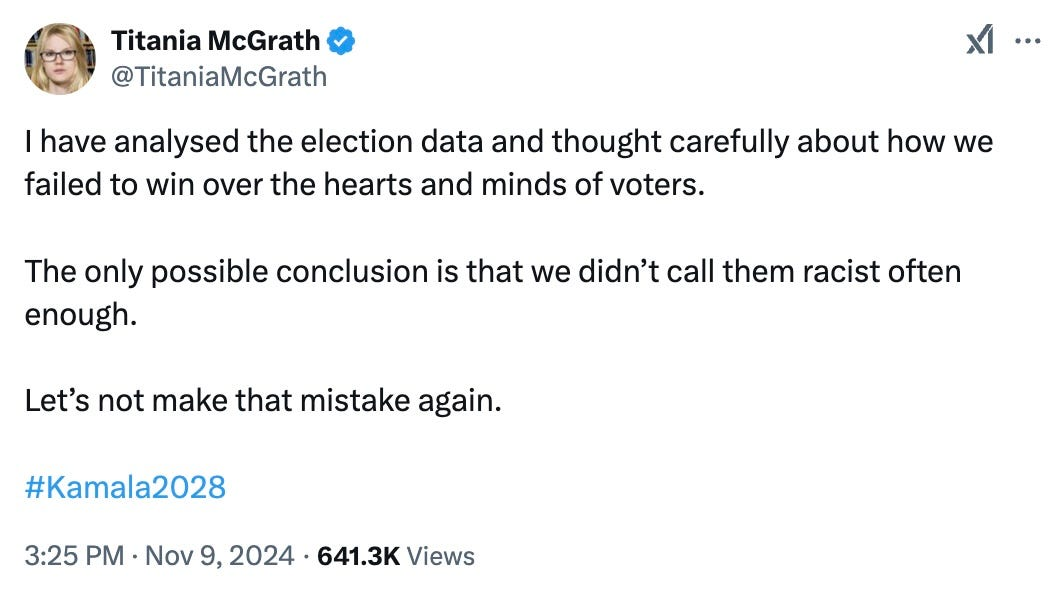
“The only possible conclusion is that we didn’t call them racist often enough”

Filed under: Health, Media, Politics, Sports, USA — Tags: , , , — Nicholas @ 05:00

Apparently there are still a lot of US politicians who think that letting men compete in womens’ sports is not only okay, but praiseworthy:

Of all the absurdities of the culture war, perhaps the most egregious is the normalisation of the idea that men should be able to identify their way into women’s sports. We are living through a period of mania, so we cannot clearly see how this will look to future generations. But I have little doubt that all those photographs of hulking men towering over women on winners’ podiums will be the memes of the future. “Can you believe they let this happen?” they’ll say, scratching their AI-enhanced cyborg heads.

Wherever one stands on Donald Trump, there can be little doubt that his imminent arrival at 1600 Pennsylvania Avenue will act as a corrective to this problem. Yesterday, the House of Representatives passed the Protection of Women and Girls in Sports Act with its goal of preventing males who identify as female from participating in school sports. If passed into law, schools that attempt to defy the ban would have their federal funds withheld. The bill was introduced by Republican representative Greg Steube of Florida, and makes clear that it will be a violation of federal law “for a recipient of Federal financial assistance who operates, sponsors, or facilitates an athletic program or activity to permit a person whose sex is male to participate in an athletic program or activity that is designated for women or girls”.

One of the most astonishing aspects of the passing of this bill was the voting outcome. 216 Republicans and only 2 Democrats (Vicente Gonzales and Henry Cueller) voted for the motion. Is it really that controversial that sex, as the bill puts it, “shall be recognized based solely on a person’s reproductive biology and genetics at birth”? You will recall the outcry back in November when Democratic politician Seth Moulton admitted that he objected to mixed-sex contact sports in schools. “I have two little girls,” he said, “I don’t want them getting run over on a playing field by a male or formerly male athlete. But as a Democrat, I’m supposed to be afraid to say that”. For this he was branded a “transphobe” and a “Nazi cooperator”, because we all know that one of the top priorities of the Third Reich was the preservation of women’s rights.

Moulton failed to retain his backbone for the latest vote (he called the bill “too extreme”), but his previous comment had been striking for its honesty. He was willing to openly state that fear was the key factor in the reticence of Democrats on this issue. It cannot be the case that only two Democratic members of the House take the view that there is no advantage in sports conferred by male puberty. Surely most of them must have glanced at a biology textbook from time to time. The charitable conclusion is that they have been browbeaten into voting ideologically, not that they genuinely don’t know that there exist anatomical differences between men and women.

Disturbingly, this vote would seem to suggest that the Democrats are not learning their lessons from the election, and instead are determined to double down on the very attitude that cost them the White House.

January 15, 2025

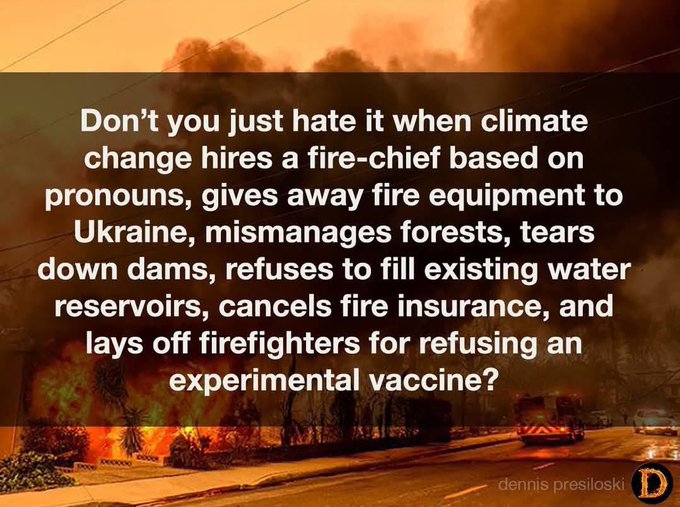
Is there anything climate change can’t do?

Filed under: Government, Media, Politics, USA — Tags: , , , , , — Nicholas @ 05:00

Seen on social media earlier this week:

Confirming this, Chris Bray talks about current reporting on the wildfires in and around Los Angeles:

In his much-discussed piece on the Los Angeles fires at the Free Press, Leighton Woodhouse looks to Mike Davis for a narrative foundation. In his book Ecology of Fear, Woodhouse notes, Davis “argued that the area between the beach and the Santa Monica Mountains simply never should have been developed. No matter what measures we take to prevent it, those hills are going to burn, and the houses we erect upon them are only so much kindling.” Malibu and the Palisades, the land of hard living. That’s why so many rich and famous people lived there: because it was so inherently miserable and dangerous.

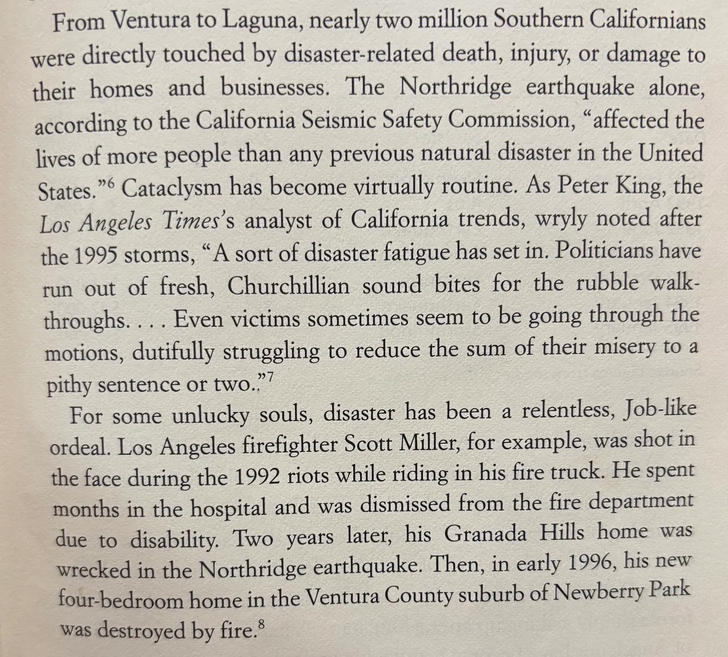
Mike Davis was full of shit for thirty years — he died in 2022 — and I’ve been rolling my eyes at him throughout. He described Los Angeles as an “apocalypse theme park”, a place of ruin and pain, populated by hardened survivors who, “dutifully struggling”, stagger on through the “Job-like ordeal” of clinging to a brutal landscape.

Also, Sierra Madre has bears. The Los Angeles suburbs are a place of horror and agony, because they back into the mountains, where blood-clawed wild animals prowl and stalk and slaughter. Places where life is especially grim and sanguinary, pgs. 240-41: Bradbury, La Crescenta, Glendora, the areas around the hellscape of Santa Barbara. A poodle was eaten by a mountain lion in Bradbury once, as neighbors gaped in open-jawed terror, YET STILL DO FOOLS ENDURE THE HORROR OF LIVING IN SUCH A PLACE.

Current real estate listings in Bradbury, a gated hillside community incorporated as an independent city in the San Gabriel Valley with a population of about 900 people:

How then would ye endure such horror, oh pilgrim, to live thus amid such blood and death? How bearest thou brutal existence upon this land?

Famously, in 1999, the Los Angeles Times, which used to be a newspaper, ran a long story examining Mike Davis and his vision of Southern California. It’s full of sentences like this:

  • Los Angeles’ most provocative social critic has stretched, bent and broken more than a few facts in “Ecology of Fear,” his latest, darkly themed work on the urban area he claims to love.
  • … more than a third of the time there were factual problems with his work.
  • Davis concedes the error.
  • Davis does not say where he got this piece of information.
  • “I honestly don’t know what I’m referring to,” Davis said.
  • Some of Davis’ mistakes involve mergers of fact and fiction, including making up a quote.
  • Davis attributes the false quote to a mix-up.
  • Then he takes readers on a partial flight of fantasy …
  • An examination of the Malibu Times article shows that Davis made up the parts about the jewels, the hair color, the kayakers’ occupations, the evidence of their callous classism and the ethnicity of their maids.
  • Davis is mischievously unrepentant.
  • Davis also merges fact and literary fiction, without acknowledgment, while arguing that Pomona, like other older, outer suburbs, is dying.

And so on.

The Times concluded that Davis could be read as “a polemicist, who makes cogent, incisive arguments on big themes”, but not as “a historian who is expected to be reliable, even on details”.

« Newer Posts — Older Posts »

Powered by WordPress