I had an acquaintance in college who was a dedicated leftist and who also believed in substantial group differences in average IQ.1 One day she was fretting at me that advances in data science, genetics, etc. were going to make this unpalatable reality impossible to ignore, with detrimental consequences for both racial justice and social harmony. Facts and logic were going to explode the noble lie, oh no!
Obviously I had to physically restrain myself from laughing at her. Assuming for the sake of argument that such differences exist and are easily measurable, only somebody totally autistic would think that mere scientific evidence for them would cause them to be acknowledged.2 Just look at all the ridiculous “sky is green” type beliefs that society already successfully forces everybody to internalize. You mentioned biological and cognitive differences between men and women, which are far more obvious and noticeable than those between populations, but which we successfully force everybody to pretend do not exist. And that’s far from the silliest thing everybody pretends to believe, in our society or in others.
Put it another way: there is no such thing as a secular society, every country has a state religion, and you won’t get very far opposing it. Were there people in Tenochtitlan who secretly believed that blood pouring down the sides of the great step pyramid day and night wasn’t actually necessary to placate the gods? Yeah probably, but if any of them had tried to point that out, they would have been laughed at (and sacrificed). Were there people in the Soviet Union who privately doubted whether dialectical materialism was the true engine of history? Probably, yes, but everybody besides Leonid Kantorovich was smart enough not to mention it.
What are the religious precepts on which our society is founded? There are a few, but a belief in absolute racial equality is clearly one of them, and that view is now enshrined in the “real” constitution (civil rights caselaw and its downstream effects on corporate HR). Anything which contradicts that precept is just a total nonstarter. If a few nerds somewhere found irrefutable evidence of important differences between groups, they would quietly hide it, and if some among them were like Reich too autistic or principled to do that, they would be ignored, shouted down, or persecuted. Possibly this would even be a good thing — every society needs its orthodoxies, and sometimes those who corrupt the youth need to drink the hemlock.
We’ve gotten far afield, though. As an inveterate shape-rotator, my favorite part of the book was Reich’s description of the statistical and mathematical techniques that can be used to determine when population bottlenecks occurred, how recently two populations shared a common ancestor, and when various mixing events occurred.
Jane Psmith and John Psmith, “JOINT REVIEW: Who We Are and How We Got Here, by David Reich”, Mr. and Mrs. Psmith’s Bookshelf, 2023-05-29.
1. Not to get all “Dems are the real racists”, but anecdotally this view does seem slightly more prevalent among my left-wing friends than my right-wing friends, though that seems to currently be changing.
2. Somebody totally autistic or somebody who had already drunk the kool-aid on literally every other ridiculous official viewpoint imposed by our society. In her case it was probably the latter. As I said she was a leftist, and women in general are much less likely to be autistic but much more likely to value social conformity.
March 20, 2025
QotD: “[T]here is no such thing as a secular society, every country has a state religion, and you won’t get very far opposing it”
March 19, 2025
The Trumpocalypse – “The outlook for universities has become dire”
John Carter suggests that American higher education needs to find a new funding model that doesn’t depend on governments to shower their administrative organizations with unearned loot:
Shortly after taking power, the Trump administration announced a freeze on academic grants at the National Science Foundation and the National Institute for Health. New grant proposal reviews were halted, locking up billions in research funding. Naturally, the courts pushed back, with progressive judges issuing injunctions demanding the funding be reinstated. Judicial activism has so far met with only mixed success: the NSF has resumed the flow of money to existing grants, but the NIH has continued to resist. While the grant review process has been restarted at the NSF, the pause created a huge backlog, resulting in considerable uncertainty for applicants.
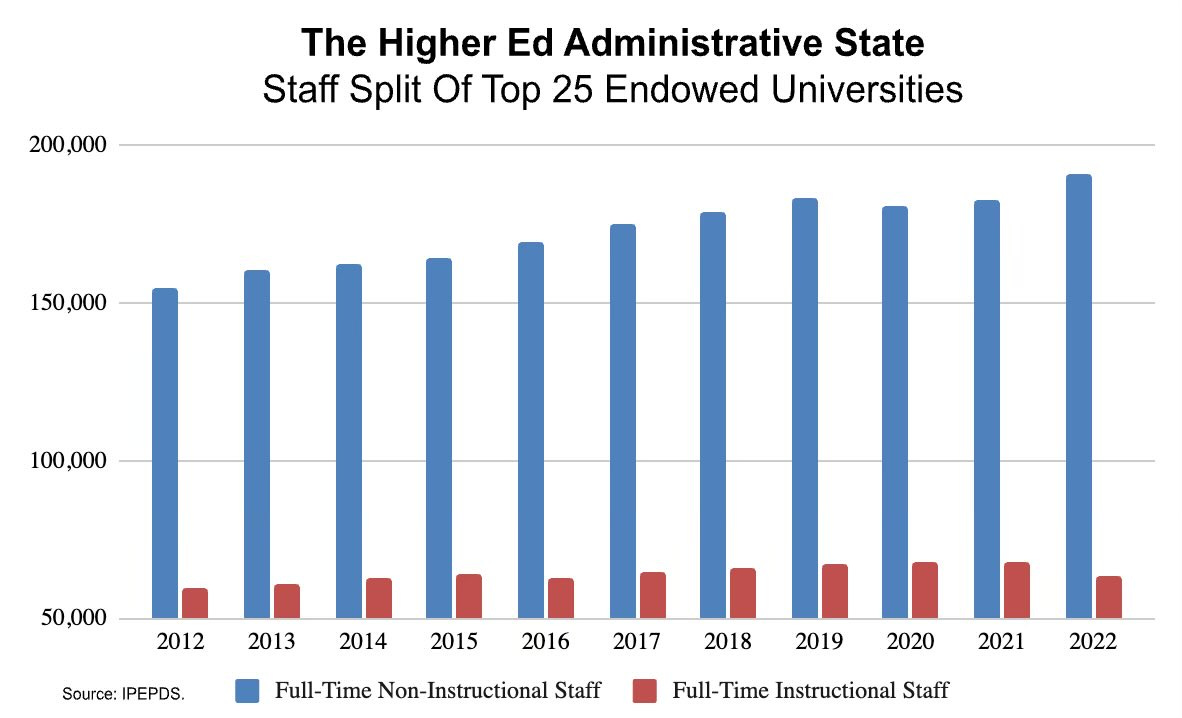
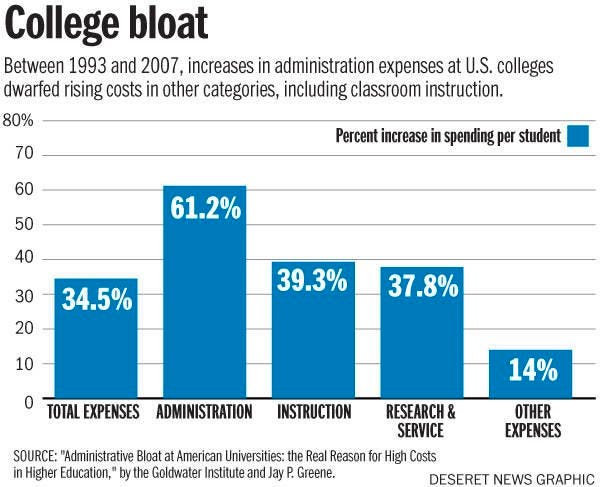
The NIH has instituted a 15% cap to indirect costs, commonly referred to as overheads. This has universities squealing. Overheads are meant to offset the budgetary strain research groups place on universities, covering the costs of the facilities they work in – maintenance, power and heating, paper for the departmental printer, that kind of thing. Universities have been sticking a blood funnel into this superficially reasonable line item for decades, gulping down additional surcharges up to 50% of the value of research grants, a bounty which largely goes towards inflating the salaries of the little armies of self-aggrandizing political commissars with titles like Associate Vice Assistant Deanlet of Advancing Excellence who infest the flesh of the modern campus like deer ticks swarming on the neck of a sick dog. Easily startled readers may wish to close their eyes and scroll past the next few images btw, but I really want to make this point here. When you look at this:
A 15% overhead cap, if applied across the board, has an effect on the parasitic university administration class similar to a diversity truck finding parking at a German Christmas market. Thoughts and prayers, everyone.
Meanwhile at the NSF, massive layoffs are ongoing, and there are apparently plans to slash the research budget by up to 50%. While specific overhead caps haven’t been announced at the NSF yet, there’s every reason to expect that these will be imposed as well, compounding the effect of budget cuts.
There is no attempt to hide the motivation behind the funding freeze, which is obvious to both the appalled and the cuts’ cheerleaders. Just as overheads serve as a blood meal for the administrative caste, scientific research funding has been getting brazenly appropriated by political activists at obscene scales. A recent Senate Commerce Committee report found that $2 billion in NSF funding had been diverted towards DEI promotion under the Biden administration. In reaction to this travesty, as this recent Nature article notes, there are apparently plans to outright cancel ongoing grants funding “research” into gay race communism. DEI programs, formerly ubiquitous across Federal agencies, have already been scrubbed both from departmental budgets and web pages. Indeed, killing those programs was one of the first actions of the MAGA administration.
The outlook for universities has become dire, and academics have been sweating bullets all over social media. Postdocs aren’t being hired, faculty offers are being rescinded, careers are on hold, research programs are in limbo. This comes at the same time that budgets are being hit by declining enrolment due to the demographic impact of an extended period of below-replacement fertility along with rapidly declining confidence in the value of university degrees, with young men in particular checking out at increasing rates as universities become tacitly understood as hostile feminine environments. They’re hitting a financial cliff at the same point that they’ve burned through the sympathy of the general public.
The entire sector is in grave danger.
Politically, going after research funding is astute. Academia is well known to be a Blue America power centre, used to indoctrinate the young with the antivalues of race Marxism, provide a halo of scholarly legitimacy to the left’s ideological pronouncements, and hand out comfortable sinecures to left-wing activists. The overwhelming left-wing bias of university faculties is proverbial. The Trump administration is using the budgetary crisis as a handy excuse to sic its attack DOGE on the unclean beast – starting with cutting off funding to the most ideological research projects, but apparently also intending to ruin the financial viability of the progressives’ academic spoils system as a whole.
Cutting the NSF budget by half may seem at first glance like punitive overkill, and no doubt the left is screeching that Orange Hitler is throwing a destructive tantrum like a vindictive child and thereby endangering American leadership in scientific research. After all, for all the attention that NASA diversity programs have received, the bulk of research funding still goes to legitimate scientific inquiry, surely? However, the problems in academic research go much deeper than its relentless production of partisan activist slop. Strip out all of the DEI funding, fire every equitied commissar and inclusioned diversity hire, and you’re still left with a sclerotic academic research landscape that has spent decades doing little of use – or interest – to anyone, and doing this great nothing at great expense.
March 18, 2025
“[T]he Liberals have no principles because it works“
The first act of our unelected prime minister was to performatively sign a piece of paper that supposedly eliminated the hated carbon tax. Well, part of the carbon tax. And not really eliminated eliminated, it just set the rate to zero percent. The carbon tax that the Liberals had proclaimed was essential to saving the entire planet from global warming. If this seems odd, buckle up, because this is just how the Liberal Party operates:
Obviously, I don’t believe Mark Carney nor the Liberal Party of Canada want to destroy the world.
Nor do I believe they could destroy the world, even if a supervillain gave them an unlimited budget in which to do so. After ten years when the supervillain checked up on the Liberals to see how the world-destruction plan was coming along, he’d find out that the world destruction equity subcommittee was waiting for a report from a sub-subcommittee responsible for convening a task force to authorize a panel to determine how to destroy the world in way which minimally impacted disadvantaged communities, but they’re having trouble finding francophone Saskatchewanians for the breakout sessions.
But I am somewhat startled to see how quickly Carney’s Liberal Party abandoned a signature policy it assured us was necessary to fight the existential threat posed by climate change:
This is like the National Socialist German Workers Party tweeting a meme cheering on Adolf Hitler for killing Hitler. (Given the state of Twitter these days, I wouldn’t be surprised if there actually is an official NSDAP account, but never mind.)
We’re left with two possibilities regarding the carbon tax policy promoted by the last Liberal Prime Minister and now abolished (or is it?!?) by the new Liberal Prime Minister:
- it never would have made much difference in the fight against climate change anyway, in which case it was always a waste of time and effort; or,
- it would have made a big difference in the fight against climate change, in which case Carney has decided it’s more important to win the impending federal election and take away his opponents’ talking points than to actually do something about a potential ecological crisis.
I’m not naive about politicians, even those I support, being hypocrites and flip-floppers. There may be some truly principled, ideologically consistent political parties out there, but they can hold their annual conventions in a Ford Club Wagon.

QotD: Lester Thurow and the other cheerleaders for “Industrial Policy” in the 1980s
And so – advised Thurow (and others) – we Americans really should step up our game by taking many production and consumption decisions out of the hands of short-sighted and selfish entrepreneurs, businesses, investors, and consumers and putting these decisions into the hands of the Potomac-residing wise and genius-filled faithful stewards of Americans’ interest.
Sound familiar? It should. While some of the details from decades ago of the news-making proponents of protectionism and industrial policy differ from the details harped on by today’s proponents of protectionism and industrial policy, the essence of the hostility to free trade and free markets of decades ago is, in most – maybe all – essential respects identical to the hostility that reigns today.
Markets in which prices, profits, and losses guide the decisions of producers and consumers were then – as they are today – asserted to be stupid, akin to a drunk donkey, while government officials (from the correct party, of course) alone have the knowledge, capacity, willpower, and power to allocate resources efficiently and in the national interest.
Nothing much changes but the names. Three or four decades ago protectionism and industrial policy in the name of the national interest was peddled by people with names such as Lester Thurow, Barry Bluestone, and Felix Rohatyn. Today protectionism and industrial policy in the name of the national interest is peddled by people with different names.
Don Boudreaux, “Quotation of the Day…”, Café Hayek, 2020-03-12.
March 17, 2025
America’s modern Triumvirate
Last month, I posted John Carter’s amusing riff on Trump, Musk, and Vance as the American Pompey, Crassus, and Caesar, the original Triumvirate. Apparently John isn’t the only one struck by the similarities, as David Friedman also considers the three as America’s modern Triumvirate:

Trump, Vance, and Musk as America’s Triumvirate – Grok
Trump is the most important at present, since both Vance and Musk have political power only to the extent he gives it to them. He is a very competent demagogue, as demonstrated by his winning a series of political conflicts that almost everyone expected him to lose. So far as I can tell from his history he has no political views of his own, uses ideology as a tool to get power, attention, status. Conservatives were a substantial faction unhappy with the state of the nation, with what they viewed as the political and cultural domination of the country by their opponents, hence a potential power base for him. Progressives had overplayed their hand, pushed woke ideology too far, due to face a backlash, useful as enemies. He adopted the role of conservative champion, destroyer of wokeism, borrowing details of his program most recently from Project 2025, a detailed conservative plan for how a conservative administration could restructure the federal government.
Trump’s Ukraine policy is to produce a peace for which he could claim credit, a deal that holds until at least 2028. To force Zelensky to accept he had to make it believable that he was willing to drop US support for Ukraine if Ukraine refuses to go along, and he did. To force Putin to accept he will have to make it believable that the US is willing to continue, even expand, support for Ukraine if Russia refuses to accept a peace plan.
[…]
Assuming no rupture with Trump and no failure of their administration extreme enough to break Trump’s control over his party, Vance will be the Republican nominee in 2028. He is young, handsome and smart with a beautiful and intelligent wife, is playing a minor role now but could be a major political figure in the post-Trump world. Unlike Trump he has political views of his own, not merely the desire for power. What are they?
I devoted two of my earlier posts to trying to answer that question, Vance and Revising the Republican Party. My conclusion:
The conservative movement of Bill Buckley rejected the New Deal. Vance does not. The past he wants to return to is an idealized version of America in the fifties, perhaps the sixties. The movement he wants to build rejects both the pro-market economics of the pre-Trump conservative movement and the cultural program of current progressives. He wants an America of stable marriages, views parents as more reliably committed to the future than the childless — hence the much-quoted line about childless cat ladies. One of his more intriguing proposals is that children should get votes, cast by their parents, giving a family with three children five votes.
…
The Republican party Vance wants to build looks, economically, like the Democratic party of the fifties and sixties, culturally like the inverse of the progressive, aka woke, movement.
[…]
The project the three of them are attempting is a full scale revision of the federal government. Of the three, Musk is the one who might be competent to do it. Trump’s skill is charisma, the ability to get people to pay attention to him, admire him, want to please him. That is how he got to a position from which to revise the government but it is not the skill needed to do it. Vance has demonstrated even less of the relevant abilities; his accomplishments so far are writing a very interesting book and winning a senate election
Musk, in contrast, has created two very successful firms, taken over and revised a third. None were projects on the scale of what he is now attempting but they are smaller projects of the same sort. Hence it is at least possible that, with the authority Trump has so far been willing to delegate to him, he can convert the federal government into something smaller, less expensive, better functioning, judged at least by the standards of Trump and his supporters.
German politicians are willing to literally bankrupt the country to keep the AfD out of power
eugyppius is clearly no fan of Friedrich Merz, the CDU leader and presumptive next Chancellor of Germany, but even he seems boggled at how much Merz is willing to concede to his ideological enemies to get himself into that position:

Let us summarise, briefly, what has happened so far:
- The CDU are the party of fiscal responsibility. His Triviality the Pigeon Chancellor Friedrich Merz presented himself throughout the campaign as an unusual fan of Germany’s constitutionally-anchored debt brake. He told everybody that he could not imagine ever borrowing in excess of 0.35% of annual GDP, so interested was he in limiting the tax burden of future generations.
- All of the while, Merz and his advisers were scheming in secret about how they might overhaul the debt brake, firstly because they could not give the slightest shit about the tax burdens of future generations, and secondly because they spent the months since November 2023 observing what happens when a government that has no ideas is also deprived of money. “I have no ideas,” Merz said to himself during this time. “What happens if like Olaf Scholz I also end up with no money?”
- Exactly two weeks ago, U.S. President Donald J. Trump and Ukrainian President Vladimir Zelensky had a verbal spat in the Oval Office. This spat put the fear of God into the Eurocrat establishment, for whom the Ukraine war has become a sacred and essentially religious cause. Merz capitalised on the panic to unveil his massive debt spending plan. He and his would-be coalition partners, the Social Democrats, announced that they wished to spend 500 billion Euros of debt on “infrastructure” and untold hundreds of billions of debt on defence. This would entail adjustments to the debt brake, in the same way setting your house on fire would entail adjustments to your living arrangements.
- This massive spending package will require a constitutional amendment, which can only be achieved with a two-thirds vote of the Bundestag. In the newly elected Bundestag, Die Linke and AfD will be in a position to block this amendment and Merz will be stuck with the debt brake. Thus Merz wants to break the debt brake in the final days of the old Bundestag – a strategy that has put him in the amazing position of groveling before the election’s biggest losers. Specifically, Merz has spent the past few days feverishly negotiating with the Green Party, who will not even have any role in his government, just to get them to sign off on his insane spending plans.
I wrote a lot here and on Twitter about the election nightmare scenario I called the “Kenyapocalypse” – a hypothetical in which the Greens and the Social Democrats would each be too weak to give the Union parties a majority on their own, such that Friedrich Merz would be forced to negotiate a coalition deal with both of them at once. In the end, Kenyapocalypse did not happen; the CDU avoided it by a razor’s breadth. Merz, however, turns out to be such a monumental retard that he has managed to recreate a simulacrum of Kenyapocalypse for himself. The man has been on his knees kissing not only Social Democrat but also Green ass for days. He has been begging the Greens to sign onto his debt plan, and the Greens have finally agreed, in return for the following concessions:
- The “defence” funding that will be exempt from the debt brake is to be defined as widely as possible. All kinds of things will count as debt brake-exempt “defence” spending now, probably including various climate nonsense.
- The 500 billion-Euro “infrastructure” debt is to include 100 billion Euros specifically earmarked for the “Climate and Transformation Fund” – the central financial instrument of the energy transition. This is basically infinity windmill money, you might as well set it on fire. Beyond this specific allocation, any projects that contribute to making Germany “climate neutral by 2045” will also be eligible for the 500 billion-Euro exception. This whole thing will be a massive wad of debt for Green nonsense and I would like to take this moment to laugh at everyone who told me how happy I should be that Merz was trying to fix Germany’s bridges with this debt bullshit. Nothing of the sort is going to happen.
- You will note that the explicit goal of achieving “climate neutrality” by 2045 is slated to be among the very few positive political points anchored in the German constitution. “Climate neutrality” is a more expansive concept than mere “carbon neutrality”, or net zero. It describes a utopian state of affairs in which human actions have no influence on the climate whatsoever.
These are prizes the Greens could not achieve even at the height of their influence, in the 2021 elections. Strictly speaking, the entire traffic light coalition fell apart over a matter of 3 billion Euros. Now the Greens are getting 100 billion Euros for free, all because Merz is determined to become Chancellor whatever the cost.
QotD: Myths from Norman Rockwell’s America
The complaint generally continues that we were robbed of this by bad policy choices. But that is at best only half true.
World War II smashed almost the entire industrial capacity of the world outside the U.S., which exited with its manufacturing plant not only intact, but greatly improved by wartime capitalization. The result was that for about 30 years, the US was a price-taker in international markets. Nobody could effectively compete with us at heavy or even light manufacturing.
The profits from that advantage built Norman Rockwell’s America — lots of prosperous small towns built around factories and mills. Labor unions could bid up salaries for semi-skilled workers to historically ridiculous levels on that tide.
But it couldn’t last. Germany and Japan and England recapitalized and rebuilt themselves. The Asian tigers began to be a thing. U.S. producers facing increasing competitive pressure discovered that they had become bloated and inefficient in the years when the penalty for that mistake was minimal.
Were there bad policy choices? Absolutely. Taxes and entitlement spending exploded because all that surplus was sloshing around ready to be captured; the latter has proven politically almost impossible to undo.
When our windfall finally ended in the early 1970s, Americans were left with habits and expectations formed by the long boom. We’ve since spent 50 years trying, with occasional but only transient successes, to recreate those conditions. The technology boom of 1980 to 2001 came closest.
But the harsh reality is that we are never likely to have that kind of advantage again. Technology and capital are now too mobile for that.
Political choices have to be made within this reality. It’s one that neither popular nor elite perception has really caught up with.
Eric S. Raymond, X (the social media platform formerly known as Twitter, 2024-07-08.
March 16, 2025
Sir Wilfred Laurier is apparently the next designated target for the decolonialization mobs
Having run out of ways to desecrate the memory of our founding prime minister, the shrieking harpies seem to have designated the best Liberal prime minister in Canadian history to be unpersoned this time:

Sir Wilfrid Laurier, Prime Minister of Canada (1896-1911)
The so-called “Laurier Legacy Project” began in 2022 when the eponymous post-secondary institution in Kitchener-Waterloo, Ontario, decided to conduct a “scholarly examination of the legacy and times” of Canada’s seventh prime minister (1896-1911). The academic investigation was launched in the wake of the murder of George Floyd in the U.S. and the suspected but unconfirmed discovery of unknown graves near the site of a former residential school in Kamloops, B.C. Institutions were facing pressure to publicly demonstrate they were taking immediate action against colonial legacies.
But was the school really committed to “conducting a scholarly examination” of Laurier? One that would weigh evidence, consider context, and arrive at a conclusion? Spoiler alert: of course not.
The university’s own website is a dead giveaway. A page titled “Who was Wilfrid Laurier?” begins with a single paragraph summarizing the former prime minister’s accomplishments, noting his ability to forge compromise, his participation in the construction of a second transcontinental railway, and the addition of two provinces, Saskatchewan and Alberta.
The rest of the answer to the question “Who is Wilfrid Laurier?” is four negative paragraphs detailing his record on Indigenous relations, restrictive immigration policies, and his role in “actively support[ing] the expansion of British imperialism on the African continent through his involvement in the South African War”. The page offers no hint of balance or objectivity. Perhaps this is what we have come to expect when institutions engage in historical investigations: the judgement has already been made. It’s just the path to get there that remains.
While the Laurier Legacy Project began in 2022, it is relevant today because the university quietly published its conclusion last fall. The report, written by post-doctoral fellow Katelyn Arac, called for 17 recommendations, most of which relate to the university and its extensive DEI policies. These included creating scholarships for communities “marginalized by Laurier” as well as building “artistic displays … in equity-deserving communities”. But few of the recommendations had to do with the actual legacy of the former prime minister.
Much like the school’s website, however, the language of the report made its bias known. Dr. Arac admitted her focus was on policy decisions related to “immigration and relations with Indigenous peoples”. She went on: “These policies were designed with two objectives in mind — assimilation and/or erasure; in other words, the eradication of Indigenous peoples in the land we now call Canada through policies of settler-colonialism”.
The report is part of an unfortunate trend in history today: measuring historical figures by a process of selective evidence. Rather than look objectively at the legacy of Canada’s first francophone prime minister, the project set out to investigate only where Laurier could be seen to have failed. And there were failures. That is part of history and governing.
March 15, 2025
Eliminating “environmental justice” from the EPA
J.D. Tuccille suggests that you not take the New York Times coverage too literally as they wail about the Trump administration’s plans for the Environmental Protection Agency:

If you were to believe reporting from The New York Times — which is an increasingly unwise idea — the Trump administration is diverting the attention of the Environmental Protection Agency (EPA) from poor and minority communities that face “disproportionately high levels of pollution”. But if you scratch the surface even a bit, you find that what’s really being eliminated are “environmental justice” offices that infuse identitarian ideology into EPA enforcement efforts. Americans should welcome efforts to strip racial obsessions from the armory of regulators who already wield too much power.
Competing Takes on “Environmental Justice”
“The Trump administration intends to eliminate Environmental Protection Agency offices responsible for addressing the disproportionately high levels of pollution facing poor communities, according to a memo from Lee Zeldin, the agency administrator,” Lisa Friedman wrote for the Times. She added that the memo directed the reorganization and elimination of “offices of environmental justice at all 10 E.P.A. regional offices as well as the one in Washington”.
Contrast that with a press release from the EPA, which states “that EPA will immediately revise National Enforcement and Compliance Initiatives to ensure that enforcement does not discriminate based on race and socioeconomic status (as it has under environmental justice initiatives) or shut down energy production and that it focuses on the most pressing health and safety issues”.
Whatever you think of the Trump administration in general, EPA Administrator Zeldin is on the right side of this debate. As I wrote in 2022 when the Biden administration formally introduced “environmental justice” concerns to the EPA, the term refers to “a decades-old school of thought that seeks to graft identitarian politics onto environmental concerns. That allows practitioners to wield civil rights law in addition to traditional environmental laws against perceived malefactors. It also makes it possible to slam offenders as ‘bigots’ if their actions affect one community more than another.”
There’s no need to read between the lines to figure out what is meant by “environmental justice” — its advocates are quite clear about their meaning. In 2021, the Northeastern University School of Public Policy and Urban Affairs published A User’s Guide to Environmental Justice: Theory, Policy, & Practice by Ken Kimmell, Alaina Boyle, Yutong Si, and Marisa Sotolongo.
The Ideology’s History of Racial Obsessions
“The demand for ‘environmental justice’ (EJ) has gained substantial traction in the last few years, as well it should,” the authors wrote in their introduction. “A key pillar in EJ will be widespread, community-designed and community-supported investment in neighborhoods that have been economically and environmentally burdened by a long history of racist government and industry decisions.”
“The environmental justice movement has evolved in parallel with and in response to traditional environmentalism to focus on the unequal distribution of environmental harms among different people and communities,” the authors add in summarizing the history of the movement. “Research revealing the whiteness of the environmental community elevated concerns that social justice and racial justice were not prioritized in mainstream environmentalism.”
“Applying the Civil Rights Act of 1964, which prohibits discrimination based on race, color, or national origin … frontline communities and others began to use the term ‘environmental racism’ to focus on the unequal (social and spatial) distribution of environmental burdens,” they continue.
March 14, 2025
“CDU Chancellor hopeful Friedrich Merz is screwing up”
I don’t follow German politics closely, so I depend on regular updates from euygppius, like this post from the other day which I’m sure wasn’t popular among CDU voters or personal fans of Friedrich Merz, the likely next German Chancellor:
For some time now, I’ve wanted to catalogue in one place all the ways that CDU Chancellor hopeful Friedrich Merz is screwing up. His strategic failures are really a thing to behold; I’ve never seen anybody screw up this frequently and this dramatically before. Yet I have delayed writing this post, above all because I wanted Merz to reach the end of his present streak and stop screwing up for a while. I wanted to have a complete unit – a full collection of screwups – to present to my readers for analysis. I now accept that this is never going to happen, and that the coming months and years are going to provide nothing but an unending parade of screwups, one after the other, each more inexplicable and baffling than the last. We must begin the tiresome work of trying to understand Merz’s screwing up now, because there will only ever be more of this.
As with all deeply rooted phenomena, it is hard to tell where the present parade of screwing up began. There was the lacklustre CDU election campaign and Merz’s ill-advised flirtations with the Greens that began last autumn, which cost the Union parties precious points in the polls. None of that looked auspicious, but the screwing up did not begin in earnest until January, in the wake of Aschaffenburg – when Merz decided to violate the firewall against Alternative für Deutschland. For the first time in history, the CDU, the CSU and the FDP voted with AfD in the Bundestag, first in a successful attempt to pass a meaningless if sternly worded anti-migration resolution, and then in a failed attempt to pass an actual piece of legislation that would take real steps to stem the influx of asylees from the developing world.
This manoeuvre had the real glimmerings of strategy, and so we would do well to ascribe it to Merz’s underlings rather than to Merz himself. It was only superficially an attempt to stop the tide of voter defections to the AfD. Above all, it was an effort to gain leverage over the Greens and the Social Democrats in any future coalition negotiations. Merz and his CDU, sobered by polls showing a left so weakened that they feared having to govern in a nightmare Kenya coalition with the SPD and the Greens both, wanted to send a clear message: “We’re not afraid to achieve parliamentary majorities with the AfD if you won’t go along with our programme”. Had Merz stuck to this line, he’d be in a far better place than he is today. Alas, the man chose to screw up instead. Spooked by yet another wave of leftist protests “against the right” – a “right” which now included not only the AfD but also the CDU and the CSU – Merz lost himself in a string of disavowals. A minority government with AfD support would be unthinkable, he and his lieutenants said. The Union parties would never work with the AfD, he and his lieutenants said.
In this way, Merz’s firewall gambit succeeded only in outraging and energising his future coalition partners, while achieving nothing for himself or his own party. A lot of CDU voters would like to see some measure of cooperation between the Union parties and the AfD, and for his constant never-again-with-the-AfD rhetoric Merz paid a price. The CDU underperformed the polls, crossing the finish line with a catastrophic 28.5% of the vote on 23 February. The Greens whom Merz had spent months courting – at the cost of alienating his own base! – emerged from the vote too weak to give his party a majority, and so the man was left to deal with the Social Democrats, newly radicalised not only by their own dim showing but also by Merz’s firewall trickery.
Thus it came to be that Merz ceded the high ground in negotiations to the SPD, the biggest losers in the 2025 German elections. That is itself remarkable, the kind of thing you could not be certain of achieving even if you tried. And yet it is only the beginning!
March 13, 2025
“Canadian liberalism has been regime ideology since at least Lester B. Pearson in 1963”
Fortissax on “Leaflibs & Puckstick Patriots”:

The past week has been very special because something happened in Canada. This something is not anything I could have anticipated, but I find myself not particularly surprised. Prime Minister Justin Trudeau propped up the husk of Jeff Douglas like an old Fisher King from some retelling of Arthurian legend. Jeff Douglas is famous for his appearance in the Molson Canadian beer commercial, released in the year 2000. This commercial was possibly the hardest-hitting, if not among the top hardest-hitting, propaganda pieces ever produced in service of regime ideology. That regime ideology is Canadian liberalism — a form of left-liberalism that emerged out of the Second World War, in direct contradiction to American right-liberalism.
Many American correspondents have asked me to explain why it seems like liberals are patriotic in Canada, while conservatives are not. The answer is simple: Canadian liberalism has been regime ideology since at least Lester B. Pearson in 1963, Pierre Trudeau’s predecessor, who laid the groundwork for a sinister, transformative cultural revolution — the likes of which I can only compare to the USSR or Communist China.
What occurred in this era was a complete and total restructuring of society — an absolutely Orwellian mind-wipe of Canadian identity, a retconning of Canadian history, culminating in the explicit purpose of erasing the historic Canadian nation. So successful was this cultural revolution that, for my entire 30 years of life, the narrative has been that Canada is an illegitimate, post-national state on stolen land. Paradoxically, the people are viciously patriotic toward the hollow state, whose newfound identity obsesses over its own dissolution, its symbols and icons mostly channeled into corporate brands and products, like Canadian Tire, fast food chains like Tim Hortons, and the timeless bread and circuses of hockey.
Canada was transformed into an international economic zone of individuals with relatively maximal allotments for personal fulfilment — including the most licentious, disgusting, and degenerate, as long as it remains acceptable within the Overton window of the time.
A cornerstone of this identity is precisely outdoing the U.S. in how liberal it can be — true to the end goal of transnational liberals like Francis Fukuyama in The End of History and the Last Man. In this 63-year era, there are two archetypes of the average man or woman. These archetypes manifest as more moderate, more common versions of the populist American wannabe or the neurotic DEI cultist I discussed in my other article. These are what I’ve coined “leaflibs” and “puckstick patriots”. They represent the centre-left liberal and centre-right liberal majority of Canada.
There is often overlap between the two, but what they have in common is an extreme ignorance of Canadian and world history and national identity. Both regularly partake in the communion of the left-liberal civic religion but do so in different ways. They are also united in that the vast majority of information they obtain about local, regional, and national politics comes from legacy media outlets like the Canadian Broadcasting Corporation (state-owned, publicly funded broadcaster), CTV, and Global News — old-school news outlets whose private owners and shareholders differ little in belief.
What the Canadian ruling classes have in common is that they are extremely insular and scarcely interact with the public. In many ways, Canada resembles European countries. Canadians were, for a long time, educated along stratified British class lines, and everyone knew their place. Canada’s national value is Order, not Liberty, and traditionally, society functioned as a collective, organic whole in a proper communitarian model, where the social expectation of the enlightened and powerful elites was to tend to their responsibilities of responsible government.
Let’s discuss these two “normie” archetypes. International readers, especially Americans, may notice parallels with their own mainstream liberal and conservative, yet otherwise ill-informed, media-consuming relations.
March 12, 2025
Free speech in Canada takes yet another hit, as Palestinian activists granted special protections
In the National Post, Tristin Hopper outlines the jaw-dropping contents of the Guide to Understanding and Combatting Islamophobia published by the federal government recently:

The federal government has dropped a new guide that, according to critics, deems it “racist” to criticize Palestinian advocacy or extremism.
The guide also defines both “sharia” and “jihad” as benign terms that are misrepresented by Westerners, with sharia defined as a means “to establish justice and peace in society”.
It’s contained in “The Canadian Guide to Understanding and Combatting Islamophobia“, a document published last week by the Department of Canadian Heritage.
The report endorses the idea of “anti-Palestinian racism”, an activist term with such a broad definition that it technically deems any criticism of Palestinians or “their narratives” to be racist.
“Public discourse often unfairly associates Palestinian and Muslim identities with terrorism,” reads the guide.
The new guide specifically links to a definition of the term circulated by the Arab Canadian Lawyers Association. Their 99-word definition says that it’s racist to link the Palestinian cause to terrorism, to describe it as “inherently antisemitic” or to say that Palestinians are not “an Indigenous people”.
The term is broad enough that merely acknowledging the existence of Israel could fall under its rubric. The definition describes the Jewish state as “occupied and historic Palestine”, and its creation as “the Nakba” (catastrophe). “Denying the Nakba” is specifically cited as one of the markers of “anti-Palestinian racism”.
In a March 4 statement criticizing the new federal report, the Centre for Israel and Jewish Affairs (CIJA) said that the term is so vague that “denouncing Hamas – the terrorists behind the October 7 massacre – could be portrayed as an act of racism”.
The new report was praised, meanwhile, by the vocally anti-Israel Centre for Justice and Peace in the Middle East, which called Ottawa’s embrace of the term anti-Palestinian racism “groundbreaking.”
“We are extremely pleased that Canada, through this guide, finally recognizes the unique racism that Palestinians experience daily,” said the group’s acting president Michael Bueckert.
The federal government’s new guide writes that Canada’s “understanding of anti-Palestinian racism” is growing, and directs readers to a 2022 report on the phenomenon by the Arab Canadian Lawyers Association.
March 11, 2025
QotD: Herbert Hoover wins the presidency
The main issue is Prohibition. Smith, true to his roots, is against. Hoover, true to his own roots (his mother was a temperance activist) is in favor. The country is starting to realize Prohibition isn’t going too well, but they’re not ready to abandon it entirely, and Hoover promises to close loopholes and fix it up. Advantage: Hoover.
The second issue is tariffs. Everyone wants some. Hoover promises that if he wins, he will call a special session of Congress to debate the tariff question. Advantage: Hoover.
The last issue is personality. Republican strategists decide the best way for their candidate to handle his respective strengths and weaknesses is not to campaign at all, or be anywhere near the public, or expose himself to the public in any way. Instead, they are “selling a conception. Hoover was the omnicompetent engineer, humanitarian, and public servant, the ‘most useful American citizen now alive’. He was an almost supernatural figure, whose wisdom encompasses all branches, whose judgment was never at fault, who knew the answers to all questions.” Al Smith is supremely charismatic, but “boasted of never having read a book”. Advantage: unclear, but Hoover’s strategy does seem to work pretty well for him. He racks up most of the media endorsements. Only TIME Magazine dissents, saying that “In a society of temperate, industrious, unspectacular beavers, such a beaver-man would make an ideal King-beaver. But humans are different.”
Apparently not that different. Hoover wins 444 votes to 87, one of the greatest electoral landslides in American history.
Anne McCormick of the New York Times describes the inauguration:
We were in a mood for magic … and the whole country was a vast, expectant gallery, its eyes focused on Washington. We had summoned a great engineer to solve our problems for us; now we sat back comfortable and confidently to watch our problems being solved. The modern technical mind was for the first time at the head of a government. Relieved and gratified, we turned over to that mind all of the complications and difficulties no other had been able to settle. Almost with the air of giving genius its chance, we waited for the performance to begin.
Scott Alexander, “Book Review: Hoover”, Slate Star Codex, 2020-03-17.
March 10, 2025
“I, for one, welcome our new unelected globalist technocratic overlord”
With a resounding 99% 85.9% of the voters whose votes were allowed, Maximum Leader Mark Carney has finally been elected to a position for the first time in his adult life:
With the support of most of Justin Trudeau’s team, Carney has been ushered in to continue on with more of Trudeau’s signature economic policies, the ones Carney has been advising Trudeau on since 2020.
Yes, Carney said that he will scrap the capital gains tax changes that have hurt so many small business owners, but that had to go. He also promised to drop the consumer carbon tax but would also increase the industrial carbon tax, a move that will have the same impact on manufacturing industries like steel as Donald Trump’s tariffs.
Few Canadians will know about the discrepancy in Carney’s plan or any others because there has never been a leader in this country elected to such high office with so little vetting. Carney preferred speeches and rallies over news conferences and interviews with U.S. media outlets over Canadian ones because the interviewer would know little about Canadian politics.
When he wasn’t appearing on The Daily Show or the podcast of Trump’s short-lived spokesman Anthony Scaramucci, Carney preferred to speak to friendly liberal media outlets like CBC. While the media narrative is that Carney has reinvigorated the Liberal party and closed the polling gap with Pierre Poilievre’s Conservatives, neither claim is demonstrably true.
While more than 400,000 people signed up as “registered Liberals” to vote in this nomination process, just over 151,000 actually took the time to vote. This is a chance to pick the next prime minister of our country at a time when we are facing a threat to our sovereignty and a threat to our economic future, yet our next PM was chosen by so few people.
By comparison, the last Conservative leadership race saw more than 400,000 people vote with 295,285 ballots cast for Poilievre alone. Sure, it might have been a longer timeline, but the stakes – becoming leader of the official Opposition with no election in sight – were much smaller.
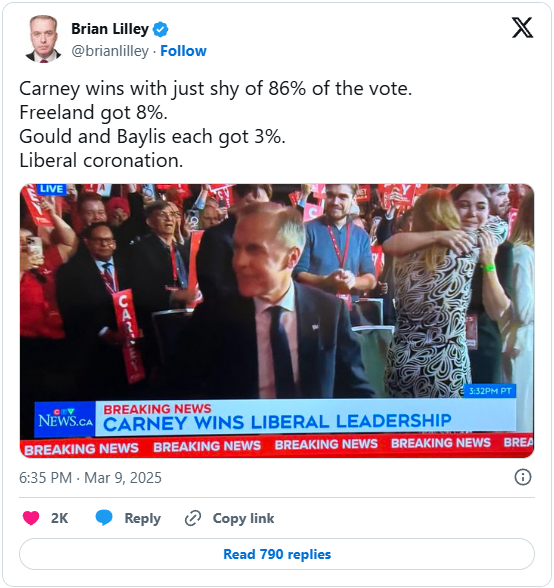
In the National Post Chris Selley doesn’t seem to be a fan of the new unelected leader of the federal government (assuming that Justin Trudeau will actually step down, of course):
Every speaker of note [at the Liberal leadership hootnanny], from the four leadership candidates to outgoing leader Justin Trudeau to former prime minister Jean Chrétien, who held the room in the palm of his hand for what felt like a day and a half, mentioned the need for Canadians to stand together, united and altogether resolute against the threat of Donald Trump’s tariffs.
At the same time, of course, Liberals were insisting that the Conservatives — who have as much or more support nationwide, and until recently had a lot more — are bent on destroying all that’s good and holy about this country. That isn’t really a unifying message.
“Pierre Poilievre just doesn’t get it,” Carney averred in his victory speech. “He is the type of life-long politician … who worships at the altar of the free market without having made a payroll himself. And now … at a time of immense economic insecurity, he would undermine the Bank of Canada. Poilievre has called for the shutting down of CBC at a time when disinformation and foreign interference are on the march. He insults our mayors and ignores our First Nations.”
“A person who worships at the altar of Donald Trump will kneel before him, not stand up to him,” Carney said of Poilievre, who has been raining invective on Trump just as fast as he can in recent days — and indeed someone whom Trump himself denigrated in recent days as “not a MAGA guy”.
Oh, and Carney said “Pierre Poilievre would let our planet burn” — on the same night he promised to axe the consumer carbon tax as a first order of business.
Other than all that, though, we’re in it together. Okey-dokey.
Dan Knight is even less impressed:

And here’s where it gets even better. The polling — oh, the polling. For months, the Liberals have been sinking. Before Trudeau resigned, they were floundering at 24% support. Then, magically, within days of picking a new leader, they skyrocket to 33%? A 9-point jump in the blink of an eye? Wow, what a coincidence! You mean to tell me that the same Canadians who couldn’t be bothered to sign up for a free membership, the same Canadians who have overwhelmingly turned against this party, suddenly decided they’re on board again — just because the party swapped one out-of-touch elitist for another?
No. That’s not how this works. That’s not how enthusiasm works.
This isn’t some grand Liberal resurgence. This is the Liberal-friendly media manufacturing a comeback narrative because their government subsidies depend on it. The same journalists who screamed for years about the Conservative “far-right” threat are now bending over backwards to convince you that Mark Carney is a fresh outside
And you know what? Maybe if they had actually let Ruby Dhalla into this race, they would’ve stood a chance. Seriously. I had to do a double-take when I looked at her policies — supporting small business, tough on crime, actual immigration regulation — I mean, that’s how you win the center. That’s how you stop a Conservative majority and turn it into a minority government. If they had let her run, we’d be having a very different conversation right now.
But what did the Liberals do? Oh, they disqualified her over — get this — campaign finance irregularities. But guess what? They kept the money. That’s right. The party flagged “violations”, kicked her out, and then conveniently pocketed the cash. If that’s not the most Liberal Party thing I’ve ever heard, I don’t know what is.
Can you feel the Carneymentum? It’s supposed to sweep the land from sea to sea to sea … any minute now.
Deep State delenda est
Elizabeth Nickson calls for the destruction of the deep state, Cato the Censor-style: salt the earth and leave no stone standing upon another stone:
There has been some argument in my house about Trump’s tariffs on Canada, and indeed the rest of the world. I’m on the American side; why on earth should the Americans pay for everything? Because they do. They pay for Europe’s defence, they allow every single country to tariff American products while allowing their goods in for pennies. When anyone, anywhere is in trouble, who do they call? The Yanks. Where do the pleas of all the desperate people all over the world land? America. Who did the Israeli captives hope for? Trump and the Americans. (Actually just Trump. They didn’t think that the Biden people would lift a finger. Which they didn’t.)
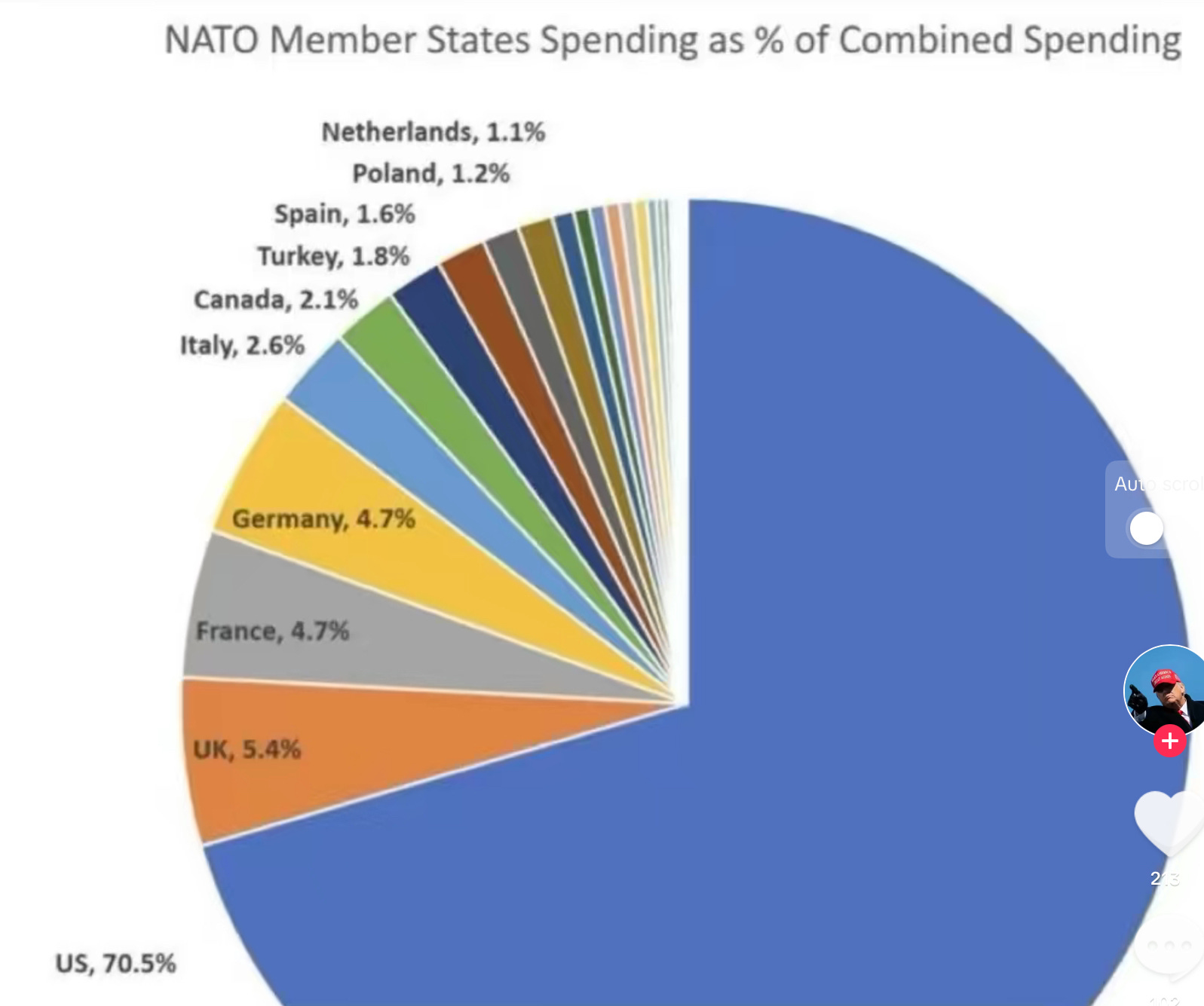
Please explain why these countries below, numbering 550 million people, cannot defend themselves?
Why can’t they defend themselves? They are broke.
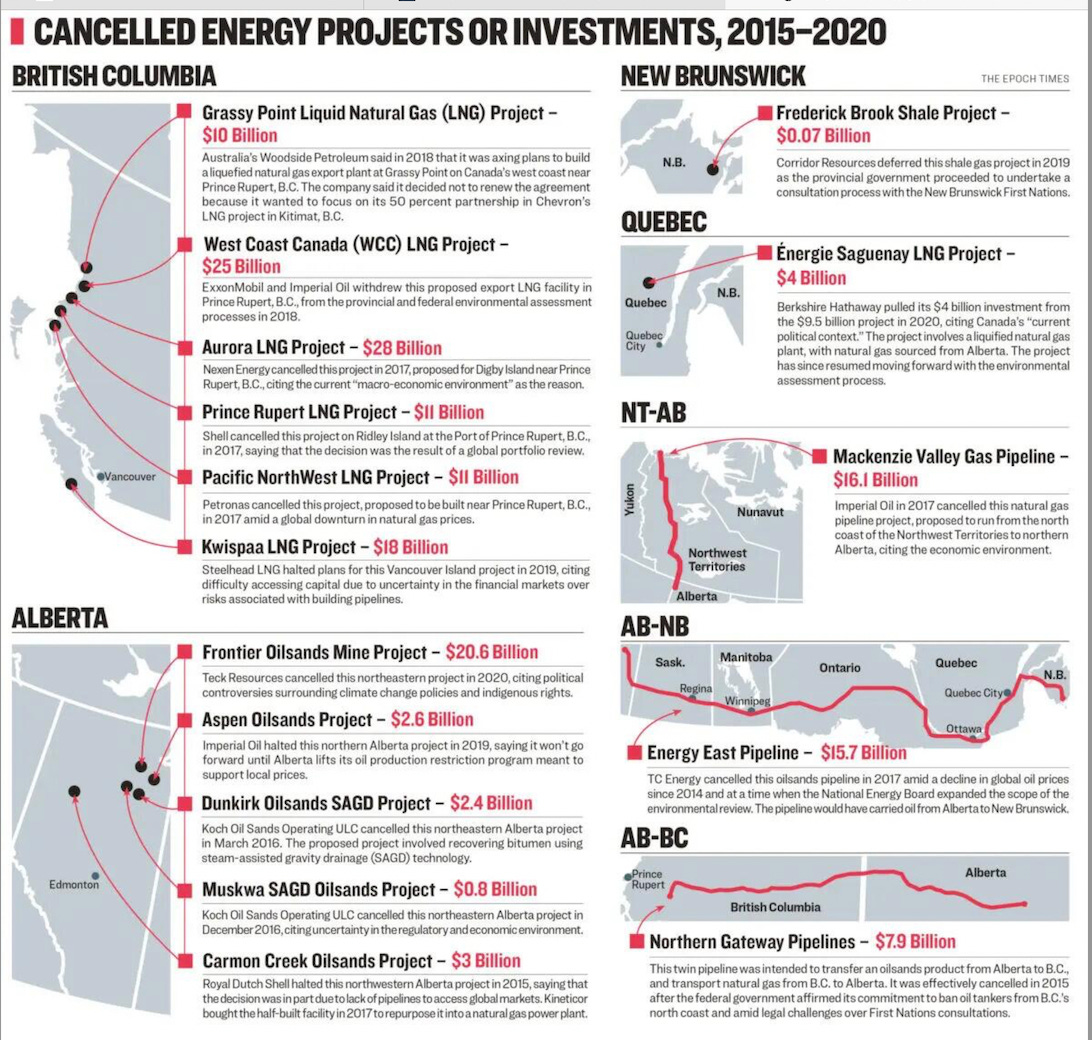
The following represents $150 billion in missed opportunity in the last FIVE years. Canada is so broke, it is broke-ass broke; it is a shriveling carbuncle on the American economy. We send 80% of our exports to you because we are TOO DAMNED LAZY to develop our own country.
If we had built those projects, Canada would be rich, the middle class would be crackling along, creativity would have soared and we would actually be proud. No one is proud of Canada except for the people paid to bloviate or who hope to be paid to bloviate, and those too stupid to bloviate. The rest of us are sullen and angry and so frustrated we don’t know what to do with ourselves.
But no. Climate Change. Look, I am sorry to say this, but anyone who “believes” in climate change being somehow catastrophic is stupid, malignant or has not done the required reading. Which means lazy. Which means childlike. There is no there there. Climate alarmism is nonsense, it is bullshit, it is utter crap made up by subsidized kids looking for “significance” and an endless supply of taxpayer dollars. The science is far too new to be reliable, there are thousands of real (not NGO) scientists in opposition to it and the policy implications are so vast we are looking at a new feudalism. Anyone promoting climate change is unserious.
Childhood is where we are. Canada is the only country in the Western Hemisphere which exacts a crippling carbon tax. And this:
The above is a perfect illustration of vanity, of a detachment from reality. And the only way people can detach from reality is that they are subsidized by the Americans. This means the Heartland people, the Flyover people. Those subsidies to the world added to a massive, unsustainable, insane, debt of thirty-seven trillion, created a giant fuzzy rainbow coloured cloud inhabited by perpetual children built by ghastly people like Samantha Powers, Al Gore, Hillary Clinton, and their legion of sick, larcenous, pedophile supporters, the ferociously stupid women on the east coat of America, the idiots at all the Ivies, and the two million federal workers who are about to be reduced by, I wish, 50%.