
The History Chap
Published 22 Apr 2026The most celebrated British hero of the First Anglo-Afghan War was brave, resourceful, and utterly magnificent under fire. He was also completely fictional – Harry Flashman.
Chris Green is The History Chap; telling stories that brings the past to life.
August 27, 2026
Britain’s Greatest Hero Never Existed!
August 26, 2026
The Korean War Week 114 – Stalin’s Secret Plan – August 25, 1952
The Korean War by Indy Neidell
Published 25 Aug 2026Heavy rains prevent action in the field in Korea this week, so the big story worldwide is talks in Moscow between Josef Stalin and Chinese Foreign Minister Zhou Enlai. They talk about Five Year Defense Plans, artillery production, Soviet aid for the Chinese, and exactly how they see the war in Korea and what they think of the American forces.
00:00 Intro
01:09 Bunker Hill
01:51 South Korean Prisoners of War
02:44 Chinese Soviet Talks
05:06 Five Year Defense Plan
07:26 Artillery Production
11:23 Stalin and the USA …
12:52 Eisenhower and the War
16:05 Summary
16:18 Conclusion
18:29 Sign Up
Comments Off on The Korean War Week 114 – Stalin’s Secret Plan – August 25, 1952
Who Destroyed the Japanese Economy in WW2?
Real Time History
Published 20 Mar 2026As the war in the Pacific develops, the United States takes the fight to Japan itself – by crippling its economy, destroying its industry, and crushing civilian morale. To do this, American submarines and heavy bombers wage campaigns beneath the sea and above the clouds. And even 80 years later, there’s a fierce debate about which of these campaigns did more to bring Japan to its knees – perhaps even more than the atomic bombs.
(more…)
Comments Off on Who Destroyed the Japanese Economy in WW2?
August 25, 2026
The new missile gap – between manufacture and deployment
Edward Luttwak offers some suggestions to help explain why the vast and lavishly funded US Military-Industrial Complex seems incapable of manufacturing enough weapons to allow the US military to fight more than a brief demonstration war before running short of the things that go boom:
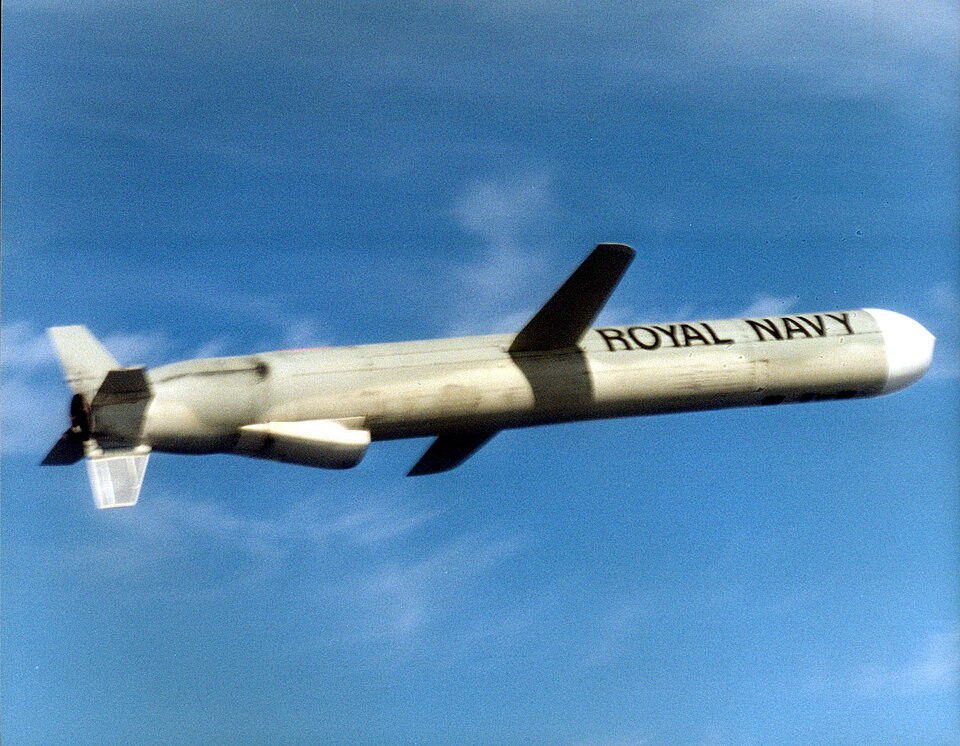
Royal Navy Tomahawk Land Attack Missile (TLAM) in flight.
MOD photo via Wikimedia Commons.
It is a strange thing indeed that among the countless stories about America’s shortage of long-range weapons — a truly crippling scarcity that now both limits President Trump’s strike options against the Islamic Republic, and might weaken responses to other looming threats — I have not found one that raises the most elementary question of all: why?
Why was Iran attacked with scarce and expensive BGM-109 Tomahawk Land Attack Missiles — costing around $3 million each — rather than ordinary gravity bombs dropped by fighter-bombers? Accuracy cannot be the answer: with so-called “JDAM” guidance kits, regular bombs become very accurate indeed, and they are still simple enough to be mass-produced cheaply.
Nevertheless, US forces had launched 850 Tomahawk missiles against Iran by 27 March this year, amounting to almost half the country’s global stockpile, though the Pentagon has since announced a huge $22.9 billion contract for more Tomahawks. Air-launched AGM-158 missiles, some of whose models can fly up to 1,000 miles, and which cost as much as $1.6 million apiece, were also used, along with Army’s Precision Strike Missiles are yet more expensive.
What makes these missiles so costly is their great virtue: they are all so-called “stand-off” weapons, which can safely be launched hundreds of miles from their targets. This means an attacker’s aircraft can remain outside enemy air space, where they could be exposed to detection by radars, and then to interception by air-defence fighters and surface-to-air missiles. There is simply no way of producing such missiles cheaply. They need powerful rocket propulsion and complicated electronic guidance to fly such vast distances and hit their targets successfully.
[…]
Nor, of course, are the implications here limited to Iran and the Gulf. Having needlessly used so many stand-off missiles to target Iran, US inventories are worryingly low in the event of the “Chinese contingency”: the invasion of Taiwan that Xi Jinping, unlike his predecessors, refuses to rule out. Any Chinese assault might start with subversion, with the activation of Chinese agents in Taiwan’s armed forces, but amphibious landings would have to follow — against which Tomahawk missiles would be the prime US weapon, alongside local anti-ship missiles.
But having examined all these technical details, we nonetheless arrive at something else entirely, a much more intractable problem than any munitions shortage could ever be: a fundamental change in the entire American attitude to war, which I described as “post-heroic” as far back as the Nineties when its first signs emerged.
This amounts to a truly drastic shift. What started with a proper striving to limit the casualties of war by every means possible — starting with prudent statecraft to avoid war in the first place, and extending to prudent tactics — has now devolved into the current predicament: whereby the US must spend billions on extremely elaborate stand-off missiles so as to further reduce risks to its pilots, which were already very low to begin with, against the vainglorious and incompetent Iranian enemy.
Of course, it’s always a possible explanation that the big defence contractors felt the need for another boost in their income, so it wouldn’t take much to persuade friends in the War Department or in the US Navy to toss a few more TLAMs at Iranian positions …
The Halftrack That Made Blitzkrieg Possible
World War Two
Published 23 Aug, 2026The tanks get the glory. But Blitzkrieg could not work on tanks alone.
The Sd.Kfz. 251 was designed to solve one of the fundamental problems of armored warfare: how do you keep infantry moving fast enough to fight alongside the Panzers? Germany’s answer was an armored half-track that helped turn infantry from a slow-moving follow-up force into an integral part of the Panzer division’s combined-arms assault.
In this German Rearmament special, we trace the Sd.Kfz. 251 from clandestine development under the restrictions of the Treaty of Versailles to its first production runs on the eve of World War Two. We examine its design, its role in the emerging doctrine of Bewegungskrieg, its deployment in Poland and France, and the extraordinary range of variants that turned it into one of the Wehrmacht’s most versatile vehicles.
But the 251 also exposes the limits behind the image of a fully mechanized German war machine. It was complicated and expensive to manufacture, there were never enough of them, and most German infantry continued to march or rely on horses and trucks. Even as production soared later in the war, Germany’s shortages of fuel, materials, manpower, and industrial capacity increasingly overwhelmed the advantages its engineers and tacticians had created.
The Sd.Kfz. 251 helped make the early German style of armored warfare possible. It also became another example of a sophisticated weapon system serving a war of aggression that Nazi Germany ultimately lacked the resources to sustain.
This is the story of the half-track that made Blitzkrieg possible.
Never Forget.
Comments Off on The Halftrack That Made Blitzkrieg Possible
Battle Rifles in the Jungle: Guatemalan AR-10
Forgotten Weapons
Published 8 Apr 2026Guatemala was one of the handful of countries to purchase original AR-10 rifles, made at Artillerie Inrichtingen (AI) in the Netherlands. The sale was made by Sam Cummings, legendary arms dealer. He spent much of 1957 and 1958 traveling through Central and South America demonstrating the new AR-10 to virtually every country’s military. In Guatemala, his demonstration resulted in an immediate order for 450 rifles to be delivered to the Escuela Politécnica (the military academy) for more extensive testing. The guns were delivered in late 1958, with serial numbers between approximately 3000 and 3500 (they were made immediately following production of the Sudanese contract batch). These Guatemalan rifles are distinctive for their ventilated bayonet shrouds, which were provided on no other rifles. While none of the Guatemalan rifles were fitted with bipods, a shortage of regular hand guards led AI to fit many of them with leftover Sudanese contract hand guards contoured for folding bipod legs.
The Guatemalan AR-10s were sold as surplus by the Escuela Politécnica to an American importer in 1985, and they were brought into the US as a mix of parts kits and pre-86 Dealer Samples. Today, most of the intact and unmodified Dutch-production AR-10s in the US (including this example) are from the Guatemalan contract.
(more…)
Comments Off on Battle Rifles in the Jungle: Guatemalan AR-10
August 24, 2026
The Ancient Greeks 04 – The Persian Invasion 4 – The Fall of Athens
seangabb
Published 26 Mar 2026Greece: A Brief History, c.700 BC – 500 AD
What happens when resistance fails?
In this lecture, we examine the dramatic collapse of Greek resistance after Thermopylae and the advance of the Persian army into central Greece. With the Spartan force destroyed, the road to Athens lay open.
We explore:
– The consequences of Thermopylae
– The evacuation of Athens under Themistocles
– The Persian capture and destruction of the city
– The psychological and strategic impact on the Greek world
– Why, at this moment, Persian victory seemed inevitableThis is the darkest point of the war for the Greeks — a moment when everything appears lost, and yet the story is far from over.
Comments Off on The Ancient Greeks 04 – The Persian Invasion 4 – The Fall of Athens
August 23, 2026
The End of the Battleship Era – Force Z
TimeGhost Cartographic and World War Two
Published 22 Aug 2026In December 1941, Britain is fighting a global war on multiple fronts when Japan enters the conflict in Southeast Asia. At the centre of Britain’s strategy is Singapore, and the arrival of two powerful warships is meant to demonstrate that the Royal Navy can still project its power across the region.
HMS Prince of Wales and HMS Repulse, accompanied by a small destroyer force, form Force Z and sail into increasingly dangerous waters. But without the aircraft carrier originally intended to accompany them, the squadron is operating under a serious disadvantage.
As Japanese forces begin their invasion of Malaya, Force Z sets out to disrupt the landings. What follows becomes one of the most dramatic naval actions of the early Pacific War, as British battleships find themselves facing a threat they were never designed to fight alone.
Comments Off on The End of the Battleship Era – Force Z
Why This “Foreign” Commonwealth Truck Was Built In 800,000 Units And Supplied Every Front
BritishWarLegends and BritishWarArmory
Published 31 Mar 2026The Canadian Military Pattern truck was built by two rival factories in Ontario for a nation of eleven million people. It ended up supplying the British Eighth Army across North Africa, Italy, Normandy, and Burma — and Canada built more of them than Germany, Italy, and Japan built trucks combined.
Almost nobody knows it existed.
When Rommel captured two thousand of them at Tobruk in 1942, he didn’t scrap them. The Afrika Korps pressed them straight into active German service. An enemy with his own purpose-built military trucks chose to keep using captured Canadian vehicles instead.
The full forgotten story.
Update: I generally try to avoid watching or re-posting clearly AI-generated slop, but this was the first video I’d encountered discussing the hundreds of thousands of CMP trucks that Canada built during WW2. At some point between me scheduling the video and today, the channel has been banned. You’ve undoubtedly seen CMP vehicles in WW2 stills or movie footage, as they’re pretty distinctive – https://en.wikipedia.org/wiki/Canadian_Military_Pattern_truck
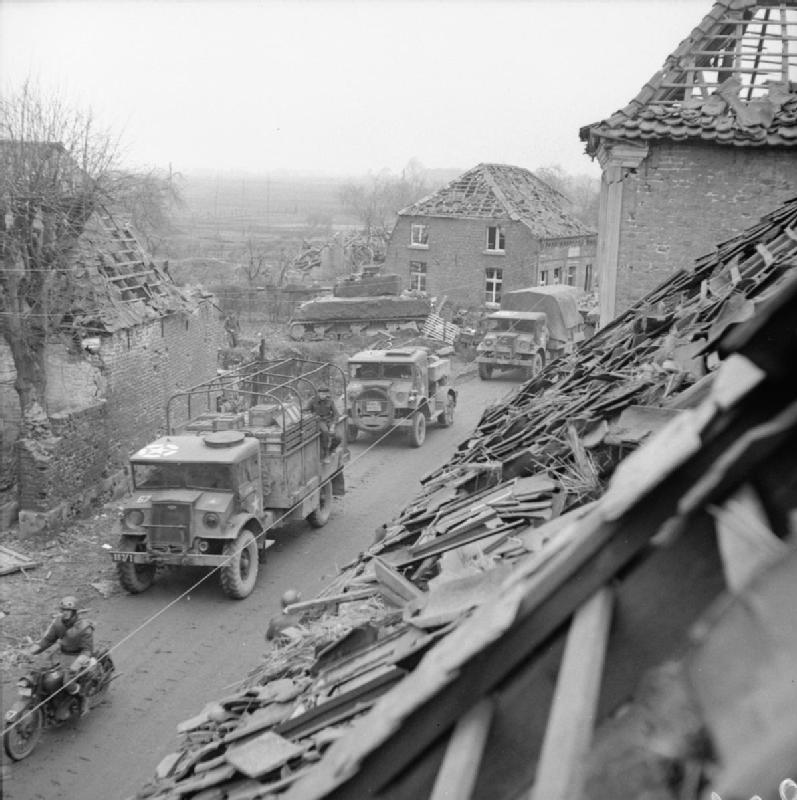
From The British Army in North-west Europe 1944-45,
CMP lorries passing through Uedem, 2 March 1945.
Photo by Carpenter (Sgt), No 5 Army Film & Photographic Unit, Photograph B 14966 from the Imperial War Museums via Wikimedia Commons.
August 22, 2026
TRW Low Maintenance Rifle: America’s Roller Locked Flechette Rifle
Forgotten Weapons
Published 30 Mar 2026TRW’s Low Maintenance Rifle seems to have been the result of a program to use a blank slate and a modern space age scientific mindset to develop a rifle that would be more reliable and effective than other existing designs. It was contracted to TRW during the Vietnam War, and they produced a very light, long stroke gas piston rifle with a roller-locked bolt. It was chambered for the XM216 single-flechette cartridge, with a muzzle velocity of a screaming 4700 fps. After production of three prototypes, the design was revised to use standard 5.56mm M193 and M196 ammunition. Three more rifles were made in this form before the program was cancelled in 1973 as the end of the Vietnam War caused funding to dry up for this sort of thing.
(more…)
Comments Off on TRW Low Maintenance Rifle: America’s Roller Locked Flechette Rifle
QotD: Fortified towns in the Middle Ages
The main difference in defending a town rather than a single fortified private residence is the area that needs to be defended: the town core is naturally much larger than the size of a single keep or bailey and so the circuit of walls surrounding it also needs to be much longer. That longer circuit, of course, means a higher cost in terms of constructing and maintaining the defense, but the advantage a town often has here is its own residents: the populace of a town often has a fair bit more labor to devote to defense construction compared to the medieval aristocracy who mostly draw their power and resources from the more thinly populated rural countryside.
Nevertheless, the larger size of the area being defended makes it harder to deploy concentric defense-in-depth solutions. There are also transit considerations: towns are, after all, economic centers, typically sitting at the junction points of many different local and regional routes, which means they tend to need lots of entry-points to facilitate all of that travel and trade and in turn that means lots of potentially vulnerable gatehouses. Meanwhile, internally, the desire for residents to move around the town freely and general land-use considerations make subdividing towns into walled districts (very common in video-games for memory-management and loading reasons) very difficult and as a result very rare. You can see this, for instance, looking back at the period city-maps from the Lonely Cities series: a good number of cities have either a citadel or a section of the town which is walled but also outside of the main circuit (often separated by a river), but full concentric styles of defense or multiple cell-like walled districts don’t really occur. There are exceptions, but they are relatively rare: most cities have a single primary circuit of walls, which, if they are breached generally give access to the main area of the town.
In Europe, the most complete and formidable set of city walls were without question the Theodosian Walls built to defend Constantinople during the reign of Theodosius II (r. 402-450). The Theodosian Walls stood for the whole Middle Ages but they really reflect the culmination of the ancient system of city wall fortifications, the ultimate answer to the kind of “big army” playbook the Assyrians (and Romans) employed. So I want to both talk about the defense system but also note points where its method diverges from the walls of later medieval towns.
The Theodosian Walls had to cover some 5.7km and had nine gates; both numbers should immediately make clear that you needed quite a few people to man these defenses effectively. This was in particular a factor for town defense: most of the defenders are going to be citizens of the town called up to defend it in an emergency, rather than a standing guard. As far as I can tell, this seems to have made towns somewhat more vulnerable to surprise “hasty assaults”, if the attacker could force a gate along a long circuit before the defenders knew where the attack was coming. Of course that problem is intensified by the fact that this is a single-point-of-failure system: the loss of one gate against a superior foe generally meant the loss of the town.
The Theodosian Walls are unusual in that they are a set of triple walls. The main fighting position was on the inner wall; in front of this was the peribolos, a low, flat, unobstructed gap, after which was the lower outer wall, a secondary forward fighting platform. The towers of the inner wall project out into the peribolos for exactly the same reason castle towers project: defenders on those towers can fire, unobstructed, down the peribolos, meaning that an attacker can find no safety here. The crenellation of the outer wall likewise only faced out, so attackers who seized the outer wall would have no cover from defenders fighting from the inner wall. Next, after another gap was a simple low forward wall, little more than a stone breastwork about 1.5m high. Finally, the low wall stood at the inner edge of a large moat, some 20m wide and 10m deep, because no good defensive system is complete without a ditch.
That low wall is a kind of what we call an “outwork”. This particular kind of outwork is a product of the ancient world and uncommon in medieval fortifications to my knowledge; it was a response to the increasing use of torsion catapults during the Hellenistic period. While it did offer a position for defenders to use to sally out (for instance to destroy enemy siege engines), the primary purpose was to prevent enemy catapults from being able to direct fire at the base of the main wall and its towers. Even if knocked down, such an outwork’s rubble would obstruct direct fire on the curtain wall or the towers. This idea – using an outwork to physically block lines of fire on the curtain wall – is going to come back a bit later.
In contrast, most later medieval town wall circuits generally only have a single curtain wall, supported by a moat. As with castles, the wall is supported by projecting towers which can direct fire along its length and hardened gatehouses. Where cities sometimes do employ defense-in-depth it is with a “citadel” – a hardened fallback position either inside the city or (more often) built in to the wall circuit; essentially a complete castle built into the city wall. The role of the citadel is important for thinking about what these defenses are intended to achieve: defenders who have lost the main area of the city but have held out in the citadel are unlikely to be in a position to recapture the city or even to seriously threaten to do so. But the citadel has important negotiating power. Even a small number of surviving defenders can likely hold a citadel (with its stockpile of supplies) for a long time; taking such a citadel by storm poses all of the problems of storming a castle, with the added disadvantage of having to do so through city streets. Consequently, defenders holed up in the citadel are in a good position to negotiate for terms: perhaps being able to march out unharmed in exchange for turning over the citadel, or else negotiate less onerous terms for the city in general (alternately, they might try to hold out until a friendly relief army could arrive).
And that brings the focus to something important about almost all medieval siegecraft: the siege and negotiations generally proceeded side-by-side. By raising the cost of a siege (either a blockade or a storming assault), the defender could improve their bargaining position, even if they were always going to have to surrender. Meanwhile the attacker, by very visibly preparing for a deliberate assault could signal to the defenders their resolve and thus attempt to encourage surrender. As far as I can tell, far more fortified medieval towns and castles surrendered than were ever taken by storm and so consequently a lot of this fortification work is as much about shifting bargaining positions in the event of an attack as it is resisting an attack.
Bret Devereaux, “Collections: Fortification, Part III: Castling”, A Collection of Unmitigated Pedantry, 2021-12-10.
Comments Off on QotD: Fortified towns in the Middle Ages
August 20, 2026
The Korean War Week 113 – The Battle of Bunker Hill – August 18,1952
The Korean War by Indy Neidell
Published 18 Aug 2026There’s plenty of action as Chinese troops battle with the US Marines over Hill 112- now known as “Bunker Hill”- throughout the whole week. Back in the USA, questions continue to circulate about the government’s strategy of limited war in Korea. The conflict looks set to play a key role in the 1952 Presidential Election, as candidates Dwight D. Eisenhower and Adlai Stevenson begin to feel the scrutiny of the American public.
00:00 Intro
00:19 Recap
00:41 The Battle of Bunker Hill
05:16 Marine Artillery
06:13 The Peace Talks
07:51 Limited War
11:45 The Presidential Candidates
13:44 Summary
13:57 Conclusion
Comments Off on The Korean War Week 113 – The Battle of Bunker Hill – August 18,1952
August 19, 2026
Why The Allied Western Front Offensives in 1915 Failed
The Great War
Published 13 Mar 2026By the spring of 1915, the Western Front had bogged down into trench warfare. Allied offensives tried to break the deadlock in spring and fall 1915. The fall offensives were among the bloodiest of the war. After unprecedented bloodletting and use of munitions, the Western Front was still locked in a stalemate at the end of 1915.
(more…)
Comments Off on Why The Allied Western Front Offensives in 1915 Failed
QotD: The Kwantung Army was the tail wagging the Japanese Imperial dog
The Lytton Commission was commissioned by the League of Nations to investigate the Mukden Incident, which was one of those false flags the Kwantung Army was fond of. They used it to seize Manchuria — technically a province of China — and set up a puppet government they called “Manchukuo” (under the Qing Emperor who was deposed in 1911 — who was 5 at the time — thus giving it a veneer of historical legitimacy). The Lytton Commission concluded that the Mukden Incident was indeed a false flag; that Japan was the aggressor; and that Manchukuo was a puppet state that should be dissolved, with Manchuria returning to Chinese sovereignty.
That’s bad, because if you’re Japan and you do any of that, you’ve now knuckled under to not just the West, but the worst hypocrites of them all (“Lytton” was Victor Bulwer-Lytton, the 2nd Earl of Lytton, formerly governor of Bengal and Viceroy of India, and oh, by the way, how exactly did Britain come to rule in India? The shit they pulled makes the Mukden Incident look like very small beer indeed). And it’s bad from the Chinese side, too, because now you’ve basically tied their hands in any peace negotiations — they can’t conclude any kind of honorable peace without getting Manchuria back, and as should be obvious from the above, you must pry Mantetsu from Japan’s cold, dead hands.
Still, Japan might’ve disciplined guys like Ishiwara … but how? You can’t cashier him; the Army would go insane. You can’t really transfer him — as much trouble as he’s causing in Manchuria, if you bring him home you might well have another February 26 Incident, and it might work this time. You certainly can’t execute him, because a) you’d have to take his entire faction with him, which would decimate your officer corps, and b) perhaps more importantly, the seizure of Manchuria was pretty popular. Mantetsu’s Media boys hadn’t been sitting on their hands during all of this, of course, and the Army’s Media people had been going nuts too.
In the end, the Japanese pretty much had no choice: They gave the League of Nations the finger. Which of course emboldened the KA even more, such that they cooked up an even faker and gayer false flag, the Marco Polo Bridge Incident, and WWII was on.
Severian, “Slipping the Leash”, Founding Questions, 2022-08-27.
Comments Off on QotD: The Kwantung Army was the tail wagging the Japanese Imperial dog


