… we need to distinguish what sort of phalanx because this is not the older hoplite phalanx in two very important ways: first, it is equipped and fights differently, but second it has a very different place in the overall tactical system: the Macedonian phalanx may be the “backbone” of a Hellenistic army, but it is not the decisive arm of the system.
So let’s start with the equipment, formation and fighting style. The older hoplite phalanx was a shield wall, using the large, c. 90cm diameter aspis and a one-handed thrusting spear, the dory. Only the front rank in a formation like this engaged the enemy, with the rear ranks providing replacements should the front hoplites fall as well as a morale force of cohesion by their presence which allowed the formation to hold up under the intense mental stress of combat. But while hoplites notionally covered each other with their shields, they were mostly engaged in what were basically a series of individual combats. As we noted with our bit on shield walls, the spacing here seems to have been wide enough that while the aspis of your neighbor is protecting you in that it occupies physical space that enemy weapons cannot pass through, you are not necessarily hunkered down shoulder-to-shoulder hiding behind your neighbor’s shield.
The Macedonian or sarisa-phalanx evolves out of this type of combat, but ends up quite different indeed. And this is the point where what should be a sentence or two is going to turn into a long section. The easy version of this section goes like this: the standard Macedonian phalangite (that is, the soldier in the phalanx) carried a sarisa, a two-handed, 5.8m long (about 19ft) pike, along with an aspis, a round shield of c. 75cm carried with an arm and neck strap, a sword as a backup weapon, a helmet and a tube-and-yoke cuirass, probably made out of textile. Officers, who stood in the first rank (the hegemones) wore heavier armor, probably consisting of either a muscle cuirass or a metal reinforced (that is, it has metal scales over parts of it) tube-and-yoke cuirass. I am actually quite confident that sentence is basically right, but I’m going to have to explain every part of it, because in popular treatments, many outdated reconstructions of all of this equipment survive which are wrong. Bear witness, for instance, to the Wikipedia article on the sarisa which gets nearly all of this wrong.
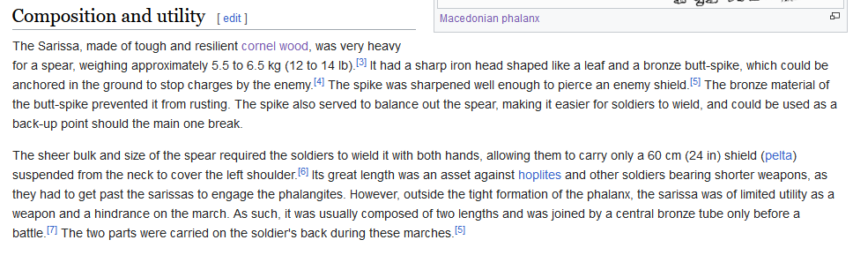
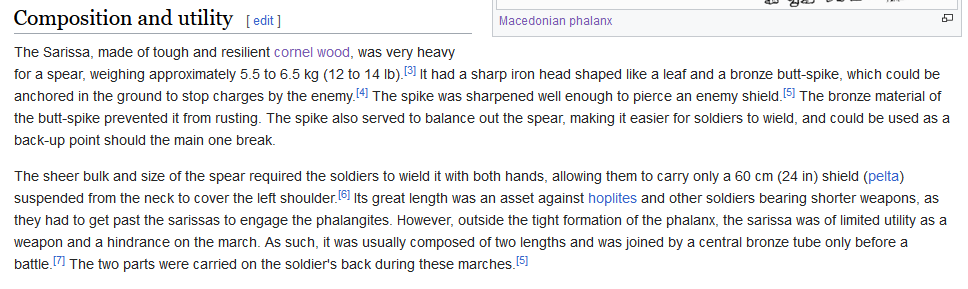
Wikipedia‘s article on the topic as of January, 2024. Let me point out the errors here.
1) The wrong wood, the correct wood is probably ash, not cornel – the one thing Connolly gets wrong on this weapon (but Sekunda, op. cit. gets right).
2) The wrong weight, entirely too heavy. The correct weight should be around 4kg, as Connolly shows.
3) Butt-spikes were not exclusively in bronze. The Vergina/Aigai spike is iron, though the Newcastle butt is bronze (but provenance, ????)
4) They could be anchored in the ground to stop cavalry. This pike is 5.8m long, its balance point (c. 1.6m from the back) held at waist height (c. 1m), so it would be angled up at something like 40 degrees, so anchoring the butt in the ground puts the head of the sarisa some 3.7m (12 feet) in the air – a might bit too high, I may suggest. The point could be brought down substantially if the man was kneeling, which might be workable. More to the point, the only source that suggests this is Lucian, a second century AD satirist (Dial Mort. 27), writing two centuries after this weapon and its formation had ceased to exist; skepticism is advised.
5) We’ll get to shield size, but assuming they all used the 60cm shield is wrong.
6) As noted, I don’t think these weapons were ever used in two parts joined by a tube and also the tube at Vergina/Aigai was in iron. Andronikos is really clear here, it is a talon en fer and a douille en fer. Not sure how that gets messed up.
Sigh. So in detail we must go. Let us begin with the sarisa (or sarissa; Greek uses both spellings). This was the primary weapon of the phalanx, a long pike rather than the hoplite‘s one-handed spear (the dory). And we must discuss its structure, including length, because this is a case where a lot of the information in public-facing work on this is based on outdated scholarship, compounded by the fact that the initial reconstructions of the weapon, done by Minor Markle and Manolis Andronikos, were both entirely unworkable and, I think, quite clearly wrong. The key works to actually read are the articles by Peter Connolly and Nicholas Sekunda.1 If you are seeing things which are not working from Connolly and Sekunda, you may safely discard them.
Let’s start with length; one sees a very wide range of lengths for the sarisa, based in part on the ancient sources. Theophrastus (early third century BC) says it was 12 cubits long, Polybius (mid-second century) says it was 14 cubits, while Asclepiodotus (first century AD) says the shortest were 10 cubits, while Polyaenus (second century AD) says that the length was 16 cubits in the late fourth century.2 Two concerns come up immediately: the first is that the last two sources wrote long after no one was using this weapon and as a result are deeply suspect, whereas Theophrastus and Polybius saw it in use. However, the general progression of 12 to 14 to 16 – even though Polyaenus’ word on this point is almost worthless – has led to the suggestion that the sarisa got longer over time, often paired to notions that the Macedonian phalanx became less flexible. That naturally leads into the second question, “how much is a cubit?” which you will recall from our shield-wall article. Connolly, I think, has this clearly right: Polybius is using a military double-cubit that is arms-length (c. 417mm for a single cubit, 834mm for the double), while Theophrastus is certainly using the Athenian cubit (487mm), which means Theophrastus’ sarisa is 5.8m long and Polybius’ sarisa is … 5.8m long. The sarisa isn’t getting longer, these two fellows have given us the same measurement in slightly different units. This shaft is then tapered, thinner to the tip, thicker to the butt, to handle the weight; Connolly physically reconstructed these, armed a pike troupe with them, and had the weapon perform as described in the sources, which I why I am so definitively confident he is right. The end product is not the horribly heavy 6-8kg reconstructions of older scholars, but a manageable (but still quite heavy) c. 4kg weapon.
Of all of the things, the one thing we know for certain about the sarisa is that it worked.
Next are the metal components. Here the problem is that Manolis Andronikos, the archaeologist who discovered what remains our only complete set of sarisa-components in the Macedonian royal tombs at Vergina/Aigai managed to misidentify almost every single component (and then poor Minor Markle spent ages trying to figure out how to make the weapon work with the wrong bits in the wrong place; poor fellow). The tip of the weapon is actually tiny, an iron tip made with a hollow mid-ridge massing just 100g, because it is at the end of a very long lever and so must be very light, while the butt of the weapon is a large flanged iron butt (0.8-1.1kg) that provides a counter-weight. Finally, Andronikos proposed that a metal sleeve roughly 20cm in length might have been used to join two halves of wood, allowing the sarisa to be broken down for transport or storage; this subsequently gets reported as fact. But no ancient source reports this about the weapon and no ancient artwork shows a sarisa with a metal sleeve in the middle (and we have a decent amount of ancient artwork with sarisae in them), so I think not.3
Polybius is clear how the weapon was used, being held four cubits (c. 1.6m) from the rear (to provide balance), the points of the first five ranks could project beyond the front man, providing a lethal forward hedge of pike-points.4 As Connolly noted in his tests, while raised, you can maneuver quite well with this weapon, but once the tips are leveled down, the formation cannot readily turn, though it can advance. Connolly noted he was able to get a English Civil War re-enactment group, Sir Thomas Glemham’s Regiment of the Sealed Knot Society, not merely to do basic maneuvers but “after advancing in formation they broke into a run and charged”. This is not necessarily a laboriously slow formation – once the sarisae are leveled, it cannot turn, but it can move forward at speed.
The shield used by these formations is a modified form of the old hoplite aspis, a round, somewhat dished shield with a wooden core, generally faced in bronze.5 Whereas the hoplite aspis was around 90cm in diameter, the shield of the sarisa-phalanx was smaller. Greek tends to use two words for round shields, aspis and pelte, the former being bigger and the latter being smaller, but they shift over time in confusing ways, leading to mistakes like the one in the Wikipedia snippet above. In the classical period, the aspis was the large hoplite shield, while the pelte was the smaller shield of light, skirmishing troops (peltastai, “peltast troops”). In the Hellenistic period, it is clear that the shield of the sarisa-phalanx is called an “aspis” – these troops are leukaspides, chalkaspides, argyraspides (“white shields”, “bronze shields”, “silver shields” – note the aspides, pl. of aspis in there). This aspis is modestly smaller than the hoplite aspis, around 75cm or so in diameter; that’s still quite big, but not as big.
Then we have some elite units from this period which get called peltastai but have almost nothing to do with classical period peltastai. Those older peltasts were javelin-equipped light infantry skirmishers. But Hellenistic peltastai seem to be elite units within the phalanx who might carry the sarisa (but perhaps a shorter one) and use a smaller shield which gets called the pelte but is not the pelte of the classical period. Instead, it is built exactly like the Hellenistic aspis – complete with a strap-suspension system suspending it from the shoulder – but is smaller, only around 65cm in diameter. These sarisa-armed peltastai are a bit of a puzzle, though Asclepiodotus (1.2) in describing an ideal Hellenistic army notes that these guys are supposed to be heavier than “light” (psiloi) troops, but lighter than the main phalanx, carrying a smaller shield and a shorter sarisa, so we might understand them as an elite force of infantry perhaps intended to have a bit more mobility than the main body, but still be able to fight in a sarisa-phalanx. They may also have had less body-armor, contributing that the role as elite “medium” infantry with more mobility.6
Finally, our phalangites are armored, though how much and with what becomes really tricky, fast. We have an inscription from Amphipolis7 setting out military regulations for the Antigonid army which notes fines for failure to have the right equipment and requires officers (hegemones, these men would stand in the front rank in fighting formation) to wear either a thorax or a hemithorakion, and for regular soldiers where we might expect body armor, it specifies a kottybos. All of these words have tricky interpretations. A thorax is chest armor (literally just “a chest”), most often somewhat rigid armor like a muscle cuirass in bronze or a linothorax in textile (which we generally think means the tube-and-yoke cuirass), but the word is sometimes used of mail as well.8 A hemithorakion is clearly a half-thorax, but what that means is unclear; we have no ancient evidence for the kind of front-plate without back-plate configuration we get in the Middle Ages, so it probably isn’t that. And we just straight up don’t know what a kottybos is, although the etymology seems to suggest some sort of leather or textile object.9
In practice there are basically two working reconstructions out of that evidence. The “heavy” reconstruction10 assumes that what is meant by kottybos is a tube-and-yoke cuirass, and thus the thorax and hemithorakion must mean a muscle cuirass and a metal-reinforced tube-and-yoke cuirass respectively. So you have a metal-armored front line (but not entirely muscle cuirasses by any means) and a tube-and-yoke armored back set of ranks. I would argue the representational evidence tends to favor this; we most often see phalangites associated with tube-and-yoke cuirasses, rarely with muscle cuirasses (but sometimes!) and not often at all in situations where they have the rest of their battle kit (helmet, shield, sarisa) as required for the regular infantry by the inscription but no armor.
Then there is the “light” reconstruction11 which instead reads this to mean that only the front rank had any body armor at all and the back ranks only had what amounted to thick travel cloaks. Somewhat ironically, it would be really convenient for the arguments I make in scholarly venues if Sekunda was right about this … but I honestly don’t think he is. My judgment rebels against the notion that these formations were almost entirely unarmored and I think our other evidence cuts against it.12
Still, even if we take the “heavy” reconstruction here, when it comes to armor, we’re a touch less well armored compared to that older hoplite phalanx. The textile tube-and-yoke cuirass, as far as we can tell, was the cost-cutting “cheap” armor option for hoplites (as compared to more expensive bell- and later muscle-cuirasses in bronze). That actually dovetails with helmets: Hellenistic helmets are lighter and offer less coverage than Archaic and Classical helmets do as well. Now that’s by no means a light formation; the tube-and-yoke cuirass still offers good protection (though scholars currently differ on how to reconstruct it in terms of materials). But of course all of this makes sense: we don’t need to be as heavily armored, because we have our formation.
Bret Devereaux, “Collections: Phalanx’s Twilight, Legion’s Triumph, Part Ia: Heirs of Alexander”, A Collection of Unmitigated Pedantry, 2024-01-19.
1. So to be clear, that means the useful is P. Connolly, “Experiments with the sarissa” JRMES 11 (2000) and N. Sekunda, “The Sarissa” Acta Universitatis Lodziensis 23 (2001). The parade of outdated scholarship is Andronikos, “Sarissa” BCH 94 (1970); M. Markle, “The Macedonian sarissa” AJA 81 (1977) and “Macedonian arms and tactics” in Macedonia and Greece in Late Classical and Early Hellenistic Times, (1982), P.A. Manti, “The sarissa of the Macedonian infantry” Ancient World 23.2 (1992) and “The Macedonian sarissa again” Ancient World 25.2 (1994), J.R. Mixter, “The length of the Macedonian sarissa” Ancient World 23.2 (1992). These weren’t, to be clear, bad articles, but they are stages of development in our understanding, which are now past.
2. Theophrastus HP 3.12.2. Polyb. 18.29.2. Asclepiodotus Tact. 5.1; Polyaenus Strat. 2.29.2. Also Leo Tact. 6.39 and Aelian Tact. 14.2 use Polybius’ figure, probably quoting him.
3. Also, what very great fool wants his primary weapon, which is – again – a 5.8m long pike that masses around 4kg to be held together in combat entirely by the tension and friction of a c. 20cm metal sleeve?
4. Christopher Matthew, op. cit., argues that Polybius must be wrong because if the weapon is gripped four cubits from the rear, it will foul the rank behind. I find this objection unconvincing because, as noted above and below, Peter Connolly did field drills with a pike troupe using the weapon and it worked. Also, we should be slow to doubt Polybius who probably saw the weapon and its fighting system first hand.
5. What follows is drawn from K. Liampi, Makedonische Schild (1998), which is the best sustained study of Hellenistic period shields.
6. Sekunda reconstructs them this way, without body armor, in Macedonian Armies after Alexander, (2013). I think that’s plausible, but not certain.
7. Greek text is in Hatzopoulos, op. cit.
8. Polyb. 30.25.2. Also of scale, Hdt. 9.22, Paus. 1.21.6.
9. The derivation assumed to be from κοσύμβη or κόσσυμβος, which are a sort of shepherd’s heavy cloak.
10. Favored by Hatzopoulos, Everson and Connolly.
11. Favored by Sekunda and older scholarship, as well as E. Borza, In the Shadow of Olympus (1990), 204-5, 298-9.
12. Representational evidence, but also the report that when Alexander got fresh armor for his army, he burned 25,000 sets of old, worn out armor. Curtius 9.3.21; Diodorus 17.95.4. Alexander does not have 25,000 hegemones, this must be the armor of the general soldiery and if he’s burning it, it must be made of organic materials. I think the correct reading here is that Alexander’s soldiers mostly wore textile tube-and-yoke cuirasses.