
When we last left our flax, it had been planted, grown and been harvested by being pulled up (by the roots) in roughly handful-sized bundles. That process leaves us with the stalks of the flax plants. The useful part of these is called bast, which must now be separated from the other plant fibers. Moving from the inner-most part of the plant outward, a flax stem is made up of a woody core (the pith), followed by the living cells of the plant which transport nutrients and water up the stem (the phloem and xylem), which are supported by our all important bast fibers, and then outside of the bast is the skin of the plant (the epidermis and cortex). So our task with our freshly harvested flax is to get rid of everything in this stalk that isn’t a bast fiber.
The process for this is called retting and changed relatively little during the pre-modern period. The term “retting”, related to the Dutch reten shares the same root as English “rot” and that is essentially what we are going to do: we are going to rot away every fiber that isn’t the bast fibers themselves. The first step is to dry the stalks out, at least to a certain point. Then in the most common form of retting (called “water retting”) the partially dried stalks are submerged in stagnant or slow-moving waters (because you do not want too much water-motion action on the flax washing it away). Pliny (Natural History 19.17) notes the use of weights to hold the stalks down under the water. The water penetrates into the partially dried stalks, causing the pith to expand and rupture the skin of the stalk, which permits bacteria into the stalk. That bacteria then rots away the chemicals which bind the fibers together (this is pectin, located in the cell walls of the plant cells) allowing the fibers to be separated. This process takes around two to three weeks to complete, but has to be carefully controlled and monitored; over-retting will make the bast fibers themselves too weak, while under-retting will make it more difficult to separate the fibers.
By the Roman period at least, the potential benefits of retting in warm water were already well known (Pliny, NH 19.17). There is some evidence, for instance from Staonia and Saetabis, that at least by the Roman period specially built pools fed by small channels and exposed to the sun (so they would heat up) were sometimes used to speed the process. Very fine flax was in some cases double-retted, where stalks are partially retted, removed early, then retted a second time. Alternately, in water-poor regions, retting might instead be done via “dew retting” where the stalks are instead spread evenly and carefully on either grassy fields or even on the roofs of houses (e.g. Joshua 2:6), where the action of morning dew provides the necessary moisture for bacteria to break down the pectin. Dew retting generally seems to have taken rather longer as a process.
Once retted, the flax must be dried completely. The nest step is breaking, where the pith of the stalks is broken up by being beaten, sometimes with a wooden club (Pliny mentions a particular type of mallet, a stupparius malleus, or a “tow-club”, tow being the term for short broken fibers produced in the processing of flax, for this purpose, Pliny, NH 19.17). In some places (particularly in Northern Europe) it seems that stomping on the flax by foot or having horses do so was used for this purpose. Once broken up, the pith and other fibers may be separated from the bast using a wooden knife in a process called scutching (the knife is called a scutching knife). By the 1800s, this process was assisted through the use of a swingle, essentially a board stood upright with an opening at the top where the flax could be inserted and held, while the scutcher then strikes with the scutching knife downward against the board. Scutching is a fairly rapid process; Sir George Nicholas detailing flax production in the 1800s (in The Flax-Grower (1848), 45-6) reports that a skilled worker could scutch ten to fifteen pounds of flax a day by hand, though improper retting or low-quality flax might be more difficult to process. Scutching, when completed, left a bundle of fibers (sometimes slightly twisted to hold them together), with almost all of the other plant matter removed.
All of these steps, from planting to scutching, seem to have generally been done on the farm where the flax was being cultivated. At least in the early modern period, it was only once the flax had been scutched that the bundles might be sold (Nicholas, op. cit., 47). That said, our flax is not quite ready to spin just yet. The final step is hackling (also spelled heckling), where the bast fibers are combed along a special tool (a hackling board or comb) to remove the last of the extraneous plant matter, leaving just the bast fibers themselves. The hackling board itself is generally a wooden board with several rows of nails (the “teeth”) put through it, through the earliest hackles seem to have been made of bone or else a wood board using thorns or thistle as teeth (see Barber (1992), 14 for a reconstruction). The fibers that come out of this process are generally separated into grades; the “tow” fibers are short, loose or broken fibers that come loose from the longer strands of bast during scutching or hackling; these are gathered and spun separately and typically make a lower-quality linen thread when spun. They stand in contrast to the “line” of long bast fiber strands, which after hackling form long wavy coils of fibers called stricks; the small tangles give these fibers coherence and account for part of the strength of high quality linen, once spun. Pliny comments on the roughness of the entire process, quipping that “the more roughly treated [the linen is] the better it is” (Pliny NH 19.18). Nicholas, on this point, is explicit that the two grades ought to be kept separate, so as not to lower the value of the more useful fibers (op. cit., 47).
There was a significant amount of skill in the entire process. Pliny notes that the ratio of flax input to usable fiber output was skill dependent (NH 19.18) and that a good worker could get around fifteen Roman pounds (10.875lbs, 4.93kg) of usable fiber out of fifty Roman pounds (36.25lbs, 16.44kg) of raw flax. Nicholas agrees, noting that hand scutching skill was deemed sufficiently important for experienced scutchers to be sent to train workers elsewhere in the best methods (op. cit. 47). Pliny concludes on this basis that producing flax was a sufficiently skilled job as to befit free men (Nicholas also assumes a male worker, at least with his pronouns; he is explicit that breaking was done by men, though with women or children assisting by placing and retrieving the bundles of flax as they are broken), though it seems that much of this work was also done by women, particularly scutching and hackling. In each case it seems fairly clear that this work was done mostly on the flax farm itself, by many of the same people living and working on that farm.
The final result of all of this processing are bundles of individual flax bast filaments which are now quite smooth, with a yellow, “flaxen” color (though early pulled, very fine flax may be a quite pale yellow, whereas utilitarian late-pulled flax is a deeper near-brown yellow), ready to spin. We’ll deal with color treatment in a later post, but I should note here that linen is notoriously difficult to dye, but can be bleached, for instance by exposing the fibers to the sun during the drying process.
Bret Devereaux, “Collections: Clothing, How Did They Make It? Part II: Scouring in the Shire”, A Collection of Unmitigated Pedantry, 2021-03-12.
March 13, 2025
QotD: Processing flax to make linen
March 12, 2025
The Korean War 038 – The US President is Angry! – March 11, 1951
The Korean War by Indy Neidell
Published 11 Mar 2025Operation Ripper kicks off this week, and gains plenty of ground … but the enemy is almost nowhere to be found. Douglas MacArthur gives what becomes known as his “die for a tie” speech, which could have a serious negative effect on UN troop morale. But the Chinese are building up their forces for an eventual counterstrike, and the North Koreans even have a new Chief of Staff.
Chapters
00:00 Intro
00:50 Recap
01:15 Plans for Operation Ripper
04:45 Die for a Tie
06:34 MacArthur Won’t Toe the Line
08:17 The KPA Build-Up
10:38 Nam Il
12:31 The Chinese Build-Up
14:01 Ripper Begins
15:33 Summary
15:45 Conclusion
(more…)
Colt Sidehammer “Root” Dragoon Prototype
Forgotten Weapons
Published 17 Nov 2016During the development of the 1860 Army revolver, Colt did consider mechanical options other than simply scaling up the 1851 Navy pattern. One of these, as evidenced by this Colt prototype, was an enlarged version of the 1855 Pocket, aka “Root”, revolver. That 1855 design used a solid frame and had been the basis for Colt’s revolving rifles and shotguns, and so it would be natural to consider it for use in a .44-caliber Army revolver. How extensive the experimentation was is not known, and I believe this is the only known surviving prototype of a Dragoon-size 1855 pistol. It survives in excellent shape, and is a really neat glimpse at what might have been …
QotD: A different parable of democracy’s origins
Then one day, somebody came up with a daring suggestion: what if instead of actually fighting a civil war, they instead had a pretend civil war. The two contenders for the throne would arm-wrestle, and everybody would treat the winner as if he had actually won the civil war, and thus many lives would be saved. Everybody applauded this idea, unfortunately the first time it was tried the loser of the arm-wrestling contest decided to try his luck anyways, broke the deal, started the civil war, and won. The problem with this approach is that it’s “unstable”, because one’s ability to win an arm-wrestle is only loosely correlated with one’s ability to win a hypothetical civil war. The rule-by-arm-wrestle system can work so long as nobody challenges it, but as soon as somebody does, it’s prone to collapse.
Then somebody else observed that in the last few civil wars, the side with the bigger army always won, and proposed that instead of settling the succession on the battlefield, the two sides simply count up the number of soldiers they would be able to muster, and the side with the largest hypothetical army would win without the war being fought. Note how different this situation is from the previous proposal! This time, the defeated party of the fake, simulated war has good reason not to be a sore loser, because he’s just seen that if the matter really came to blows, he’d probably lose. The solution is “stable” in this sense, all sides are incentivized to accept the outcome. And thus democracy was born.
I like this as a pragmatic argument for a loosely democratic system. It has nothing to do with the moral case for popular sovereignty, or whether it is right and just for the governed to have a say in government, it’s simply about avoiding violent instability by giving everybody a sneak peek at how the putative civil war might turn out, then all agreeing to not have it. But this theory has another selling-point, which is that it also tells us why democracy arose when it did, and why it may now be on the way out. If the principle is that governments will tend towards a form and structure and rule of succession that’s closely tied to their ability to fend off challengers, the that suggests that the most common form of government will depend heavily on what the dominant military technology and strategy of its era happens to be.
For example: in the early Middle Ages, wars were fought by a much smaller number of people, and success in warfare was more dependent on the actions of an elite group of professional soldier-aristocrats. And sure enough, political power was also concentrated in the hands of this much smaller group, because in the event that somebody decided to contest the state, it was the opinion of this group that mattered, not the opinions of everybody.
Sometime in the nineteenth century, the “meta” for total warfare changed dramatically. The combination of mass production, replaceable parts in machinery, and new weaponry that was deadly even in the hands of the untrained masses, all meant that suddenly the pure, arithmetic quantity of men under arms on each side became a much more potent factor in the military calculus. Is it any wonder that a little while later, democracy began to spread like wildfire around the globe? Mass suffrage and mass conscription are inextricably bound with one another. The people have generally ruled in our lifetimes, but only because a little while before (these things always operate on a lag) wars were decided by masses of conscripts with rifles.
There’s no rule that says this connection between military success and popular support has to hold true forever, and in fact it probably won’t. You can imagine this going a few different ways. Perhaps the conflicts of the future will be settled by vast swarms of autonomous killer robots, and the winner will be whoever can produce the best robots the fastest. This world might be conducive to rule by industrial conglomerates and robber-barons, a return to the great age of oligarchy, but with a less aristocratic, more plutocratic spin. If we look to the past, there was a class of societies whose militaries had an extreme ratio of capital intensity to labor intensity — the Mediterranean merchant republics with their fleets and their mercenary armies of condottieri. If future wars are settled by robots, we may find ourselves bowing to a new, doubtless very different, doge.
There’s another possible world, where control of information becomes supreme. You can think of this world as being an intensification of our current one, with an arms race of ever more sophisticated techniques for swaying the masses. Surface democracy spins out of control as an ecosystem of competing psychological operations vie to program or reprogram or deprogram swarms of bewildered and unsuspecting voters, alternatingly using them as betting chips and battering rams. This is a world ruled by the meme lords — brutally efficient teams of spin doctors, influencers, AIs, and the occasional legacy media organization. Like I said, pretty much just an intensified version of our current world.
My guess, however, is that neither of these worlds will come to pass, but instead a third one. The history of military technology is a history of the ancient contest between offensive technologies and defensive technologies, with both sides having held the crown at various points. We may be about to see the balance shift decisively in favor of offensive technologies, with extreme political consequences. Arguably we’ve been in that world ever since the invention of the atom bomb, but WMDs haven’t affected this strategic calculus as much as you might guess, due to all the issues surrounding their use (to be clear, this is a good thing).
Technology marches on, however, and I believe there’s a chance that it’s about to deliver us into a new golden age of assassination.1 Between miniaturized drones with onboard target recognition, bioengineered plagues designed to target exactly one person, and a host of more creative ideas that I don’t even want to write about for fear of summoning them into existence, it may soon become very dangerous to be a public figure with any enemies — that is to say, dangerous to be a public figure at all. What kind of men will rule such a world, where your reign could end the moment somebody discovers it?
Two kinds of men: men with nothing to lose, and men that you will never find. This world of ever-present threat to those with power is a world eerily well adapted to governance by grey, faceless men in grey, faceless buildings. A world of conspiracies hatched in unobtrusive exurban office parks, of directives concealed within stacks of paperwork, where the primary goal of power is to hide itself from view. In other words it’s the world that MITI already inhabits. As in so many things, the future is here, it’s just unevenly distributed.
John Psmith, “REVIEW: MITI and the Japanese Miracle by Chalmers Johnson”, Mr. and Mrs. Psmith’s Bookshelf, 2023-04-03.
1. Japan had a high-profile and socially traumatizing assassination just recently. I find it noteworthy that Abe was killed when he wasn’t Prime Minister anymore, but was perhaps more influential than ever as a deep state power player.
March 11, 2025
Could even William Shakespeare rescue Hollywood?
Ted Gioia laments the apparent death of creativity in Hollywood over the last few decades:
They need somebody like Bill Shakespeare in Hollywood today.
That’s not as crazy as it sounds. We know very little about the Bard of Avon, but these facts are indisputable:
- He worked successfully in the entertainment business for 30 years.
- He mastered the art of the deal — all six of his surviving signatures come from legal documents.
- He handled money wisely, as entrepreneur, grain merchant, property owner, money lender, etc.
- He still sells tickets today — more than 400 years after his death.
Not even Harvey Weinstein can match that track record.
And — best of all—Shakespeare didn’t let business get in the way of creativity. He knew how to make a buck without compromising his Bard status.
Here’s another fact about Shakespeare: He never used the words “intellectual property” or “content” or “brand franchise”.
I was reminded of that recently when I encountered this headline in The Hollywood Reporter.
I’ve often accused the entertainment industry of abandoning creativity — and turning into boring IP [intellectual property] management companies run by lawyers, bankers, and accountants.
But they don’t even hide it anymore.
There was a day when they pretended to care about artistry — seeking out fresh talent and bold new ideas. But today it’s the exact opposite. They actually want content.
(This is where I concur with Barbara Broccoli, who had creative control over the James Bond films until last week. She forced Amazon execs to buy her out, after she called them “fucking idiots”. This outburst happened in response to the head of Amazon Studios describing the Bond films as content.)
So I read the Bain report and wept. So would Shakespeare — he would rage like King Lear on the heath if he saw a sentence like this:
[Media] companies are essentially themselves converging to compete with the tech media platforms; they’re also acquiring to gain more evergreen IP that can be used across modalities. By owning these cross-sector assets and IP, they create fan communities and multimodal content …
I thought content was bad enough. But we’re now dealing with multimodal content.
That sounds like one of the seven plagues of ancient Egypt — a step above locusts, but definitely worse than frogs and hail. Somebody at the consultancy deserves to be smote down at bonus time.

The Myth and Truth behind Croissants – A Recipe from 1850
Tasting History with Max Miller
Published 29 Oct 2024Crescent-shaped bread rolls, from before the croissant was a flaky pastry
City/Region: France
Time Period: 1853Croissants weren’t always the buttery, flaky pastries that we know and love. While today, that flakiness is what defines a croissant, in the past, it was the crescent shape that was most important.
This recipe from the mid-19th century, a good 50 years before the croissant got its flakes, is a wonderfully soft bread. It doesn’t bear much resemblance to a modern croissant besides the shape, but it is much easier to make. The bread is a little plain, but would be lovely with some butter and jam.
In luxury bakeries, small loaves called croissants are prepared, usually in the semi-circular shape of a roll curved and tapered at the ends. The liquid is used to form the dough with one kilogram of flour consists of one or two eggs beaten and mixed with about five hundred grams of water. Moreover, the choice of flour, the dose of yeast, as well as the working of the dough, require the same care as when it comes to the other luxury breads mentioned.
— Des substances alimentaire et des moyens de les améliorer by Anselme Payen, 1853.
QotD: Herbert Hoover wins the presidency
The main issue is Prohibition. Smith, true to his roots, is against. Hoover, true to his own roots (his mother was a temperance activist) is in favor. The country is starting to realize Prohibition isn’t going too well, but they’re not ready to abandon it entirely, and Hoover promises to close loopholes and fix it up. Advantage: Hoover.
The second issue is tariffs. Everyone wants some. Hoover promises that if he wins, he will call a special session of Congress to debate the tariff question. Advantage: Hoover.
The last issue is personality. Republican strategists decide the best way for their candidate to handle his respective strengths and weaknesses is not to campaign at all, or be anywhere near the public, or expose himself to the public in any way. Instead, they are “selling a conception. Hoover was the omnicompetent engineer, humanitarian, and public servant, the ‘most useful American citizen now alive’. He was an almost supernatural figure, whose wisdom encompasses all branches, whose judgment was never at fault, who knew the answers to all questions.” Al Smith is supremely charismatic, but “boasted of never having read a book”. Advantage: unclear, but Hoover’s strategy does seem to work pretty well for him. He racks up most of the media endorsements. Only TIME Magazine dissents, saying that “In a society of temperate, industrious, unspectacular beavers, such a beaver-man would make an ideal King-beaver. But humans are different.”
Apparently not that different. Hoover wins 444 votes to 87, one of the greatest electoral landslides in American history.
Anne McCormick of the New York Times describes the inauguration:
We were in a mood for magic … and the whole country was a vast, expectant gallery, its eyes focused on Washington. We had summoned a great engineer to solve our problems for us; now we sat back comfortable and confidently to watch our problems being solved. The modern technical mind was for the first time at the head of a government. Relieved and gratified, we turned over to that mind all of the complications and difficulties no other had been able to settle. Almost with the air of giving genius its chance, we waited for the performance to begin.
Scott Alexander, “Book Review: Hoover”, Slate Star Codex, 2020-03-17.
March 10, 2025
Chinese Civil War Part 1 – W2W 11 – Q1 1947
TimeGhost History
Published 9 Mar 2025After WWII, China is plunged into chaos as Chiang Kai-shek’s Nationalists and Mao Zedong’s Communists reignite a decades-old conflict. This episode traces the roots of the Chinese Civil War — from the guerrilla strategies honed in Yan’an to the shifting power dynamics after Japanese occupation. Discover how ideological fervor, battle-hardened tactics, and the struggle for legitimacy set China on a path that would redefine its future.
(more…)
Rome (2004): HBO’s Untold 5 Season Story
Little Wars TV
Published 6 Sept 2024HBO’s Rome is one of the greatest television shows ever made, but the premium network infamously cancelled Rome after just two seasons. It is a decision HBO executives later admitted was a mistake. In this video essay, we explore why HBO cancelled Rome and what the showrunners envisioned as the full, five-season story arc. Which characters were meant to survive? What historical storylines would have been explored? And what was the show’s final scene supposed to be at the end of five seasons?
We’ll unearth interviews with Bruno Heller and William J MacDonald, hear from actors like Kevin McKidd, and attempt to piece together a vision of Rome‘s full potential if HBO had not cancelled the show prematurely.
(more…)
March 9, 2025
Italy’s Italian Fiasco
World War Two
Published 8 Mar 2025Today Sebastian puts Indy and Sparty in the hot seat for questions about the war in China and North Africa. Just what is the deal with the Italian Army anyway? How much fighting did the CCP do against the Japanese? And what’s the most overlooked event of the first year of war?
(more…)
Sulla: bloodthirsty psycho or saviour of the Republic?
Adrian Goldsworthy. Historian and Novelist
Published 23 Oct 2024Today’s question asked about Lucius Cornelius Sulla, the first man to the march his legions against the city of Rome, starting the first — but far from the last — of Rome’s civil wars. He killed a lot of people, broke a lot of laws and conventions, but as dictator also introduced a very “conservative” programme of reforms. How should we judge Sulla, as a selfish, brutal murderer, or as a reluctant rebel and well-intentioned reformer?
March 8, 2025
Murder in the Name of Democracy – War Against Humanity 002
The Korean War by Indy Neidell
Published 7 Mar 2025The battles on the Korean peninsula started long before 1950. Today Sparty looks back at the uprising and insurgency on Jeju Island in 1948, the threat of Communist revolt, and the harsh reaction of the Korean government. This really was the war before the war.
(more…)
Joslyn M1862 and M1864 Carbines
Forgotten Weapons
Published 15 Jun 2015While US infantry forces during the Civil War had only limited access to the newest rifle technology, cavalry units adopted a wide variety of new carbines in significant numbers. Among these were a design by Benjamin Joslyn. It first appeared in 1855 designed to use paper cartridges, but by the time the US Army showed an interest Joslyn had updated the weapon to use brass rimfire ammunition. The first version purchased by the government was the 1862 pattern carbine, of which about a thousand were obtained. Many more were ordered, but it took Joslyn a couple years to really get his manufacturing facility and processes worked out. By the time he had this all straightened out, the design had been updated again to the 1864 pattern, addressing several minor problems with the earlier version. Ultimately more than 11,000 of the 1864 pattern carbines were purchased by the Union, chambered for the same .56-.52 cartridge as the Spencer carbines also in service.
QotD: India’s post-independence economic mistake
Strong and centralised control is something that only a rich country can afford because only a rich economy can weather the costs – the inefficiencies, the politically directed nonsenses – that such control insists upon.
Of course, rich countries shouldn’t make themselves poorer in this manner either but an already poor place can’t afford to have them – because if it does then people die.
India’s poor because of that attempt at socialist development. Something we can prove by the manner in which development sped up when even some portion of the socialism was dropped. Sure, the Webbs set up the LSE, the place I started to learn my economics but they were responsible for far greater evils than my views as well.
Tim Worstall, “A Sad Lesson About India’s History”, Continental Telegraph, 2020-05-01.
March 7, 2025
Trump marks the overdue end of the Long Twentieth Century, part 2
In The Conservative Woman, N.S. Lyons continues his essay contending that the arrival of Donald Trump, version 2.0, may finally end the era we’ve been living in since immediately after the end of WW2:
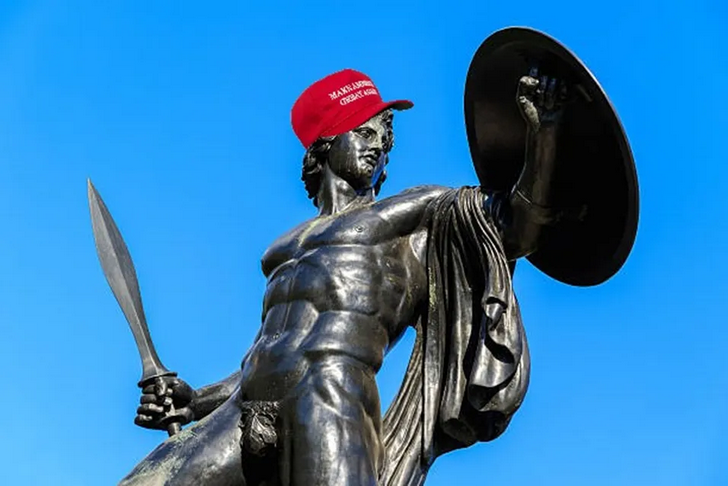
The Long Twentieth Century has been characterized by these three interlinked post-war projects: the progressive opening of societies through the deconstruction of norms and borders, the consolidation of the managerial state, and the hegemony of the liberal international order. The hope was that together they could form the foundation for a world that would finally achieve peace on earth and goodwill between all mankind. That this would be a weak, passionless, undemocratic, intricately micromanaged world of technocratic rationalism was a sacrifice the post-war consensus was willing to make.
That dream didn’t work out, though, because the “strong gods” refused to die.
Mary Harrington recently observed that the Trumpian revolution seems as much archetypal as political, noting that the generally “exultant male response to recent work by Elon Musk and his ‘warband’ of young tech-bros” in dismantling the entrenched bureaucracy is a reflection of what can be “understood archetypally as [their] doing battle against a vast, miasmic foe whose aim is the destruction of masculine heroism as such”. This masculine-inflected spirit was suppressed throughout the Long Twentieth Century, but now it’s back. And it wasn’t, she notes, “as though a proceduralist, managerial civilization affords no scope for horrors of its own”. Thus now “we’re watching in real time as figures such as the hero, the king, the warrior, and the pirate; or indeed various types of antihero, all make their return to the public sphere”.
Instead of producing a utopian world of peace and progress, the open society consensus and its soft, weak gods led to civilizational dissolution and despair. As intended, the strong gods of history were banished, religious traditions and moral norms debunked, communal bonds and loyalties weakened, distinctions and borders torn down, and the disciplines of self-governance surrendered to top-down technocratic management. Unsurprisingly, this led to nation-states and a broader civilization that lack the strength to hold themselves together, let alone defend against external threats from non-open, non-delusional societies. In short, the campaign of radical self-negation pursued by the post-war open society consensus functionally became a collective suicide pact by the liberal democracies of the Western world.
But, as reality began to intrude over the past two decades, the share of people still convinced by the hazy promises of the open society steadily diminished. A reaction began to brew, especially among those most divorced from and harmed by its aging obsessions: the young and the working class. The “populism” that is now sweeping the West is best understood as a democratic insistence on the restoration and reintegration of respect for those strong gods capable of grounding, uniting and sustaining societies, including coherent national identities, cohesive natural loyalties, and the recognition of objective and transcendent truths.
Today’s populism is more than just a reaction against decades of elite betrayal and terrible governance (though it is that too); it is a deep, suppressed desire for long-delayed action, to break free from the smothering lethargy imposed by proceduralist managerialism and fight passionately for collective survival and self-interest. It is the return of the political to politics. This demands a restoration of old virtues, including a vital sense of national and civilizational self-worth. And that in turn requires a rejection of the pathological “tyranny of guilt” (as the French philosopher Pascal Bruckner dubbed it) that has gripped the Western mind since 1945. As the power of endless hysterical accusations of “fascism” has gradually faded, we have – for better and worse – begun to witness the end of the Age of Hitler.


