
Real Time History
Published 18 Oct 2024November 1939. Germany and the Soviet Union have conquered Poland, and Germany is at war with France and Britain. Moscow is free to do as it pleases in Eastern Europe and sets its sights on Finland – but the Winter War will be a nasty surprise for Stalin.
Corrections:
02:19 The dot marking Leningrad is about 80km too far east, it’s of course directly at the far eastern end of the Gulf of Finland.
(more…)
March 7, 2025
Soviet Invasion of Finland: Winter War 1939-40
Comments Off on Soviet Invasion of Finland: Winter War 1939-40
QotD: Infantry combat and esprit de corps
What about the personal relationships that are formed in the context of conflict? Surely, the “band of brothers” is a truly universal experience, right (but note on the complexities of Shakespeare’s Henry V)? Surely the social bonds that held Easy Company together in 1944 and 1945 are the same as those from 1415? Or 415?
Well, no. Not quite.
We can approach this question through the idea of cohesion – the moral force that holds a group of combatants together on the battlefield under the intense emotional stresses of combat. The intense bonds that soldiers form in modern armies (particularly those in the European pattern) are not an accident, but a core part of how those armies, institutionally, seek to build cohesion. [W]e discussed briefly the emergence of the extensively drilled and disciplined “mechanical” soldier of Early Modern Europe, noting that this approach wasn’t necessary for the effective use of firearms (the Ottoman Janissaries, for instance, were quite good with firearms, but were not trained and organized in this way), but rather was a product of elite aristocratic (read: officer) disdain for their up-jumped peasant soldiers and thus the assumption by those aristocrats that the only way to get such men to fight effectively was to relentlessly drill them.
Now the funny thing about this system is that it clearly worked, but not for the reasons its aristocratic pioneers believed. It was only really after the Second World War that systematic study began to be made of unit cohesion (e.g. S.L.A. Marshall, Men Against Fire (1947), though subsequent literature on the topic is voluminous and Marshal’s work has its problems, but its conclusions are broadly accepted having been confirmed in subsequent studies) [NR: Some discussion on Marshall and his theories here]. What emerged quite clearly was that it wasn’t “the cause” or patriotism that held troops together under fire, but group cohesion born out of an intense need not to let fellow soldiers in the unit down. In short, what held units together and made them fight more effectively was (in part, there are many conclusions in Men Against Fire) the strong social bonds between comrades.
And, in fact, the drill and discipline of early modern European armies unintentionally did quite a lot of cohesion building things. Soldiers were removed from civilian society (isolation from larger groups builds unit cohesion), split into very small groups (keeping the core group that coheres below Dunbar’s number aids in group cohesion; thus why the platoon is a natural unit size) and then pushed through difficult and unpleasant training (that drill and discipline) creating a sense of unique shared experience and sacrifice. All of which doesn’t render men machines, but it does create strong social bonds within the units that will keep the men fighting even when they care little for their cause (which they generally did in this period; one does not find a super-abundance of patriotism among, say, the Army of Flanders).
And there is a tendency to point to this cohesion, its modern source in “toughening” boot camp and to say, “aha! That is the true universal about effective soldier-warriors!” Except – and you knew there was going to be an except – except it isn’t. Systems built on the use of drill and discipline for the development of unit cohesion through social bonds are actually, historically speaking, quite rare. We see systems like that in use by the Romans from the Middle Republic forward (but significantly faded by the end of late antiquity; the Byzantine army doesn’t seem to function this way), in China from the Han Dynasty onward, in Japan for the ashigaru infantry from the Sengoku period, and in Europe from the Early Modern period. That sounds like a lot, but that is relatively small minority of the historical period and even then in a relatively small minority of places. It is, for instance, a period that only covers about half of the historical period in Western Europe, the place most often associated with this very system of organization (though that association is perhaps unfair to East Asia).
Instead, most societies relied on existing social bonds formed outside of the experience of war for cohesion. Greek hoplite armies, for instance, generally formed up by polis (read: city) and then within those blocks by still smaller and smaller social divisions, so that family and neighbors would be standing shoulder to shoulder in the battle line (Sparta does this through the system of communal messes, the syssitia, but the idea that you fought alongside the men you dined with socially – your neighbors, generally – was perfectly normal in most Greek cities). That was intentional – it allowed the phalanx to cohere through the social pressure not to be seen as a coward before the men who meant the most to you, whose shaming gaze you would have to endure in civilian life. The same pressures, by the well, held together the (mostly volunteer) armies of the American Civil War (on this, see, McPherson, For Cause and Comrades (1997)).
By contrast, “warrior” classes often rely on a sort of class solidarity along with the demand of an individual military aristocrat to be individually militarily excellent. Richard Kaeuper quips of the literature of the medieval knightly class that it was filled with “utterly tireless, almost obsessional emphasis placed on personal prowess” (R.W. Kaeuper, Chivalry and Violence in Medieval Europe (1999)). We’ve talked a fair bit about the values of mounted aristocrats, both in their role as combatants and in their roles as generals and those values are relatively disconnected from discipline-induced forms of buddy-cohesion. Of course exactly what “good generalship” or “good officership” looks like varies wildly from place to place – Alexander was expected to command his cavalry from the front; Roman emperors rarely took the battlefield and when they did they commanded from the rear since it would be foolish to risk the “brain” of the army in personal combat and in any event someone at the front of a cavalry charge can hardly direct the rest of the army.
One of the things I find most striking about the “warrior ethos” advanced by writers like Pressfield is that it accepts as normal the unique nature of the bonds that hold soldiers together in battle, assuming this bond and its shared sacrifice to be at once unique to combat and also transcendent to all combatants. But one of the key points made very well in Sebastian Junger’s War (2010) and later Tribe (2016) is just how strange that experience is, historically. Junger notes that in earlier societies, soldiers would have returned from war into communities (often small, agricultural communities or tribal communities) every bit as close-knit as the infantry platoon – and indeed, often involving literally the same people as the infantry platoon. Instead, the intense feeling of uniqueness that modern soldiers feel about the bonds of combat is because of the historically unusual deracination produced by modern societies by the industrial revolution and the post-industrial period.
Bret Devereaux, “Collections: The Universal Warrior, Part IIb: A Soldier’s Lot”, A Collection of Unmitigated Pedantry, 2021-02-05.
Comments Off on QotD: Infantry combat and esprit de corps
March 6, 2025
Passionate belief in historical untruths
As mentioned in earlier posts, one of the most toxic exports from Australia to the rest of the Anglosphere has been the academic indulgence in believing that “settler colonialism” explains everything about the history of Canada, Australia, New Zealand and anywhere else the British diaspora touched:

Welby in Zanzibar
Throughout the English-speaking world elites are falling over themselves to believe the very worst of their own countries.
In Britain, the Church of England has committed itself to spend an initial £100 million on slavery-reparations in response to the discovery that its endowment had “links” with African enslavement. “The immense wealth accrued by the Church … has always been interwoven with the history of African chattel enslavement”, a document explains. “African chattel enslavement was central to the growth of the British economy of the 18th and 19th centuries and the nation’s wealth thereafter”. And this has “continuing toxic consequences”.
Yet almost none of this is true. The evidence shows that the Church’s endowment fund was hardly involved in the evil of slave-trading at all. Most economic historians reckon the contribution of slave-trading and slavery to Britain’s economic development as somewhere between marginal and modest. And between abolition in 1834 and the present, multiple causes have intervened to diminish slavery’s effects.
Consonant with his church’s policy, the (then) Archbishop of Canterbury, Justin Welby preached a sermon in Christ Church Cathedral, Zanzibar last year, in which he criticised Christian missionaries for treating Africans as inferior and confessed that “we [British] must repent and look at what we did in Zanzibar”.
Really? What the British did in Zanzibar during the second half of the 19th century was to force the Sultan to end the slave-trade. Indeed, the cathedral in which the archbishop was preaching was built over the former slave-market. And here’s what the pioneering missionary David Livingstone wrote about black Africans in 1871: “I have no prejudice against [the Africans’] colour; indeed, anyone who lives long among them forgets they are black and feels that they are just fellow men…. If a comparison were instituted, … I should like to take my place among [them], on the principle of preferring the company of my betters”.
[…]
St. John Baptiste church was one of many local churches to go up in flames during Justin Trudeau’s performative national guilt trip over “unmarked mass graves” at former Residential Schools across Canada.
Which bring us to Canada. The May 2021 claim by a Kamloops Indian band to have discovered the remains of 215 “missing children” of an Indian Residential School was quickly sexed up by the media into a story ‘mass graves’, with all its connotation of murderous atrocity. The Toronto Globe and Mail published an article under the title, “The discovery of a mass gravesite at a former residential school in Kamloops is just the tip of the iceberg”, in which a professor of law at UBC wrote: “It is horrific … a too-common unearthing of the legacy, and enduring reality, of colonialism in Canada”. Prime Minister Justin Trudeau ordered Canadian flags to be flown at half-mast on all federal buildings to honour the murdered children. Because the Kamloops school had been run by Roman Catholics, some zealous citizens took to burning and vandalising churches, 112 of them to date. The dreadful tale was eagerly broadcast worldwide by Al Jazeera.
Yet, four years later, not a single set of remains of a murdered Indian child in an unmarked grave has been found anywhere in Canada. Judging by the evidence collected by Chris Champion and Tom Flanagan in their best-selling 2023 book, Grave Error: How the Media Misled us (and the Truth about the Residential Schools), it looks increasingly probable that the whole, incendiary story is a myth.
So, prime ministers, archbishops, academics, editors, and public broadcasters are all in the business of exaggerating the colonial sins of their own countries against noble (not-so-very) savages — from London to Sydney to Toronto. Why?

Comments Off on Passionate belief in historical untruths
The Iron Curtain Descends – W2W 10 – News of 1946
TimeGhost History
Published 5 Mar 20251946 sees the world teetering on the brink of a new global conflict. George Kennan’s long telegram outlines Moscow’s fanatical drive against the capitalist West, while our panel covers escalating espionage, strategic disputes over Turkey, and the emerging ideological battle between the U.S. and the USSR. Tune in as we break down the news shaping the dawn of the Cold War.
(more…)
Comments Off on The Iron Curtain Descends – W2W 10 – News of 1946
HMCS Bonaventure – The Pride of Canada’s Fleet
Skynea History
Published 22 Oct 2024For today’s video, we’ll be looking at the last of Canada’s aircraft carriers. Not typically a navy you associate with that kind of ship, but the Canadians actually operated three during the Cold War.
The third, HMCS Bonaventure, is an interesting one. A small ship, that operated aircraft at the very edge of her capability. And routinely baffled American pilots in the process.
Yet, she was also a ship that came to an end before her time. Decommissioned and scrapped, right after an expensive (and extensive) mid-life overhaul. In what is generally seen as a bad political move, more than anything to do with her capabilities.
(more…)
Comments Off on HMCS Bonaventure – The Pride of Canada’s Fleet
QotD: Old Etonians
When I first started there, the traditions seemed daunting, and while you had a week of grace period to find your feet, it took a lot longer for the novelty truly to wear off. Dressed in a tailsuit that makes you look like a penguin, and that even the production team of Downton Abbey would question, it’s a complete culture shock. Teachers become “beaks”; homework becomes “EW (short for Extra Work)”, and the threat of “tardy book” (a punishment where you have to get up early to report to the School Office) is ever present. Your life is governed by a tutor, housemaster, and dame (a surrogate mother for your time there, and the most influential person in your day-to-day life), and outside of lessons (known as “schools”) you’re left to your own devices. It’s a sink or swim situation, and some can’t hack the overload of independence.
You’re constantly surrounded by things named after great men who have come before you – whether that be John Maynard Keynes (an economics society) or William Gladstone (a library) – and you can’t help but see yourself as heir to some great dynasty. Sitting in Upper School – a large schoolroom now mainly used for talks by visiting speakers – the walls are lined with marble busts of illustrious Old Etonians past, and it’s not hard to daydream about joining them. In our first ever assembly the head master put it best: “If you know that some interesting people have gone on to do some interesting things, whether it’s George Orwell or the Duke of Wellington, that does implicitly ask the question, why not you?” Success never seems far away, and often you’re regaled with tales about the time your beak caught a famous actor smoking, or how awful a pupil a noted academic once was. Neither does service, particularly when you pass the memorial boards for the First World War (as you do daily on the way to chapel): 1157 Old Etonians died, and 37 Old Etonians have won the Victoria Cross – 17 more than any other school.
In your final years, it’s fun to try and work out who’s going to be most successful after leaving, and – it never seems too outlandish – who among you could be a future prime minister. The people you consider are never confined to a particular group – it’s not “one of the debaters” or “one of the Rugby XV” – in fact, it’s often those who you can’t seem to categorize, or transverse the groups that are most magnetic. To get into Eton, you have to do well in the infamous “List Test”, composed of a computerized assessment and an interview with one of the beaks. For an eleven year old, it can be brutal (one boy left crying midway through our test), particularly as you don’t know what they want: they’re not looking for candidates that fit a particular box. Potential is valued more than current ability, and the greatest asset is that of being interesting. With only one in five getting an offer (odds stiffer than Oxbridge), and after five years of being expected to perform at the highest level, it’s unsurprising that students end up so successful.
Ivo Delingpole, “Boris and the Spirit of Eton”, Die Weltwoche, 2020-01-29.
Comments Off on QotD: Old Etonians
March 5, 2025
The Korean War 037 – Matt the Ripper! – March 4, 1951
The Korean War by Indy Neidell
Published 4 Mar 2025This week is really a week of planning, as Matt Ridgway unveils the plans for Operation Ripper — to follow the somewhat disappointing Operation Killer, but there are South Korean spies involved, the blockade of Wonsan, and the continuing escalation of tensions between Douglas MacArthur and Harry Truman, with people in American High Command concerned that MacArthur is bent on starting World War 3.
Chapters
00:00 Intro
00:25 Recap
00:44 Killer and Ripper
04:14 Intel and Distractions
06:57 South Korean Spies
08:06 Truman and MacArthur (Again)
(more…)
Comments Off on The Korean War 037 – Matt the Ripper! – March 4, 1951
QotD: British and French Enlightenments
By the time she wrote, a number of historians had accepted that the Enlightenment, once characterized as the “Age of Reason”, came in two versions, the radical and the skeptical. The former was identified with France, the latter with Scotland. Historians of the period also acknowledged that the anti-clericalism that obsessed the French philosophes was not reciprocated in Britain or America. Indeed, in both the latter countries many Enlightenment concepts — human rights, liberty, equality, tolerance, science, progress — complemented rather than opposed church thinking.
Himmelfarb joined this revisionist process and accelerated its pace dramatically. She argued that, central though many Scots were to the movement, there were also so many original English contributors that a more accurate name than the “Scottish Enlightenment” would be the “British Enlightenment”.
Moreover, unlike the French who elevated reason to a primary role in human affairs, British thinkers gave reason a secondary, instrumental role. In Britain it was virtue that trumped all other qualities. This was not personal virtue but the “social virtues” — compassion, benevolence, sympathy — which British philosophers believed naturally, instinctively, and habitually bound people to one another. This amounted to a moral reformation.
In making her case, Himmelfarb included people in the British Enlightenment who until then had been assumed to be part of the Counter-Enlightenment, especially John Wesley and Edmund Burke. She assigned prominent roles to the social movements of Methodism and Evangelical philanthropy. Despite the fact that the American colonists rebelled from Britain to found a republic, Himmelfarb demonstrated how very close they were to the British Enlightenment and how distant from French republicans.
In France, the ideology of reason challenged not only religion and the church, but also all the institutions dependent upon them. Reason was inherently subversive. But British moral philosophy was reformist rather than radical, respectful of both the past and present, even while looking forward to a more enlightened future. It was optimistic and had no quarrel with religion, which was why in both Britain and the United States, the church itself could become a principal source for the spread of enlightened ideas.
In Britain, the elevation of the social virtues derived from both academic philosophy and religious practice. In the eighteenth century, Adam Smith, the professor of moral philosophy at Glasgow University, was more celebrated for his Theory of Moral Sentiments (1759) than for his later thesis about the wealth of nations. He argued that sympathy and benevolence were moral virtues that sprang directly from the human condition. In being virtuous, especially towards those who could not help themselves, man rewarded himself by fulfilling his human nature.
Edmund Burke began public life as a disciple of Smith. He wrote an early pamphlet on scarcity which endorsed Smith’s laissez-faire approach as the best way to serve not only economic activity in general but the lower orders in particular. His Counter-Enlightenment status is usually assigned for his critique of the French Revolution, but Burke was at the same time a supporter of American independence. While his own government was pursuing its military campaign in America, Burke was urging it to respect the liberty of both Americans and Englishmen.
Some historians have been led by this apparent paradox to claim that at different stages of his life there were two different Edmund Burkes, one liberal and the other conservative. Himmelfarb disagreed. She argued that his views were always consistent with the ideas about moral virtue that permeated the whole of the British Enlightenment. Indeed, Burke took this philosophy a step further by making the “sentiments, manners, and moral opinion” of the people the basis not only of social relations but also of politics.
Keith Windschuttle, “Gertrude Himmelfarb and the Enlightenment”, New Criterion, 2020-02.
Comments Off on QotD: British and French Enlightenments
March 4, 2025
FDR – behind closed doors – was as bad as Trump while the Dunkirk evacuation was going on
Winston Churchill became prime minister of Britain the same day the Germans launched their attack against France and the Low Countries in May, 1940. The situation went from bad to appalling in very short order as the vaunted French army’s high command crumbled under the stress (even if the soldiers fought bravely in most cases). The British Expeditionary Force retreated with the French mobile forces toward the English Channel, eventually evacuating as many troops as they could from the port of Dunkirk. During this time, Churchill was appealing to the American President Franklin D. Roosevelt for whatever aid he could send.
Postwar histories tended to portray FDR as both benevolent and helpful toward Churchill in this stressful period, but behind closed doors FDR was far less a future ally, as Andreas Koureas explained on Twitter:
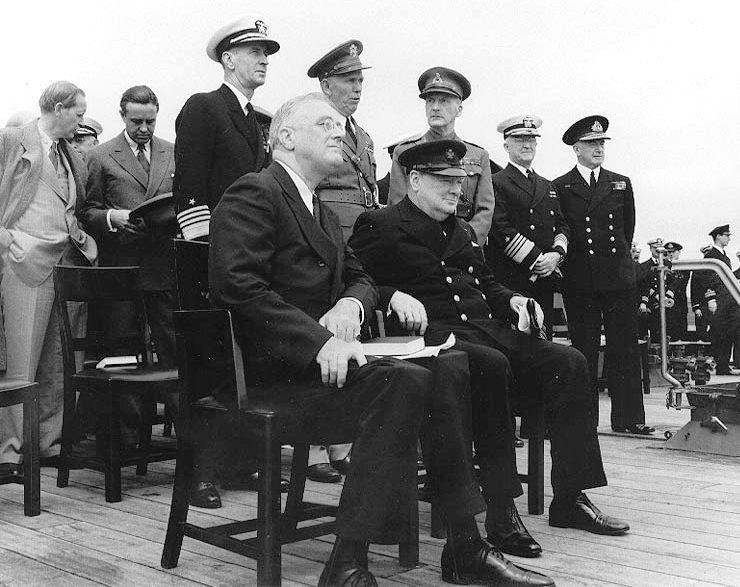
More than a year after FDR’s attempt to pry Canada and the Royal Navy away from a “dying” Britain, he and Churchill met onboard HMS Prince of Wales, in Placentia Bay, Newfoundland, during the Atlantic Charter Conference. President Franklin D. Roosevelt (left) and Prime Minister Winston Churchill are seated in the foreground. Standing directly behind them are Admiral Ernest J. King, USN; General George C. Marshall, U.S. Army; General Sir John Dill, British Army; Admiral Harold R. Stark, USN; and Admiral Sir Dudley Pound, RN. At far left is Harry Hopkins, talking with W. Averell Harriman.
US Naval Historical Center Photograph #: NH 67209 via Wikimedia Commons.
Ironically, the truth is that in 1940, Roosevelt — behind closed doors — behaved worse than Trump.
On the 20th May 1940, after multiple failed pleas for aid, Churchill wrote to Roosevelt that:
“If members of the present administration were finished and others came in to parley amid the ruins, you must not be blind to the fact that the sole remaining bargaining counter with Germany would be the fleet, and if this country was left by the United States to its fate no one would have the right to blame those then responsible if they made the best terms they could for the surviving inhabitants. Excuse me, Mr. President, putting this nightmare bluntly.”
Roosevelt’s refusal for aid was understandable given the political situation in America. As he told Churchill earlier that month, it wasn’t “wise for that suggestion to be made to the Congress at this moment”.
However, what he did after the 20th May telegram wasn’t.
Not bothering to even reply to Churchill’s warnings, Roosevelt instead sought to get Canada to give up on Britain.
As Roosevelt thought that Britain would likely collapse, and Churchill could not be trusted to maintain the struggle, he summoned a delegation for Canada.
The aim was to get Canada to pester Britain to have the Royal Navy sent across the Atlantic, before Britain’s seemingly-inevitable collapse.
Furthermore, to ensure this, the Americans wanted Canada to encourage the other British Dominions to get on board such a plan, and likewise gang up against Britain.
You can see Mackenzie King’s (PM of Canada) disbelief and horror in his diary,
“The United States was seeking to save itself at the expense of Britain. That it was an appeal to the selfishness of the Dominions at the expense of the British Isles. […] I instinctively revolted against such a thought. My reaction was that I would rather die than do aught to save ourselves or any part of this continent at the expense of Britain.”
King telegrammed Churchill on the 30th May that this was the closed-door political situation across the Atlantic.
Bear in mind, Roosevelt was trying to instigate this during the Dunkirk evacuations.
How Churchill didn’t break knowing the one ally he needed in his darkest hour thought he’d fail, I have no idea.
On the 5th June 1940, Churchill wrote back to Mackenzie King,
“We must be careful not to let the Americans view too complacently prospect of a British collapse, out of which they would get the British Fleet and the guardianship of the British Empire, minus Great Britain. […] Although President [Roosevelt] is our best friend, no practical help has been forthcoming from the United States as yet.”
(The first key mover that swung Roosevelt into entrusting Churchill to continue the struggle — and as such aid would not be wasted on Britain — was when Churchill ordered the Royal Navy’s Force H to open fire and destroy the French Fleet at Mers-el-Kébir — after Admiral Gensoul had refused the very reasonable offers from Britain, despite Germany and Italy demanding the transference of the French Fleet as part of the armistices.)
Comments Off on FDR – behind closed doors – was as bad as Trump while the Dunkirk evacuation was going on
The Titanic Survivors Arrive in New York – Hamilton Pudding
Tasting History with Max Miller
Published 18 Oct 2024A tart with apricot jam topped with a vanilla cookie-like filling, and toasted meringue
City/Region: Carpathia | United Kingdom | United States of America
Time Period: 1903 | 1912The menu from the last meal aboard RMS Carpathia before it docked in New York, carrying the survivors of the Titanic, lists Pouding Hamilton as one of the dessert options. After a fruitless search of my late 19th- and early 20th-century cookbooks, I finally found one recipe for it in a newspaper from 1903.
Honestly, I don’t know why there isn’t more mention of this tart. It’s delicious. The texture has kind of a wonderful crumbly shortcrust quality to it, and it’s not too sweet. It’s reminiscent of a vanilla cookie with jam, and you could really swap out the apricot jam for any flavor you like. I could see this being a great dessert for the holidays.
Hamilton Pudding –
Line a pie dish with a good short crust and cover the bottom with a layer of apricot jam; then fill up with the following mixture: Cream three ounces of butter with the same quantity of caster sugar, then add the yolks of two well beaten eggs and the white of one. Sift in by degrees three ounces of flour and flavor with a few drops of vanilla essence. Bake in a moderate oven and when nearly cooked beat the remaining white of egg to a stiff froth and lay it on top in tough lumps. Return the pudding to the oven till it is slightly browned.
— The Gazette, York, Pennsylvania, Sunday, August 9, 1903.
Comments Off on The Titanic Survivors Arrive in New York – Hamilton Pudding
March 3, 2025
Is DOGE merely uncovering what used to be called “honest” graft?
Jon Miltimore explains where the expression “honest graft” came from and gives examples of what the DOGE investigations have turned up so far:

In 1905, George Washington Plunkitt made arguably the most famous defense of political graft in American history.
“Everybody is talkin’ these days about Tammany men growin’ rich on graft,” the New York state senator and Tammany Hall member wrote, “but nobody thinks of drawin’ the distinction between honest graft and dishonest graft”.
Plunkitt was responding to The Shame of the Cities, a book by journalist Lincoln Steffens that exposed sweeping political corruption in U.S. cities.
The ward boss’s shameless defense of “honest graft”, which is still assigned to undergraduates a century after Plunkitt’s death, comes to mind when looking at the fraud, waste, and abuse Elon Musk’s Department of Government Efficiency and others are uncovering.
To take but one example, consider the billions of dollars in taxpayer funds the Environmental Protection Agency awarded last year to Power Forward Communities. If you’ve never heard of the nonprofit group, you’re forgiven. Almost nobody has — because it didn’t exist until late 2023.
Power Forward Communities had no footprint, online or otherwise, until October 2023, when it was announced as part of the Rewiring America program, an organization linked to former Georgia Democratic gubernatorial candidate Stacey Abrams, which says its mission is “all about Rewiring America’s values, people, and culture.”
Less than a year after its creation, Power Forward Communities was awarded $2 billion via the EPA’s National Clean Investment Fund — even though it reported just $100 in revenue during its first three months of operation.
The payment, which is slated to continue through June 2031, caught the attention of Lee Zeldin, the new EPA administrator.
“It’s extremely concerning that an organization that reported just $100 in revenue in 2023 was chosen to receive $2 billion,” Zeldin said.
Indeed. It’s graft on a scale the Tammany Hall charlatans couldn’t have imagined.
Historical sources say 19th-century politician Boss Tweed and his ring of cronies took in at least $50 million in corrupt money in backroom deals, kickbacks, and skimming before Tweed was convicted of larceny and forgery in 1873 and fled to Cuba, and later Spain. In 2025 dollars, that’s about $1.3 billion — considerably less than the single payoff former President Joe Biden’s EPA awarded Power Forward Communities.
Europe’s Imperial Giants: On the Brink of Collapse? – W2W 09 Q4 1946
TimeGhost History
Published 2 Mar 2025In 1946, Britain, France, and the Netherlands fight to regain control over shattered colonies — from Indonesia’s revolt to Vietnam’s war with France. Meanwhile, the U.S. and USSR maneuver to shape these emerging nations for their own global interests. Will independence spark true liberation, or will it simply swap one master for another?
(more…)
Comments Off on Europe’s Imperial Giants: On the Brink of Collapse? – W2W 09 Q4 1946
All The Basics About XENOPHON
MoAn Inc.
Published 7 Nov 2024I actually found this video really tricky considering I want to go into the texts of Xenophon and if I told you everything about the march of the ten thousand then I would have just told you the whole Anabasis?? Which defeats the whole purpose of an introductory video?? So I PROMISE more clarity will come in future videos as Xenophon himself breaks down his journey home from Persia and why they were there in the first place. Therefore, you have ALL OF THAT to look forward to — coming soon!!!
(more…)
Comments Off on All The Basics About XENOPHON
March 2, 2025
Which is better – Spitfire or Bf 109? – Battle of Britain Fireside Chat
World War Two
Published 1 Mar 2025Indy and Sparty answer questions about the Battle of Britain! Spitfire vs Bf 109, the Big Wing Debate, and whether Goering had any kind of plan for the battle.
(more…)
Comments Off on Which is better – Spitfire or Bf 109? – Battle of Britain Fireside Chat
The Mexican Revolution – Bandits Turned Heroes
The Great War
Published 11 Oct 2024The Mexican Revolution of 1910-1920 was a conflict of shifting alliances and assassinations, peasant revolutionaries, an attack on US soil, and US intervention in Mexico. The decade of struggle cost hundreds of thousands of lives, resulted in new constitutions and governments, and — for some at least — turned bandits into heroes.
(more…)
Comments Off on The Mexican Revolution – Bandits Turned Heroes


