
toldinstone
Published 25 Apr 2025Chapters:
0:00 Introduction
0:53 Introducing hieroglyphs
2:15 Hieroglyphs in Roman Egypt
3:10 The great temples
3:53 Decline of the temples
5:04 FlexiSpot
6:28 Vanishing hieroglyphs
7:40 Roman ignorance of hieroglyphs
8:44 Hieroglyphica
9:28 Mysterious or powerless
September 1, 2025
How did the Egyptians forget Hieroglyphs?
Comments Off on How did the Egyptians forget Hieroglyphs?
August 31, 2025
What Would Donald Sutherland Say About This? – Blooper Reel
World War Two
Published 30 Aug 2025People think that we’re perfect hosts, almost robotic in our perfection in our task of presenting history. Well, that is true. We are perfect. However, there are some people out there that look just like us, and they screw up all the time. Here’s a chance to see them in action.
(more…)
Comments Off on What Would Donald Sutherland Say About This? – Blooper Reel
Military-Issue Colt Model 1839 Paterson Revolving Rifle
Forgotten Weapons
Published 23 Apr 2025The first rifle made in Sam Colt’s Paterson NJ factory was the 1837 “ring lever” rifle. These were rather fragile and underpowered and while they were used successfully in the First Seminole War, they needed improvement. Colt set about doing this with his 1839 pattern, which was more robust and more powerful. It had six chambers of .525″, with much greater powder capacity than the first Colt revolving rifles. A total of about 950 were made before the Paterson company failed in 1842, and nearly 700 of those were military sales. The US War Department bought 360 (including this example), the Republic of Texas bought 300, and the State of Rhode Island bought 46 — the rest were sold to private companies or individuals. Despite its improvements, though, the 1839 revolving rifle was still not a mature design and was not successful enough to keep Colt in business.
Colt 1837 Ring-Lever Rifle: Sam Colt’s Paterson No1 Model Carbine
Colt 1847 Walker Revolver: 1847 Walker Revolver: the Texas Behemoth
(more…)
Comments Off on Military-Issue Colt Model 1839 Paterson Revolving Rifle
QotD: The “working” world
In the dark days of the early 1970s, Britain was obliged by a coal-miners’ strike to go on to a three-day working week (our power stations were then mostly coal-fired, and hence there was a shortage of power). Strictly speaking, production should have declined by 40 per cent, but instead declined only by 20 per cent. This surely meant that, on average, people spent one day at work completely unproductively, which will come as a surprise only to those who have never worked in an enterprise or organisation of any kind.
In other words, at least a fifth of our working time is spent doing nothing, or rather nothing productive. Most people are incapable of doing nothing, in the strict sense that a meditator does nothing. Moreover, much of their activity may not merely be unproductive but positively counterproductive, in so far as most people at work feel obliged to do something, and by far the easiest thing for them to do with their superfluous time is to obstruct others, to have unnecessary meetings and so forth.
If taken seriously, not only offices, but millions of journeys to offices, would become unnecessary, pollution would decline and leisure time would increase. This latter would be a disaster, since most people do not know what to do with themselves as it is. It is for this reason that work is not arranged as efficiently as possible, but its productive aspect is diluted by myriad unnecessary tasks — unnecessary, that is, from the narrow point of view of production. Except in the factories of the East, where production is all, a great deal of work is designed to keep us occupied while we produce nothing. It ameliorates boredom and prevents the bad behaviour in which boredom results.
Anthony Daniels, “The Pleasant Embrace of Fear”, Quadrant, 2020-05-06.
Comments Off on QotD: The “working” world
August 30, 2025
HBO’s Rome – Ep 9 “Utica” and Ep 10 “Triumph” – History and Story
Adrian Goldsworthy. Historian and Novelist
Published 26 Mar 2025This time we look at Episode 9, which begins with the aftermath of the Battle of Thapsus in 46 BC and also Episode 10 which focuses on Caesar’s Triumph — one rather than the four he celebrated over the course of several weeks in 46 BC. There is less history and more character-driven elements in these two episodes, so to make the video the same sort of length as the others in the series, I have combined the two.
00:00 Episode 9 “Utica”
19:48 Episode 10 “Triumph”
Comments Off on HBO’s Rome – Ep 9 “Utica” and Ep 10 “Triumph” – History and Story
August 29, 2025
Memories of Bournemouth
It’s nearly sixty years since my family emigrated, but I still have golden memories of the family trips to the seaside, although my family went to Scarborough, Whitby, and Redcar rather than the Bournemouth of Pimlico Journal‘s childhood:
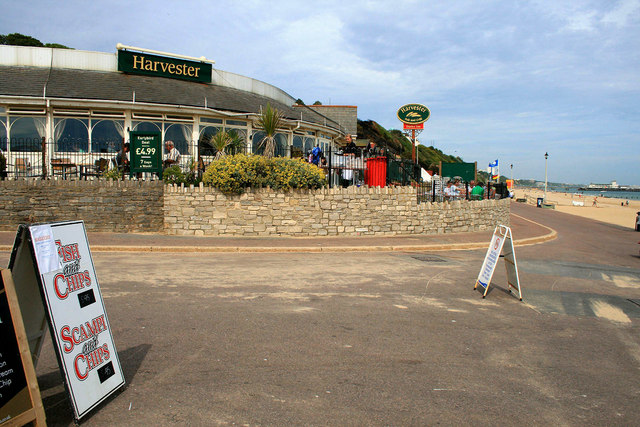
“Harvester at Durley Chine” by David Lally is licensed under CC BY-SA 2.0 

 .
.
At every possible opportunity in the summer weekends of my childhood, my father would take our family down to the coast. Our route to the sea was normally through the medieval city of Salisbury, across the chalk downs of Hardy’s Wessex, and into the piney moors of the New Forest. The destination would nearly always be Bournemouth, the prim, stately model of the British seaside town, perched magisterially on Dorset’s sandstone cliffs, above a long golden strand lapped by the warm waves of the Channel.
Our favourite beach was at Durley Chine, where we could park (for free, greatly appealing to my father) among obscured mansions in the shade of thick-smelling conifers, and make our descent to the shore, where the chine gives way to the rows of huts that line the promenade, and a reassuringly lower-middle class Harvester restaurant. We would while away the hours on the sand until the sky was orange, my mother reading, my father swimming, and my brother and I playing whatever games we could devise, mostly involving the throwing of sand. The day would end with fish and chips under the pines, watching the sun sink over the jurassic cliffs past Poole harbour, the gateway to King Alfred’s stronghold at Wareham.
These were among the most precious times of my early life, and the sights and sounds and smells of that part of the world and the accompanying hazy, worriless bliss are cherished sensations. Though the beach is public, it was one of those places that felt special and individual to my family, as if we had somehow carved out our own summer fief on the crowded shore.
It was on Durley Chine beach, on 24 May 2024, that two innocent women, Amie Grey and Leanne Miles, were attacked by Nasen Saadi, a criminology student from Croydon of Iraqi and Thai heritage. Saadi murdered Grey and left Miles in critical condition, and was sentenced this year to thirty-nine years in prison for his crimes. The incident was part of an escalating pattern of violence, particularly sexual violence, in the Bournemouth area over the past few years, with the beach as the focal point, a pattern which had begun in July 2021 with the brutal rape of a 15-year-old girl by Gabriel Marinoaica, a young man from Walsall who dragged his victim into the sea to commit his attack. Another notable incident occurred eight months later. Afghan asylum seeker and convicted killer Lawangeen Abdulrahimzai (he had shot two fellow Afghans while living illegally in Serbia in 2018, before fleeing to Norway, where his asylum claim was rejected, then travelling to Britain and successfully claiming asylum by pretending to be an unaccompanied fourteen-year-old, despite being an adult) stabbed Thomas Roberts (a local man and qualified precision engineer who had recently applied to join the Royal Marines) to death outside a Subway in the city centre, in a dispute over an e-scooter.
The news stories become relentless from that point. Among many depravities are the sexual assault of a 17-year-old boy by a group of Asian males on 17 June 2023, accompanied the same day by an attempted assault on a 16-year-old girl outside the fish and chip shop on the seafront. A week later, two girls, aged just 10 and 11, who would have been in primary school at the time, were sexually assaulted while swimming in the sea. As far as I can tell, none of these crimes have yet been prosecuted.
Two months after the murder of Amie Grey, on 19 July 2024, a day of delirious warmth culminated in violent clashes between youths, many coming in from London, on the seafront — clashes which were filmed and circulated on social media. In the chaos, a teenage girl was sexually assaulted. Jessica Toale, the freshly-elected Labour MP for Bournemouth West, a seat which had been Tory since its creation in 1950, said after the events of 19 July that crime and anti-social behaviour had become a ‘huge issue’ in contrast to the safe Bournemouth she remembered as a girl, stating that ‘… parents had told [her] that they are concerned about letting their daughters go to the town’. These are almost reactionary words from a Labour MP, and reflective of the mood of anxiety and decline that seems to have enveloped the city, a mood founded on the series of despair-inducing events plaguing residents and visitors. On 30 June, disorder similar to that witnessed in July last year returned to the seafront, with police making arrests across the country in the aftermath.
A week later, on 6 July, a young woman was raped in a public toilet adjoining the beach. The police have charged Mohammed Abdullah, a Syrian asylum seeker living in West London, with the crime.
Comments Off on Memories of Bournemouth
Poetry corner: “Norman and Saxon” by Rudyard Kipling
“My son,” said the Norman Baron, “I am dying, and you will be heir
To all the broad acres in England that William gave me for share
When he conquered the Saxon at Hastings, and a nice little handful it is.
But before you go over to rule it I want you to understand this:–
“The Saxon is not like us Normans. His manners are not so polite.
But he never means anything serious till he talks about justice and right.
When he stands like an ox in the furrow – with his sullen set eyes on your own,
And grumbles, ‘This isn’t fair dealing,’ my son, leave the Saxon alone.
“You can horsewhip your Gascony archers, or torture your Picardy spears;
But don’t try that game on the Saxon; you’ll have the whole brood round your ears.
From the richest old Thane in the county to the poorest chained serf in the field,
They’ll be at you and on you like hornets, and, if you are wise, you will yield.
“But first you must master their language, their dialect, proverbs and songs.
Don’t trust any clerk to interpret when they come with the tale of their wrongs.
Let them know that you know what they’re saying; let them feel that you know what to say.
Yes, even when you want to go hunting, hear ’em out if it takes you all day.
“They’ll drink every hour of the daylight and poach every hour of the dark.
It’s the sport not the rabbits they’re after (we’ve plenty of game in the park).
Don’t hang them or cut off their fingers. That’s wasteful as well as unkind,
For a hard-bitten, South-country poacher makes the best man-at-arms you can find.
“Appear with your wife and the children at their weddings and funerals and feasts.
Be polite but not friendly to Bishops; be good to all poor parish priests.
Say ‘we’, ‘us’ and ‘ours’ when you’re talking, instead of ‘you fellows’ and ‘I’.
Don’t ride over seeds; keep your temper; and never you tell ’em a lie!”
Comments Off on Poetry corner: “Norman and Saxon” by Rudyard Kipling
The dangers of joining the online hive mind of social media
At The Freeman, Nicole James discusses the experience of being immersed in a social media swarm or hive mind phenomenon:

Ever noticed how your social media feed doesn’t sound like “independent thought” so much as a stadium of people chanting, “Yaasss, queen!” in matching sequins? One minute you’re scrolling idly, the next you’ve been recruited into a sect with better lighting filters and the odd ironic dog meme. All it takes is clicking on one video of a dachshund in a raincoat, and suddenly you’ve been ordained High Priest of Sausage Dogs, condemned to a lifetime of puddle-splash reels and algorithmic sermonizing. That’s the hive mind. It’s the Internet’s favorite parlor trick, turning ordinary humans into synchronized swimmers thrashing about in a soup so murky it makes the Hudson on a hot July afternoon look like Perrier.
Bees and ants nailed this millennia ago: buzzing, working in lockstep, worshipping a terrifying queen—basically the Kardashians of the insect world. But instead of honey, humanity now churns out TikTok dances, Reddit debates about whether Die Hard was a Christmas movie (it wasn’t), and Facebook is where your uncle accidentally joins a cult.
Yet this collective buzz can tip into something darker. Collaboration can harden into groupthink, flattening individuality like a raccoon on the New Jersey Turnpike.
Cristina Dovan, a life coach based in the UK, calls the hive mind “group decision-making where individuals meld into one big throbbing consciousness”. Which sounds noble, and also like the worst hangover imaginable.
Collective intelligence can shine. Wikipedia (on a good day), Reddit’s problem-solving posters, Kaggle competitions, GitHub fixes. It’s a brainstorming session without the burnt office coffee and stale biscuits.
But history, and the Internet, remind us there’s a darker wing.
Psychologist Irving Janis, who coined “groupthink,” pointed to the Bay of Pigs invasion as Exhibit A.
Let’s return to 1961 where JFK is young, popular, and surrounded by Very Serious Men in suits. The CIA pitches a plan to topple Fidel Castro that went roughly like this:
- Train a ragtag bunch of Cuban exiles.
- Drop them on a swampy stretch of coastline actually called the Bay of Pigs (because nothing says “stealth” like announcing your arrival in Pork Bay).
- Hope the Cuban people spontaneously rise and overthrow Castro, preferably in a neat anti-communist conga line.
Everyone in the room knew it sounded dodgy. The beaches were wrong, the surprise was nonexistent, Castro’s army was enormous and very much awake. But instead of saying, “Excuse me, Mr. President, this is bananas”, the advisors all nodded along as if they were trapped in a corporate retreat exercise called Let’s Pretend We’re Bold Visionaries.
The result? A fiasco. Castro’s forces crushed the invaders in three days flat. America looked ridiculous, Kennedy was humiliated, and “Bay of Pigs” became shorthand for “the world’s worst team-building activity”. In short, a textbook case of groupthink, or as we’d call it today, “watching as your drunk mate climbs onto the shed roof, yells that he can backflip, and you cheer instead of calling an ambulance”.
Comments Off on The dangers of joining the online hive mind of social media
The History of Hungarian Goulash
Tasting History with Max Miller
Published 25 Mar 2025Hungarian goulash with beef, paprika, potatoes, and tomato
City/Region: Hungary
Time Period: Late 19th Century, written down in 1935The development and history of goulash mirrors the history of Hungary in a really interesting way, and the story goes something like this:
800s: A group of people from the Ural Mountains called the Magyars settled the area. Being herdsmen, they brought with them a dish of boiled meat or stew.
1400s: The Hungarian king imported Italian ingredients, like onions, and hired Italian chefs to please his new wife, who was from Naples.
1500s: Hungary becomes part of the Ottoman Empire, and thus ingredients like coffee and paprika enter Hungarian cuisine.
1800s: Two brothers invent a machine to remove the seeds and ribs from hot peppers in order to make sweet paprika.
This recipe from the late 19th century reflects all of these developments, with the meat, onions, and sweet paprika. It is so delicious and really easy to make. If you’ve never had real Hungarian goulash (which is a soup, not a thick stew), give this a try!
Bográcsgulyás
1 kg (2 1/4 lb) beef
80 g (5 Tbs) lard
300 g (1 3/4 cups) onion
20 g (4 tsp) paprika
salt, caraway seeds, garlic
1 kg (2 1/4 lb) potato
140 g (1 cup) green pepper
60 g (1 small) fresh tomato
6 portions of soup paste (csipetke, Recipe 14)
Use meat rich in gelatine (shin-beef, blade or neck). Cube the meat into 1.5-2 cm (1/2-3/4 in) pieces. Fry the chopped onion in the melted lard (shortening) until it is golden yellow. Lower the heat, then add the paprika, stir it rapidly, add the meat, keep on stirring, add salt. When the meat is browned and all the liquid is evaporated, add the caraway seeds, finely chopped garlic and a small amount of cold water, cover, and braise the meat slowly. Stir it occasionally and add small quantities of cold water, cover, and braise the meat slowly. Stir it occasionally and add small quantities of water if necessary. The meat should be braised, not boiled. While the meat is cooking, cube the potatoes, green pepper and tomatoes into pieces 1 cm (1/3 in) in size and prepare the dough for the soup pasta (csipetke). Just before the meat is completely tender, reduce the pan juices, add the cubed potatoes, let them brown slightly, add the stock, green pepper and tomato. When the potato is almost cooked and the soup is ready to be served, add the pasta (csipetke), and adjust quantity by the addition of stock or water.
— Károly Gundel, late 19th century
Comments Off on The History of Hungarian Goulash
QotD: The early “Motte and Bailey” castles
But as noted, the personal manor home of a significant noble (the rank in this case is often a “castellan”, literally the keeper of a castle, so entrusted by one of the more powerful nobles who holds sway over a larger territory; the castellan has the job of holding the castle and administering the countryside around it) is also an administrative center, managing the extraction of agricultural surplus from the countryside and also a military base, housing the physical infrastructure for that noble’s retinue, which again is the fundamental building block of larger armies. Which means that it is going to need more structures to house those functions: stables for horses, storehouses for food, possibly food processing facilities (bakeries, mills) and living space both for retainers (be they administrators or military retainers) and for the small army of servants such a household expects. Those structures (to the degree they can’t exist in the keep) are put in the bailey, a wider enclosed part of the settlement constructed at the base of the motte. As with the motte, the bailey is typically enclosed only by a wooden palisade; naturally that means the most valuable things (the physical treasury, the lord’s family) go in the keep on the motte, while the more space-demanding but less valuable things go in the bailey. There is a lot of room for variation in this basic type, but for now the simple version will serve.
The resulting fortification seems almost paradoxically vulnerable. The bailey, after all, is protected only by a ditch and a wooden palisade which a determined work-party could breach with just iron axes and an afternoon to kill. The core defensive motte with its keep adds perhaps only one more palisade and a steep climb. But in fact, these relatively modest defenses have greatly increased the cost of attacking this settlement. The motte and bailey castle, at least in its early wooden form, won’t stand up to a determined assault by a large and well-coordinated enemy, but that isn’t its purpose. Instead, the purpose of the motte and bailey castle is to raise the cost of an assault such that a potential opponent must bring a significant force and make a careful, well-planned assault; this the motte and bailey accomplishes quite well, which explains the long durability of the basic design, with stone versions of the motte and bailey persisting into the 15th century.
The quick mounted raid is now impossible; precisely because it will take a solid afternoon to breach the defenses, there is little hope of surprising the defenders. At the same time, the ditches will make any such work party vulnerable to missile fire (arrows, yes, but also javelins or just large rocks) from the palisade. And most of all, taking the place now demands you coordinate a work party, with some of your attackers splitting up to suppress the defenders, some making sure to block the exits so the defenders don’t rush out and attack your work party directly, and still more of your attackers in the work party itself. These very basic defenses have suddenly taken you from a position where a bit of surprise and rough numerical parity was enough to contemplate an assault to a position where you need several times as many attackers (for each of those divisions needs to be large enough to confidently win against the defenders if assailed).
Perhaps most importantly, the basic structure of this defense demands that you do this multiple times in sequence. We’ve already discussed the value of defense-in-depth, but in brief, every attack is at its strongest in the moment after it jumps off: everyone is alive, in the right positions, at the right time, coordinated and at least in theory clear on their objectives. Every movement and action beyond this point diminishes the power of the effort as coordination breaks down, attackers are killed and things break; this is what Clausewitz terms (drink!) friction – the unpredictable interaction of probabilities takes their toll on any plan, no matter how carefully designed. This is, by the by, more true in real warfare, where coordination is limited by communications technology, than it is in film or video games, where armies appear to mostly communicate by some form of instantaneous telepathy (it is amazing just how many clever sounding movie or game assault plans fall apart once you imagine trying to coordinate them with nothing more than shouting, or even a radio). As more and more things turn out unexpectedly or have to be improvised, the plan slowly shakes apart until eventually all of the momentum is lost.
The basic structure of a motte and bailey castle exploits this feature of warfare, forcing an attacker to overcome a series of obstacles in sequence, all while in contact with the enemy. Recall that this is a defense which really doesn’t envisage enemy artillery (because armies with lots of effective siege artillery were not common in the often small-scale warfare of the period; that’s not to say they didn’t exist, but if your motte and bailey castle forces the enemy to only attack with a big, expensive army that can build catapults, it has done its job, not the least because most possible enemies won’t have that capability at all), so an attacker is going to have to breach each layer in sequence while in contact with the defense and to pierce them all more or less “in one go”. Consequently, taking the castle by storm means crossing (and probably filling in) at least one deep ditch, breaching a palisade under fire, then moving up a steep hill under fire, then breaching another palisade, at the end of all of which, the attacker must arrive at the keep with enough force and cohesion to take it. All of that is going to take a substantial attack and a lot of coordination and most potential attackers, the defender may hope, will lack either the resources or the determination to go through so much effort, especially as they are likely to have to do it multiple times: being entirely wooden, motte and bailey castles were fairly cheap and so a large territory could have quite a lot of them (note on the Bayeux Tapestry how William has to take several such castles in order to capture Conan II of Britanny). Each motte and bailey castle thus raises the cost of trying to seize control of the territory; collectively they make that cost prohibitive.
Of course our principle of “antagonistic co-evolution” is not done and the vulnerabilities of a wooden motte and bailey castle are fairly clear and easy to exploit. For one, the wooden palisade is mostly a blocking element, rather than a fighting position; attackers that reach the wall can actually use it as cover while tearing it down or setting it on fire. The entire setup, being made of wood, is vulnerable to fire but also to any kind of even-quite-modest catapult. And quite naturally, any military leader (which is to say, the military aristocracy which was emerging at the very same time as these castles) is going to want to build the kind of capabilities which will allow for successful castle assaults because, as we’ve already noted, castles function more or less as the “nails” on the map which hold down the canvas of revenue extraction and military power.
Which in turn means evolving castle design to resist the methods by which a motte and bailey castle might fall. The most immediate change is in building material: wooden walls can only be so high, so thick and so resistant to fire. Stone, though far more expensive, offers advantages on all three fronts. And so, already in the late 10th century, we start to see stone keeps and gatehouses (supporting still wooden palisades); full stone castles would soon follow.
As an aside, one solution to this problem which doesn’t much appear in the Middle Ages but was very well-used in Iron Age Europe was what the Romans called the murus Gallicus, a hybrid wood-and-stone wall system. Gallic hillforts (called oppida) were built on hills, as the name suggests; their outer walls could be built by using earth fill to construct what was essentially a retaining wall, faced in stone, with transverse reinforcing wood beams every few feet. That created, in turn, a vertical stone surface, supported by the hillside itself, on which could be additionally built a wooden palisade for added height. The result was a very formidable fortification, assuming one had the hill to work with initially. You couldn’t knock it over or really undermine it effectively and the stone face was nearly vertical; the height of the hill meant that effective escalade meant coming up with a mole, tower or ladder taller than the hill (a thing, naturally, that the Romans ended up doing). That this style of fortification didn’t really reemerge in the Middle Ages speaks to the degree of path dependence in fortification design. Because fortification design tends to be evolutionary, it is possible in similar conditions to get very different responses as different designers try to meet the same threats by modifying different preexisting systems of fortification.
Bret Devereaux, “Collections: Fortification, Part III: Castling”, A Collection of Unmitigated Pedantry, 2021-12-10.
Comments Off on QotD: The early “Motte and Bailey” castles
August 28, 2025
History of Britain VII: Fall of Roman Britain
Thersites the Historian
Published 23 Feb 2025After its efflorescence during the 2nd Century, Roman Britain entered steep decline during the 3rd Century and the benefits of Roman civilization had all but vanished by the time that the Romans withdrew their forces and support.
Comments Off on History of Britain VII: Fall of Roman Britain
QotD: The rise and fall of the chariot in combat
The classic chariot was driver and archer or spearmen. A friend describes them as being like a pilot and a navigator (or bomb-aimer) on a bombing run. The pilot/charioteer concentrates on getting the pair of you where you need to be (or not to be). The archer/spearmen/navigator/bomb-aimer concentrates on killing the enemy.
The most famous driver/warrior pairing in myth and literature is Krishna and Prince Arjuna in the Mahabharata and, specifically, the Bhagavad Gita. (Normally, the driver serves the warrior, but if your driver is an incarnation of Vishnu, things work differently.) The warriors of the Iliad are also chariot-driving warriors — hence scenes such as Achilles dragging Hector‘s dead body behind his chariot. Chariots were a major element in Chinese warfare up to the Warring States period. New Kingdom Egypt was very much a chariot empire, as were their great rivals, the Hittites.
Once recurve bows able to match chariot archery from horseback arrived, chariots largely disappeared from combat in the major Eurasian civilisations. This began to occur around the time of the Assyrians — who were a transitional case using both chariots and cavalry — about a thousand years before the invention of the stirrup and even longer before the stirrup’s arrival in the Mediterranean world. Lancers — the heavily armoured version of which was the cataphract — then developed as a way of dealing with horse archers.
Lorenzo Warby, “Stirrups, a rant”, Lorenzo from Oz, 2025-02-28.
Comments Off on QotD: The rise and fall of the chariot in combat
August 27, 2025
The Korean War Week 62: Chinese Break Off Peace Talks! But Whose Fault Is It? – August 26, 1951
The Korean War by Indy Neidell
Published 26 Aug 2025The Chinese claim that American bombers have attacked the Kaesong conference area and break off the peace talks. The UN delegation smells a set up. Meanwhile, the Battle of Bloody Ridge is in full swing and earning its name, as the casualties mount on both sides.
Chapters
00:41 Recap
01:11 A ROK Success
01:47 Bloody Ridge
06:17 Soviet Reinforcements
07:08 Operation Strangle
11:06 Summary
11:45 Conclusion
13:37 Call to Action
(more…)
Comments Off on The Korean War Week 62: Chinese Break Off Peace Talks! But Whose Fault Is It? – August 26, 1951
M1922 BAR Cavalry Light Machine Gun
Forgotten Weapons
Published 21 Apr 2025After World War One, there was a lot of tinkering with the BAR by the US military. It was recognized as being a very good platform, but the original M1918 configuration left a lot to be desired. It was deemed too heavy to use effectively from the shoulder, but also not really well suited to sustained fire. In an effort to optimize it for use as a dynamic support weapon by a small squad, the Infantry & Cavalry Board requested a model with a heavier barrel and lightweight bipod in 1920. Six experimental examples were made form existing BARs, and the design was formalized two years later as the Model 1922.
This pattern of BAR has a heavy finned barrel to give it more sustained fire capacity and a folding bipod and rear monopod for more accurate use prone. The Board also experimented with larger magazines, and ended up recommending a 30-round size — although this was never put into production. In total, 500 of the Model 1922 guns were made, all converted from existing BARs. Experimentation continued slowly, and eventually in 1937 a lighter pattern was adopted as the M1918A1. The Model 1922 was formally declared obsolete in April 1941, and virtually all of them were rebuilt to the new M1918A2 pattern for use in World War Two. Surviving examples like this one are extremely rare — this is the only known example in private hands.
(more…)
Comments Off on M1922 BAR Cavalry Light Machine Gun
August 26, 2025
Plunder does not explain western prosperity
Lorenzo Warby digs deep into the “mountain range of bullshit” over the issue of plunder, as in the claims that the First World got that way by stealing everything they could from what became identified as the Third World:
I am using mainly European examples because it is the genetically (and archaeologically) best mapped continent. But these grim patterns are normal in the history of Homo sapiens. Consider, for example, the Bantu expansion across Africa that mirrors the march of Anatolian farmers across Europe.
The development of farming and animal herding led to the y-chromosome Neolithic bottleneck: a massive harrowing of male lineages that only about 1-in-17 male lineages survived. The development of farming and pastoralism created much higher populations plus plunderable assets. Folk developed much more coherent kin-groups. Teams of male warriors wiped each other out, taking the land, animals and women of the defeated as their spoils.
Plunder was thus endemic in farming and herding societies. The harrowing of male lineages came to an end via the development of chiefdoms and states. That is, the technology of exploitation — keep defeated males alive so they could breed more payers of tribute and taxes — overtook the technology of aggression (kin-groups).
States were both ordering and predatory. This process worked less well among pastoralists, as the need to defend the mobile assets of animal herds generated highly effective warriors who were harder to control or extract surplus from. Pastoralist states tended to be super-chiefdoms rather than full states and the harrowing of pastoralist male lineages continued, just at a lower level.
Africa was the continent of slavery because, being where Homo sapiens evolved, it was full of pathogens, parasites, predators and mega-herbivores that co-evolved with Homo sapiens, so could cope with them.1 This kept population density down. This meant that labour was more valuable than land. There was more potential wealth in grabbing able-bodied people than in grabbing land.
This made slavery endemic in Sub-Saharan Africa long before the Islamic, then the Atlantic, slave trades developed. Sub-Saharan African states were overwhelmingly slave states. Even those that were trade states traded in slaves.
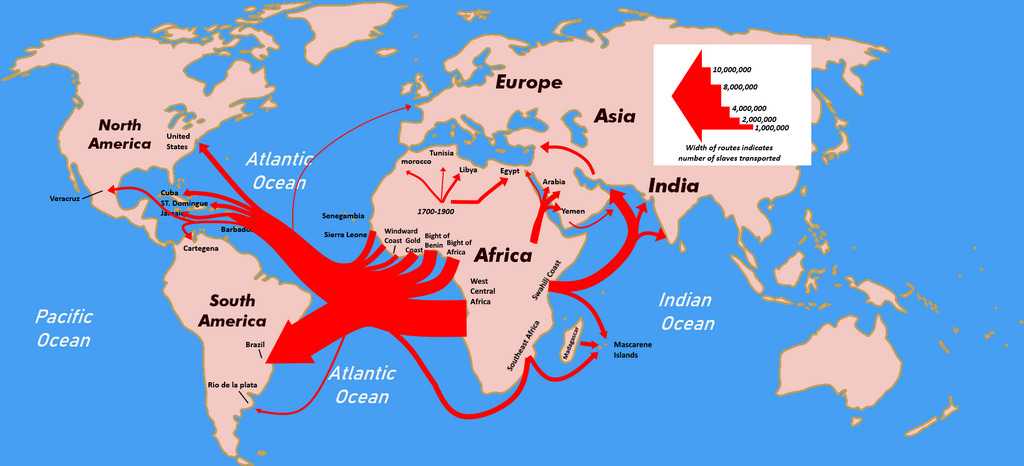
The Atlantic slave trade looks like the most extreme pattern of Europeans plundering others — in this case, Sub-Saharan Africans. It was certainly true that the Atlantic slave trade was horrific and had multiple adverse effects on African society. But those adverse effects were to intensify patterns that already existed. Moreover, the original plundering of people by turning them into slaves was done by … Africans.
The life expectancy of a European who left the African coast was about a year: it was not practical for Europeans to do the original enslaving. They bought the slaves from Africans. This enabled the slave trade carried on by Catholics to conform to the Papal Bull Sublimis Dei (1537) which banned Catholics from enslaving the indigenous inhabitants of the Americas (and, by implication, elsewhere), but did not ban trading in, or owning, slaves.
Wikimedia Commons
Plunder was endemic across human societies: including turning fellow humans into plunder — aka slavery. It was sadly ordinary. It was not a European pattern, it was a Homo sapien pattern. The Islamic slave trade was on the same scale—given it operated for centuries longer — as the Atlantic slave trade, the Saharan passage was every bit as horrific as the Atlantic passage, and the Islamic slave trade had the extra horror of the castration of male slaves. Hence, there is not an ex-slave diaspora in Islam as there is in the Americas.
Just as plunder was endemic, so was poverty. Mass poverty was the norm across farming societies. While there were economic efflorescences across human history, and evidence of periods of sustained growth, the dramatic shifts to mass prosperity since the 1820s — since the application of steam power to railways and steamships — is utterly without precedent. Moreover, it started in precisely one society — Great Britain. None of the other Atlantic littoral societies of Europe showed any sign of such a take-off.
- The megafauna outside Africa — which did not co-evolve with Homo sapiens — almost all died out when Homo sapiens turned up.
Comments Off on Plunder does not explain western prosperity


