
The Tank Museum
Published 18 Apr 2025Jagdpanther vs Churchill. Tank destroyer vs tank. New technology vs proven veteran. Who will emerge victorious?
It’s 6pm on 30th July 1944. Outnumbered 6 to 1, a platoon of 3 German Jagdpanthers is about to go into action for the first time. Facing them will be a squadron of 18 British Churchill tanks. Within 5 minutes, 11 tanks will be knocked out.
The Jagdpanther is the latest German armoured vehicle to arrive in Normandy. With a devastating gun, and a heavily armoured superstructure, this tank hunter is quick, reliable and deadly.
The Churchill has been fighting with Allied armies in North Africa, Italy and on the Eastern Front. The early marks struggled with a range of issues, but by 1944 it is an essential part of the British and Canadian tank force.
It’s during Operation Bluecoat where these two machines would come face-to-face for the very first time. The Churchills of S Squadron, 3rd Battalion, Scots Guards, have captured Hill 226 – a strategically important area to the south of Caumont. They are preparing for a German counterattack, but their infantry is yet to arrive – leaving their left flank dangerously exposed. And a platoon of Jagdpanthers is ready to take full advantage of their vulnerable state …
00:00 | Introduction
00:35 | The Jagdpanther
02:38 | The Churchill
05:43 | Operation Bluecoat
07:46 | A Turkey Shoot?
12:25 | Aftermath
17:40 | Roll of Honour
(more…)
August 26, 2025
When Jagdpanther Fought Churchill
August 25, 2025
Vietnam 1950: Giáp Crushes France on Route Coloniale 4 – W2W 41
TimeGhost History
Published 24 Aug 2025Viet Minh forces shift to the offensive, attacking French troops up and down the country. As guerilla war reigns in the southern half of Vietnam, more organised attacks begin in the north up near Hanoi. France cycles through multiple new commanders, trying to stem the tide. But do they truly have a hope of turning this around? Or are they just delaying the inevitable?
(more…)
The Sharpest Pen of the Edwardian Age | Who Was Saki?
Vault of Lost Tales
Published 5 Apr 2025Delve into the razor-sharp world of Saki in this engaging author talk exploring his chillingly clever short story, “The Open Window”. Discover the man behind the pen name — H.H. Munro — and uncover how his biting satire, Edwardian upbringing, and darkly humorous worldview shaped this unforgettable tale. Perfect for fans of classic literature, Oscar Wilde-style wit, and unsettling plot twists, this literary deep dive offers historical context, thematic insights, and just enough spookiness to keep you on edge. Whether you’re a student, a short story lover, or just curious about the mind that created one of literature’s most deviously satisfying endings, this talk is your open invitation.
“Saki”, the wickedly sharp pen name of Hector Hugh Munro, masked a man whose wit could slice through Edwardian society like a silver butter knife through scandal.
Born in 1870 in British Burma and raised in England, Munro brought an acerbic wit to the drawing rooms of empire, crafting tales that balanced dry humor, social critique, and sudden, often shocking twists. Writing under the name “Saki”, he produced short stories that mocked the pretensions of the upper class, exposed the darkness beneath genteel facades, and made readers laugh — sometimes uncomfortably. His life, marked by loss, repressed identity, and service in World War I, ended tragically in 1916 on the battlefield, but his stories continue to delight and disturb to this day.
(more…)
QotD: The rise of the state … the rise of the egregore
You may have noticed that [Against the Grain author] James C. Scott is not a fan of the state. He tends to describe it as a sort of alien intrusion into the human world, an aggressive meme that’s colonized first our material environment and then our minds, imposing its demands for legibility in order to expropriate innocent peasants:
Peasantries with long experience of on-the-ground statecraft have always understood that the state is a recording, registering, and measuring machine. So when a government surveyor arrives with a plane table, or census takers come with their clipboards and questionnaires to register households, the subjects understand that trouble in the form of conscription, forced labor, land seizures, head taxes, or new taxes on cropland cannot be far behind. They understand implicitly that behind the coercive machinery lie piles of paperwork: lists, documents, tax rolls, population registers, regulations, requisitions, orders — paperwork that is for the most part mystifying and beyond their ken. The firm identification in their minds between paper documents and the source of their oppression has meant that the first act of many peasant rebellions has been to burn down the local records office where these documents are housed. Grasping the fact that the state saw its land and subjects through record keeping, the peasantry implicitly assumed that blinding the state might end their woes. As an ancient Sumerian saying aptly puts it: “You can have a king and you can have a lord, but the man to fear is the tax collector”.
This “state as egregore” language recurs throughout the book. Scott writes that the state “arises by harnessing the late Neolithic grain and manpower module as a basis of control and appropriation”. It “battens itself” on the concentration of grain and manpower to “maximiz[e] the possibilities of appropriation, stratification, and inequality”, and with its birth “thousands of cultivators, artisans, traders, and laborers [are] … repurposed as subjects and … counted, taxed, conscripted, put to work, and subordinated to a new form of control”.1 But it’s vital to remember that this metaphor is just a metaphor: the state isn’t actually an alien brainworm or a memetic infohazard that will hijack your neocortex the moment you set eyes on a triumphal arch and force you to spend the rest of your life making lists of things and renaming roads with numbers;2 it’s just an institution that people have invented, because hierarchy and inequality are inescapable facts of life in a society of any scale and the state is a particularly effective bundle of social technologies to leverage those hierarchies. There’s a reason that, after states had their “pristine” invention at least three separate times, they’ve proliferated across every part of the world that can support them!
But more interesting than “are we better off with the state?” is to ask ourselves, as Ronald Blythe does in Akenfield, what has been lost. Here Scott offers some fascinating musings on the way not merely the state but the entire agriculturalist life-world limits us:
We might … think of hunters and gatherers as having an entire library of almanacs: one for natural stands of cereals, subdivided into wheats, barleys and oats; one for forest nuts and fruits, subdivided into acorns, beechnuts, and various berries; one for fishing, subdivided by shellfish, eels, herring, and shad; and so on. … one might think of hunters and gatherers as attentive to the distinct metronome of a great diversity of natural rhythms. Farmers, especially fixed-field, cereal-grain farmers, are largely confined to a single food web, and their routines are geared to its particular tempo. … It is no exaggeration to say that hunting and foraging are, in terms of complexity, as different from cereal-grain farming as cereal-grain farming is, in turn, removed from repetitive work on a modern assembly line. Each step represents a substantial narrowing of focus and a simplification of tasks.
The Neolithic Revolution, he argues, was like the Industrial Revolution, a great boost to human productivity and social complexity but at the same time a de-skilling. The surface area of our contact with the world shrank from hundreds of plants and animals, used in different ways at different times of year, to a mere handful of domesticates whose biological clocks became the measure of our lives. Of course, the modern contact area is smaller still — dimensional lumber purchased from a store in place of felling and milling your own trees, natural gas at the turn of a knob with nary a need to build a fire — and is sometimes reduced all the way to your fingertip on a smooth glass screen. The ease and efficiency are undeniable, and I’m sure a forager or premodern farmer would kill for Home Depot and seamless pizza delivery (I certainly wouldn’t want to give them up). But there has been “a contraction of our species’ attention to and practical knowledge of the natural world” because that knowledge and attention is no longer necessary, and I think that Scott is right to suggest that there is something richer about a more extensive involvement with the world. That said, Scott’s case is somewhat overstated: after all, even hunter-gatherers have specialized craftsmen who engage deeply with particular materials at the expense of other endeavors, and farmers3 have a far more intimate relationship with their animals than a hunter does with his many different kinds of prey. Similarly, farmers may be on one particular bit of land but (especially in a preindustrial context) all that plowing and hedging and draining and spiling, not to mention the gathering of various woodland foodstuffs, can rival forager familiarity when it comes to their bit of landscape. (My new favorite poem is Kipling’s “The Land“, on just this idea.)
Scott closes the book with an elegy for the “late barbarians”, who had the best of both worlds: healthier and longer-lived than farmers, and with greater leisure, they were “not subordinated or domesticated to the hierarchical social order of sedentary agriculture and the state” but were still able to benefit tremendously from lucrative trade with those states. Unfortunately, much of that trade was in weaker non-state peoples whom they captured and sold as agricultural slaves, thereby “reinforc[ing] the state core at the expense of their fellow barbarians”, and much of the rest was in their own martial skills as mercenaries (which of course also served to protect and expand the influence of the state). It’s a salutary reminder for the aspiring modern barbarian: the best place to be is just outside the purview of the state, where you can reap its benefits4 without being under its control. But beware, because in a world of states even those “outside the map” must fill niches created by the state. It’s great to have a cushy work-from-home laptop job that lets you live somewhere nice, with trees and no screaming meth-heads on your subway commute, but more land comes under the plow every year, and your time, too, may come.
Jane Psmith, “REVIEW: Against the Grain, by James C. Scott”, Mr. and Mrs. Psmith’s Bookshelf, 2023-08-21.
- And of course Scott argues that the state is a parasite in the most literal way, since the word derives from the Greek παρά “beside” + σῖτος “grain.”
- Although this would be a pretty sweet novel, sort of a Tim Powers alt-history: anarcho-primitivist occultists go back in time to ancient Mesopotamia to destroy the me of kingship and render the state metaphysically impossible. Someone write this.
- Like Scott, in fact, who keeps sheep on 46 acres of Connecticut. There’s a funny little aside in the book where he complains about people using “sheeplike” in a derogatory sense, given that we’ve spent several millennia selectively breeding sheep to behave that way.
- Better yet, wait for the peasants to do the reaping then ride in on your shaggy little ponies and take it all. Uh, metaphorically.
August 24, 2025
The Supreme Court of British Columbia has detonated a legal mine under all of Canada’s established property titles
Conrad Black discusses just how much the Supreme Court of British Columbia’s decision on First Nations land claims in BC will undermine established property rights across the entire country:
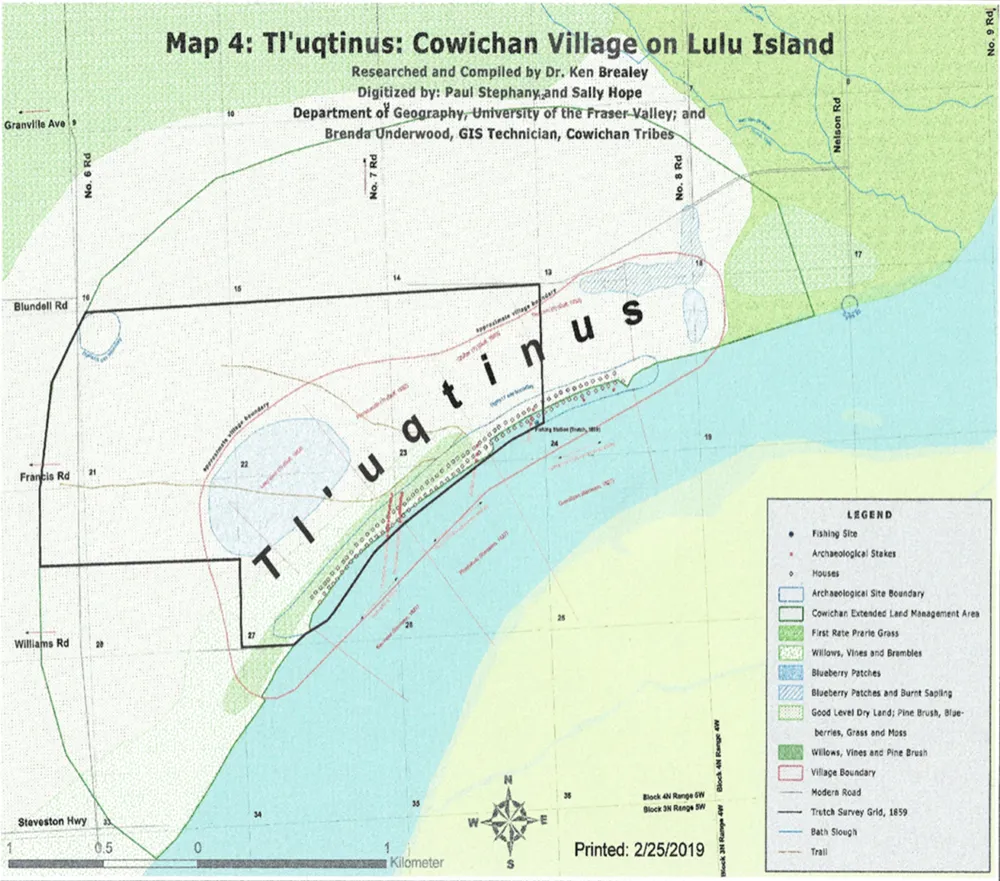
A map shows the Cowichan title lands outlined in black. (B.C. Supreme Court) Photo by B.C. Supreme Court
The decision earlier this month by the Supreme Court of British Columbia that the Cowichan tribes hold title over federal, city, and private land in Richmond B.C. that enjoys a higher legal status than the fee simple ownership of the current proprietors is outrageous but may have some positive consequences. The decades and $7 billion that have been spent or pledged for what is called the “reconciliation” process, has finally hit a stone wall. The almost universal desire to be fair to Indigenous people and where appropriate to compensate them for inequitable treatment, has finally collided with the entrenched economic rights and interests of every owner of real property in Canada, including those of Indigenous ancestry.
Inexplicable latitude has been granted to the thickening population of crusaders for indigenous rights. Even the NDP government of British Columbia, which has been pathologically addicted to prostrating itself at the feet of anyone or anything purporting to champion any definition of the Indigenous interest, was reduced to monosyllabic waffling by the court decision brought down by Justice Barbara Young. Premier David Eby’s office declared an ambition to continue seeking a negotiated resolution of the conflict between Aboriginal rights and common law rights of affected property owners, (including the municipal, provincial, and federal governments-of $100 billion of property in Richmond B.C. that is directly affected by the decision).
This is an understandable ambition, but in the circumstances, his government might have pressed the negotiations over the six years that this case has been litigated. Our judiciary has been addicted to truckling to almost any Indigenous claim, on the restricted occasions when the federal and provincial governments have even had the temerity to conduct a defense against them. Now the taxpayers’ negotiating position has been tanked by this ludicrous decision, which is being appealed.
If courts with authority for the whole country were to come to similar judgments, and we cannot doubt that activists will continue to push on an open door and quite rightly take all they can get, then every property title deed in the country is compromised, including the Houses of Parliament. There were only approximately 200,000 native people in all of what is now Canada when the French and British explorers and settlers came here starting at the end of the 15th century. Yet the implication of this ruling is that they legitimately owned all of Canada and that in the patchwork of numbered treaties and other agreements following absorption of the politically organized parts of Canada into the British Empire at the end of the Seven Years War in 1763, ancient and undocumented Aboriginal rights took precedence over any subsequent real estate law allocations of property rights under the common or civil law systems that gradually spread across Canada.
Given the activist preferences of courts across the country, we can expect to see similar cases pop up everywhere, as First Nations sensibly try to strike while the iron is hot and lay claim to as much of the real estate of Canada as the courts will let them … which might well be the entire land mass plus fishing rights.
Much of our prosperity is based on trust, and we’re rapidly losing it
Ted Gioia foresees a precipitous fall in trust coming at us very soon, and I’m afraid he might be being too optimistic:
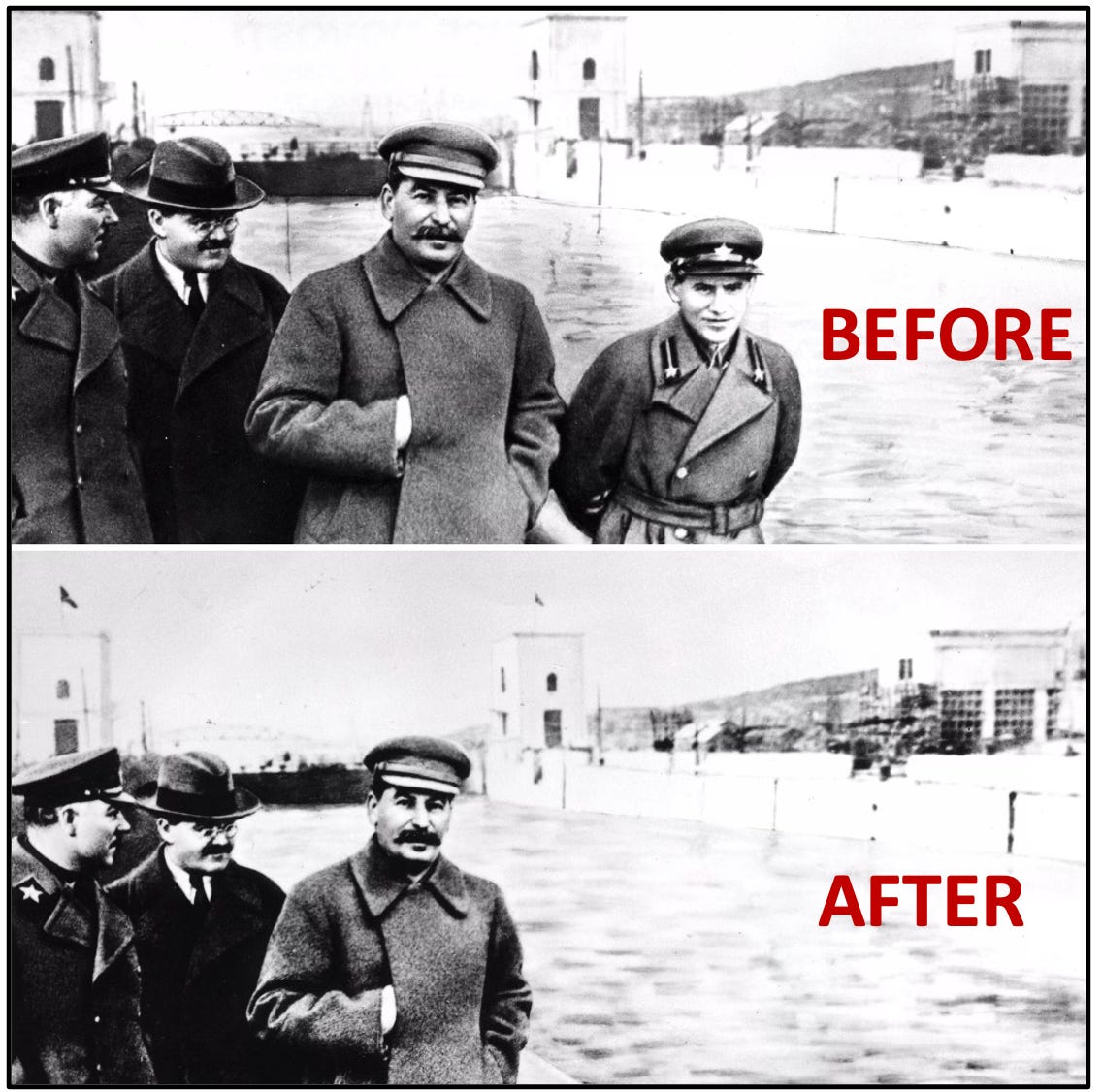
During the great purges of the 1930s, Stalin ordered the execution of a million people, including some of his closest associates. But it wasn’t enough to kill these victims — they also had to disappear from photographs.
In a famous case, Nikolai Yezhov got removed from his position next to Stalin in a photo taken by the Moscow Canal. This erasure alarmed many party elites because Yezhov, head of the secret police, had been one of the most feared men in the Soviet Union.
And now he got totally deleted.
Well, not totally. In those days of print media, original photos survived, and a paper trail made it difficult to erase history.
So this photo was later used to mock Stalin, and the pretensions of dictators. They can try to change reality, but that’s not possible.
Or is it? Maybe dictators now get the last laugh. Because in the last few months, reality has been defeated — totally, completely, unquestionably.
It is now possible to alter reality and every kind of historical record — and perhaps irrevocably. The technology for creating fake audio, video, and text has improved enormously in just the last few months. We will soon reach — or may have already reached — a tipping point where it’s impossible to tell the difference between truth and deception.
- Can I tell the difference between a fake AI video and a real video? A few months ago, I would have said yes. But now I’m not so sure.
- Can I tell the difference between fake AI music and human music? I still think I can discern a difference in complex genres, but this is a lot harder than it was just a few months ago.
- Can I tell the difference between a fake AI book and a real book by a human author? I’m fairly confident I can do this for a book on a subject I know well, but if I’m operating outside my core expertise, I might fail.
At the current rate of technological advance, all reliable ways of validating truth will soon be gone. My best guess is that we have another 12 months to enjoy some degree of confidence in our shared sense of reality.
But what happens when it’s gone?
Back in 2023, I asserted that trust is the most scarce thing in society. But that was before all these tech deceptions came online. Trust will soon get even more scarce — or perhaps disappear completely from the public sphere.
This is not a small matter.
Most discussions of this issue focus on the technology. I believe that’s a mistake. The real turmoil will take place in social cohesion and individual psychology. They will both fracture in a world where our shared benchmarks of truth and actuality disappear.
We will be — already are — in desperate need of Robert Heinlein’s Fair Witnesses:
A Fair Witness is an individual trained to observe events and report exactly what is seen and heard, making no extrapolations or assumptions. While wearing the Fair Witness uniform of a white robe, they are presumed to be observing and opining in their professional capacity. Works that refer to the Fair Witness emphasize the profession’s impartiality, integrity, objectivity, and reliability.
An example from the book [Stranger in a Strange Land] illustrates the role of Fair Witness when Anne is asked what color a house is. She answers, “It’s white on this side.” The character Jubal then explains, “You see? It doesn’t occur to Anne to infer that the other side is white, too. All the King’s horses couldn’t force her to commit herself … unless she went there and looked – and even then she wouldn’t assume that it stayed white after she left.”
This is Westland Helicopters (1960s)
British Helicopters History
Published 17 Jan 2020Major rationalisation of the UK aircraft industry occurred during the 1960s. With the acquisition of Bristol Helicopters, Fairey Aviation and Saunders-Roe, Westland Helicopters transformed itself into Britain’s only helicopter maker with plants at Yeovil, Weston-super-Mare, Eastleigh, and Hayes, producing helicopters for all roles.
August 23, 2025
T-55: 70 Years Old. Still in Service
The Tank Museum
Published 22 Aug 2025No tank in history has been produced in the quantities that the T-55 and its relatives have. Some sources suggest as many as 100,000 have been built since 1946, this tank is still seeing service across the globe. So how come this 80-year-old tank is still in service in 2025?
When looking at its predecessor, the T-34, the move to the T-55 looks like a massive leap in design. But there is a clear evolutionary progression – there is just a missing link. The T-44 laid the groundwork for future Soviet tank design – pioneering torsion bar suspension and a transverse engine.
It was soon decided that the T-44 would require a new 100mm gun to replace the 85mm. This new model would be called the T-54. While NATO classes both the T-54 and 55 as the same vehicle, the T-55 is a substantially better tank. A comprehensive series of upgrades made this an effective force on the battlefield.The T-55 would prove popular with forces around the world. It would even go head-to-head against itself in the Iran-Iraq War of the 1980s. Eventually the T-55 would become outdated as NATO technology became more and more advanced. But it is still in service in the conflict in Ukraine – why?
The Russian army, despite the stereotype of having unending stockpiles of weaponry, have been struggling to keep up with the astounding loss rate the Ukrainians have been able to inflict on them. This has resulted in older and older vehicles being dragged out of those large storage depots across Russia, mainly being used as mobile, protected artillery.
The T-55 has endured partly due to its sheer numbers, availability and upgradability. Its performance on the battlefield has varied, but its basic but effective design has proven itself again and again throughout the decades. It is worth reiterating how remarkable it that a vehicle conceived at the end of the Second World War is still even a consideration for armies 80 years on.
In this video, historian James Donaldson explores the history of the most-produced tank in history – the T-55. This Soviet design has its roots in the iconic T-34, evolving through the years to become an effective fighting machine that was sold around the world. Despite manufacturing ending in the 1980s, this tank is still a feature on the battlefield, with both sides making use of T-55s in the current conflict in Ukraine. It may not be engaging in tank-on-tank combat as initially intended, but the T-55 is still providing a useful, effective and relatively cheap addition to the arsenal of many armies in the 21st Century.
00:00 | Introduction
00:43 | The Missing Link
02:31 | Making the T-55
05:24 | Upgrades
08:34 | A Numbers Game
12:51 | In Action
16:41 | T-55 Today
(more…)
QotD: The background of Tiberius Gracchus
Meanwhile, as D.J. Gargola has noted, Appian is also bending his account of Tiberius Gracchus’ reforms, in particular by presenting the Lex Sempronia Agraria as an entirely traditional, conventional response to a pressing crisis.1 But in fact, the provisions of the Lex Sempronia Agraria were not traditional: no similar law (save for a re-enactment by Gaius Gracchus) – had ever or would ever be passed in Rome and the legal precedent that Appian presents as providing the foundation for Tiberius’ law appears to be at least substantially an anachronistic invention. Meanwhile, the crisis Appian thinks Tiberius Gracchus thought he was addressing probably didn’t exist in the form he understood it.
But that’s what we have, so it is what we must work with. And we should note that both Plutarch and Appian are quite favorable to the Gracchi, even though both men were clearly very controversial in their day. So in a sense this is a reverse of the situation we had with Cleopatra, where we had to contend with relentlessly negative sources: here the sources are broadly positive.
So, on with what we know.
Tiberius Gracchus was elected tribune in 133. His election was already unusual in that he seems to have run on something like a program (land reform, which we’ll get to); Romans generally ran on character and background rather than promising specific political actions if elected, so this was unusual. Part of the reason for it was doubtless that Tiberius Gracchus’ political fortunes were in difficulties. Now we should note here that while Tiberius Gracchus was a plebian (that is, not a patrician) that doesn’t make him a political outsider: Tiberius Gracchus was not remotely a political outsider or poor man or lacking in influence. His father (also Ti. Sempronius Gracchus) had been consul in 177 and 163 and censor in 169; his father (or grandfather) was consul in 215 and 213. Our Tiberius Gracchus’ mother, Cornelia, was the daughter of P. Cornelius Scipio Africanus, the man who defeated Hannibal. Tiberius Gracchus was born into substantial wealth and influence, the sort of man whose eventual political ascent was almost guaranteed.
(Indeed, it was so guaranteed that he gets to bend the rules and hold many of his offices early. He’s quaestor at just 26, which implies that he started his military service at 15 or 16 instead of the normal 17, doing so as a military tribune, not a common soldier. I do think this is relevant to understanding Tiberius Gracchus: this was a man born with a silver spoon and a carefully paved, flat-and-easy road to power and influence laid out for him by his family and his political backers, the most notable among whom was his key supporter Scipio Aemilianus (destroyer of Carthage and shortly Numantia).)
Except. Except he got wrapped up in something of a nasty foreign policy scandal during his year as quaestor, when he was assigned to the amazingly named but less amazingly capable C. Hostilius Mancinus who as consul in 137 was supposed to deal with Numantia in Spain. Mancinus blew it and got his army effectively trapped and sent Tiberius – his quaestor and the next highest ranking Roman present – to negotiate to get his army out. Tiberius did this, but the whole thing caused a great stink and a scandal at Rome (Roman armies are supposed to go down fighting, not negotiate shameful retreats!). Indeed, the Senate was so enraged they rejected the treaty and instead sent Mancinus, bound in chains, to the Numantines as part of a ritual process by which his treaty was disowned. Tiberius doesn’t get packed off to Numantia, but some of the political stink does rub off on him, so while he’s connected enough to get elected as a plebeian tribune in 133, he must know he needs a big second act to get his political career back on track, or he may never reach the consulship. That context – a political insider who had a golden ticket but must now win it back, rather than an outsider without connections – is important for understanding the reaction he is going to get.
Bret Devereaux, “Collections: On the Gracchi, Part I: Tiberius Gracchus”, A Collection of Unmitigated Pedantry, 2025-01-17.
- 1. D.J. Gargola, “The Gracchan Reform and Appian’s Representation of an Agrarian Crisis” in People, Land and Politics, eds. L. De Ligt and S.J. Northwood (2008).
August 22, 2025
History’s Oldest Dessert – 4,000 Year Old Mersu
Tasting History with Max Miller
Published 18 Mar 2025Short pastry filled with pistachios and dates
City/Region: Mari, Mesopotamia
Time Period: c. 1800 B.C.E.In the ancient ruined Mesopotamian city of Mari, a clay tablet receipt from 4,000 years ago was found that mentioned dates and pistachios for making mersu for the king. We don’t know exactly what mersu was or if there were other ingredients in it, but I think there was more to it than just dates and pistachios. The king employed eight specialists who made mersu, so my guess is that it was at least as complicated as this pastry, possibly much more so.
The flavor combination in this interpretation is wonderful. The pastry is a little crumbly, and the filling is chewy, rich, and quite sweet, with the added texture of the nuts.
I made my pastry dough unsweetened and I really liked the contrast between the unsweetened dough and the very sweet filling, but you can add some date syrup or honey to your dough if you’d like.
1 gur of dates
And 10 sila of pistachios
For making mersu
Meal of the king
— Receipt from Mari, c. 1800 BCE
August 21, 2025
Six Reasons Operation Market Garden FAILED
The Tank Museum
Published 3 April 2025Operation Market Garden failed because the tanks of XXX Corps did not reach the Paras in Arnhem in time. Many historians have argued that the British armoured column “let the side down”. But is this actually true?
We reckon there are six reasons why the operation was a total disaster. It was a poor plan from the get-go, relying on a rate of advance that would outmatch the German invasion of France in 1940. Bad weather prevented the deployment of badly-needed reinforcements, and the terrain Guards Armoured were expected to traverse – a single road with impassable conditions on either side – significantly hampered the efforts of the tank crews.
Poor intelligence also meant that the British column was not prepared for resistance from a retreating and desperate German Army. It was a combination of all these factors that caused Market Garden to unravel completely.
Despite the complications, many acts of valour were carried out by both the airborne and armoured divisions, including the legendary assault across the Waal by the US 82nd Airborne.
So, join us as we explore these six reasons why Operation Market Garden failed and decide for yourself whether XXX Corps could have done anymore.
00:00 | Introduction
02:23 | #1 – A Bad Plan
06:22 | #2 – Poor Intelligence
07:51 | #3 – Difficult Terrain
11:27 | #4 – Determined Resistance
13:45 | #5 – Bad Weather
14:38 | #6 – Loss of Surprise
19:45 | What Went Wrong?
(more…)
August 20, 2025
The Korean War Week 61: The South Koreans Strike as Ceasefire Talks Stall – August 19, 1951
The Korean War by Indy Neidell
Published 19 Aug 2025After two months of inactivity, 8th Army begins new offensive operations this week, and it is the South Korean forces doing the fighting. Meanwhile, the Kaesong peace talks are ever more threatened by continuing neutral zone violations.
Chapters
00:00 Hook
00:48 Recap
01:13 Neutral Zone Violations
02:17 The UN Defense System
06:59 The ROK Attacks
10:38 Summer Diseases
12:48 Summary
13:33 Conclusion
15:20 Call to Action
(more…)
UK vz.59 Czech Universal Machine Gun: History and Mechanics
Forgotten Weapons
Published 21 Mar 2018In 1952, Czechoslovakia adopted a whole new family of small arms, including the vz.52 pistol, vz.52 rifle, and vz.52 light machine gun. The rifle and LMG were both chambered in the Czech 7.62x45mm cartridge, and both would be adapted to the Soviet standard 7.62x39mm a few years later, in 1957. Very shortly thereafter, the Czechs would also introduce a heavier universal machine gun version in 7.62x54mmR under the designation UK vz.59 (universal machine gun model 59).
The UK 59 was basically a scaled up sibling of the vz.52 and vz.52/57 machine guns, although it fed from a belt only, where its smaller predecessors had allowed either belt or magazine feed. It used a pivoting locking block system much like the Walther P38 and Beretta pistols, in conjunction with a long stroke gas piston much like that of the vz.26 light machine gun.
The weapon did not see much interest outside of Czechoslovakia, although it does remain in service in that region in the modernized 7.62x51mm iteration.
Thanks to Marstar for letting me examine and shoot their UK vz.59!
QotD: Most “mass movements” really do need that “vanguard” to start moving
And yet, as Orwell knows better than anyone, the proles can’t do it on their own. You really do need a vanguard of the proletariat. As Orwell himself notes, Hitler was backed by the big industrialists, and if you really want to needle the eggheads in your life, point out how quickly and thoroughly the German professors knuckled under […] They couldn’t wait to lick his jackboots, any more than his British and American colleagues could wait to kiss Stalin’s ass. They called themselves a “workers’ party”, but in the early days [German fascists] were almost exclusively found among the dueling fraternities – and professors! — of the German university system.
In other words, maybe the proles don’t need nothin’ but a good time, like the old song says, but though the proles are the “mass” of “mass movement”, the “movement” part gets started considerably higher up the social ladder … that is, with guys like Orwell. Guys who know, deep in their bones, that there’s more to life than hygiene, short working hours, birth control, etc. Because he’s one of the great prose stylists, it’s not as apparent in Orwell, but in lesser hands than his you can smell the contempt dripping off every sentence an egghead writes about the proles …
It’s not that the proles want hygiene, birth control, etc. It’s what they need. What they deserve, when you come right down to it, because that’s what you do with livestock — keep ’em clean and well fed, and of course control their breeding. You could take the most purple passage of “animal rights” eco-lunacy and set it side by side with the Webbs’ Soviet Communism: A New Civilization, and see no difference at all. Sure, every aspect of our lives is managed for us by Our Betters, but at least we’re free range!
Severian, “Bonfire of the Vanities II”, Founding Questions, 2021-12-29.


