
The Tank Museum
Published 11 Mar 2022► TIMESTAMP:
00:00 – INTRO
00:43 – FEATURES
(more…)
July 9, 2022
Tank Chat #151 Plastic Tank | The Tank Museum
Comments Off on Tank Chat #151 Plastic Tank | The Tank Museum
July 8, 2022
The Early Emperors – Part 7: The Imperial Women
seangabb
Published 11 Jan 2022The Roman Empire was the last and the greatest of the ancient empires. It is the origin from which springs the history of Western Europe and those nations that descend from Western Europe. It is the political entity within which the Christian Faith was born, and the growth of the Church within the Empire, and its eventual establishment as the sole faith of the Empire, have left an indelible impression on all modern denominations. Its history, together with that of the ancient Greeks and the Jews, is our history. To understand how the Empire emerged from a great though finally dysfunctional republic, and how it was consolidated by its early rulers, is partly how we understand ourselves.
Here is a series of lectures given by Sean Gabb in late 2021, in which he discusses and tries to explain the achievement of the early Emperors. For reasons of politeness and data protection, all student contributions have been removed.
More by Sean Gabb on the Ancient World: https://www.classicstuition.co.uk/
Learn Latin or Greek or both with him: https://www.udemy.com/user/sean-gabb/
His historical novels (under the pen name “Richard Blake”): https://www.amazon.co.uk/Richard-Blak…

Comments Off on The Early Emperors – Part 7: The Imperial Women
QotD: Sparta’s vaunted hoplite phalanx differed little from hoplite armies from other Greek cities
The hoplite phalanx was the common fighting style of essentially all Greek poleis. It was not unique to Sparta.
That comes with all sorts of implications. The Spartans used the same military equipment as all of the other Greeks: a thrusting spear (the dory), a backup sword (a xiphos or kopis; pop-culture tends to give Spartans the kopis because it looks cool, but there is no reason to suppose they preferred it), body armor (either textile or a bronze breastplate), one of an array of common Greek helmet styles, and possibly greaves. We might expect the Spartiates – being essentially very wealthy Greeks – to have equipment on the high end of the quality scale, but the Perioikoi, and other underclasses who fought with (and generally outnumbered) the Spartiates will have made up the normal contingent of “poor hoplites” probably common for any polis army.
Xenophon somewhat oddly stops to note that the Spartiates were to carry a bronze shield (kalken aspida; Xen. Lac. 11.3 – this is sometimes translated as “brass” – it is the same word in Greek – but all Greek shield covers I know of are bronze). This is not the entire shield, as in [the movie] 300 – that would be far too heavy – but merely a thin (c. 0.25mm) facing on the shield. It’s odd that Xenophon feels the need to tell us this, because this was standard for Greek shields. Perhaps poorer hoplites couldn’t afford the bronze facing and used a cheaper material (very thin leather, essentially parchment, is common in many other shield traditions) and Xenophon is merely noting that all of the Spartiates were wealthy enough to afford the fancy and expensive sort of shield (it has also been supposed that elements of this passage have dropped out and it would have originally included a complete panoply, in which case Xenophon is just uncharacteristically belaboring the obvious).
The basics of the formation – spacing, depth and so on – also seem to have been essentially the same. The standard depth for a hoplite phalanx seems to have been eight (-ish; there’s a lot of variation). The Spartans seem to have followed similar divisions with a fairly wide range of depths, perhaps trending towards thinner lines in the fourth century than in the fifth, though certainty here is difficult. The drop in depth may be a consequence of manpower depletion, but it may also indicate a greater faith held by Spartan commanders of their line’s ability to hold. Depth in a formation is often about morale – the deeper formation feels safer, which improves cohesion.
It’s hard to say if the Spartan phalanx was more cohesive. It might have been, at least for the Spartiates. The lifestyle of the Spartiates likely created close bonds which might have aided in holding together in the stress of combat – but then, this was true of essentially every Greek polis to one degree or another. The best I can say on this point is that the Spartan battle record – discussed at length below – argues against any large advantage in cohesion.
That said, the Spartan battle order does seem to have been notably different in two respects:
First: it had a much higher ratio of officers to regular soldiers. This was clearly unusual and more than one ancient source remarks on the fact (Thuc. 5.68; Xen. Lac. 11.4-5, describing what may be slightly different command systems). Each file was under the command of the man in front of it (Xen. Lac. 11.5). Six files made an enomotia (commanded by an enomotarchos); two of these put together were commanded by a pentekonter (lit: commander of fifty, although he actually had 72 men under his command); two of those form a lochos (commanded by a lochagos) and four lochoi made a mora, commanded by a polemarchos (lit: war-leader) – there were six of these in Xenophon’s time. Compared to most Greek armies of the time, that’s a lot of officers, which leads to:
Second: it seems to have been able to maneuver somewhat more readily than a normal phalanx. This follows from the first. Smaller tactical subdivisions with more command personnel made the formation more agile. Xenophon clearly presents this ability as exceptional, and it does seem to have been (Xen. Lac. 11.4). Hoplite armies victorious on one flank often had real trouble reorganizing those victorious troops and wheeling them to flank and roll up the rest of the line (e.g. the Athenians at Delium, Thuc. 4.96.3-4). The Spartans were rather better at this (e.g. at Mantinea, Thuc. 5.73.1-4). They also seem to have been better at marching and moving in time.
Now, I do not want to over-sell this point. We’re comparing the Spartans to other hoplite forces which – in the fifth century especially – were essentially dumbfire missiles. The general (or generals) point the phalanx at the enemy, hit “go” and then hope for the best. Really effective command – what Everett Wheeler refers to as the general as “battle manager” – really emerges in the fourth century, mostly after Spartan power was already broken (E. Wheeler, “The General as Hoplite” in Armies of Classical Greece, ed. Wheeler (2007)). While “right wing, left wheel” is hardly the most complicated of maneuvers (especially given that the predictable rightward drift of hoplite armies in battle meant that it could be planned for), compared to the limitations of most hoplite forces, it marked the Spartans out as unusually adept.
More complicated Spartan maneuvers often went badly. Spartan forces at Plataea (479 – Hdt. 9.53) failed to effectively redeploy under orders, precipitating an unintended engagement. Plugging a gap in the line once the advance was already underway, but before battle was joined (something Roman armies did routinely) was also apparently beyond the capabilities of a Spartan army (Thuc. 5.72). While the Spartans are often shown in popular culture with innovative tactical formations – like the anti-cavalry wedge or anti-missile shield-ball (both of which, to be clear, are nonsense) formations in 300 – in practice the Spartan army was tactically uncreative. Like every other hoplite army, the Spartans formed a big rectangle of men and smashed it into the front of the enemy’s big rectangle of men. Notably, as we’ll see, the Spartans made limited and quite poor use of other arms, like light infantry or cavalry, even compared to other Greek poleis (and the bar here is very low, Greek combined arms, compared to say, Roman or Macedonian or Persian combined arms, was dismal). If anything, the Spartans were less adaptable than other hoplites.
Bret Devereaux, “Collections: This. Isn’t. Sparta. Part VI: Spartan Battle”, A Collection of Unmitigated Pedantry, 2019-09-20.
Comments Off on QotD: Sparta’s vaunted hoplite phalanx differed little from hoplite armies from other Greek cities
July 7, 2022
“Boris was the latest incarnation of the slippery mountebank in politics”
As I’m writing this, Boris Johnson seems to be losing a cabinet minister every couple of hours, and there’s a finite number of them so at some point soon he’s likely to resign — or in Tory tradition, be knifed by a former trusted colleague. Ed West gets in an early political obituary for Boris:
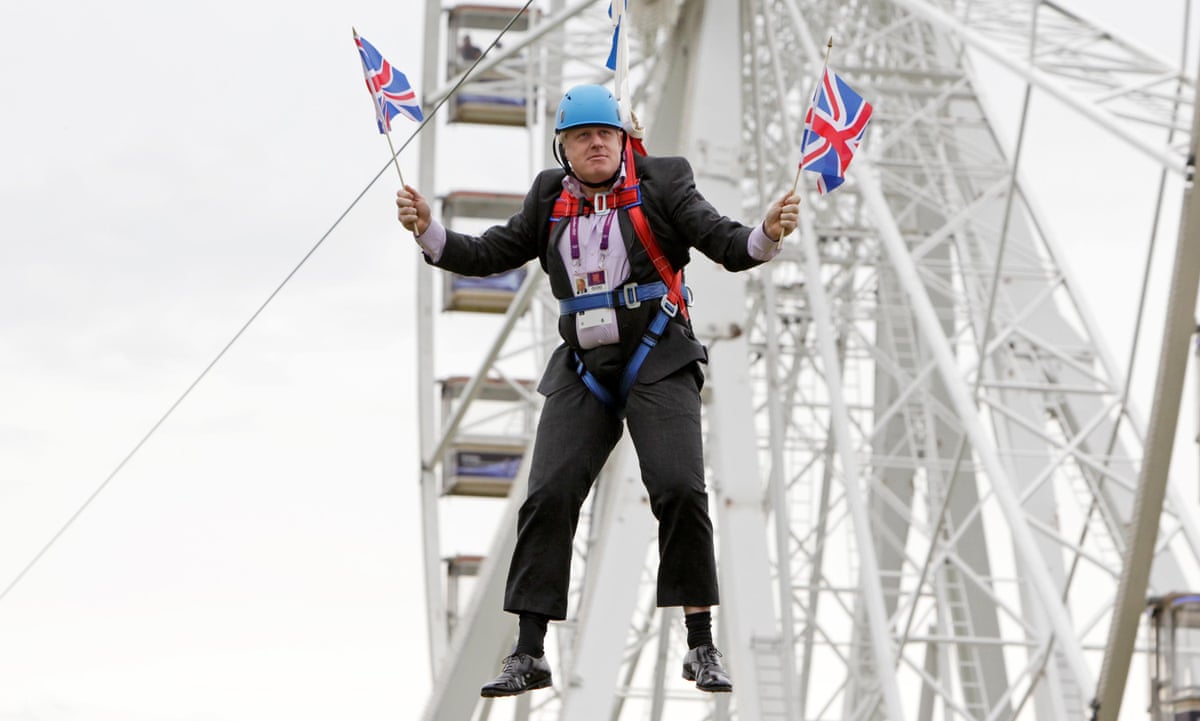
However bad Boris Johnson’s career ends, it will surely be a better finale than that of his great-grandfather, the Turkish journalist, editor and liberal politician Ali Kemal. Almost exactly a century ago, following the trauma of defeat and the end of the Ottoman Empire, Kemal was attacked by a mob of soldiers, hanged from a tree, his head smashed in with cudgels before being beaten to death. I can’t imagine that the Tory backbenchers will go that far.
There is something charming and colourful about Johnson’s background, the mixture of Turkish, Russian, Jewish and even a Circassian slave just a few generations back (according to Boris himself, and if you can’t trust his version of events, who can you trust?). Just like David Cameron, he is also descended (via a mistress) from George II, the last king of England to fight in battle.
As Rod Liddle once put it, Boris is “the esoteric product of millennia of Eurasian toff miscegenation”, and that’s part of the attraction. It explains his ease with people of different backgrounds, and his liberal persona as London Mayor, which felt like the real him, more than his later populist act. It’s why the charges of racism never stuck; he has his faults, but racial prejudice isn’t one of them.
It’s often been noted that Boris was the latest incarnation of the slippery mountebank in politics while his opponents, both Keir Starmer and Jeremy Corbyn, came from that other British political archetype, the do-gooding Puritan. Disraeli and Gladstone were the Platonic examples of these contrast, but the division dates back further to the Civil War, and there could be no doubt which side Boris would have fought for at Marston Moor.
In fact he is almost more like an oriental potentate, a benevolent and cosmopolitan sultan, hampered by court intrigue and presiding over a crumbling empire. At the time of his ascension to Downing Street, Wikipedia listed Johnson’s de jure and de facto spouses, making Boris the first polygamous ruler of England since King Canute. Since coming to power his rule has been marked by unprecedented court drama, with quite obvious parallels to the reign of Henry VIII, with Carrie Symonds as Anne Boleyn and Dominic Cummings playing Thomas Cromwell.
And on his political legacy, such as it might be:
There’s a whole new generation out there who hate progressivism, who don’t want social norms dictated by dysfunctional, miserable people, and yet the Tories have nothing to offer them. Everywhere there is a sense of overwhelming gloom about the state of the country and its lack of future. Boris Johnson, one of the funniest men to inhabit Number 10, has left his audience with a feeling of dread and sadness, a lesson perhaps in allowing newspaper columnists too much of a say.
As Johnson’s rule nears it end, it feels like everything is collapsing, from the health service to the police, even a shared faith in institutions — and as a Conservative voter I’ve got no “buts” to give in response, except perhaps that Corbyn would have been worse.
In clear expectation of the smash, Mark Steyn reposted what he wrote when Boris took possession of Number 10 Downing Street:
Boris Johnson, it seems, is determined to hang on. Tonight I chanced to see, on the one hand, his father, apparently breezy and unperturbed. On the other hand, a senior Tory backbencher told me that, were another confidence vote to be held, Boris would win the support of fewer than sixty Conservative MPs, with over three hundred voting against him.
I don’t really have anything new to say about this failed prime minister because, in the third of a century since I first met him, he has been, in the turbulence of a constantly changing world, eternally unchanging. Here is what I wrote about him upon the occasion of him taking office as PM:
Is he a nice person? Well, he’s left an awful lot of human wreckage in his wake. Some of the women he’s used and discarded seem to me, without naming names, to be sad and profoundly damaged from their brief intersection with his wandering zipper. His latest squeeze seems likely to be moving into Number Ten without benefit of clergy — a first for the Tories and a sign of how desperate they are after years of letting all the sober, serious, earnest types turn their party into a laughingstock.
What does he believe in? Other than himself, not terribly much. About a decade ago, I was in London for a couple of days and had lunch with him and Stuart Reid at a favorite Italian restaurant. Stuart was the deputy editor who did all the hard grind at the Speccie, while Boris was the great fizzing impresario fronting the operation — a business model he transferred successfully into his mayoral regime, and will no doubt be trying again in Downing Street. He was going on the BBC’s Question Time that night and was worried that he didn’t have anything sufficiently arresting to say, so asked if I had any tips. I gave him a few thoughts on the passing scene, and he considered them not in terms of his own public-policy positions (if any) but in terms of attitudinal cachet. Finally, I said, “Why don’t you really stir them up and put in a word for social conservatism?”
“You mean abortion and all that? Oh, God …” he sighed, and ordered dessert.
If that seems to be (for self-interested reasons) his most firmly drawn red line, don’t nevertheless overstate his ideological flexibility. Like Boris, Theresa May schemed and maneuvered for decades to reach the top spot … and, by the time she pulled it off, she’d spent so much time and effort on the scheming and maneuvering that she had no idea of what to do once she got there. Boris is likewise invested in himself, but, having reached the finial of Disraeli’s greasy pole, he doesn’t intend to be just the latest seat-filler. Mrs May wanted to be prime minister; Johnson wants to be a great and consequential prime minister.
So much for that. That was July 2019. Six weeks later came the first of what would become an avalanche of ministerial resignations …
Comments Off on “Boris was the latest incarnation of the slippery mountebank in politics”
M38 Carcano Carbine: Brilliant or Rubbish?
Forgotten Weapons
Published 1 Aug 2017http://www.patreon.com/ForgottenWeapons
Cool Forgotten Weapons merchandise! http://shop.bbtv.com/collections/forg…
Carcano vs K98k Match video: https://www.youtube.com/watch?v=FAyxL…
I would like to propose that the M38 Carcano short rifle was, despite the poor reputation of the Carcano series of rifles, one of the best thought-out bolt action weapons of World War 2. Why, you ask? Well, let’s consider …
Only a few nations actually recognized the short ranges at which combat actually took place. Germany was one, as seen with its 8x33mm cartridge development, and Italy was another. The sights on the M38 series of carbines were made as simple fixed notches, with no adjustments to be knocked out of place unintentionally. With a 200 meter zero (or 150 meters, with the Finnish replacement front sight), the weapon needed no adjustment to make hits out to 300 meters, which is as far as anyone could realistically engage a target.
The M38 is a light and handy weapon compared to its contemporaries — 8.1 pounds and 40.2 inches (3.7kg and 1.02m) — and it fired a significantly lighter cartridge as well. The 7.35x51mm round used a 128gr (8.3g) bullet at 2400-2500 fps (735-755 m/s) depending on barrel length. This produced noticeably less recoil than rounds like the .30-06 or 8mm Mauser, which made it easier for troops to shoot effectively. The Carcano also had a 6-round capacity and fed with Mannlicher type clips, which are potentially faster to load than Mauser-type stripper clips.
Today we will discuss the M38 and these features (along with its predecessor, the M91 rifle) as they appear on paper. At the same time, over on InRangeTV, today we have the first stage of a 2-Gun Action Challenge Match in which I am shooting this M38 Carcano against Karl, who is using a Mauser K98k – so we will see how the theory works out in the field!
If you enjoy Forgotten Weapons, check out its sister channel, InRangeTV! http://www.youtube.com/InRangeTVShow

Comments Off on M38 Carcano Carbine: Brilliant or Rubbish?
July 6, 2022
The ongoing protests by Dutch farmers demand your attention
Protests in many countries in the western world can get violent and even be claimed (by the targets of the protest) to be “insurrections”, but protests in the Netherlands always have more of an edge to them than elsewhere, because when the Dutch really get angry they have, in the past, gone so far as to kill AND EAT their prime minister. The current protests haven’t gone that far yet, but politicians should keep in mind that Dutch farmers can react primally to being treated in the way the Soviets treated the kulaks:
This is really important – you know, on the level of “pay attention or your food supply is next”.
We reported last week that Dutch farmers were attacking government vehicles, blocking roads, and dumping manure on government buildings in response to a new “climate” policy that shut down numerous family farms because their cows were farting too much.
These farmers are now banned from working their own land to feed their families.
Let me explain what’s happening and why it is of the utmost importance as I randomly drop in videos of what the Dutch farmers are doing to keep your attention.
Unelected elites at the World Economic Forum, World Bank, United Nations, and BlackRock think us little people are rodents that are polluting the Earth, and that it’s their job to cull us and tame us so we can follow their smartypants amazingness into what is obviously a glorious future.
These elites get corporations to fall in line by promoting “Environmental-Social-Governance” metrics (a scorecard, if you will) that shows how many woke policies a company is adopting. Do they have a climate pledge? Are they hiring based on skin color, gender, and sexual fetish? Do they fly a rainbow flag over their headquarters? Do they have at least a few dozen “equity” executives to make sure everyone is a good little Marxist?
Companies lose customers by joining this radical, perverse cult, but they get access to the trillions of dollars represented by the elites and the corrupt organizations, from the WEF to the WHO to the mega-investment firms. They don’t care if you boycott them because they are expecting to simply outlast you.
The elites then get governments to fall in line by lobbying, pushing big money into local elections, and taking over school boards and classrooms to ensure good little disciples are being churned out to vote for the right people. They get young people riled up, telling them the planet is burning and that unarmed black men are yelling “Hands up, don’t shoot!” while being gunned down by racist white cops in the streets. Good people watch as their cities burn and politicians bail out the rioters.

Comments Off on The ongoing protests by Dutch farmers demand your attention
Decapitating the French Resistance – WAH 066 – June 26, 1943
World War Two
Published 5 Jul 2022The Gestapo deals a devastating blow to French Resistance, and in Bengal, British India the famine is only getting worse.
(more…)
Comments Off on Decapitating the French Resistance – WAH 066 – June 26, 1943
“The Great Charter of the Liberties” was signed on June 15, 1215 at Runnymede
Ed West on the connections between England’s Magna Carta and the American system (at least before the “Imperial Presidency” and the modern administrative state overwhelmed the Republic’s traditional division of powers):
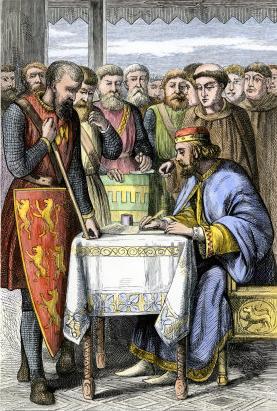
King John signs Magna Carta on June 15, 1215 at Runnymede; coloured wood engraving, 19th century.
Original artist unknown, held by the Granger Collection, New York. Image via Wikimedia Commons.
England does not really go in for national monuments, and when it does they are often eccentric. There is no great shrine to Alfred the Great, for example, the great founder of our nation, but we do have, right in the middle of London, a large marble memorial to the animals that gave their lives in the fight against fascism. And Runnymede, which you could say is the birthplace of English liberty, would be a deserted lay-by were it not for the Americans.
Beside the Thames, some 10 miles outside London’s western suburbs, this place “between Windsor and Staines”, as it is called in the original document, is a rather subdued spot, with the sound of constant traffic close by. Once there you might not know it was such a momentous place were it not for an enclosure with a small Romanesque circus, paid for by the American Association of Lawyers in 1957.
American lawyers are possibly not the most beloved group on earth, but it would be an awful world without them, and for that we must thank the men who on June 15, 1215 forced the king of England to agree to a document, “The Great Charter of the Liberties”.
Although John went back on the agreement almost immediately, and the country fell into civil war, by the end of the century Magna Carta had been written into English law; today, 800 years later, it is considered the most important legal document in history. As the great 18th-century statesman William Pitt the Elder put it, Magna Carta is “the Bible of the English Constitution”.
It was also, perhaps more importantly to the world, a huge influence on the United States. That is why today the doors to America’s Supreme Court feature eight panels showing great moments in legal history, one with an angry-looking King John facing a baron in 1215.
Magna Carta failed as a peace treaty, but after John’s death in 1216 the charter was reissued the following year, an act of desperation by the guardians of the new boy king Henry III. In 1300 his son Edward I reconfirmed the Charter when there was further discontent among the aristocracy; the monarch may have been lying to everyone in doing so, but he at least helped establish the precedent that kings were supposed to pretend to be bound by rules.
From then on Parliament often reaffirmed Magna Carta to the monarch, with 40 such announcements by 1400. Clause 39 heavily influenced the so-called “six statutes” of Edward III, which declared, among other things, that “no man, of whatever estate or condition he may be … could be dispossessed, imprisoned, or executed without due process of law”, the first time that phrase was used.
Magna Carta was last issued in 1423 and then barely referenced in the later 15th or 16th centuries, with the country going through periods of dynastic fighting followed by Tudor despotism and religious conflict. By Elizabeth I’s time, Magna Carta was so little cared about that Shakespeare’s play King John didn’t even mention it.
Comments Off on “The Great Charter of the Liberties” was signed on June 15, 1215 at Runnymede
Look at Life — Playing Trains (1967)
Classic Vehicle Channel
Published 19 Apr 2020

Comments Off on Look at Life — Playing Trains (1967)
QotD: Like Communism, “true” Social Credit has never been attempted
The bits of Social Credit that people in Alberta liked, amid the misery of the 1930s, were the hatred of high finance and the promise of an unearned monetary dividend. Alberta Social Credit tried to govern on this general basis, even after Douglas came to Edmonton personally and informed the cabinet that it had failed to comprehend his genius. Despite this, “Douglasite” true believers remained prominent in the party until shortly after the war, when premier E.C. Manning purged them from the Social Credit electoral apparatus. (Many were vague but obvious anti-Semites, like Douglas himself.)
Colby Cosh, “Social Credit may be dead. Long live Social Credit!”, National Post, 2019-04-22.
Comments Off on QotD: Like Communism, “true” Social Credit has never been attempted
July 5, 2022
How to Fool a Führer – Operation Mincemeat – WW2 – Spies & Ties 19
World War Two
Published 4 Jul 2022Glyndwr Michael, the dead secret agent, has deposited his deceptive letters in Spain. Now the next phase of Operation Mincemeat begins. If Charles Cholmondely of MI5 and Ewen Montagu of Naval Intelligence have done their job right, the letters should make their way into Hitler’s hands.
(more…)
Comments Off on How to Fool a Führer – Operation Mincemeat – WW2 – Spies & Ties 19
Julius Caesar and the City of Rome
toldinstone
Published 14 May 2021Julius Caesar was not only a gifted general and fiercely ambitious politician. He was also a great builder, who reshaped the heart of Rome in his own image.
For much more on Caesar and his successors, check out my book Naked Statues, Fat Gladiators, and War Elephants: Frequently Asked Questions about the Ancient Greeks and Romans.
https://www.amazon.com/Naked-Statues-…
If you’re so inclined, you can follow me elsewhere on the web:
https://www.patreon.com/toldinstone
https://www.reddit.com/r/AskHistorian…
https://www.instagram.com/toldinstone/
https://www.goodreads.com/author/show…0:00 Introduction
1:29 The Forum in Caesar’s time
3:30 Caesar’s new forum
4:42 The Temple of Venus Genetrix
5:37 The Basilica Julia
6:10 The Curia and Rostra
6:57 Dedication games
8:02 Caesar the godThanks for watching!

Comments Off on Julius Caesar and the City of Rome
QotD: The Great Enrichment
In particular, it is ideas that people have for commercially tested betterment that matter. Consider alternating-current electricity, cardboard boxes, the little black dress, The Pill, cheap food, literacy, antibiotics, airplanes, steam engines, screw-making machines, railways, universities, cheap steel, sewers, plate glass, forward markets, universal literacy, running water, science, reinforced concrete, secret voting, bicycles, automobiles, limited access highways, free speech, washing machines, detergents, air conditioning, containerization, free trade, computers, the cloud, smart phones, and Bob Gordon’s favorite, window screens. …
And the Great Enrichment depended on the less famous [but] crucial multitudes of free lunches prepared by the alert worker and the liberated shopkeeper rushing about, each with her own little project for profit and pleasure. Sometimes, unexpectedly, the little projects became big projects, such as John Mackey’s one Whole Foods store in Austin, Texas resulting in 479 stores in the U.S. and the U.K., or Jim Walton’s one Walmart in Bentonville, Arkansas resulting in 11,718 stores worldwide.
Letting people “have a go” to implement such ideas for commercially tested betterment is the crux. It comes, in turn, from liberalism, Adam Smith’s “obvious and simple system of natural liberty”, “the liberal plan of [social] equality, [economic] liberty, and [legal] justice”. Liberalism permitted, encouraged, honored an ideology of “innovism” — a word preferable to the highly misleading word “capitalism,” with its erroneous suggestion that the modern world was and is initiated by piling up bricks and bachelors’ degrees.
Dierdre McCloskey, “How Growth Happens: Liberalism, Innovism, and the Great Enrichment (Preliminary version)” [PDF], 2018-11-29.
Comments Off on QotD: The Great Enrichment
July 4, 2022
A Dish for the First 4th of July … and why it should be on the 2nd
Tasting History with Max Miller
Published 30 Jun 2020While we may think of BBQ, hot dogs, and potato salad as traditional 4th of July fare, the Founding Fathers certainly did not. We’ll take a look at one of the earliest celebratory meals and explore why John Adams wasn’t a fan of July 4th.
Follow Tasting History with Max Miller here:
Instagram: https://www.instagram.com/tastinghist…
Twitter: https://twitter.com/TastingHistory1
Reddit: r/TastingHistoryHelp Support the Channel with Patreon: https://www.patreon.com/tastinghistory
LINKS TO INGREDIENTS & TOOLS**
Organic Nut Milk Bag: https://amzn.to/3i6D3sh
Wilton Candy Thermometer: https://amzn.to/3i0KkdbLINKS TO SOURCES**
1776 the Musical: https://amzn.to/3eDvXZX
John Adams by David McCullough: https://amzn.to/3i3SBNj
1776 by David McCullough: https://amzn.to/3i8cAKY
Townsends: Spanish Cooking – Salmon and Onions From 1750 https://www.youtube.com/watch?v=DjrGc…
The Martha Washington Cook Book: A Compendium of Cookery and Reliable Recipes: https://amzn.to/38dRwhz
Did you know… Independence Day Should Actually Be July 2nd?: https://www.archives.gov/press/press-…**Amazon offers a small commission on products sold through their affiliate links, so each purchase made from this link, whether this product or another, will help to support this channel with no additional cost to you.
MENTIONED LINKS
Everlasting Syllabub: https://www.youtube.com/watch?v=CQksG…Poached Salmon in Egg Sauce
ORIGINAL RECIPES (From The Martha Washington Cook Book)
EGG SAUCE
Make a drawn butter; chop two hard-boiled eggs quite fine, the white and yolk separately, and stir it into the sauce before serving. This is used for boiled fish or vegetables.TO MAKE DRAWN BUTTER
Put half a pint of milk in a perfectly clean stewpan, and set it over a moderate fire; put into a pint bowl a heaping tablespoonful of wheat flour, quarter of a pound of sweet butter, and a saltspoonful of salt; work these well together with the back of a spoon, then pour into it, stirring it all the time, half a pint of boiling water; when it is smooth, stir it into the boiling milk, let it simmer for five minutes or more, and it is done.Drawn butter made after this recipe will be found to be most excellent; it may be made less rich by using less butter.
Boiled Salmon
The middle slice of salmon is the best. Sew up neatly in a mosquito-net bag, and boil a quarter of an hour to the pound in hot, salted water. When done, unwrap with care, and lay upon a hot dish, taking care not to break it … Garnish with parsley and sliced eggs.MODERN RECIPE
INGREDIENTS
– 2 Hard Boiled Eggs, chopped into small pieces
– 1 Cup (240ml) of whole milk
– A heaping tablespoon of flour
– 1 Stick or 113g of softened butter
– ½ teaspoon salt
– 1 Cup of boiling water
– Salmon
– Salted WaterMETHOD
1. Add the milk to a sauce pan and set over medium heat and simmer making sure not to scorch it.
2. In a small bowl, add the flour, the butter, and the salt, and mix together. Slowly add the boiling water while continuing to stir. Once smooth, pour into the milk and allow to simmer for 5 minutes. Then stir in the chopped eggs and allow to simmer for another minute, then remove from the heat.
3. Fill a medium saucepan half full with water and add some salt (about 2 tsp). Set over low heat and bring to a simmer of 175-180°F/80°C. Place salmon into the water and cook until ready (12-15 per pound). Make sure not to let the temperature raise past the 180°F.
4. Once cooked, place salmon on a warm dish and pour the egg sauce on top. Garnish with parsley.PHOTO CREDITS
Richard Henry Lee: National Portrait Gallery / CC BY (https://creativecommons.org/licenses/…)MUSIC CREDITS
Record Scratch – Raccoonanimator https://freesound.org/s/160909/#tastinghistory #colonialcooking #4thOfJuly #IndependenceDay
Comments Off on A Dish for the First 4th of July … and why it should be on the 2nd
QotD: The French solution to trench warfare
On the defensive, the French had adopted many of the same principles of the German defense-in-depth we’ve already discussed. On the offense, they came to favor (particularly under the influence of Philippe Pétain and […] Ferdinand Foch) an offensive doctrine designed to maximize France’s position in an attritional contest: that is to limit losses and maximize enemy casualties while still taking and holding ground. The system favored limited “bite-and-hold” attacks, ideally limited such that the attack stopped before triggering the inevitable German counter-attack. Remember that it was when the attacker ran out of steam and the defender’s counter-attack came that the casualty ratios tended to shift to favor the defender. In French thinking, the solution was just to not reach that point.
Instead, the French came to favor – and the British and Americans picked up the same method by the end – elaborately prepared small offensives. The elaborate preparation meant planning out the attack carefully, using shorter but carefully planned hurricane barrages (all of this planning, of course took time) and then seizing the enemy’s forward positions and just their forward positions. Instead of then trying to push through – the old French notion of assault brutal et continu (“brutal and continuous” – a “keep up the pressure till they break” method) which Robert Nivelle had favored – methodical battle focused on “bite-and-hold”.
Once you hit your limited objectives in that first rush where enemy resistence is disoriented (from the short, hurricane barrage) and weaker – and thus where the casualty ratio favors you – you stop and begin fortifying your position. You dig those communications trenches, move up your artillery and brace for the counter-attack. By the time the enemy realizes you aren’t going to attack his second or third line positions (and trigger his devastating counter-attack), you are dug in and prepared for his attack (the hold part of “bite-and-hold”). To reestablish defense in depth, the defender now has to back up to establish new lines to the rear (or launch his own fresh offensive, but by late 1918, the Germans were too weak for this). A long series of such attacks – with significant intervals for fresh careful planning and stockpiling resources – could slowly but surely lever your opponent off of key positions, one by one. It would also preserve a favorable balance of casualties, ensuring that in the end, the enemy runs out of men and shells before you do (that is the “rupture” that Joffre had always hoped for, but which arrived but two years too late for his career).
Such a slow, expensive, bloody and unglamorous strategy was in some ways only politically possible once, by 1918, it had become apparent that all other options were exhausted. That said, to argue that this bite-and-hold operational doctrine broke the trench stalemate is probably not fair either. The progress of allied offensives in 1918 was extremely slow by even the standards of 1914. The German Spring Offensive was well and truly done in July and the Allied offensive picked up in August and ran through November as fast as it could (with Foch doing everything short of getting out and pushing the offensive to try to speed it up) and yet the final allied positions by November were not even in Germany. Even at its greatest distance in 100 days of unbroken victories by a force with materiel and numerical superiority, the front moved less than 100 miles and the overall casualty ratio was roughly even (around a million on both sides).
Bret Devereaux, “Collections: No Man’s Land, Part II: Breaking the Stalemate”, A Collection of Unmitigated Pedantry, 2021-09-24.
Comments Off on QotD: The French solution to trench warfare


