Quotulatiousness

July 3, 2022

David Warren waves the flag

As noted the other day, the official period of mourning sickness that enveloped Canada last year after the blockbuster revelations about residential schools has not been followed-up by any substantive proof of any of the sensational claims that Prime Minister Trudeau seized upon to lecture Canadians about our historical guilt (the “genocideal nation” that he claimed we were) and to haul the national flag down to half-staff for half a year. David Warren chooses to wave the flag instead:
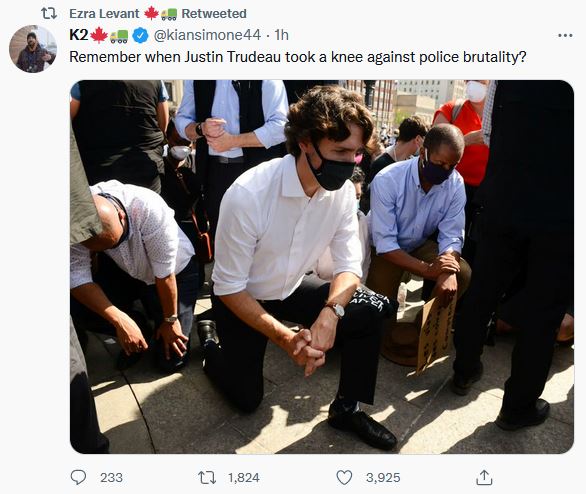
Justin Trudeau has always had a strong affinity for the symbolic gesture, especially when the media are around to record it.

The latest trick in what we might call “eco-commie-perv agitprop”, emerged while shaming Canadian history and traditions. I’ll touch on it in a moment. It is a product chiefly of the Indian Wars of the last few years. The White Man, and more specifically when Catholic, has been accused of massacring the Native People in 20th-century residential schools, just as he did upon coming to the continent. He then ploughs the anonymous victims into mass graves, showing his affinity to, exempli gratia, the Nazis.

This propaganda campaign, which quickly reached the tedious stage, was founded on a series of oft-repeated unambiguous lies, driven into our susceptible children in our compulsory public schools, and throughout life by such agencies as the CBC. (All our significant media are now under government control, subsidy, and watch.) White men, especially the Catholics, contaminate Canadian history by their Satanic essence, according to this malicious fantasy. Goodness and innocence can be found only in their victims, the “visible minorities” (or majorities, as the case may be). Shame is inculcated among persons exhibiting the wrong race.

I write of Canada, but something similar is happening in the United States, and has been carried to Europe on the sails of Hollywood and popular “music”. Canada is, however, an extreme example — of brazen idiocy — and even to underprivileged (all-white) rural places the message is piped in. Disharmonious voices must expect state interference, and eventual arrest.

For Canada now has political prisoners, including many who participated in the Freedom Convoy of truck drivers. Tamara Lich, a prominent organizer of this demonstration, has been gratuitously jailed, though she didn’t even try to commit a plausible crime. This week she was gaoled again, apparently for receiving a freedom medal. (Persons it was in her bail conditions not to meet may have been in the audience.) She was put out of sight for “Canada Day” (the former Dominion celebration, yesterday). This manipulation of Canadian law is, sadly, no longer unprecedented. It seems to be ordered directly from the Prime Minister’s Office.

Tougher than Guadalcanal: New Georgia – 201 – July 2, 1943

World War Two
Published 2 Jul 2022

The Allies begin the next phase of their Solomon Islands offensives, the invasion of New Georgia, even as the regional fighting continues on New Guinea. Adolf Hitler schedules his summer Kursk offensive for July 5th, and the Allied invasion of Sicily is set for July 10th.
(more…)

Model 1907/15 Berthier: The WW1 Standard Infantry Rifle

Filed under: France, History, Military, Weapons, WW1 — Tags: , , — Nicholas @ 02:00

Forgotten Weapons
Published 24 Jul 2017

http://www.patreon.com/ForgottenWeapons

When World War One broke out in 1914, France mobilized millions of men into military service — and it became abundantly clear that a lot of new rifles would need to be manufactured. The 1886 Lebel was no longer in production and was a slow rifle to make in any case — but the 1907 Colonial Berthier was being produced already, and was a more efficient design as well. By late 1914, plans were underway to drastically increase Berthier rifle production.

A few changes were made to the 1907 pattern, mainly changing the front end to accept the standard 1886 Lebel bayonet (“Rosalie”). After the first 80,000 had been made, the bolt handle was also changed from the bent carbine style to a heavier duty straight type. With these changes made, the Modele 07/15 was ready for mass adoption by the infantry, where it would serve side by side with the Lebel.

The primary manufacturer of 07/15 rifles was the St. Etienne arsenal, which build between 1.0 and 1.2 million of them by the spring of 1917. The Chatellerault arsenal produced another 436,000, and the Delauney Belleville automobile factory retooled its workshops to make rifles, producing another 170,000 of them. The Remington company in the US also took a contract to make 250,000 Berthier rifles, but was unable to meet the terms of the contract. Remington had taken on more wartime production work than it could handle, and failed to meet French quality and scheduling requirements. In August of 1916 that contract was cancelled, with just 9,440 rifles sent to France for use. The remaining 5,000-10,000 that had been made by Remington were sold on the commercial market in the US.

By 1916, it was clear that the 3-round capacity of the Berthier was a very real disadvantage (both tactically and psychologically) to the German Mauser rifles, and an upgrade program was put underway. This would ultimately become the 1916 pattern and would go into production in 1917.

If you enjoy Forgotten Weapons, check out its sister channel, InRangeTV! http://www.youtube.com/InRangeTVShow

July 2, 2022

Versailles – “It will be what you make of it” – Sabaton History 111 [Official]

Filed under: Britain, Europe, France, Germany, History, Italy, Media, Military, Russia, WW1 — Tags: , , , , , — Nicholas @ 04:00

Sabaton History
Published 1 Jul 2022

There are a great many myths and misconceptions about the Treaty of Versailles, and it has been used and even weaponized many times over the years. Today, Indy goes over the nuts and bolts of what it actually was and what it actually did.

Support Sabaton History on Patreon: https://www.patreon.com/sabatonhistory

Listen to “Versailles” on the album The War To End All Wars: https://music.sabaton.net/TheWarToEnd…

Listen to Sabaton on Spotify: http://smarturl.it/SabatonSpotify
Official Sabaton Merchandise Shop: http://bit.ly/SabatonOfficialShop

Hosted by: Indy Neidell
Written by: Markus Linke and Indy Neidell
Directed by: Rickard Erixon and Indy Neidell
Produced by: Pär Sundström, Astrid Deinhard and Spartacus Olsson
Creative Producer: Rickard Erixon, Indy Neidell
Set Design: Daniel Eriksson, Rickard Erixon,
Executive Producers: Pär Sundström, Joakim Brodén, Tomas Sunmo, Indy Neidell, Astrid Deinhard, and Spartacus Olsson
Post-Production Director: Marek Kamiński
Editor: Iryna Dulka
Sound Editor: Marek Kamiński
Archive: Reuters/Screenocean – https://www.screenocean.com
Colorizations by: Olga Shirnina, a.k.a. Klimbim – https://klimbim2014.wordpress.com/

Sources:
IWM: 130-09+10, IWM 130-01
Auckland Libraries Heritage Collections 5-1276
Médiathèque de l’architecture et du patrimoine
hpebley3 from freesond.org
All music by: Sabaton

An OnLion Entertainment GmbH and Stuffed Beaver LTD co-Production.

© Stuffed Beaver LTD, 2019 – all rights reserved.

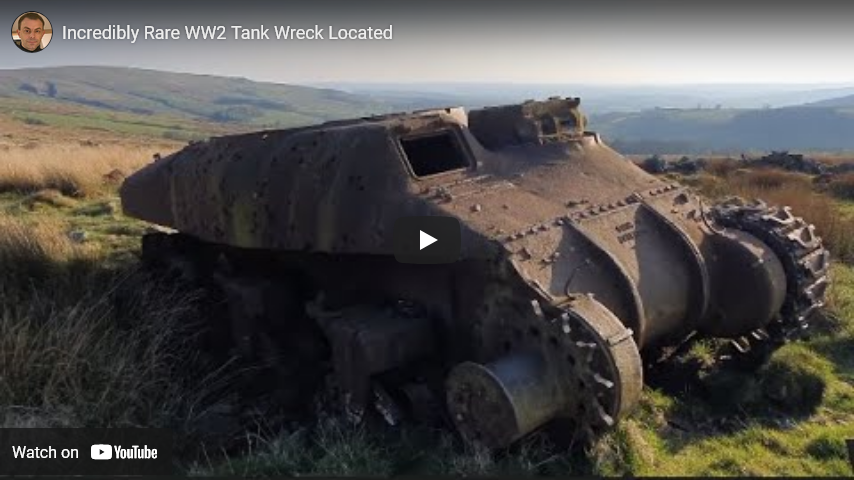
Incredibly Rare WW2 Tank Wreck Located

Filed under: Britain, Cancon, Europe, History, Military, USA, Weapons, WW2 — Tags: , , — Nicholas @ 02:00

Mark Felton Productions
Published 5 Mar 2022

The story of an incredibly rare WW2 tank that remains forgotten on a UK gunnery range.

Many thanks to Destination Discovery (ADTV) for tank footage. Please visit their wonderful channel for more footage: https://www.youtube.com/channel/UCxyc…

Dr. Mark Felton is a well-known British historian, the author of 22 non-fiction books, including bestsellers Zero Night and Castle of the Eagles, both currently being developed into movies in Hollywood. In addition to writing, Mark also appears regularly in television documentaries around the world, including on The History Channel, Netflix, National Geographic, Quest, American Heroes Channel and RMC Decouverte. His books have formed the background to several TV and radio documentaries. More information about Mark can be found at: https://en.wikipedia.org/wiki/Mark_Fe…

Help support my channels:
https://www.paypal.me/markfeltonprodu…
https://www.patreon.com/markfeltonpro…

Disclaimer: All opinions and comments expressed in the ‘Comments’ section do not reflect the opinions of Mark Felton Productions. All opinions and comments should contribute to the dialogue. Mark Felton Productions does not condone written attacks, insults, racism, sexism, extremism, violence or otherwise questionable comments or material in the ‘Comments’ section, and reserves the right to delete any comment violating this rule or to block any poster from the channel.

Credits: US National Archives; Library of Congress; Imperial War Museum; YouTube Creative Commons; LHOON; Martin van Dalen.
Thumbnail: Destination Discovery (ADTV)

July 1, 2022

Trying to reconcile the highly mediagenic “Residential School mass graves” stories with facts-on-the-ground

Filed under: Cancon, Education, History, Media, Religion — Tags: , , , , — Nicholas @ 05:00

Prime Minister Justin Trudeau — never one to miss opportunities to preen before the camera and shed a performative tear or two — quickly ordered Canadian flags to half-staff when the stories about unmarked graves on the grounds of former residential schools spread across the world. Claims and accusations flew, based on ground-penetrating radar scans that didn’t actually prove that the surveyed land contained lost graves. Once the narrative was established, it provided many opportunities for First Nations organizations, activists, and Canadian and foreign politicians to moralize, condemn, and demand investigations, restitution, and apologies from the Catholic church (which ran over 40% of the residential schools), and the provincial and federal governments.

So, more than a year later … what has been investigated? Not much, it turns out:

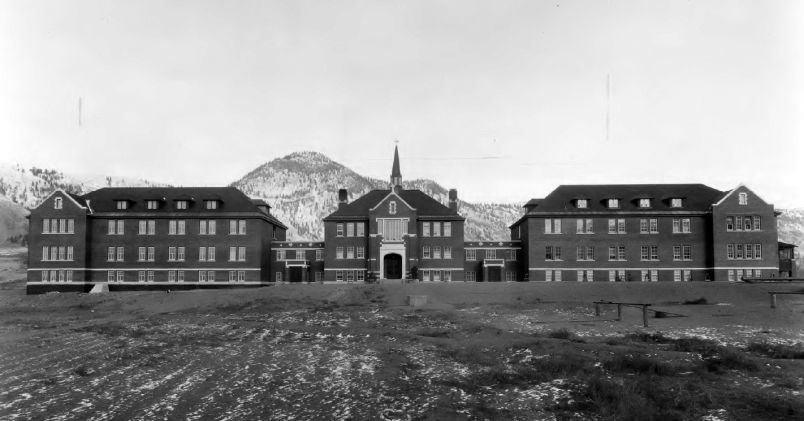
Kamloops Indian Residential School, 1930.
Photo from Archives Deschâtelets-NDC, Richelieu via Wikimedia Commons.

Sixty-eight Christian churches, mostly Roman Catholic, were vandalised or even burned to the ground. Many of these were historical church buildings still used and revered by native people. The pretext for arson and vandalism was that the Kamloops Indian Residential School had been run by a Catholic religious order, as had 43% of all residential schools. Imagine the outrage if 68 synagogues or mosques had been vandalised and burned. Yet the attacks on 68 Catholic churches passed with only mild criticism.

An article in the New York Times was typical of media commentary about the unmarked graves. It was first published under the headline “Horrible History: Mass Grave of Indigenous Children Reported in Canada” on 28 May and updated on 5 October under the same title. It asserted that: “For decades, most Indigenous children in Canada were taken from their families and forced into boarding schools. A large number never returned home, their families given only vague explanations, or none at all.”

Because the corporate press take their cue from the New York Times, its perspective echoed widely. The discovery of the so-called unmarked graves was chosen by Canadian newspaper editors as the “news story of the year”. And the World Press Photo of the Year award went to “a haunting image of red dresses hung on crosses along a roadside, with a rainbow in the background, commemorating children who died at a residential school created to assimilate Indigenous children in Canada”.

But the award this news report should have won is for fake news of the year. All the major elements of the story are either false or highly exaggerated.

First, no unmarked graves have been discovered at Kamloops or elsewhere. GPR has located hundreds of soil disturbances, but none of these has been excavated, so it is not known whether they are burial sites, let alone children’s graves. At her original press conference, the Chief of the Kamloops Indian Band called these findings unmarked graves, and the media, politicians, and even Pope Francis ran with the story without waiting for proof.

Similar claims from the chiefs of other Indian reserves ran into grave difficulty (no pun intended) because the GPR research was conducted in whole or in part on community cemeteries located near the sites of residential schools. It would hardly be surprising to find burial sites in a cemetery! But again, since no excavations have been conducted, it is not known whether these unmarked graves contain the bodies of children.

North American Indians did not conduct burials; they usually exposed the bodies of the dead to be worn away by predators and the elements. Christian missionaries introduced the practice of burial. But Indian graves were usually marked by simple wooden crosses that could not long withstand the rigours of Canadian weather. Thus Indian reserves today contain probably tens of thousands of forgotten unmarked graves of both adults and children. To “discover” these with ground-penetrating radar proves nothing without excavation.

Second, there are no “missing children”. This concept was invented by the Truth and Reconciliation Commission (TRC), whose members spoke at various times of 2,800 or 4,200 Indian children who were sent to residential schools but never returned to their parents. Indeed, some children died at residential schools of diseases such as tuberculosis, just as they did in their home communities. But the legend of missing students arose from a failure of TRC researchers to cross-reference the vast number of historical documents about residential schools and the children who attended them.

The Early Emperors – Part 6: The Birth of Christianity

Filed under: Europe, Greece, History, Middle East, Religion — Tags: , , , , , , — Nicholas @ 04:00

seangabb
Published 27 Dec 2021

The Roman Empire was the last and the greatest of the ancient empires. It is the origin from which springs the history of Western Europe and those nations that descend from the Western Roman Empire. It is the political entity within which the Christian faith was born, and the growth of the Church within the Empire, and its eventual establishment as the sole faith of the Empire, have left an indelible impression on all modern denominations. Its history, together with that of the ancient Greeks and the Jews, is our history. To understand how the Empire emerged from a great though finally dysfunctional republic, and how it was consolidated by its early rulers, is partly how we understand ourselves.

Here is a series of lectures given by Sean Gabb in late 2021, in which he discusses and tries to explain the achievement of the early Emperors. For reasons of politeness and data protection, all student contributions have been removed.

More by Sean Gabb on the Ancient World: https://www.classicstuition.co.uk/

Learn Latin or Greek or both with him: https://www.udemy.com/user/sean-gabb/

His historical novels (under the pen name “Richard Blake”): https://www.amazon.co.uk/Richard-Blak…

More than just the iconic Snowbirds demonstrator aircraft: the story of the Canadair CT-114 Tutor

Filed under: Cancon, History, Military, Weapons — Tags: , , — Nicholas @ 02:00

Polyus Studios
Published 13 Apr 2019

Support me on Patreon – https://www.patreon.com/polyusstudios

The humble Canadair CT-114 Tutor, or “Toot” as it was affectionately called, trained every fast aircraft pilot in the RCAF from the mid-1960 through past the turn of the century. But it wasn’t just Canadians who benefited from its outstanding training qualities, the Tutor trained hundreds of pilots from other NATO and friendly countries. Today only the famous Snowbirds flight demonstration team continue to fly the jet and as the airframes age and fewer remain available, they too will eventually retire one of Canada’s most iconic jets.

**One of the Toots had a rather unique history that’s worth mentioning in detail. The first production CL-41G serial number 2201 was built in Montreal and delivered to Malaysia in 1967. It saw combat near the border with Thailand and after it was retired from military service in 1986, was sold to an American flight school in Michigan. It was then sold to the actor and accomplished pilot John Travolta. He flew it until 2001 when he donated it to a school in Florida who have kept it flying to this day.**

Aircraft mentioned:
CL-41A Tutor
CL-41R
CL-41G Tebuan
CF-104 Starfighter
CT-133 Shooting Star
AT-16 Harvard trainer

Music:
Denmark – Portland Cello Project

Research sources:
Canada Aviation and Space Museum Aircraft, Canadair Tutor by Bill Upton (huge thanks to Mr. Upton for his fine work)
https://www.militaryfactory.com/aircr…
http://www.royalaviationmuseum.com/78…
http://www.geocities.ws/faisal4589/te…
http://www.rwrwalker.ca/CAF_Tutor_det…
http://www.warbirdalley.com/tutor.htm
http://www.rcaf-arc.forces.gc.ca/en/a…
https://ingeniumcanada.org/aviation/c…
http://www.canadianflight.org/content…
https://www.wingsmagazine.com/operati…

0:00 Introduction
1:48 Initial Development
4:04 The Tutor is Born
8:30 CL-41R Starfighter Radar Trainer
10:26 The Tutor enters service
13:13 Air Demonstration Squadrons
15:36 Heavily Armed Tutor
17:49 Proposed Advanced Variants
19:08 Upgrades and Final Flights
21:09 Conclusion

Canadair CT-114 Tutor; The iconic Snowbirds demonstrator and NATO pilot training jet
#Snowbirds #RCAF #CanadianAerospace

June 30, 2022

A Deep Dive into the Tiger I, by the Chieftain

Filed under: Germany, History, Military, Weapons, WW2 — Tags: , , — Nicholas @ 04:00

World War Two
Published 29 Jun 2022

The best tank of World War Two or a piece of junk? Using the original held at the U.S. Army Armor & Cavalry Collection, Chieftain and Rob Cogan take you on a literal deep dive into the iconic Tiger I.
(more…)

QotD: Sparta had Lycurgus, while Athens had Solon … who at least actually existed

Filed under: Europe, Government, Greece, History, Quotations, Religion — Tags: , , , — Nicholas @ 01:00

Lycurgus was the name the Spartans gave for their mythical founder figure, a Spartan who had supposedly lived in the late 9th century and had set up the Spartan society as we see it in the classical period. Almost all of our details for his life come from a biography by Plutarch, written c. 100 A.D. (date to be significant in a moment). The story the Spartans told went thusly:

    Once upon a time … there was a Spartan named Lycurgus, and he was the very best Spartan …

Lycurgus had been the younger brother of one of Sparta’s two kings, but had left Sparta to travel when his brother died, so that he would be no threat to his young nephew.

After a time, the Spartans begged Lycurgus to come back and reorganize society, and Lycurgus – with the blessing of the Oracle at Delphi – radically remade Spartan society into the form it would have for the next 400 years. He did not merely change the government, but legislated every facet of life, from child-rearing to marriage, to the structure of households, the economic structure, everything. Once he had accomplished that, Lycurgus went back to Delphi, but before he left he made all the Spartans promise not to change his laws until he returned. Once the Oracle told him his laws were good, he committed suicide, so that he would never return to Sparta, thus preventing his laws from ever being overturned. So the Spartans never changed Lycurgus’ laws, which had been declared perfect by Apollo himself. Subsequently, the Spartans accorded Lycurgus divine honors, and within Sparta he was worshiped as a god.

    And that’s how Lycurgus remade Sparta. The End.

The role Lycurgus serves in the sources is as the perfect, infallible founder figure. No less than the Oracle at Delphi – the divine word of Apollo – declared Lycurgus a god (Hdt. 1.65.3). For later sources who, we must stress – believe their own religion (as people everywhere are wont to do) – that means, essentially a priori that Lycurgus’ “constitution” must be practically flawless and all flaws must stem from its imperfect implementation.

But – wait a second – what is our evidence for the actual person of Lycurgus or the character of the state he set up?

Remember how I said Lycurgus is dated to the late 9th century – specifically the 820s B.C. or so. That’s a huge problem. The earliest Greek literature comes from around (very roughly – there is deep scholarly debate here that I’m glossing over) the mid-8th century (c. 750 or so) and is entirely mythological in nature. The first actual history is Herodotus, writing in the mid-400s. The earliest historical event we have evidence for is the Lelantine War (c. 700ish), at least a century after the life of Lycurgus. None of our sources have anything to go on about Lycurgus – save for what the Spartans – who already worship this figure as a god – tell them. Crucially, Tyrtaeus, writing in the 650s B.C., while he does mention the rhetra (an oracle the Spartans received concerning the arrangement of their government) does not mention Lycurgus (although Plutarch is quick to connect the two, Plut. Lyc. 6.5), meaning that the earliest source for Lycurgus’ existence is Herodotus.

Wait, it gets even better – the one thing we do know about Lycurgus’ laws is that they were not written down (Plut. Lyc. 13.1). Also, Lycurgus supposedly took steps to prevent his remains from returning to Sparta (Plut. Lyc. 29.5-6, but cf. 31.4) and no continued family line, which seems like exactly the sort of explanation you put at the end of a good campfire story for why there was absolutely no trace of such an important man save his legend. So not only the details of Lycrugus’ life, but also the society he created will have lived as oral tradition – potentially changing from one telling to the next, being embellished or expanded – for generations before being committed to the permanent, unchanging memory of written history.

In short, our only evidence for Lycurgus are the campfire stories told about him by people who worshiped him as a god, as related to individuals centuries later. Which is to say that, by historical standards, there is no reliable evidence at all that Lycurgus existed.

[…]

Lycurgus is often set against Solon – the early 6th century Athenian reformer. It is true that Athenians also tend to attribute things to Solon that were later developments, but we need to note the key differences: Solon comes two centuries after Lycurgus (thus, unlike Lycurgus, in the historical period), didn’t receive divine honors and most importantly writes to us (he wrote poetry, some of which survives), so that we can know he was an actual real person. Asking students – as I have seen done – to compare a real, flawed reformer with an idealized, semi-mythical demi-god without any kind of guidance as to the nature of these two figures is, quite frankly, educational malpractice.

Bret Devereaux, “Collections: This. Isn’t. Sparta. Part III: Spartan Women”, A Collection of Unmitigated Pedantry, 2019-08-29.

June 29, 2022

How to Identify a Real M1A1 Carbine vs a Fake

Filed under: History, Military, USA, WW2 — Tags: , , — Nicholas @ 02:00

Forgotten Weapons
Published 10 Feb 2018

Looking for a light and compact weapon to equip its new Airborne units, the US military adopted the M1A1 Carbine in May of 1942. This was mechanically identical to the existing M1 Carbine but with a wire-frame side-folding stock in place of the standard wooden stock. This allowed the M1A1 to fit into a very handy leg bag for paratroops.

Deliveries began in October 1942, with all of the guns being manufactured by the Inland company. A total of 140,591 were made in two batches (71,000 between October 1942 and October 1943 and another 69,000 between April and December 1944). This is a very small fraction of the more than 6 million M1 Carbines made during the war, and the M1A1 has become quite notable and desirable for its association with elite Airborne units. As a result, reproduction and fake stocks abound, and are quite difficult to tell from original ones.

Today we are going to look at some of the specific features that can help you authenticate an M1A1 stock.

http://www.patreon.com/ForgottenWeapons

Cool Forgotten Weapons merch! http://shop.bbtv.com/collections/forg…

If you enjoy Forgotten Weapons, check out its sister channel, InRangeTV! http://www.youtube.com/InRangeTVShow

Contact:
Forgotten Weapons
6281 N Oracle #36270
Tucson, AZ 85704

June 28, 2022

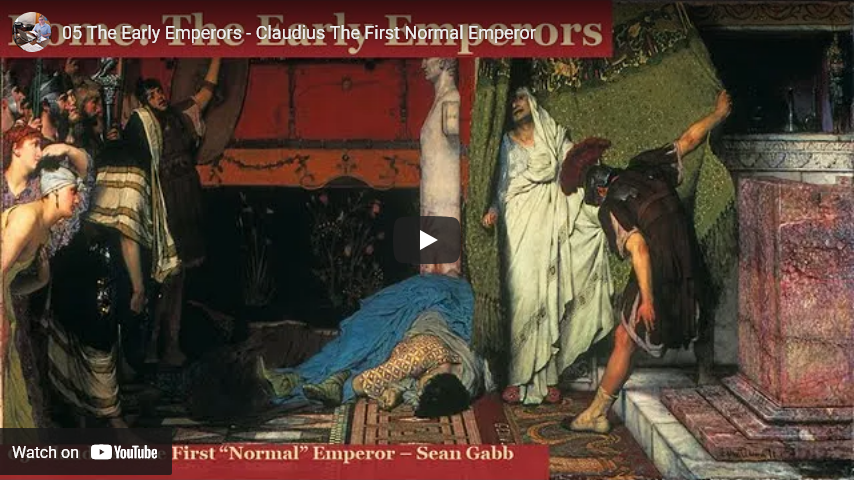
The Early Emperors – Part 5: Claudius, the First Normal Emperor

Filed under: Europe, History — Tags: , , , , , , — Nicholas @ 04:00

seangabb
Published 13 Dec 2021

The Roman Empire was the last and the greatest of the ancient empires. It is the origin from which springs the history of Western Europe and those nations that descend from the Western Roman Empire. It is the political entity within which the Christian faith was born, and the growth of the Church within the Empire, and its eventual establishment as the sole faith of the Empire, have left an indelible impression on all modern denominations. Its history, together with that of the ancient Greeks and the Jews, is our history. To understand how the Empire emerged from a great though finally dysfunctional republic, and how it was consolidated by its early rulers, is partly how we understand ourselves.

Here is a series of lectures given by Sean Gabb in late 2021, in which he discusses and tries to explain the achievement of the early Emperors. For reasons of politeness and data protection, all student contributions have been removed.

More by Sean Gabb on the Ancient World: https://www.classicstuition.co.uk/

Learn Latin or Greek or both with him: https://www.udemy.com/user/sean-gabb/

His historical novels (under the pen name “Richard Blake”): https://www.amazon.co.uk/Richard-Blak…

History of Rome in 15 Buildings 15. Keats-Shelley House

Filed under: Architecture, Britain, History, Italy — Tags: , , — Nicholas @ 02:00

toldinstone
Published 2 Oct 2018

For well over a century, the “Odes” of John Keats have been boring high school students, enchanting lovers of poetry, and giving scholars of English literature interesting things to overinterpret. When he died in 1821, however, Keats was virtually unknown – an anonymous member of Rome’s large community of travelers and expatriates in the last years of the Grand Tour.

To see the story and photo essay associated with this video, go to:
https://toldinstone.com/keats-shelley…

June 27, 2022

High Altitude Research Project and the Martlet Launch Vehicles; Gerald Bull’s dream of a space gun

Filed under: Cancon, History, Military, Space, Technology, USA, Weapons — Tags: , , , , , , , — Nicholas @ 04:00

Polyus Studios
Published 26 Jun 2022

Support me on Patreon – https://www.patreon.com/polyusstudios

In 1968, 7 countries were operating satellites in orbit, while only 3 countries had the ability to launch one themselves. But they were on the verge of being joined by a Canadian university. Starting in the early 1960s, Montreal, Quebec based McGill University developed and began testing an ambitious concept to place small satellites into orbit. It was the culmination of decades of pioneering work across multiple fields. It was the High Altitude Research Project and the Martlet orbital launch vehicle.

Music:
Denmark – Portland Cello Project
Your Suggestions – Unicorn Heads

Chapters:
0:00 Introduction
0:28 Bull’s early career
3:00 Birth of the Program
7:47 Getting HARP off the ground
10:52 Martlet 1
13:26 Early Martlet 2
15:41 Martlet 3
18:05 Enhanced Martlet 2s
21:40 Other HARP Guns
24:19 Quest for an Orbital Capability, the 2G-1
27:53 Satellite Delivery Model, Martlet 4
30:27 Advanced gun research
31:30 Hard times for HARP
32:30 Bull’s Ambition Gets The Best Of Him
35:28 Legacy of the HARP Project

Look at Life — The Jumping Jets (1965)

Filed under: Britain, Germany, History, Military, Technology, USA, Weapons — Tags: , , , , — Nicholas @ 02:00

PauliosVids
Published 20 Nov 2018

The revolutionary vertical take-off capacity of the RAF Kestrel.

[Wikipedia: “The Hawker P.1127 and the Hawker Siddeley Kestrel FGA.1 are the British experimental and development aircraft that led to the Hawker Siddeley Harrier, the first vertical and/or short take-off and landing (V/STOL) jet fighter-bomber.

“Development began in 1957, taking advantage of the Bristol Engine Company’s choice to invest in the creation of the Pegasus vectored-thrust engine. Testing began in July 1960 and by the end of the year the aircraft had achieved both vertical take-off and horizontal flight. The test program also explored the possibility of use upon aircraft carriers, landing on HMS Ark Royal in 1963. The first three aircraft crashed during testing, one at the 1963 Paris Air Show.

“Improvements to future development aircraft, such as swept wings and more powerful Pegasus engines, led to the development of the Kestrel. The Kestrel was evaluated by the Tri-partite Evaluation Squadron, made up of military pilots from the United Kingdom, the United States, and West Germany. Later flights were conducted by the U.S. military and NASA.

“Related work on a supersonic aircraft, the Hawker Siddeley P.1154, was cancelled in 1965. As a result, the P.1127 (RAF), a variant more closely based on the Kestrel, was ordered into production that year, and named Harrier – the name originally intended for the P.1154 – in 1967. The Harrier served with the UK and several nations, often as a carrier-based aircraft.”]

« Newer PostsOlder Posts »

Powered by WordPress