
grovesey69
Published 26 Feb 2013Old B&W film of relaying railway permanent way. Includes making the baseplates from scratch and building an S&C layout piecemeal. Some say the old ways are best!! they certainly knew what they were doing.
Bit of dud film in the middle but does not spoil it too much
August 9, 2022
QotD: Fusty old literary archaism
For as long as I can remember, readers have been trained to associate literary archaism with the stuffy and Victorian. Shielded thus, they may not realize that they are learning to avoid a whole dimension of poetry and play in language. Poets, and all other imaginative writers, have been consciously employing archaisms in English, and I should think all other languages, going back at least to Hesiod and Homer. The King James Version was loaded with archaisms, even for its day; Shakespeare uses them not only evocatively in his Histories, but everywhere for colour, and in juxtaposition with his neologisms to increase the shock.
In fairy tales, this “once upon a time” has always delighted children. Novelists, and especially historical novelists, need archaic means to apprise readers of location, in their passage-making through time. Archaisms may paradoxically subvert anachronism, by constantly yet subtly reminding the reader that he is a long way from home.
Get over this adolescent prejudice against archaism, and an ocean of literary experience opens to you. Among other things, you will learn to distinguish one kind of archaism from another, as one kind of sea from another should be recognized by a yachtsman.
But more: a particular style of language is among the means by which an accomplished novelist breaks the reader in. There are many other ways: for instance by showering us with proper nouns through the opening pages, to slow us down, and make us work on the family trees, or mentally squint over local geography. I would almost say that the first thirty pages of any good novel will be devoted to shaking off unwanted readers; or if they continue, beating them into shape. We are on a voyage, and the sooner the passengers get their sea legs, the better life will be all round.
David Warren, “Kristin Lavransdatter”, Essays in Idleness, 2019-03-21.
Comments Off on QotD: Fusty old literary archaism
August 8, 2022
Barbarian Europe: Part 6 – The Birth of England
seangabb
Published 4 Aug 2021In 400 AD, the Roman Empire covered roughly the same area as it had in 100 AD. By 500 AD, all the Western Provinces of the Empire had been overrun by barbarians. Between April and July 2021, Sean Gabb explored this transformation with his students. Here is one of his lectures. All student contributions have been removed.
(more…)
Comments Off on Barbarian Europe: Part 6 – The Birth of England
Boring British politicians
Katherine Bayford compares the last set of cabinet ministers appointed by lame duck PM Boris Johnson with some of the Parliamentarians of the 20th century … and it’s difficult not to feel nostalgic for a past Golden Age at Westminster:
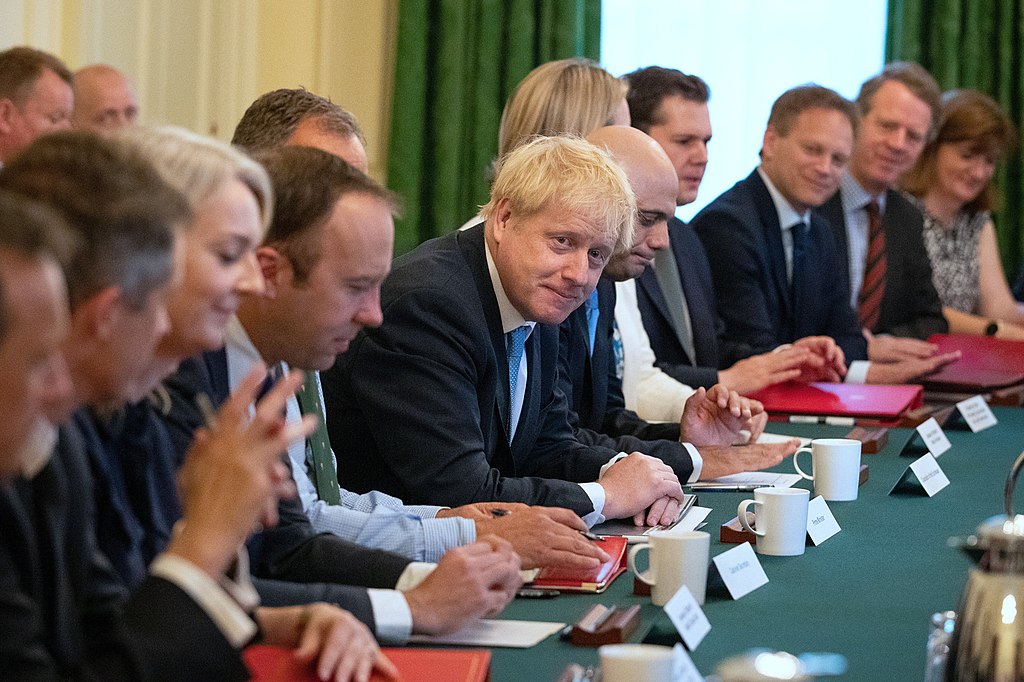
Prime Minister Boris Johnson at his first Cabinet meeting in Downing Street, 25 July 2019.
Official photograph via Wikimedia Commons.
One of Boris Johnson’s final, whimpering acts of power in his premiership was to appoint a new cabinet. Fatally wounded by a team of ministers made up of those with little charm, intelligence or experience, who was actually left for Boris to replace them with?
A veritable who’s-that of the worst unknowns that can be found down the side of parliamentary benches was swiftly conscripted in. I tell a lie — Johnny Mercer MP achieved mild public recognition for defending elderly soldiers accused of war crimes and getting very angry at certain risqué insinuations made in the comments section of the Plymouth Herald.
[…]
There is nothing unusual about this class of minister, however. They are representative figures: dim, without verbal sparkle, frequently light on narrow policy insights and wider understandings of social and economic history. The median British politician has been like this for decades now. Tony Blair would bemoan the shoddy material he had to work with at every reshuffle, and David Cameron likewise found himself struggling for a front bench neither too hateful nor too stupid. The difference in political acumen and sophistication from the most forgotten of ministerial interviews from fifty years ago reveal a steep decline in both the eloquence and elegance of our politicians.
Perhaps the 20th century spoiled the voting public. Pick any decade and you will discover frontline politicians with vast hinterlands. Harold Macmillan recited Aeschylus — in the original Greek — whilst lying shot in the trenches. Enoch Powell rose from private to brigadier during the Second World War, after becoming the youngest professor in the empire. When Winston Churchill was attempting to stay solvent in the face of decades worth of excess, he maintained financial buoyancy by being the highest-paid journalist in the world. Publishers adored him. He could be trusted to write a million-word definitive biography of his relative, the first Duke of Marlborough. Roy Jenkins would in turn distinguish himself as a biographer of Churchill — as well as Gladstone, and the Chancellors of the Exchequer at large. Second-hand embarrassment is the only proper response when comparing such authorial endeavours to Boris Johnson’s biography of Churchill.
It’s not a matter of our politicians not being able to write anymore. Compared to the recent past they can barely speak. Political debates have succumbed to an entropic, deadening mediocrity. Recent discourse between a patronising, bland Sunak and a po-faced, blank Truss was not a nadir: it was standard fare.
Look upon this 1970 debate between Jenkins and Powell. Both men hold articulate and intelligent positions, arguing intricately and considerately, with a commitment to truth rather than point-scoring. They agree where relevant and have an ability to articulate clearly and fluently. Half a century on, political debate of such quality seems unrealisable. When watching vintage ministerial debates, the viewer is struck by the level of knowledge and attention that the speakers assumed their audience would possess, whether on the finer points of tackling inflation or whether IRA bombers deserved to the death penalty.
The slightest glance at cabinets fifty years ago demonstrates a far higher set of standards and abilities than those found today. Harold Wilson — always keen to consolidate as much power as possible — nevertheless packed his cabinet with the best and brightest, even if he kept them in positions in which they wouldn’t be able to outshine him. Wilson himself was a subtle and clever debater, not above using cheap PR tricks (such as his much-perfected pipe smoking) but always as a tool to realise his political vision.
Mediocrity requires mediocrity in order to survive. When judged against excellence — or even simple competence — the insufficiencies of today’s politician become intolerable. It is this which leads the public to distrust politicians more than their policy choices.
Comments Off on Boring British politicians
FN-DA1: The BAR for NATO
Forgotten Weapons
Published 13 Apr 2022After World War Two, FN put the BAR back into production. This was initially the FN-D version with a quick-change barrel, but with NATO’s adoption of the 7.62mm cartridge, there was a demand for the BAR in that chambering. The Belgian Army adopted this new round, and plenty of other nations did as well. This prompted FN to release a new version of the FN-D for it, designated the FN-DA1.
In addition to the new chambering, the DA1 also had these three changes:
– Larger bipod feet and a wider bipod stance
– A rear aperture sight instead of an open notch
– A more protected barrel release latchThe FN-DA1 would remain in production until 1967, when it was finally discontinued.
(more…)
Comments Off on FN-DA1: The BAR for NATO
QotD: How houses have changed to fit the times
But today telephones have collapsed into our pocket magic mirrors, and TVs are going in two directions — flattening and expanding to fill entire walls of the living room, and simultaneously shrinking to mate with our phones. A not-uncommon aspect of modern luxury TV design is that they’re framed in wood or glass, made to look like a wall-hanging or a painting. The TV is becoming invisible: a visitor from the 1960s or 1970s might look around in bafflement for a while before realizing that the big print in middle of the living room wall is glowing and sometimes changes (when it’s in standby, running a screensaver). Meanwhile, microwave ovens and ready meals and fast food have reduced the need for the dining room and even the kitchen: to cook a family dinner and serve it in a formal dining room is an ostentatious display of temporal wealth, a signal that one has the leisure time (and the appliances, and the storage for ingredients) to practice and perfect the skills required. The middle classes still employ cooks: but we outsource them to timeshare facilities called restaurants. Similarly, without the daily battle to keep soot and dirt at bay, and equipped with tools like vacuum cleaners and detergents, the job of the housemaid has been shrunk to something that can be outsourced to a cleaning service or a couple of hours a day for the householder. So no more cramped servants’ bedrooms.
The very wealthy ostentatiously ape the behaviour of the even richer, who in turn continue the traditions they inherited from their ancestors: traditions rooted in the availability of cheap labour and the non-existence of labour-saving devices. Butlers, cooks, and live-in housemaids signal that one can afford the wage bill and the accommodations of the staff. But for those who can’t quite afford the servants, the watchword seems to be social insulation — like the dining room at the opposite end of the corridor from the kitchen.
The millionaire’s home cinema, in an auditorium of its own, is the middle class TV in the living room, bloated into an experience that insulates its owner from the necessity of rubbing shoulders with members of the public in the cinema. Likewise, the bedroom with en-suite bathroom insulates the occupants from the need to traipse down a corridor through their dwelling and possibly queue at the bathroom door in the middle of the night.
Types of domestic space come and go and sometimes change social and practical function.
The coal cellar is effectively dead in this era of decarbonization and clean energy, as is the chimney stack. Servants’ quarters are a fading memory to all but the 0.1% who focus on imitating the status-signaling behavior of royalty, although they may be repurposed as self-contained apartments for peripheral residents, granny flats or teenager basements. The dining room and the chef’s kitchen are becoming leisure pursuits — although, as humans are very attached to their eating habits, they may take far longer to fade or mutate than the telephone nook in the hallway or the out-house at the end of the back yard.
Likewise, outdoor climate change and indoor climate control are changing our relationship with the window. Windows used to be as large as possible, because daylight lighting was vastly superior to candlelight or oil-lamp. But windows as generally poor insulators, both of sound and heat, and indoor lighting has become vastly more energy efficient in recent years. Shrinking windows and improving insulation (while relying on designed-in ventilation and climate control) drive improvements in the energy efficiency of dwellings and seem to militate against the glass bay and big sash windows of yesteryear.
Charles Stross, “Social architecture and the house of tomorrow”, Charlie’s Diary, 2019-04-29.
Comments Off on QotD: How houses have changed to fit the times
August 7, 2022
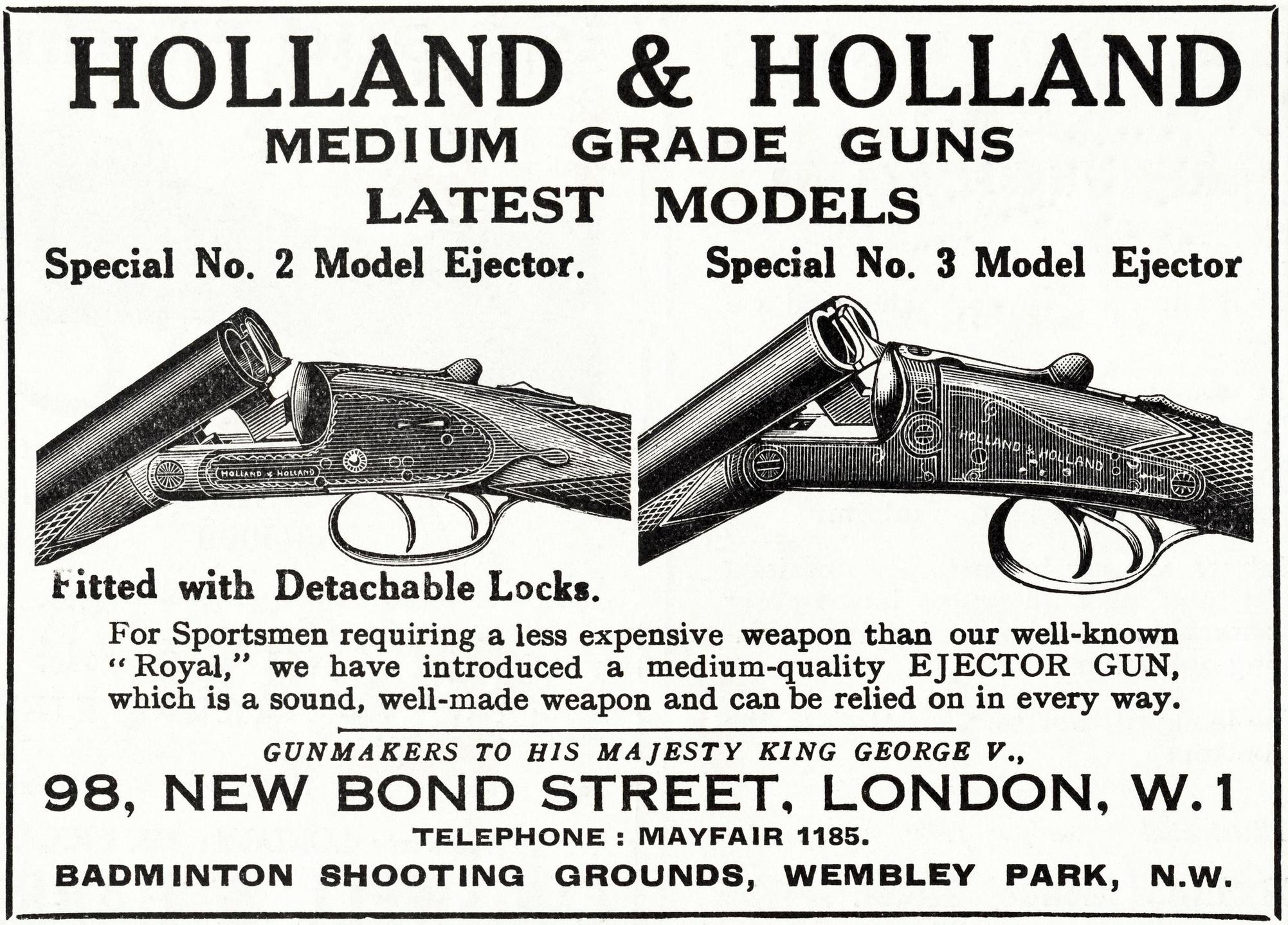
Legendary British gunmaker Holland & Holland, now a Beretta subsidiary
In The Critic, Patrick Galbraith talks to the current head of the Beretta company, which took over Britain’s Holland & Holland:
On the steps up to the blue door a man in a faded red tracksuit leans on one of the stone pillars in the Monday morning sun. All down Jermyn Street windows have been thrown open and flags above shop doors hang still in the heat.
I knock three times then push a bottle of Sudafed up my nose, squeeze twice, and lick at the bitter liquid as it runs over my lip. I was 20 before I ever experienced hay fever. I was fishing somewhere I shouldn’t have been when it first hit. I’ve not enjoyed June much since.
When I get up there, Franco Gussalli Beretta is sitting in the middle of the room in a puddle of sunlight: blue suit, thick grey hair, and a trio of arrows on his big silver belt buckle, the logo of a business established by his ancestor in Lombardy almost 500 years ago.
The earliest documented order was from the Venetian Republic for 185 barrels: “296 ducats made payable to Bartolomeo Beretta”. Fifteen generations later, Franco oversees the production of 1,500 guns a day, from grenade launchers to the ubiquitous “Silver Pigeon”, probably the most popular shotgun in the world.
The current generation are aggressively acquisitive. In recent years they’ve bought a German optics firm, a Finnish rifle manufacturer, and an American company that makes replicas of the sort of weapons that won the West — my own cowboy costume has been too small for some time.
Then, last February, Beretta made their boldest move yet by buying Holland & Holland, the finest gunmaker in London. Franco is a likeable man: he speaks at twice the volume he needs to and he laughs more loudly still. He loves cars and art and boats, and he admits that the day there’s a Beretta running the business who isn’t passionate about guns will be the day it all goes bang. What Holland & Holland needs, he reckons, is innovation.
British gunmakers have been stuck in the late nineteenth century for over a hundred years now and it might just be that Franco has the coglioni to make it new. We talk for half an hour and then as I’m standing to go, Carlo walks in — nonchalant at 25, a black t-shirt, dark sunglasses and jeans. Bartolomeo’s 16 times great-grandson. Franco gestures towards him and asks if I have any questions for the boy. Carlo talks to me briefly about NFTs but then tells me the real struggle is going to be a political one. He wants to make the world understand that hunting can be part of conservation. “And do you hunt?” I ask, thinking we might swap rabbit recipes. He shakes his head and tells me that as crazy as it sounds he doesn’t get out very much: “In Italy, young people don’t hunt so much anymore.”
Comments Off on Legendary British gunmaker Holland & Holland, now a Beretta subsidiary
Allied Tidal Wave in Romania – WW2 – 206 – August 6, 1943
World War Two
Published 6 Aug 2022The Allies bomb the Romanian oil fields, a major Axis source of oil, but it does not go well for the attackers. They do advance in both Sicily and the Solomon Islands — where a future President has one heck of an adventure, and in the USSR a huge Soviet counteroffensive begins, taking Belgorod after just a few days and threatening Kharkov.
(more…)
Comments Off on Allied Tidal Wave in Romania – WW2 – 206 – August 6, 1943
QotD: The post-WW1 experiment in banning chemical weapons
Now, when I was in school – this was a topic I was taught about in high school – the narrative I got was fairly clear: we didn’t use chemical weapons because after World War I the nations of the world got together and decided that chemical weapons were just too horrible and banned them, and that this was a sign of something called “progress“. In essence, the narrative I got was, we had become too moral for chemical weapons and so the “civilized” nations (a term sometimes still used unironically in this context) got together and enforced a moral taboo against chemical (and biological) weapons. And, we were told (this was, I should note, the late 90s and early aughts, long before the Syrian Civil War) that this taboo had mostly held.
Which was important, because in this narrative as it was impressed upon that younger version of me, the ban on chemical weapons showed the path towards banning all sorts of other terrible weapons: landmines, cluster-munitions and of course most of all, nuclear weapons. All we would need to do is for the “civilized” nations of the world to summon the moral courage to abandon such brutal weapons of war. Man, the end of history was nice while it lasted! But the example of the “successful” ban on chemical and biological weapons was offered as proof that the dream of a world without nuclear weapons was possible, if only we showed the same will.
When I was a child, I talked like a child, I thought like a child, I reasoned like a child. When I became a man, I put away childish things. But what was my teacher’s excuse? I guess the end of history was a hell of a drug.
[…] all three of these answers (including my high school answer) actually miss the point, because they all assume something fundamental: that chemical weapons are effective weapons, and so the decision not to use them is fundamentally moral, rather than practical.
Quite frankly, we don’t use chemical weapons for the same reason we don’t use war-zeppelin-bombers: they don’t work, at least within our modern tactical systems.
Bret Devereaux, “Collections: Why Don’t We Use Chemical Weapons Anymore?”, A Collection of Unmitigated Pedantry, 2020-03-20.
Comments Off on QotD: The post-WW1 experiment in banning chemical weapons
August 6, 2022
QotD: Locke’s Treatise
This is important, because Our Thing is almost exclusively backward-looking. We’re looking for a (hypothetical, FBI goons, hypothetical) right to revolution, and Locke’s social contract seems to be the answer, just as it (seemed to be) for the Founders. All the stuff George III did to the colonists, FedGov does to us, in spades.* Our problem, though, is that to us, “liberty” and “property” are what “life” was to John Locke — a necessary precondition, sure, but nothing to get too worked up over. They’d just stopped burning heretics in England twenty years before Locke’s birth, after all, and every day, in every port of the realm, sailors signed on for very likely death sentences on international voyages. In a world where starving to death was still a very real possibility, in other words, convincing people to roll the dice with their lives was pretty easy. It was the other two that were the toughies.
We Postmoderns, though, carry on like we’re in Auschwitz if Twitter goes down for a few hours. We have no idea what “sacred honor” could possibly mean, but we’ll riot in the streets if our sportsball team wins a championship. The Revolution (again, FBI goons, hypothetically) won’t come when they take away one more liberty. It’ll come when the Obamaphone doesn’t have the latest version of Angry Birds.
We need to think long and hard about why that is, and what to do about it, because our John Locke is going to be a hard man indeed.
* Well, except that whole “refusing to encourage migrations hither” bit — FedGov is fucking aces at that. But no historical analogy is perfect, alas.
Severian, “Overturning Locke: Life”, Rotten Chestnuts, 2019-09-11.
Comments Off on QotD: Locke’s Treatise
August 5, 2022
Don Camillo blesses the river Po
Perhaps the first foreign author I encountered as a child was Giovanni Guareschi — in English translation, of course, I’m not a natural linguist — and I’d read most of his stories by the time I was twelve. They didn’t always make a lot of sense to me as far as the political aspects were concerned, but the human stories always hit home. Clearly, Sarah Hoyt (who is a natural linguist … she read them in the original Italian, although I’d expect they would work very well for Portuguese readers) feels much the same way about the Don Camillo stories:
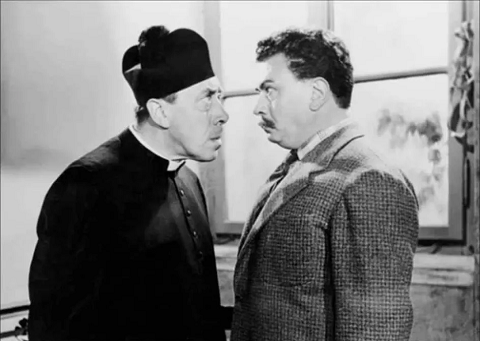
A still from one of the 1952-1965 film adaptations of the Don Camillo stories, with Fernandel as Don Camillo and Gino Cervi as Mayor Peppone.
There is a poignant scene in one of the Giovanni Guareschi Don Camillo books, (set in mid-century Italy, where communism and Catholicism are fighting it back and forth. They’re humorous, profoundly human, and easy reads. The stories are like 200 words each.) in which, during a period of high strife, the priest goes out to bless the river. Btw, if you need examples of how to be a flea on the side of the commies, that character is terribly subversive in little ways (as well as liking to hit them on the head. I might have taken him for a model when I was a pre-teen. Sigh. And Comrade Don Camillo is the best book for how to turn things on their heads if you’re in deep hiding in a lefty stronghold, either professional or geographic.)
Anyway, in the little village on the Po river where the priest and the communist mayor fight it out, the river is an ever present danger, and people cope with it the way they have coped with such things throughout history: every year the priest goes to the river and blesses it, in the hopes that it will become (I am remembering in Italian, the English translation is probably different) “A well behaved citizen and stay within its bounds”.
Now, this is not magic, of course, and the priest explains that. Blessing the river does not guarantee that the river won’t burst out of its bed and flood the village (later on in the book there are accounts of a flood, and if you think that a book can’t paint a picture, be sure it can. For the rest of my life, I’ll carry the image of the priest saying mass in the deserted and flooded village, while across the river, on the safe bank, his flock who fled the flood kneel on the muddy soil at the tolling of the consecration bell. BTW Guareschi is the writer I’d like to be when I grow up. Trained as a journalist, he uses minimal words, but the images stay with you.) It’s just that blessing it gives people hope it won’t, and allows them to live in a precarious place, at a precarious time without losing their minds. (It is important to remember that whatever else humans are, they’re creatures of ritual and habit, and sometimes those are the only panaceas for difficult situations.)
Well, the communists have their dander up, so they tell the priest they want to march in the procession to bless the river with their flags and paraphernalia and the priest says no, they say anyone in the procession will get beaten. They demand the priest cancel it, and people lose their minds. So, the priest says he’ll go alone, if needed. Needless to say, the communists follow, in what is an intimidation maneuver (they have no new moves, really.)
So, Don Camillo, without looking back, gets to the river and prays that the Lord will keep the river within its bounds. And of course, because he knows the audience at his back, he says “If the houses of decent people could float, I’d ask you for a flood like Noah’s. But since the houses of decent people are made of the same stone and brick and sink like the houses of scoundrels, I beg you to make the river behave.”
In case you’re wondering what went wrong in America, and why we are where we are: we forgot our houses can’t flood.
Comments Off on Don Camillo blesses the river Po
ARNHEM – A Bridge Too Far – THE TRUE STORY (2001)
British Army Documentaries
Published 25 Jun 2022Please help us to keep bringing you great content! We are able to bring you these interesting documentaries, which would otherwise be held in a vault, or away from public view because we purchase commercial licenses often at considerable expense. Unfortunately, YouTube’s re-use policy now means we can’t monetise it. This means we can’t invest in new licenses for new documentaries. Please help us by subscribing to our Patreon page from just £2/month so we can keep bringing you great content, otherwise, this channel may need to close forever. Thank You
https://www.patreon.com/BritishArmyDocs
——————————————————————————————————————————
At 3:00 a.m., the commanders of the 2nd South Staffordshire battalion and the 1st and 11th Parachute battalions met to plan their attack. At 4:30 a.m., before dawn, the 1st Parachute Brigade began its attack towards Arnhem bridge, with the 1st Battalion leading supported by remnants of the 3rd Battalion, with the 2nd South Staffordshires on the 1st Battalion’s left flank and the 11th Battalion following. As soon as it became light the 1st Battalion was spotted and halted by fire from the main German defensive line. Trapped in open ground and under heavy fire from three sides, the 1st Battalion disintegrated and what remained of the 3rd Battalion fell back. The 2nd South Staffordshires were similarly cut off and, save for about 150 men, overcome by midday. The 11th Battalion, (which had stayed out of much of the fighting) was then overwhelmed in exposed positions while attempting to capture high ground to the north. With no hope of breaking through, the 500 remaining men of these four battalions withdrew westwards in the direction of the main force, 5 km (3.1 mi) away in Oosterbeek.
The 2nd Battalion and attached units (approximately 600 men) were still in control of the northern approach ramp to the Arnhem bridge. They had been ceaselessly bombarded by enemy tanks and artillery from two battle groups led by SS-Sturmbannführer [Major] Brinkmann and one commanded by Major Hans-Peter Knaust. The Germans recognized that they would not be moved by infantry attacks such as those that had been bloodily repulsed on the previous day so instead, they heavily shelled the short British perimeter with mortars, artillery, and tanks; systematically demolishing each house to enable their infantry to exploit gaps and dislodge the defenders. Although in the battle against enormous odds, the British clung to their positions, and much of the perimeter was held.
(more…)
Comments Off on ARNHEM – A Bridge Too Far – THE TRUE STORY (2001)
FN MAG: Best of the Western GPMGs
Forgotten Weapons
Published 6 Apr 2022
(more…)
Comments Off on FN MAG: Best of the Western GPMGs
August 4, 2022
Barbarian Europe: Part 5 – The Vandals in Africa
seangabb
Published 21 May 2021In 400 AD, the Roman Empire covered roughly the same area as it had in 100 AD. By 500 AD, all the Western Provinces of the Empire had been overrun by barbarians. Between April and July 2021, Sean Gabb explored this transformation with his students. Here is one of his lectures. All student contributions have been removed.
(more…)
Comments Off on Barbarian Europe: Part 5 – The Vandals in Africa
Boris wanted to be another Churchill, but he turned out to be another Lloyd George
Long before Boris Johnson achieved his goal of becoming Prime Minister, he was consciously modelling himself on Winston Churchill … but his real life adventure showed him to be much more the next coming of an earlier PM than Churchill:
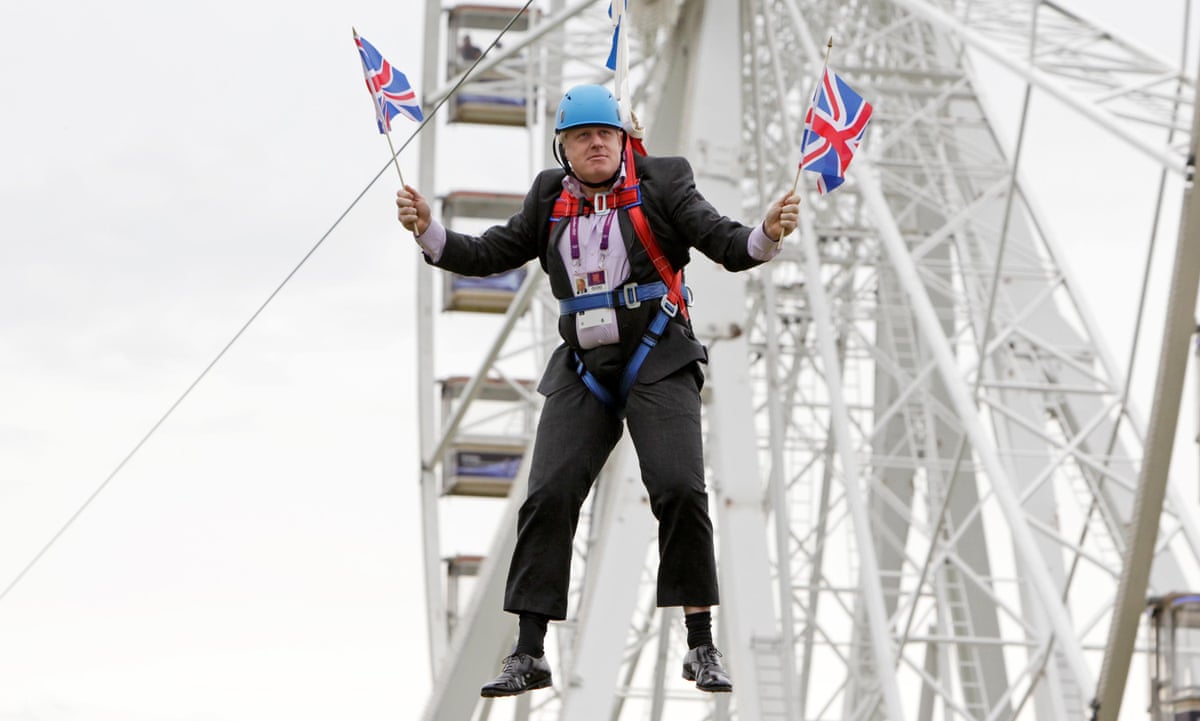
Boris Johnson labours under the illusion that he is another Churchill. Actually the resemblance, astonishing both in gross and in detail, is to Churchill’s other great contemporary, David Lloyd George.
Indeed, the parallels between the two men and their careers are so close that it’s tempting to give Karl Marx’s dictum yet another dust-down and talk of history happening twice: first as tragedy and then as farce. Which would make Boris Johnson Napoleon III to the Welsh Wizard’s imperial premiership.
Which, to be truthful, sounds about right.
[…]
Consider A.J.P. Taylor’s masterly pen-portrait of Lloyd George:
He had no friends and did not deserve any. He repaid loyalty with disloyalty. He was surrounded by dependants and sycophants, whom he rewarded lavishly and threw aside when they had served their turn. His rule was dynamic and sordid at the same time. He himself gave hostages to fortune by the irregularity of his private life. But essentially his devious methods sprang from his nature. He could do things no other way.
There is scarcely a single word that does not apply equally to Boris Johnson.
These two extraordinary, outsize personalities also benefitted from extraordinary times. Lloyd George became prime minister in 1916 at the nadir of the First World War when it seemed, as he himself wrote, “we are going to lose this war”. Johnson reached Number Ten at a comparable moment in domestic affairs, when the three year-long crisis brought about by the furious rear-guard action of the Remainer elites against the Brexit referendum threatened to turn into a sort of national nervous breakdown.
Both therefore took the premiership over the political corpse of their failed predecessor (Herbert Asquith and Theresa May), and both were haunted by their unquiet ghosts. Finally, both had a single, though infinitely difficult, job: Lloyd George’s was to win the war; Johnson’s to cut the parliamentary Gordian knot and “Get Brexit Done”. And both were given, or took, carte blanche to do it.
Taylor makes no bones about it and calls Lloyd George “dictator for the duration of the war”. He even invokes the comparison with Napoleon I. Contemporaries, like the former Tory premier, A. J. Balfour, used the same language: “If [Lloyd George] wants to be dictator, let him be. If he thinks he can win the war, I’m all for him having a try.”


