
World War Two
Published 12 Aug 2022While enslavement, and mass murder continues unabated in August 1943, at the Treblinka Death Factory the forced laborers decide that enough is enough, and bring battle to the SS in a daring escape attempt.
Huge thanks to Purple Purple, Steven Yarnell, Pieter Kleij and Ruben Alikhanyan for their support during the episode premiere.
(more…)
August 13, 2022
The Great Escape from a Death Factory – WAH – August 7, 1943
Comments Off on The Great Escape from a Death Factory – WAH – August 7, 1943
Mysterious Home Features No Longer Used
Rhetty for History
Published 22 Apr 2022Home designs have changed a lot over the years and so have the features. In this video we will take a look at some of the mysterious features no longer used in new homes. You may run across these if you purchase an old home or you visit one.
(more…)
Comments Off on Mysterious Home Features No Longer Used
QotD: Erich von Manstein
One parallel between the Russian invasion of Ukraine and the conduct of the Second World War that has hitherto escaped notice concerns the relationship between the dictator and his generals. Just as the German General Staff obeyed Hitler’s orders, even when they knew him to be leading them not only to defeat but to depravity, so the Russian high command has capitulated to Putin despite realising that his war was not only a mistake but a crime.
In the Britain of the Sixties, a certain mystique still attached to the generals of the Third Reich. In their stylish uniforms and their gleaming jackboots, they had swaggered. Only two, Keitel and Jodl, were executed at Nuremberg; the rest got away with murder.
Even some of those who were convicted of war crimes had friends in high places. One of the most prominent was Erich von Manstein, the architect of many German victories both in the Battle of France and on the Eastern front. He was also complicit in the genocide of more than a million Jews and others by the Nazi Einsatzgruppen in Ukraine.
Yet Churchill was among those who successfully campaigned to have Manstein’s 18-year sentence reduced to 12, of which he served only four.
Manstein’s memoir Verlorene Siege (translated as Lost Victories) appeared in 1958, a key text in the mythology that depicted the Wehrmacht as “clean” and laid the blame for war crimes on Hitler. Konrad Adenauer, the first chancellor of the postwar Federal Republic, also played his part in the rehabilitation of Manstein, on the grounds that West German rearmament required a sharp distinction between the Nazis and an untainted military tradition as the basis for the new Bundeswehr.
Daniel Johnson, “The moral blindness of Putin’s generals”, The Critic, 2022-05-10.
Comments Off on QotD: Erich von Manstein
August 12, 2022
Apple, afterwards
In Quillette, Jonathan Kay looks at Apple after the death of Steve Jobs:

In 2004, Apple co-founder Steve Jobs asked famed author Walter Isaacson to write his biography. It’s a mark of Jobs’s hallowed place in the pantheon of American corporate titans that Isaacson, whose other subjects included Henry Kissinger, Benjamin Franklin, and Albert Einstein, would eventually say yes. While best-selling books about successful business leaders represent a popular niche, most specimens are fawning airport reads that combine hagiography with self-help advice for aspiring entrepreneurs. Isaacson’s Steve Jobs (2011), by contrast, was a serious work of literary non-fiction that exalted its subject as a once-in-a-generation technological savant, while also showing him to be a callous parent and scathing boss, not to mention a proponent of loopy “fruitarian” medical theories. (Much has been made of Jobs’s use of fringe therapies to treat the pancreatic cancer that killed him in 2011, but he also entertained the bizarre belief that his vegan diet allowed him to avoid bathing for days on end without developing body odour, a proposition vigorously disputed by co-workers.)
Tripp Mickle, a Wall Street Journal technology journalist who covered the Apple beat for five years, isn’t Walter Isaacson (few of us are); and, to his credit, doesn’t try to be. Nor does he seek to present his primary subjects — former lead Apple designer Jony Ive and incumbent chief executive Tim Cook — as world-changing visionaries on par with their departed boss. Indeed, the very title of his book — After Steve: How Apple Became a Trillion-Dollar Company and Lost Its Soul — presents Apple as existing in a state of creative denouement since Jobs’s death — a bloated (if massively profitable) corporate bureaucracy that increasingly feeds shareholders’ demands for quarterly earnings by milking subscription services such as Apple Music and iCloud instead of developing new products.
The first five chapters of After Steve are structured as a twinned biography, following the lives of Ive and Cook from their precocious childhoods (in England and Alabama, respectively), and on through the 2010s, when the pair jointly ran Apple (in function, if not in title) following Jobs’s death.
Timothy Donald Cook grew up in Robertsdale, a farming community located roughly halfway between Mobile, Alabama and Pensacola, Florida, the middle child of a Korean War veteran and a pharmacist’s assistant. In high school, Cook was named “most studious”, and served as the business manager for the school yearbook. “In three years of math, he had never missed a homework assignment”, reports Mickle, also noting that one teacher remembers him as “efficient and dependable”. Cook also happens to be gay, a subject that caused some awkwardness for his Methodist parents, even though Cook wouldn’t come out publicly till later in life. As a means to deflect questions, Mickle reports, Cook’s mother told drug-store coworkers that her son was dating a girl in Foley, a nearby town.
Following high-school graduation, Cook went on to study industrial engineering at Auburn University and business administration at Duke. He then gravitated to the then-burgeoning field of personal computing, quickly carving out a niche within its production and supply-management back office. At IBM and Compaq, Cook turned himself into a sort of human abacus, ruthlessly bringing reduced costs, increased efficiencies, and smaller inventories to every assembly line he set eyes on. By the time he’d arrived at Apple in 1998, Mickle reports, Cook was completely neurotic about keeping any stocked materials off the books, calling inventory, “fundamentally evil”. In time, he pioneered a process by which yellow lines were painted down the floor of Apple’s production plants, with materials on the storage side of the line remaining on suppliers’ books until the very moment they were brought to the other side for assembly.
Like Ive, Cook declined to be interviewed for After Steve. And so it is entirely possible that the man has a rich inner life that remains opaque to Mickle and the outside world more generally. But the portrait that emerges in this book is one of a fanatically dedicated workaholic who rises before 4am to begin examining spreadsheets, and thinks about little else except the fortunes of Apple Inc. during the waking hours that follow. Mickle reports a sad scene in which Cook is spotted by sympathetic strangers at a fancy Utah resort, dining alone during what appears to be a solitary vacation. We also learn that Cook’s Friday-night meetings with Apple’s operations and finance staff were sometimes called “date night with Tim” by attendees, “because it would stretch for hours into the evening, when Cook seemed to have nowhere else to be.”
Comments Off on Apple, afterwards
Canadian Army Newsreel – Allies take Sicily
canmildoc
Published 4 Sep 2011Canadian war news reel.
Comments Off on Canadian Army Newsreel – Allies take Sicily
The 1983 “Gimli Glider” Incident
TheHistoryGuy
Published 27 Apr 2022Captain Sully’s US Airways Flight 1549 lost its engines almost immediately after takeoff, after reaching an altitude of only 2,800 feet. In 1983, a very different flight lost power at a staggering 41,000 feet, and the pilots had no choice but to try to land the plane without engines.
(more…)
Comments Off on The 1983 “Gimli Glider” Incident
August 11, 2022
Nostalgia seen as harmful
In The Critic, Michael Ledger-Lomas reviews a new book that is critical of Britain’s chronic case of nostalgia for “the good old days”:
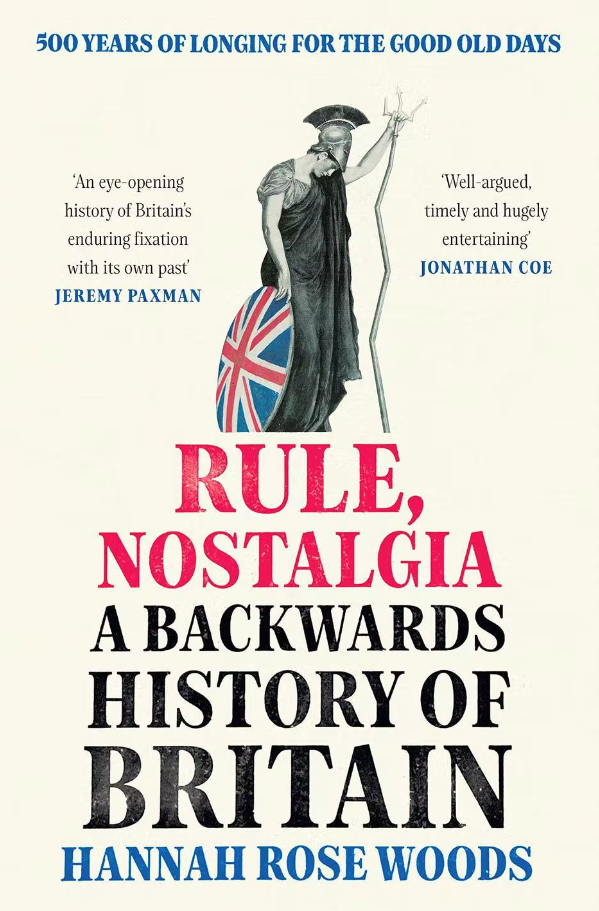
Indulging in pained regret for lost times might seem a harmless pleasure, but Hannah Rose Woods is here to warn it has become a pathological “fixation”. The Right, she argues, has “weaponised” nostalgia, tapping “inchoate yearnings about fading pride and glory” to fuel hatred against historians who are simply “putting the facts back in” to the national “storybook”.
Apparently, the first cure for this “peculiarly English affliction” involves refuting errors and egregious simplifications in Tory talk about the national past. Woods is an inveterate Tweeter and her Rule, Nostalgia often works like a book-length version of the “Hi, historian here” threads that infest that medium.
The Government exhorted people to get through Covid by showing the Blitz spirit, but historians know German bombing caused as much fear and resentment as pride and resolve. Britons were supposed to Keep Calm and Carry On, “but this was a fantasy”, Woods writes, because the 1940s poster with that motto never entered circulation. The tea towels lied to us.
Woods is more productive when she probes nostalgia as a cluster of emotions, rather than condemning it as a set of errors. For like all emotions, it can be usefully historicised. This insight shapes the basic structure and approach of the book, which is more ironic than irate. Our times seem to be gripped by nostalgia for the days before yesterday, but the sixties, seventies and eighties abounded with yearning for the simplicities of the Second World War.
The thirties and forties were, in turn, full of voices lamenting what one of Orwell’s heroes called the “newness of everything”, pining for the sun-dappled afternoons of Edwardian England. The Edwardians themselves lamented the lost certainties of the high Victorian age and fretted that rural tranquillity was on the wane. And so on. Woods turns the periods of our history into Russian dolls of nostalgia, each nested within the other.
It is an engaging literary device which palls as succeeding chapters ask readers to re-enact their surprise that apparently stable times were consumed with anxiety about losing touch with tradition. Woods says the “calmly elegant Georgian heyday” fretted about whether Britain should go global or remain a tight little island, while it would be a “hard sell” to claim that the age of the Reformation and the Civil War was an “age of contentment and stability”. Well, quite.
The further Woods progresses away from the “rancid Englishness” of the present, the more forgiving she becomes of nostalgia — or at least of wistful absorption in the past, which is not quite the same thing. She rightly sees that nostalgia has generally not been an obstacle to rapid social change — what bolder Victorians would have called “progress” — but has offered psychological compensation for them.
Comments Off on Nostalgia seen as harmful
US Navy Fleet Problems – Now its time to play with carriers (VIII-XII)
Drachinifel
Published 10 Aug 2022Today we take a look at the background and thinking behind the inter-war USN Fleet Problems, with summaries of Fleet Problems 8 through 12
(more…)
Comments Off on US Navy Fleet Problems – Now its time to play with carriers (VIII-XII)
“Carbine” Williams’ Battle Rifle: The Winchester G30R
Forgotten Weapons
Published 8 Jan 2018The Winchester G30R is the final iteration of David Marshall Williams’ work on a full power .30 caliber military rifle. The project began with a design by Ed Browning (John Browning’s half brother) using a tilting bolt and annular gas piston, manufactured for US military trials by Colt. It moved to the Winchester company, which assigned Williams to the project when Browning died in 1939. Williams first replaced the annular gas piston with his gas tappet system, creating the G30M rifle. This performed poorly in trials, and the next iteration was the replacement of the tilting bolt with a Garand-type rotating bolt, creating the Winchester M2 rifle.
The US military was not interested in the M2 in .30-06, but thought the concept could be ideal for the Light Rifle trials then underway, and Winchester scaled it down to .30 carbine, and won the Light Rifle trials with it. That weapon would go on to become the M1 Carbine. Once it was in mass production, Winchester returned to the M2 design and improved it into this G30R. It was tested by the Marine Corps, but not adopted. The Canadian military also expressed an interest, but the US government opted to not allow any exports, and so Canada never tested it.
The US Army was quite satisfied with the M1 Garand, but suggested that this rifle might be made into a replacement for the BAR if it were redesigned a bit for greater sustained fire capacity. Winchester did so, creating the Winchester Automatic Rifle (WAR), which was on track for adoption until World War Two ended and immediate arms development became a much less important priority for the military.
Thanks to the Institute of Military Technology for allowing me to have access to this rifle so I can bring it to you! Check out the IMT at:
Comments Off on “Carbine” Williams’ Battle Rifle: The Winchester G30R
QotD: Logistical limits to Spartan military action against Athens
During the first phase of the Peloponnesian War, called the Archidamean war, after the Spartan king who conducted it, Sparta invaded Attica functionally every year in an effort to inflict enough agricultural devastation that the Athenians would be forced to come out and fight […] The core problem is that it just isn’t possible to do a meaningful amount of damage in the short campaigning season before the army has to go home.
And I want to be clear just how long they bang their head against this rock. The Spartans invade in 431, besiege a minor town, accomplish nothing and leave (Thuc. 2.18-20), and in 430 (Thuc. 2.47), in 429, because of a plague in Athens, they instead besiege tiny Plataea (Thuc. 2.71ff) and then leave, but in 428 they’re back at it in Attica (Thuc. 3.1), and in 427 (Thuc. 3.26), and in 426 but turn back early due to earthquakes (Thuc. 3.89). But they’re back again in 425 (Thuc. 4.2), leaving each time when supplies run out. Sparta mounts no attack in 424 because Athenian naval raiding forces them to keep the army at home (Thuc. 4.57); in 423 they have a year-long truce with Athens (Thuc. 4.117). They only finally suggest the creation of a permanent base in Attica in 422/1 (Thuc. 5.17) but the war ends first (they’ll actually fortify a small outpost, Decelea, only when the war renews in 413).
Thucydides is in several cases (e.g. Thuc. 3.1.3) explicit that what causes these armies to fail and disperse back home is that they run out of supplies. They are two days – on foot! – from a major friendly trade port (Corinth), and they run out of supplies. Their last invasion was six years after their first and they still had not resolved the logistics problem of long-term operations in what is effectively their own backyard.
Bret Devereaux, “Collections: This. Isn’t. Sparta. Part VII: Spartan Ends”, A Collection of Unmitigated Pedantry, 2019-09-27.
Comments Off on QotD: Logistical limits to Spartan military action against Athens
August 10, 2022
Raising a generation to emulate Pavel Morozov
Theodore Dalrymple on the dangers of a culture that welcomes and supports denunciation as a political mechanism:
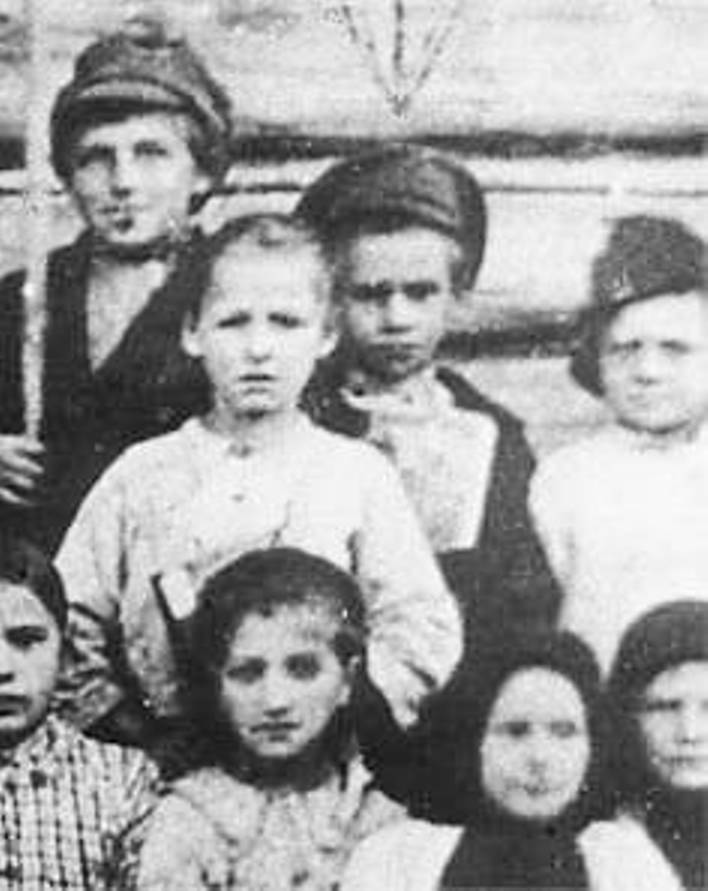
Believed to be the only photograph of Pavel “Pavlik” Morozov (centre, wearing cap), circa 1930.
… a culture of denunciation is an important step in the direction of totalitarianism. Is there anyone whose life is such that the discreditable things done or said by him or her could not be woven into a reason for public execration or worse? The habit of denunciation was a powerful weapon in the hands of every totalitarian dictator.
In the Soviet Union, for example, the story of Pavel Morozov — little Pavlik — was used to inculcate the habit of denunciation as a social duty into Soviet children. Little Pavlik denounced his own parents and grandparents as kulaks, that is to say as rich and exploitative peasants, to the Soviet authorities, and was thereafter “martyred” for his truthfulness. Soviet children were encouraged to emulate lovely little Pavlik by snitching on all around them. There were posters in school of heroic children denouncing their fellows for something that they had done wrong. This was the Soviet version of truth-telling.
We should not complacently suppose that it couldn’t happen here — wherever here is. In Britain recently, which is suffering from a shortage of water because of unusually hot weather, residents of some areas have been prohibited from using hosepipes to water their garden — and have been encouraged to denounce neighbors or others to the authorities who flout the prohibition.
One can just hear the arguments in favor of such denunciations. It’s only fair and right, for example, that everyone should share the hardship caused by the shortage of water. It’s almost psychopathic of some not to obey the rules while most do so: Who do they think they are, that they are not obliged to obey? Moreover, we live in such times that, if you approach such a person directly, he’s likely to become furious and violent. It’s safer to call the authorities and let them deal with him.
This overlooks how easily the culture of denunciation can establish itself, and lead to a society in which everyone fears everyone else. Such is the way in which people are constituted that for many, at least, it’s a pleasure to bring harm to others in the name of doing good for society. That was the justification of denunciation in Nazi Germany, Soviet Russia, and Maoist China, as well as in a host of other totalitarian fiefdoms. And Maugham — he who actively solicits denunciations of Nick Cohen — even admits, perhaps without really meaning to, the pleasure he would derive from passing on any denunciations he receives in a kind of meta-denunciation, as it were.
This is authentically disgusting, but it has the merit of reminding us that totalitarianism did not land on earth like an asteroid but had its origins in the human heart, and that no society can be immune from the temptations of totalitarianism once and for all. Totalitarianism has its pleasures, chief of which is doing harm to others, albeit that today’s denouncer tends to become tomorrow’s denounced.
Comments Off on Raising a generation to emulate Pavel Morozov
Barbarian Europe: Part 7 – The Lombards in Italy
seangabb
Published 31 Aug 2021In 400 AD, the Roman Empire covered roughly the same area as it had in 100 AD. By 500 AD, all the Western Provinces of the Empire had been overrun by barbarians. Between April and July 2021, Sean Gabb explored this transformation with his students. Here is one of his lectures. All student contributions have been removed.
(more…)
Comments Off on Barbarian Europe: Part 7 – The Lombards in Italy
“Every nation is divided, and thrives on division. But France illustrates the rule rather too well.”
Ed West on the historical divisions of the many regions in what we now know as “France”:
France is gigantic, like a continent in itself, and the most visited country on earth. It is four times the size of England and until the 17th century had a population four to five times as big (today it is 67 million v 56 million). Yet “France” until relatively recently extended not much further than Paris, in the area under the king’s direct control called the Île-de-France — beyond that, regional identity was distinctive and dialect pre-dominated.
As Robb writes, at the time of the Revolution just 11 per cent of the population, or 3 million people, spoke “French”; by 1880 still only one in five could communicate in the national language. Even with decades of centralisation, today there are still 55 distinct dialects in France; most are Romance, but the country is also home to Flemish, Alsatian, Breton and Basque-speaking communities. (Tintin has been translated into at least a dozen French dialects.) No regional identity in England, except the north-east, is as distinctive.
Many famous French historical figures wouldn’t have even understood “French”, among them St Bernadette, living in the then obscure village of Lourdes. She described the figure she saw as un petito damisela (or in French une petite demoiselle), the name for the local forest fairies in the Pyrenees. The Demoiselles dressed in white, lived in caves and grottos and were associated with water. They were also seen as being on the side of the poor, Robb points out, because here as is often the case there was a political underside to this folk belief. Indeed, a peasant conflict with the authorities from the 1830s to the 1870s had been called The War of the Demoiselles. But then conflict with the authorities — with Paris — almost defines French history.
[…]
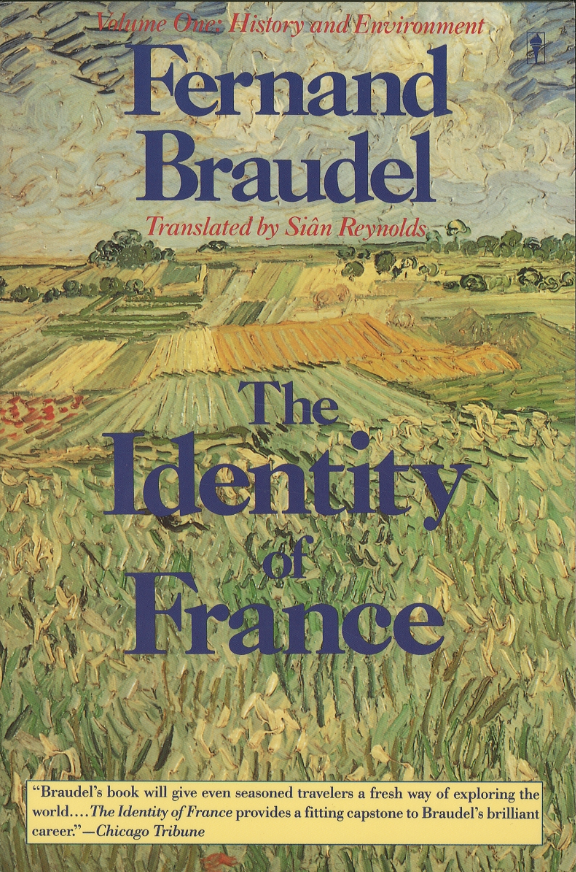
If you like Robb’s work, you’ll also enjoy Fernand Braudel’s The Identity of France, published in 1986 and supposed to be part one of a series by the great 20th century historian. Unfortunately, Braudel was already dead by the time part one was published, and so the series was never finished.
Braudel loved his country and believed in a deep and abiding Frenchness, yet he was also fascinated by its divisions, the various different pay — from Gallo-Roman pagus — which translates as land, although it can mean either country or region. Within this, dialects can be very varied: Gascon is “quite distinct” to Languedocien and Provencal, he wrote, but in Gascony “two completely different patois” were spoken. Near to Salins the language spoken in each village “varies to the point of being unrecognisable” and “what is more extraordinary” the town “being almost half a league in length, is divided by language and even customs, into two distinct halves”.
France’s regional identity is defined by language, food — the division between butter and olive, wine and cider — and even roof tiles. Braudel was essentially a geographic determinist and, citing Sartre’s line that France was “non-unifiable”, the author lamented that: “Every nation is divided, and thrives on division. But France illustrates the rule rather too well.”
To illustrate the rivalry, compare the words of two 19th-century historians: Jean-Bernard Mary-Lafon, who contrasted the “refined and freedom-loving” southerners with “brute barbarism” of “knights from across the Loire”, violent, fanatical and pillaging. And Ernest Renan, who wrote in 1872: “I may be mistaken, but there is a view derived from historical ethnography which seems more and more convincing to my mind. The similarity between England and northern France appears increasingly clear to me every day. Our foolishness comes from the south, and if France had not drawn Languedoc and Provence into her sphere of activity, we should be a serious, active, Protestant and parliamentary people.”
He was surely mistaken, for it’s the south which is more Protestant and the north more Catholic. Just like in England, where regional and religious identity are intertwined.
Yet it is true that France’s great bounty was also its curse; this western European isthmus forms a natural unit within which the most powerful warlord could dominate, and that man was bound to be based somewhere on the Seine or Loire, close to the continent’s richest wheat-growing area. Yet in the early modern era this unit was far too big to govern effectively — 22 days’ ride from north to south — compared to England or the Netherlands. The author quotes an essayist who suggested that: “France is not a synchronised country: it is like a horse whose four legs move in a different time.”
Comments Off on “Every nation is divided, and thrives on division. But France illustrates the rule rather too well.”
Coca de Sant Joan & the Fires of Saint John’s Eve
Tasting History with Max Miller
Published 22 Jun 2021
(more…)
Comments Off on Coca de Sant Joan & the Fires of Saint John’s Eve
August 9, 2022
The Never Ending Failures in France – WW2 – Spies & Ties 21
World War Two
Published 8 Aug 2022The typical image of the French Resistance is of a man, beret at an angle, cigarette hanging from his bottom lip, captured MP40 across his chest. But one of the most successful resistance leaders is a woman – Marie-Madeline Fourcade. And right now, the Germans have her on the run!
(more…)
Comments Off on The Never Ending Failures in France – WW2 – Spies & Ties 21


