
A lot of swordfighting in medieval-period movies is even less appropriate if you know what the affordances of period weapons were. The classic Errol Flynn vs. Basil Rathbone duel scene from the 1938 Adventures of Robin Hood, for example. They’re using light versions of medieval swords that are reasonably period for the late 1100s, but the footwork and stances and tempo are all French high line, albeit disguised with a bunch of stagey slashing moves. And Rathbone gets finished off with an epée (smallsword) thrust executed in perfect form.
It was perfect form because back in those days acting schools taught their students how to fence. It was considered good for strength, grace, and deportment; besides, one might need it for the odd Shakespeare production. French high-line because in the U.S. and Europe that was what there were instructors for; today’s Western sword revival was still most of a century in the future.
This scene exemplifies why I find the ubiquitousness of French high-line so annoying. It’s because that form, adapted for light thrusting weapons, produces a movement language that doesn’t fit heavier weapons designed to slash and chop as well as thrust. If you’re looking with a swordsman’s eye you can see this in that Robin Hood fight. Yes, the choreographer can paste in big sweeping cuts, and they did, but they look too much like exactly what they are – theatrical flourishes disconnected from the part that is actually fighting technique. When Flynn finishes with his genuine fencer’s lunge (not a period move) he looks both competent and relieved, as though he’s glad to be done with the flummery that preceded it.
At least Flynn and Rathbone had some idea what they were doing. After their time teaching actors to fence went out of fashion and the quality of cinematic sword choreography nosedived. The fights during the brief vogue for sword-and-sandal movies, 1958 to 1965 or so, were particularly awful. Not quite as bad, but all too representative, was the 1973 Three Musketeers: The Queen’s Diamonds, a gigantic snoozefest populated with slapdash, perfunctory swordfights that were on the whole so devoid of interest and authenticity that even liberal display of Raquel Welch’s figure could not salvage the mess. When matters began to improve again in the 1980s the impetus came from Asian martial-arts movies.
Eric S. Raymond, “A martial artist looks at swordfighting in the movies”, Armed and Dangerous, 2019-01-13.
August 4, 2022
QotD: Errol Flynn versus Basil Rathbone in the 1938 Adventures of Robin Hood
August 3, 2022
QotD: Relative wealth among the Spartiates
It is important to begin by noting that the sheer quantity of food the spartiates were to receive from their kleros would make almost any spartiate wealthy by the standards of most Greek poleis – spartiates, after all, lived a live of leisure (Plut. Lyc. 24.2) supported by the labor of slaves (Plut. Lyc. 24.3), where the closest they got to actual productive work was essentially sport hunting (Xen. Lac. 4.7). If the diet of the syssition was not necessarily extravagant, it was also hardly … well, Spartan – every meal seems to have included meat or at least meat-broth (Plut. Lyc. 12.2; Xen. Lac. 5.3), which would have been a fine luxury for most poorer Greeks. So when we are talking about disparities among the spartiates, we really mean disparities between the super-rich and the merely affluent. As we’ll see, even among the spartiates, these distinctions were made to matter sharply and with systematic callousness.
Now, our sources do insist that the Spartan system offered the Spartiates little opportunity for the accumulation or spending of wealth, except […] they also say this about a system they admit no longer functions … and then subsequently describe the behavior of wealthy Spartans in their own day. We’ve already noted Herodotus reporting long-standing wealthy elite spartiates as early as 480 (Hdt. 7.134), so it’s no use arguing they didn’t exist. Which raises the question: what does a rich Spartiate spend their wealth on?
In some ways, much the same as other Greek aristocrats. They might spend it on food: Xenophon notes that rich spartiates in his own day embellished the meals of their syssitia by substituting nice wheat bread in place of the more common (and less tasty) barley bread, as well as contributing more meat and such from hunting (Xen. Lac. 5.3). While the syssitia ought to even this effect out, in practice it seems like rich spartiates sought out the company of other rich spartiates (that certainly seems to be the marriage pattern, note Plut. Lys. 30.5, Agis. 5.1-4). Some spartiates, Xenophon notes, hoarded gold and silver (Xen Lac. 14.3; cf. Plut. Lyc. 30.1 where this is supposedly illegal – perhaps only for the insufficiently politically connected?). Rich spartiates might also travel and even live abroad in luxury (Xen. Lac. 14.4; Cf. Plut. Lyc. 27.3).
Wealthy spartiates also seemed to love their horses (Xen. Ages. 9.6). They competed frequently in the Olympic games, especially in chariot-racing. I should note just how expensive such an effort was. Competing in the Olympics at all was the preserve of the wealthy in Greece, because building up physical fitness required a lot of calories and a lot of protein in a society where meat was quite expensive. But to then add raising horses to the list – that is very expensive indeed (note also spartiate cavalry, Plut. Lyc. 23.1-2). Sparta’s most distinguished Olympic sport was also by far the most expensive one: the four-horse chariot race.
In other ways, however, the spartiates were quite unlike other Greek aristocrats. They do not seem to have patronized artists and craftsmen. The various craft-arts – decorative metalworking, sculpture, etc – largely fade away in Sparta starting around 550 B.C. – it may be that this transition is the correct date for the true beginning of not only “Spartan austerity” but also the Spartan system as we know it. There are a few exceptions – Cartledge (1979) notes black-painted Laconian finewares persist into the fifth century. Nevertheless, the late date for the archaeological indicators of Spartan austerity is striking, as it suggests that the society the spartiates of the early 300s believed to have dated back to Lycurgus in the 820s may well only have dated back to the 550s.
The other thing we see far less of in Sparta is euergitism – the patronage of the polis itself by wealthy families as a way of burnishing their standing in society. While there are notable exceptions (note Pritchard, Public Spending and Democracy in Classical Athens (2015) on the interaction and scale of tribute, taxes and euergitism at Athens), most of the grand buildings and public artwork in Greek cities was either built or maintained by private citizens, either as voluntary acts of public beneficence (euergitism – literally “doing good”) or as obligations set on the wealthy (called liturgies). Sparta had almost none of this public building in the Classical period – Thucydides’ observation that an observer looking only at the foundation of Sparta’s temples and public buildings would be hard-pressed to say the place was anything special is quite accurate (Thuc. 1.10.2). There are a handful of exceptions – the Persian stoa, a few statue groups, some hero reliefs, but far, far less than other Greek cities. In short, while other Greek elites felt the need – or were compelled – to contribute some of their wealth back to the community, the spartiates did not.
Passing judgment on those priorities, to a degree, comes down to taste. It is easy to cast the public building and patronage of the arts that most Greek elites engaged in as crass self-aggrandizement, wasting their money on burnishing their own image, rather than actually helping anyone except by accident. And there is truth to that idea – the Greek imagination has little space for what we today would call a philanthropist. On the other hand – as we’ll see – a handful of spartiates will come to possess a far greater proportion of the wealth and productive capacity of their society. Those wealthy spartiates will do even less to improve the lives of anyone – even their fellow spartiates. Moreover, following the beginning of Spartan austerity in the 550s, Sparta will produce no great artwork, no advances in architecture, no great works of literature – nothing to push the bounds of human achievement, to raise the human spirit.
Bret Devereaux, “Collections: This. Isn’t. Sparta. Part IV: Spartan Wealth”, A Collection of Unmitigated Pedantry, 2019-08-29.
August 2, 2022
The Last Battle in the West – How The Allies Crossed The Rhine 1945
Real Time History
Published 30 Jul 2022Get CuriosityStream + Watch Rhineland 45 on Nebula: https://curiositystream.com/realtimeh…
The Rhine river was the last major natural obstacle on the Western Front of WW2 in early 1945. The Allied armies needed to cross the symbolic river to enter the heart of Nazi Germany. While General Patton’s 1st Army crossed the river at Remagen first, the actual set-piece battle of the Rhine took place further north and involved the biggest airborne operation in a single day in the entire war.
(more…)
M34: The Berthier Converted to the 7.5mm Rimless Cartridge
Forgotten Weapons
Published 3 Aug 2017http://www.patreon.com/ForgottenWeapons
With the end of World War One, it was finally possible for the French military to replace the 8mm Lebel cartridge with a modern rimless cartridge, and they wasted no time in doing so. By 1924 a new round had been adopted, and along with it a new modern light machine gun. Next, the arsenals would start working on converting 8mm rifles to the new cartridge. The first candidate was the Lebel, and in 1927 a conversion was approved and a batch of a few hundred made — but this was a more expensive and time-consuming process than anyone wanted. After some brief trials, it was decided to work on adapting the Berthier instead, and in 1934 a conversion designed from St Etienne was approved as the 1907/15-M34.
This new design used a new 22.5″ barrel (570mm), a Mauser style internal 5-round double stack magazine, and new sights. The receivers and trigger parts were retained from the rifles being converted, along with the nosecaps and barrel bands, but not much else. Still, these conversions were put into production alongside the manufacture of new MAS-36 bolt action rifles. By the time of the German invasion about 63,000 M34 Berthiers had been converted, and were issued to frontline troops. They would fight in the Battle of France, and would also be used by German occupation forces as the Gewehr 241(f).
(more…)
August 1, 2022
Hannah Arendt on Adolf Eichmann’s exemplification of the “banality of evil”
Lawrence W. Reed on what Hannah Arendt observed during Eichmann’s trial:

Nine months after the Nazi war criminal Adolf Eichmann died at the end of a noose in Israel, a controversial but thoughtful commentary about his trial appeared in The New Yorker. The public reaction stunned its author, the famed political theorist and Holocaust survivor Hannah Arendt (1906-1975). It was February 1963.
Arendt’s eyewitness assessment of Eichmann as “terribly and terrifyingly normal” took the world by surprise. Her phrase, “the banality of evil”, entered the lexicon of social science, probably forever. It was taken for granted that Eichmann, despite his soft-spoken and avuncular demeanor, must be a monster of epic proportions to play such an important role in one of the greatest crimes of the 20th Century.
“I was only following orders,” he claimed in the colorless, matter-of-fact fashion of a typical bureaucrat. The world thought his performance a fiendishly deceptive show, but Hannah Arendt concluded that Eichmann was indeed a rather “ordinary” and “unthinking” functionary.
[…]
As Arendt explained, “Going along with the rest and wanting to say ‘we’ were quite enough to make the greatest of all crimes possible.”
Eichmann was a “shallow” and “clueless” joiner, someone whose thoughts never ventured any deeper than how to become a cog in the great, historic Nazi machine. In a sense, he was a tool of Evil more than evil himself.
Commenting on Arendt’s “banality of evil” thesis, philosopher Thomas White writes, “Eichmann reminds us of the protagonist in Albert Camus’s novel The Stranger (1942), who randomly and casually kills a man, but then afterwards feels no remorse. There was no particular intention or obvious evil motive: the deed just ‘happened’.”
Perhaps Hannah Arendt underestimated Eichmann. He did, after all, attempt to conceal evidence and cover his tracks long before the Israelis nabbed him in Argentina in 1960 — facts which suggest he did indeed comprehend the gravity of his offenses. It is undeniable, however, that “ordinary” people are capable of horrific crimes when possessed with power or a desire to obtain it, especially if it helps them “fit in” with the gang that already wields it.
The big lesson of her thesis, I think, is this: If Evil comes calling, do not expect it to be stupid enough to advertise itself as such. It’s far more likely that it will look like your favorite uncle or your sweet grandmother. It just might cloak itself in grandiloquent platitudes like “equality”, “social justice”, and the “common good”. It could even be a prominent member of Parliament or Congress.
Hamburg’s Citizens Burnt Alive – WAH 071 – July 31, 1943
World War Two
Published 31 Jul 2022In Italy the Fascists fall from power in a peaceful coup, while in Germany the RAF and USAAF bring down a rain of fire of biblical proportions in Operation Gomorrah, launching the Firestorm of Hamburg.
(more…)
July 31, 2022
Milton Mayer’s They Thought They Were Free
Joshua Styles on a book written after the Second World War that appears to have renewed relevance today:
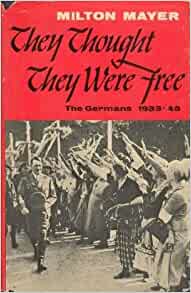
“I came back home a little afraid for my country, afraid of what it might want, and get, and like, under pressure of combined reality and illusion. I felt — and feel — that it was not German man that I had met, but Man. He happened to be in Germany under certain conditions. He might, under certain conditions, be I.” — Milton Mayer, They Thought They Were Free, ix.
It’s been more than seventy-five years since the Nazis were defeated and Auschwitz was liberated. Seventy-five years is a long time — so long, in fact, that while many still learn of the horrors of the Holocaust, far fewer understand how the murder of the Jews happened. How were millions of people systematically exterminated in an advanced Western nation — a constitutional republic? How did such respectable and intelligent citizens become complicit in the murder of their countrymen? These are the questions Milton Mayer sought to answer in his book They Thought They Were Free.
In 1952, Mayer moved his family to a small German town to live among ten ordinary men, hoping to understand not only how the Nazis came to power but how ordinary Germans — ordinary people — became unwitting participants in one of history’s greatest genocides. The men Mayer lived among came from all walks of life: a tailor, a cabinetmaker, a bill-collector, a salesman, a student, a teacher, a bank clerk, a baker, a soldier, and a police officer.
Significantly, Mayer did not simply conduct formal interviews in order to “study” these men; rather, Mayer had dinner in these men’s homes, befriended their families, and lived as one of them for nearly a year. His own children went to the same school as their children. And by the end of his time in Germany, Mayer could genuinely call them friends. They Thought They Were Free is Mayer’s account of their stories, and the title of the book is his thesis. Mayer explains:
“Only one of my ten Nazi friends saw Nazism as we — you and I — saw it in any respect. This was Hildebrandt, the teacher. And even he then believed, and still believes, in part of its program and practice, ‘the democratic part’. The other nine, decent, hard-working, ordinarily intelligent and honest men, did not know before 1933 that Nazism was evil. They did not know between 1933 and 1945 that it was evil. And they do not know it now. None of them ever knew, or now knows, Nazism as we knew and know it; and they lived under it, served it, and, indeed, made it” (47).
Until reading this book, I thought of what happened in Germany with a bit of arrogance. How could they not know Nazism was evil? And how could they see what was happening and not speak out? Cowards. All of them. But as I read Mayer’s book, I felt a knot in my stomach, a growing fear that what happened in Germany was not a result of some defect in the German people of this era.
The men and women of Germany in the 1930s and 40s were not unlike Americans in the 2010s and 20s — or the people of any nation at any time throughout history. They are human, just as we are human. And as humans, we have a great tendency to harshly judge the evils of other societies but fail to recognize our own moral failures — failures that have been on full display the past two years during the covid panic.
Mayer’s book is frighteningly prescient; reading his words is like staring into our own souls. The following paragraphs will show just how similar the world’s response to covid has been to the German response to the “threat” of the Jews. If we can truly understand the parallels between our response to covid and the situation in Hitler’s Germany, if we can see what lies at the end of “two weeks to flatten the curve”, perhaps we can prevent the greatest atrocities from being fully realized in our own day. But to stop our bent toward tyranny, we must first be willing to grapple with the darkest parts of our nature, including our tendency to dehumanize others and to treat our neighbors as enemies.
Mussolini Falls from Power – WW2 – 205 – July 30, 1943
World War Two
Published 30 Jul 2022The Allied advance on Sicily continues, though they’re really gearing up for operations next week. The Soviet advances in the USSR and in New Georgia also continue, with the enemy deciding to withdraw in both; Allied firebombing kills tens of thousands of German civilians, but the big news is still the fall of Benito Mussolini from power in Italy.
(more…)
Look at Life — Pipeline (1961)
ian16th Jones
Published 20 Aug 2017Refuelling at Sea and in the Air 1960’s style
QotD: Intervention and non-intervention in the Spanish Civil War
The most baffling thing in the Spanish war was the behaviour of the great powers. The war was actually won for Franco by the Germans and Italians, whose motives were obvious enough. The motives of France and Britain are less easy to understand. In 1936 it was clear to everyone that if Britain would only help the Spanish Government, even to the extent of a few million pounds’ worth of arms, Franco would collapse and German strategy would be severely dislocated. By that time one did not need to be a clairvoyant to foresee that war between Britain and Germany was coming; one could even foretell within a year or two when it would come. Yet in the most mean, cowardly, hypocritical way the British ruling class did all they could to hand Spain over to Franco and the Nazis. Why? Because they were pro-Fascist, was the obvious answer. Undoubtedly they were, and yet when it came to the final showdown they chose to stand up to Germany. It is still very uncertain what plan they acted on in backing Franco, and they may have had no clear plan at all. Whether the British ruling class are wicked or merely stupid is one of the most difficult questions of our time, and at certain moments a very important question. As to the Russians, their motives in the Spanish war are completely inscrutable. Did they, as the pinks believed, intervene in Spain in order to defend Democracy and thwart the Nazis? Then why did they intervene on such a niggardly scale and finally leave Spain in the lurch? Or did they, as the Catholics maintained, intervene in order to foster revolution in Spain? Then why did they do all in their power to crush the Spanish revolutionary movements, defend private property and hand power to the middle class as against the working class? Or did they, as the Trotskyists suggested, intervene simply in order to prevent a Spanish revolution? Then why not have backed Franco? Indeed, their actions are most easily explained if one assumes that they were acting on several contradictory motives. I believe that in the future we shall come to feel that Stalin’s foreign policy, instead of being so diabolically clever as it is claimed to be, has been merely opportunistic and stupid. But at any rate, the Spanish civil war demonstrated that the Nazis knew what they were doing and their opponents did not. The war was fought at a low technical level and its major strategy was very simple. That side which had arms would win. The Nazis and the Italians gave arms to the Spanish Fascist friends, and the western democracies and the Russians didn’t give arms to those who should have been their friends. So the Spanish Republic perished, having “gained what no republic missed”.
Whether it was right, as all left-wingers in other countries undoubtedly did, to encourage the Spaniards to go on fighting when they could not win is a question hard to answer. I myself think it was right, because I believe that it is better even from the point of view of survival to fight and be conquered than to surrender without fighting. The effects on the grand strategy of the struggle against Fascism cannot be assessed yet. The ragged, weaponless armies of the Republic held out for two and a half years, which was undoubtedly longer than their enemies expected. But whether that dislocated the Fascist timetable, or whether, on the other hand, it merely postponed the major war and gave the Nazis extra time to get their war machine into trim, is still uncertain.
George Orwell, “Looking back on the Spanish War”, New Road, 1943 (republished in England, Your England and Other Essays, 1953).
July 30, 2022
Beartrap: The Best Way To Land A Big Helicopter On A Small Ship At Sea
Polyus Studios
Published 29 Jul 2022Don’t forget to like the video and subscribe to my channel!
Support me on Patreon – https://www.patreon.com/polyusstudiosToday, navies across the world use an ingenious system to land helicopters on the rolling deck of a ship at sea. It enabled the powerful helicopter-destroyer combination that has become the dominant form of at sea anti-submarine warfare. It’s the “helicopter haul down and rapid securing device”, more commonly known as Beartrap. This device may be little known to the public, but it stands as one of the greatest contributions Canada has ever made to naval aviation, and ushered in the age of helicopters at sea.
(more…)
Alexis de Tocqueville
In The Critic, Paul Sagar reviews a new biography of Alexis de Tocqueville by Olivier Zunz:
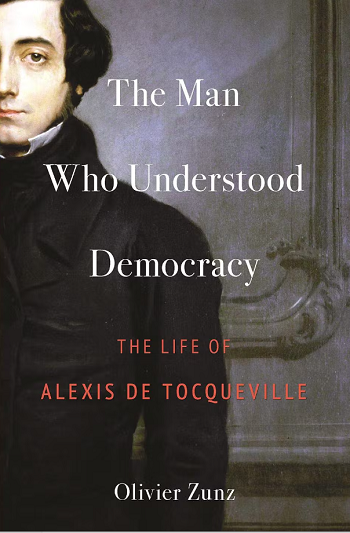
Alexis de Tocqueville came perilously close to never existing at all. His parents, married in 1793, spent 10 of their first 18 months of matrimony in jail — arrested for the crime of being aristocrats during the height of the French revolutionary Terror. Tocqueville’s great-grandfather was guillotined in April 1794, after being forced to watch the beheadings of his daughter and grandchildren. His newlywed parents were in the queue, awaiting the same fate, but the fall of Robespierre in July meant they were spared.
Alexis, the third son of the family, would be born in 1805, and go on to write not one, but two, of the most influential works in the history of ideas. His two-volume Democracy in America (published in 1835 and 1840) has been hailed as, variously, the first work of political science, a founding text of sociological analysis, and a landmark in the history of political philosophy.
It remains a touchstone for those attempting to understand both democracy and the United States, as well as post-Revolutionary France (Tocqueville’s animating point of comparison). His later The Ancien Régime and the Revolution (1856) attempted to locate the long-term causes of the events of 1789, and inaugurated a school of French Revolution historiography that remains alive and influential to this day.
He also enjoyed a moderately successful career as a practising politician, directly involved in France’s tumultuous political upheavals from the 1830s to the early 1850s. Constitutionally frail, and wracked by tuberculosis for the final nine years of his life before dying at just 54, he nonetheless packed a lot in.
As a narrative biography, Olivier Zunz’s The Man Who Understood Democracy succeeds tremendously. The details of Tocqueville’s life — and the events he lived through — are rendered with engaging clarity. The detailed reconstruction of Tocqueville’s nine-month trip to America in 1831–32 is especially valuable, shedding a great deal of light on what Tocqueville saw and, crucially, who he spoke to and took his lead from. Zunz does not shy away from dissolving the myth to reveal the man. Sometimes treated as though he were a gimlet-eyed sage who saw through to the very soul of the fledgling United States, Zunz shows instead the extent to which Tocqueville tended to take too much at face value, especially regarding what he was told by less than impartial interlocutors, frequently failing to scratch below the surface on his whirlwind tour.
Thus, for example, he went on to write in Democracy in America that the liberty of the United States meant that secret societies were unknown there, entirely failing to recognise not only the extent of Masonic influence in local politics, but also how objections to Masonic influence were a core feature of contestation. A young man, dazzled by the hustle and bustle of the New World, he tended to see what he wanted to see — or what others hoped he would.
PTRD 41: The Simple Soviet Antitank Rifle of WWII
Forgotten Weapons
Published 25 May 2018http://www.patreon.com/ForgottenWeapons
Cool Forgotten Weapons merch! http://shop.bbtv.com/collections/forg…
The Soviet Union had originally eschewed the use of large numbers of antitank rifles, anticipating that any potential combat use of them would be largely against tanks impervious to AT rifle cartridges. However, when German forces came flooding across the border in 1941, the Soviet Union found themselves being attacked by quite large numbers of tanks which were in fact vulnerable to an antitank rifle cartridge. Stalin ordered an immediate development and production of such a weapon, and the designers responded with concepts. Simonov produced the PTRS-41, a semiautomatic 14.5mm weapon that was sophisticated, expensive, and effective. Degtyarev produced the PTRD-41, a single shot 14.5mm weapon which was simple, cheap, and also effective. Both used the same cartridge, which fires a 980gr armor piercing projectile at a remarkable 3320 fps.
Both the Simonov and Degtyarev rifles were ordered into production, with the PTRD-41 being available and fielded within a month because of its very simple nature. By the end of the war some 185,000 of these rifles had been made, and even after the new German tanks became impervious to them, they remained effective weapons for use on light armored vehicles, field guns, machine gun nests, pillboxes, and other hardened targets.
The PTRD-41 is a mechanically interesting and unusual weapon in that despite being only a single shot system, it is recoil operated. When fired, the entire barrel assembly recoils rearward, absorbing some of the immense recoil energy and also opening the bolt and ejecting the spent case. The shooter then need only drop a new cartridge into the action and close the bolt to be ready for a subsequent shot.
(more…)
QotD: The advent of horses and firearms on the North American plains
Horses arrived in the Great Plains from the south via the Spanish and moving through Native American peoples west of the Rocky Mountains by both trade and eventually raiding in the early 1700s. Notably firearms also began moving into the region in the same period, but from the opposite direction, coming from British and French traders to the North and West (the Spanish had regulations against trading firearms to Native Americans, making them unavailable as a source). Both were thus initially expensive trade goods which could only be obtained from outside and then percolated unevenly through the territory; unlike firearms, which remained wholly external in their supply, horses were bred on the plains, but raiding and trade were still essential sources of supply for most peoples on the plains. We’ll get to this more when we talk about warfare (where we’ll get into the four different military systems created by this diffusion), but being in a position where one’s neighbors had either the horse or the gun and your tribe did not was an extreme military disadvantage and it’s clear that the “falling out” period whereby these two military innovations distributed over the area was very disruptive.
But unlike guns, which seem to have had massive military impacts but only minimal subsistence impacts (a bow being just as good for hunting bison as a musket, generally), the arrival of the horse had massive subsistence impacts because it made hunting wildly more effective. But the key thing to remember here is: the horse was introduced to the Great Plains no earlier than 1700, horse availability expanded only slowly over the area, but by 1877 (with the end of the Black Hills War), true Native American independence on the Great Plains was functionally over. Consequently, unlike the Steppe, where we have a fairly “set” system that had already been refined for centuries, all we see of the Plains Native American horse-based subsistence system is rapid change. There was no finally reached stable end state, as far as I can tell.
Though there is considerable variation and also severe limits to the evidence, it seems that prior to the arrival of the horse, most Native peoples around the Great Plains practiced two major subsistence systems: nomadic hunter-gathering on foot (distinct from what will follow in that it places much more emphasis on the gathering part) on the one hand and a mixed subsistence system of small-scale farming mixed seasonally with plains hunting seems to have been the main options pre-horse, based on the degree to which the local area permitted farming in this way (for more on those, note Isenberg, op. cit., 31-40). Secoy (op. cit.) notes that while there is some evidence that the Plains Apache may have shifted through both systems, being hunter-gatherers prior to the arrival of horses, by the time the evidence lets us see clearly (which is shortly post-horse) they are subsisting by shifting annually between sedentary agricultural racheirias (from the Spring to about August) and hunting bison on the plains during the fall. Isenberg notes the Native Americans of the Missouri river combining corn agriculture with cooperative bison hunting in the off-season (in that case, in the summer). Meanwhile, the Comanches and Kiowas seem to have mostly subsisted on pedestrian bison hunting along with gathering fruit and nuts, with relatively little agriculture, prior to going fully nomadic once they acquired horses. Bison hunting on foot required a lot of cooperation (so a group) and it seems clear that it was not enough to support a group on its own and had to be supplemented somehow, at least before the arrival of the horse. Some mix of either bison+gathering or bison+horticulture was required.
Isenberg argues (op. cit.), that at this point the clear advantage was to what he terms the “villagers” – that is the farmer-hunters who lived in villages, rather than the nomadic hunter-gathers. These horticulturists were more numerous and seem quite clearly to have had the better land and living conditions. Essentially the hunter-gatherers stuck on marginal land were mostly hunter-gatherers because they were stuck on marginal land, which created a reinforcing cycle of being stuck on marginal land (the group is weak due to small group size because the land is marginal and because the group is weak, it is only able to hold on to marginal lands). That system was stable without outside disruption. The horse changed everything.
A skilled Native American hunter on a horse, armed with a bow, could hunt bison wildly more effectively than on foot. They could be found more rapidly, followed at speed and shot in relative safety. It is striking that while pedestrian bison hunting was clearly a team effort, a hunter on a horse could potentially hunt effectively alone or in much smaller groups. In turn, that massively increased effectiveness in hunting allowed the Native Americans of the region, once they got enough horses, to go “full nomad” and build a subsistence system focused entirely on hunting bison, supplemented by trading the hides and other products of the bison with the (increasingly sedentary and agrarian) peoples around the edges of the Plains. Many of the common visual markers of Plains Native Americans – the tipi, the travois, the short bow for use from horseback – had existed before among the hunter-gathering peoples, but now spread wore widely as tribes took to horse nomadism and hunting bison full time. At the same time, Isenberg (op. cit. 50-52) has some fascinating paragraphs on all sorts of little material culture changes in terms of clothing, home-wares, tools and so on that changed to accommodate this new lifestyle. The speed of the shift is quite frankly stunning.
We’ll come back to this later, but I also want to note here that this also radically changed the military balance between the nomads and the sedentary peoples. The greater effectiveness of bison hunting meant that the horse nomads could maintain larger group sizes (than as hunter-gatherers, although eventually they also came to outnumber their sedentary neighbors, though smallpox – which struck the latter harder than the former – had something to do with that too), while possession of the horse itself was a huge military advantage. Thus by 1830 or so, the Ute and Comanche pushed the Apache off of much of their northern territory, while the Shoshone, some of the earliest adopters of the horse, expanded rapidly north and east over the Northern Plains, driving all before them (Secoy, op. cit., 30-31, 33). Other tribes were compelled to buy, raise or steal horses and adopt the same lifestyle to compete effectively. It was a big deal, we’ll talk about specifics later.
Bret Devereaux, “That Dothraki Horde, Part II: Subsistence on the Hoof”, A Collection of Unmitigated Pedantry, 2020-12-11.
July 29, 2022
Nightmare Fuel For Soviet Submarines; the story of the Canadair CP-107 Argus
Polyus Studios
Published 4 Dec 2020Don’t forget to like the video and subscribe to my channel!
Support me on Patreon – https://www.patreon.com/polyusstudiosIn its day the Argus was the most formidable anti-submarine warfare platform fielded by any NATO country. Canadair adapted the Bristol Britannia into a highly effective low and slow sub hunter. This gave Maritime Air Command the edge in the North Atlantic. It served on the front-line of the Cold War and kept the Soviet submarine threat in check for almost 25 years.
(more…)


