
Overly Sarcastic Productions
Published 22 Jul 2017How did people fight in ancient times? Well that’s a good question! Step right up and I’ll learn you a thing or two about history.
(more…)
September 12, 2022
History Summarized: Classical Warfare (Feat. Shadiversity!)
Comments Off on History Summarized: Classical Warfare (Feat. Shadiversity!)
September 11, 2022
The Allies’ Latest Victory – WW2 – 211 – September 10, 1943
World War Two
Published 10 Sep 2022Dwight Eisenhower publicly announces the secret armistice signed last week, and Italy is now officially out of the war. The Italian fleet sails for Malta and Allied captivity. The Allies have landed in force in Southern Italy and they do face some heavy opposition from German forces — who have no intention of giving up Italy. In the USSR, though, the Soviets continue liberating territory all over Ukraine as they force the Germans back to the Dnieper River.
(more…)
Comments Off on The Allies’ Latest Victory – WW2 – 211 – September 10, 1943
Are we looking at a modern equivalent to the Bronze Age Collapse?
If you’re feeling happy and optimistic, Theophilus Chilton has a bucket of cold water to douse you with:
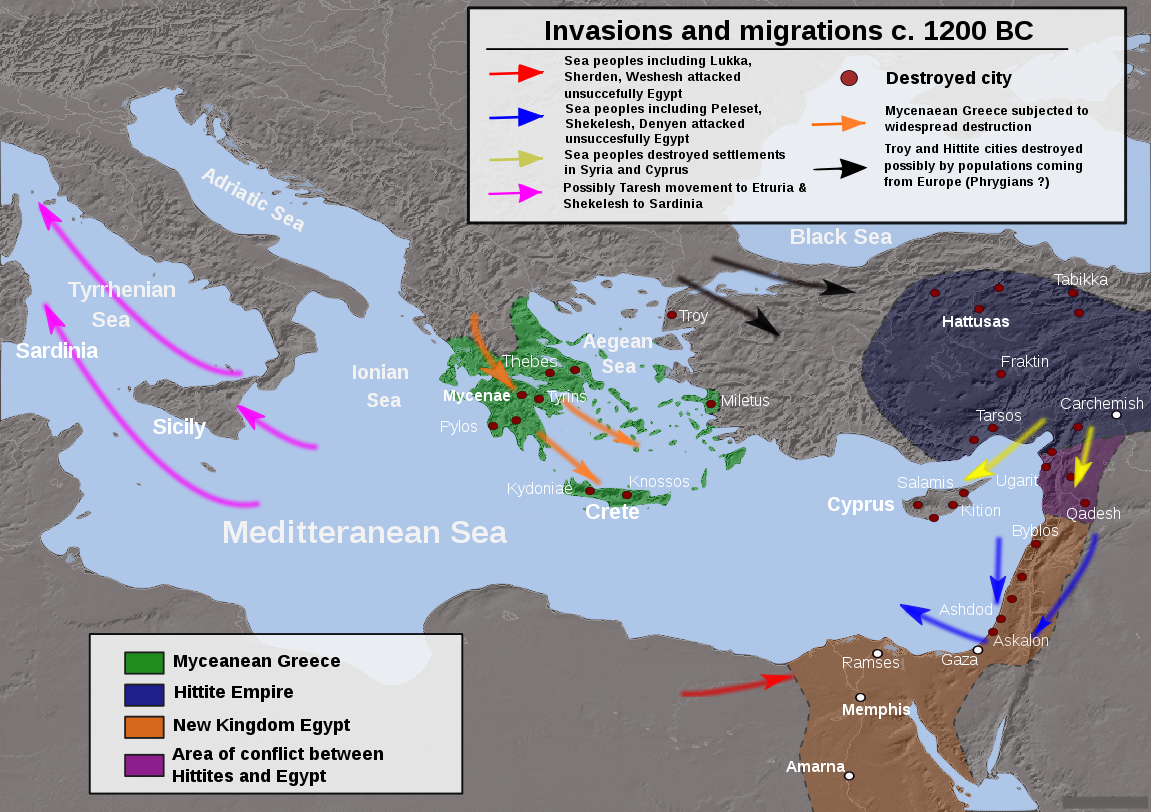
Migrations, invasions and destructions during the end of the Bronze Age (c. 1200 BC), based on public domain information from DEMIS Mapserver.
Map by Alexikoua via Wikimedia Commons.
Regular readers know that I’ve talked about collapse (as well as the implied regeneration that follows it) on here a lot. In nearly all cases, though, I’ve discussed it within a specifically American context – the collapse of the present American system and the potential for one or more post-American successor states arising in place of the present globohomo order. However, we should recognise that collapse is a general phenomenon that affects any and all large nations eventually. Just as America is not a special snowflake who is exempt from the laws of demographic-structural theory, so also is she not the only one subject to them.
Further in this vein, we should recognise that no major nation is isolated from its neighbours. No matter how self-sufficient, sooner or later everybody gets hooked up into trade networks. As trade networks expand, you develop world systems that display increased international interconnectedness and interdependency. From a demographic-structural perspective, the interconnectedness of these global systems acts to “synch up” the secular cycles of the nations involved as “information flows” increase. The upside to this is that when one part of the system prospers, everyone does. The downside, of course, is that when one part collapses, everyone does as well.
There are several historical examples of this kind of interconnected system synching up and then collapsing. Probably one of the most well-known examples would be the Bronze Age collapse which occurred in the Mediterranean world system roughly between 1225-1150 BC. Likely due to several shocks to the system working in tandem (drought, volcanic eruptions, migrations into the Balkans from the north, etc.), a series of invasions of the Sea Peoples spread out across the entire eastern end of the Mediterranean, toppling Mycenaean Greece and the Hittite Empire, and nearly did the same to Egypt. From there, the shocks moved outward throughout the rest of Anatolia and Syro-Palestine and eastward into Mesopotamia, disrupting the entire interconnected trade network. The system was apparently already primed to be toppled by these jolts, however, due to the top-heavy political structures (elite overproduction) and overspecialisation in these empires that contributed to their fragility in the face of system shocks. When the first one fell, the effects spread out like dominoes falling in a row.
There is evidence that this collapse extended beyond the Mediterranean basin and disrupted the civilisation existing in the Nordic Bronze Age around the Baltic Sea. Right around the same time that Bronze Age Mediterranean society was collapsing, serious changes to society in the Baltic basin were also taking place, primarily due to the disruption of trade routes that connected the two regions, with amber flowing south and metals and prestige goods returning north. During this period, the population in the area transitioned from a society organised primarily around scattered villages and farms into one that became more heavily militarised and centred around fortified towns, indicating that there was a change in the region’s elite organisation, or at least a strong modification of it (remember that collapse phases are characterised by struggles between competing elite groups). A large battle that dates to this era has been archaeologically uncovered in the Tollense Valley of northeastern Germany which is thought to have involved over 5000 combatants — a huge number for this area at this time, indicating more centralised state-like organisational capacities than were previously thought to have existed in the region. All in all, the evidence seems to suggest that this culture underwent some type of collapse phase at this time, likely in tandem with that occurring further south.
Other times and places have also seen such world system collapses take place. for instance, when the western Roman Empire was falling in the 3rd-5th centuries AD, the entire Mediterranean basis (again) underwent a systemwide socioeconomic collapse and decentralisation. More recently, the entire Eurasian trade system, from England to China, underwent a synchronised collapse phase in the early 17th century AD that saw revolutions, elite conflict, decentralisation, and social simplification take place across the length of the continent.
The great irony of interconnectedness is that too much of it actually works to reduce resilience within a system. Because an intensively globalised world system entails a lot of specialisation as different parts begin to focus on the production of different commodities needed within the network, this makes each part of the system more dependent upon the others. This works to reduce the resiliency of each of these individual parts, and the greater interconnectedness allows failure in one part to be communicated more widely and rapidly to other parts than might otherwise be the case in less interconnected systems.
Comments Off on Are we looking at a modern equivalent to the Bronze Age Collapse?
MAS-36: The Backup Rifle is Called to Action
Forgotten Weapons
Published 25 Sep 2017There is a common assumption that the MAS-36 was a fool’s errand from the outset — why would a country develop a brand new bolt-action rifle in the mid 1930s, when obviously semiautomatic combat rifles were just on the cusp of widespread adoption? Well, the answer is a simple one — the French were developing a semiautomatic rifle at the same time, and the MAS-36 was only intended to go to rear echelon and reserve troops. It would serve as a measure of economy, reducing the number of the more complex and expensive self-loaders necessary, while still providing sufficient arms to equip the whole reserve in case of a mobilization.
Well, the plan didn’t quite work out that way, because Germany invaded France before the semiauto rifle was ready for production (it was, at that point, the MAS-40 and was in trials). Not until 1949 would the self-loader go into mass production with the MAS-49 (discounting the short-lived MAS-44). With this in mind, the MAS-36 suddenly makes much more sense. It is a simple, economical, and entirely adequate rifle without extraneous niceties. In a word, it is a Russian rifle rather than a Swiss one.
Production began in the fall of 1937, and by the time of the German invasion there were about 205,000 in French stockpiles. They saw extensive use in the Battle of France, along with M34 Berthiers in 7.5x54mm. Some would escape to serve the Free French forces worldwide through the war, and others would be captured and used by German garrisons in France and along the Atlantic Wall. Production resumed upon the liberation of St Etienne in 1944, and by 1957 about 1.1 million had been made. They basically fall into two varieties, with several pre-war milled components changed to more economical stamped designs after the war.
(more…)
Comments Off on MAS-36: The Backup Rifle is Called to Action
QotD: De-institutionalization
[In Desperate Remedies: Psychiatry’s Turbulent Quest to Cure Mental Illness, Andrew] Scull stresses the degree to which external pressures have shaped psychiatry. “Community psychiatry” supplanted “institutional psychiatry” in part because of professional insecurity. Psychiatrists needed a new model for dealing with mental diseases to keep pace with the advances that mainstream health care was making with other diseases. Fiscal conservatives viewed the practice of confining hundreds of thousands of Americans to long-term commitment as overly expensive, and civil libertarians viewed it as unjust.
Deinstitutionalization began slowly at first, in the 1950s, but the pace accelerated around 1970, despite signs that all was not going according to plan. On the ground, psychiatrists noticed earlier than anyone else that the most obvious question — where are these people going to go when they leave the mental institutions? — had no clear answers. Whatever misgivings psychiatrists voiced over the system’s abandonment of the mentally ill to streets, slums, and jails was too little and too late.
That modern psychiatry is mostly practiced outside of mental institutions is not its only difference from premodern psychiatry. Scull devotes extensive coverage to two equally decisive developments: the rise and fall of Freudianism, and psychopharmacology.
The Freudians normalized therapy in America and provided crucial intellectual support for the idea that mental health care is for everyone, not just the deranged. Around the same time as deinstitutionalization, Freud’s reputation, especially in elite circles, was on a level with Newton and Copernicus. Since then, Freudianism has mostly gone the way of phlogiston and leeches. That happened not just because people decided the psychoanalysts’ approach to therapy didn’t work but also because insurance wouldn’t pay for it. Insurance would, however, pay for modes of therapy that were less open-ended than the “reconstruction of personality that psychoanalysis proclaimed as its mission”, more targeted to a specific psychological symptom, and, most crucially of all, performed by non-M.D.s. Therapy was on the rise, but psychiatrists found themselves doing less and less of it.
As psychiatry cast aside Freudian concepts such as the “refrigerator mother”, which rooted mental illness in psychodynamic tensions, it increasingly trained its focus on biology. Drugs contributed to, and gained a boost from, this reorientation. Scull loathes the drug industry and only grudgingly allows that it has made improvements in the lives of mentally ill Americans. He divides up the vast American drug-taking public into three groups: those for whom they work, those for whom they don’t work, and those for whom they may work, but not enough to counter the unpleasant side effects. He argues that the last two groups are insupportably large.
Stephen Eide, “Soul Doctors”, City Journal, 2022-05-18.
Comments Off on QotD: De-institutionalization
September 10, 2022
The Land Rover Defender Story
Big Car
Published 27 Dec 2019The Land Rover is Britain’s bullet-proof off-roader born out of Rover’s post-war desperation and became the indispensable go-anywhere vehicle. Like its famed bullet-proof ruggedness, Land Rover production kept going, and going, and going. But with a brief gap of 4 years, the Land Rover is still with us and looks like it’s not going away any time soon.
(more…)
Comments Off on The Land Rover Defender Story
QotD: “Working toward the Führer“
This had several big advantages. First, it’s in line with Nazi philosophy. The Nazis were Social Darwinists. Social Darwinists hold that “survival of the fittest” applies not only to humans as a whole, but to human social groups as well. Any given organization, then, must exist to do something, to advance some cause, to reach some goal. Ruthless competition between groups, and inside each group, is how the goal works itself out (you should be hearing echoes of Hegel here). The struggle refines and clarifies what the group’s goal is, even as the individual group members compete to reach it. The end result gets forced back up the system to the Führer, such that, dialectically (again, Hegel), “National Socialism means X” now encompasses the result of the previous struggle.
[…]
As with philosophy, “working towards the Führer” fit well with German military culture. Auftragstaktik is a fun word that means “mission-type tactics.” In practice, it delegates authority to the lowest possible level. Each subordinate commander is given an objective, a force, and a due date. High command doesn’t care how the objective gets taken; it only cares that the objective gets taken. Done right, it’s a wonderfully efficient system. It’s the reason the Wehrmacht could keep fighting for so long, and so well, despite being overpowered in every conceivable way by the Allies. The Allies, too, were constantly flabbergasted by their opponents’ low rank — corporals and sergeants in the Wehrmacht were doing the work of an entire Allied company command staff (and often doing it better).
Consider the career of Adolf Eichmann. In the deepest, darkest part of the war, this man pretty much ran the Reich’s rail network. Say what you will about the Nazi’s plate-of-spaghetti org chart, that’s some serious power. He was a lieutenant colonel.
The final great advantage of “working towards the Führer” is “plausible deniability”. Let’s stipulate Atrocity X. Let’s further stipulate that we’re in the professional historian’s fantasy world, where every conceivable document exists, and they’re all clear and unambiguous. It’s a piece of cake to pin Atrocity X on someone … and that someone would, in all probability, be a corporal or a sergeant. Maybe a lieutenant. What you wouldn’t be able to do is trace it up the chain any higher. Everyone from the captain to Hitler himself could / would give you the “Who, me?” routine. “I didn’t tell Sergeant Schultz to execute those prisoners. All I said was to go secure that objective / defeat that army / that National Socialism means fighting with an iron will.”
*I’m deliberately conflating them here — to make it clearer how confusing this could be — but in talking about this stuff the terminology is crucial. Adolf Hitler, the man, played the role of The Führer. What Hitler the man wanted was often in line with what the Führer role required, of course, but not always. This is one of the footholds Holocaust deniers have. Did Hitler-the-man actually put his name to a liquidation order? No. Did Hitler-the-man actually want it to happen? Unquestionably yes, but like all men, Hitler-the-man vacillated, had second thoughts, doubted himself, etc., and you can find documented instances of that. But The Führer very obviously wanted it to happen, and it was The Führer that motivated the rank-and-file. The man created the role, but very soon the role started playing the man …
Severian, “Working Towards the Deep State”, Rotten Chestnuts, 2020-01-06.
Comments Off on QotD: “Working toward the Führer“
September 9, 2022
The Byzantine Empire: Part 2 – Survival and Growth
seangabb
Published 15 Oct 2021Between 330 AD and 1453, Constantinople (modern Istanbul) was the capital of the Roman Empire, otherwise known as the Later Roman Empire, the Eastern Roman Empire, the Mediaeval Roman Empire, or The Byzantine Empire. For most of this time, it was the largest and richest city in Christendom. The territories of which it was the central capital enjoyed better protections of life, liberty and property, and a higher standard of living, than any other Christian territory, and usually compared favourably with the neighbouring and rival Islamic empires.
The purpose of this course is to give an overview of Byzantine history, from the refoundation of the City by Constantine the Great to its final capture by the Turks.
Here is a series of lectures given by Sean Gabb in late 2021, in which he discusses and tries to explain the history of Byzantium. For reasons of politeness and data protection, all student contributions have been removed.
(more…)
Comments Off on The Byzantine Empire: Part 2 – Survival and Growth
The Velvet Glove and Sparrow II missiles; A Beginners Guide To Post-War Bomber Interception Tactics
Polyus Studios
Published 14 Jul 2018The Velvet Glove was a semi-active guided missile system developed by the Canadian Armament Research and Development Establishment. Its successor, the Sparrow II, was developed by Canadair in association with the US Air Force. This is the story of the development of the missiles in the context of contemporary weapons systems.
(more…)
Comments Off on The Velvet Glove and Sparrow II missiles; A Beginners Guide To Post-War Bomber Interception Tactics
QotD: The BBC behind-the-scenes in 1983
I was in the studio next door, which had been transformed into a vast Green Room, tables stacked high with food and booze. Us trainees had been brought in to help organise the guests and manage the hospitality.
And that party was only getting started. As the night wore on and the politicians, academics and journalists came and went, but mostly came and stayed, the whole place, and the labyrinth of corridors, scenery docks and stage lifts surrounding it, began to resemble something between a University May Ball and the last days of Rome.
People were being sick in corridors, being discovered “in flagrante” in lifts or sneaking off into unlocked offices. Some, bearing an uncanny resemblance to their Spitting Image puppets, became far too slurry and unsteady on their feet to go before Dimbleby and co at the appointed time.
Back then, juniors like me were often sent to pick up politicians and other public figures, because if they were not physically guided they’d forget to turn up altogether or go to the wrong place. We’d arrive rather sheepishly outside clubs, parties and private homes — sometimes not the private homes that they were supposed to be living in. We’d gently lead them away from whatever drunken dinner they were at and take them to the studio where more free alcohol was always available. And everyone was smoking.
For politicians and journalists alike, it was an especially louche time. And secrets, by and large, were kept along an arc of tolerated misbehaviour that ran from Westminster through St James’ to Notting Hill and White City. Albertines Wine Bar and Julie’s restaurant both had booths you could dissolve into during lunches that slipped toward early evening, and the “cinq a sept” trade in the local hotels was always healthy.
There was a BBC chauffeur driving company run by a man called Niven, and a late night “Niven Car” was the ultimate perk when the White City and Lime Grove bars finally closed. I’m not the only BBC veteran who’ll remember when a certain public figure left an item of intimate female clothing on the back seat of her “Niven” after an over-enthusiastic snog on her way home. It was duly recovered, popped into a plastic bag and discreetly couriered back to its proper owner.
I’m making it sound more fun than it was. There was a lot of awful behaviour that went unremarked and unpunished, especially the leering, groping and grabbing that my female colleagues had to put up with endlessly, some of which would today rightly be called sexual assault. And, of course, this permissive culture was the ideal environment for celebratory predators, the Jimmy Savilles, Stuart Halls and Cyril Smiths (one of David Dimbleby’s guests that very election night). We all heard the gossip, but nobody made a challenge.
But if I could have any part of that world back it would be this: we didn’t expect, need or want our MPs, ministers or their shadows to be plaster saints.
Phil Craig, “I’m done with po faced politicians”, The Critic, 2022-05-18.
Comments Off on QotD: The BBC behind-the-scenes in 1983
September 8, 2022
Queen Elizabeth II (21 April, 1926 – 8 September, 2022)
It was inevitable that the Queen would die, yet the news was still an unwelcome surprise and a shock. I shared the news on social media, and as you’d expect, the very first response was from someone clearly looking for a fight over the monarchy and the bugaboos of his current obsessions. Thank goodness for the “mute” function. Prince Charles is now the King, although I understand he plans to choose a different regnal name.
In The Critic, Ben Sixsmith looks at the Queen’s reign in retrospect:
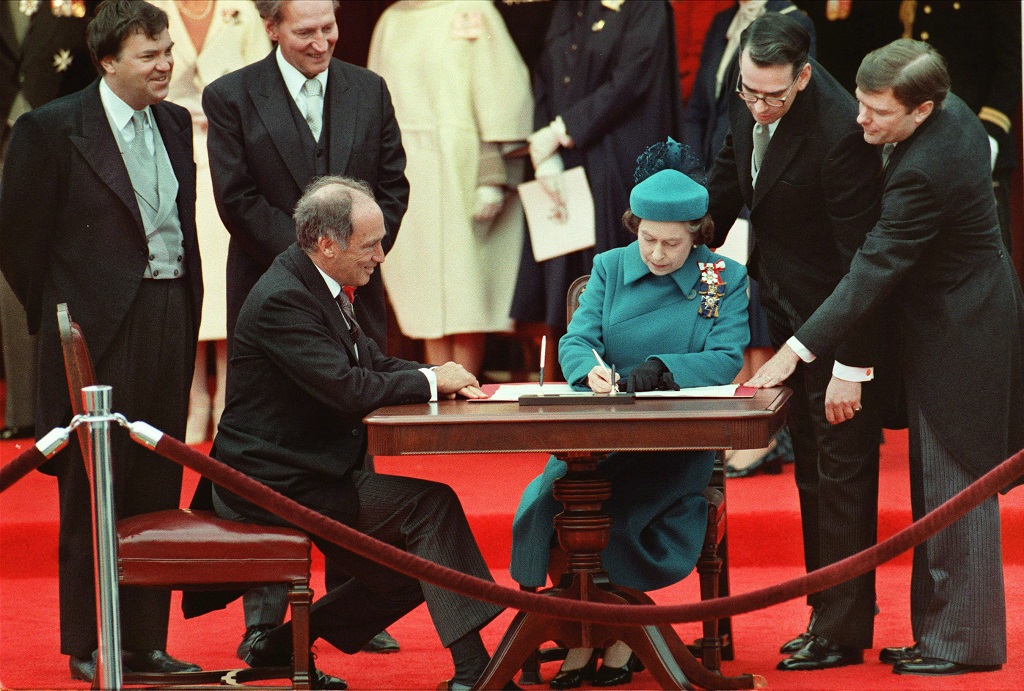
Queen Elizabeth II signs Canada’s constitutional proclamation in Ottawa on April 17, 1982 as Prime Minister Pierre Trudeau looks on.
The Canadian Press/Stf-Ron Poling
For years, Queen Elizabeth II was a link to another age — an age of tradition, and respect, and restraint. Did that age ever exist in an ideal form? Of course not. But we still admire its echoes, which surrounded our conception of the Queen.
She was crowned in 1953, looking rather vulnerable at the age of 25. Winston Churchill was Prime Minister. Man had only just reached the top of Everest and was more than fifteen years away from reaching the Moon.
The Empire was crumbling but the young, elegant, stoical Queen kept alive a sense of British importance and stability. Her personal calmness and courage as she toured dangerous regions was noted (and would be later tested when Michael Fagan, a disturbed socialist, snuck into her bedroom).
Her popularity never faltered. Governments, institutions, actors, athletes et cetera have risen and fallen in their popular esteem but Her Majesty was always loved. Was this in part because our exposure to her was so limited? Of course. But there is something special in that. She never imposed herself upon the public. She was committed to the tiring, traditional, constitutional, life-affirming, often rather modest and unheralded duties that she had inherited. The monarchy is a lot more than one person, of course, but it took a special person to embody it.
All the way back in the 1950s, Malcolm Muggeridge warned that elevating royals to the status of celebrities would kill the institution. Who could deny that he was onto something? Princess Diana was drowned in prurience and sentimentality, and some of the Queen’s own descendants have disgraced themselves, to greater and lesser degrees, by embracing the sordid lifestyles and the haughty status of the rich and the famous. Throughout it all, Queen Elizabeth maintained her dignity and grace, and her focus on her own responsibility.
The CBC posted an obituary for Her Majesty as soon as the news was confirmed:
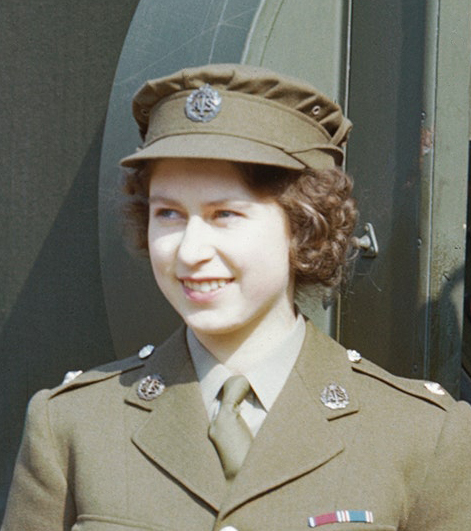
HRH Princess Elizabeth as a junior officer in the Auxiliary Territorial Service in April 1945.
Queen Elizabeth, Canada’s head of state and the longest-reigning British monarch, has died.
She died on Thursday afternoon at Balmoral Castle in Scotland, Buckingham Palace said in a short statement. She was 96.
“The Queen died peacefully at Balmoral this afternoon. The King and The Queen Consort will remain at Balmoral this evening and will return to London tomorrow,” the palace said, in reference to the Queen’s son Charles, who automatically became king upon her death, and his wife, Camilla.
Her husband, Prince Philip, died in April 2021.
Elizabeth became Queen in 1952, at the relatively tender age of 25, and presided over the country and the Commonwealth, including Canada, for seven decades. Those 70 years as monarch were recognized during this year’s Platinum Jubilee events, which reached their height in London in early June.
In her time as monarch, Elizabeth bore witness to profound changes at home and abroad, including the decline of the British Empire and decolonization of many African and Caribbean countries, along with the end of hostilities with Irish republicans.
As one of the most famous women in the world, she was also under great public scrutiny during some of the most painful moments of her life, including the death of her father, King George VI, the marriage breakups of three of her four children and the death of her former daughter-in-law, Diana, Princess of Wales.
But Elizabeth always had a keen sense of her role.
“I cannot lead you into battle, I do not give you laws or administer justice,” she said during her first televised Christmas address in 1957. “But I can do something else: I can give you my heart and my devotion to these old islands and to all the peoples of our brotherhood of nations.”
In the National Post, Araminta Wordsworth points out the Queen’s fondness for Canada during her reign:
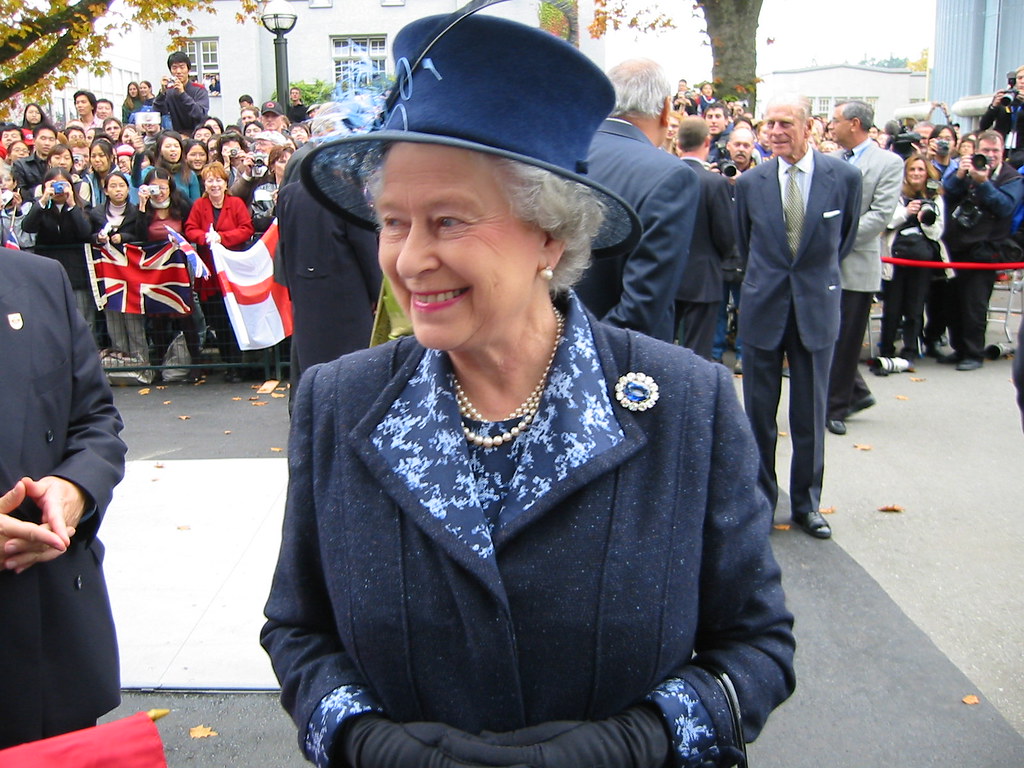
“Her Majesty Queen Elizabeth II” by Tinker Sailor Soldier Spy is licensed under CC BY-NC-ND 2.0 


 .
.
After a record-breaking reign of 70 years Her Majesty Queen Elizabeth died on Sept. 8, 2022.
She was the longest-ruling British monarch, outpacing her great-great-grandmother, Queen Victoria. However, Louis XIV of France still holds the absolute record, with 72 years, 100 days.
For most Canadians, the 96-year-old is the only sovereign they have ever known, but whether the country will sustain the connection after her death remains to be seen.
Certainly, Canada was the country she chose to visit most often. She was also here at one of the pivotal moments in our history when then-prime minister Pierre Elliott Trudeau brought home the Constitution in 1982. As sovereign, she signed the document in a rain-spattered and windy ceremony on Parliament Hill in Ottawa, the capital chosen by Queen Victoria.
But her connection to Canada had begun decades earlier. In 1939, Princess Elizabeth was reportedly the first British royal to make a transatlantic phone call: the recipients were her parents, then the Duke and Duchess of York, who were on a North American tour.
In 1951, the princess spent almost five weeks in Canada, filling in for her ailing father, George VI.
Winston Churchill, then in opposition, had wanted the princess and her husband, Prince Philip, the Duke of Edinburgh, to travel by boat, arguing air travel was unsafe.
But he was overruled and the royal couple became the first to embark on such a tour by air. With an action-packed schedule, they crossed the country from the Atlantic to the Pacific, including a side trip to Washington, D.C., greeted all the way by rapturous crowds. The royal pair square-danced, attended a hockey game and accepted countless bouquets.
Comments Off on Queen Elizabeth II (21 April, 1926 – 8 September, 2022)
Chinese Type 56 AK-47 (Shooting and History)
Forgotten Weapons
Published 23 Sep 2016One of the most common types of AK rifle in existence today is the Chinese Type 56 in its several variations, although very few of those rifles are in the United States in authentic full-auto form. This particular one was captured by a US soldier in the Vietnam War, who brought it back and registered it, making it a fully transferrable gun.
The Chinese received the technical package for the AK (and also the SKS, among other weapons) from the Soviet Union in the 1950s, as part of the USSR’s policy of providing military and technical aid to other nations sympathetic to the Communist cause (although a rift would grow between the USSR and China later). China would manufacture tens of millions of AK rifles, both of this milled receiver type (the Type 3 style) and the later stamped AKM pattern. The standard fixed-stock rifles like this one were fitted with under-folding spike bayonets. Folding stocked types were also made, both underfolding (Type 56-1) and side folding (Type 56-2). These weapons have become extremely prolific, and can be found in virtually any significant international conflict zone to this day.
(more…)
Comments Off on Chinese Type 56 AK-47 (Shooting and History)
QotD: Pre-modern armies could not march much faster than 8-12 miles per day … on good days
For reference on how much time this can eat up, 1950s US Army marching regulations (this is again FM21-18 “Foot Marches”) suggest that “battle groups or smaller” (800 men or less, generally – so small, fast-moving infantry) can “under favorable conditions” (read: good, modern paved roads in good weather) make 15-20 miles in a continuous eight hour march. A forced march – marching longer than 8 hours and at a higher than normal pace – can cover more ground (c. 35 miles in a day in some cases) but such a pace will wear out an infantry force fast.
At the end of the day, the army needs to arrive at its planned camp site [early] enough to make camp. Cooking needs to be done. Food that was foraged by flanking units needs to get to the camp, be recorded and stored (or processed and eaten) – speaking of which, note that we haven’t even discussed flankers, scouts and foraging parties. Wages may need to be paid, paperwork needs to be done. In many armies, the camp will need to be fortified – the Romans built a wood-palisade fortified camp every night on the march. And then everyone goes to sleep around 9pm. And that, to be clear, is when everything works like clockwork – which it never does.
For a large army, the breaking camp, waiting to begin marching, waiting for the last man to arrive, dealing with pack animals and wagons slices a few hours off of that eight hour march routine. All of which is why a normal large body of infantry moves something closer 8-12 miles per day than the 24 miles (8 hours x 3.1mph) per day implied by Wikipedia’s Average Human Walking Speed.
Historians doing studies of campaigns thus tend to use these sorts of rule-of-thumb speeds without much feeling the need to explain why armies move so slow because I think they expect that most of their readers are either fellow historians or former soldiers and in either case, already know. These rules of thumb, in turn, derive from staff planning in the age when armies still mostly walked to war (especially the 1800s and early 1900s): those staff office planners would have (and presumably still do have) elaborate tables of how many men can move how fast over what sort of roads in what kind of weather – because bad staff work multiplied over massive armies can mean catastrophic logistics and timing failures (see: Frontiers, Battle of the (1914) for examples).
If anything, for a medieval army of conscripts, fresh from a successful battle, with a long supply-train moving off of the main roads, 12 miles per day is actually quite fast. Large armies with lots of wagons often strayed into single-digit marching speeds. And, to be clear, marching speeds are highly variable based on terrain and the rest.
Bret Devereaux, “New Acquisitions: How Fast Do Armies Move?”, A Collection of Unmitigated Pedantry, 2019-10-06.
Comments Off on QotD: Pre-modern armies could not march much faster than 8-12 miles per day … on good days
September 7, 2022
The Original Caesar Salad from Mexico
Tasting History with Max Miller
Published 6 Sep 2022
(more…)
Comments Off on The Original Caesar Salad from Mexico
Tamale Pie: What did WW2 Food Ration Stamps Look Like?
YesterKitchen
Published 3 Nov 2019I hope you enjoy this special trip back in food history!! WW2 brought food rationing to America and American housewives needed recipes to accommodate the scarcity. Never fear, warm, hearty dishes such as this were created to feed the nation. This Tamale Pie is classic war ration cooking and is just YUM!
(more…)
Comments Off on Tamale Pie: What did WW2 Food Ration Stamps Look Like?


