
… let’s say you still have a research question that the ancient sources don’t answer, or only answer very incompletely. Where can you go next? There are a few categories, listed in no particular order.
Let’s start with the most text-like subcategories, beginning with epigraphy. Epigraphy is the study of words carved into durable materials like stone or metal. For cultures that do this (so, Mesopotamians, Egyptians, Greeks, Romans: Yes! Gauls, pre-Roman Iberians, ancient Steppe nomads: No!), epigraphy provides new texts to read and unlike the literary texts, we are discovering new epigraphic texts all the time. The downside is that the types of texts we recover epigraphically are generally very limited; mostly what we see are laws, decrees and lists. Narrative accounts of events are very rare, as is the epigraphic preservation of literature (though this does happen, particularly in Mesopotamia with texts written on clay tablets). That makes epigraphy really valuable as a source of legal texts (especially in Greece and Rome), but because the texts in question tend to be very narrowly written (again, we’re talking about a single law or a single decree; imagine trying to understand an act of Congress renaming a post office if you didn’t [know] what Congress was or what a post office was) without a lot of additional context, you often need literary texts to give you the context for the new inscription you are looking at.
The other issue with epigraphy is that it is very difficult to read and use, both because of wear and damage and also because these inscriptions were not always designed with readability in mind (most inscriptions are heavily abbreviated, written INALLCAPSWITHNOSPACESORPUNCTUATIONATALL). Consequently, getting from “stone with some writing on it” to an edited, usable Greek or Latin text generally requires specialists (epigraphers) to reconstruct the text, reconstructing missing words (based on the grammar and context around them) and making sense of what is there. Frankly, skilled epigraphers are practically magicians in terms of being able figure out, for instance, the word that needs to fit in a crack on a stone based on the words around it and the space available. Fortunately, epigraphic texts are published in a fairly complex notation system which clearly delineates the letters that are on the stone itself and those which have been guessed at (which we then all have to learn).
Related to this is papyrology and other related forms of paleography, which is to say the interpretation of bits of writing on other kinds of texts, though for the ancient Mediterranean this mostly means papyrus. The good news is that there is a fairly large corpus of this stuff, which includes a lot of every day documents (tax receipts! personal letters! census returns! literary fragments!). The bad news is that it is almost entirely restricted to Egypt, because while papyrus paper was used far beyond Egypt, it only survives in ultra-dry conditions like the Egyptian desert. Moreover, you have all of these little documents – how do you know if they are typical? Well, you need a very large sample of them. And then we’re back to preservation because the only place you have a very large sample is Egypt, which is strange. Unfortunately, Egypt is quite possibly the strangest place in the Ancient Mediterranean world and so papyrological evidence is frequently plagued by questions of applicability: sure we have good evidence on average household size in Roman Egypt, but how representative is that of the Roman Empire as a whole, given that Egypt is such an unusual place?
Outside of Egypt and a handful of sites (I can think of two) in England? Almost nothing. To top it all off, papyrology shares epigraphy’s problem that these texts are difficult and often require specialists to read and reconstruct them due to damage, old scripts and so on. The major problem is that the quantity of recovered papyrus has vastly outstripped the number of trained papyrologists, bottle-necking this source of evidence (also a lot of ancient papyri get traded on the antiquities black market, potentially destroying their provenance, and there is a special level in hell for people who buy black market antiquities).
Bret Devereaux, “Fireside Friday: March 26, 2021 (On the Nature of Ancient Evidence”, A Collection of Unmitigated Pedantry, 2021-03-26.
November 3, 2023
QotD: The use of Epigraphy and Papyrology in interpreting and understanding the ancient and classical world
November 2, 2023
Keeping Clean in Rome
seangabb
Published 2 Jul 2023A lecture, given in June 2023, about bathing and keeping clean in the Roman World — plus an overview of depilation and going to the toilet.
(more…)
November 1, 2023
The BAR M1918A3 by Ohio Ordnance – Shooting and Mechanism
Forgotten Weapons
Published 13 Jul 2014Today we’re looking at one of Ohio Ordnance’s semiauto M1918A3 BARs – how it shoots, how it works, and what the pros and cons of the military BAR variants were in World War I and World War II.
(more…)
QotD: The original United States government
And in any case, that government – IF it worked as designed – lasted the span of one long-ish (then, average now) human lifetime: 1788-1861.
Most “political” problems, on this theory, can be boiled down to the attempt to retrofit old, unsuitable institutions to new creatures. To take the most basic example, that stuff about a “well-regulated militia” rests on the assumption – integral to a rough frontier society of Anglo-Celt misfits – that everyone is armed, and competent with their arms. This is simply not the case in a more settled society, with the higher information velocity that entails / requires, so we get all the endless wrangling over “gun control” (assuming anyone in that debate was ever arguing in good faith, which is also a big IF, etc.).
One obvious counter to this line of thought is to put it mostly down to technology – just as the Founders couldn’t imagine drones and ballistic missiles and “assault rifles” and the rest while they were writing the 2nd Amendment, so the problems with government can almost all be boiled down to old institutions trying to cope, not with new people, but with new technology.
Severian, “Bio-Marxism Grab Bag”, Founding Questions, 2021-01-21.
October 31, 2023
As we’re always told in a pious tone of voice, “violence never settles anything”
Chris Bray, ever the iconoclast, begs to differ:
One of the things everyone knows about Gaza is that the Israeli attack is just creating more violence, as the next generation of Palestinians watches the bombs fall. Inevitably, the story goes, the young are learning hate and rage, and will pay it forward. Here’s the upscale think tank version of the argument, under the headline, “Israel risks creating a newly traumatized and radicalized generation of Palestinians”:
What will remain of Gaza’s population, and among Palestinians elsewhere in the occupied West Bank and East Jerusalem and inside Israel proper, will be a newly traumatized and radicalized generation of youth, none of whom were born or of voting age when Hamas was elected … As a result, Hamas’s self-declared raison d’etre — “resisting the [Israeli] occupation with all means and methods” — will only grow in the minds of Palestinian youth. This will render unsuccessful Israel’s attempts to eliminate Hamas militarily.
Here’s an example of the Twitter rando version, which you’ll see over and over again if you engage with social media at all:
But is that true? Without advocating for brutality, I find myself looking for historical examples and mostly coming up with the opposite. To start managing the “yes, but” up front, there are many ways of waging war, and the extractive nation-building warfare of an imperial constabulary — low-grade fighting, prolonged counterinsurgency without decisive violence — does seem to often lead to more violence and “blowback” over time. But what Israel is doing now in Gaza seems like something else entirely.
If this violence will create “the next generation of Hamas”, then the children of the Germans who were firebombed in Dresden and Hamburg should be constantly strapping on suicide vests and attacking Ramstein air base. After the Wounded Knee massacre, it shouldn’t be safe for white settlers to live near the Lakota, and South Dakota should be a hellscape. Or consider North Vietnam, which won its war: “The US carried out more than a million bombing raids during the 20-year conflict, dropping some 5 million tonnes of ordnance on the Southeast Asian country.” After the war, a substantial Vietnamese population resettled in California. Violence trains the next generation to hate, right? So the Vietnamese must constantly attack Orange County.
The horror of total war has mostly not seemed to produce more violence. It seems to have mostly left later generations brutalized and horrified, and highly unlikely to go on fighting. Waging war decisively seems to be historically … decisive? The experience of crushing defeat seems to be a cycle-breaker, and even a horrifyingly costly victory — as for the North Vietnamese — seems to limit the appetite of next generations for more war.
Japan nurtured a profoundly violent warrior culture for a long time, with the nation’s soldiers serving as brutal invaders and horrible occupiers, then faced a ghastly campaign of firebombing and two nuclear bombs. Japan no longer has a brutal martial culture; the next generations didn’t become the new warriors. The currently popular theory says that they had to: the children witnessing this horror will be the next generation of militants, because trauma teaches violence. Tomorrow’s Hamas comes from today’s JDAMs. The people who lost World War II don’t seem to prove that theory.
Someone is going to say in the comments that I have blood on my fangs, but the point isn’t to cheerlead for the killing in Gaza. The point is to consider evidence about what comes next, and to ask what the comparable examples are. Is it factually true that youth, traumatized by war, become the violent next generation? We ran this experiment a lot in the twentieth century, and I think we have some strong hints at a consistent answer.


As Robert Heinlein had retired Lt. Col. Jean V. Dubois say to his History and Moral Philosophy class in Starship Troopers:
Anyone who clings to the historically untrue — and thoroughly immoral — doctrine that “violence never settles anything” I would advise to conjure the ghosts of Napoleon Bonaparte and the Duke of Wellington and let them debate it. The ghost of Hitler could referee, and the jury might well be the Dodo, the Great Auk and the Passenger Pigeon. Violence, naked force, has settled more issues in history than has any other factor, and the contrary opinion is wishful thinking at its worst. Breeds that forget this basic truth have always paid for it with their lives and their freedoms.
In the 1920 presidential election, Americans voted overwhelmingly for a return to “normalcy”
Warren G. Harding’s term in office has been treated like a punchline by progressive writers and commentators for a century, but Lawrence W. Reed refutes this easy mockery and points out that the winner of the 1920 election deserves much better:
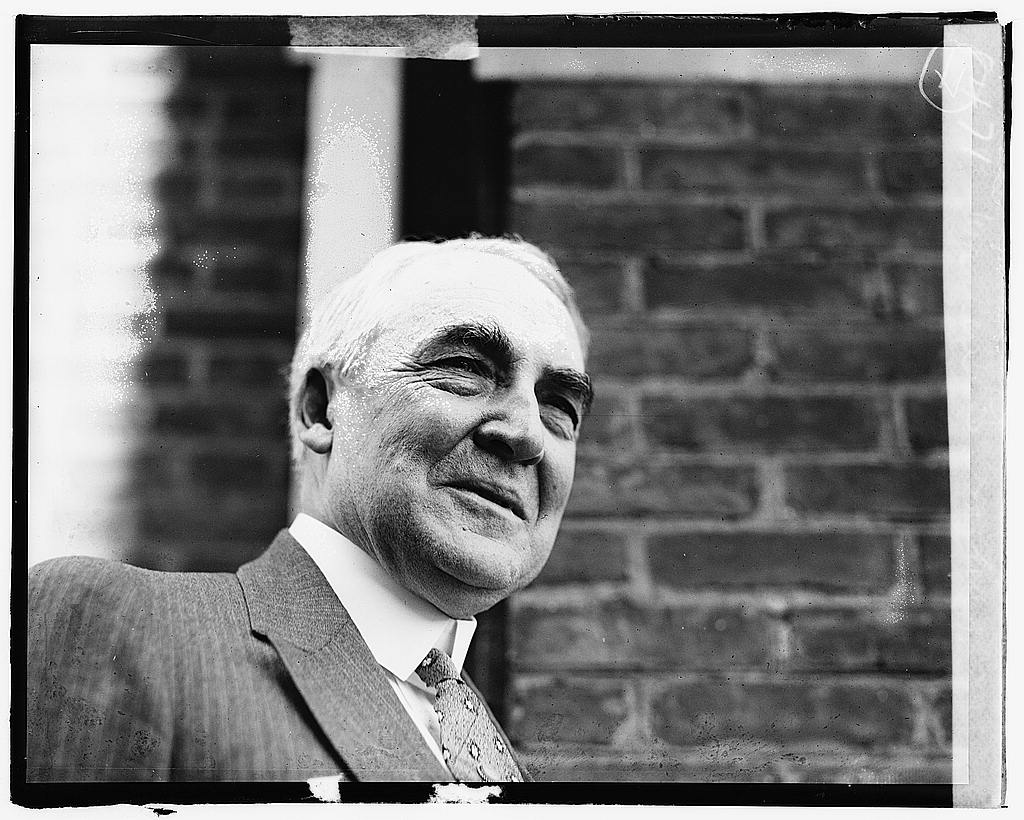
Warren G. Harding, 14 June 1920.
Library of Congress control number 2016828156
Routinely dismissed as a bad chief executive, Harding’s reputation is undergoing a long overdue renovation. The latest contribution in that regard is a new, must-read biography by Ryan S. Walters titled, The Jazz Age President. Read it, and you’ll forever be skeptical of the lazy, biased, conventional historians who worship power and those who wield it.
Warren Harding didn’t just tell audiences what they wanted to hear. He sometimes told them what they did not want to hear. He went to Birmingham, Alabama to condemn racism and Jim Crow laws, for example — a fact I’ve previously pointed out.
Conventional historians praise Presidents for the bills they signed into law but often it requires more courage and conviction to veto them. On that score too, Harding can be judged favorably. He vetoed six bills in the 2-1/2 years he served in the White House. None of the six was overridden. That may not sound like a lot but remember, his party controlled both houses by big majorities; Congress didn’t send him much it thought he wouldn’t sign.
Four bills Harding vetoed concerned minor issues and generated little attention, but one concerned a bonus for veterans of World War I. It stirred up quite a fuss. As the bill worked its way through the House and Senate, Harding gave ample warning that he wouldn’t even consider a bonus that wasn’t paid for. Congress ignored him and sent the bill to his desk. He rejected it, noting as follows:
In legislating for what is called adjusted compensation, Congress fails to provide the revenue from which the bestowal is to be paid. We have been driving in every direction to curtail our expenditures and establish economies without impairing the essentials of governmental activities. It has been a difficult and unpopular task. It is vastly more applauded to expend than to deny.
After the Civil War, Congress paid pensions to veterans of the conflict and their dependents. Sixty years later, in 1923, it sent a bill to Harding to grant pensions to women who married aging Civil War veterans long after the war. It even authorized higher payments to them than what recent widows of veterans in the war with Germany were getting. His veto message included this unassailable objection:
The compensation paid to the widows of World War veterans, those who shared the shock and sorrows of the conflict, amounts to $24 per month. It would be indefensible to insist on that limitation upon actual war widows if we are to pay $50 per month to widows who marry veterans 60 years after the Civil War.
Congress should have known better than to expect Harding to sign such bills. This was the same man who declared at his modest, unembellished inauguration that “Our most dangerous tendency is to expect too much of government”. He had expressed a desire to put “our public household in order”. He said he wanted “sanity” in economic policy, combined with “individual prudence and thrift, which are so essential to this trying hour and reassuring for the future”.
If somebody told me all that, I wouldn’t even think of asking him to approve a check for an able-bodied 30-year-old simply because she married an 80-year-old veteran.
This was the same Warren Harding, remember, who gave the country perhaps the best Treasury Secretary in its history, Andrew Mellon. According to historian Burton Folsom, Mellon slashed government expenses and eliminated an average of one Treasury staffer per day for every single day he held the office. Harding, Mellon and Calvin Coolidge (Harding’s successor), together with a friendly Congress, reduced the federal budget and cut the national debt by more than one-third.
Why Vampires Hate Garlic – A Transylvanian Recipe from 1580
Tasting History with Max Miller
Published 19 Oct 2021
(more…)
October 30, 2023
Halloween Special: Dracula
Overly Sarcastic Productions
Published 31 Oct 2016It’s creepy! It’s classic! It’s surprisingly infrequently read! It’s everyone’s favorite gothic horror, Bram Stoker’s Dracula!
Wanna bypass the intro? Skip straight to 3:16 and party on!
For those asking, the outro song is “I Love The Night” by Blue Oyster Cult.
(more…)
QotD: Study military history in hopes of avoiding future conflicts
Bret Devereaux, “Collections: Why Military History?”, A Collection of Unmitigated Pedantry, 2020-11-13.
October 29, 2023
The Battle of Leyte Gulf – WW2 – Week 270 – October 28, 1944
World War Two
Published 28 Oct 2023This is it — the big showdown between US and Japanese Navies, and the largest naval battle ever fought in terms of total tonnage. American landings on Leyte itself are still in progress, and the Soviets’ Debrecen Operation comes to its end.
(more…)
“Citizens of the World, Unite! You have nothing to lose but your illusions!”
Sarah Hoyt addresses the people who think of themselves not as Americans, Canadians, Brits, or Germans, but as “Citizens of the world”:

One of the funniest conceit of our age has to be the idea that the sophisticated and “bien pensant” are “citizens of the world”.
I was profoundly amused that Alvin Toffler fell for his in his last book I read sometime in the 90s. Keep in mind that, despite everything else, I believe his Future Shock is brilliant and explains a lot of life in the US in the last fifty years. (Note in the US. I’m not sure about the rest of the world. And I could explain why, but it would sidetrack us a lot more than this.) However the book about how the most powerful were the ones who had the most information (arguable) also pushed the “citizens of the world, not a country” thing as being the one for most powerful people.
I was amused because, though I agree this is the CONCEIT of most self-styled international elites, it is also in practicality, a load of stinking Hooey. (Or as we call it around here, #2 son’s pre-school teacher. Yes, that really was her last name.)
Part of the reason the “elites” believe themselves multinational or “citizens of the world” is oikophobia. They believe themselves to have risen above their co-citizens in their lands of origin, who are … well, in their minds, stupid and uneducated, which is a way to say “less rich” than the “elites”.
Therefore, in the same way that the nobility of old had more in common with other nobility from other lands than with their own country, they think they are a caste set aside and by reason of existing or having money inherently superior to all those who are loyal in and interested in their homelands.
Part of it is the belief that “nationalism” is bad and it led to WWI and WWII. Having been taught that (at this point it, drank it with mother’s milk) the richest and “best” (Most expensively) educated want to get as far away from that as possible, and be at a level when they’re free from that irrational passion, since it’s their conceit that they can rule “impartially” and from above for the good of all.
The problem with it is that not only is none of it true, but they are in fact both more provincial and less well educated than their countrymen. And also that what they aspire to is not only impossible, but really easy to manipulate.
So, the long war of the 20th century was not because of nationalism. In fact, the only explanation I have found for its being assumed to be so is that the international socialists who dominated intellectual discourse for the rest of the century despised the fact that, against their theory, workers of the world didn’t unite, but rather rallied to defend their homeland.
However, if you do a deep dive into the reasons for the first war, ignoring the opinions of those writing about it — which I did, because I was profoundly unsatisfied with the reasons given and none of it made sense — the war’s causation was attempts at internationalism. yes, the internationalism wasn’t of the “supra-national, pseudo worldwide” type (Actually the mask worn by Russian national imperialism) but of the “extended noble family trying to grab the entire world” type. But it was still internationalism, with all the problems of internationalism. (More on that later.)
And the current elites are not “better educated” and don’t rise above much of anything. In fact the world-renowned establishments most of them attend take so many “legacy” and “endowed an entire specialty” students, not to mention “admitted because diversity of skin color or origin” that their meritocratic requirements (I.E. knows or gives a damn about the subject), might be lower than your average state university. Also, once admitted, these people are guaranteed to graduate. Or at least will, barring some particularly egregious violation of code of “everybody knows”.
[…]
But more importantly, these “Citizens of the world” have no clue how their country is constituted, nor how many miles of miles and miles with the occasional house there are in this country. Or that each state has a different culture. Or –
In fact, these people who by and large don’t mix with local populations have a vague idea that the country has a lot more cities/apartments than it does, and that people act more compliant than they do. Because like Europeans, what they know about America is what they see in movies, not realizing movies are made by people like them and are feeding their assumptions back to them.
They also have a vague idea most of the country is easily led, because of course the only reason to disagree with them is that we’re being lied to by extremely persuasive evil people. (That it never occurs to them this might be happening to them, is a measure of [their] lack of self awareness.) Hence their reason to try to get Trump. Because without his evil persuasion, we’d be fully on board with their crazy-cakes insanity.
As for the European elites, I don’t know. I used to hobnob with them, in the sense that I tended to hobnob with the over-educated which were, definitionally, better off than I, but it’s been a minute. However, judging from that and what I see now, my belief is they’re not really “citizens of the world” so much as citizens of their homeland which they secretly believe should rule all nations due to the “nationality” — race/breed being obviously superior.
What I do know is that there is no such a thing as a citizen of the world, no matter the level of self delusion that induces people to believe they are such.
We are all members of our culture. While we can believe everything about our culture is bad and evil, we still project it on everything else we see. Therefore, you know, well to do Americans keep believing criminals and terrorists don’t really exist, and must be decent people driven to extremes by need or oppression. (The results of these beliefs would be hilarious, if they didn’t more or less break everything.) Heck, they keep believing the LAZY or lacking ambition don’t exist, and if people aren’t working hard to succeed it must be because of a terrible condition. (Look up “Bee sting” theory of poverty sometime.)
When the various international elites meet abroad, they each read in the other what they themselves would do, but don’t actually understand each other beyond vague fashion sense, and spending money like water.Ultimately their entire attempt to be “international” seems to consist of an idea that if they just become the people of the song “Imagine” and don’t believe in or care about anything, they can lead people better.
They are wrong because it’s not only impossible to divest yourself of all passion and interest (well, without offing yourself or doing a lot of drugs) but also because it’s impossible to totally divest yourself of your basic culture. (You can acculturate, but that involves a lot of work, and ACQUIRING another culture, which defeats their purpose. The “citizen of the world” culture doesn’t exist, beyond some shibboleths like “humans are killing the Earth” and “The proles are really stupid, eh?”). MORE IMPORTANTLY, even if they managed it, that wouldn’t make them impartial or able to lead anyone to utopia. What it would make them is very, very people-stupid and unable to realize why certain people do certain things, and others don’t. Or why certain countries are the way they are.
In fact, to the extent they’ve managed to shed their culture and replace it with Marxism, all they’ve done is become an unreasoning cult, unable to realize the population isn’t in fact exploding — because people lie in census, and so do nations — but also that there is not only no necessity but no benefit in “eating bugs”.
Architect Breaks Down 5 of the Most Common New York Apartments | Architectural Digest
Architectural Digest
Published 14 Jun 2022Michael Wyetzner of Michielli + Wyetzner Architects returns to AD, this time breaking down five of the most common apartment types found in New York City. From long and narrow railroad-style abodes to stately multi-level brownstones and everything in between, Michael gives expert insight on the many different places you can call home in the big apple.
(more…)
QotD: Leni Riefenstahl’s Triumph of the Will
Ah, if only it weren’t for that awkward patch …
In the 1930s, Fräulein Riefenstahl put her formidable film-making talents to the cause of the Third Reich, and, after attending the Reichsparteitag des Willens in 1934, produced one of the most remarkable films ever made: Triumph Of The Will.
Go back to that scuba-diving disembarkation scene in Ray Müller’s The Wonderful Horrible Life Of Leni Riefenstahl. In theory, it could all be a setup, and the participants chewed over how best to do it beforehand and did fifteen takes: anyone who’s worked in documentaries knows how phony the whole business is. But the point is it seems careless — as if it happened, and the camera happened to be there to record it.
There’s no sense of that in any frame of Triumph Of The Will. Granted that audiences were a lot less media savvy in 1934, and granted that a people dumb enough to fall for National Socialism will fall for anything, it’s still hard to believe that even in its day anyone accepted what remained Fräulein Riefenstahl’s official explanation to the end — that this was just a “documentary record” of the 1934 annual party convention. Early on, we see the Führer‘s motorcade driving through Nuremberg, with what seems like the entire citizenry jammed on to the streets to greet him. Riefenstahl’s camera shoots Hitler (if you’ll forgive the expression) from directly behind him, a sequence which for some reason always reminds me of Gore Vidal’s boast that only very famous people such as himself know what the back of their heads look like. There’s a fabulous moment when the great man — Adolf, not Gore — is responding to the Hitler salutes offered up by the crowds with his campy little elbow-bend and wrist-flip and, as his Mercedes moves forward, the sun catches his fingers and fills the palm, first bathing it in glory and then making it appear as if the Führer‘s hand is the very source of the sunlight itself. Did the director just get lucky? Did the sun just happen to hit? Seconds later, we cut to a long shot of Hitler in the Mercedes continuing down the street. There’s no camera in the car, although the scene we’ve just witnessed could only have been filmed by someone in the back seat. Another minute goes by, and we’re back to the close-up of the Führer‘s neck.
Did she stop the car, get out and film the long shot, and then get back in? Did Leni get Adolf to do re-takes? Or maybe she made the entire population of Nuremberg re-take the scene; maybe they staged the procession twice. If Hitler was unusually agreeable about taking direction, it was because this was never a filmed record of an event so much as an event created for the film. Whatever Triumph Of The Will is, it’s not a documentary. Its language is that of feature films — not Warner Brothers gangster movies or John Ford westerns, but rather the supersized genres, the epics and musicals where huge columns of the great unwieldy messy mass of humanity get tidied and organized — and, if that isn’t the essence of totalitarianism, what is? Riefenstahl has the same superb command of the crowd as Busby Berkeley, the same flair for human geometry (though Berkeley would have drawn the line at giving the gentlemen of the chorus as swishy a parade step as Hitler’s personal SS bodyguard do).
Mark Steyn, “Triumph of the Will”, SteynOnline, 2019-09-07.
October 28, 2023
Smith versus Smith: US Army/Marine relations in 1944
World War Two
Published 27 Oct 2023When Marine Corps General Holland “Howling Mad” Smith removed Infantry General Ralph Smith from command in 1944 during the Battle of Saipan, it began a controversy that soon snowballed, threatening to sabotage Army-Marine relations at a time when cooperation was the key to victory.
(more…)
The transition from burning wood to burning coal
The latest Age of Invention newsletter touches on some of the details Anton Howes uncovered while researching some work on commission for Britain’s NESTA (formerly the National Endowment for Science, Technology and the Arts):
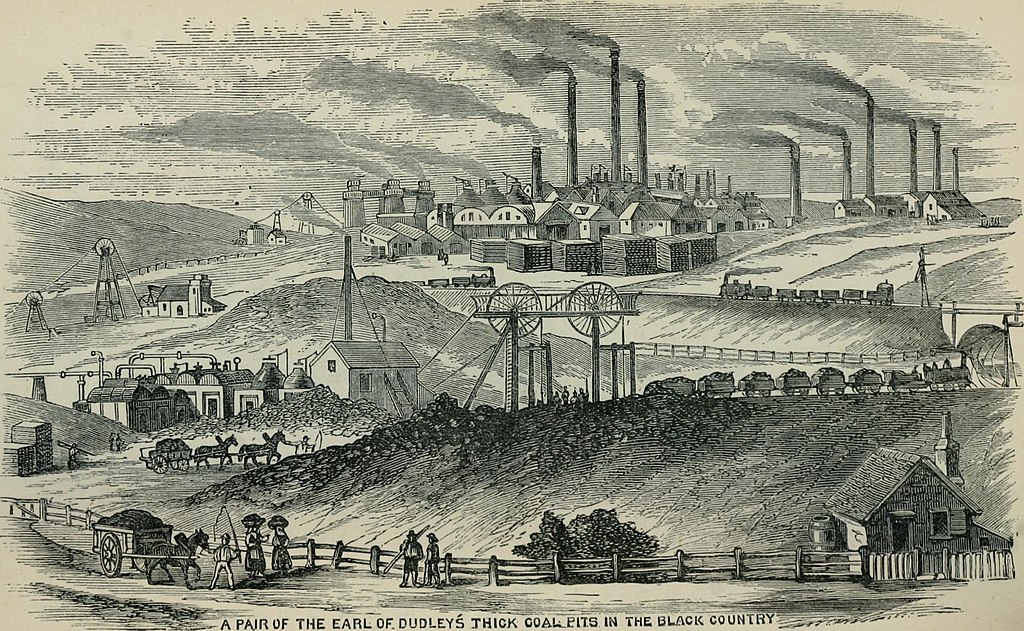
An image of coal pits in the Black Country from Griffiths’ Guide to the iron trade of Great Britain, 1873.
Image digitized by the Robarts Library of the University of Toronto via Wikimedia Commons.
Here are a few key things that I hadn’t really fully appreciated until undertaking this particular commission, though each has provided even more threads I still need to pull on:
ONE. The transition to coal was started by finding ways to exploit the lower-grade, cheaper and more sulphurous coals: initially by finding ways to burn it in people’s homes that would not leave everyone crying and coughing from the stinking fumes; and then with the expanded supply of even the lowest-grade coals making it cost-effective to do things like boil seawater in pans to make salt. The very lowest-grade coal was termed simply “pan coal”. While I’m pretty certain that these innovations were responsible for much of the rise of coal — coal-fuelled salt pans were even the foundation of the Scottish Lowlands economy going into the eighteenth century — the actual inventors involved are still a bit of a mystery. It’s something I need to return to, as “lots of anonymous people just invented through trial and error and adaptation” just doesn’t cut it for me — I’ve never found such stories to be true upon closer investigation.
TWO. Nobody ever talks about lime! Lime was one of the few things burnt with coal since ancient times, but largely to produce mortar for building. The increased availability of cheaper coal in the sixteenth century, however, meant that lime also soon found much wider use as a soil acidity regulator, as well as to control some pests and improve the absorption of fertilisers. It was especially favoured for sandy soils, allowing the conversion of barren heaths to agricultural land by increasing the soil’s water retention.
Yet lime is a huge blind spot for economic historians, despite it increasing the productivity of what was still by far the largest portion of the economy: agriculture. I have a rough and ready test of whether economic historians are paying enough attention to an industry, which is to look up the word in Stephen Broadberry et al.’s British Economic Growth 1270-1870, most scholars’ go-to resource on how historical British output is estimated. Lime is mentioned only once, and only as an input to the construction industry, for mortar. We should know more about lime’s impact.
THREE. Coal, through its various effects on agriculture, also led to an increase in the availability of grain, in turn leading to an abundance of muscle power. Horses were the literal workhorses of industrial cities, grinding the pigments for dyes and paints, tobacco for snuff, charred bones for shoe polish, tannin-rich oak bark for leather, flint for glass and ceramics, and grain for flour, beer, and spirits. Horses fulled cloth, pounded rags into paper, flatted metal into sheets, and bored pipes, guns and even cannon. And of course they powered the transportation infrastructure, hauling the waggons and barges laden with goods.
A theme I keep coming across when I do my research is that there was a lot of effort put into what we might call the “improvement of animals”. I’ve touched on this briefly before, but I get a sense that there’s a whole lot of iceberg lying in wait under the surface for me to uncover. It likely extended to dogs, for example, who like horses were also often used for mechanical tasks. Just yesterday, for example, I read an account by a visitor to 1630s Bristol mentioning how the roasting spits at its inns were driven by dogs in treadwheels. At some point I need to go through all this evidence I’ve inadvertently collected.
FOUR. The Dutch Republic’s Golden Age did not fail because it lacked energy sources. I had already suspected this, as it never rang true, but had not quite appreciated the extent of the evidence: the fairly rapid collapse of so many Dutch industries in the 1650s-80s was, if anything, accompanied by a super-abundance of energy. Both peat and grain were in fact cheaper than ever, largely as a result of plummeting demand. Even the products made using wind —such as the timber sawn for ships along the windy banks of the Zaan river — failed to survive the general collapse in demand.
If energy had been lacking, we would have expected the prices of peat and grain to have been at all-time highs, not in a slump. Indeed, the lack of demand for peat and grain, by sapping demand for infrastructure projects like bog drainage and canal-building, is what led to the re-flooding of much of the Dutch countryside. The causes of the collapse are still something of a mystery to me, but I now feel very confident in ruling the energy theory out.


