
Forgotten Weapons
Published 8 Sept 2014Today we’re looking at a pair of military survival rifles. One is a Luftwaffe M30 drilling — the most finely finished and luxurious survival rifle ever issued by a military force. The other is a US Air Force M6 survival gun — spartan and utilitarian — the polar opposite of the M30.
(more…)
November 10, 2023
Luftwaffe Drilling and US M6 Survival Rifle
Comments Off on Luftwaffe Drilling and US M6 Survival Rifle
QotD: Economic distortions of slavery in the Antebellum South
This notion that slavery somehow benefited the entire economy is a surprisingly common one and I want to briefly refute it. This is related to the ridiculously bad academic study (discussed here) that slave-harvested cotton accounted for nearly half of the US’s economic activity, when in fact the number was well under 10%. I assume that activists in support of reparations are using this argument to make the case that all Americans, not just slaveholders, benefited from slavery. But this simply is not the case.
At the end of the day, economies grow and become wealthier as labor and capital are employed more productively. Slavery does exactly the opposite.
Slaves are far less productive than free laborers. They have no incentive to do any more work than the absolute minimum to avoid punishment, and have zero incentive (and a number of disincentives) to use their brain to perform tasks more intelligently. So every slave is a potentially productive worker converted into an unproductive one. Thus, every dollar of capital invested in a slave was a dollar invested in reducing worker productivity.
As a bit of background, the US in the early 19th century had a resource profile opposite from the old country. In Europe, labor was over-abundant and land and resources like timber were scarce. In the US, land and resources were plentiful but labor was scarce. For landowners, it was really hard to get farm labor because everyone who came over here would quickly quit their job and headed out to the edge of settlement and grabbed some land to cultivate for themselves.
In this environment the market was sending pretty clear pricing signals — that it was simply not a good use of scarce labor resources to grow low margin crops on huge plantations requiring scores or hundreds of laborers. Slave-owners circumvented this pricing signal by finding workers they could force to work for free. Force was used to apply high-value labor to lower-value tasks. This does not create prosperity, it destroys it.
As a result, whereas $1000 invested in the North likely improved worker productivity, $1000 invested in the South destroyed it. The North poured capital into future prosperity. The South poured it into supporting a dead-end feudal plantation economy. As a result the south was impoverished for a century, really until northern companies began investing in the South after WWII. If slavery really made for so much of an abundance of opportunities, then why did very few immigrants in the 19th century go to the South? They went to the industrial northeast or (as did my grandparents) to the midwest. The US in the 19th century was prosperous despite slavery in the south, not because of it.
Warren Meyer, “Slavery Made the US Less Prosperous, Not More So”, Coyote Blog, 2019-07-12.
Comments Off on QotD: Economic distortions of slavery in the Antebellum South
November 9, 2023
Remembering Weimar
In The Critic, Darren O’Byrne reviews some recent books on German society between the Armistice of 1918 and the rise of Hitler, including Frank McDonough’s The Weimar Years: Rise and Fall 1918–1933.
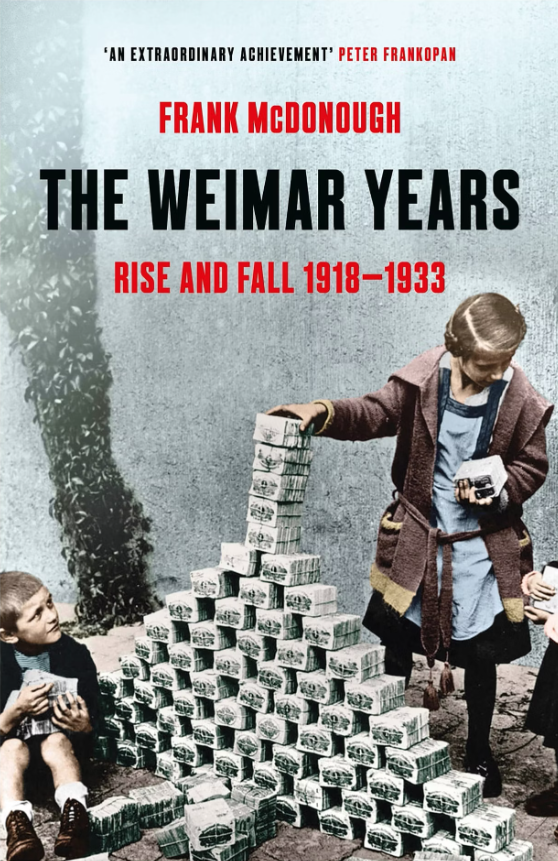
One of the latest additions to the canon is Frank McDonough’s The Weimar Years (1918–33). A prequel to his two-volume narrative history of the Third Reich, The Hitler Years, it sets out to explain the Nazis’ rise to power by examining the reasons why democracy failed in Germany. Like the earliest histories of the period, the Republic is not examined on its own terms but rather as a kind of backstory to what followed, the numerous crises that befell it being used to explain the ultimate catastrophe.
Structured chronologically, the book provides a devastating, play-by-play account of why, for McDonough, democracy stood little chance in Germany. Defeat in World War I, the Kaiser’s abdication and the humiliating terms of the Versailles treaties challenged the legitimacy of the Republic from the start, as did its failure to contain political violence. Crippling inflation and mounting government debt, exacerbated by the obligation to pay reparations to the Allies, hampered German economic recovery from the start and threatened to wipe out the middle classes.
A degree of economic stability did return in the mid-1920s, but the country experienced its second “once-in-a-lifetime” economic crisis in the early 1930s, causing further instability and ultimately paving the way for Hitler. It’s a well-known story, skilfully retold for a contemporary audience by one of the foremost authorities on modern German history.
Does McDonough tell us anything we didn’t already know? The answer, in short, is no. In comparison to other recent histories of the period, more attention is paid here to high politics than Weimar’s cultural achievements, which are mentioned, but this tends to disrupt the flow of what is otherwise a high-paced, edge-of-the-seat political history of Germany’s first democracy. Despite being nearly 600 pages in length, the book’s focus is quite narrow, with little attention paid to what was happening below the national level in the federal states.
This may seem like an inane criticism. Who, after all, would demand to read more about Buckinghamshire in a political history of interwar Britain? However, the Weimar Republic, like Germany today, was a federation. Understanding what was happening in states like Prussia, which contained three-fifths of Germany’s population, is crucial to understanding the country as a whole.
Indeed, McDonough places some of the blame for Weimar’s collapse on the Social Democrats, who he argues should have participated in more national governments. Prussia was governed by an SPD-led coalition for most of the Weimar years, though, yet the Republic still fell. McDonough sees another reason for this fall in the failure to purge the military and civil service of hostile elements.
Again, Prussia replaced a considerable number of these officials with others loyal to the new democratic order, yet the Republic still fell. The book’s rigid focus on high politics, in short, obscures an understanding of the more structural reasons why democracy failed.
Unlike most history books, however, The Weimar Years is a genuine page-turner, full of lessons for those who want to learn something about the present from the past. It’s also a beautiful book to hold, full of period photos that help bring the story alive. This all makes the book worth reading, even if there’s not much in it that can’t be found in other histories of the period.
Comments Off on Remembering Weimar
Defending a stateless society: the Estonian way
David Friedman responded to a criticism of his views from Brad DeLong. Unfortunately, the criticism was written about a decade before David saw it, so he posted his response on his own Substack instead:

English version of the Estonian Defence League’s home page as of 2023-11-08.
https://www.kaitseliit.ee/en
Back in 2013 I came across a piece by Brad DeLong critical of my views. It argued that there were good reasons why anarcho-capitalist ideas did not appear until the nineteenth century, reasons illustrated by how badly a stateless society had worked in the Highlands of Scotland in the 17th century. I wrote a response and posted it to his blog, then waited for it to appear.
I eventually discovered what I should have realized earlier — that his post had been made nine years earlier. It is not surprising that my comment did not appear. The issues are no less interesting now than they were then, so here is my response:
Your argument rejecting a stateless order on the evidence of the Scottish Highlands is no more convincing than would be a similar argument claiming that Nazi Germany or Pol Pot’s Cambodia shows how bad a society where law is enforced by the state must be. The existence of societies without state law enforcement that work badly — I do not know enough about the Scottish Highlands to judge how accurate your account is — is no more evidence against anarchy than the existence of societies with state law enforcement that work badly is against the alternative to anarchy.
To make your case, you have to show that societies without state law enforcement have consistently worked worse than otherwise similar societies with it. For a little evidence against that claim I offer the contrast between Iceland and Norway in the tenth and eleventh centuries or northern Somalia pre-1960 when, despite some intervention by the British, it was in essence a stateless society, and the situation in the same areas after the British and Italians set up the nation of Somalia, imposing a nation state on a stateless society. You can find short accounts of both those cases, as well as references and a more general discussion of historical feud societies, in my Legal Systems Very Different From Ours. A late draft is webbed.
So far as the claim that the idea of societies where law enforcement is private is a recent invention, that is almost the opposite of the truth. The nation state as we know it today is a relatively recent development. For historical evidence, I recommend Seeing Like a State by James Scott, who offers a perceptive account of the ways in which societies had to be changed in order that states could rule them.
As best I can tell, most existing legal systems developed out of systems where law enforcement was private — whether, as you would presumably argue, improving on those systems or not is hard to tell. That is clearly true of, at least, Anglo-American common law, Jewish law and Islamic law, and I think Roman law as well. For details again see my book.
In which context, I am curious as to whether you regard yourself as a believer in the Whig theory of history, which views it as a story of continual progress, implying that “institutions A were replaced by institutions B” can be taken as clear evidence of the superiority of the latter.
And From the Real World
In chapter 56 of the third edition of The Machinery of Freedom I discussed how a stateless society might defend against an aggressive state, which I regard as the hardest problem for such a society. One of the possibilities I raise is having people voluntarily train and equip themselves for warfare for the fun (and patriotism) of it, as people now engage in paintball, medieval combat in the Society for Creative Anachronism, and various other military hobbies.
A correspondent sent me a real world example of that approach — the Estonian Defense League, civilian volunteers trained in the skills of insurgency. They refer to it as “military sport”. Competitions almost every week.
Estonia’s army of 6000 would not have much chance against a Russian invasion but the Estonians believe, with the examples of Iraq and Afghanistan in mind, that a large number of trained and armed insurgents could make an invasion expensive. The underlying principle, reflected in a Poul Anderson science fiction story1 and one of my small collection of economics jokes,2 is that to stop someone from doing something you do not have to make it impossible, just unprofitable. You can leverage his rationality.
Estonia has a population of 1.3 million. The league has 16,000 volunteers. Scale the number up to the population of the U.S. and you get a militia of about four million, roughly twice the manpower of the U.S. armed forces, active and reserve combined. The League is considered within the area of government of the Ministry of Defense, which presumably provides its weaponry; in an anarchist equivalent the volunteers would have to provide their own or get them by voluntary donation. But the largest cost, the labor, would be free.
Switzerland has a much larger military, staffed by universal compulsory service, but there are also private military associations that conduct voluntary training in between required military drills. Members pay a small fee that helps fund the association and use their issued arms and equipment for the drills.
1. The story is “Margin of Profit“. I discuss it in an essay for a work in progress, a book or web page containing works of short literature with interesting economics in them.
2. Two men encountered a hungry bear. One turned to run. “It’s hopeless,” the other told him, “you can’t outrun a bear.” “No,” he replied, “But I might be able to outrun you.”
QotD: The end of the “spoils system” and the professionalization of the bureaucracy
I know, that seems weird, but unless you’ve really studied this stuff — it’s not taught in most high school or even college classes, for some mysterious reason — you probably don’t know that the civil service used to be entirely patronage-based. Our two most famous literary customs inspectors, for instance (Hawthorne and Melville), got their jobs through political connections, and that’s the way it worked for everyone — every time the other party won an election, most of the bureaucrats got turfed out, to be replaced by loyal party men. Trust me: very few of the names on this list would ring much of a bell even to field specialists, but they were big political cheeses in their day; Postmaster General was a plum federal post that was often handed to loyal Party men as a reward for a lifetime of faithful service. And so on down the line, including your local postmaster.
It took until 1883 to finally kill of this last vestige of federalism, but the Pendleton Act did it. Here again, this isn’t taught in school for some mysterious reason, but the political class took a very different lesson from the Civil War than the hoi polloi. While for the proles the Civil War was presented as a triumph of the common man, the elite understood that it was training, logistics, bureaucratization, professionalism that won the war for the Union. The Republicans made a big show of putting up U.S. Grant as “the Galena Tanner” in their campaign rhetoric but Grant had been a bankrupt tanner, and indeed a conspicuous failure at everything except war … and even there, his record was carefully doctored to present an image of a bumbling amateur suddenly being struck by inspiration, when in fact Grant was a West Pointer with an impressive combat record in the Mexican War. Now is not the time or place to discuss the merits, or not, of various Civil War figures, so just go with me on this: Pretty much all the big name generals on both sides of the war were presented to the public as talented gentleman amateurs, and it was heavily insinuated that the ones they couldn’t so portray — McClellan, and especially Robert E. Lee — lost because they were too hidebound, too “professional”.
The reality is almost the complete opposite — yeah, Stonewall Jackson ended the Mexican War as a mere captain (no mean feat in The Old Army, but whatever), but he had a tremendous combat record, and was so much of a military professional that he actually taught at a military academy. This is not to say there weren’t naive geniuses in the Civil War — see e.g. Nathan Bedford Forrest — but the Civil War, like all wars since the invention of the arquebus, was won by hardcore, long-service, well-trained professionals. A naive genius like Forrest might’ve been a better tactician, mano-a-mano and in a vacuum, than a West Point professional like Custer — then again, maybe not — but wars aren’t fought in vacuums. They’re fought on battlefields, and they’re won by supply weenies and staff pogues.
[…]
They took that experience with them into politics, and so it’s no surprise that the Federal government of the Gilded Age, though tiny by our standards, grew into such a leviathan in so short a time. Again, I’m just going to have to ask you to trust me on this, since for some reason it never gets covered in school, but back in the later 19th century words like “efficiency” really meant something to the political class. All those politician-generals (and politician-colonels and politician-majors and all the rest down at the local level) expected the State to function like the Army — that is to say, as a self-enclosed world where efficiency not only counts, but triumphs. An amateur civil service can’t do that, and so the days of the political sinecure had to end.
Severian, “Real Federalism Has Never Been Tried”, Rotten Chestnuts, 2021-05-03.
Comments Off on QotD: The end of the “spoils system” and the professionalization of the bureaucracy
November 8, 2023
Sampling the alternate history field
Jane Psmith confesses a weakness for a certain kind of speculative fiction and recommends some works in that field. The three here are also among my favourites, so I can comfortably agree with the choices:
As I’ve written before, I am an absolute sucker for alternate history. Unfortunately, though, most of it is not very good, even by the standards of genre fiction’s transparent prose. Its attraction is really the idea, with all its surprising facets, and means the best examples are typically the ones where the idea is so good — the unexpected ramifications so startling at the moment but so obvious in retrospect — that you can forgive the cardboard characters and lackluster prose.
But, what the heck, I’m feeling self-indulgent, so here are some of my favorites.
- Island in the Sea of Time et seq., by S.M. Stirling: This is my very favorite. The premise is quite simple: the island of Nantucket is inexplicably sent back in time to 1250 BC. Luckily, a Coast Guard sailing ship happens to be visiting, so they’re able to sail to Britain and trade for grain to survive the winter while they bootstrap industrial civilization on the thinly-inhabited coast of North America. Of course, it’s not that simple: the inhabitants of the Bronze Age have obvious and remarkably plausible reactions to the sudden appearance of strangers with superior technology, a renegade sailor steals one of the Nantucketers’ ships and sets off to carve his own empire from the past, and the Americans are thrust into Bronze Age geopolitics as they attempt to thwart him. The “good guys” are frankly pretty boring, in a late 90s multicultural neoliberal kind of way — the captain of the Coast Guard ship is a black lesbian and you can practically see Stirling clapping himself on the back for Representation — but the villainous Coast Guardsmen and (especially) the natives of 1250 BC get a far more complex and interesting portrayal.1 Two of them are particularly well-drawn: a fictional trader of the thinly attested Iberian city-state of Tartessos, and an Achaean nobleman named Odikweos, both of whom are thoroughly understandable and sympathetic while remaining distinctly unmodern. The Nantucketers, with their technological innovations and American values, provide plenty of contrast, but Stirling is really at his best in using them to highlight the alien past.
- Lest Darkness Fall, by L. Sprague de Camp: An absolute classic of the genre. I may not love what de Camp did with Conan, but the man could write! One of the great things about old books (this one is from 1939) is that they don’t waste time on technobabble to justify the silly parts: about two pages into the story, American archaeologist Martin Padway is struck by lightning while visiting Rome and transported back in time to 535 AD. How? Shut up, that’s how, and instead pay attention as Padway introduces distilled liquor, double-entry bookkeeping, yellow journalism, and the telegraph before taking advantage of his encyclopedic knowledge of Procopius’s De Bello Gothico to stabilize and defend the Italo-Gothic kingdom, wrest Belisarius’s loyalty away from Justinian, and entirely forestall the Dark Ages. If this sounds an awful lot like the imaginary book I described in my review of The Knowledge: yes. The combination of high agency history rerouting and total worldview disconnect — there’s a very funny barfight about Christology early on, and later some severe culture clash that interferes with a royal marriage — is charming. Also, this was the book that inspired Harry Turtledove not only to become an alt-history writer but to get a Ph.D. in Byzantine history.
[…]
- Ruled Britannia, by Harry Turtledove: Turtledove is by far the most famous and successful alternate history author out there, with lots of short pieces and novels ranging from “Byzantine intrigue in a world where Islam never existed” (Agent of Byzantium) to “time-travelling neo-Nazis bring AK-47s to the Confederacy” (The Guns of the South), but this is the only one of his books I’ve ever been tempted to re-read. The jumping-off point, “the Spanish Armada succeeded”, is fairly common for the genre2 — the pretty good Times Without Number and the lousy Pavane (hey, did you know the Church hates and fears technology?!) both start from there — but Turtledove fasts forward only a decade to show us William Shakespeare at the fulcrum of history. A loyalist faction (starring real life Elizabethan intriguers like Nicholas Skeres) wants him to write a play about Boudicca to inflame the population to free Queen Elizabeth from her imprisonment in the Tower of London, while the Spanish authorities (represented, hilariously, by playwright manqué Lope de Vega) want him to write one glorifying the late Philip II and the conquest of England. Turtledove does a surprisingly good job inventing new Shakespeare plays from snippets of real ones and from John Fletcher’s 1613 Bonduca, but of course I’m most taken by his rendition of the Tudor world. Maybe I should check out some of his straight historical fiction …
1. Well, except for the peaceful matriarchal Marija Gimbutas-y “Earth People” being displaced from Britain by the invading Proto-Celts; they’re also “good guys” and therefore, sadly, boring.
2. Not as common as “the Nazis won”, obviously.
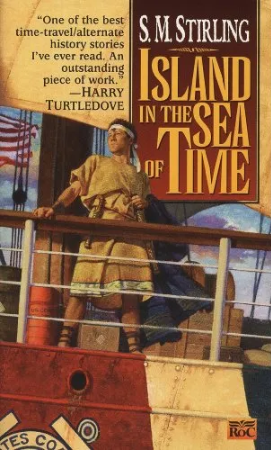
I agree with Jane about Island in the Sea of Time, but my son and daughter-in-law strongly preferred the other series Stirling wrote from the same start point: what happened to the world left behind when Nantucket Island got scooped out of our timeline and dumped back into the pre-collapse Bronze Age. Whereas ISOT has minimal supernatural elements to the story, the “Emberverse” series beginning with Dies the Fire went on for many, many more books and had much more witchy woo-woo stuff front-and-centre rather than marginal and de-emphasized.
While I quite enjoyed Ruled Britannia, it was the first Turtledove series I encountered that I’ve gone back to re-read: The Lost Legion … well, the first four books, anyway. He wrote several more books in that same world, but having wrapped up the storyline for the Legion’s main characters, I didn’t find the others as interesting.
Comments Off on Sampling the alternate history field
November 7, 2023
Swiss Tankbuchse 41 Semi-automatic Antitank Rifle
Forgotten Weapons
Published 29 Oct 2018Originally developed for use in light tanks purchased from Czechoslovakia, the Tankbuchse 41 was a 24x139mm semi-automatic rifle designed by Adolph Furrer of the Waffenfabrik Bern factory. Furrer was also responsible for the LMG-25 and MP41/44 used by the Swiss, and with the TB-41 he once again used the operating system he was most familiar with: a short recoil toggle-locked action. The gun was ready and adopted in 1941, and a total of 3,581 were produced, used in light tanks, lake patrol boats, fortifications, and on wheeled carriages by the infantry.
High explosive and armor piercing projectiles were made, both weighing 3475 grains (225g) and with muzzle velocities between 2800 and 2950 fps (860-900 fps). The armor piercing round could perforate 30cm of perpendicular armor plate at 500m — more than most other contemporary antitank rifles. Designed specifically for rapid fire, the gun fed from six-round magazines, and automatically ejected the magazine when the last round was chambered, so that the crew could reload it without having to run the crank handle. The guns never saw combat use, and by the end of World War Two were being pulled back out of inventory and relegated primarily to fortress use.
(more…)
Comments Off on Swiss Tankbuchse 41 Semi-automatic Antitank Rifle
QotD: As we all know, medieval peasants wore ill-fitting clothes of grey and brown, exclusively
What we see in ancient and medieval artwork is that even the lower classes of society wore clothes that were bleached or dyed, often in bright, bold colors (in as much as dyes were available). At Rome, this extended even to enslaved persons; Seneca’s comment that legislation mandating a “uniform” for enslaved persons at Rome was abandoned for fear that they might realize their numbers, the clear implication being that it was often impossible to tell an enslaved person apart from a free person on the street in normal conditions (Sen. Clem. 1.24.1). Consequently, fulling and dyeing was not merely a process for the extremely wealthy, but an important step in the textiles that would have been worn even by every-day people.
That said, fulling and dyeing (though not bleaching) were fundamentally different from the tasks that we’ve discussed so far because they generally could not be done in the home. Instead they often required space, special tools and equipment and particular (often quite bad smelling) chemicals and specialized skills in order to practice. Consequently, these tasks tended to be done by specialist workers for whom textile production was a trade, rather than merely a household task.
Bret Devereaux, “Collections: Clothing, How Did They Make It? Part IVa: Dyed in the Wool”, A Collection of Unmitigated Pedantry, 2021-04-02.
November 6, 2023
The Army Door Knocker | Pak 35/36 | Anti-Tank Chats
The Tank Museum
Published 14 Jul 2023In this video, we look at the Pak 35/36, the German Army’s first anti-tank gun. Obsolete by 1941, it picked up the nickname Heeresanklopfgerat – the army door knocker – after its inability to penetrate tank armour. In spite of this, it carried on in service until 1945. Chris Copson talks you through the gun and its history.
(more…)
Comments Off on The Army Door Knocker | Pak 35/36 | Anti-Tank Chats
QotD: The “German Catastrophe”
Germany had entered modernity without democracy. The Kaiserreich (German Empire) had united the many small German states, aggressively worked to catch up with industrialization, built a state to rival France and Great Britain, and remained authoritarian throughout. Commoners had negligible political influence. They did get social insurance, but not through their own political power but granted top-down, as an appeasement to undermine socialist movements. Civil marriage, secularized state education, prospering state universities and a long series of modernizing laws kept increasing state power. And that meant executive power. There were parties, a parliament and a newly homogenized judiciary, but they had little power to check the executive.
And this entire development was accompanied by a lot of theorizing about this new German nation. Much of this theorizing ended up justifying authoritarianism, by making quickly-spreading myths about how obedience to authority, respect for aristocracy and love for tradition were uniquely German traits that set Germans apart from the French and the Jews and other dubious foreigners. Such myths, and opposition to them, colored the German population’s hard work to get accustomed to industrialization, urbanization, education, rapid population growth, militarization, national media and various culture wars.
This had seemed to work okay-ish while Bismarck, wielding both enormous ruthlessness and enormous political acumen, had navigated Germany through the trials and tribulations of the late 19th century, largely at the expense of France. But in 1890, Emperor Wilhelm II had taken over authority with less ruthlessness and much less political acumen. While his populace remained nearly unable to influence politics, Wilhelm II made critical political mistakes, especially in dealing with other European powers.
These mistakes culminated in the first World War. You know how that one went.
Germany’s defeat led into Germany’s first real democracy. Everyone was very obviously new to this. The right attacked the new state, falsely claiming it had needlessly capitulated. The left also attacked the new state, because it wasn’t Soviet-Union-like enough. There was a lot of political violence. The massive damage incurred in the war, and the restrictions and reparations Germany had accepted in the peace settlement, put massive strains on an already fragile political system. Elections were tumultuous and frequent. Hyperinflation caused a huge crisis in 1923, and the Great Depression of 1929 was another huge disaster for Germany. Overall, the abolition of authoritarianism was widely felt to be a mistake.
This seeming mistake was fixed when Hitler stepped in. And you know how that one went.
Anonymous, “Your Book Review: On the Marble Cliffs”, Astral Codex Ten, 2023-07-28.
Comments Off on QotD: The “German Catastrophe”
November 5, 2023
Hugo Chávez
The most recent entry in the Dictator Book Club at Astral Codex Ten looks at former Venezuelan President Hugo Chávez:

Former Venezuelan President Hugo Chávez.
Photo by Roberto stuckert Filho/PR via Wikimedia Commons.
All dictators get their start by discovering some loophole in the democratic process. Xi realized that control of corruption investigations let him imprison anyone he wanted. Erdogan realized that EU accession talks provided the perfect cover to retool Turkish institutions in his own image.
Hugo Chavez realized that there’s no technical limit on how often you can invoke the emergency broadcast system. You can do it every day! The “emergency” can be that you had a cool new thought about the true meaning of socialism. Or that you’re opening a new hospital and it makes a good photo op. Or that opposition media is saying something mean about you, and you’d like to prevent anyone from watching that particular channel (which is conveniently bound by law to air emergency broadcasts whenever they occur).
This might not be the only reason or even the main reason Hugo Chavez ended up as dictator. But it’s a very representative reason. If Putin is basically a spook and Modi is basically an ascetic, Hugo Chavez was basically a showman. He could keep everyone’s attention on him all the time (the emergency broadcast system didn’t hurt). And once their attention was on him, he could delight them, enrage them, or at least keep them engaged. And he never stopped. Hugo Chavez was the marathon runner of dictators.
He was on television almost every day for hours at a time, invariably live, with no script or teleprompter, mulling, musing, deciding, ordering. His word was de facto law, and he specialised in unpredictable announcements: nationalisations, referenda, troop mobilizations, cabinet shuffles. You watched not just for news value. The man was a consummate performer. He would sing, dance, rap; ride a horse, a tank, a bicycle; aim a rifle, cradle a child, scowl, blow kisses; act the fool, the statesman, the patriarch. There was a freewheeling, improvised air to it all. Suspense came from not knowing what would happen.
There would be no warning. Soap operas, films, and baseball games would dissolve and be replaced by the familiar face seated behind a desk or maybe the wheel of a tractor … it could [last] minutes or hours. Sometimes Chavez wouldn’t be talking, merely attending a ceremony … One time Chavez decided to personally operate a machine on the Caracas-to-Charallave rail tunnel. A television and radio announcer improvised commentary for the first few minutes, but gradually ran out of things to say as the president continued drilling, drilling, drilling. Radio listeners, blind to Chavez pounding away, were baffled and then alarmed by the mechanical roar monopolizing the airwaves. Some thought it signaled a coup.
In 2012, while he was dying of cancer, Chavez gave “a state of the nation address lasting nine and a half hours. A record. No break, no pause.” Put a TV camera in front of him, and the man was a machine.
If he had been an ordinary celebrity, he would be remembered as a legend. But he went too far. He became his TV show. He optimized national policy for ratings. The book goes into detail on one broadcast in particular, where he was filmed walking down Venezuela’s central square, talking to friends. He remarked on how the square needed more monuments to glorious heroes. But where could he put them? The camera shifted to a mall selling luxury goods. A lightbulb went on over the dictator’s head: they could expropriate the property of the rich capitalist elites who owned the mall, and build the monument there. Make it so! Had this been planned, or was it really a momentary whim? Nobody knew.
Then he would move on to some other topic. An ordinary citizen would call in and describe a problem. Chavez would be outraged, and immediately declare a law which solved that problem in the most extreme possible way. Was this staged? Was it a law he had been considering anyway? Again, hard to tell.
Sometimes everyone in government would ignore his decisions to see if he forgot about them. Sometimes he did. Other times he didn’t, and would demand they be implemented immediately. Nobody ever had a followup plan. They expropriated the mall, but Chavez’s train of thought had already moved on, and nobody had budgeted for the glorious monuments he had promised. The mall sat empty; it became a dilapidated eyesore. Laws declared on the spur of the moment to sound maximally sympathetic to one person’s specific problem do not, when combined into a legal system, form a great basis for governing a country.
But Chavez TV was also a game show. The contestants were government ministers. The prize was not getting fired. Offenses included speaking out against Chavez:
Chavez clashed with and fired all his ministers at one time or another but forgave and reinstated his favorites. Nine finance ministers fell in succession … it was palace custom not to give reasons for axing. Chavez, or his private secretary, would phone the marked one to say thank you but your services are no longer required. Good-bye. The victim was left guessing. Did someone whisper to the comandante? Who? Richard Canan, a young, rising commerce minister, was fired after telling an internal party meeting that the government was not building enough houses. Ramon Carrizales was fired as vice president after privately complaining about Cuban influence. Whatever the cause, once the axe fell, expulsion was immediate. The shock was disorienting. Ministers who used to bark commands and barge through doors seemed to physically shrink after being ousted … they haunted former colleagues at their homes, seeking advice and solace, petitioning for a way back to the palace. “Amigo, can you have a word with the chief?” One minister, one of Chavez’s favorites, laughed when he recounted this pitiful lobbying. “They know it as well as I do. In [this government] there are no amigos.”
… or taking any independent action:
[A minister] was not supposed to suggest an initiative, solve a problem, announce good news, theorise about the revolution, or express an original opinion. These were tasks for the comandante. His fickleness encouraged ministers to defer implementation until they were certain of his wishes. In any case they spent so much time on stages applauding — it was unwise to skip protocol events — that there was little opportunity for initiative. Thus the oil minister Rafael Ramirez would lurk, barely visible, while the comandante signed a lucrative deal with Chevron […]
But upon command, the stone would transform into a whirling dervish … the comandante‘s impulsiveness demanded instant, urgent responses. He would become consumed by a theme. Rice! Increase rice production! The order would ricochet through [the government]. The agriculture, planning, transport, commerce, finance, and infrastructure ministers would work around the clock devising a scheme or credits, loans, cooperatives, mills and trucks to have it ready, at least on paper, for the comandante to unveil on his Sunday show. Thus was born the Mixed Company for Socialist Rice. Then, the next week, chicken! Cheaper chicken! The same ministers would forget about rice while they rushed to squeeze farmers, truckers, and supermarkets so that the comandante could say, on his next show, that chicken was cheaper.
… or, worst of all, not enjoying Chavez’s TV shows enough:
[Ministers had to] arrange their features into appropriate expressions when on camera or in the comandante‘s sight line. This was tricky when the comandante did something foolish or bizarre because the required response could contradict instinct … Missing a cue could be fatal. During a show the comandante‘s laser-beam gaze swung from face to face, spotlighting expressions, seeking telltale tics. Immediately after a broadcast, Chavez reviewed the footage, casting a professional eye over the staging, lighting, camera angles — and audience reaction.
The comandante‘s occasional lapses into ridiculous were inevitable. He spoke up to nine hours at a time live on television, without a script … Being capricious and clownish also sustained interest in the show and underlined his authority. No other government figure, after all, dared show humour in public. But on occasion this dissolved into absurdity. Who tells a king he is being a fool?
Ministers faced another test of the mask in September 2007, when the comandante announced clocks would go back half an hour. The aim was to let children and workers wake up in daylight, he said. “I don’t care if they call me crazy, the new time will go ahead, let them call me whatever they want. I’m not to blame. I received a recommendation and said I liked the idea.” Chavez wanted it implemented within a week — causing needless chaos — and bungled the explanation, saying clocks should go forward rather than back. If ministers realized the mistake, they said nothing, only smiled and clapped […]
On rare occasions the correct response was not obvious, sowing panic. In a speech to mark World Water Day in 2011, the comandante said capitalism may have killed life on Mars. “I have always said, heard, that it would not be strange that there had been civilisation on Mars, but maybe capitalism arrived there, imperialism arrived and finished off the planet.” Some in the audience tittered, assuming it was a joke, then froze when they saw neighbors turned to stone. To these audience veterans it was unclear if it was a joke, so they adopted poker faces, pending clarification. It never came; the comandante moved on to other topics.
How did a once-great nation reach this point? I read Rory Carroll’s Comandante to find out.
Comments Off on Hugo Chávez
Guy Fawkes and The Gunpowder Plot 1605
The History Chap
Published 4 Nov 2022The story behind Guy Fawkes and the Gunpowder Plot, the audacious plan to kill the king of England. It is also the complicated story behind our annual Bonfire Night celebrations.
In 1605 a group of dissident Catholics came within a whisker of one of the greatest assassination coups in history — blowing up the King of England, and his government as he attended parliament in London. 36 barrels of gunpowder (approximately 1 tonne of explosives) had been placed directly under where he would open parliament. Experts estimate that no one within 300 feet would have survived.
Had it succeeded it would have rivalled 9/11 in its audacity and would have changed English (& arguably world) history forever. But who were the plotters, what were they trying to achieve and how close did they really come to success? Were they freedom fighters or 17th century terrorists? And why is only one conspirator, Guy Fawkes, remembered when he wasn’t even the brains behind the operation?
After years of persecution by England’s Protestants, a small group of Catholic nobles under Robert Catesby (aka Robin Catesby) decided to take matters into their own hands and blow up the king (King James I of England / James VI of Scotland) whilst he attended parliament in London.
Guy Fawkes (aka Guido Fawkes) smuggled 36 barrels of gunpowder into a cellar directly beneath the hall where parliament would meet in the Palace of Westminster. In the early hours of 5th November 1605, he was arrested by guards who had been tipped off about the gunpowder plot. After three days of torture in the Tower of London, Guy Fawkes finally broke and named his fellow conspirators.
The conspirators, under Robert Catesby, had fled London for the English midlands where they hoped to abduct the king’s daughter and organise a catholic rising. Both failed to materialise and Catesby’s small band were surrounded by a government militia at Holbeach House, just outside Kingswinford in Staffordshire. A brief shoot-out resulted in the death of some of the Catholic rebels (including their leader, Catesby) and the arrest of the others.
The surviving gunpowder plotters (including Guy Fawkes) were executed in London at the end of January 1606, by the grisly execution reserved for traitors — Hanged, drawn and quartered (quite literally a “living death”).
The Gunpowder Plot of 1605 was a complete failure but the event is still celebrated on the 5th November every year on Bonfire Night.
(more…)
QotD: The Auftragstaktik principle of the Third Reich
Obviously civilian life isn’t as goal-directed as the military in wartime, but a similar principle applied — given a vague set of generalized objectives from the top (Kershaw’s famous “working towards the Führer” thesis), everyone at every level was encouraged to move the ball downfield as he saw fit … with the added twist that, in the absence of a clearly defined, military-style chain of command, the various “subordinates” would ruthlessly battle it out with each other, Darwin-style, for bureaucratic supremacy.
Thus the Nazis’ infamous plate-of-spaghetti org charts. I’m not an expert, but I’m pretty sure there were more than a few guys who held wildly different ranks in various different organizations simultaneously. He might be a mere patrolman in the Order Police, but an officer in the SS, a noncom in the SA (you could be in both, at least in the early days), and so forth. I wouldn’t be surprised if there was more than one guy who technically reported to himself, somewhere deep in the bowels of the RHSA [Reich Security Main Office]. You could spend a lifetime trying to sort this stuff out …
Severian, “The Crisis of the Third Decade”, Rotten Chestnuts, 2021-03-18.
Comments Off on QotD: The Auftragstaktik principle of the Third Reich
November 4, 2023
MKb-42(H) Assault Rifle with ZF-41 scope
Forgotten Weapons
Published 31 Aug 2014The MKb-42(H), or Maschinenkarabiner-42 (Haenel), was the first production iteration of the German Sturmgewehr. It was chambered for the then-new 8x33mm kurz cartridge, and fired both semiauto and full-auto from an open bolt. Approximately 11,000 of these were made before production changed to the closed-bolt MP43.
(more…)
Comments Off on MKb-42(H) Assault Rifle with ZF-41 scope
November 3, 2023
Understanding Combined Arms Warfare
Army University Press
Published 24 Mar 2023Designed to support the U.S. Army Captains Career Course, “Understanding Combined Arms Warfare” defines and outlines the important aspects of modern combined arms operations. This is not a complete history of combined arms warfare. It is intended to highlight the most important aspects of the subject.
The beginning of the documentary establishes a common understanding of combined arms warfare by discussing doctrinal and equipment developments in World War I. The second part compares the development of French and German Army mechanization during the interwar period and describes how each country fared during the Battle of France in 1940. The film concludes by showing how the United States applied combined arms operations in the European Theater in World War II.
(more…)
Comments Off on Understanding Combined Arms Warfare


