
… the discovery by the Mail on Sunday that Enid Blyton — one of Britain’s most enduringly popular and influential children’s authors, creator of Noddy and the Famous Five series — was denied a commemorative 50p coin on the 50th anniversary of her death because a Royal Mint “advisory committee” declared that “she is known to have been a racist, sexist, homophobe and not a very well-regarded writer”.
Enid Blyton was born in 1897. Pretty much everyone of that generation — and of every one preceding it — would qualify as a “racist, sexist, homophobe” by the standards of the modern left.
As for “not very well-regarded”, well she has sold over 600 million books — which probably counts for something, no?
We do not know the identities of this Royal Mint “advisory committee” but we know exactly what type of person they are. They are the same type of people who make up the committee of the Advertising Standards Authority (ASA) which has decided to make adverts that promote “gender stereotypes” effectively illegal in the UK.
[…]
There is no shortage of similar examples of the “political correctness gone mad” which has hijacked British culture. But the people enforcing it are a tiny minority of committed Social Justice Warriors — most of them educated in some worthless degree subject like gender studies, often “working” either in the human resources department or one with “diversity”, “equality”, or “sustainability” in their title — entirely at odds with the way most of the country still thinks.
Like the Soviet Politburo or China’s Central Committee, they are the very few who exert extraordinary — indeed, terrifying — power over the many.
True to Marxist Antonio Gramsci’s call for a “long march through the institutions”, these people have gained key positions of power the length and breadth of British culture.
James Delingpole, “From ‘Sexist’ Advert Bans to ‘Racist’ Enid Blyton, the Left Has Ruined Britain”, Breitbart, 2018-08-27.
November 15, 2023
November 14, 2023
“Like all Luttwak stories, this is probably false but totally believable”
In the latest book review from Mr. and Mrs. Psmith’s Bookshelf, John Psmith considers Edward Luttwak’s fascinating and controversial The Grand Strategy of the Roman Empire, a book I quite enjoyed reading although I think his much later The Grand Strategy of the Byzantine Empire one of his best books.
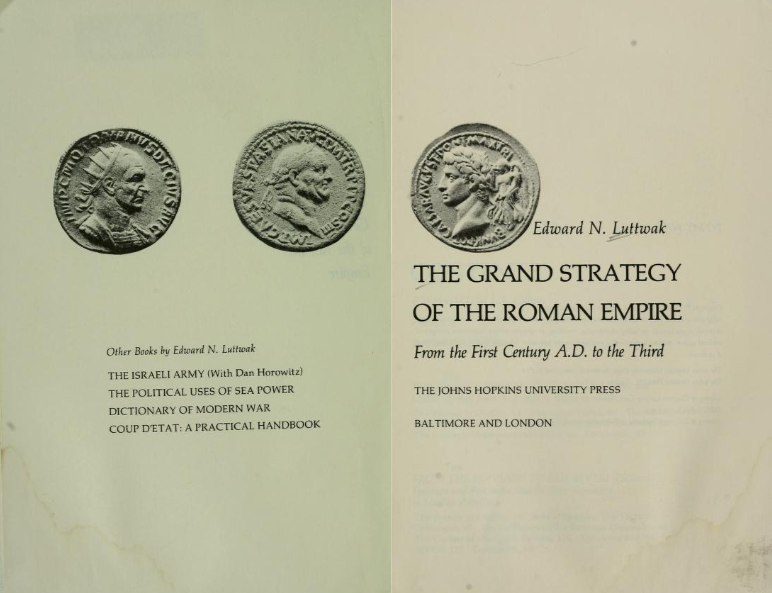
In one of the dozens of notorious interviews of Edward Luttwak that float around the internet, he’s asked how he chose the topic for his PhD dissertation. His answer is that one day at university he had a humiliating social encounter. Immediately afterwards, somebody pounced on him and asked what his dissertation was about anyway. He hadn’t even started thinking about what his topic would be, but he obviously couldn’t say that, and so instead he puffed himself up and made something up on the spot, and he did so by saying the most grandiloquent series of words one at a time like a large language model feverishly choosing the next token to maximize self importance: “The … GRAND … Strategy … … OF THE ROMAN EMPIRE!!” His interlocutor was sufficiently awed and impressed, but then he had to write the damn thing. Like all Luttwak stories, this is probably false but totally believable.1
But I’m very glad he wrote that thesis, because it was later turned into the wonderful book I’m reviewing. Now, one of the ways that the Psmiths subvert traditional gender roles is that it’s Jane, not I, who thinks about the Roman Empire every day. But this is only pretending to be a book about the Roman Empire. It’s really a book about “grand strategy” — how states can efficiently allocate scarce military, diplomatic, and financial resources to counter a variety of internal and external threats. It’s true that the examples are mainly drawn from four centuries of Roman history — starting with the Julio-Claudian dynasty and ending with the Empire losing control of Italy and Western Europe — but the analysis, and the lessons, are abstract enough that they transcend that particular context.
Luttwak believes that the state is a kind of machine for turning arable land into military power via taxation and conscription. A state that wants to maximize its survival odds can do so in three ways: (1) it can increase its “inputs”, by bringing a larger quantity of arable land under its control (so long as it avoids a commensurate increase in the threats it faces); (2) It can increase the efficiency of the machine, by extracting more grain and more labor from the people it rules, or by undertaking internal reforms to reduce the amount of potential that’s bled away by corruption and decadence; or (3) It can use its military as effectively as possible, doing more with less, killing many birds with one stone or setting up situations where a small allocation of force can tie down much larger opponents.
This third option is more or less what Luttwak means by “grand strategy,” and I think it may be the key that ties together all of Luttwak’s writing and thought. What do a book about the ancient world and a book about Cold War era coups have in common? They’re both about doing more with less, economizing force by wielding it with overwhelming brutality and efficiency. Luttwak’s coldly arithmetic view of the state is reminiscent of nothing so much as James C. Scott’s view of the world,2 but Luttwak is on the opposite team. Scott is an anarchist, Luttwak is a hard-boiled realist, and moreover he’s one with a deep aesthetic appreciation for power and violence, especially when used elegantly, like a scalpel, such that they have effects far out of proportion with their quantity.3
The history of Rome that Luttwak wants to tell is not the history of its cultural or civilizational achievements, but rather the history of how these people were so incredibly good at economizing on violence that they were able to waste a huge portion of their military and economic potential on civil wars, but still keep the lights on and the barbarians at bay. “Grand strategy” is how they accomplished that, but the strategy changed as the threats evolved and as the internal condition of the empire deteriorated. Luttwak delineates three distinct epochs — the founding of the empire under the Julio-Claudian dynasty, the rationalization of frontiers under the Antonine emperors, and the Crisis of the Third Century — and argues that each of the three featured a fundamentally different overall strategic posture on the part of Rome.
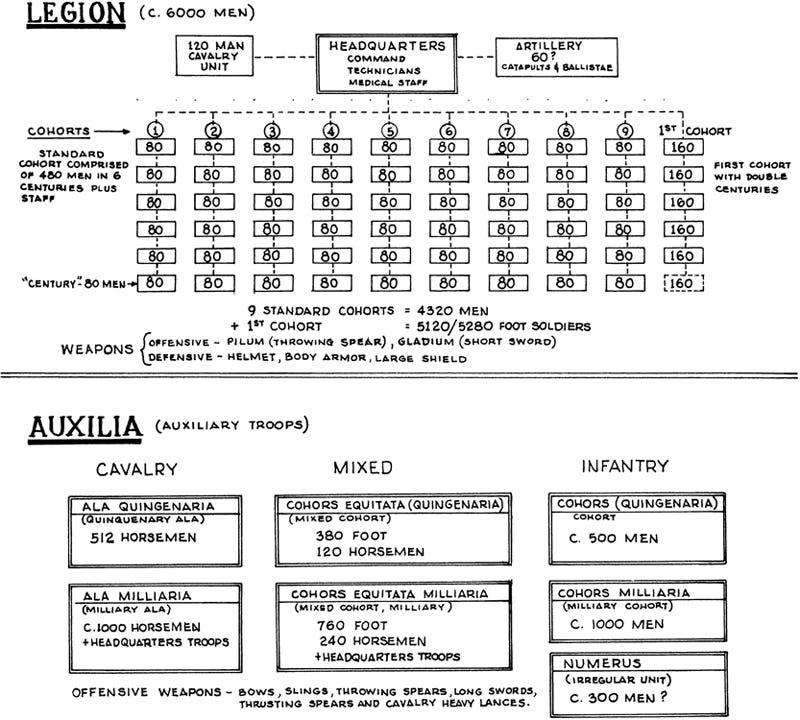
But before we get into all of that, I suppose we ought to talk about the legions. When people think of Roman military power, they usually think of the heavily-armed guys with red cloaks and horsehair plumes on their helmets. But of course they only made up a small fraction of the Roman military. We know that this has to be true because ancient armies, as much as modern armies, relied on combined-arms for their success. A legionary was a very scary kind of soldier, combining the roles of heavy infantry and combat engineer, but an army made up entirely of heavy infantry would be shredded by an opposing force of horse archers, for instance. So the Romans brought many other kinds of troops to bear: skirmishers, slingers, archers, light infantry, cavalry of their own (including mounted archers, light cavalry, and lancers with primitive barding that are a clear precursor of Medieval knights). And … almost to a man, all of these other forces were non-Roman.4 They were either mercenaries, or allied barbarians, or auxiliaries. As a kid in ancient history class I just accepted this as a fact, but reflect on it for a second and it seems very weird. This whole arrangement caused the Romans no end of trouble, so why did they do it that way?
Take the Luttwak pill and it all becomes clear: the Romans went all-in on legionaries as a way of economizing on force. The only people Rome could absolutely rely on were her citizens. The definition of a “real” Roman changed over time — at first it was only inhabitants of the city of Rome itself, later it was expanded to the surrounding countryside, and finally to all of Italy. But at every point it was a tiny fraction of the total population of the empire. Of that tiny fraction, some even smaller fraction are available to be trained as soldiers and to bear arms. What do you want those guys to be doing? The Roman answer is that you want them to be legionaries, because legionaries are not general-purpose soldiers, they’re specialists, and their specialties are: (1) besieging enemy cities, and (2) battles of attrition and annihilation.
1. Evidence that it’s false, he tells a completely different story in a different interview!
“I chose the subject because no theme in contemporary strategy was anywhere as interesting as the simple question of how Rome defended its territories (and added to them, now and then). Also, I did not want to waste my days reading the stultified & chaotically duplicative literature of ‘political science’ in which Strategy is imprisoned, when I could read instead in the often elegant, multi-lingual literature of Roman imperial studies.”
2. The zoomed-out, autistic alien robot anthropologist nature of this analysis also reminds me a bit of Vaclav Smil.
3. Wouldn’t the most elegant use of power be its deployment in such a way that it doesn’t really have to be used at all? In fact this is the main theme of Luttwak’s most recent book, The Grand Strategy of the Byzantine Empire, a sort of sequel to this one. In the same interview as in the first footnote, Luttwak summarizes the argument of that book: Byzantine strategy was based on:
“a single, paradoxical, principle: do everything possible to raise, equip and train the best possible army and navy, and then … do everything possible to use them as little as possible … every alternative was to be tried to avoid, or at least minimize the destructive ‘attrition’ combat of main forces. Instead, potential enemies were to be dissuaded, bribed, subverted, weakened by getting others to attack them, sidetracked into other ventures; if enemy forces attacked nonetheless, they were to be contained and delayed by skirmishing, feints and demonstrations while the search went on for other powers near or far willing to attack or at least threaten the enemy power; if enemy attacks persisted nonetheless, they were to be met by countering maneuvers designed to exhaust them rather than the destructive combat of main forces, the very last resort. It was not only the precious trained manpower of the empire that this strategy wanted to conserve, but also the enemy’s … because today’s enemy could become tomorrow’s ally.
4. This isn’t quite true in every period. For instance during the Punic Wars, the Romans fielded “equites“, native Roman cavalry of their own, but it fell out of fashion pretty quickly thereafter.
Australian voters rejected “The Voice”, fearing “they were being sold a pig in a poke”
Theodore Dalrymple on the recent failure of the Austrialian government to install a nebulous and ill-defined advisory body for Australian Aboriginal and Torres Strait Islander representation to Parliament:
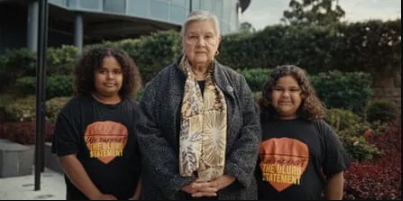
Uluru Dialogue co-chair Pat Anderson in an early ad for “The Voice” referendum.
Screen capture from YouTube.
Among my wife’s family papers dating from the Occupation of France are a couple of certificates of aryanité issued to her forebears, that they might continue to be employed and not deported. In Australia, people apply for certificates of aboriginality, in order that they might receive various advantages, subventions, etc.
The former is bad racism, the latter good, at least for those who believe in positive racial discrimination. Unfortunately, it is logically impossible to believe in positive racial discrimination without also believing in the negative kind, irrespective of one’s supposed good intentions.
Australia recently held a referendum on a proposed race-based amendment to the constitution. The amendment proposed something called “The Voice” to be inscribed in the constitution: an advisory body composed of Aborigines who would advise parliament on matters specifically affecting Aborigines. The details of the proposed body — how it was to be chosen or appointed, its purpose, its powers, its duties, its emoluments — were not specified, and those in favour of it, up to and including the Prime Minister, Anthony Albanese, were either unwilling or unable to specify further, relying entirely on the Australian emotional equivalent of Noel Coward’s famous song, “Don’t Let’s Be Beastly to the Germans”. The latter was not much of a policy.
Australian voters, initially favourable to the proposal, rejected it by a large majority, suspecting, rightly in my view, that they were being sold a pig in a poke. They also suspected, I surmise, that what was being proposed was a corrupt and corrupting bureaucratic pork barrel that would reward a small class of Aboriginal Al Sharptons. Far from improving the situation of Australian Aborigines, which is sometimes but not always tragic, the Voice would permanently raise the ideological temperature and prevent measured debate about practical improvements. Benefits would be received without gratitude and, would never, virtually by definition, be sufficient. And of course, the Voice would be the end of the ideal of racial equality. Australia would join the old South Africa in its inscription of race in its constitution.
The abysmal intellectual level of the proponents of the Voice was very well instantiated in an article by Thomas Keneally, the famous Australian novelist, in the Guardian newspaper. It began as follows:
Last Sunday, many in Australia profoundly mourned the loss of the Indigenous voice to parliament referendum, the greatest kindly Amendment ever to be proposed for the Australian constitution, those dreary old articles of association by which our states and territories rub along together in far-flung federation.
I will overlook the use of the word profoundly in this context: I think the words superficially, self-satisfactorily, and exhibitionistically would have been better. But note that, even if the loss were deeply mourned, only the grossest of sentimentalists would claim that such mourning would have any bearing on the rightness or otherwise of the loss that was mourned. Many Nazis and many communists mourned the loss of Nazi Germany and Soviet Russia far more deeply than any Australian mourned the loss of the referendum, but no one, I think, would sympathise with them because of the depth of their sorrow.
Inside T-72: A Commander’s Perspective | Tank Chats Reloaded
The Tank Museum
Published 21 Jul 2023A fast tank with a low profile and a big gun, the T-72 is a classic Soviet designed Main Battle Tank, in use all over the world. In this video, we talk to Dag Patchett, a former T-72 commander and get his impressions of a tank built in the Cold War era but still very much in service.
(more…)
November 13, 2023
Lessons for Canada from the Australian referendum on “The Voice”
Conrad Black contrasts the experiences of First Nations in Australia and Canada after contact with European explorers and settlers and the recent attempt to create a formal role for Aboriginal representation in the Australian Parliament.
Uluru Dialogue co-chair Pat Anderson in an early ad for “The Voice” referendum.
Screen capture from YouTube.
Canadians should perhaps pay more attention than we have to the referendum in Australia on Oct. 14 on the subject of the Aboriginal peoples. There are just under one million designated Aboriginals in Australia, slightly below four per cent of Australia’s 25 million people. The roughly corresponding figures in Canada are that Indigenous Canadians, including in both countries a good number of mixed ancestry, are slightly under five per cent — just, at under two million in a population of 40 million. The issue in the referendum was a proposed amendment to the Australian Constitution by which a federal advisory body comprised of native people would be set up which would have only a consultative role. How this body would be selected and its recommendations presented would be dealt with later. The idea was just to give Aboriginal people, in the wording of the referendum, a “voice” in the politics of the country.
The history of the white settlers of Australia and the natives whom they encountered there is fairly parallel to the Canadian experience. Initial contact was friendly enough, but there was a native vulnerability to certain diseases to which the Australian natives had had no occasion to develop an immunity. Their lands were gradually encroached upon although the inconvenience to them was for a time not as great as it was in Canada where the conversion of huge tracts of arable land on the prairies into immensely productive grain producing farms made it steadily more difficult for our native people to maintain that part of their diet based on the buffalo. Australian Aboriginals had less difficulty, at least for some time, retreating to places that did not especially attract the settlers, and where it was comparatively possible to maintain a traditional life.
However, there was soon inevitably interaction, some of it successful intermarriage, and some of it outright racial friction with not infrequent outbursts of violence, though nothing on the scale of the Riel rebellions in this country, let alone the outright warfare of the American Indian Wars. But eventually, reservations were created for some Australian Aboriginals. In contrast to this country, there was practically no attempt to help formally educate them or to assist them in integrating into the larger Australian society. They were gradually pushed to the nether regions of the immense country, almost as large as Canada and with a greater habitable area, and the provision of health and education services to the natives was greatly less generous in the amounts of money and numbers of personnel involved than the corresponding efforts in Canada.
Gradually the theory developed and took hold in Australia that perhaps the early settlers and the autonomous government of Australia created by the British in 1901, could have been more generous and thoughtful. As these matters tend to do, the issue gnawed somewhat at the conscience of white Australia and finally in 2008, the government of Australia passed through both houses of its Parliament an apology and expression of regret for past injustices. There was nothing remotely like the orgy of self-defamatory penitence backed by stupefying amounts of money that has flowed in this country like the Niagara River onto the native people.
Shortly after the new Labor government in Australia was elected in 2022, it proceeded with its declared intention to hold a referendum on the issue of giving the Aboriginal peoples a “voice”. And soon after this campaign began, it became clear that the proposed measure was going to have a rocky ride with the country. The predominant opinion among Australians above the age of 45 was that the native had the opportunity to participate fully in Australian life and that there were some substantial gestures of assistance made to them that the more purposeful native people took up.
Winners and losers of the “sexual revolution”
Janice Fiamengo missed her trip to London this week due to illness, so she also missed a panel discussion at the ARC (Alliance for Responsible Citizenship) Conference that raised her ire:
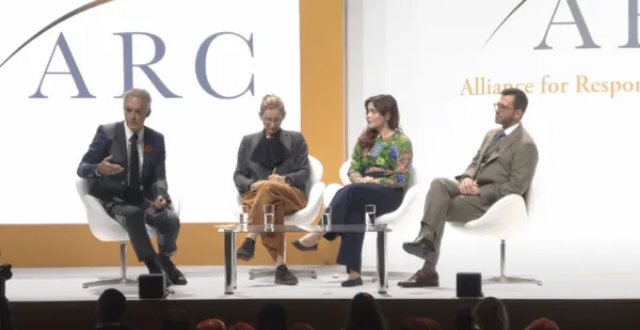
On the subject of widespread sexual promiscuity, family breakdown, and fatherless homes, pundits Jordan Peterson, Louise Perry, Mary Harrington, and Stephen Blackwood carefully ignored the hulking feminist elephant in the room, arguing that the primary victims of the sexual revolution have been women (and children as well, as something of an afterthought). The primary beneficiaries have been a few psychopathic men who have left a trail of broken hearts and rudderless children in their wake. It’s a convenient thesis in a culture terminally averse to criticizing women, but it avoids some important facts.
The whole discussion, actually, begins from a false premise. If there was ever a sexual revolution in which we all simply consented to do what we wanted sexually, as Louise Perry claimed, that revolution ended over 30 years ago when Anita Hill complained before a Senate Judiciary Committee that Clarence Thomas, former chair of the Equal Employment Opportunity Commission, should not be confirmed as a Supreme Court Justice because he had once joked to her about a pubic hair floating on his Coke. At that point, the alleged sexual vulnerability of women, whose sensitive ears must not be subject to comments by male colleagues about pornography or penis size — and the need for legislation to protect and accommodate them at the expense of male freedom of expression — reasserted itself with a vengeance. The feminist claim that women merely wanted equal rights and an end to sexual double standards was exposed as a feeble lie.
Sexual harassment legislation soon made it a potential firing offence for a man to make a female workmate uncomfortable, whether by standing too close, looking too intently, or making the wrong joke or comment. Later, the #MeToo movement proclaimed it righteous that any man who had ever been sexual with any woman (or even just any man, who didn’t even have to know the woman smearing his name) could be accused of sexual misconduct, fired from his job, and permanently disgraced (the DAMN Handbook contains an extraordinary list of celebrity men destroyed by allegations in 2017 alone; see pp. 8-17). Free love, if it ever existed, has been dead for a long time, and some of the same women who cheered on the idea of sexual freedom were the ones who killed it.
But #MeToo, false allegations, the ever-expanding territory of sexual misconduct, and the anti-male tenor of nearly every public discussion about sex—these were emphatically not the focus of the ARC panel, which zeroed in on female sexual victimization. The goals that countless women have proclaimed necessary—sexual freedom, abundant birth control, single motherhood—were criticized as harms for women. We heard that the medium to long-term well-being of women and children has been sacrificed to the short-term gratification of a minority of men; and that these men also tend to be, according to Peterson, possessed of psychopathic, Machiavellian, narcissistic, and sadistic tendencies. Amongst the fallout are the 50% of British children raised in homes without fathers.
It was stirring stuff, certainly, though not exactly a new proposition. Radical feminists like Sheila Jeffries have long argued (in her book Anticlimax: A Feminist Perspective on the Sexual Revolution and elsewhere) that the sexual revolution merely affirmed and updated the victimization of women by men while conservative non-feminists like Phyllis Schlafly pointed out how feminist policies and laws have disadvantaged women.
Yet even those of us without doctorates in psychology might wonder how it could be true that so many women have been the innocent and unwitting victims of men even when they themselves chose those men. Are there not women who engage in abundant casual sex with as much blithe indifference as the men; some of them too psychopathic, narcissistic, Machiavellian and cruel? Why have so many women over the years championed the loosening of sexual mores — including the availability of abortion, never mentioned by any of the panelists — if it was not in their own best interests to do so?
Or are these panelists saying that women cannot be trusted to know their own best interests and those of their children? Why do so many women continue to embrace sexual hedonism, abortion, and divorce? In reality, the epidemic of fatherlessness, as nobody on the panel was interested in exploring, is not the result of the sexual revolution per se, but was made possible specifically by the rise of no-fault divorce and child support laws that, in feminist-compliant family courts, made it highly attractive for women to discard their husbands while still living off his earnings (divorce is today initiated by women in about 70% of cases, and is one of the major reasons so many young men today are averse to marriage). It may well be that nobody’s long-term well being is served by this reality, but it is what women have been choosing with their eyes wide open for many years, and it is a bit rich now to pretend it was something done to them without their consent.
Krešimir: Croatia’s Truly Insane Grenade Launcher
Forgotten Weapons
Published 17 Jul 2023The Krešimir is honestly the most bonkers weapon I have come across in a long while. Made by IM Metall in Croatia at the beginning of the Croatian Homeland War circa 1991, this is a semiautomatic grenade launcher. Most grenade launchers fire a big cartridge with an explosive warhead, but not this thing. Instead, it uses a 5-round magazine of M50 hand grenades with percussion fuses. A second magazine holds 7.62x39mm grenade-launching blank cartridges. Pulling the trigger drops two strikers in succession; one to ignite the hand grenade fuse, and then one to fire the launching cartridge. What could possibly go wrong?
When you do fire, the recoil cycles the whole barrel and bolt backwards like a long recoil action, although it appears to be blowback and not locked. This loads a fresh grenade in the barrel and leaves it ready to fire again with the next trigger pull. We don’t know how many of these insane creations were actually made, but I have multiple reports of their actual wartime use from veterans of the conflict.
Thanks to the Sisak Municipal Museum for giving me access to film this!
(more…)
QotD: The “queering-the-museum” movement
That at least is the objective. But the actual result is an exercise in narcissism. It turns the past into little more than a mirror reflecting the identitarian obsessions of the present back at us. It tells us less than nothing.
And no wonder. Understanding the past through a “queer” prism is profoundly ahistorical. In the 1500s, “queer” didn’t mean what it does today. It meant “strange, peculiar, odd or eccentric“, and had nothing to do with sexual or gender identity at all. Queer only started to be used as a term for gay men at the turn of the 20th century. And “queer studies” was not named as such until the mid-1990s. Viewing the Mary Rose collection through a “queer” lens is to obscure its historical specificity.
It’s not just the Mary Rose Museum that has succumbed to the cult of queer theory, either. Even more bizarrely, the British Library claimed during Pride month this year that the animal world can be viewed through a queer lens. And so Britain’s national centre of knowledge and learning staged events “celebrat[ing] nature in all its queerness”. In particular, it focussed on animals whose sexual behaviour breaks free from standard “gender roles”, from bisexual penguins and lesbian albatrosses to gender-bending fish. “[Researchers’] discoveries”, stated a press release, “show that animal sexuality is far more diverse than we once thought and has been limited by narrow human stereotypes of heterosexuality, monogamy and gender roles”.
This is obviously absurd. Animals do not experience or possess a sense of identity, sexuality or gender. For a fish to “bend” gender it would need to understand what gender is and how to subvert it – quite an achievement for a creature with a five-second memory recall.
Applying “queer” models to the animal world in this way does a disservice not just to our knowledge of animals, but also to our understanding of humans. Non-human animals aim to remain alive and comfortable and propagate their species. Human sex and sexual identity goes far beyond mere survival and comfort. While there may be many interesting reasons why two female penguins pair off, we can be certain that a sense of lesbian self-identity is not one of them.
As the cases of the Mary Rose Museum and the British Library show, queer methodology does not help us to understand history or nature. This is hardly a surprise. Applying a queer lens to species or epochs where it has no place simply exposes the banality of queer theory. It sees nothing but its own reflection. This narcissistic endeavour is now posing a threat to knowledge itself.
Ann Furedi, “The narcissism of queer theory”, Spiked, 2023-08-12.
November 12, 2023
The Futile Fight in Hurtgen Forest – WW2 – Week 272 – November 11, 1944
World War Two
Published 11 Nov 2023The struggle for Hurtgen forest, one tiny piece at a time, continues. The Allies have, however, secured Walcheren Island, and also launch Operation Queen to try and reach and cross the Roer River, and further south even launch a new offensive aiming for Metz. Things are not going well for the Americans on Leyte, though, but they’re even worse for the Chinese as both Guilin and Liuzhou fall to the Japanese. As for the Soviets, they are busy making big plans for a gigantic offensive to drive in to Germany when the new year comes.
(more…)
Who Destroyed The Library of Alexandria? | The Rest is History
The Rest is History
Published 21 Jul 2023Step back in time with renowned historians Dominic Sandbrook and Tom Holland as they embark on an enthralling journey to explore the enigmatic tale of the Library of Alexandria’s destruction. Join them as they uncover the who, what, and why behind one of history’s greatest losses.
#LibraryOfAlexandria #DominicSandbrook #TomHolland
QotD: Archaeological evidence on the foundation of Rome
Rome itself, a cluster of hills situated at an important ford over the Tiber (and thus a natural trade and migration route running north-south along Italy’s Western side), was already inhabited by the close of the Neolithic with small settlement clusters on several of its hills. As you might well imagine, excavating pre-historic Rome is difficult, due to the centuries of development piled on top of it and the fact that in many cases pre-historic evidence must exist directly below subsequent ruins which are now cultural heritage sites. Nevertheless, archaeology sheds quite a lot of light. That archaeological evidence allows us to reject the sort of “empty fields” city foundation that Livy implies. Rather than being “founded”, the city of Rome as we know it formed out of the political merger of these communities (the technical term is synoecism from Greek συνοικισμóς, literally “[putting] the houses together”). There is, importantly, no clear evidence of any archaeological discontinuity between the old settlements on the hills and the newly forming city; these seem to have been the same people. The Palatine hill, which is “chosen” by Romulus in the legend and would be the site of the houses of Rome’s most important and affluent citizens during the historical period, seems to have been the most prominent of these settlements even at this early stage.
A key event in this merging comes in the mid-600s, when these hill-communities begin draining the small valley that lay between the Capitoline and Palatine hills; this valley would naturally have been marshy and quite useless but once drained, it formed a vital meeting place at the center of these hill communities – what would become the Forum Romanum. That public works project – credited by the Romans to the semi-legendary king Tarquinius Priscus (Plin. Natural History 36.104ff) – is remarkably telling, both because it signals that there was enough of a political authority in Rome to marshal the resources to see it done (suggesting somewhat more centralized government, perhaps early kings) and because the new forum formed the meeting place and political center for these communities, quite literally binding them together into a single polity. It is at this point that we can really begin speaking of Rome and Romans with confidence.
What does our archaeology tell us about this early community at this point and for the next several centuries?
The clearest element of this early polity is the Latin influence. Linguistically, Rome was of Latium, spoke (and wrote their earliest inscriptions) in Latin and it falls quite easily to reason that the majority of the people in these early hilltop communities around the Tiber ford were culturally and linguistically Latins. But there are also strong signs of Etruscan and Greek influence in the temples. For instance, in the Forum Boarium (between the Tiber and the Palatine), we see evidence for a cult location dating to the seventh century, with a temple constructed there in the early sixth century (and reconstructed again towards the end of that century); votive offerings recovered from the site include Attic ware pottery and a votive ivory figurine of a lion bearing an inscription in Etruscan.
Archaeological evidence for the Sabines is less evident. Distinctive Sabine material culture hasn’t been recovered from Rome as of yet. There are some clear examples of linguistic influence from Sabine to Latin, although the Romans often misidentify them; the name of the Quirinal hill, for instance (thought by the Romans to be where the Sabines settled after joining the city) doesn’t seem to be Sabine in origin. That said, religious institutions associated with the hill in the historical period (particularly the priests known as the Salii Collini) may have some Sabine connections. More notably, a number of key Roman families (gentes in Latin; we might translate this word as “clans”) claimed Sabine descent. Of particular note, several of these are Patrician gentes, meaning that they traced their lineage to families prominent under the kings or very early in the Republic. Among these were the Claudii (a key family in Roman politics from the founding of the Republic to the early Empire; Liv. 2.16), the Tarpeii (recorded as holding a number of consulships in the fifth century), and the Valerii (prominent from the early days of the Republic and well into the empire; Dionysius 2.46.3). There seems little reason to doubt the ethnic origins of these families.
So on the one hand we cannot say with certainty that there were Sabines in Rome in the eighth century as Livy would have it (though nothing rules it out), but there very clearly were by the foundation of the Republic in 509. The Sabine communities outside of Rome (because it is clear they didn’t all move into Rome) were absorbed in 290 and granted citizenship sine suffrago (citizenship without the vote) almost immediately; voting rights came fairly quickly thereafter in 268 BC (Vel. Pat. 1.14.6-7). The speed with which these Sabine communities outside of Rome were admitted to full citizenship speaks, I suspect, to the degree to which the Sabines were already by that point seen as a kindred people (despite the fact that they spoke a language quite different from Latin; Sabine Osco-Umbrian was its own language, albeit in the same language family).
The only group we can say quite clearly that there is no evidence for in early Rome from Livy’s fusion society are the Trojans; there is no trace of Anatolian influence this early (and we might expect the sudden intrusion of meaningful amounts of Anatolian material culture to be really obvious). Which is to say that Aeneas is made up; no great surprise there.
But Livy’s conception of an early Roman community – perhaps at the end of the sixth century rather than in the middle of the eighth – that was already a conglomeration of peoples with different linguistic, ethnic and religious backgrounds is largely confirmed by the evidence. Moreover, layered on top of this are influences that speak to this early Rome’s connectedness to the broader Mediterranean milieu – I’ve mentioned already the presence of Greek cultural products both in Rome and in the area surrounding it. Greek and eastern artistic motifs (the latter likely brought by Phoenician traders) appear with the “Orientalizing” style in the material culture of the area as early as 730 B.C. – no great surprise there either as the Greeks had begun planting colonies in Italy and Sicily by that point and Phoenician traders are clearly active in the region as well. Evidently Carthaginian cultural contacts also existed at an early point; the Romans made a treaty with Carthage in the very first year of the Republic, which almost certainly seems like it must have replaced some older understanding between the Roman king and Carthage (Polybius 3.22.1). Given the trade contacts, it seems likely that there would have been Phoenician merchants in permanent residence in Rome; evidence for such permanently resident Greeks is even stronger.
In short, our evidence suggests that were one to walk the forum of Rome at the dawn of the Republic – the beginning of what we might properly call the historical period for Rome – you might well hear not only Latin, but also Sabine Umbrian, Etruscan and Greek and even Phoenician spoken (to be clear, those are three completely different language families; Umbrian, Latin and Greek are Indo-European languages, Phoenician was a Semitic language and Etruscan is a non-Indo-European language which may be a language isolate – perhaps the modern equivalent might be a street in which English, French, Italian, Chinese and Arabic are all spoken). The objects on sale in the markets might be similarly diverse.
I keep coming back to the languages, by the by, because I want to stress that these really were different people. There is a tendency – we will come back to it next time – for a lot of modern folks to assume that, “Oh well, these are all Italians, right?” But the idea of “Italians” as such didn’t exist yet (and Italy even today isn’t quite so homogeneous as many people outside of it often assume!). And we know that the different languages were mirrored by different religious and cultural practices (although material culture – the “stuff” of daily life, was often shared through trade contacts). Languages thus make a fairly clear and easy marker for a whole range of cultural differences, though – and we will come back to this as well – it is important to remember that people’s identities are often complex; identity is generally a layered, “yes, but also …” affair. I have only glanced over this, but we also see traces of Latin, Etruscan, Greek and Umbrian religious practice in early Roman sanctuaries and our later literary sources; Phoenician influence has also been posited – we know at least that there was a temple to Uni/Astarte in Pyrgi within 30 miles of Rome so Phoenician religious influence could never have been that far away.
We thus have to conclude that Livy is correct on at least one thing: Rome seems to have been a multi-ethnic, diverse place from the beginning with a range of languages, religious practices. Rome was a frontier town at the beginning and it had the wide mix of peoples that one would expect of such a frontier town. It sat at the juncture of Etruria (inhabited by Etruscans) to the north, of Latium (inhabited by Latins) to the South, and of the Apennine mountains (inhabited by Umbrians like the Sabines). At the same time, Rome’s position on the Tiber ford made it the logical place for land-based trade (especially from Greek settlements in Campania, like Cumae, Capua and Neapolis – that is, Naples) to cross the Tiber moving either north or south. Finally, the Tiber River is navigable up to the ford (and the Romans were conscious of the value of this, e.g. Liv 5.54), so Rome was also a natural destination point for seafaring Greek and Phoenician traders looking for a destination to sell their wares. Rome was, in short, far from a homogeneous culture; it was a place where many different peoples meet, even in its very earliest days. Indeed, as we will see, that fact is probably part of what positioned Rome to become the leading city of Italy.
(For those looking to track down some of these archaeological references or get a sense of the source material, though it is now a touch dated, The Cambridge Ancient History, Vol 7.2: The Rise of Rome to 220 B.C., edited by F.W. Walbank, A.E. Astin, M.W. Frederiksen, and R.M. Ogilvie (1990) offers a fairly good overview, particularly the early chapters by Ogilvie, Torelli and Momigliano. For something more suited to regular folks, when I teach this I use M.T. Boatwright, D.J. Gargola, N. Lenski and R.J.A. Talbert, The Romans: From Village To Empire (2012) and it has a decent textbook summary, p. 22-42, covering early Rome with particularly good reference to the archaeology)
Bret Devereaux, “Collections: The Queen’s Latin or Who Were the Romans? Part I: Beginnings and Legends”, A Collection of Unmitigated Pedantry, 2021-06-11.
November 11, 2023
In memoriam
A simple recognition of some of our family members who served in the First and Second World Wars:
The Great War
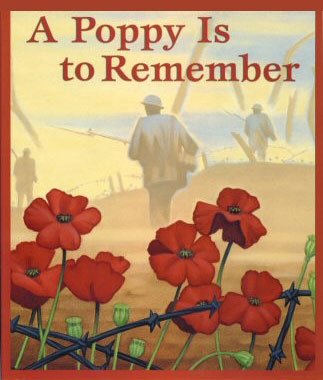 Private William Penman, Scots Guards, died 16 May, 1915 at Le Touret, age 25
(Elizabeth’s great uncle)- Private Archibald Turner Mulholland, Argyll & Sutherland Highlanders, mortally wounded 25 September, 1915 at Loos, age 27
(Elizabeth’s great uncle) - Private David Buller, Highland Light Infantry, died 21 October, 1915 at Loos, age 35
(Elizabeth’s great grandfather) - Private Harold Edgar Brand, East Yorkshire Regiment. died 4 June, 1917 at Tournai.
(My first cousin, three times removed) - Private Walter Porteous, Durham Light Infantry, died 4 October, 1917 at Passchendaele, age 18
(my great uncle, who had married the day before he left for the front and never returned) - Corporal John Mulholland, Argyll & Sutherland Highlanders, wounded 2 September, 1914 (shortly before the First Battle of the Aisne), wounded again 29 June, 1918, lived through the war.
(Elizabeth’s great uncle)
The Second World War
- Flying Officer Richard Porteous, Royal Air Force, survived the defeat in Malaya, was evacuated to India and lived through the war
(my great uncle) - Able Seaman John Penman, Royal Navy, served in the Defensively Equipped Merchant fleet on the Atlantic convoys, the Murmansk Run (he may have been on a ship in convoy PQ-17, as we know he spent a winter in Russia) and other convoy routes, was involved in firefighting and rescue efforts during the Bombay Docks explosion in 1944, lived through the war
(Elizabeth’s father) - Private Archie Black (commissioned after the war and retired as a Major), Gordon Highlanders, captured during the fall of Singapore (aged 15) and survived a Japanese POW camp (he had begun to write an autobiography shortly before he died)
(Elizabeth’s uncle) - Elizabeth Buller, “Lumberjill” in the Women’s Timber Corps, an offshoot of the Women’s Land Army in Scotland through the war.
(Elizabeth’s mother) - Trooper Leslie Taplan Russon, 3rd Royal Tank Regiment, died at Tobruk, 19 December, 1942 (aged 23).
Leslie was my father’s first cousin, once removed (and therefore my first cousin, twice removed).
My maternal grandfather, Matthew Kendrew Thornton, was in a reserved occupation during the war as a plater working at Smith’s Docks in Middlesbrough. The original design for the famous Flower-class corvettes came from Smith’s Docks and 16 of the 196 built in the UK during the war (more were built in Canada). My great-grandmother was an enthusiastic ARP warden through the war (she reportedly enjoyed enforcing blackout compliance in the neighbourhood using the rattle and whistle that came with the job).
For the curious, the Commonwealth War Graves Commission the Royal British Legion, and the Library and Archives Canada WW1 and WW2 records site provide search engines you can use to look up your family name. The RBL’s Every One Remembered site shows you everyone who died in the Great War in British or Empire service (Canadians, Australians, New Zealanders, South Africans and other Imperial countries). The CWGC site also includes those who died in the Second World War. Library and Archives Canada allows searches of the Canadian Expeditionary Force and the Royal Newfoundland Regiment for all who served during WW1, and including those who volunteered for the CEF but were not accepted.
In Flanders fields the poppies blow
Between the crosses row on row,
That mark our place; and in the sky
The larks, still bravely singing, fly
Scarce heard amid the guns below.We are the Dead. Short days ago
We lived, felt dawn, saw sunset glow,
Loved and were loved, and now we lie
In Flanders fields.Take up our quarrel with the foe:
To you from failing hands we throw
The torch; be yours to hold it high.
If ye break faith with us who die
We shall not sleep, though poppies grow
In Flanders fields.Lieutenant Colonel John McCrae, MD Canadian Army Medical Corps (1872-1918)
Here is Mark Knopfler’s wonderful song “Remembrance Day” from his Get Lucky album, set to a slideshow of British and Canadian images from World War I through to more recent conflicts put together by Bob Oldfield:
The Mississauga Train Derailment (1979)
The Raven’s Eye
Published 8 Nov 2022It was called “The Mississauga Miracle” — a train derailment involving 26 cars of toxic and flammable materials, just a few miles from a major Canadian city center. Faced with the prospect of a cloud of killer phosgene gas being released, authorities had no choice but to order the mass evacuation of an entire city …
(more…)
QotD: Diary entry, 11 November, 1979
I hope you’ll forgive my self-insert here, but watching the video on the Mississauga train derailment prompted me to dig up a bit of personal history related to this thankfully non-tragic event in Canadian history. This is what I wrote about the events of that week not at the time (I was far too busy living it to record anything) but a couple of months after the fact. Samuel Pepys I wasn’t. I note in passing that my memories today don’t exactly match what I wrote in early 1980, which does bring home to me the fallibility of “eyewitness” reports after the fact.
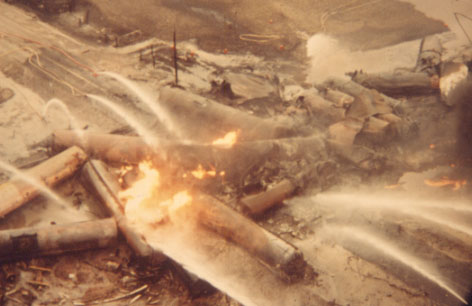
On the night of November 10, 1979, a 106-car Canadian Pacific freight train derailed at Mavis Road, north of Dundas Street. As a result of the subsequent explosion, when one of the tank cars carrying propane exploded, and because other tank cars were carrying chlorine, the decision was made to evacuate nearby residents in one of the largest peace time evacuations in history. This photo shows flames from the wreckage, with hoses pouring water on it.
Photo from the Mississauga Library System website, Identifier M466. Full gallery here.
In November of ’79, on the 11th actually, a chemical train derailed just northwest of [our apartment near Dundas and Hurontario Streets]. It spilled 16 tank cars full of propane and one full of chlorine all over the Mavis Road crossing.
I was driving back to Hamilton on Saturday night to drop off [my girlfriend]. Rockney was inexplicably along with us that night. Around midnight, I noticed the road all around us light up as though dawn had come early. Also noticed a pronounced mushroom-type cloud and lots of incident light at its base. Right there, my mind kicked into Hyperdrive and I analyzed the data, assumed the worst, and nearly swung off the highway to protect us behind an embankment. [The others] saw that it wasn’t an H- or A-type of explosion, and so we didn’t worry too much. Flames [on the eastern horizon] were easily visible from Hamilton.
I went back [to Mississauga], dropped Rockney off [and] noticed a police car blocking the intersection of Dundas and Hurontario with its lights going. Talked to Mum, who was still up, and went to bed at 3:00am.
We were woken up at 10:00am by police evacuating the building. I called Rockney and we all trooped over to his place. I stayed for 1/2 an hour, and decided to go back to the house, change into [my army reserve] uniform, and go up to Brampton for our Remembrance Day parade. On the way, I was stopped by the police and directed to go to Square One, where an evacuation centre had been set up. As I arrived there, the last bus-load of evacuees left headed for Streetsville Secondary School. I arrived there in time [to be given responsibility for security] with 15 assorted army and navy cadets [who were in uniform for their respective Remembrance Day services] who had no officer handy. We cleared the halls [at the direction of police and school authorities] and tried to maintain calm among the evacuated throng.
By 8 that evening, my force had shrunk to seven cadets led by Petty Officer Linda P. An officer cadet of the Air Reserve and five air cadets with him refused to assist me or the police. [I was angry at the time, but he was probably worried about the legal side of providing “aid to the civil power” while in uniform without permission from his chain of command. I was a junior NCO, so that thought never crossed my mind until much later.]
By this time, I had attached Chris P. [a friend of Rockney’s who was evacuated to Streetsville] and several other husky teenagers to my “security force” and we were able to keep things fairly quiet.
As people [started to realize] that they would be there all night, most of them settled down very nicely. [My team of cadets] issued blankets we’d received on a truck from CFB Downsview and shared out the available gym mats [as makeshift mattresses].
A local McDonalds sent in a “breakfast” of cold Big Macs [I’m sure they were hot going out the door, but they took a long time to get to us] — [the non-cadet members of] my security force got more than their fair share, but that was expected. Most of the media had disappeared by this time so we soon got involved in minor disputes with some irate citizens.
Sometime during Monday afternoon a Master Corporal from CFB Downsview called me to arrange a coffee run down to the [emergency crews working to contain] the fire. Nothing came of it in the end [I have no idea why they thought I’d be a useful participant, as I had no transportation other than my own car … maybe I was the only member of the military in the immediate vicinity].
Tried calling Rockney’s place [to see how my family were doing] but got no answer, same at Bill & Clive’s apartment [several miles further east of Rockney’s]. No idea where my parents have gone. [After being evacuated a second time, they’d ended up at the International Centre with the family cat and stayed there until later in the week, as I found out later. My sister hadn’t been at home so she was evacuated elsewhere with her boyfriend’s family. I have no idea where she spent the week.]
Monday night wasn’t too bad, except for [media reports] that there were 3 escaped cons in the area so i couldn’t send girls out alone on security sweeps [outside the school building]. Me, Chris P., Jordan L., and John D. were the only [ones available to do exterior security] now, getting VERY tired. Got an hour’s sleep.
On Tuesday a bunch of students from Humber College showed up. They were all taking the Law Enforcement course and wanted to help me with security. [The] only problem was that the course was 9/10ths female [so] I couldn’t use them [for exterior patrols, which is where we needed help the most].
Also showing up [later on Tuesday] was a local CB radio group who tried to take over from me and my team. It took two hours [of argument] before they gave up and went off to try to take over some other evacuation centre. [Around this time,] vandalism started on the back side of the school and in the portable classrooms. No one was caught at it, unfortunately. [I didn’t note it here, but I strongly suspected that one or more of my volunteers had done some of the damage out of boredom, but I had no proof.]
The biggest problem, however, was racial. A large group of black teenagers had taken over one of the Home Economics classrooms and had 2 competing ghetto blasters to make mucho noise. 2 fights had to be broken up in there and we had to call the police in to cope with the second fight.
[Tuesday] night was uneventful for a change. Wednesday wasn’t, as rumours of being able to go home kept hitting the people in the evacuation centre and nearly overwhelming the security teams at the doors. One asshole, a guy about 20-25 years old, kept buttonholing me and other members of my team and demanding shampoo, of all things. Eventually, someone got him some and he “went to the showers”. [In hindsight, he probably had just come down from whatever drugs he’d been on for the previous few days.]
On Wednesday night, the evacuation centre in Streetsville was shut down and everyone was moved to other facilities on Mississauga Transit buses. Most were taken to the Royal York Hotel in downtown Toronto, but my remaining team members were sent to a Holiday Inn in Scarborough. [I was in rough shape by then and someone got me to hospital to get checked out. I was there for about 10 hours before they discharged me with advice to “get plenty of rest”.]
Thursday we spent in the hotel, charging everything to CP Rail. They must have hit the roof when the bill arrived — especially the bar bill! We threw an “exhaustion party” in our room on Thursday night and on Friday we were finally allowed to go home (most of us, anyway).
When I went back to school the following week, I was given the third degree by the vice principal because the Red Cross didn’t have me listed as an evacuee. I had to get the hospital records to show that I had actually taken part before I was allowed back into class. [A similar thing happened the next unit parade night, as I’d been on TV several times in my uniform during the event and my commanding officer was quite upset about it, thinking I’d been pretending to act in some sort of official capacity, which I hadn’t been.]
November 10, 2023
Luftwaffe Drilling and US M6 Survival Rifle
Forgotten Weapons
Published 8 Sept 2014Today we’re looking at a pair of military survival rifles. One is a Luftwaffe M30 drilling — the most finely finished and luxurious survival rifle ever issued by a military force. The other is a US Air Force M6 survival gun — spartan and utilitarian — the polar opposite of the M30.
(more…)


