
The Tank Museum
Published 28 Jul 2023Join David Willey as he tells the complex story of how the Centaur and its sister vehicles were developed when the need for a new cruiser tank emerged.
(more…)
November 21, 2023
Centaur | Tank Chats #172 | The Tank Museum
Comments Off on Centaur | Tank Chats #172 | The Tank Museum
November 20, 2023
A Tour of the Excavations at Vindolanda
Scenic Routes to the Past
Published 4 Aug 2023This spring, Dr. Andrew Birley gave me a tour of the ongoing excavations at Vindolanda, a Roman fort near Hadrian’s Wall.
Chapters:
0:00 Welcome to Vindolanda
4:41 The wooden underworld
7:13 Layers of history
9:03 Becoming part of the story
Comments Off on A Tour of the Excavations at Vindolanda
QotD: Flax and linen in the ancient and medieval world
Linen fabrics are produced from the fibers of the flax plant, Linum usitatissimum. This common flax plant is the domesticated version of the wild Linum bienne, domesticated in the northern part of the fertile crescent no later than 7,000 BC, although wild flax fibers were being used to produce textiles even earlier than that. Consequently the use of linen fibers goes way back. In fact, the oldest known textiles are made from flax, including finds of fibers at Nahal Hemar (7th millennium BC), Çayönü (c. 7000 BC), and Çatalhöyük (c. 6000 BC). Evidence for the cultivation of flax goes back even further, with linseed from Tell Asward in Syria dating to the 8th millennium BC. Flax was being cultivated in Central Europe no later than the second half of the 7th millennium BC.
Flax is a productive little plant that produces two main products: flax seeds, which are used to produce linseed oil, and the bast of the flax plant which is used to make linen. The latter is our focus here so I am not going to go into linseed oil’s uses, but it should be noted that there is an alternative product. That said, my impression is that flax grown for its seeds is generally grown differently (spaced out, rather than packed together) and generally different varieties are used. That said, flax cultivated for one purpose might produce some of the other product (Pliny notes this, NH 19.16-17)
Flax was a cultivated plant (which is to say, it was farmed); fortunately we have discussed quite a bit about farming in general already and so we can really focus in on the peculiarities of the flax plant itself; if you are interested in the activities and social status of farmers, well, we have a post for that. Flax farming by and large seems to have involved mostly the same sorts of farmers as cereal farming; I get no sense in the Greco-Roman agronomists, for instance, that this was done by different folks. Flax farming changed relatively little prior to mechanization; my impression reading on it is that flax was farmed and gathered much the same in 1900 BC as it was in 1900 AD. In terms of soil, flax requires quite a lot of moisture and so grows best in either deep loam or (more commonly used in the ancient world, it seems) alluvial soils; in both cases, it should be loose, unconsolidated “sandy” (that is, small particle-sized) soil. Alluvium is loose, often sandy soil that is the product of erosion (that is to say, it is soil composed of the bits that have been eroded off of larger rocks by the action of water); the most common place to see lots of alluvial soil are in the flood-plains of rivers where it is deposited as the river floods forming what is called an alluvial plain.
Thus Pliny (NH 19.7ff) when listing the best flax-growing regions names places like Tarragona, Spain (with the seasonally flooding Francoli river) or the Po River Basin in Italy (with its large alluvial plain) and of course Egypt (with the regular flooding of the Nile). Pliny notes that linen from Sætabis in Spain was the best in Europe, followed by linens produced in the Po River Valley, though it seems clear that the rider here “made in Europe” in his text is meant to exclude Egypt, which would have otherwise dominated the list – Pliny openly admits that Egyptian flax, while making the least durable kind of linen (see below on harvesting times) was the most valuable (though he also treats Egyptian cotton which, by his time, was being cultivated in limited amounts in the Nile delta, as a form of flax, which obviously it isn’t). Flax is fairly resistant to short bursts of mild freezing temperatures, but prolonged freezes will kill the plants; it seems little accident that most flax production seems to have happened in fairly warm or at least temperate climes.
Flax is (as Pliny notes) a very fast growing plant – indeed, the fastest growing crop he knew of. Modern flax grown for fibers is generally ready for harvesting in roughly 100 days and this accords broadly with what the ancient agronomists suggest; Pliny says that flax is sown in spring and harvested in summer, while the other agronomists, likely reflecting practice further south suggest sowing in late fall and early winter and likewise harvesting relatively quickly. Flax that is going to be harvested for fibers tended to be planted in dense bunches or rows (Columella notes this method but does not endorse it, De Rust. 2.10.17). The reason for this is that when placed close together, the plants compete for sunlight by growing taller and thinner and with fewer flowers, which maximizes the amount of stalk per plant. By contrast, flax planted for linseed oil is more spaced out to maximize the number of flowers (and thus the amount of seed) per plant.
Once the flax was considered ready for harvest, it was pulled up out of the ground (including the root system) in bunches in handfuls rather than as individual plants […] and then hung to dry. Both Pliny and Columella (De Rust. 2.10.17) note that this pulling method tended to tear up the soil and regarded this as very damaging; they are on to something, since none of the flax plant is left to be plowed under, flax cultivation does seem to be fairly tough on the soil (for this reason Columella advises only growing flax in regions with ideal soil for it and where it brings a good profit). The exact time of harvest varies based on the use intended for the flax fibers; harvesting the flax later results in stronger, but rougher, fibers. Late-pulled flax is called “yellow” flax (for the same reason that blond hair is called “flaxen” – it’s yellow!) and was used for more work-a-day fabrics and ropes.
Bret Devereaux, “Collections: Clothing, How Did They Make It? Part I: High Fiber”, A Collection of Unmitigated Pedantry, 2021-03-05.
Comments Off on QotD: Flax and linen in the ancient and medieval world
November 19, 2023
Ted Gioia wonders if we need a “new Romanticism”
He raised the question earlier this year, and it’s sticking with him to the point he’s gathering notes on the original Romantic movement and what it was reacting against:
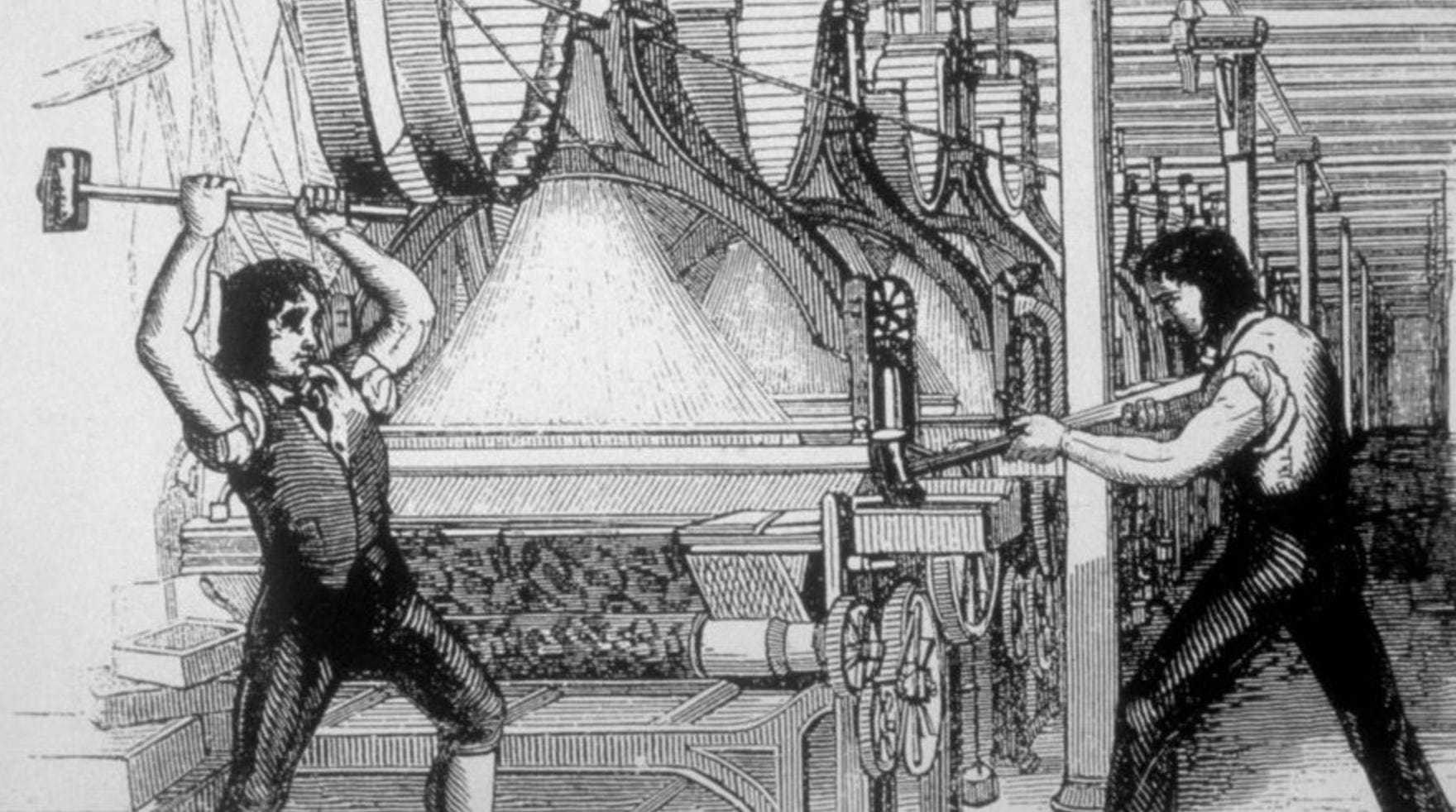
The issues that enraged the original Luddites certainly have many modern echoes.
I realized that, the more I looked at what happened circa 1800, the more it reminded me of our current malaise.
- Rationalist and algorithmic models were dominating every sphere of life at that midpoint in the Industrial Revolution — and people started resisting the forces of progress.
- Companies grew more powerful, promising productivity and prosperity. But Blake called them “dark Satanic mills” and Luddites started burning down factories — a drastic and futile step, almost the equivalent of throwing away your smartphone.
- Even as science and technology produced amazing results, dysfunctional behaviors sprang up everywhere. The pathbreaking literary works from the late 1700s reveal the dark side of the pervasive techno-optimism — Goethe’s novel about Werther’s suicide [Wiki], the Marquis de Sade’s nasty stories [Wiki], and all those gloomy Gothic novels [Wiki]. What happened to the Enlightenment?
- As the new century dawned, the creative class (as we would call it today) increasingly attacked rationalist currents that had somehow morphed into violent, intrusive forces in their lives — an 180 degree shift in the culture. For Blake and others, the name Newton became a term of abuse.
- Artists, especially poets and musicians, took the lead in this revolt. They celebrated human feeling and emotional attachments — embracing them as more trustworthy, more flexible, more desirable than technology, profits, and cold calculation.
That’s the world, circa 1800.
The new paradigm shocked Europe when it started to spread. Cultural elites had just assumed that science and reason would control everything in the future. But that wasn’t how it played out.
Resemblances with the current moment are not hard to see.
“Imagine a growing sense that algorithmic and mechanistic thinking has become too oppressive. Imagine if people started resisting technology. Imagine a revolt against STEM’s dominance. Imagine people deciding that the good life starts with NOT learning how to code.”
These considerations led me, about nine months ago, to conduct a deep dive into the history of the Romanticist movement. I wanted to see what the historical evidence told me.
I’ve devoted hours every day to this — reading stacks of books, both primary and secondary sources, on the subject. I’ve supplemented it with a music listening program and a study of visual art from the era.
What’s my goal? I’m still not entirely sure.
Comments Off on Ted Gioia wonders if we need a “new Romanticism”
How Himmler Learned to Love the Russians – WW2 – Week 273 – November 18, 1944
World War Two
Published 18 Nov 2023Heinrich Himmler wants to build an Army of Soviet POWs, but that has some problems; Patrick Hurley becomes US Ambassador to China, but even before that he’s in hot water with Chiang Kai-Shek; and in the field in the west, the Allies launch Operation Queen to try to cross the Roer River and reach the Rhine.
(more…)
Comments Off on How Himmler Learned to Love the Russians – WW2 – Week 273 – November 18, 1944
Last Ditch Innovation: The Development of the Gerat 06 and Gerat 06H Rifles
Forgotten Weapons
Published 19 Nov 2012I’m very happy today to present a video we did in cooperation with Oleg Volk, which I’ve titled “Last Ditch Innovation”. It is a look at two late-WW2 German prototype rifles which are the evolutionary grandparents of the CETME and the H&K series of roller-delayed firearms (91, 93, MP5, etc). Thanks to some very generous friends, we have examples of both guns to disassemble and shoot … so sit back, relax, and enjoy the show.
Comments Off on Last Ditch Innovation: The Development of the Gerat 06 and Gerat 06H Rifles
November 18, 2023
“René Girard’s famous book I See Satan Fall Like Lightning isn’t directly about Barack Obama being the Antichrist”
At Astral Codex Ten, Scott Alexander reviews I See Satan Fall Like Lightning by René Girard:
The phrase “I see Satan fall like lightning” comes from Luke 10:18. I’d previously encountered it on insane right-wing conspiracy theory websites. You can rephrase it as “I see Satan descend to earth in the form of lightning”. But “lightning” in Hebrew is barak. So the Bible says Satan will descend to Earth in the form of Barak. Seems like a relevant Bible verse for insane right-wing conspiracy theorists!
Philosopher / theologian Rene Girard’s famous book I See Satan Fall Like Lightning isn’t directly about Barack Obama being the Antichrist. It’s an ambitious theory-of-everything for anthropology, mythography, and the Judeo-Christian religion. After solving all of those venerable fields, it will, sort of, loop back to Barack Obama being the Antichrist. But it’ll do it in such an intellectual and polymathic Continental philosophy way that can’t even get mad.
Girard’s starting point is the similarity between Bible stories and pagan myths. You’ve heard about this before — dying-and-resurrecting gods, that sort of thing. You might expect Girard, a good Catholic, to reject these similarities. He doesn’t. He says they’re real and important. Pagan myths resemble the Bible because they’re both describing the same psychosocial process. The myths are distorted propaganda supporting the process, and the Bible is a clear-eyed description of the process which reveals it to be evil. Just as worshipful Soviet hagiographies of Stalin and sober historical analyses of Stalin will have many similarities (since they’re both describing Stalin), so there will be unavoidable resonances between myth and the Bible.
Girard calls this process “the single-victim process” or “Satan”. It goes like this:
- Most (all?) human desire is mimetic, ie based on copying other people’s desires. The Bible warns against coveting your neighbor’s stuff, because it knows people’s natural tendencies run that direction. It’s not that your neighbor has particularly good stuff. It’s that you want it because it’s your neighbor’s. Think of two children playing in a room full of toys. One child picks up Toy #368 and starts playing with it. Then the other child tries to take it, ignoring all the hundreds of other toys available. It’s valuable because someone else wants it.
- As with the two children, conflict is inevitable. As the mimetic process intensifies, everyone goes from complicated individuals with individual wants, to copies of their neighbors (ie their desires copy their neighbors’ desires, and they become the sort of people who would have those desires). Alliances form and dissipate. There is a war of all against all. The social fabric starts to collapse.
- Instead of letting the social fabric collapse, everyone suddenly turns their ire on one person, the victim. Maybe this person is a foreigner, or a contrarian, or just ugly. The transition from individuals to a mob reaches a crescendo. The mob, with one will, murders the victim (or maybe just exiles them).
- Then everything is kind of okay! The murder relieves the built-up tension. People feel like they can have their own desires again, and stop coveting their neighbors’ stuff quite so hard, at least for a while. Society does not collapse. If there was no civilization before, maybe people take advantage of this period of relative peace to found civilization.
- (Optional step 5) Seems pretty impressive that killing one victim could cause all this peace and civilization! The former mob declares their victim to be a god. Killing the god was the necessary prerequisite to civilization. Now the god probably reigns in heaven or something. Maybe they die and resurrect every year. Whatever.
- Rinse and repeat.
Girard is against this process. Not just because it involves violent mobs lynching innocent people (although it does), but because that step perpetuates the whole cycle: people greedily desiring whatever their neighbors have, people hating their neighbors, internecine war of all against all. He dubs the process Satan, based partly on the original Hebrew meaning of Satan as “prosecutor”. Satan is the force that tells people that the victim is guilty and deserves to be lynched.
(and did you know that Paraclete, the Greek word for the Holy Spirit, originally meant “defense attorney”? The Paraclete is the force that — no, we’ll get to that later).
Are all myths and Bible stories really about this process? Girard says yes. For example, consider the myth of Oedipus. Around the end, Thebes is stricken by plague (Girard says plagues should usually be interpreted metaphorically as social plagues, ie discord). Everyone goes to the oracle and asks for a solution. The oracle says that someone has killed his father and married his mother, and the plague won’t end until that person is removed. It is revealed that Oedipus is the culprit. The mob expels Oedipus from the city, and the plague ends.
Okay, that’s one myth. Are there others?
Comments Off on “René Girard’s famous book I See Satan Fall Like Lightning isn’t directly about Barack Obama being the Antichrist”
World War Two’s most common tank
Lindybeige
Published 2 Aug 2023What click-bait title should I have used for this? “The tank that gave the Germans nightmares”? “The Commonest Communist tank?” “The tank of the teeming red hordes”? As I describe here, they made ever-so many of this type of tank, and that fact alone makes it an important tank.
(more…)
Comments Off on World War Two’s most common tank
November 17, 2023
Prometheus
Virginia Postrel tries to correct the common misinterpretation of the story of the Titan Prometheus:
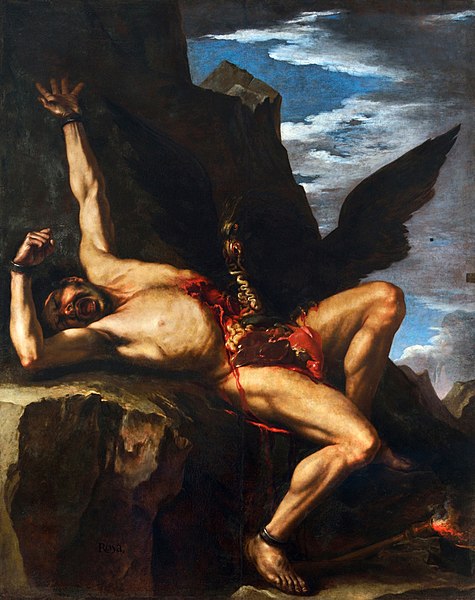
“The Torture of Prometheus” by Salvator Rosa (1615-1673)
Oil painting in the Galleria Nazionale d’Arte Antica di Palazzo Corsini via Wikimedia Commons.
Listening to Marc Andreessen discuss his Techno-Optimist Manifesto on the Foundation for American Innovation’s Dynamist podcast, I was struck by his repetition of something that is in the manifesto and is completely wrong. “The myth of Prometheus – in various updated forms like Frankenstein, Oppenheimer, and Terminator – haunts our nightmares,” he writes.1 On the podcast, he elaborated by saying that, although fire has many benefits, the Prometheus myth focuses on its use as a weapon. He said something similar in a June post called “Why AI Will Save the World“:
The fear that technology of our own creation will rise up and destroy us is deeply coded into our culture. The Greeks expressed this fear in the Prometheus Myth – Prometheus brought the destructive power of fire, and more generally technology (“techne”), to man, for which Prometheus was condemned to perpetual torture by the gods.
No. No. No. No.
Prometheus is punished for loving humankind. He stole fire to thwart Zeus’ plans to eliminate humanity and create a new subordinate species. He is a benefactor who sacrifices himself for our good. His punishment is an indicator not of the dangers of fire but of the tyranny of Zeus.
Prometheus is cunning and wise. His name means foresight. He knows what he is doing and what the likely consequences will be.
Eventually his tortures end when he is rescued by the hero Herakles (aka Hercules), who shoots the eagle charged with eating Prometheus’ liver every day, only for it to grow back to be eaten again.
The Greeks honored Prometheus. They celebrated technē. They appreciated the gifts of civilization.
The ancient myth of Prometheus is not a cautionary tale. It is a reminder that technē raises human beings above brutes. It is a myth founded in gratitude.
1. Frankenstein isn’t The Terminator either. Frankenstein is a creator who won’t take responsibility for his creation, a father who rejects and abandons his child. The Creature is frightening and dangerous but he is also the book’s moral center, a tragic, sympathetic character who is feared and rejected by human beings because of his appearance. Only then does he turn deadly. Frankenstein arouses pity and terror because we empathize with its central figure and understand his rage.
The novel’s most reasonable political reading is not as a story of the dangers of science but as a parable of slavery and rebellion. “By the eighteen-fifties, Frankenstein’s monster regularly appeared in American political cartoons as a nearly naked black man, signifying slavery itself, seeking his vengeance upon the nation that created him,” writes historian Jill LePore, who calls the “Frankenstein-is-Oppenheimer model … a weak reading of the novel.” I agree.
The Romantics tended to identify with Prometheus and Mary Shelley’s husband, Percy Bysshe Shelley, wrote a play called Prometheus Unbound, further undermining the reading of Frankenstein as an anti-Promethean fable.
Comments Off on Prometheus
Rationing In Britain
Imperial War Museums
Published 8 Jan 2010An American commentator looks at the effects of rationing on the people of England in 1944. The film presents a “typical” family of four (housewife, engine-driver husband, factory-working daughter, schoolboy son) to illustrate the basic rationing system, the workings of “point” systems and other restrictions, and the difficulties the average family faced when eating “on the ration”.
Explore IWM’s film collection: https://film.iwmcollections.org.uk
Comments Off on Rationing In Britain
November 16, 2023
Maryland Council of Safety Revolutionary Flintlock
Forgotten Weapons
Published 20 Nov 2014In the buildup to the US War of Independence, “Committees of Safety” were organized in the colonial state to form shadow governments for the independence movement. These committees (or councils, as a few were named) had, among other tasks, the responsibility of sourcing arms for the local militia forces.
This was done both by purchasing arms available at the time from gunsmiths, commercial dealers, and private individuals and also by contracting with gunsmiths to manufacture guns specifically for the council or committee. Typically these guns were not specially marked — there was no particular reason to do so — and as a result they are very difficult to authenticate today. A Revolutionary War weapon could have been anything available at the time.
One notable exception is an order placed by the Maryland Council of Safety. They ordered quite a lot of guns from area manufacturers, including a batch of 500 pistols. In addition, they hired an inspector to verify the quality of the finished guns, and mark them. The inspector was named Thomas Ewing, and his marking looked rather like a tulip. Records about the guns he oversaw and marked remain in existence, and allow them to be identified — including this example.
(more…)
Comments Off on Maryland Council of Safety Revolutionary Flintlock
QotD: Infantry soldiers in the age of pike and shot
Such soldiers were, in their ideal, to quickly but mechanically reload their weapons, respond to orders and shift formation more or less oblivious to the battle around them. Indeed, uniforms for these soldiers came to favor high, starched collars precisely to limit their field of vision. This is not the man who, in Tyrtaeus’ words (elsewhere in his corpus), “bites on his lip and stands against the foe” but rather a human who, in the perfect form, was so mechanical in motions and habits that their courage or lack thereof, their awareness of the battlefield or lack thereof, didn’t matter at all. But at least, the [Classical] Greek might think, at least such men still ought not quail under fire but instead stood tall in the face of it.
After all, as late as the Second World War, it was thought that good British officers ought not duck or take cover under fire, in order to demonstrate and model good coolness under fire for their soldiers. The impression I get from talking to recent combat veterans (admittedly, American ones rather than British, since I live in the United States) is that an officer who behaved in that same way on today’s battlefield would be thought reckless (or stupid), not brave. Instead, the modern image of courage under fire is the soldier moving fast, staying low, moving to and through cover whenever possible – recklessness is discouraged precisely because it might put a comrade in danger.
Instead, the courage that is valued in many of today’s armies is the courage to stay calm and make cool, rational decisions. It is, to borrow the first line in Rudyard Kipling’s “If-“, “If you can keep your head when all about you/Are losing theirs and blaming it on you.” Which is not at all what was expected of the 17th century infantryman, whose officers trusted him to make nearly no decisions at all! But, as we’ve discussed, the modern system of combat demands that lots of decisions be devolved down further and further in the command hierarchy, with senior officers giving subordinates (often down to NCOs) the freedom to alter plans on the fly at the local level so long as they are following the general mission instructions (a system often referred to by its German term, auftragstaktik).
Bret Devereaux, “Collections: The Universal Warrior, Part IIa: The Many Faces of Battle”, A Collection of Unmitigated Pedantry, 2021-02-05.
Comments Off on QotD: Infantry soldiers in the age of pike and shot
November 15, 2023
Can we criticize the Climate Goblin now?
Brendan O’Neill asks if it’s allowed to criticized Greta “The Climate Goblin” Thunberg now:

Can we criticise Greta Thunberg now? For a time, anyone who raised even the mildest objection to the pint-sized prophetess of doom risked being damned as a bully. Surely this moratorium on Greta-scepticism will end following her platforming – to use woke lingo – of an activist with very iffy views. An activist who has trivialised the Holocaust and seems pretty chilled about Hamas’s pogrom of 7 October. Calling out Greta for her fact-lite blather about the planet being “on fire” may have been forbidden – pulling her up for hanging out with Holocaust relativists must not be.
Thunberg has made waves by switching her focus from saving the planet to saving Gaza. Like every other Gen Zer with a TikTok and an insatiable urge to signal his / her / zir virtue to the world, she’s become an overnight authority on Israel-Palestine. She posed with a placard saying “Stand with Gaza“. She turned Fridays for Future – where pious rich kids bunk off school to raise awareness about climate change – into “Justice for Palestine” stunts. And on Sunday, she made a climate protest in Amsterdam pretty much all about Palestine.
She invited activists to the stage. One was Sara Rachdan, a Palestinian studying in Amsterdam. It didn’t take German newspaper Bild long to discover that Ms Rachdan holds views which – how should we put this? – are not very pleasant. On Hamas’s pogrom, Ms Rachdan said: “This is finally Palestinians taking action [against] the occupation”. She’s dabbled in Holocaust denigration. She shared a blood-spattered graphic comparing Israel’s actions in Gaza with the Nazis’ actions in Auschwitz. Repulsively, it implies the Jewish State is worse than the Nazis. Where 127 kids a day were killed in Auschwitz, 178 a day are currently dying in Israel’s war in Gaza, it alleges.
Shorter version: the Jews are more accomplished child-killers than even Hitler’s henchmen were. This is rank Holocaust relativism. Comparing the greatest crime in history to this horrendous war denudes that crime of its unique horror. It renders it ordinary. It was no big deal – just the same kind of thing you see on your TV screens every night from Gaza. The implication of moral equivalence between the Nazis’ minutely planned gassing of Jewish children and the deaths of Palestinian kids as a terrible byproduct of Israel’s war on Hamas is beyond immoral. It is the gravest of inversions, treating the Jewish State’s war against anti-Semitic mass murderers as indistinguishable from the Nazis’ acts of anti-Semitic mass murder.
Of course, there’s nothing to suggest Greta shares Ms Rachdan’s views. But isn’t her woke generation obsessed with “platforming”, with only rubbing shoulders with the perfectly politically correct and no one else? Indeed, Thunberg ostentatiously flounced out of the Edinburgh Book Festival earlier this year because it received funding from a firm that invests in fossil fuels. Take oil money and she’ll dodge you like the plague; describe an anti-Semitic pogrom as an act of resistance and she’s all over you like a cheap suit. Care to explain, Greta?
Comments Off on Can we criticize the Climate Goblin now?
“If you cannot make your own pig iron, you are just LARP’n as a real power”
CDR Salamander talks about the importance of an old industry to a modern industrial economy:

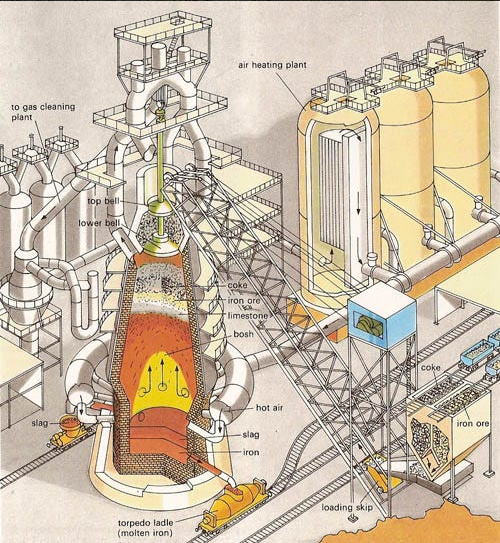
We probably need to start this out by explaining exactly what a blast furnace is and why it is important if you want to be a sovereign nation.
First of all, what it does;
The purpose of blast furnace is to chemically reduce and physically convert iron oxide into liquid iron called “hot metal” The blast furnace is a huge, steel stack lined with refractory brick where iron ore, coke and limestone are charged into the top and preheated air is blown into the bottom. The raw materials require 6 to 8 hours to descend to the bottom of the furnace where they become the final product of liquid slag and liquid iron. These liquid products are drained from the furnace at regular intervals. The hot air that was blown into the bottom of the surface ascends to the top in 6 to 8 seconds after going through numerous chemical reactions. Once the blast furnace is started it continuously runs for four to ten years with only short stops to perform planned maintenance.
Why are blast furnaces so important? Remember the middle part of Billy Joel’s “Iron, coke, chromium steel?”
“Coke” is in essence purified coal, almost pure carbon. It is about the only thing that can at scale make “new” or raw iron, aka “pig iron”. Only coke in a blast furnace can make enough heat to turn iron ore in to iron. You can’t get that heat with an electric furnace.
Pig iron is the foundation of everything that follows that makes an industrial power. If you cannot make your own pig iron, you are just LARP’n as a real power.
It takes a semester at least to understand this, but here is all you really need to know;
Primary differences
While the end product from each of these is comparable, there are clearly differences between their capabilities and process. Comparing each type of furnace, the major distinctions are:
Material source – blast furnaces can melt raw iron ore as well as recycled metal, while electric arc furnaces only melt recycled or scrap metal.
Power supply – blast furnaces primarily use coke to supply the energy needed to heat up the metal, while EAFs use electricity to accomplish this.
Environmental impact – because of the fuels used for each, EAFs can produce up to 85% less carbon dioxide than blast furnaces.
Cost – EAFs cost less than blast furnaces and take up less space in a factory.
Efficiency – EAFs also reach higher temperatures much faster and can melt and produce products more quickly, as well as having more precise control over the temperature compared to blast furnaces.
We’ll get to that environmental impact later, but the “Material source” section is your money quote.
Without a blast furnace, all you can do is recycle scrap iron.
You cannot fight wars at scale if all you have is scrap iron. You cannot be an industrial hub off of just scrap iron. If you are a nation of any size, you then become economically and security vulnerable at an existential level. I don’t care how much science fiction you get nakid and roll in; wars are won by steel, ungodly amounts of steel.
Where do you get the steel to build your warships? Your tanks? Your factories? Your buildings? Your factories?
If you can only use scrap, then you are simply a scavenger living off the hard work of previous generations. Eventually you run out. You will wind up like the cypress mills of old Florida where, once they ran out of cypress trees, they simply sold off the cypress lumber their mills were constructed of … and then went bankrupt.
Comments Off on “If you cannot make your own pig iron, you are just LARP’n as a real power”
The Future of Railways (circa 1961)
Jago Hazzard
Published 26 Jul 2023The future is slightly dingy.
(more…)
Comments Off on The Future of Railways (circa 1961)


