
Sumer just before the dawn of civilization was in many ways an idyllic place. Forget your vision of stark Middle Eastern deserts; in the Paleolithic the area where the first cities would one day arise was a great swamp. Foragers roamed the landscape, eating everything from fishes to gazelles to shellfish to wild plants. There was more than enough for everyone; “as Jack Harlan famously showed, one could gather enough [wild] grain with a flint sickle in three weeks to feed a family for a year”. Foragers alternated short periods of frenetic activity (eg catching as many gazelles as possible during their weeklong migration through the area) with longer periods of rest and recreation.
Intensive cereal cultivation is miserable work requiring constant toil with little guarantee of a good harvest. Why would anyone leave this wilderness Eden for a 100% wheat diet?
Not because they were tired of wandering around; Scott presents evidence that permanent settlements began as early as 6000 BC, long before Uruk, the first true city-state, began in 3300. Sometimes these towns subsisted off of particularly rich local wildlife; other times they practiced some transitional form of agriculture, which also antedated states by millennia. Settled peoples would eat whatever plants they liked, then scatter the seeds in particularly promising-looking soil close to camp – reaping the benefits of agriculture without the back-breaking work.
And not because they needed to store food. Hunter-gatherers could store food just fine, from salting animal meat to burying fish and letting it ferment to just having grain in siloes like everyone else. There is ample archaeological evidence of all of these techniques. Also, when you are surrounded by so much bounty, storing things takes on secondary importance.
And not because the new lifestyle made this happy life even happier. While hunter-gatherers enjoyed a stable and varied diet, agriculturalists subsisted almost entirely on grain; their bones display signs of significant nutritional deficiency. While hunter-gatherers were well-fed, agriculturalists were famished; their skeletons were several inches shorter than contemporaneous foragers. While hunter-gatherers worked ten to twenty hour weeks, agriculturalists lived lives of backbreaking labor. While hunter-gatherers who survived childhood usually lived to old age, agriculturalists suffered from disease, warfare, and conscription into dangerous forced labor.
Scott Alexander, “Book Review: Against The Grain“, Slate Star Codex, 2019-10-15.
April 15, 2024
QotD: Cereal cultivation also helped grow the centralized state
April 14, 2024
Soviets Take Vienna and Königsberg – WW2 – Week 294 – April 13, 1945
World War Two
Published 13 Apr 2024The prizes of Vienna and Königsberg fall to the Soviets as they continue what seems an inexorable advance. In the West the Allies advance to the Elbe River, but there they are stopped by command. The big news in their national papers this week is the death of American President Franklin Roosevelt, which provokes rejoicing in Hitler’s bunker. The Allied fighting dash for Rangoon continues in Burma, as does the American advance on Okinawa, although Japanese resistance is stiffening and they are beginning counterattacks.
Chapters
00:32 Recap
01:05 Operation Grapeshot
01:57 Roosevelt Dies
06:01 Soviet Attack Plans for Berlin
12:45 Stalin’s Suspicions
14:31 The fall of Königsberg
17:02 The fall of Vienna
18:38 Japanese Resistance on Okinawa
20:34 The War in China
21:09 Burma and the Philippines
22:38 Summary
22:57 Conclusion
25:05 Memorial
(more…)
Elmer Keith’s Revolver Number 5
Forgotten Weapons
Published Feb 28, 2015Elmer Keith’s No.5 Single Action Army is arguably the most famous custom revolver ever made. Keith had it built in 1928 after developing a friendship with Harold Croft, another revolver enthusiast. Croft had shown Keith his own custom revolvers, which he had numbered 1 through 4. Croft had been trying to make an ideal pocket gun, and Keith used several of his ideas along with some of Keith’s own to put together a revolver for general-purpose field use. In recognition of Croft’s work, Keith called his gun Number 5. It featured an extended flat top with windage-adjustable sights, an improved mainspring, redesigned cylinder pin, custom hammer spur, and modified Bisley grip. It was chambered for the .44 Special/.44 Russian cartridges (the Russian being a slightly shorter version of the Special), and it was Keith’s favorite shooting piece until the .44 Magnum cartridge was introduced in the late 1950s. He described this gun in detail in a 1929 American Rifleman article entitled “The Last Word”.
http://www.forgottenweapons.com
Theme music by Dylan Benson – http://dbproductioncompany.webs.com
QotD: Imperium in the Roman Republic
That power was represented visually around the person of magistrates with imperium through the lictors (Latin: lictores), attendants who follows magistrates with imperium, mostly to add dignity to the office but who also could act as the magistrate’s “muscle” if necessary. The lictors carried the fasces, a set of sticks bundled together in a rod; often in modern depictions the bundle is thick and short but in ancient artwork it is long and thin, the ancient equivalent of a policeman’s less-lethal billy club. That, notionally non-lethal but still violent, configuration represented the imperium-bearing magistrate’s civil power within the pomerium (recall, this is the sacred boundary of the city). When passing beyond the pomerium, an axe was inserted into the bundle, turning the non-lethal crowd-control device into a lethal weapon, reflective of the greater power of the imperium-bearing magistrate to act with unilateral military violence outside of Rome (though to be clear the consul couldn’t just murder you because you were on your farm; this is symbolism). The consuls were each assigned 12 lictors, while praetors got six. Pro-magistrates [proconsuls and propraetors] had one fewer lictor than their magistrate versions to reflect that, while they wielded imperium, it was of an inferior sort to the actual magistrate of the year.
What is notable about the Roman concept of imperium is that it is a single, unitary thing: multiple magistrates can have imperium, you can have greater or lesser forms of imperium, but you cannot break apart the component elements of imperium.1 This is a real difference from the polis, where the standard structure was to take the three components of royal power (religious, judicial and military) and split them up between different magistrates or boards in order to avoid any one figure being too powerful. For the Romans, the royal authority over judicial and military matters were unavoidably linked because they were the same thing, imperium, and so could not be separated. That in turn leads to Polybius’ awe at the power wielded by Roman magistrates, particularly the consuls (Polyb. 6.12); a polis wouldn’t generally focus so much power into a single set of hands constitutionally (keeping in mind that tyrants are extra-constitutional figures).
So what does imperium empower a magistrate to do? All magistrates have potestas, the power to act on behalf of the community within their sphere of influence. Imperium is the subset of magisterial potestas which covers the provision of violence for the community and it comes in two forms: the power to raise and lead armies and the power to organize and oversee courts. Now we normally think of these powers as cut by that domi et militiae (“at home and on military service”) distinction we discussed earlier in the series: at home imperium is the power to organize courts (which are generally jury courts, though for some matters magistrates might make a summary judgement) and abroad the power to organize armies. But as we’ll see when we get to the role of magistrates and pro-magistrates in the provinces, the power of legal judgement conferred by imperium is, if anything, more intense outside of Rome. That said it is absolutely the case that imperium is restrained within the pomerium and far less restrained outside of it.
There were limits on the ability of a magistrate with imperium to deploy violence within the pomerium against citizens. The Lex Valeria, dating to the very beginning of the res publica stipulated that in the case of certain punishments (death or flogging), the victim had the right of provocatio to call upon the judgement of the Roman people, through either an assembly or a jury trial. That limit to the consul’s ability to use violence was reinforced by the leges Porciae (passed in the 190s and 180s), which protected civilian citizens from summary violence from magistrates, even when outside of Rome. That said, on campaign – that is, militae rather than domi – these laws did not exempt citizen soldiers from beating or even execution as a part of military discipline and indeed Roman military discipline struck Polybius – himself an experienced Greek military man – as harsh (Polyb. 6.35-39).
In practice then, the ability of a magistrate to utilize imperium within Rome was hemmed in by the laws, whereas when out in the provinces on campaign it was far less limited. A second power, coercitio or “coercion” – the power of a higher magistrate to use minor punishments or force to protect public order – is sometimes presented as a distinct power of the magistrates, but I tend to agree with Lintott (op. cit., 97-8) that this rather overrates the importance of the coercive powers of magistrates within the pomerium; in any case, the day-to-day maintenance of public order generally fell to minor magistrates.
While imperium was a “complete package” as it were, the Romans clearly understood certain figures as having an imperium that outranked others, thus dictators could order consuls, who could order praetors, the hierarchy neatly visualized by the number of lictors each had. This could create problems, of course, when Rome’s informal systems of hierarchy conflicted with this formal system, for instance at the Battle of Arausio, the proconsul Quintus Servilius Caepio refused to take orders from the consul, Gnaeus Mallius Maximus, because the latter was his social inferior (being a novus homo, a “new man” from a family that hadn’t yet been in the Senate and thus not a member of the nobiles), despite the fact that by law the imperium of a sitting consul outranked that of a pro-consul. The result of that bit of insubordination was a military catastrophe that got both commanders later charged and exiled.
Finally, a vocabulary note: it would be reasonable to assume that the Latin word for a person with imperium would be imperator2 because that’s the standard way Latin words form. And I will say, from the perspective of a person who has to decide at the beginning of each thing I write what circumlocution I am going to use to describe “magistrate or pro-magistrate with imperium“, it would be remarkably fortunate if imperator meant that, but it doesn’t. Instead, imperator in Latin ends up swallowed by its idiomatic meaning of “victorious general”, as it was normal in the republic for armies to proclaim their general as imperator after a major victory (which set the general up to request a triumph from the Senate). In the imperial period, this leads to the emperors monopolizing the term, as all of the armies of Rome operated under their imperium and thus all victory accolades belonged to the emperor. That in turn leads to imperator becoming part of the imperial title, from where it gives us our word “emperor”.
That said, the circumlocution I am going to use here, because this isn’t a formal genre and I can, is “imperium-haver”. I desperately wish I could use that in peer reviewed articles, but I fear no editor would let me (while Reviewer 2 will predictably object to “general”, “commander” or “governor” for all being modern coinages).3
Bret Devereaux, “Collections: How to Roman Republic 101, Part IIIb: Imperium”, A Collection of Unmitigated Pedantry, 2023-08-18.
1. I should note here that Drogula (in Commanders and Command (2015)) understands imperium a bit differently than this more traditional version I am presenting (in line with Lintott’s understanding). He contends that imperium was an entirely military power which was not necessary for judicial functions and was not only indivisible but also, at least early on, did not come in different degrees. In practice, I’m not sure the Romans were ever so precise with their concepts as Drogula wants them to be.
2. Pronunication note because this bothers me when I hear this word in popular media: it is not imPERator, but impeRAtor, because that “a” is long by nature, and thus keeps the stress.
3. And yes, really, I have had reviewers object to “general” or “commander” to mean “the magistrate or pro-magistrate with imperium in the province”. There is no pleasing Reviewer 2.
April 13, 2024
When there was an active counterculture
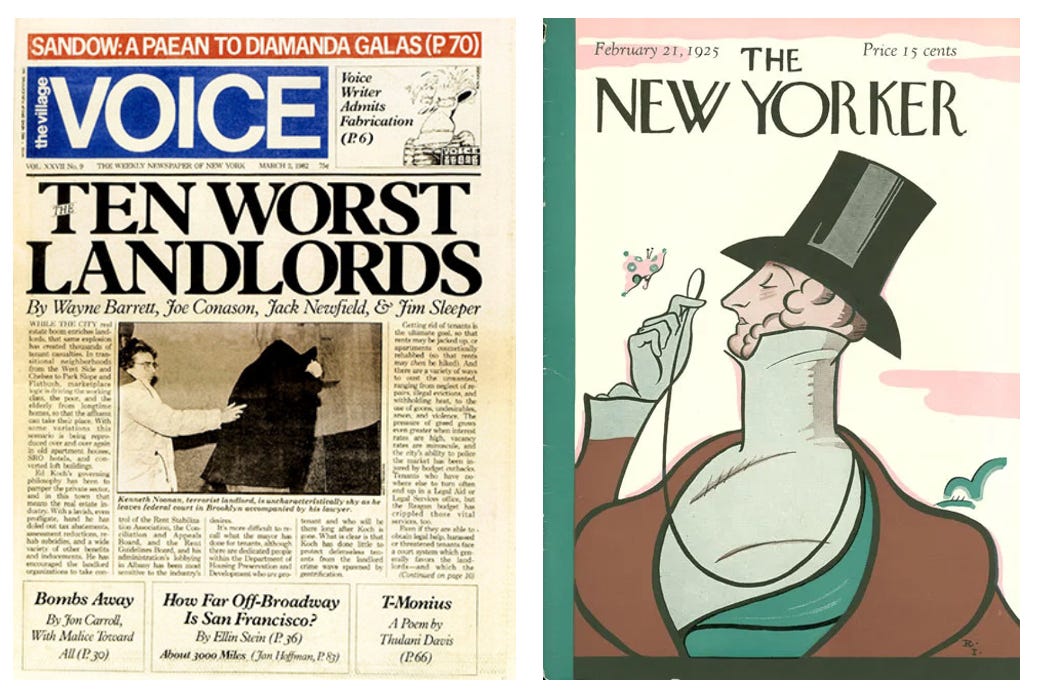
Ted Gioia on a recent oral history of the countercultural touchstone, The Village Voice:
At the start of her oral history of The Village Voice, author Tricia Romano provides a “cast of characters”. It goes on for 15 pages, and includes 216 people — each with some connection to the alternative newspaper.
Many people nowadays have never lived in a society with such a vibrant counterculture. In a time when official sources all seem part of a predictable Disney-fied monoculture, just reading this list of names and mini-bios can be a revelation.
Many of these individuals are now revered as historic figures who changed society. They had power and prestige. It’s easy to forget that most of them operated as outsiders.
That’s how they wanted it.
These renegades at The Village Voice knew that working outside the system — and typically against the system — was their superpower. They could criticize ruling institutions. They could speak harsh truths. They could go against the grain.
One thing is certain: They didn’t align their interests with globalist corporate CEOs, billionaire technocrats, the surveillance state, and establishment bureaucracies. They would have laughed at journalists who did that — believing, rightly, that honest media requires distance, or even an adversarial stance, vis-à-vis entrenched powers.
Because that’s what a counterculture does. That’s what it’s expected to do.
Romano captures the peculiar vibe in the title of her book The Freaks Came Out to Write. She makes clear that The Village Voice wasn’t The New York Times and it definitely wasn’t The New Yorker.
Nobody ever stepped into its madcap offices and said “Ah, the Gray Lady”. No reader ever picked up a copy and expected to see Eustace Tilley on the cover.
Can you tell the difference between culture and counterculture?
And The Voice was heard. Even establishment insiders knew they needed to listen to these “Freaks”. Sometimes they feared The Voice, sometimes they secretly agreed with it, but they always treated it as a force deserving respect.
Until recently that’s how it worked. The tension between insiders and outsiders was a source of creative energy in society. The upstarts provided alternative views and new ideas. They kept everybody accountable.
I’m pointing this out because this no longer happens. This is the world we’ve lost.
The Death of Franklin Roosevelt
World War Two
Published 12 Apr 2024He lead his nation through the Great Depression, transformed it into a war-winning titan, and is working to shape the coming postwar world in his image. But today, 4,422 days into his record breaking presidency, Franklin Roosevelt dies. What was his final year really like?
(more…)
“One of the banes of the traditionalist and neoreactionary is ideology”
Theophilus Chilton urges conservatives to rebuild the crucial social structures that modern life has so signally undermined: churches, the männerbund, and militias (and no, I’d never heard of männerbund either).
One of the banes of the traditionalist and neoreactionary is ideology. Now, any thinking person has a worldview, a comprehensive picture of how they view the world and interpret what they see around them that is based on their experiences, education, and background. However, this is not what is meant with the term “ideology.” Instead, an ideology is a set of beliefs – often unsubstantiated – which are held in a doctrinaire fashion, even in the face of any and all evidences that the beliefs are wrong. Moreover, ideologues will demand adherence to these beliefs, and will actively seek to ridicule and punish those who do not sufficiently fill out the list of checkboxes demanded by the ideology. In short, an ideology is a way for people to avoid having to think for themselves, to resist bringing their worldview into line with reality as it is manifested around them. The key to the concept here is not that of having a cohesive worldview, but the fact that this worldview is held in spite of any countervailing evidence. The ideologue refuses to consider any evidences or objections to his belief system, and will try to find ways (accusing his opponent of being racist, sexist, etc.) to get around having to deal with them.
One such ideology is modern American conservatism, along with its close relative by cousin marriage libertarianism. Just as much as modern neoliberalism demands a blind adherence to a rigidly held set of ideological positions which are increasingly out of step with human nature and reality, so also does modern conservatism. One of the most obvious examples of this is the conservative/libertarian idolisation of “rugged individualism” and “the sovereign individual”. Indeed, these folks have created an elaborate mythology which places the “rugged individual” at the centre of the American experience throughout our history. Like most beliefs built on a purely ideological foundation, this mythology is deeply held while being deeply out of touch with actual history and reality.
If I were to make this criticism on a typical conservative site such as Free Republic, it would be roundly met with automatic and unreasoning condemnation. How dare I suggest that Americans should be anything less than atomised individuals with no connexions or associations of community to each other! I must be the reincarnation of Josef By-George Stalin!
And yet, the whole history of America has been one of traditional communities acting in concert. The Revolution was driven by citizen associations formed in churches and taverns, who then fought as community militias. The settling of the West was not done by individuals, by and large, but by groups who traveled by wagon train for mutual support and self-defence. Even today, most local community matters are handled by citizens acting together. While the individuals in American history may have been rugged, they were not alone. America, like most other traditional Western societies from the classical period forward, was communitarian and group oriented.
In other words, there is ample evidence which suggests that our choices don’t have to be either Ayn Rand or Bernie Sanders. There is a third option, which is to recognise the organic bonds of community, society, and nation which bind men together.
This is important for us to keep in mind today because there are any number of influences due to the modernism of our world today which act to draw people away from community and the positive associative bonds we used to have with each other. One of these which I’ve discussed previously is the set of social phenomena surrounding the creation of suburbia after World War II. Our forms of popular entertainment work toward this end as well – instead of towns and villages coming together to celebrate births, marriages, and deaths with song, dance, and competitions, modern American man sits alone in front of his television or in a darkened movie theatre where he’s not allowed to talk to those sitting next to him. Modern American religion plays into this as well, with its selfish emphasis on “what church can do for me”, rather than the other way around, and where Americans “church hop” from assembly to assembly, never integrating into a body of believers, but always flitting about looking for the next new program for their kids.
I say that we ought to reject this modernism as inferior to what we once had. In place of the atomised individual of conservative and libertarian phantasies, those of us in tradition and neoreaction ought to seek to restore and then strengthen traditional social bonding institutions.
The three institutions which I’d like to discuss in particular here are churches, the männerbund, and militias. Each of these institutions play different, yet complementary, roles in communitarian society. Each also, I believe, appeals particularly to one of the three complementary and interdependent tripartite divisions (spirit, soul, and body) of the holistic makeup of man.
The Legend of the Wiener Schnitzel
Tasting History with Max Miller
Published Jan 9, 2024Variations of wienerschnitzel throughout history and its legendary origin stories, and a recipe for a 19th century version.
Fried breaded veal cutlets served with the traditional lemon wedges and parsley
City/Region: Vienna
Time Period: 1824Breaded and fried meat has been around for a very long time in many places, but it wasn’t until 1893 that we get the first mention of the word wienerschnitzel. Then in the early 20th century, the Austrian culinary scene decided to champion this term to refer to a veal cutlet that is made into a schnitzel, and restaurants in Vienna began specializing in schnitzel.
This recipe predates the term wienerschnitzel, and unlike modern versions it isn’t dredged in flour first. This makes it so that the breading doesn’t puff away from the meat, but the flavor is rich and delicious, just like I remember from my trip to Vienna. If you don’t like veal or don’t want to use it, you can use pork or chicken. It won’t technically be wienerschnitzel, but nobody’s going to judge you. You can also use another fat instead of the clarified butter, but butter gives the best flavor.
(more…)
QotD: Architects and modern architecture
Professor Curl’s is a very painful book to read. In one sense his targets are easy for, as the photos amply demonstrate, modernist architecture and its successors are so awful that it scarcely requires any powers of judgment to perceive it. It is like seeing a TV evangelist and knowing at once that he is a crook. Yet modernist architecture, despite its patent hideousness and inhumanity, still has its defenders, especially in the purlieus of architectural schools. Moreover, the population has been browbeaten into believing that there was never any alternative, and it is obvious that to undo the damage would take decades, untold determination and vast expenditure. Removing the Tour Montparnasse alone would probably cost several billion. No one is prepared to make this colossal effort.
What Walter Godfrey wrote in 1954 is debatable:
It is not an exaggeration to say that nine men out of ten have lost all sensitiveness to an art that was once a matter of common interest.
If this is true, it is because they have learned to accept, or swallow what they are given. The epidemiology of graffiti, however, suggests to me that, at least subliminally, men still take notice of their surrounding and are affected by them: defacement is overwhelmingly of hideous Corbusian surfaces, that is to say on what Corbusier called “my friendly concrete”.
As for the architects and their acolytes, the architectural commentators, they hide behind the claim that most people do not “understand”. They claim that modernist architecture is better than it looks or functions, that it is “honest”, a weaselly word in this context. The architects cannot recognise the obvious for the same reason that Macbeth could not stop murdering once he had started:
I am in blood
Stepped in so far that should I wade no more
Returning were as tedious as to go o’reProfessor Curl has written an essential, uncompromising, learned, sometimes slightly densely, critique of one of the worst and most significant legacies of the 20th century. He offers a slight glimmer of hope in the existence of architects who, bravely, have resisted the blandishments of celebrity status and the approbation of their corrupted peers. His book has a wonderful bibliography, the fruit of a lifetime of reading and reflection, that will give me occupation for a long time to come. It is a loud and salutary clarion call to resist further architectural fascism.
Theodore Dalrymple, “Architectural Dystopia: A Book Review”, New English Review, 2018-10-04.
April 12, 2024
Greek History and Civilization, Part 6 – The Search for Stability
seangabb
Published Apr 7, 2024This sixth lecture in the course deals with the period of Greek history between the end of the Persian Wars and the assassination of Philip II of Macedon.
(more…)
FURY – How a Museum with a Sherman Made a Movie
The Tank Museum
Published Jan 5, 2024If you enjoyed the 2014 movie FURY, watch this and get the inside scoop behind The Tank Museum’s role in David Ayer’s Hollywood production. Ten years on from its release, David Willey describes how one of The Tank Museum’s Shermans and Tiger 131 took starring roles alongside Brad Pitt, Shia LaBeouf, Logan Lerman, Michael Peña, and Jon Bernthal. From initial discussions to the red carpet, David reveals every inch of the process, the lessons learned and the impact it has had on The Tank Museum.
Let us know what you thought of FURY and our tank’s performance in it in the comments below… What else would you like to know?
00:00 | Intro
00:50 | Fury – The Beginning
02:48 | Tiger Inquiries
05:00 | Insurance & Contracts
08:06 | Hollywood in Dorset
09:51 | On Set & Filming
14:55 | Was it worth it?
16:34 | Fury’s Longevity
(more…)
QotD: Prepper fantasy versus prepper reality
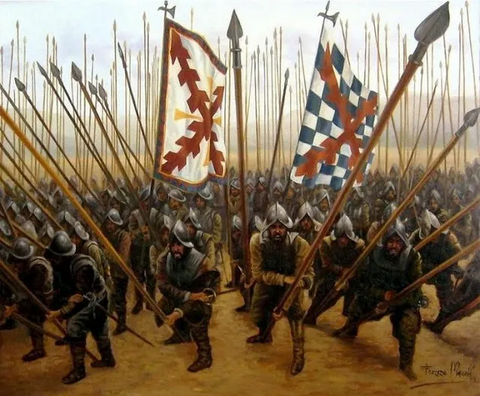
The thing is these stories are totally ahistorical — the best that solitary survivors have ever managed was to survive, none of them have rebuilt civilization. As Jane notes in her review of BAP, the sandal-clad barbarians have generally been subjected to a “tyranny of the cousins” even more intrusive and meticulous than the gynocratic safetyism that Bronze Age Lifestyle offers an imaginative escape from. And as for the pioneers, Tanner Greer notes that:
Many imagine the great American man of the past as a prototypical rugged individual, neither tamed nor tameable, bestriding the wilderness and dealing out justice in lonesome silence. But this is a false myth. It bears little resemblance to the actual behavior of the American pioneer, nor to the kinds of behaviors and norms that an agentic culture would need to cultivate today. Instead, the primary ideal enshrined and ritualized as the mark of manhood was “publick usefuleness”, similar, if not quite identical, to the classical concept of virtus. American civilization was built not by rugged individuals but by rugged communities. Manhood was understood as the leadership of and service to these communities.
It would be too easy to end the review here, with the implication that the prepper identity is a fantasy of radical individualism and like all such fantasies, kinda dumb. But the thing is, the prepper world has by and large absorbed this critique and incorporated it into its theorizing. In contrast to the libertarian fantasies of the 1970s, second-wave prepperism (reformed prepperism?) is constantly talking about community, the importance of having friends you can trust, of cultivating deep social bonds with your neighbors, etc.
What Yu Gun reminds us is that this is still totally ahistorical, but this time in a way that indicts not only the preppers, but also a much broader swathe of our society. A man without a community is unnatural, but so is a community without leadership, hierarchy, and order. The prepper version of community is a vision of freely contracting individuals respecting each others’ autonomy while cooperating because it’s in their best interests. This is also the folk version of community that motivates much of our economic and legal regime. Scratch an American “communitarian”, and underneath it’s just another individualist.
If you hang out on prepper forums, a recurrent mantra is to “practice your preps”, that is to start living on the margin as if the apocalypse had already occurred. The purpose of this is to gain experience in the skills you’ll need after the end, and to work out the kinks in your routine now, while it’s still easy to make adjustments. Originally this meant practicing getting lost in the woods, using and maintaining your weapon of choice, eating some of your food stockpile, or whatever. In second-wave prepperism it means all that, plus a bunch of new stuff like hanging out with your neighbors, attending community barbecues, and whatever else it is that freely contracting individuals like to autonomously do while temporarily occupying the same space.
But for we third-wave preppers, it has to take on a very different meaning. Greer’s essay that I quoted above is mainly about how leadership and service in local-scale organizations served as training for leadership and service in much larger groups aimed at problems with much higher stakes. In other words, they were practicing their preps. One of the great secrets of leadership is that following and leading are actually closely related skills, and that practice at one of them transfers well to the other. This is difficult for we Americans to see, because an aversion to hierarchy is built into our national character, and consequently we operate with impoverished models of what it means to be in a position of authority or of subordination.
Long ago I read an article contrasting Western and Korean massively-multiplayer online role-playing games (MMORPGs). Even if you know nothing about computer games, you probably know that in most of them you are the hero, the chosen one, the child of destiny. Talk about fantasies of agency! MMORPGs thus have a tricky needle to thread — somehow all the thousands and thousands of players need to simultaneously be the chosen one, the child of destiny, etc., etc. And they mostly accomplish this by just rolling with it and asking everybody to suspend disbelief. But this article claimed that Korean MMORPGs are different — when players join these games, they’re randomly assigned a role. A tiny fraction might become kings or generals or children of destiny, with the power to decide the fates of peoples and kingdoms, but most are given a role as ordinary soldiers or porters or blacksmiths, and toil away at their in-game mundane tasks, without much ability to affect anything at all.
We like to imagine that after the bombs fall and the smoke clears we will emerge as the new Yu Gun, apportioning merit and assigning tasks. And perhaps you will indeed be called upon to do that, so you should prepare yourself to step up and do it. That preparation will involve some practice commanding others and some practice obeying others’ commands, because the two are inextricably bound together. But in life as in Korean video games, there’s isn’t very much room at the top. Far more likely, when the stage of history is set, we will be cast in a supporting role, like the Korean gamer assigned to role-play as a peasant or like Yu’s followers standing in orderly ranks. Let us not turn our noses up at this vocation, the poorly-behaved seldom make history.
John Psmith, “REVIEW: Medieval Chinese Warfare, 300-900 by David A. Graff”, Mr. and Mrs. Psmith’s Bookshelf, 2023-06-05.
April 11, 2024
All the ways A few of the ways Canada is broken
In The Line, Andrew Potter outlines some of the major political and economic pressures that prompted the formation of the Dominion of Canada in 1867, then gets into all the ways some of the myriad ways that Canada is failing badly:

It is useful to remember all this, if only to appreciate the extent to which Canada has drifted from its founding ambitions. Today, there are significant interprovincial barriers to trade in goods and services, which add an estimated average of seven per cent to the cost of goods. Not only does Canada not have a free internal market in any meaningful sense, but the problem is getting worse, not better. This is in part thanks to the Supreme Court of Canada which continues its habit of giving preposterously narrow interpretations to the clear and unambiguous language in the constitution regarding trade so as to favour the provinces and their protectionist instincts.
On the defence and security front, what is there to say that hasn’t been said a thousand times before. From the state of the military to our commitments to NATO to the defence and protection of our coasts and the Arctic to shouldering our burden in the defence of North America, our response has been to shrug and assume that it doesn’t matter, that there’s no threat, or if there is, that someone else will take care of it for us. We live in a fireproof house, far from the flames, fa la la la la. Monday’s announcement was interesting, but even if fully enacted — a huge if — we will still be a long way from a military that can meet both domestic and international obligations, and still a long way from the two per cent target.
As for politics, only the most delusional observer would pretend that this is even remotely a properly functioning federation. Quebec has for many purposes effectively seceded, and Alberta has been patiently taking notes. Saskatchewan is openly defying the law in refusing to pay the federal carbon tax. Parliament is a dysfunctional and largely pointless clown show. No one is happy, and the federal government is in some quarters bordering on illegitimacy.
All of this is going on while the conditions that motivated Confederation in the first place are reasserting themselves. Global free trade is starting to go in reverse, as states shrink back from the openness that marked the great period of liberalization from the early 1990s to the mid 2010s. The international order is becoming less stable and more dangerous, as the norms and institutions that dominated the post-war order in the second half of the 20th century collapse into obsolescence. And it is no longer clear that we will be able to rely upon the old failsafe, the goodwill and indulgence of the United States. Donald Trump has made it clear he doesn’t have much time for Canada’s pieties on either trade or defence, and he’s going to be gunning for us when he is returned to the presidency later this year.
Ottawa’s response to all of this has been to largely pretend it isn’t happening. Instead, it insists on trying to impose itself on areas of provincial jurisdiction, resulting in a number of ineffective programs — dentistry, pharmacare, daycare, and now, apparently, school lunches — that are anything but national, and which will do little more than annoy the provinces while creating more bureaucracy. Meanwhile, the real problems in areas of clear federal jurisdiction just keep piling up, but the money’s all been spent, so, shrug emoji.
What to do? We could just keep going along like this, and follow the slow-mo train wreck that is Canada to its inevitable end. That is is the most likely scenario.
The CIA would “brief the press on matters of national importance … when ‘we, the CIA, wanted to circulate disinformation on a particular issue'”
Jon Miltimore outlines the fascinating revelations from 1983 about how the CIA directly manipulated American journalists to propagandize certain issues in the way the Agency desired:

One of Snepp’s many jobs at the Agency was to brief the press on matters of national importance. Or in Snepp’s words, when “we, the CIA, wanted to circulate disinformation on a particular issue”.
Snepp made this statement in a 1983 interview (see above) that I’d encourage readers to watch. In the video, the former CIA analyst discusses how the CIA manipulates journalists with lies and half-truths in pursuit of its own agendas.
For instance, if we wanted to get across to the American public that the North Vietnamese were building up there force structure in South Vietnam, I would go to a journalist and advise him that in the past 6 month X number of North Vietnamese forces had come down the Ho Chi Minh Trail system through southern Laos. There is no way a journalist can check that information, so either he goes with that information or he doesn’t. Usually the journalist goes with it, because it looks like some kind of exclusive.
What Snepp was describing was one of the most simple tactics the CIA has used for decades to control information. He said the success rate of planting these stories in the media was 70-80 percent.
“The correspondents we targeted were those who had terrific influence, the most respected journalists in Saigon,” Snepp said.
Snepp even offered the names of the journalists he successfully targeted: Bud Merrick of US News and World Report; Robert Chaplin of the New Yorker; Malcom Brown of the New York Times; and others.
Snepp worked his way into these journalists’ trust exactly as one would expect.
“I would be directed to cultivate them, to spend time with them at the Caravel Hotel or the Continental Hotel, to socialize with them, to slowly but surely gain their confidence,” Snepp said.
All of this sounds sleazy, but it gets worse.
SVT-40: The Soviet Standard Semiauto from WW2
Forgotten Weapons
Published Jan 10, 2024The Red Army was interested in developing a semiautomatic rifle clear back to the mid 1920s, and they spent about 15 years running trials and development programs to find one. First in 1930 a Degtyarev design was adopted, followed by the Simonov AVS-36, and then Tokarev won out in 1938 with the SVT-38. Combat experience in the Winter War led to an upgrade program to reduce the weight of the rifle, and that created the SVT-40. Between April 1940 and mid 1942, about 1.4 million SVT-40s were produced in three different factories. They were supposed to be the new standard infantry rifle and also the sniper’s rifle — although they ultimately failed to really be either.
In 1942, production shifted to the AVT-40, identical to the SVT-40 but with a trigger group capable of fully automatic fire. Another roughly 500,000 of these were produced by the end of the war, but the focus of small arms issue had changed to Mosins and submachine guns — options that were a lot cheaper to produce.
(more…)


