
It’s like the thing with the aprons, that science fiction writers older than I think that Heinlein was a sexist, because he has women wearing aprons. Instead of “Everyone who worked with staining liquids and fire wore aprons. Because clothes were insanely expensive, that’s why.” We stopped wearing aprons [because today] a pack of t-shirts at WalMart is $10. Nothing to do with sexism.
Sarah Hoyt, “Teaching Offense”, According to Hoyt, 2019-10-25.
April 10, 2024
QotD: Aprons
Comments Off on QotD: Aprons
April 9, 2024
Checking in on the front lines of paleontology research
Sarah Hoyt is amazed and surprised at some recent revelations about the latest paleontological discoveries:
Yesterday I did something I used to do more often, and looked into the latest discoveries in paleontology and archaeology and such.
And shortly after remembered why I no longer do it every month.
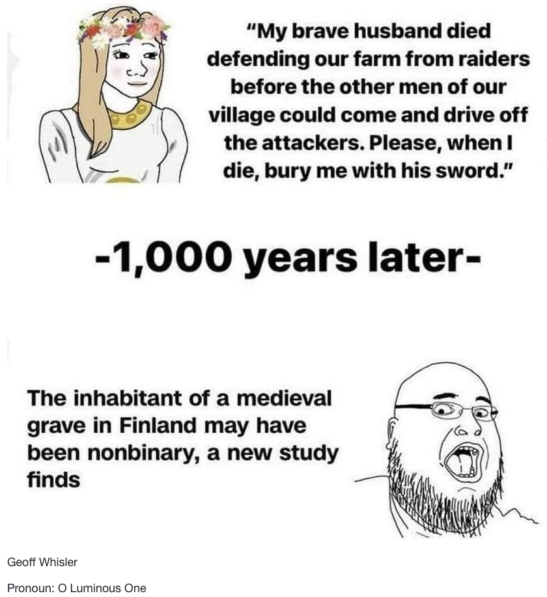
Apparently the latest, greatest news is that — yo, this is amazing — they’re finally not studying pre-history through the eyes of racism and sexism, and as such have determined that pre-historic hunting parties were as much as 80% female.
This is a discovery that of course makes perfect sense. No doubt the males were all back at base camp, chest-feeding the babies. Thereby freeing the pre-historic girl bosses to go and hunt them some mammoth.
If you’re staring at the screen with dropped jaws, I haven’t gone insane. I know this is utter and complete nonsense. It’s not my fault that the people running all our intellectual institutions, including research are morons studying to be idiots.
Applying the Heinlein filter for the actual reason they have to believe that up to 80% — 80%! — of pre-historic hunters were female, i.e. “Again and again, what are the facts?” we get that they found one grave — one — where the DNA of the remains are female (and here we’ll keep quiet about the strange idea that 6000 (I think) year old DNA is easily extracted, non-contaminated, etc. We’ll pretend we don’t know all the times they walked back “new species” because the DNA amplification techniques CREATED those discoveries.)
Let’s assume they’re correct and this was a female, buried with hunting implements. Sure, maybe she was a hunter. There will always be one or two in a large enough band, for the reason that in primitive societies some women are brought up as male: lack of a son, need to support the family, etc. (It is rarely a sexual thing, or because the person WANTED this. In fact it’s often decided for them before they are weaned. In fact, in primitive/ancient societies including the ones of our ancestors that we know about in detail, there was remarkably little room for self expression, self-conception or self interest. When you live close to the bone, such things are subjugated to the needs of the family, the clan, the tribe, more or less in that order. Because survival is hard.) We’re also informed, in BREATHLESS tones that it’s now thought that spear throwers were used to make sure women could throw spears fast enough! That’s why they exist.
But spear throwers are made and used by males, the world over. Go look at the tubes of you and you’ll see videos of people making them and using them, and they’re all male.
Further there is no society today of the ones still surviving more or less in a stone age way that has that kind of distribution for hunters. More importantly, there is no record of them, going as far back as we can.
Maybe this is because yes indeed, the past (being much closer to the bone, and therefore less willing to indulge in story telling) viewed things through a racist and sexist lens. Why not? After all I grew up in an intensely patriarchal society that still hadn’t adapted to the idea of women taking any hand in intellectual pursuits. And yes, that was unwarranted sexism. And every society is racist against every other (Actually culturist, but it’s often couched in terms of race.)
But still … You’d think that here and there there would be a race of valiant Amazons, whose men stay home and pound the taro while they go out and hunt, right?
But the truth is that if you put this notion to the remaining stone age people, they will laugh till they pee themselves. Yes, I know, I know, they internalized sexism from the evil white colonizers whom they’ve met three times in the last 100 years. That’s how powerful and evil whiteness is.
Or, listen, okay? I know this is just crazy talk, but maybe males and females are different and have evolved to fulfill different reproductive functions. And the reproductive function of females is more onerous than that of males. Women in our natural state, and unless something has gone seriously wrong — which of course makes us of less use to the tribe — spend most of our lives pregnant, nursing or carrying for children too young to care for themselves.
US PT Boats of WW2 – Guide 369
Drachinifel
Published Jan 6, 2024The PT Boats, fast attack craft of the United States Navy, is today’s subject.
(more…)
Comments Off on US PT Boats of WW2 – Guide 369
April 8, 2024
The Battle of Okinawa Begins – WW2 – Week 293 – April 6, 1945
World War Two
Published Apr 6, 2024It’s the next step toward invading Japan’s Home Islands — invading Okinawa, and it begins April 1st. Advances are easy by land, but at sea the kamikaze menace is in full swing. In Burma, plans are made to liberate Rangoon; in the west hundreds of thousands of Germans are surrounded in the Ruhr; and in the east, the Soviets begin assaults on Königsberg and Vienna.
(more…)
Comments Off on The Battle of Okinawa Begins – WW2 – Week 293 – April 6, 1945
Beecher’s Bible: A Sharps 1853 from John Brown’s Raid on Harpers Ferry
Forgotten Weapons
Published Jan 8, 2024On October 16, 1859 John Brown and 19 men left the Kennedy farmhouse and made their way a few miles south to the Harpers Ferry Arsenal. They planned to seize the Arsenal and use its arms — along with 200 Sharps 1853 carbines and 1,000 pikes they had previously purchased — to ignite and arm a slave revolt. Brown was a true fanatic for the abolitionist cause, perfectly willing to spill blood for a just cause. His assault on the Arsenal lasted three days, but failed to incite a rebellion. Instead of attracting local slaves to his banner, he attracted local militia and the US Marines. His force was besieged in the arsenal firehouse, and when the Marines broke through the doors they captured five surviving members of the Brown party, including Brown himself. All five were quickly tried and found guilty of murder, treason, and inciting negroes to riot. They were sentenced to death, and hanged on December 2, 1859.
Most of Brown’s 200 Sharps carbines were left in the farmhouse hideout, to be distributed when the insurrection took hold. These were found by local militia, among them the Independent Greys, and some were kept as souvenirs — including this example.
There is an intriguing historical question as to whether Brown’s raid was ultimately good for the country or not. It was extremely divisive at the time, and it can be argued that the raid was a major factor leading to Lincoln’s election and the Civil War. Could slavery have been abolished without the need for a cataclysmic war if John Brown had not fractured the Democratic Party? To what extent is killing for a cause justifiable? Do the ends always justify the means? John Brown had no doubts about his answers to these questions … but maybe he should have.
(more…)
Comments Off on Beecher’s Bible: A Sharps 1853 from John Brown’s Raid on Harpers Ferry
QotD: The classical Roman Republic
It is the things held in common. That ambiguity of meaning actually matters quite a bit because what the res publica was and what was important about it was different for different people. But naturally for some res to be publica, that meant other res needed to be privata; much like the polis was a collection of oikoi (and thus its ability to reach within the oikos as a unit was limited) so too the res publica was a collection of familiae (a word we’ll come back to, because it is complicated; it does not neatly mean “family”), the affairs of which were privatae, private.
What I think is worth noting as one of those subtle differences is how this contrasts with the Greek conception of the polis: a polis was fundamentally a collection of politai (citizens) whose institutions were their politeia (government, state). But the res publica is not a collection of citizens (Latin: cives), it is something distinct from them, held in common by them.
We can see this principle in the interesting phrase the Romans used to represent the senate: senatus populusque Romanus, “The Roman Senate and People” – usually abbreviated to SPQR.1 The division there is striking: there is a Roman People (the populus Romanus) and a Roman Senate and in some sense these are non-overlapping groups that together compose the republic. The Senate is not some sub-group of the populus but a distinct one with is a co-equal element of the republic with the populus.
Not only is the res publica thus not simply a collection of citizens, but it is in a real sense understood as a shared interest of different groups in the community, of which the populus is only one group. The Romans, more comfortable with open hierarchy among the citizens, can understand the republic as a balancing act between the interests of the political and social elite (the exact composition of which changes over time, but their mouthpiece is the Senate) and the people. The elite do not represent the people, they are not a select group of the people, but instead a distinct interest within the state which has its own legitimate expression, balanced against the expression of the people.
If all of that doesn’t make much sense, don’t worry: we’ll see these principles work themselves out in the way the res publica works and is structured.
Bret Devereaux, “Collections: How to Roman Republic 101, Part I: SPQR”, A Collection of Unmitigated Pedantry, 2023-07-21.
1. “Romanus” the adjective, modifies both senatus and populus, so both the Senate and the People are Roman. The phrase is often rendered into more idiomatic English as, “the Senate and People of Rome” to make that clearer.
Comments Off on QotD: The classical Roman Republic
April 7, 2024
Instructions for American Servicemen in Britain (1942)
Henry Getley on the US War Department publication Instructions for American Servicemen in Britain produced for incoming GIs on arrival in Britain from early in 1942:
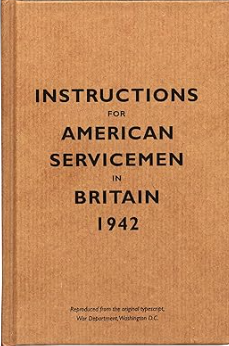
[W]ith their troops pouring into this country from 1942 onwards to prepare for D-Day, officials at the US War Department did their best to make the culture clash as trouble-free as possible. One of their main efforts was issuing GIs with a seven-page foolscap leaflet called Instructions for American Servicemen in Britain.
It’s available in reprint as a booklet and makes fascinating reading, not least for its straightforward, jargon-free writing style and its overriding message – telling the Yanks to use “plain common horse sense” in their dealings with the British.
In parts, it now seems clumsy and condescending. But its purpose was praiseworthy – to try to get American troops to damp down the impression that they were overpaid, oversexed and over here. Many GIs qualified in all three aspects, of course, but you couldn’t blame the top brass for trying.
The leaflet paints a sympathetic (some would say patronising) picture for the incoming Americans of a Britain – “a small crowded island of forty-five million people” – that had been at war for three years, having initially stood alone against Hitler and braved the Blitz. Hence this “cradle of democracy” was now a “shop-worn and grimy” land of rationing, the blackout, shortages and austerity. But beneath the shabbiness, there was steel.
The British are tough. Don’t be misled by the British tendency to be soft-spoken and polite. If need be, they can be plenty tough. The English language didn’t spread across the oceans and over the mountains and jungles and swamps of the world because these people were panty-waists.
There were helpful hints about cricket, football, darts, pounds, shillings and pence, warm beer and badly-made coffee. And because we are two nations divided by a common language, the Yanks were urged to listen to the BBC.
In England the “upper crust” speak pretty much alike. You will hear the newscaster for the BBC (British Broadcasting Corporation). He is a good example, because he has been trained to talk with the “cultured” accent. He will drop the letter “r” (as people do in some sections of our own country) and will say “hyah” instead of “here”. He will use the broad “a”, pronouncing all the a’s in “banana” like the “a” in father.
However funny you may think this is, you will be able to understand people who talk this way and they will be able to understand you. And you will soon get over thinking it’s funny. You will have more difficulty with some of the local accents. It may comfort you to know that a farmer or villager from Cornwall very often can’t understand a farmer or villager in Yorkshire or Lancashire.
The GIs were warned against bravado and bragging, being told that the British were reserved but not unfriendly. “They will welcome you as friends and allies, but remember that crossing the ocean doesn’t automatically make you a hero. There are housewives in aprons and youngsters in knee pants in Britain who have lived through more high explosives in air raids than many soldiers saw in first-class barrages during the last war.”
Comments Off on Instructions for American Servicemen in Britain (1942)
How Traditional English Stilton Cheese Is Made At A 100-Year-Old Dairy | Regional Eats
Insider Food
Published Dec 4, 2019Stilton cheese takes its name from the village of Stilton, in the east of England. The earliest reports of cheese made and sold here date to the 17th century. In 1724, English writer Daniel Defoe referred to the town being “famous for cheese”, calling the product the “English Parmesan”. Today, Stilton can only be made in six dairies, which are spread across three counties in England: Nottinghamshire, Leicestershire, and Derbyshire. We visited Colston Bassett Dairy in Nottinghamshire to learn more about the cheese is made.
For more, visit:
https://www.colstonbassettdairy.co.uk/——————————————————
(more…)
Comments Off on How Traditional English Stilton Cheese Is Made At A 100-Year-Old Dairy | Regional Eats
April 6, 2024
Italian Communists, the French in Indochina, and the fate of Italy’s army – WW2 – OOTF 34
World War Two
Published 5 Apr 2024What happened to Italian soldiers overseas after the fall of Mussolini? What about the French soldiers left over in Indochina after the Japanese “occupation by invitation”? And, what did the Allies think of the Italian Communist movement and its partisan forces?
(more…)
Comments Off on Italian Communists, the French in Indochina, and the fate of Italy’s army – WW2 – OOTF 34
The Fake (and real) History of Potato Chips
Tasting History with Max Miller
Published Jan 2, 2024The fake and true history of the potato chip and an early 19th century recipe for them. Get the recipe at my new website https://www.tastinghistory.com/ and buy Fake History: 101 Things that Never Happened: https://lnk.to/Xkg1CdFB
(more…)
Comments Off on The Fake (and real) History of Potato Chips
April 5, 2024
Ero: The Croatian Uzi (With Israeli Help?)
Forgotten Weapons
Published Jan 3, 2024The best of the submachine guns made in Croatia during the Homeland War was the Ero, made by a company called Arma. The Ero is a basically perfect, parts-interchangeable copy of the Israeli Uzi that was developed in 1992 and adopted into Croatian Army service in 1993. The only really distinguishable difference between the Ero and Uzi is the Ero’s use of Croatian-language selector markings (and receiver markings). Between 15,000 and 20,000 were produced, and they remained in service long after Croatian independence was secured. They were issued to vehicle crews, military police, special forces, and reconnaissance units.
Arma was a subsidiary of a major Croatian engineering firm, and after the Ero production it developed the APS-95 Croatian AK (which is a story for another video). They were a very competent company, but the details and quality of the Ero are so good that I believe it must have been made with tacit or explicit assistance from Israel. Croatia does have a strong Jewish community, and there were rumors during the war that the technical data package for the Uzi did find its way into Croatia. There is no official acknowledgement of this happening, but it would certainly not be hard to believe. But however the development happened, the result was a very high quality submachine gun.
A big thanks to the Croatian Police Museum (Muzej Policije) in Zagreb for giving me access to film this cool piece for you! Check them out at: https://muzej-policije.gov.hr
(more…)
Comments Off on Ero: The Croatian Uzi (With Israeli Help?)
April 4, 2024
See Inside Panther | Tank Chats Reloaded
The Tank Museum
Published Dec 29, 2023Chris Copson takes a detailed look inside and out, of arguably the most advanced German tank of WW2 … the Panther.
Is the Panther the formidable opponent that is was made out to be? Would the allies use such a vehicle and was it over engineered? Find out in today’s video.
00:00 Intro
00:54 Overview – Our Panther
02:41 War time variants & armour
06:06 Design
08:30 Weaponry
10:18 Crew, equipment and flaws – a look inside
17:53 Performance & conclusion
(more…)
Comments Off on See Inside Panther | Tank Chats Reloaded
QotD: What we mean by the term “indigenous”
But of course this is pedantic nitpicking (my speciality), because legally “indigenous” means “descended from the people who were there before European colonialism”: the Inuit are “indigenous” because they were in Newfoundland and Greenland when Martin Frobisher showed up, regardless of the fact that they had only arrived from western Alaska about five hundred years earlier. Indigineity in practice is not a factual claim, it’s a political one, based on the idea that the movements, mixtures, and wholesale destructions of populations since 1500 are qualitatively different from earlier ones. But the only real difference I see, aside from them being more recent, is that they were often less thorough — in large part because they were more recent. In many parts of the world, the Europeans were encountering dense populations of agriculturalists who had already moved into the area, killed or displaced the hunter-gatherers who lived there, and settled down. For instance, there’s a lot of French and English spoken in sub-Saharan Africa, but it hasn’t displaced the Bantu languages like they displaced the click languages. Spanish has made greater inroads in Central and South America, but there’s still a lot more pre-colonial ancestry among people there than there is pre-Bantu ancestry in Africa. I think these analogies work, because as far as I can tell the colonization of North America and Australia look a lot like the Early European Farmer and Bantu expansions (technologically advanced agriculturalists show up and replace pretty much everyone, genetically and culturally), while the colonization of Central and South America looks more like the Yamnaya expansion into Europe (a bunch of men show up, introduce exciting new disease that destabilizes an agricultural civilization,1 replace the language and heavily influence the culture, but mix with rather than replacing the population).
Some people argue that it makes sense to talk about European colonialism differently than other population expansions because it’s had a unique role in shaping the modern world, but I think that’s historically myopic: the spread of agriculture did far more to change people’s lives, the Yamnaya expansion also had a tremendous impact on the world, and I could go on. And of course the way it’s deployed is pretty disingenuous, because the trendier land acknowledgements become, the more the people being acknowledged start saying, “Well, are you going to give it back?” (Of course they’re not going to give it back.) It comes off as a sort of woke white man’s burden: of course they showed up and killed the people who were already here and took their stuff, but we’re civilized and ought to know better, so only we are blameworthy.
More reasonable, I think, is the idea that (some of) the direct descendants of the winners and losers in this episode of the Way Of The World are still around and still in positions of advantage or disadvantage based on its outcome, so it’s more salient than previous episodes. Even if, a thousand years ago, your ancestors rolled in and destroyed someone else’s culture, it still sucks when some third group shows up and destroys yours. It’s just, you know, a little embarrassing when you’ve spent a few decades couching your post-colonial objections in terms of how mean and unfair it is to do that, and then the aDNA reveals your own population’s past …
Reich gets into this a bit in his chapter on India, where it’s pretty clear that the archaeological and genetic evidence all point to a bunch of Indo-Iranian bros with steppe ancestry and chariots rolling down into the Indus Valley and replacing basically all the Y chromosomes, but his Indian coauthors (who had provided the DNA samples) didn’t want to imply that substantial Indian ancestry came from outside India. (In the end, the paper got written without speculating on the origins of the Ancestral North Indians and merely describing their similarity to other groups with steppe ancestry.) Being autochthonous is clearly very important to many peoples’ identities, in a way that’s hard to wrap your head around as an American or northern European: Americans because blah blah nation of immigrants blah, obviously, but a lot of northern European stories about ethnogenesis (particularly from the French, Germans, and English) draw heavily on historical Germanic tribal migrations and the notion of descent (at least in part) from invading conquerors.
One underlying theme in the book — a theme Reich doesn’t explicitly draw out but which really intrigued me — is the tension between theory and data in our attempts to understand the world. You wrote above about those two paradigms to explain the spread of prehistoric cultures, which the lingo terms “migrationism” (people moved into their neighbors’ territory and took their pots with them) and “diffusionism”2 (people had cool pots and their neighbors copied them), and which archaeologists tended to adopt for reasons that had as much to do with politics and ideology as with the actual facts on (in!) the ground. And you’re right that in most cases where we now have aDNA evidence, the migrationists were correct — in the case of the Yamnaya, most modern migrationists didn’t go nearly far enough — but it’s worth pointing out that all those 19th century Germans who got so excited about looking for the Proto-Indo-European Urheimat were just as driven by ideology as the 21st century Germans who resigned as Reich’s coauthors on a 2015 article where they thought the conclusions were too close to the work of Gustaf Kossinna (d. 1931), whose ideas had been popular under the Nazis. (They didn’t think the conclusions were incorrect, mind you, they just didn’t want to be associated with them.) But on the other hand, you need a theory to tell you where and how to look; you can’t just be a phenomenological petri dish waiting for some datum to hit you. This is sort of the Popperian story of How Science Works, but it’s more complex because there are all kinds of extra-scientific implications to the theories we construct around our data.
The migrationist/diffusionist debate is mostly settled, but it turns out there’s another issue looming where data and theory collide: the more we know about the structure and history of various populations, the more we realize that we should expect to find what Reich calls “substantial average biological differences” between them. A lot of these differences aren’t going to be along axes we think have moral implications — “people with Northern European ancestry are more likely to be tall” or “people with Tibetan ancestry tend to be better at functioning at high altitudes” isn’t a fraught claim. (Plus, it’s not clear that all the differences we’ve observed so far are because one population is uniformly better: many could be explained by greater variation within one population. Are people with West African ancestry overrepresented among sprinters because they’re 0.8 SD better at sprinting, or because the 33% higher genetic diversity among West Africans compared to people without recent African ancestry means you get more really good sprinters and more really bad ones?) But there are a lot of behavioral and cognitive traits where genes obviously play some role, but which we also feel are morally weighty — intelligence is the most obvious example, but impulsivity and the ability to delay gratification are also heritable, and there are probably lots of others. Reich is adorably optimistic about all this, especially for a book written in 2018, and suggests that it shouldn’t be a problem to simultaneously (1) recognize that members of Population A are statistically likely to be better at some thing than members of Population B, and (2) treat members of all populations as individuals and give them opportunities to succeed in all walks of life to the best of their personal abilities, whether the result of genetic predisposition or hard work. And I agree that this is a laudable goal! But for inspiration on how our society can both recognize average differences and enable individual achievement, Reich suggests we turn to our successes in doing this for … sex differences! Womp womp.
Jane Psmith and John Psmith, “JOINT REVIEW: Who We Are and How We Got Here, by David Reich”, Mr. and Mrs. Psmith’s Bookshelf, 2023-05-29.
1. aDNA works for microbes too, and it looks like Y. pestis, the plague, came from the steppe with the Yamnaya. It didn’t yet have the mutation that causes buboes, but the pneumonic version of the disease is plenty deadly, especially to the Early European Farmers who didn’t have any protection against it. In fact, as far as we can tell, in all of human history there have only been four unique introductions of plague from its natural reservoirs in the Central Asian steppe: the one that came with or slightly preceded the Yamnaya expansion around 5kya, the Plague of Justinian, the Black Death, and an outbreak that began in Yunnan in 1855. The waves of plague that wracked Europe throughout the medieval and early modern periods were just new pulses of the strain that had caused Black Death. Johannes Krause gets into this a bit in his A Short History of Humanity, which I didn’t actually care for because his treatment of historic pandemics and migrations is so heavily inflected with Current Year concerns, but I haven’t found a better treatment in a book so it’s worth checking it out from the library if you’re interested.
2. I cheated with that “pots not people” line in my earlier email; it usually gets (got?) trotted out not as a bit of epistemological modesty about what the archaeological record is capable of showing, but as a claim that the only movements involved were those of pots, not of people.
Comments Off on QotD: What we mean by the term “indigenous”
April 3, 2024
Man of his era, indeed – “we think too much of Thomas Jefferson, because we don’t see his cultural context”
Chris Bray on the sudden discovery of his dissertation topic in a quite unexpected venue:

Thomas Jefferson, 1800.
Oil portrait by Rembrandt Peale via Wikimedia Commons.
Fifteen years ago, more or less, I stumbled into a topic for a dissertation when I got frustrated and took a walk. I was in Worcester, Massachusetts, working in the archives at the American Antiquarian Society and finding just absolutely nothing at all that answered my question. So I wandered, and passed a decommissioned armory with a sign over the door that said MASSACHUSETTS MILITARY ARCHIVES. They let me poke around, and by the end of the day I was running around with my hair on fire and shouting at everybody that my dissertation was about something else, now.
State militia courts-martial in the opening decades of a new republic recorded every word, in transcripts that could run to hundreds of pages — frequently interspersed with a line that said something like, “Clerk again reminded witnesses to speak slowly.” The dozen officers who made up a militia court weren’t military professionals, but were instead the prominent farmers and craftsmen who were elected to militia office by their townsmen. So transcripts of state military trials were verbatim discussions among something like the most respected farmers of a county, or of this county and the next one over. They were not recorded debates between the great statesmen of the era. And they needed a big room where a dozen men could sit at a long table in front of the parties and the spectators, so state courts-martial tended to convene in taverns.
One more important thing: The formalization of military courts was way in the future, and there wasn’t a professional JAG Corps in the militia to run trials. State courts-martial were a lawyer-free forum. The accuser was expected to “prosecute” his case — to show up and prove the wrongdoing he had claimed to know about. And defendants were expected to personally defend themselves, questioning witnesses and presenting arguments to the court. At the end of testimony, the “prosecutor” and the defendant personally went home to write their own closing statements, and we still have these documents, tied into the back of the trial transcripts with a ribbon. Courts would stop in the evening and resume in the morning, and men accused of military offenses would show up with twenty-page closing statements in their own handwriting, with holes in the page where the pen poked through.
So: a panel of farmers, serving as local militia officers, listening to an argument between farmers who served as local militia officers, in a tavern, and we have a detailed record of every word they said.
They were magnificent. They were clear, thoughtful, fair, and logical. They had no patience at all for dithering or innuendo; they expected a man who accused another man of wrongdoing to get to it, in an ordered and serious way. Witnesses who fudged or evaded ran into a buzzsaw. The officers on the courts would interject with their own questions: Look, captain, did he say it or didn’t he? And then they wanted a serious summary of the evidence, with a consistent argument. Their thinking was structured, and they expected the same of others.
We distinguish between talking and doing, and between talkers and doers. But these men were doers in the hardest sense. Their families starved or thrived because of their work with tools and the skill in their hands. Their food came from their dirt, outside their front door. They mostly weren’t formally educated; they didn’t spend their young lives going to school. They worked, from childhood. And yet they could talk, meaningfully and carefully. They could address a controversy with measured discourse, gathering as a community to assess an institutional failure and organize a logical response. Their talking was another way of doing.
The historian Pauline Maier has written that we think too much of Thomas Jefferson, because we don’t see his cultural context. The Declaration of Independence looks to us like a startling act of political creativity, systematically describing a set of grievances and proposing an ordered response based on a clear philosophy of action. But Jefferson showed up after years of disciplined and thoughtful local proclamations on the crisis, Maier says. He was the national version of a hundred skillful town conventions, standing on the foundation of an ordered society that knew what it believed and what it meant to do about it.
Comments Off on Man of his era, indeed – “we think too much of Thomas Jefferson, because we don’t see his cultural context”
Canada’s The Idler was intended for “a sprightly, octogenarian spinster with a drinking problem, and an ability to conceal it”
David Warren had already shuttered The Idler by the time I met him, but I was an avid reader of the magazine in the late 80s and early 90s. I doubt he remembers meeting me, as I was just one of a cluster of brand-new bloggers at the occasional “VRWC pub nights” in Toronto in the early aughts, but I always felt he was one of our elder statesmen in the Canadian blogosphere. He recalls his time as the prime mover behind The Idler at The Hub:
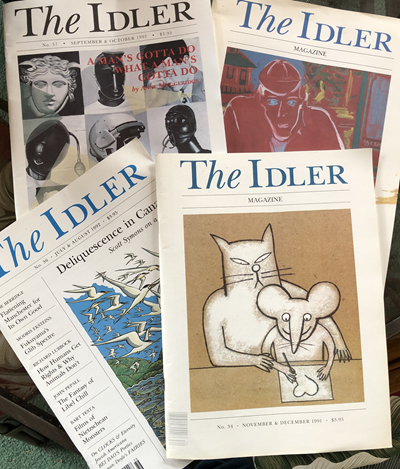
Some late Idler covers from 1991-92. I’ve got most of the magazine’s run … somewhere. These were the ones I could lay my hands on for a quick photo.
This attitude was clinched by our motto, “For those who read.” Note that it was not for those who can read, for we were in general opposition to literacy crusades, as, instinctively, to every other “good cause”. We once described the ideal Idler reader as “a sprightly, octogenarian spinster with a drinking problem, and an ability to conceal it”.
It was to be a magazine of elevated general interest, as opposed to the despicable tabloids. We — myself and the few co-conspirators — wished to address that tiny minority of Canadians with functioning minds. These co-conspirators included people like Eric McLuhan, Paul Wilson, George Jonas, Ian Hunter, Danielle Crittenden, and artists Paul Barker and Charles Jaffe. David Frum, Andrew Coyne, Douglas Cooper, Patricia Pearson, and Barbara Amiel also graced our pages.
I was the founder and would be the first editor. I felt I had the arrogance needed for the job.
I had spent much of my life outside the country and recently returned to it from Britain and the Far East. I had left Canada when I dropped out of high school because there seemed no chance that a person of untrammelled spirit could earn a living in Canadian publishing or journalism. Canada was, as Frum wrote in an early issue of The Idler, “a country where there is one side to every question”.
But there were several young people, and possibly many, with some literary talent, kicking around in the shadows, who lacked a literary outlet. These could perhaps be co-opted. (Dr. Johnson: “Much can be made of a Scotchman, if he be caught young.”)
The notion of publishing non-Canadians also occurred to me. The idea of not publishing the A.B.C. of official CanLit (it would be invidious to name them) further appealed.
We provided elegant 18th-century design, fine but not precious typography, tastefully dangerous uncaptioned drawings, shrewd editorial judgement, and crisp wit. I hoped this would win friends and influence people over the next century or so.
We would later be described as an “elegant, brilliant and often irritating thing, proudly pretentious and nostalgic, written by philosophers, curmudgeons, pedants, intellectual dandies. … There were articles on philosophical conundrums, on opera, on unjustifiably unknown Eastern European and Chinese poets.”
We struck the pose of 18th-century gentlemen and gentlewomen and used sentences that had subordinate clauses. We reviewed heavy books, devoted long articles to subjects such as birdwatching in Kenya or the anthropic cosmological principle, and we printed mottoes in Latin or German without translating them. This left our natural ideological adversaries scratching their heads.


