
Rex’s Hangar
Published Dec 29, 2023Today we’re taking a look at a concept “aircraft” developed in the 1950s, the Avro Canada Silver Bug — part of a long line of flying discs drawn up by designer John Frost.
(more…)
April 3, 2024
The Flying Saucer Designed To Ram Soviet Bombers | Avro Canada Silver Bug
Comments Off on The Flying Saucer Designed To Ram Soviet Bombers | Avro Canada Silver Bug
April 2, 2024
Gear-Ratio-Accelerated? Yep, It’s a Thing: French MAT 1955 Prototype
Forgotten Weapons
Published Dec 20, 2023EDIT: Shoot, I managed to get the gear ratio backwards. Sorry! The recoil action provides the necessary delay, and then the gear ratio provides acceleration to ensure the bolt can open reliably, akin to the accelerator in a Browning M1917 or 1919 machine gun, or a Lahti L35 pistol. Please excuse the error …
In the search for an improvement to the MAS 1949 rifle for the French military, all the French arsenals proposed new designs. MAS supplied an updated version that was ultimately adopted as the MAS 49/56, but the Tulle Arsenal (MAT) had a wacky idea of its own. In 1955, they presented a short-recoil, tilting bolt, gear-ratio-delayed system. It was an open bolt firing rifle chambered for the 7.5x54mm cartridge, using detachable 20-round magazines. Today we have one of the first models to look at, and there was a second iteration in 1956, which lightened the rifle by replacing some steel parts with aluminum. Neither was successful, much to the relief of the French Army …
Many thanks to the IRCGN (Institut de Recherche Criminelle de la Gendarmerie Nationale) for allowing me access to film this unique rifle for you!
(more…)
Comments Off on Gear-Ratio-Accelerated? Yep, It’s a Thing: French MAT 1955 Prototype
QotD: Supersizing the Polis, Roman-style
Discussing the Roman Republic after already looking at the normal structure of a polis offers an interesting vantage point. As we’ll see, the Roman Republic has a lot of the same features as a polis: a citizen body, magistrates, a citizen assembly, all structured around a distinct urban center and so on. On the other hand, as we’re going to see, the Romans have some different ideas about the res publica (that’s their phrase which gives us our word “republic”). They imagine the republic differently than a polis and that leads to some meaningful differences in its structure and nature, even though it seems to share a lot of “DNA” with a polis and in some sense could be described as an “overgrown” city-state.
Which leads into the other major difference: size. We’re going to be taking a snapshot of the Roman Republic, necessary because the republic changed over time. In particular what we’re going to look at here is really a snapshot of the republic as it functioned in the third and second centuries, what Roman historians call the “Middle Republic” (c. 287-91BC). Harriet Flower defines this period as part of “the republic of the nobiles” which as we’ll see is an apt title as well.
But even by the beginning of this period, the Roman Republic is enormous by the standards of a polis. While a polis like Athens or Sparta with total populations in the low hundreds of thousands was already very large by Greek standards, the Roman Republic was much bigger. We know that in Italy in 225 there was something on the order of three hundred thousand Roman citizens liable for conscription, which implies a total citizen population right around a million. And that massive polity in turn governed perhaps another two million other Italians who were Rome’s “socii” (“allies”), perhaps the social category at Rome closest to “resident foreigners” (metics) in Greek poleis. This is in Italy alone, not counting Rome’s “overseas” holdings (at that point, Sicily, Corsica and Sardinia). In short, the Roman Republic may in some ways be shaped like a polis, but it was a full order of magnitude larger than the largest poleis, even before it acquired provinces outside of Italy. As you may imagine, that has implications!
Bret Devereaux, “Collections: How to Roman Republic 101, Part I: SPQR”, A Collection of Unmitigated Pedantry, 2023-07-21.
Comments Off on QotD: Supersizing the Polis, Roman-style
April 1, 2024
The most likely outcome of a 2nd US Civil War isn’t two successor states, but a modern version of the Holy Roman Empire
Kulak, at the start of a very long post on historical eras of centralization and decentralization, touches on the most likely outcome of a second US civil war, and it’s not a rump USA and a neo CSA:
Every time the subject of a possible US civil war or national divorce comes up I hear the same micron deep takes. America couldn’t break up because the division isn’t by state, its Urban Vs. Rural. Or that Urban vs. Rural isn’t the divide, even then people of different politics are mixed up together. Or that for every clear red or blue state there’s a purple state. None of which is in any way relevant to anything until you recognize the naïve mental model many of these people are working on …
These takes betray a belief that a second civil war would be some kind of conflict between coherent independent states who’ve started identifying with/against the idea of union such as happened in the 1860s … or that somehow there’d be a series of tidy Quebec style referendums resulting in a clean division such as exists in so many meme maps:
The truth is any post-breakup map of America would not resemble an electoral map following state lines, nor even a redrawing of state boundaries, such that the fantastical greater Idaho or Free State of Jefferson might exist as part of a wider Confederation of Constitutional Republics, or a Breakaway Philadelphia city-State join a Union of Progressive Democracies …
No. It’d be nothing so comprehensible or easily mapped to modern politics.
A post breakup America would probably look closer to this:
If you’re a sane person and your immediate reaction is: WHAT THE HELL AM I LOOKING AT!?
… Well that’s kinda the point.
(I really do apologize for all I’m going to have to digress)
For our purposes we can broadly divide history into 2 types of period … Periods of Centralizing trends, and periods of Decentralizing trends.


March 31, 2024
Allies Charge Forward from the Rhine! – WW2 – Week 292 – March 30, 1945
World War Two
Published 30 Mar 2024All along the Western Front the Allies break out in force, invading German territory and receiving German surrenders by the thousands. In the east, the Soviets take Danzig and Gdynia, and rout the Germans in Hungary. There’s a new Japanese offensive in China, though the fight on Iwo Jima ends with a Japanese defeat.
Chapters
00:45 Recap
01:08 Big Advances all over the West
05:48 Soviets take Gdynia and Danzig
07:09 Zhukov’s forces take Kustrin
10:39 The War in China
12:21 Iwo Jima Ends
14:30 Preliminaries for Okinawa
18:46 More Landings in the Philippines
19:23 Slim focuses on Rangoon
20:12 Notes to end the week
20:48 Summary
21:28 Conclusion
24:47 Call To Action
(more…)
Comments Off on Allies Charge Forward from the Rhine! – WW2 – Week 292 – March 30, 1945
August, 1945 – The Soviets enter the war in China
Big Serge outlines the Soviet invasion of Manchuria in August 1945 and its devastating impact on the Japanese Kwantung Army, finally shattering any remaining illusions that the Soviets would broker a peace between Japan and the western allies:
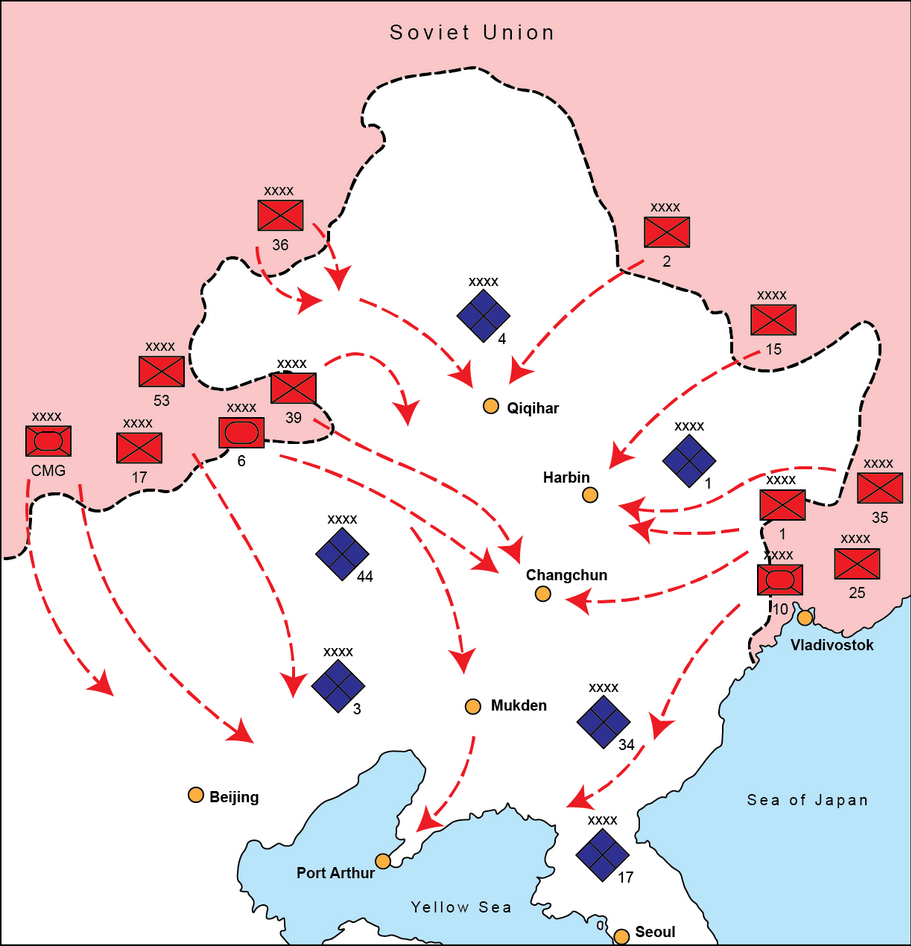
August Storm: The Soviet Invasion of Manchuria (August 9-20, 1945)
The Second World War had a strange sort of symmetry to it, in that it ended much the way it began: namely, with a well-drilled, technically advanced and operationally ambitious army slicing apart an overmatched foe. The beginning of the war, of course, was Germany’s rapid annihilation of Poland, which rewrote the book on mechanized operations. The end of the war — or at least, the last major land campaign of the war — was the Soviet Union’s equally totalizing and rapid conquest of Manchuria in August 1945.
Manchuria was one of the many forgotten fronts of the war, despite being among the oldest. The Japanese had been kicking around in Manchuria since 1931, consolidating a pseudo-colony and puppet state ostensibly called Manchukuo, which served as a launching pad for more than a decade of Japanese incursions and operations in China. For a brief period, the Asian land front had been a major pivot of world affairs, with the Japanese and the Red Army fighting a series of skirmishes along the Siberian-Manchurian border, and Japan’s enormously violent 1937 invasion of China serving as the harbinger of global war. But events had pulled attention and resources in other directions, and in particular the events of 1941, with the outbreak of the cataclysmic Nazi-Soviet War and the Great Pacific War. After a few years as a major geopolitical pivot, Manchuria was relegated to the background and became a lonely, forgotten front of the Japanese Empire.
Until 1945, that is. Among the many topics discussed at the Yalta Conference in the February of that year was the Soviet Union’s long-delayed entry into the war against Japan, opening an overland front against Japan’s mainland colonies. Although it seems relatively obvious that Japanese defeat was inevitable, given the relentless American advance through the Pacific and the onset of regular strategic bombing of the Japanese home islands, there were concrete reasons why Soviet entry into the war was necessary to hasten Japanese surrender.
More specifically, the Japanese continued to harbor hopes late into the war that the Soviet Union would choose to act as a mediator between Japan and the United States, negotiating a conditional end to war that fell short of total Japanese surrender. Soviet entry into the war against Japan would dash these hopes, and overrunning Japanese colonies in Asia would emphasize to Tokyo that they had nothing left to fight for. Against this backdrop, the Soviet Union spent the summer of 1945 preparing for one final operation, to smash the Japanese in Manchuria.
The Soviet maneuver scheme was tightly choreographed and well conceived — representing in many ways a sort of encore, perfected demonstration of the operational art that had been developed and practiced at such a high cost in Europe. Taking advantage of the fact that Manchuria already represented a sort of salient — bulging as it did into the Soviet Union’s borders — the plan of attack called for a series of rapid, motorized thrusts towards a series of rail and transportation hubs in the Japanese rear (from north to south, these were Qiqihar, Harbin, Changchun, and Mukden).
By rapidly bypassing the main Japanese field armies and converging on transit hubs in the rear, the Red Army would effectively isolate all the Japanese armies both from each other and from their lines of communication to the rear, effectively slicing Manchuria into a host of separated pockets.
There were, of course, a host of reasons why the Japanese had no hope of resisting this onslaught. In material terms, the overmatch was laughable. The Soviet force was lavishly equipped and bursting with manpower and equipment — three fronts totaling more than 1.5 million men, 5,000 armored vehicles, and tens of thousands of artillery pieces and rocket launchers.
The Japanese (including Manchurian proxy forces) had a paper strength of perhaps 900,000 men, but the vast majority of this force was unfit for combat. Virtually all of the Japanese army’s veteran units and equipment had been steadily transferred to the Pacific in a cannibalizing trickle — a vain attempt to slow the American onslaught. Accordingly, by 1945 the Japanese Kwantung Army had been reduced to a lightly armed and poorly trained conscript force that was suitable only for police actions and counterinsurgency against Chinese partisans.
Really, there was nothing for the Japanese to do. The Kwantung Army had far less of a fighting chance in 1945 than the Wehrmacht had in the spring of that year, and everyone knows how that turned out. Unsurprisingly, then, the Soviets broke through everywhere at will when they began the assault on August 9. Soviet armored forces found it trivially easy to overrun Japanese positions (armed primarily with archaic, low caliber antitank weaponry that could not penetrate Soviet armor even at point blank range), and by the end of the first day the Soviet pincers were driving far into the rear.
It is easy, in hindsight, to write off the Manchuria campaign as something of a farce: a highly experienced, richly equipped Red Army overrunning and abusing an overmatched and threadbare Japanese force. In many ways, this is an accurate assessment. However, what the offensive demonstrated was the Red Army’s extreme proficiency at organizing enormous operations and moving at high speeds. By August 20 (after only 11 days), the Red Army had reached the Korean border and captured all their objectives in the Japanese rear, in effect completely overrunning a theater that was even larger than France. Many of the Soviet spearheads had driven more than three hundred miles in a little over a week.
To be sure, the combat aspects of the operation were farcical, given the totalizing level of Soviet overmatch. Red Army losses were something like 10,000 men — a trivial number for an operation of this scale. What was genuinely impressive — and terrifying to alert observers — was the Red Army’s clear demonstration of its capacity to organize operations that were colossal in scale, both in the size of the forces and the distances covered.
More to the point, the Japanese had no prospect of stopping this colossal steel tidal wave, but who did? All the great armies of the world had been bankrupted and shattered by the great filter of the World Wars — the French, the Germans, the British, the Japanese, all gone, all dying. Only the US Army had any prospect of resisting this great red tidal wave, and that force was on the verge of a rapid demobilization following the surrender of Japan. The enormous scale and operational proclivities of the Red Army thus presented the world with an entirely new sort of geostrategic threat.
Comments Off on August, 1945 – The Soviets enter the war in China
HMS Unicorn (I72) – Guide 367
Drachinifel
Published Dec 23, 2023The Unicorn, a fleet maintenance carrier of the British Royal Navy, is today’s subject.
(more…)
Comments Off on HMS Unicorn (I72) – Guide 367
March 30, 2024
Extra Firepower for Vietnam: the Aussie “B!tch”
Forgotten Weapons
Published Dec 18, 2023Many of the special forces groups that operated during the Vietnam War found their standard issue weapons a bit unwieldy for use in confined jungle environments. They also found a need for something that could deliver an immediate large volume of fire to break contact during an ambush (or deliver an ambush of their own). The Australians were no exception, and with the typical Special Forces attitude towards customization a few guys made some improvements to what they were issued …
What we have today is a recreation (by Mark Graham of ARS, build on a DSA semiauto receiver) of an Australian L1A1 with its flash hider cut down and a second pistol grip mounted to the barrel. The real examples of these often had rather shorter barrels, and ones that began life as semiauto L1A1 rifles were typically converted to fully automatic (some began as L2A1 automatic rifles and did not require this extra step). Fitted with a large LMG magazine, they could deliver a lot of firepower in a very short time; just the ticket for a small jungle patrol.
(more…)
Comments Off on Extra Firepower for Vietnam: the Aussie “B!tch”
March 28, 2024
The History of Fish Sauce – Garum and Beyond!
Tasting History with Max Miller
Published Dec 26, 2023Sweet frittata-like patina of pears with classic ancient Roman flavors and sprinkled with long pepper
City/Region: Rome
Time Period: 1st CenturyThis patina de piris is one of over a dozen recipes for similar dishes in Apicius’ De re coquinaria, a staple for ancient Roman recipes. It would have probably been part of mensa secunda, or second meal. Not a second breakfast, it was the final course in a larger meal and usually consisted of sweets, pastries, nuts, and egg dishes, kind of like a modern dessert course.
I finally made my own true ancient Roman garum in the summer of 2023, from chopped up fish pieces and salt to clear amber umami-laden liquid. There’s no fishiness in this surprisingly sweet dish, just a saltiness and savory umami notes that complements the other very ancient Roman flavors.
As with all ancient recipes, this is my interpretation and you can change things up how you like. I separated my eggs before beating them, but you could just whisk them up whole and add them like that.
(more…)
Comments Off on The History of Fish Sauce – Garum and Beyond!
QotD: Honest scholarship … and whatever passes for scholarship these days
Equally distressing as these (and an increasing number of other) examples of scholarly utter shoddiness or execrable dishonesty is the complete incredulity of many people in accepting the “findings” of such “scholars”.
A perverted form of amusement can be had by imagining what sort of “scholarly” output you might offer to the world were you to operate according to the standards used by “scholars” such as Nancy MacLean. Free to present fiction as fact, you might, say, claim that because Dr. MacLean studied at the University of Wisconsin, and because Wisconsin was once home to the serial killer Jeffrey Dahmer – and because in her book Democracy in Chains she did not explicitly denounce serial killing – that Dr. MacLean’s work is a surreptitious attempt to justify serial killing.
Of course, any such conclusion would be both preposterous and inexcusably unethical. Anyone who (unlike me here) seriously offered such a wacky, detached-from-all-reality, ideologically motivated thesis to the public should lose not only any claim to scholarly respect, but any claim to respect of any sort. And yet the bases for the conclusions reached by “scholars” such as Dr. MacLean are no more realistic than are those in my previous, satirical paragraph.
Don Boudreaux, “The Wisdom of Bob Higgs”, Café Hayek, 2019-08-29.
March 27, 2024
Civil Defence is a real thing in Finland
Paul Wells reports back on his recent trip to Finland, where he got to tour one of the big civil-defence shelters in Helsinki:
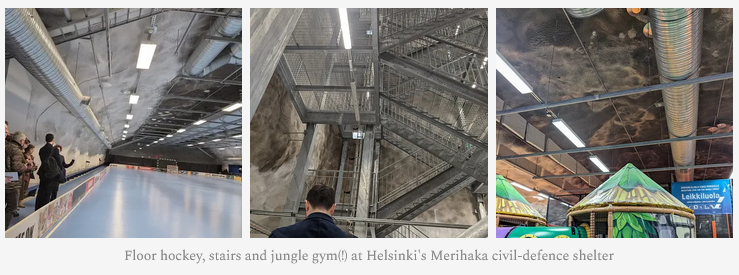
One of the best playgrounds for children in Helsinki is the size of three NFL football fields, dug into bedrock 25 metres below a street-level car park, and built to survive a nuclear bomb.
The air down here is surprisingly fresh. The floor-hockey rinks — there are two, laid end to end — are well maintained. The refreshment stands are stocked with snacks. The steel blast doors are so massive it takes two people to slam one shut.
Finland has been building civil-defence shelters, methodically and without fuss, since the late 1950s. This one under the Merihaka residential district has room for 6,000 people. It’s so impressive that it’s the Finnish capital’s unofficial media shelter, the one visiting reporters are likeliest to be shown. The snack bar and the jungle gym are not for show, however: as a matter of government policy, every shelter must have a second, ordinary-world vocation, to ensure it gets used and, therefore, maintained between crises.
The Merihaka shelter was one of the stops on my visit to Helsinki last week. The first anniversary of Finland’s membership in NATO, the transatlantic defence alliance, is next week, on April 4. Finland’s foreign office invited journalists from several NATO countries to visit Helsinki to update us on Finland’s defence situation. I covered my air travel and hotel. Or rather, paid subscribers to this newsletter did. Your support makes this sort of work possible. I’m always grateful.
The Finnish government used to build most of the shelters. But since 2011, the law has required that new shelters be built at the owners’ expense, by owners of buildings larger than 1,200 square metres and industrial buildings larger than 1,500 square metres.
The city of Helsinki has more shelter space than it has people, including visitors from out of town. Across the country the supply is a little tighter. Altogether today Finland has a total of 50,500 shelters with room for 4.8 million people.
That’s not enough for the 5.5 million people in Finland. But then, if war ever comes, much of the population won’t need shelter, because they’ll be staying groundside to fight.
Conscription is universal for Finnish men between 18 and 60. (Women have been enlisting on a voluntary basis since the 1990s.) The standing armed forces, 24,000, aren’t all that big. But everyone who finishes their compulsory service is in the reserves for decades after, with frequent training to keep up their readiness. In a war the army can surge to 280,000. In a big war, bigger still.
The Soviet Union invaded Finland in 1939, during what was, in most other respects, the “phony war” phase of the Second World War. The Finnish army inflicted perhaps five times as many casualties on the Soviets as they suffered, but the country lost 9% of its territory and has no interest in losing more. Finland’s foreign policy since then has been based on the overriding importance of avoiding a Russian invasion.
Comments Off on Civil Defence is a real thing in Finland
The Volkssturm – a Million men to save the Reich?
World War Two
Published 26 Mar 2024The Volkssturm is the last-ditch people’s army of the Third Reich. Sure, on paper, there are millions of old men and boys ready to defend Germany. But how will they be armed? Are they truly willing to die for Hitler? Will they make any difference at all?
(more…)
Comments Off on The Volkssturm – a Million men to save the Reich?
As the kids will be taught, pre-Columbian culture was feminist, egalitarian, non-violent, etc.
The way history will be taught in future will distort historical facts to flatter modern sensibilities, especially with regard to First Nations history:

Linguistic groups of pre-contact North America.
Wikimedia Commons
In my previous missive of this series, I outlined the socio-economic problems facing Indigenous people in Canada and identified the official narrative, promoted by the federal government, Indigenous leaders, and their non-Indigenous allies. This narrative is basically that colonialism, racism, and oppression are the sole (or at least the major) causes of the long list of socio-economic difficulties so many Indigenous people are suffering from today. The narrative focuses on colonialism, oppression, as well as “intergenerational trauma” and “genocide”, neither of which claims stand up to the slightest bit of objective scrutiny and analysis. The genocide claim is particularly laughable in that the Indigenous population has increased from about 100 thousand in 1900 to nearly 2 million today, which is at least four times the pre-contact Indigenous population.
Pre-contact living conditions for Indigenous people
In order to blame all the problems on European settlers and their descendants, the narrative starts out by implying that life in pre-contact Canada was idyllic. Students are led to believe that this was a time of peace, cooperation, and prosperity based on teachings and knowledge systems that were superior to what we have now (the Western enlightenment-based ethos and the scientific method). Students are told that people lived well- sustainably, with little environmental impact, and with a respect for each other and the land, with which their relationship was one of stewardship and symbiotic coexistence.
This is presented in contrast to the purported European world view, which kids are told was, and still is, characterized by exploitation and a belief in European superiority. Europeans are described as ruthless and greedy people who just wanted to enrich themselves by maximally extracting any and all resources without regard for impacts on the environment or Indigenous people. It is presented as a case of good vs. evil.
But what was life really like for pre-contact Indigenous people? Certainly their stone age way of living combined with their small, scattered population was eco-friendly, but was their standard of living, on balance, better than that of modern Canada? Were they more moral, or wiser than modern non-Indigenous Canadians? An honest answer to these questions demands a hard look at the available evidence and a willingness to draw conclusions wherever that evidence may lead.
And that evidence shows that pre-contact indigenous people demonstrated the full range of behaviors we find in all stone age hunter gatherer/horticulturalist societies. While there is much to admire about these people, who were able to survive in a challenging environment with only the most rudimentary of wooden, stone, and bone tools, the evidence is clear that, compared to modern times
- life expectancy was very low
- child mortality was very high
- warfare was endemic
- slavery was a common practice
- violence of all kinds was common
- people suffered a great deal from simple health problems which would now be easily treatable with antibiotics and surgical techniques.
It should also be pointed out that while the allegation that Indigenous people were the victims of genocide at the hands of the government of Canada is ridiculous, it is a well-established (but rarely mentioned) fact that Indigenous people carried out genocides against one another on a regular basis, for example the genocide of the Hurons by the Iroquois.
Comments Off on As the kids will be taught, pre-Columbian culture was feminist, egalitarian, non-violent, etc.
Weirdest of the French Trials SMGs: the EROP 1954
Forgotten Weapons
Published Dec 15, 2023“EROP” was a small company based in Paris, which produced about 18 submachine gun prototypes between 1954 and 1956. These were submitted to French military trials in several different configurations first in 1954 and later in 1956, and none of them were given any further consideration after that.
Mechanically, the EROP guns are closed-bolt and striker-fired, using modified MP40 magazines (and chambered for 9mm Parabellum). They use a small square-profile tubular receiver, and several (including this particular one) have a very perplexing buttstock system that I really can’t figure out.
Many thanks to the IRCGN (Institut de Recherche Criminelle de la Gendarmerie Nationale) for allowing me access to film this unique SMG for you!
(more…)
Comments Off on Weirdest of the French Trials SMGs: the EROP 1954
QotD: Roman imperial strategy
If deterrence fails and you have to fight, then the next best way to economize on force is by making somebody else do the fighting for you. In the late Republic and early Empire, much of Roman territory wasn’t “officially” under Roman rule. Instead, it was the preserve of dozens of petty and not-so-petty kingdoms that, on paper at least, were fully independent and co-equal sovereign entities.2 Rome actually went to some effort to keep up the charade: the client rulers were commonly referred to as “allies” [socii], and Rome took care never to directly tax or conscript their citizens. But, to be clear, it was a charade. If any of these “allies” ever wanted to leave the alliance or conduct any sort of independent foreign policy, he would not continue to be a king for long. Oftentimes the legions wouldn’t even have to show up — the terrified citizens of the client kingdom would overthrow and execute their wayward ruler themselves, in the hopes that Rome might thereby be induced not to make an example of the citizenry.
What was the point of all of this complicated kabuki theater? Once again, it’s about economy of force, this time on both the “input” and the “output” sides of the great machine of the state. On the input side: efficient government is hard to scale. Roman provincial governors were legendarily corrupt, and could get up to all kinds of mischief out there without supervision. Having a Roman ruling a whole bunch of non-Romans was also bound to cause resentment: it could lead to rebellions, or worse, tax-evasion. All of these problems were solved by pretending to have the barbarians be ruled by one of their own, a barbarian king. He could collect the taxes, and suppress revolts, and generally keep an eye on things. Moreover, as a fellow barbarian, he would know better how to keep his subjects in line, and would be less likely to commit an awkward cultural blunder. On the output side, he could also deal with border raids and other low-intensity threats. This exponentially magnified Roman military power, because it meant that instead of being stuck on garrison duty, spread out along the frontiers, the legions could be concentrated in a strategic reserve. They could then be deployed for “high intensity” operations in some remote part of the empire without worrying that they were thereby leaving the borders unguarded: operations like conquering new lands, or persuading a rebellious client kingdom that their interests lay with Rome.
If you can’t make somebody else do the fighting, then the next, next best thing is to carefully choose the time, circumstances, and location of the fight. Ideally you would muster a heavy concentration of your own forces and confront the enemy while they’re still dispersed. Ideally the ground would be thoroughly surveyed, well understood, and perhaps even prepared with static defenses. Ideally your own forces would have ample supply and good lines of communication, and your opponent would have neither of these things. It was to all these ends that in the second of the periods Luttwak surveys, the Romans built the limes3 — a massive system of defensive emplacements. These extended for thousands of miles around almost the entire frontier of the empire, but the most famous portion was Hadrian’s Wall.
John Psmith, “REVIEW: The Grand Strategy of the Roman Empire by Edward Luttwak”, Mr. and Mrs. Psmith’s Bookshelf, 2023-11-13.
1. This is actually also true of modern wars, and if you think you have an exception in mind, you may just not know the history that well. For instance, the current war in the Donbass wasn’t really a surprise invasion, but is best viewed as the latest and most violent stage of a conflict that’s been slowly ratcheting up for a decade.
2. Were you ever confused by who exactly this King Herod guy in the Gospel stories was? Why was there a king and also a Roman governor? He was precisely one of these client rulers!
3. Pronounced “lee-mays”, not like the fruit.
Comments Off on QotD: Roman imperial strategy


