
So I first want to suggest a set of basic characteristics for what I am going to term the “omni-spear“, the standard kind of iron-tipped one-handed thrusting spear that almost everyone fought with in the Mediterranean world.
So let us posit a spear. Its haft is made of wood – our ancient sources tend to be particular that certain kinds of wood, particularly ash and cornelian cherry (cornel wood), are best – and about 2.5 to 3m in length and roughly 2.5cm in diameter. Obviously, on one end we’ll have our iron spear head. On the other end, we probably have a smaller iron spear butt, sometimes called a ferrule.
For our spear tip, we’re going to have a hunk of iron about 250-450g in mass. It’s going to have a circular socket, about 2 to 2.5cm in diameter (to fit the haft) at its base. That socket will then proceed upwards into the tip as a “mid-ridge”, though it generally stops being entirely hollow at some point. In two directions from the mid-ridge are going to project some “blades” – if we’re French, we’ll call them flamme, “flames”, while if we’re Spanish they’ll be hoja, “blades”, and if we’re German they’re Blätter, “sheets, leaves”. These taper at the tip and widen towards the base, usually before curving gracefully inward on the socket a few inches up from its base. Often scholars have called this a “leaf shaped” spearhead, which I always find a bit awkward in phrasing (leaves can have many shapes), but the alternatives, like “tear-drop” shaped, aren’t any less awkward. If you are having a hard time conceptualizing that picture, here is an example of what I mean.
For the bottom of the spear we could just go with nothing. We could also make a simple conical socket in iron and secure it with a rivet or, if we’re being really creative, a nail hammered into the base of the shaft. If we want to be really fancy, we might make a spear-butt that combines a circular socket with a long square-sectioned projection so that it serves better as a backup point in a pinch. If you want to see the more developed version of that, here is a Greek “sauroter“, about the most elaborate this part of the spear gets.
And there we go. We have the “omni-spear”. Basic spear-butt, “leaf-shaped” spearhead with a strong mid-ridge, both generally in iron, joined by a 2.5-3m long wooden haft, about 2.5cm thick (though the haft might be thicker, as it could taper before meeting the socket) made of hardwood, with a grip at the center of balance.
That basic description describes the famous Greek dory, the spear of the hoplite. It also describes one of the more common forms of the Roman hasta, one with what I’ve termed a “Type A” Roman spearhead. And it also describes the La Tène spear, the native name of which we don’t know.1 And it also describes common thrusting spears of the Iberian Peninsula, both those used by the Iberians living in the coastal Levante and the Celtiberian peoples living on the Meseta; the names of those spears too are lost to us.2 And it also describes the common weapon of the Persian infantry, including their elite infantry which Herodotus calls “Immortals”. Almost certainly it describes spears even further afield, but we are rapidly reaching the edge of my expertise, so I’ll stop with the Persian Empire.
Bret Devereaux, “Collections: The Mediterranean Iron Omni-Spear”, A Collection of Unmitigated Pedantry, 2023-11-10.
1. And before you jump up to tell me “oh, it was called a gaesum“, no, that’s a javelin and we do not know what sort of javelin correlates to that name preserved in our sources.
2. And before someone jumps up and tells me, “oh, it was called a soliferreum, no, that’s also a javelin and we do know exactly what sort of javelin that correlates to. They’re super cool, but they are throwing weapons, not thrusting spears. Interestingly, all over the Iberian peninsula it seems to have been standard for warriors to carry one javelin (often, but not always a soliferreum) and one thrusting spear. We find that pattern over and over again in burial deposits.
April 21, 2024
QotD: The “omni-spear” of the Mediterranean World
April 20, 2024
How much of your language do you have to destroy to avoid the taint of historical fascist usage?
For understandable reasons, German governments since the end of World War 2 have been twitchy about any symbols, songs, words and phrases that were used by Hitler’s various fascist organizations … to the point of making many things illegal. eugyppius outlines one particular case where the use of a simple German phrase by an AfD politician has landed him in court, facing a possible three-year prison sentence even though he denies that he knew the phrase had such connotations:

Today, the leader of the Alternative für Deutschland faction in the Thuringian state parliament, Björn Höcke, appeared before the district court in Halle for the first day of his long-awaited speech trial. He stands accused of having used a forbidden Nazi slogan favoured by the Sturmabteilung at a political rally in Merseburg on 29 May 2021. Höcke pleads that he used the three-word phrase in a moment of spontaneous elaboration at the end of his speech, without knowing its National Socialist associations. Out of an abundance of caution, I won’t quote the phrase here, even in translation, but I’ll provide it in context below; it begins with the words “Everything for” (“Alles für“) and concludes with the name of the Federal Republic. As slogans go, it is so seemingly banal that before the trial many Germans would have been surprised to know it had any Nazi associations at all.
For the moment, not much has happened. Höcke’s lawyers filed a variety of requests, among them that the Federal Constitutional Court answer a question surrounding the court’s jurisdiction. In consequence, it’s unclear whether the trial will continue as scheduled next week or whether it will have to be substantially delayed. The state prosecutor’s position is that Höcke’s background as a history teacher makes his claims of ignorance implausible. The prosecutors’ office have also added an additional charge for Höcke’s defiance at a rally in Gera last December, where he shouted the first two words of the slogan at the crowd, and invited them to supply the last one. I fear that this was a grave mistake, because as we will see, the original case against Höcke is laughably weak.
If found guilty, Höcke could be fined or sentenced to prison for up to three years. It is also conceivable that his right to vote and run for office could be suspended. Whatever you think of Höcke or his politics, the political dimensions of this trial are undeniable, as it is occurring mere months ahead of the Thuringian state elections, and as Alternative für Deutschland commands a solid plurality of polling numbers in that state.
[…]
That Höcke deliberately used the SA slogan as a subtle enticement to the extreme right is more than doubtful; that he also did so in hopes that he would be prosecuted and profit politically from his victimisation is so ridiculous, I can’t imagine that even Hillje really believes this. This obnoxious thesis nevertheless recurs whenever the German press report on the harassment of AfD politicians; it is somehow their fault, because they are held to benefit from it.
Der Spiegel, always a source of unintentional amusement, ran a headline today mocking Höcke as a “history teacher with no knowledge of history“. “He claims not to know it was an SA slogan”, they report, “but there are doubts about this”. Alas, the very same news magazine last September accidentally used the forbidden phrase to headline an approving article on Olaf Scholz’s proposed “Germany Pact”. They rapidly changed the headline, appending this brief and embarrassing correction to the bottom:
An earlier version of the article was headed with a line that was used by the SA as a slogan. This was not intended by the author and editors and has now been changed.
Russian and French Nazis Defend the Reich – ϟϟ Foreign Fighters Part 3
World War Two
Published 19 Apr 2024As the war turns ever more against Germany, Reichsführer-SS Heinrich Himmler keeps loosening the racial standards of his Waffen SS. More and more non-Germans fill the ranks of his forces. Some of these non-German fighters will be among the last defenders of the Third Reich.
Click here for parts one and two:
Cape Esperance and the Japanese Evacuation of Guadalcanal
Forgotten Weapons
Published Jan 12, 2024Today we return to Guadalcanal, to the site of the last actions of the campaign. For the Japanese, the defeat at Edson’s Ridge (aka Bloody Ridge) forced a disastrous and uncoordinated retreat into the jungle. With their supply lines destroyed, Japanese troops largely moved west on the island, away from American positions and in search of food. This would eventually bring them to Cape Esperance, where a rearguard force was landed, and some 10,652 Japanese soldiers were successfully evacuated on fast-moving destroyers over the course of several nights in early February, 1943.
On the American side, Army troops landed to relieve the Marines. In January and into early February they ran what was considered a mopping-up campaign west, including landings on the far west end of the island beyond Esperance. The intention was to encircle the remaining Japanese forces, under the assumption that the destroyer activity was landing fresh troops. Instead, when the American forces joined up at Cape Esperance it was an anticlimactic end to the fighting, as all they found were remnants of equipment that had been left on the beaches.
(more…)
April 19, 2024
The Führerbunker – Hitler’s Grave
World War Two
Published 18 Apr 2024The man who once conquered Europe, Adolf Hitler, now cowers underground in the Führerbunker as bombs and artillery rain down on the ruins of the Reich. Today Sparty gives you a tour of the damp and claustrophobic concrete maze that will soon become the dictator’s coffin.
(more…)
Breakfast in Jane Austen’s England
Tasting History with Max Miller
Published Jan 16, 2024What you could tell about someone from their breakfast in Jane Austen’s England, and a recipe for Bath buns as she might have eaten them for her first meal of the day.
Caraway buns topped with glaze, sugar, and caraway, served with butter. Perfect for a Jane Austen inspired breakfast with some hot chocolate
City/Region: England
Time Period: 1769It is a truth universally acknowledged that a person who has recently risen from bed must be in want of breakfast. In Jane Austen’s time, breakfast could be around 8:00 or 9:00 in the morning if you were a manual laborer or servant, or it could be as late as 3:00 or 4:00 in the afternoon if you were upper class.
Jane wrote a letter to her sister Cassandra saying that she wanted to join her on her trip to Bath, but didn’t want to inconvenience their hosts, so she would fill up on bath buns for breakfast. I can see why this would have been a sound strategy. The buns are denser than modern versions, but still soft and very good (they would certainly fill you up). The caraway is present but not overpowering, and they’re sweet but not as sweet as a dessert.
Caraway comfits were candy-coated caraway seeds (think M&Ms), but they don’t use caraway to make them anymore. I mimic them as best I can with caraway seeds and sugar.
To make Bath Cakes.
Rub half a pound of butter into a pound of flour, and one spoonful of good barm, warm some cream, and make it into a light paste, set it to the fire to rise, when you make them up, take four ounces of carraway comfits work part of them in, and strew the rest on the top, make them into a round cake, the size of a French roll, bake them on sheet tins, and send them in hot for breakfast.
— The Experienced English Houskeeper by Elizabeth Raffald, 1769
QotD: The “Greatest Generation”
P.J. O’Rourke, interviewed by Scott Walter, “The 60’s Return”, American Enterprise, May/June 1997.
April 18, 2024
Wagner’s Ring Cycle, summarized
I have to admit that aside from some amazing helicopter music, most of Wagner’s music isn’t my cup of tea drinking horn of mead. As a result, I didn’t know what the whole Ring Cycle was all about and mostly didn’t care. Coming to my rescue, Kulak provides a summary for my fellow non-Wagner fans:
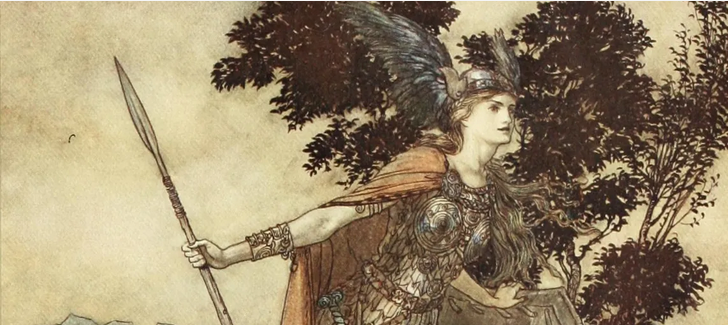
So researching my epic length piece on female warriors, pre-Christian sexual politics, and the unique development of North European culture I got really into Richard Wagner’s Ring Cycle after stumbling on Arthur Rackham’s gorgeous illustrations to the English translations of the text of the operas (Link 1, Link 2).
And one of the things that immediately jumped out to me, even beyond everything listed in the long piece, is how weird and unique the sexual politics of Pagan Germanic culture is.
Sure it’s Wagner, it’s not a primary source. It’s a 19th century romantic composer interpreting several different legends of pagan era Germany and Scandinavia, as record by Christian monks and scholars 100s of years after the fact. So academically not the most accurate thing to draw conclusions from, however if you subscribe to any blood memory, or spirit of a people, or eternal culture theory … it’s almost better.
This is the version of the tale that’s survived and been refined across first oral, then written traditions, then preserved by Christian monks, then revived by high Victorian romantics into one of the most celebrate and popular operas of all time. If there’s anything we could learn about the eternal character of North European women, sexuality, and sexual politics (and by extension modern sexual politics, we’re all North Europeans now) it is here.
And damned … what a datapoint.
What follows is a MeToo story on hyperborean crack.
The Female lead Brunhilde starts out as a Valkyrie who disobeys her master/father the god Wotan (Odin) in a matter of divine importance so as to save a mortal man. For her disobedience Wotan strips her of her divine nature and curses her to sleep on the earth as a mortal woman until such a time as the first man to find her wakes her, then she is to be his wife. However, taking pity Wotan lays out an magical wall of fire to guard her so no coward, only a great hero, would ever succeed. (end opera 1/3).
20-ish years later Siegfried, the son of the man Brunhilde saved, finds her (she hasn’t aged a day), and perfectly fearless he braves the fire to wake her, where-upon they fall in love (end opera 2/3)… then taking leave for more adventure Siegfried takes off promising to return and remember their. Where-upon he meets the King Gunther and his sister Gutrune, who seduces Siegfried and makes him forget Brunhilde. Making friends with Gunther, Siegfried conspires with him that he should have Brunhilde for a wife (given she’s the best woman he can think of for his friend), but there’s a problem … Gunther cannot brave the fire, he’s not fearless like Siegfried. So Siegfried, conspires to impersonate Gunther using his magic, brave the fire again, seduce Brunilde again, get her to consent to marry him in the Guise of Gunther, spend the night using his sword to divide himself from Brunhilde. Then in the morning swap back, Siegfried Married to Gutrune, Gunther to Brunhilde … The plan worked perfectly.
Then Brunhilde found out.
Learning what had been done she conspires with Siegfried’s enemies to have him killed, falsely accuses him of rape, and successfully maneuvers him into admitting to lying in an oath he wasn’t even aware was a lie … so that his fearless perfect life can end with a stab in the back.
So you may ask: Having avenged herself does she settle-down with her husband?
Hell no! You think you could fill the shoes of Siegfried you curr, you coward, you beta-cuck?! You will NEVER be Siegfried.
Instead she gives the mother of all angry speeches denounces Gertrude and everyone else of the court to their face, and then rides Siegfried’s horse onto his funeral pyre, determined it is better to die with Chad than live with Brad.
THE END.
Of the entire opera cycle. No more.
The Fat Lady has sung.
Your 4 day trip into the German mountains to experience 3 1/2 Operas over as many days and a combined 15 hours has concluded. Go Home.
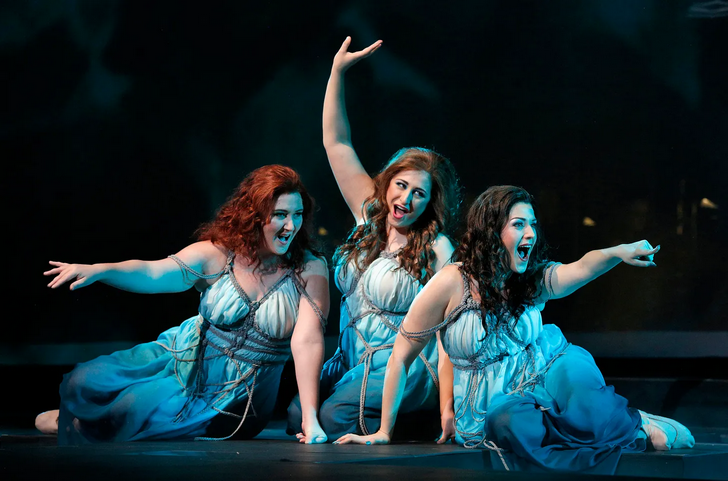
Rhinemaidens, Minnesota Opera production of Das Rheingold
I’m Sorry bros, the hoes have always been like this.
Even in the mythical past of high Germanic mythology … the hoes were like this.
What to do if Romans Sack your City
toldinstone
Published Jan 12, 2024Chapters:
0:00 Introduction
0:34 Progress of a siege
1:55 Looting and violence
3:42 Recorded atrocities
4:45 Captives
5:27 BetterHelp
6:36 Surviving a Roman sack
7:13 Where to hide
8:27 What to do if you’re captured
9:20 Advice for women
10:09 The fate of captives
(more…)
April 17, 2024
Soviet Berlin Offensive Begins – WW2 – Week 294B – April 16, 1945
World War Two
Published 16 Apr 2024The final Soviet assault on Berlin begins today. The Soviets have two million men supported by tens of thousands of guns, tanks, and aircraft. Opposite them stand millions of men and boys of the German Wehrmacht, Waffen SS, Volkssturm, and Hitler Youth. The forces of Nazism are weakened and disorganised but determined to fight on as long as possible.
00:41 Roosevelt’s death
03:09 Preparations for the Soviet drive on Berlin
08:49 Zhukov’s Offensive
12:48 Konev’s Offensive
14:57 Summary & Conclusion
(more…)
French M14 Conversion – the Gras in 8mm Lebel
Forgotten Weapons
Published May 16, 2016The French adopted the Gras as their first mass-issued metallic cartridge rifle in 1874, replacing the needlefire 1866 Chassepot. Quite a lot of Gras rifles were manufactured, and they became a second-line rifle when the 1886 Lebel was introduced with brand-new smokeless powder and its smallbore 8mm projectile. When it became clear that the quick and decisive war against Germany was truly turning into the Great War, France began looking for ways to increase the number of modern Lebel rifles it could supply to the front.
One option that was used was to take Gras rifles from inventory and rebarrel them for the 8mm Lebel cartridge (which was based on the Gras casehead anyway). These could be issued to troops who didn’t really need a top-of-the-line rifle (like artillery crews, train and prison guards, etc). Then the Lebel rifles from those troops could be redirected to the front.
The rebarreling process was done by a number of contractors, using Lebel barrels already in mass production. The 11mm barrel from the Gras would be removed, and only the front 6 inches (150mm) or so kept. A Lebel barrel and rear sight would be mounted on the Gras receiver, and that front 6 inches of Gras barrel bored out to fit tightly over the muzzle of the new 8mm barrel. This allowed the original stock and nosecap to be used (the 8mm barrel being substantially smaller in diameter, and not fitting the stock and hardware by itself). It also allowed the original Gras bayonet to be fitted without modification, since the bayonet lug was also on that retained section of barrel. In addition, a short wooden handguard was fitted. This was designated the modification of 1914, and an “M14” was stamped on the receivers to note it.
These guns are of dubious safety to shoot, since the retain the single locking lug of the Gras, designed for only black powder pressures. However, this was deemed safe enough for the small amount of actual shooting they were expected to do.
QotD: The mid-life crisis, male and female versions
Which is why I’ve found the COVID overreaction so bizarre. Realizing your own mortality changes things. You can always tell, for instance, when it has happened to a younger person — when they come home, combat vets often act like middle-aged men going through a midlife crisis. Readjustment to civilian life is hard. Read the great war narratives, and it’s clear that none of them ever really “got over it”. Robert Graves and Ernst Junger, for instance, both lived to ripe old ages (90 and 103, respectively), and were titans in fields far removed from battle … and yet, the war WAS their lives, in some way we who haven’t been through it will never understand, and it comes through in every line they wrote.
If the Covidians were really freaking out about COVID, then, I’d expect one of two broad types of reaction: Either party-hearty midlife crisis mode, or a new determination to get on with whatever’s left of life. Obviously neither of those are true, and I just can’t grasp it — these might be your last few weeks on Earth, and that’s how you’re going to spend them? Sitting in your apartment like a sheep, wearing a mask and eating takeout, glued to a computer screen?
If you want a measure of just how feminized our society has become, there you go. Call this misogyny if you must, but it’s an easily observed fact of human nature — indeed, it has been observed, in every time, place, and culture of which we have knowledge — that post-menopausal women go a bit batty. Though a man might know for certain that he dies tomorrow, he can still keep plugging away today, because he’s programmed to find real meaning in his “work” — we are, after all, running our snazzy new mental software over kludgy old caveman hardware.
Women aren’t like that. They have one “job”, just one, and when they can’t do it anymore, they get weird. In much the same way high-end sports cars would cease to exist if middle aged men ceased to exist, so there are entire aspects of culture that don’t make sense in any other way except: These are channels for the energies of post-menopausal, and therefore surplus-to-requirements, women. You could go so far as to say that pretty much everything we call culture — traditions, history, customs — exist for that reason. Women go from being the bearers, to being the custodians, of the tribe’s future.
Severian, “Life’s Back Nine”, Rotten Chestnuts, 2021-05-11.
April 16, 2024
Gabriele D’Annunzio’s Impresa – the 1919 occupation of Fiume
Ned Donovan on the turbulent history of the Adriatic port of Fiume (today the Croatian city of Rijeka) after the end of the First World War:
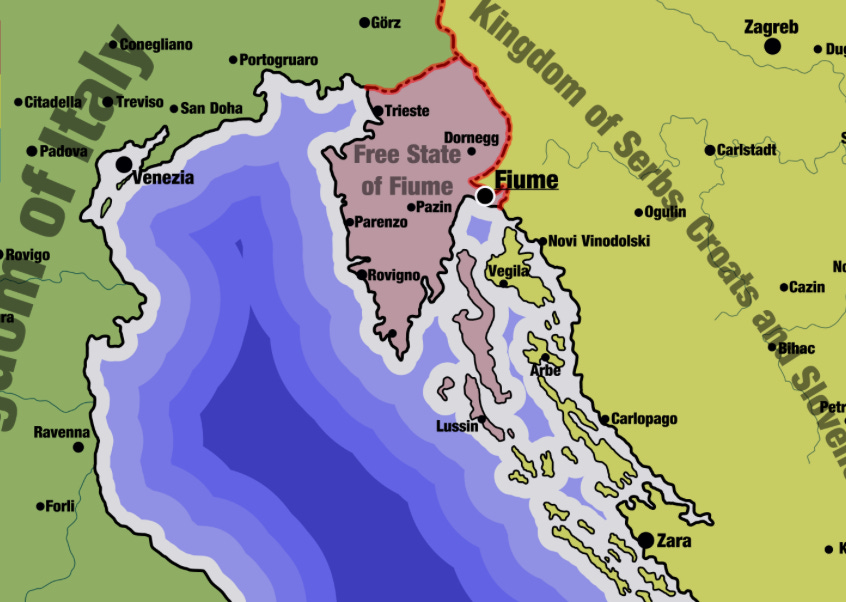
Fiume was a port on the Adriatic coast with several thousand residents, almost half of whom were ethnic Italians that had been under Austro-Hungarian rule for several hundred years after it once having been a Venetian trade port. By some quirk, Fiume was missed in the Treaty of London, probably because it had never been envisioned by the Allies that the Austro-Hungarian Empire would ever truly disintegrate and the rump of it that would remain required a sea port in some form. The city’s other residents were ethnically Serbian and Croatian, who knew the city as Rijeka (as you will find it named on a map today). All of this complexity meant that the fate of Fiume became a major topic of controversy during the Versailles Peace Conference. President Woodrow Wilson had become so unsure of what to do that he proposed the place become a free city and the headquarters of the nascent League of Nations, under the jurisdiction of no country.
By September 1919 there was still no conclusion as to the fate of Fiume. Events had overtaken the place and through the Treaty of St Germain, the Austro-Hungarian Empire had been dissolved after the abdication of the final Habsburg Emperor Charles I. Once again, Fiume had not been mentioned in the treaty and the country it had been set aside for no longer existed. The city’s fate was still at play.
Enter Gabriele D’Annunzio, an aristocrat from Abruzzo on the eastern coast of Italy. Born in 1863, he was a handsome and intelligent child and was nurtured by his family to be exceptional, with a predictable side effect of immense selfishness. As a teenager, he had begun to dabble in poetry and it was praised by authors unaware of his age. At university he began to be associated with Italian irredentism, a philosophy that yearned for all ethnic Italians to live in one country – by retaking places under foreign rule like Corsica, Malta, Dalmatia and even Nice.
[…]
The Italian government’s lack of interest [in Fiume] was unacceptable to D’Annunzio and he made clear he would take action to prevent it becoming part of Yugoslavia by default. With his fame and pedigree he was able to quickly assemble a small private force of ex-soldiers, who he quickly took to calling his “legionaries”. In September 1919 after the Treaty of St Germain was signed, his small legion of a few hundred marched from near Venice to Fiume in what they called the Impresa – the Enterprise. By the time he had reached Fiume, the “army” numbered in the thousands, the vanguard crying “Fiume or Death” with D’Annunzio at its head in a red Fiat.
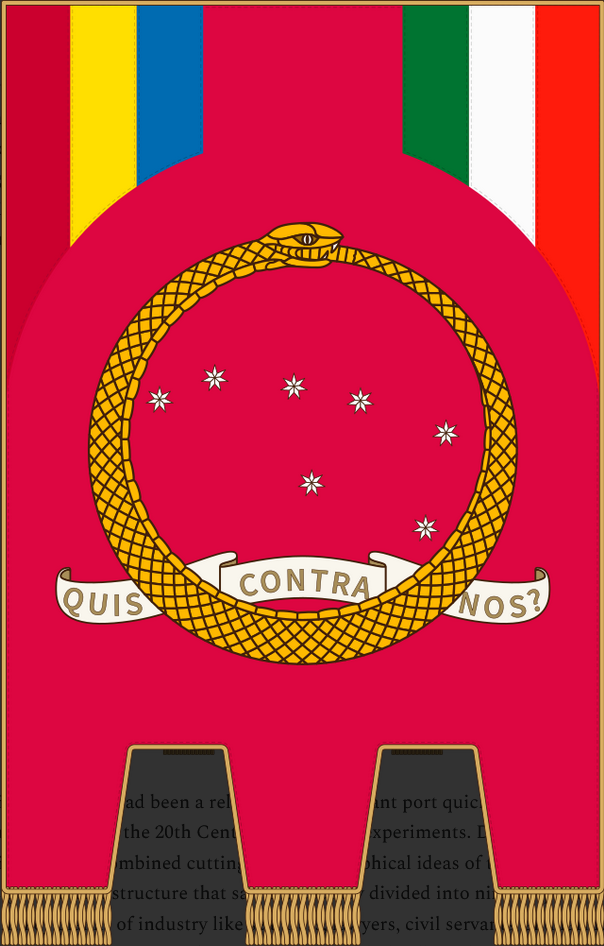
A flag designed by Gabriele D’Annunzio for the would-be independent state of Fiume, 1919.
The only thing that stood in his way was the garrison of the Entente, soldiers who had been given orders to prevent D’Annunzio’s invasion by any means necessary. But amongst the garrison’s leaders were many [Italian officers] sympathetic to D’Annunzio’s vision, some even artists themselves and before long most of the defenders had deserted to join the poet’s army. On the 12th September 1919, Gabriele D’Annunzio proclaimed that he had annexed Fiume to the Kingdom of Italy as the “Regency of Carnaro” – of which he was the Regent. The Italian government was thoroughly unimpressed and refused to recognise their newest purported land, demanding the plotters give up. Instead, D’Annunzio took matters into his own hands and set up a government and designed a flag (to the right).
The citizens of what had been a relatively unimportant port quickly found themselves in the midst of one of the 20th Century’s strangest experiments. D’Annunzio instituted a constitution that combined cutting-edge philosophical ideas of the time with a curious government structure that saw the country divided into nine corporations to represent key planks of industry like seafarers, lawyers, civil servants, and farmers. There was a 10th corporation that existed only symbolically and represented who D’Annunzio called the “Supermen” and was reserved largely for him and his fellow poets.
These corporations selected members for a state council, which was joined by “The Council of the Best” and made up of local councillors elected under universal suffrage. Together these institutions were instructed to carry out a radical agenda that sought an ideal society of industry and creativity. From all over the world, famous intellectuals and oddities migrated to Fiume. One of D’Annunzio’s closest advisers was the Italian pilot Guido Keller, who was named the new country’s first “Secretary of Action” – the first action he took was to institute nationwide yoga classes which he sometimes led in the nude and encouraged all to join. When not teaching yoga, Keller would often sleep in a tree in Fiume with his semi-tame pet eagle and at least one romantic partner.
If citizens weren’t interested in yoga, they could take up karate taught by the Japanese poet Harukichi Shimoi, who had translated Dante’s works into Japanese. Shimoi, who quickly became known to the government of Fiume as “Comrade Samurai” was a keen believer in Fiume’s vision and saw it as the closest the modern world had come to putting into practice the old Japanese art of Bushido.
The whole thing would have felt like a fever dream to an outsider. If a tourist was to visit the city, they would have found foreign spies from across the world checking into hotels and rubbing shoulders with members of the Irish republican movement while others did copious amounts of cocaine, another national pastime in Fiume. The most fashionable residents of Fiume carried little gold containers of the powder, and D’Annunzio himself was said to have a voracious habit for it. Sex was everywhere one turned and the city had seen a huge inward migration of prostitutes and pimps within days of D’Annunzio’s arrival. Almost every day was a festival, and it was an odd evening if the harbour of Fiume did not see dozens of fireworks burst above it, watched on by D’Annunzio’s uniformed paramilitaries.
D’Annunzio himself lived in a palace overlooking the city, Osbert Sitwell describes walking up a steep hill to a Renaissance-style square palazzo which inside was filled with plaster flowerpots the poet had installed and planted with palms and cacti. D’Annunzio would cloister himself in his rooms for 18 hours a day and without food. Immaculate guards hid amongst the shrubs to ensure he would not be disturbed. In D’Annunzio’s study, facing the sea, he sat with statutes of saints and with French windows onto the state balcony. When he wanted to interact with his people he would wait for a crowd to form over some issue, walk to the balcony and then ask what they wanted.
April 15, 2024
Simon & Schuster, founded 1924
In the latest SHuSH newsletter, Ken Whyte provides a thumbnail history of the American publishing house Simon & Schuster:
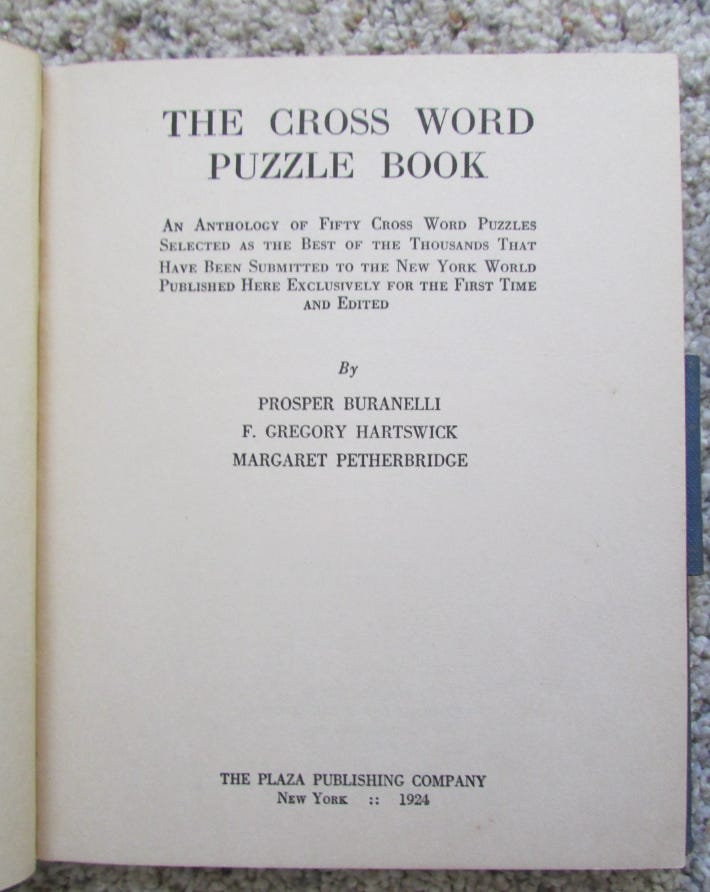
The firm was started by Richard Leo Simon, a Great War veteran and piano salesman, and his partner, Max Lincoln Schuster, an auto magazine editor. They had met when Simon failed to sell Schuster a piano. They scraped together $8,000 in savings and loans from friends, family, and a telephone operator, and launched their first title in 1924: The Cross Word Puzzle Book, a collection compiled by the editors of the New York World, which was reputed to have the best crossword of the day. Each copy of the book came with a pencil and an eraser.
Messrs. Simon and Schuster initially called themselves The Plaza Publishing Company (something S&S doesn’t mention on its history webpage). They didn’t want to be personally associated with a novelty publishing project.
The novelty project sold 40,000 copies in three months and just under half a million in its first year, earning the boys a profit of $100,000, which has to be the fastest start ever for a book publisher. The Cross Word Puzzle Book was a cash cow for decades to come — there were at least fifty-six more editions, the vast majority published as S&S books. Its proceeds funded many better quality publishing initiatives.
Will Durant’s The Story of Philosophy was published in 1926 to critical success and impressive sales. Hervey Allen’s Anthony Adverse won the Pulitzer in 1934, as did Thomas Wolfe’s You Can’t Go Home Again in 1940. Will and Ariel Durant’s eleven-volume The Story of Civilization, which started publishing in 1935 and would take forty years to complete, also won a Pulitzer and was another huge seller.
By the time S&S acquired the paperback rights to Margaret Mitchell’s Gone with the Wind in 1942 and Fitzgerald’s The Great Gatsby in 1945, it was already the leading publisher in America. To make sure everyone knew it, the boys moved into a stunning new headquarters at one of the most expensive addresses in the world, 1230 Avenue of the Americas, part of Rockefeller Center.
While it was winning its share of literary awards and publishing some great books, Simon & Schuster never forgot its roots in commercial projects. In mid-life it was famous as the how-to publisher: How to Read a Book, How to Improve your Memory, How to Raise a Dog, How to Think Straight, How to Play Winning Checkers, and the bestselling granddaddy of them all, Dale Carnegie’s How to Win Friends and Influence People, which has sold a staggering thirty million copies and still routinely shows up on bestseller lists.
Interestingly, the operational brains behind S&S was an unnamed partner, Leonard Shimkin, who joined the company as business manager at age seventeen. It was largely at Shimkin’s initiative that S&S launched Pocket Books in 1939, establishing the concept of inexpensive paperbacks, which broadened the reading public and opened the door to the expansion of genre fiction. He was also the one who walked Dale Carnegie into S&S.
The boys sold the company to Marshall Field, owner of the Chicago Sun, in 1944 but continued to work at it. They bought it back when Field died in 1956, this time with Shimkin taking an equity position. Simon retired in 1957 and Schuster not long after, eventually leaving Shimkin with sole ownership.
Meanwhile, the hits kept coming. Joseph Heller’s Catch-22 in 1961, Rachel Carson’s Silent Spring in 1962, Capote’s In Cold Blood in 1966, Alex Haley’s Roots in 1976, Larry McMurtry’s Lonesome Dove in 1985, Stephen Hawking’s A Brief History of Time in 1988, and so on.
In 1975, Shimkin sold S&S to Gulf + Western, the first in a depressing series of corporate foster homes, none of which has known anything about or cared anything for books. G+W became Paramount in 1989, which was acquired by Viacom in 1994, which split into two companies in 2005, with Simon & Schuster becoming part of CBS Corporation, which in 2019 was merged back with Viacom, which in 2022 changed its name to Paramount Global and, after failing to unload S&S to Penguin Random House that same year, landed it with KKR the next. More on why all the corporate shuffling is far from over here.
Simon & Schuster and its subsidiary, Scribner, are the last great American-owned monuments to the golden age of American book publishing, which runs from about 1920 through to … I don’t know, the 1970s? All the others — Random House, Knopf, HarperCollins, Little, Brown & Co. — are owned by foreign conglomerates (HC’s owner, News Corp, is technically American but its controlling family, the Murdochs, are culturally British when they’re not being Australian).
The MOST INCOMPETENT Railroad You’ve Ever Seen!
Southern Plains Railfan
Published Jan 6, 2024In today’s video, we recount the time Penn Central let nearly all of Maine’s potato harvest rot in Selkirk yard; ruining thousands of lives and nearly taking down other railroads in the process.
Merch Shop: http://okieprint.com/SPR/shop/home


