Quotulatiousness

May 4, 2022

Good intentions to rectify problems caused by earlier good intentions in Charleston, South Carolina

Filed under: Economics, Government, USA — Tags: , , , — Nicholas @ 05:00

Everyone seems to agree that affordable housing is a major need across North America … it certainly is in the Toronto area! In South Carolina, local politicians are doing what they can to make legal changes to encourage more affordable residences to come to market … even when the problem is at least partly caused by earlier attempts to encourage more affordable housing to come to market:

“A converted carriage house, Tradd Street, Charleston, SC” by Spencer Means is licensed under CC BY-SA 2.0

The City of Charleston is considering new legislation that would deregulate accessory dwelling units in hopes of increasing the supply of affordable housing in the city. Also known as carriage houses or mother-in-law suites, accessory dwelling units are small structures that are built in the backyards of homes, and they can be a great source of affordable housing for those in need.

The initiative, which was proposed by Councilmember Ross Appel two weeks ago, would remove red tape that is currently presenting a significant barrier for building this kind of housing. The ironic part is that the regulation which is primarily to blame for stopping the creation of these units was passed specifically to make these units more accessible.

“The city is looking at taking away a rule that requires these buildings to be affordable for 30 years,” WCSC reports, “which, Appel says, has been an obstacle for developers and homeowners.”

“We don’t want people to be artificially limited in terms of what they can charge,” Appel said. “The affordability requirement was a good-intended measure, but actually, that’s been currently in effect for the past year and a half, and we haven’t had a single accessory dwelling unit permitted since that time.”

Put simply, the affordability requirement backfired big time. Its goal was to make new accessory dwelling units more affordable, but by restricting the price people could charge it actually made them so unprofitable that people just stopped building them altogether. For all practical purposes, new accessory dwelling units might as well have been banned.

The implications are not hard to tease out. With no new accessory dwelling units to live in, people have been forced to bid up other kinds of housing, which has no doubt contributed to soaring housing prices. This is why Appel is eager to repeal this rule. He knows that building more supply is the key to bringing prices down, and he knows that regulations like this have been getting in the way of that process.

There’s a maxim in economics that this story highlights: the solution to high prices is high prices. The reasoning goes as follows. When a good like housing becomes scarce, prices naturally rise. But as prices rise, producers see an opportunity for profit and begin expanding the supply. Then, as additional supply comes to market, prices begin to fall.

QotD: Masking a young child

Filed under: Government, Health, Quotations, USA — Tags: , , , — Nicholas @ 01:00

I am not usually one for issuing trigger warnings, but this video of an unhappy two year old child is genuinely disturbing:

New York, where two-year-olds are forced to wear masks all day in nursery.

I have a single memory – a three second “video clip” of my brother’s fourth birthday – that I can confidently date as having happened before I was three. Humans do not seem to lay down recoverable memories of most of what happens to them before the age of four or so. Yet a child’s experiences in those early years have a profound effect on their later personality. That little boy will probably never remember that he tried again and again to push away the damp thing that made it hard to breathe but that his carers, with pitiless good cheer, always forced it back on. But he will have learned the lesson of the powerless. You are weak, they are strong. Crying and protesting do not help.

I am told that in Muslim societies where women must go fully veiled it is difficult to get the little girls into their coverings at first. But even they wait until the girls are at least five.

Natalie Solent, “The carers”, Samizdata, 2021-09-19.

May 1, 2022

QotD: How Thomas Sowell abandoned Marxism

Filed under: Bureaucracy, Business, Economics, Government, Politics, Quotations, USA — Tags: , — Nicholas @ 01:00

The brilliant Thomas Sowell, when in college, considered himself a Marxist. Asked what changed him, Sowell said, “Evidence.”

After completing undergrad at Harvard and obtaining a master’s in economics, Sowell landed a summer internship with the Department of Labor. While there, he researched the impact of minimum wage law on employment. Sowell learned two things, both of which he found startling. First, minimum wage laws create job loss by pricing the unskilled out of the labor force. Second, Sowell discovered that “the people in the labor department really were not interested in that, because the administration of the minimum wage was supplying one-third of the money that was keeping the labor department going. … I realized that institutions have their own agendas and their own incentives.” In short, Sowell found that the Department of Labor did not care about the real-world effects of the minimum wage law. He credits this experience, this search for evidence, with having the “biggest” impact on his thinking.

Larry Elder, “If $15 Minimum Wage Is Such a Good Idea, Why Did AOC’s Bar Close Down?”, TownHall.com, 2019-03-21.

April 30, 2022

Welcome to the Ministry of Truth, aka the “Disinformation Governance Board”

Filed under: Bureaucracy, Government, Media, USA — Tags: , , , , — Nicholas @ 05:00

Jim Treacher wraps up some of the noteworthy events of the week, including the almost-too-Orwellian-to-be-true “Disinformation Governance Board”:

The Department of Homeland Security just created something called the “Disinformation Governance Board”. Apparently, “Ministry of Truth” was too on-the-nose. All they can do anymore is scream about Russia, yet now they’ve dreamed up a propaganda org with the initials DGB. Great branding, geniuses!

I can’t put it any better than this:

Dems just spent four years screaming about the government because they weren’t in charge of it. Then they forgot all about that and immediately started amassing power again, which inevitably will be handed over to their enemies the next time the Dems are voted out of office. They never think about that, because thinking isn’t really what they do. As soon as their foes grab the levers of power the left has assembled, they’ll just start screaming about “fascism”.

Fortunately, there’s a useful logo for the new organization floating around the internet:

April 25, 2022

Trudeau’s Liberals shocked to discover that not everyone wants the internet censored

The free segment of The Line‘s weekend round-up looked at the federal government’s gone-wrong public consultation about their proposed internet censorship Online Harms bill:

Your Line editors have been diligently seeking out educated comment about the Liberals’ forays into Internet regulation and censorship; as we suspected, they are finding out the hard way that determining which speech is fit to be heard is a philosophical fools’ errand. Only a very little research into the history of liberal norms around free speech could have spared them the trouble, but, alas, this seems to be the lesson that every generation needs to re-learn from first principles.

Well, a little out-of-school learning landed in the laps of the Liberals back in September of last year via a seven-page letter written by Michele Austin, then-Twitter Canada’s head of public policy. She took the government’s proposed Online Harms Bill to task in a submission that was only revealed when this country’s lone Internet warrior, Saint Michael Geist (*sign of the cross*), filed an Access To Information request revealing Austin’s scathing critique.

To wit:

    Sacrifices freedom of expression to the creation of a government run system of surveillance of anyone who uses Twitter. Even the most basic procedural fairness requirements you might expect from a government-run system such as notice or warning are absent from this proposal. The requirement to “share” information at the request of Crown is also deeply troubling.

It’s rare to see a piece of proposed legislation so poorly conceived, so profoundly over-reaching, that virtually every organization asked to comment on it proves to be against it. But so it was. As Geist notes, even organizations that one would imagine to be at least nominally in favour of a regulatory regime intended to crack down on unequivocally harmful Internet carcinomas like child porn, hate speech, and terrorism, in fact came out against it. The National Association of Friendship Centres, Canadian Centre for Child Protection, Safe Harbour Outreach Project, Centre for Israel and Jewish Affairs, and the National Council of Canadian Muslims all noted that the government’s proposal stood to do much more harm to their respective communities than it would prevent.

Again, even a little bit of historical research would have demonstrated that those dastardly, evil, liberal values of “free speech” have traditionally done more to help marginalized communities than hinder them. But we digress.

Heritage Minister Pablo Rodriguez has subsequently announced the government would halt its Online Harms Bill, presumably in the wake of the disastrous consultation process. So the protests did, indeed, work. But as Geist rightly notes, the fact that he even had to spend months formally seeking out these submissions to be publicly released ought to raise serious questions about this government’s commitment to openness and transparency in how it approaches one of the most foundational freedoms we have as citizens. This is not a government that is philosophically well equipped, nor technically able, to control access to information in the way it so clearly wishes to. Something to keep in mind when evaluating its other Internet bills, C-11 and C-18.

I used to regularly post links to Michael Geist’s work, but at some point in the last few months his RSS feed went down and I stopped getting updates. I’ve relinked to his Twitter feed, which hopefully will provide notice when he publishes something on this file.

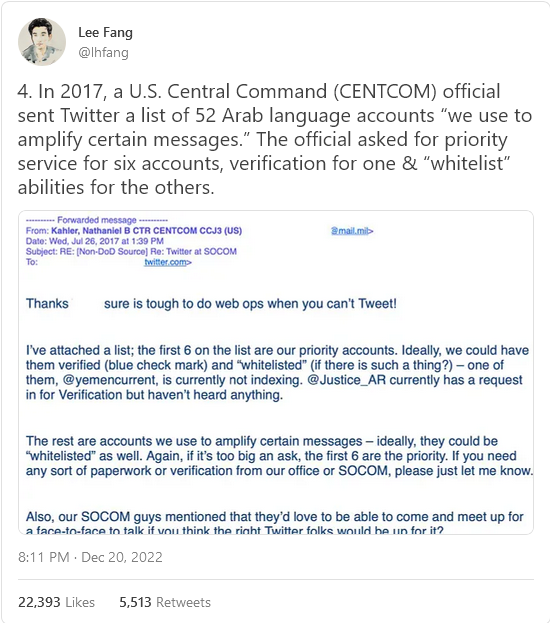
Today’s post identifies at least four problems. First, lack of transparency runs counter to promises of an open, transparent government. @justintrudeau even introduced a bill on open by default in 2014. Disclosures only via ATIP are not transparency. 2/5

Second, notion that the government was simply consulting on some ideas and will now course correct requires Canadians to overlook the reality that the actual plan was to introduce this as a bill last year. This was the Internet regulation plan. 3/5

Third, “What We Heard” report from @pablorodriguez significantly understated the extent of the public criticism and feedback. Recommendations omitted, criticisms softened. Having now seen the actual submissions, I feel misled. 4/5

Most importantly, this is part of a larger Internet regulation plan:
1️⃣Bill C-11 opens the door to regulating user generated content
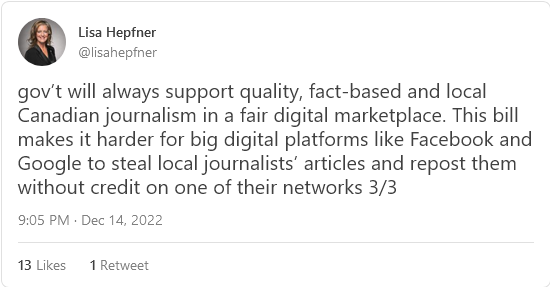
2️⃣Bill C-18 mandates payments for links
3️⃣Online harms wasn’t an outlier. It reflects plan for regulating the Internet.
5/5

April 24, 2022

Let us bid an unfond farewell to all the “cool city” initiatives

Elizabeth Nickson on a few of the ways that governments’ and pan-national organizations’ love for urban intensification looks to be finally fading away:

A decade ago cool cities were all the rage and tax money was pouring into cultural events and buildings to “attract” and densify people because “climate change”. Richard Florida, drawing upon a dubious book about cultural creatives had started his ferocious PR drive towards the mega-city as the apex of modernist civilization, a mixed-race cauldron of creativity and more, an economic engine that would power the world and leave the countryside to the bees and trees. Smart Growth was insinuated into every regulatory structure in order to, just like Captain Picard, make it so.

There were a few oppositional voices. There was me, a very minor chord along with Randal O’Toole, Wendell Cox, Joel Kotkin who detailed the risks. But mostly it was all rah rah rah. If we build it they will come. Masses of public money poured in to attract “them”. Country infrastructure was starved, and if broken, left to rust.

And did they come. To all the glamorous cities came the genius thieves of the modern age, oligarchs creating bolt holes for their money and mistresses, looters from Communist regimes, ditto for Africans stealing aid money. Every crime syndicate facing looser immigration rules started branch-plants, laundering money, and seducing the marginal into lives of misery.

Increased levels of crime was one of our objections, but hell on wheels, the devastation in LA, San Francisco, Chicago, New York and Vancouver sure wasn’t foreseen.

Housing affordability would collapse said Wendell Cox, and was he right. In Vancouver, which has been taken over by Chinese mega-crime-syndicates, is the third most expensive city in the world. People whose families founded the city, can’t afford a studio apartment.

Politicians did nothing but take the laundered cash earned by ruining the lives of their citizens, and used it to build casinos so laundering drug money from all over North America would be easier. We Canadians are so helpful. And nice. To everyone, Even child traffickers. Yeah, come here, the scenery is grand and we can take care of all the people you broke with our “free” health care.

I objected to the potential noise being noise sensitive. Also viruses. That was a big one. Courtesy of my ex-husband’s trips to Asia, I picked up a couple viruses which my immune system couldn’t suppress, since I had no built immunity. The indiscriminate mixing, flooding of people overwhelming resources would create health catastrophes I thought, and lo and behold, it looks like WHO is planning for world-wide pandemics as far as the eye can see.

So, like all the other bad ideas of the age, cool cities failed leaving massive massive debt. Everyone with a scrap of money and initiative is plotting to leave the mega cities for the distinctly uncool country these days. Out here we are bracing ourselves for your bad ideas, but we are also ready. We know what you are like. You are as dumb as rocks, and you would destroy the country just like you ruined the cities. You have zero humility. You are a nightmare coming to join the other nightmare visited on our home places, the mass confiscation of our land. The land that feeds you idiots.

April 21, 2022

The fight for freedom of speech must continue

Chris Bray on the foundation of the US Republican Party (aka the “GOP”) and the fight for freedom of speech then and now:

In 1854, Whig Party members disgusted by their party’s weak opposition to the westward expansion of slavery founded the Republican Party. Two years later, the new party ran its first presidential candidate, John C. Fremont, behind the slogan that appears at the bottom of these campaign rally-song lyrics:

Free Speech, Free Press, Free Soil, Free Men, Fremont!

The reason free speech and a free press were in there as political premises in 1856, as contested values a new political party was fighting for …

Okay, hold on a minute. In 2022, we’re a little baffled that we’re fighting for free speech. An army of sniveling shitweasels insists that we need guardrails around our discourse to prevent extremism, and Twitter employees gasp and sob as some horrible monster threatens to use their platform to let people just say stuff.

Stop trying to let people speak freely, you Nazis!

The whole thing is so baffling because we feel like the other side is trying to win the game as we amble out of the locker room and get on the team bus to head back to the hotel, like, game’s over, folks, we won an hour ago. Aren’t these long-settled questions? How is it that people are trying to drive us back against the powerful course of the American free speech tradition?

And one argument I’d like to offer, if Robert Reich will allow me to make it HITLER HITLER HITLER this content should me moderated out of existence to protect democracy, is that the argument we’re hearing right now is very much one of the American traditions regarding political speech. We buried it for a long time, but it’s real, it has been quite powerful, and it’s back.

Max Fucking Boot, my God.

April 18, 2022

Jen Gerson raises the banner of revolution against the Boomergeoisie

In the free-to-read portion of last week’s weekend post from The Line, Jen Gerson channels the anger and frustration of the Millennial sans-culottes (or should that be the sans-maisons?) who are being systematically locked out of the housing market in Canada to protect the paper investments of the Boomer generation:

“Green suburbs” by Pierre Metivier is licensed under CC BY-NC 2.0

It’s come to the attention of several of the editors at The Line that some of you Boomers are mad at us. Or, more specifically, you’re mad at co-founder Jen Gerson who popped up a particularly scathing screed about the housing market earlier this week.

To wit:

    Our Boomer got his and that’s what matters. We have an entire government apparatus set up to protect that guy. The guy with the money and the guy who votes. The rich-on-paper people are happy, and as long as everybody gets a seat somewhere on this pyramid, then everybody else should be happy too.

We will admit that Gerson didn’t intend this column to come across as an anti-Boomer harangue. She intended it as an anti-government-housing-policy-that-favours-boomers-over-young-people rant, but we can understand why some of our more mature readers took umbrage. We would say we were sorry but … we’re mostly not. A few points:

Firstly, when we talk about macroeconomics and intergenerational equity issues, we are emphatically not talking about individuals. Nobody born between the years 1946 and 1964 is personally, individually morally culpable for the state of the housing market, or the economy, or climate change or any other tragedy of the commons.

[Otherwise, we’d be adopting the tactics of the CRT movement and talking about “Boomer Fragility” and other similar kafkatraps where denial is proof of guilt.]

If you bought a $40,000 house in the ’80s, you couldn’t possibly have known that that purchase would eventually lead to a six-figure real estate portfolio by 2020: you took a risk on the economy as it existed at the time, even struggling through a rough patch of high interest rates, and that risk paid off. No Millennial would have done any differently had we been in your position.

But, let’s be honest, if you are a Canadian Boomer, you were probably born in a country that hadn’t been bombed to the ground just before an historic economic boom so grand that it allowed unprecedented investment in your health, education, development and well being.

That doesn’t mean you didn’t also work hard, and suffer setbacks, as all humans must do over the course of a lifetime. Some of you made bad decisions, and some of you were unlucky, certainly. The bell curve tolls for us all. But you did get to play the game of life during a particularly fortuitous period of history. That period is now ending and the currents of history aren’t going to be as kind to your kids as they were to you (although let’s not kid ourselves. Canadian Millennials and Zers don’t have it so bad in the greater scheme of things, either.) Recognizing this — let’s call it Boomer privilege — doesn’t cost you anything. It doesn’t hurt you. It’s not a personal attack.

What we do find fascinating is the Boomers among our readership who take discussions about intergenerational equity and demographic advantage very, very personally. Forgive us for playing pop psychologist, but it almost feels like some of you park so much of your worth as human beings into your ability to earn wealth that to have someone point out that this wealth accumulation was helped by macroeconomic factors over which you had no control — luck, essentially — seems to be read as an attack on your sense of self, purpose, and identity. (Is this why so many of you struggle to retire? Is there a frisson of guilty conscience at play?)

That is … your issue. Being lucky isn’t an indictment of your character. We assume all of our Line subscribers are genuinely good people who knit little paw mittens for orphaned cats, okay? Otherwise, why else would you be here?

April 15, 2022

Volodymyr Zelensky has become a “pop cultural admixture of Churchill and an ’80s action hero”

Filed under: Europe, Government, Media, Russia — Tags: , , , — Nicholas @ 05:00

In The Line, Andrew Potter explains how Ukrainian President Zelensky has shamed all the western leaders — like Trudeau — who have been long on rhetoric and short on action to support their claimed values:

“Volodymyr Zelensky Official portrait” by http://www.president.gov.ua/ is licensed under CC BY 4.0

When asked by journalists to explain his refusal to head for safety, Zelensky has made it clear that he has no wish to die, and that he fears for the lives of his loved ones (his wife and kids have since been moved to relative safety.) But, he added: “As for my life: I am the president of the country, and I simply do not have the right to it.” Sure, he could flee to preserve his own life. But, he has said, how would he explain his actions to his kids? As Zelensky sees it, he has no choice in the matter. His duty requires that he remain and lead his country in the fight; to do anything less would be dishonourable.

But while his Last Action Hero schtick has proven enormously popular with European and North American audiences, Zelensky’s refusal to leave Kyiv, and Ukraine’s insistence on fighting off the Russians instead of capitulation, has put our so-called leaders in a bit of a bind.

To begin with, Ukraine’s refusal to capitulate to Russian aggression has forced many governments into taking steps they almost certainly would have preferred to avoid — economic and political sanctions against Russia, costly shipments of arms and other aid, diplomatic side-choosing, rethinking of trade agreements, and so on. Ukraine’s defence is coming at a pretty high cost, and the final bill is far from being tallied.

But beyond the economic and political price that is being paid to support Ukraine, there is the extraordinary amount of cognitive dissonance Zelensky’s behaviour has generated amongst the leadership of the West. Honour? Duty? Sacrifice? What century does he think he’s living in?

For centuries, honour reflected the sorts of qualities that gentlemen were expected to possess: dignity, integrity, courage. But it is hard to even talk about honour now with a straight face. It brings to mind 19th-century aristocrats in wigs and hose, demanding satisfaction and challenging one another to a meeting over some best-forgotten offence. The old honour codes couldn’t survive the triumph of the values of liberal democracy and the arrival of what Francis Fukuyama famously called the End of History, where the willingness to risk one’s life for abstract ideas or principles has been replaced by voting and economic calculation in the public sphere and “the satisfaction of sophisticated consumer demands” in the private.

Today, the old notion of honour survives only in small and isolated precincts of (mostly) male society, places like the military and some sports, places where how you behave in front of your peers matters more than comfort, more than money, more than health, maybe even more than life itself. The rest of us have become versions of what Nietszche derided as “the last man” — creatures of liberalism who have no pride, take no risks, and desire only comfort and security.

April 14, 2022

“This might just be the dumbest, most ill-advised and lethally consequential thing Biden has said since taking office”

Filed under: Europe, Government, Military, Politics, Russia, USA — Tags: , , — Nicholas @ 05:00

Brendan O’Neill on Joe Biden’s most recent maybe official/maybe “Joe being Joe” moment on the Russia-Ukraine conflict:

Once considered a gaffe, Biden doing this again might have been a good move.

Bumbling Joe Biden isn’t funny anymore. It might be amusing when your crazy uncle blurts out something unexpected at a family dinner. But when the most powerful man on Earth does it? Not so much. Yesterday, “in passing”, as the Guardian put it, President Biden referred to Russia’s war in Ukraine as a “genocide”. This might just be the dumbest, most ill-advised and lethally consequential thing Biden has said since taking office.

The circumstances in which he uttered the g-word, in which he made the most serious accusation you can make against a nation state, were bizarre. He was in Iowa, at a public discussion on the use of ethanol in petrol, of all things. Then – “in passing” – he said: “Your family budget, your ability to fill up your tank, none of it should hinge on whether a dictator declares war and commits genocide half a world away.” And so did an announcement about the lifting of restrictions on ethanol use in order to reduce the price of fuel turn – “in passing” – into the United States of America accusing the Russian Federation of committing the most heinous crime known to man.

It is unclear whether accusing Putin of genocide is White House policy now, or if Biden was just running his mumbling mouth, as is his wont. Pressed by reporters as to whether he really meant to say “genocide”, Biden said: “Yes, I called it genocide because it’s become clearer and clearer that Putin is just trying to wipe out the idea of even being Ukrainian.” Not surprisingly, other world leaders were a tad alarmed. French president Emmanuel Macron rebuked Biden for his “verbal escalations”. We need to be “careful” with our terminology, he said, rightly.

It remains to be seen whether this is the White House consciously upping the ante or just Biden having another senior moment. He has form, after all. At the end of March – again in passing – he called for regime change in Russia. “This man cannot remain in power”, he said about Putin in an “off the cuff” remark at the end of March. Most of us make jokes off the cuff or express exasperation off the cuff – Biden expands America’s war aims off the cuff. The White House swiftly walked back this unscripted declaration of regime-change hostilities. Before that, Biden made a blunder that suggested US troops had been deployed to Ukraine. The White House walked that back, too. “[We] are not sending US troops to Ukraine”, a spokesman clarified.

Maybe the White House will walk back the “genocide” thing as well. Though it might be too late. The word’s out there now. And not just from the mouths of those irritating liberal commentators and laptop bombardiers who think every war is a genocide (except the ones they support, of course, like Iraq, Afghanistan, Libya), but from the mouth of the American president himself. Make no mistake – this is incredibly dangerous war talk. It transforms Ukraine from an undoubtedly bloody conflict that has global implications into a possible site of further external intervention and fighting. Indeed, the United Nations’ policy on “The Responsibility to Protect” expressly obliges the Security Council to take action – ideally diplomatic action, but if that fails, then military action – in order to “protect populations from genocide”. If Russia is committing genocide, then the US and its allies have a responsibility to stop it somehow. This is the dire, destabilising situation Biden has either blunderingly or consciously pushed the world towards.

April 12, 2022

Calvin Coolidge: The Silent President

Biographics
Published 27 Sep 2021

Simon’s Social Media:
Twitter: https://twitter.com/SimonWhistler
Instagram: https://www.instagram.com/simonwhistler/

This video is #sponsored by Squarespace.

Source/Further reading:

Miller Center, in-depth overview: https://millercenter.org/president/co…

History Today, overview: https://www.historytoday.com/archive/…

New Yorker, “The case for Coolidge” (cached): https://webcache.googleusercontent.co…

NY Times, “Coolidge, the great refrainer”: https://www.nytimes.com/2013/02/17/bo…

NY Times, 1933 obituary for Coolidge: https://archive.nytimes.com/www.nytim…

Atlantic, “Coolidge and depression”: https://www.theatlantic.com/magazine/…

Politico, “How Coolidge survived the Harding-era scandals”: https://www.politico.com/magazine/sto…

History, “Boston Police Strike of 1919”: https://www.history.com/this-day-in-h…

Coolidge letter written after death of his son: https://www.shapell.org/manuscript/pr…

April 11, 2022

Ours is a fundamentally unserious culture, two examples

Filed under: Education, Government, Law, Media, Politics, USA — Tags: , , , , , — Nicholas @ 03:00

Chris Bray provides some examples of just how decayed western culture has become in our headlong flight toward total unseriousness:

In Europe this month to lead the diplomatic response to a war, the Vice-President of the United States responded to a question about refugees by giggling and cackling and babbling in typical form:

And then the “fact-checkers” at Reuters explained that she actually didn’t giggle and cackle and babble, because, okay, she did cackle and giggle and babble, but she didn’t cackle and giggle and babble specifically about the refugees, so it doesn’t count: “It is clear from viewing the longer video in context that Harris and Duda laughed at the awkwardness of not knowing who should speak first. There is no evidence that Harris was laughing at the refugees or the crisis in Ukraine.” The question was about refugees, and she laughed — she laughed a lot — right after the question, but Reuters apparently called no tagbacks before the play, so no points accrue.

So we have an awkward and ineffective playactor who occupies the position of a political leader, but lacks the stature or ability to go along with it, and we have journalists who labor to protect people in powerful political positions from the possibility that people will notice who they really are and what they really do. We have political leaders who aren’t political leaders, and journalists who aren’t journalists: the form without the substance.

Meanwhile, a recent debate on the topic of free speech at Yale Law School — the nation’s top-ranked law school, which produces presidents and Supreme Court justices — began with law students screaming abuse (“I’ll fight you, bitch”) at one of the panelists, before walking out as a group and continuing to shout and pound on the walls of the adjacent hallway.

Now: The students were angry at the panelist, the bitch they wanted to fight, because she’s an anti-trans social conservative, and couldn’t you just die? But the thing that law students are learning to do is be lawyers — advocates for a position in a formalized exchange of competing views, in controversies that play out in open court. They’re training at the profession of making an argument. The point of sitting through an argument made by a person whose views you despise is that you can learn about something you want to fight against; you can see what the enemy says, and how she says it, and so do a part of the work of preparing yourself to advance a different position. So we have law students, people training for a debate-and-exchange-centered profession, who don’t want to hear things they don’t agree with. It’s like a minor league baseball player saying he refuses to touch a baseball, because baseballs offend him, but anyway, when are you assholes sending me up to the major leagues? We have people who want to occupy the profession of the law without preparing for the substance of professional engagement with competing positions: the form without the substance.

(Doing what journalists do, now, the fact-checkers explain that none of this puts points on the anti-free-speech scoreboard: “The students made their point at the very start of the event and walked out before the conversation began.” It is precisely the point that 1.) law students 2.) walked out before the conversation began. In ten years, oral argument before the Supreme Court will be that Woke lawyers stand up and scream I’M NOT GONNA LISTEN TO THIS SHIT, YOU ASSHOLES at the justices, then storm out and descend into a long round of day-drinking while waiting for the court to rule in their favor, because oh my god they CAN’T EVEN.)

April 10, 2022

“Canadian media, ‘independent’ or otherwise, is about as sparkly as dry toast”

Filed under: Bureaucracy, Business, Cancon, Government, Media — Tags: , , , — Nicholas @ 05:00

It’s impossible to disagree with the editors at The Line about the negative impact of government involvement, oversight and subsidization of the media, and the ensuing neutralization (or even Pablumization) of the news presented to Canadians:

“Newspaper Boxes” by Randy Landicho is licensed under CC BY 2.0

There is no way to create such a system without an inherently political process to answer philosophically fraught questions like “what is news?” and “what is a journalist?” And that takes us ever closer to the perilous path of state credentialization of a profession that only operates properly when it is free of both undue government interference and of government assistance. State meddling is bad for journalism whether the intent be good, bad or indifferent.

Every outlet is beholden to the people who cut the cheque, and if your business model relies on impressing government grant gifters or corporate social responsibility committees, then your content is going to reflect the milquetoast sensibilities of your true audience.

Which, bluntly, is why so much Canadian media, “independent” or otherwise, is about as sparkly as dry toast. Whole grain. To rely on government money is not only philosophically untenable, it is almost inherently corrupting. There are public journalism enterprises in Canada, including, for instance, the CBC and TVO, and your Line editors contribute to both. You can trust us when we tell you that the people in charge of those organizations work very, very hard to avoid the impossible conflicts public funding of journalism cannot help but produce. The readers can judge the results, but no one in either outlets pretends it’s easy. It’s not.

And in case it needs to be noted here again, The Line accepts no public cash. Not a dime. We rely entirely on paid subscriptions from our reader base, and we like it that way. Our relationship with you, the reader, is what allows us to be risky, innovative, and occasionally belligerent. You’re here because you like us — you really like us! — and as a result, we serve only you. That doesn’t mean that you’re always going to agree with us, of course, but rather that you can trust us to tell you what we really think.

We looked into the QCJO program and although we believe we would qualify for the program, we are simply too horrified by its mere existence to consider applying. This puts us at a severe competitive disadvantage, and one that can only be overcome by outperforming everyone else.

April 9, 2022

It wasn’t the Wuhan Coronavirus that crippled the world economy — it was government reaction to the pandemic

Filed under: Cancon, China, Europe, Government, Health, Media, USA — Tags: , , , — Nicholas @ 03:00

Dan Sanchez points out the undeniable truth that most of the economic damage we’ve sustained over the last two years wasn’t due to the pandemic itself, but to the incredibly disruptive public health measures almost every western government implemented in response (with huge connivance on the part of the legacy media and the social media companies):

… it will not be the coronavirus making us poorer, but the fallacy, embraced by officials from Beijing to DC, that central planners can manage society-wide problems, like “healing” a global pandemic or “fixing” a global supply chain.

As the great economists Ludwig von Mises and F.A. Hayek explained, societies and economies are inconceivably complex, and it is literally impossible for anyone to centrally plan something so far beyond their comprehension. To think otherwise is, as Hayek called it, a “fatal conceit”.

The fatal conceit of central planners is manifest in the very term “global supply chain”. The metaphor of a “chain” portrays the economy as something static and linear: something simple enough for a single mind to “fix”.

But, as Leonard Read vividly showed in his classic essay “I, Pencil”, even a seemingly simple good like a pencil is not the product of a single supply chain. Every good in the economy is descended from a vast “family tree” of innumerable factors of production. And all the family trees of all goods are intricately interconnected, making the economy, not a “chain”, but as economist Murray Rothbard depicted it, “a highly complex, interacting latticework of exchanges”.

This vast, dynamic latticework is self-healing and self-fixing: through the actions and interactions of its constituent individuals. Blundering, arrogant central planners only get in the way and make things worse.

That has been the lesson of free-market economists and social theorists going back to Adam Smith. The western world partly embraced that lesson, and it flourished as a result, becoming a beacon to the world. Starting in the 1970s, even Communist China emulated its example, opening up its markets. This was a humanitarian miracle for the Chinese people and a boon for us all. If not for Chinese manufacturing being integrated into the global division of labor, it is hard to imagine the west having the modern high-tech living standards and super-comfortable working conditions we enjoy (however precariously) today.

Whereas once China liberalized in emulation of the west, now the leaders of the “free world” are emulating (and, in the case of Canada’s prime minister, openly admiring) the authoritarianism of the CCP. As crises continue to mount, it is clear that this turn toward tyranny is putting our future at risk.

April 8, 2022

The structure of the Chinese government

Filed under: China, Government — Tags: , — Nicholas @ 03:00

Scott Alexander reviews The Third Revolution, by Elizabeth Economy, although as he says up front, “It’s a look through recent Chinese history, with The Third Revolution as a very loose inspiration.”:

How Does China’s Government Work?

The traditional answer is a flowchart like this one (source):

But you could give a similarly convoluted flowchart for America, and it would tell people much less than words like “democracy” or “balance of powers”. What’s the Chinese equivalent?

I found it a little more helpful to see it diagrammed it as a series of nested squares:

The inner levels have real power, and the outer layers are theoretically overseers but actually rubber stamps. Things get more and more rubber-stampy as you go out, culminating in the National People’s Congress, which recently voted to re-elect Xi by a vote of 2,970 in favor, 0 against — it’s so irrelevant that it’s literally called “the NPC”.

Who chooses the members of the inner groups? In theory, the outer groups; for example, the Central Committee is supposed to elect the Politburo Standing Committee. In practice, these selections tend to be of the “2,970 in favor, 0 against” variety, so they must be taking marching orders from someone. Who? The Chinese government doesn’t talk about it much, but probably the members of the Politburo Standing Committee hand-pick everyone, including the Paramount Leader and their own successors.

How do they pick? Mostly patron-client relationships. Every leading politician cultivates a network of loyal supporters; if he takes power, he tries to put as many of his people into top posts as he can. The seven Politburo members wheel and deal with each other about whose clients should get which positions, including any unoccupied Politburo seats.

If the two word description of US politics is “democracy, checks-and-balances”, then the two word description of Chinese politics is “oligarchy, patrons-and-clients”. If this seems exotic, it shouldn’t: it’s not much different from how the US fills unelected posts like “ambassador” and “White House staffer”. The Trump presidency put this into especially sharp relief, either because Trump did it more blatantly than usual or just because Trump’s clients were so obviously different from the normal Washington crowd. Consider eg the appointment of Jeff Sessions (among the first Congressmen to endorse Trump) as Attorney General.

In the US, this is a peripheral part of the system, checked by democracy. In China, it’s the whole game.

« Newer PostsOlder Posts »

Powered by WordPress