
An incompetent king doesn’t invalidate the very notion of monarchy, as monarchs are men and men are fallible. A bad, mad king (or a minor child) would surely find himself sidelined, or suffering an unfortunate hunting accident, or in extreme cases deposed, but the process of replacing X with Y on the throne didn’t invalidate monarchy per se. Deposing a king for incompetence was a very dangerous maneuver for lots of reasons, but it could be, and was, recast as a kind of “mandate of heaven” thing. Though they of course didn’t say that, the notion wasn’t a particularly tough sell in the age of Avignon and Antipopes.
But notice the implied question here: Sold to whom?
That’s where the idea of “information velocity” comes in. Exaggerating only a little for effect: Most subjects of most monarchs in the Medieval period had only the vaguest idea of who the king even was. Yeah, sure, theoretically you know that your lord’s lord’s lord owes homage to some guy called “Edward II” – that whole “feudal pyramid” thing – but as to who he might be, who cares? You’ll never lay eyes on the guy, except maybe as a face on a coin … and when will you ever even see one of those? So when you finally hear, weeks or months or years after the fact, that “Richard II” has been deposed, well … vive le roi, I guess. Meet the new boss, same as the old boss, and meanwhile life goes on the same as it ever did.
Information velocity out to the sticks, in other words, was very low. By the time you find out what the great and the good are up to, it’s already over. And, of course, the reverse – so long as the taxes come in on time, on the rare occasions they’re levied (imagine that!), the king doesn’t much care what his vassal’s vassals’ vassals’ vassals are up to.
Severian, “Inertia and Incompetence”, Founding Questions, 2020-12-25.
September 26, 2023
QotD: Bad kings, mad kings, and bad, mad kings
September 23, 2023
“Canada is, as a whole, a naive, spoiled country that stands a pretty good chance of getting punched in the face by reality”
In The Line, Matt Gurney praises both the delivery and the content of a recent report by the Business Council of Canada urging Canadian governments to pay a lot more attention to economic security issues that seem to be almost universally neglected in favour of mediagenic gestures and battlespace prep for the next election.
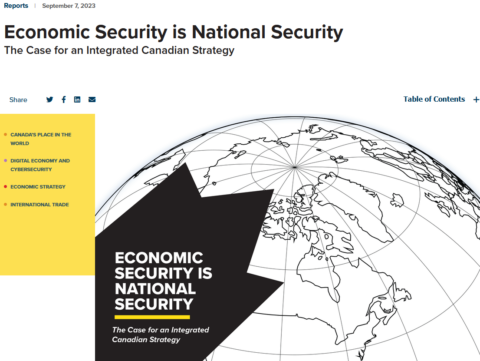
Business Council of Canada report – https://thebusinesscouncil.ca/report/economic-security-is-national-security/
But as I was reading the report, there was this nagging thought in the back of my mind. Why is the Business Council of Canada trying to impress upon the government (and the country at large) the importance of economic security? Why do we need a report from top business leaders to remind our political leadership that poor countries aren’t generally safe and peaceful ones, and that there are countries out there that would wish us harm and that we need to be on guard against? Like, shouldn’t we know that already? Because none of this stuff is revolutionary. It’s all extremely basic stuff that any mature country should just sort of intuitively grasp. Right?
And that’s when the shoulder-slumping realization lands on you like a ton of bricks. We should, but in this country, we don’t. We just don’t. Because, well ….
Uh oh.
It seems to me that a country shouldn’t need a report to impress upon key civilian leadership that economic prosperity is the cornerstone of all security, or that, on the flip side, security is a prerequisite for prosperity. Toronto is a fair bit rougher than it used to be these days — join us at our event next month! — but when I leave the house to run an errand, I’m reasonably confident I’m not going to be abducted by a band of roving pirates prowling the leafy streets of Leaside. When I head up north for the weekend, it doesn’t occur to me that there’ll be a checkpoint along the route, looking to shake me down or carry off my children into slavery. In the mornings, when I lurch out of bed with a groan that gets louder with each passing year, I expect that the light switch will indeed result in light and that the faucet in the bathroom will provide clean water. I don’t have to worry about whether the water treatment plant has been bombed or the power lines shelled.
Many of my Canadian readers may find the above absurd or, at least, a bit of hyperbole. But that’s the point. As I have written many times before, almost everything we do in this country, and almost our entire self-identity as Canadians, accepts internal security and safety from military attack as an ironclad given, just by default. That makes sense: that has been the norm for us, for a long time. It seems absurd precisely because how distant it seems from our normal.
But it isn’t the norm in any historical sense much beyond a human lifetime or two or three, even in Canada. And more to the point, as the voice-over guys in the commercials say, past performance may not be indicative of future results.
We are not owed prosperity in perpetuity. We are not guaranteed security by virtue of our niceness. These are precious things that require more than just good luck — and good luck, thank God, is something Canada still does seem to have. In addition to luck, though, we need realistic understandings of our strengths, weaknesses and the threats we face. We need political leadership that is mature and aware enough to understand the difference between political interest and national interest, and that is seized enough with these issues to devote the necessary resources to building up and preserving our security, from all reasonably foreseeable threats. That includes not just investments of money and people, but also simply intellectual bandwidth and emotional toil. We have to think, hard, about things that aren’t nice to think about, and have robust, effective institutions and a critical mass of people with the necessary combination of mindset, academic and professional training and lived experience to be effective at foreseeing, heading off and, when necessary, managing crises that threaten our safety and prosperity. We need a supportive bureaucracy that is efficient and task-focused and doesn’t get in the way of all this vital work.
Does any of this sound like Canada to you?!
Does it sound like the leader of any of our governments, or any of the people who’ll replace those leaders? Does it sound like any of our institutions except the ones specifically tasked with security and defence? You know, the ones we habitually starve so we can spend a few extra bucks and a bit more political capital on something a bit more pleasing to the average voter? Does it sound like the sort of thing smart, well-read and educated Canadians spare a single solitary moment thinking about as they go about their day to day lives?
Of course not. No one does, and our politics reflect this. These just aren’t issues of concern in Canada outside of the military, the intelligence agencies and a few fellow journalists and academics I could probably recount here in their totality by their first names.
September 22, 2023
Political psychosis and the never-ending “narrative”
Chris Bray points out several instances of the legacy media continuing to push “the narrative” despite any inconvenient facts that cast doubt on the official story:
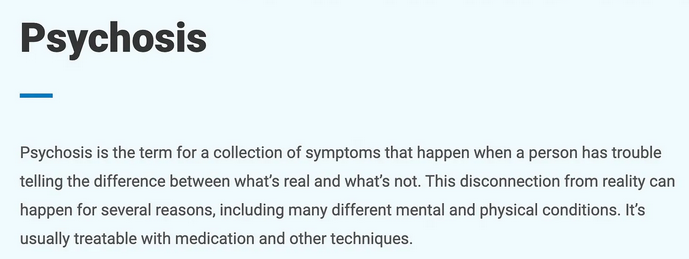
Every day is opposite day. Every day is a bucket of fake. The narrative is the narrative; once it’s established, nothing penetrates it. It rattles on down the road, impervious to inputs, convinced of its own truth without regard to events outside the shell. Psychologists have a term for this.
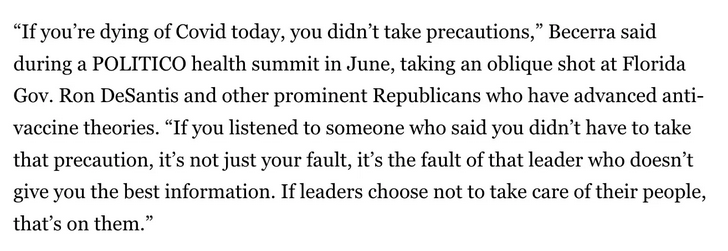
So Politico warns this week that faith in vaccines is falling, and anti-vaxxer narratives are “on the rise.” Sample paragraph, this one describing Health Secretary Xavier Becerra:
The summer of 2023, a claim made in June and credulously repeated in the bottom half of September: If you take Covid vaccines, you can’t get sick, but if you don’t take Covid vaccines, you die. Government leaders who don’t push the 7th and 8th doses of the mRNA injections “choose not to take care of their people”.
[…]
But the narrative rolls on, unperturbed. If you’re dying of Covid, it’s because you hesitated to get your 7,369th dose, anti-vaxxer! Maybe you should have stopped being such a Nazi! In the news media, it’s 2021 forever, and the virtuous science-lovers are rolling up their sleeves to rebuke the science-hating morons, who will not survive the … okay, well, who will not survive the next … okay, well, YOU’LL PROBABLY DIE AT SOME POINT because you didn’t get it. You’re facing a winter of severe illness and death by 2054, at the latest. No amount of evidence will force the storytellers to stop telling this story. It’s the story, so they tell it. The Politico thing ends by quoting Peter Hotez, by the way, as you knew it would.
Similarly, The Atlantic warns now that Donald Trump was a time bomb who kept nearly going off for four years, and only the courage of General Mark Milley kept him under control. Look at the premise at the top of the piece: Disobeying, resisting, and undermining the President of the United States, a military officer protected the Constitution.
How well does the story parse the constitutional issues at stake? This well:
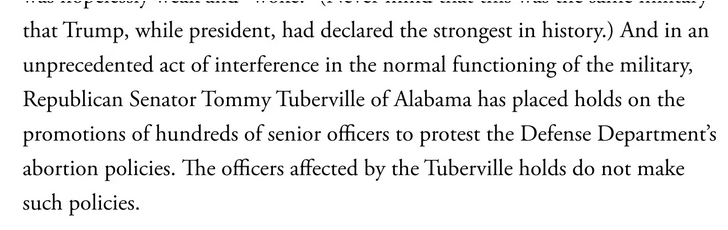
The military decided to have an abortion travel policy, and to fund it. A senator is now interfering in military policy and the unilateral executive appropriations of the Department of Defense, a sign of the ongoing constitutional crisis that began with Trump. Typically, you see, in our constitutional order, the military does whatever it wants, and spends money on its own authority however it feels like spending it, but Tuberville is engaging in the “unprecedented” act of suggesting that Congress should decide how to appropriate federal funds and regulate the armed forces, which means that he hates the Constitution. Article I, Section 8 would like a word, in this obviously extremist description of the authority of Congress:
To raise and support Armies, but no Appropriation of Money to that Use shall be for a longer Term than two Years;
To provide and maintain a Navy;
To make Rules for the Government and Regulation of the land and naval Forces;
And so on. Why is Tommy Tuberville being such a Nazi?

“The Online News Act … has been an utter disaster”
Michael Geist on the ongoing disaster the federal government created with the Online News Act:

Prime Minister Justin Trudeau was asked this week about concerns with the implementation of Bill C-18, to which he responded that other countries are quietly backing Canada in its battle against tech companies. I posted a reality check tweet noting that Meta is not returning to news in Canada, the law’s regulation stipulating a 4% fee on revenues is not found anywhere else, and that Bill C-18 has emerged as a model for what not to do. With the House of Commons back in session, it is worth providing a more fulsome reality check on where things stand with the Online News Act. While the government is still talking tough, the law has been an utter disaster, leading to millions in lost revenues with cancelled deals, reduced traffic for Canadian media sites, declining investment in media in Canada, and few options to salvage this mess.
For those that took the summer off, Bill C-18 received royal assent in late June. Over the past three months:
1. Meta has blocked all news links in Canada and cancelled existing deals with Canadian news outlets. The blocked links covers both Canadian and foreign news in light of the broad scope of the law. While the Australian experience lasted a few days, the blocking in Canada has now gone on for weeks and there is little reason to believe that the company will reverse its position to comply with the law by simply not linking to news.
2. The government responded to the blocked news links by stopping to advertise on Facebook and Instagram and encouraging others to do the same. The boycott has had little effect as the Liberal party is still advertising on the platforms with a new round of ads this week, the Prime Minister is still posting on the platforms, and reports indicate that Facebook has not experienced a reduction in user activity. In fact, reports suggest that the experience on Facebook without news has improved. Further, a Competition Act complaint has not sparked any action.
3. Google responded to Bill C-18 by advising it too would remove news links from its services before the law takes effect in December. That position enabled it to wait for the government to release draft regulations that provide further detail on the application of the law and the standards for obtaining an exemption from the mandatory bargaining process that can lead to final offer arbitration overseen by the CRTC.
Several more items of concern at the link.
September 20, 2023
How the feds could lower grocery prices without browbeating CEOs
Jesse Kline has some advice for Prime Minister Jagmeet Singh Justin Trudeau on things his government could easily do to lower retail prices Canadians face on their trips to the grocery store:
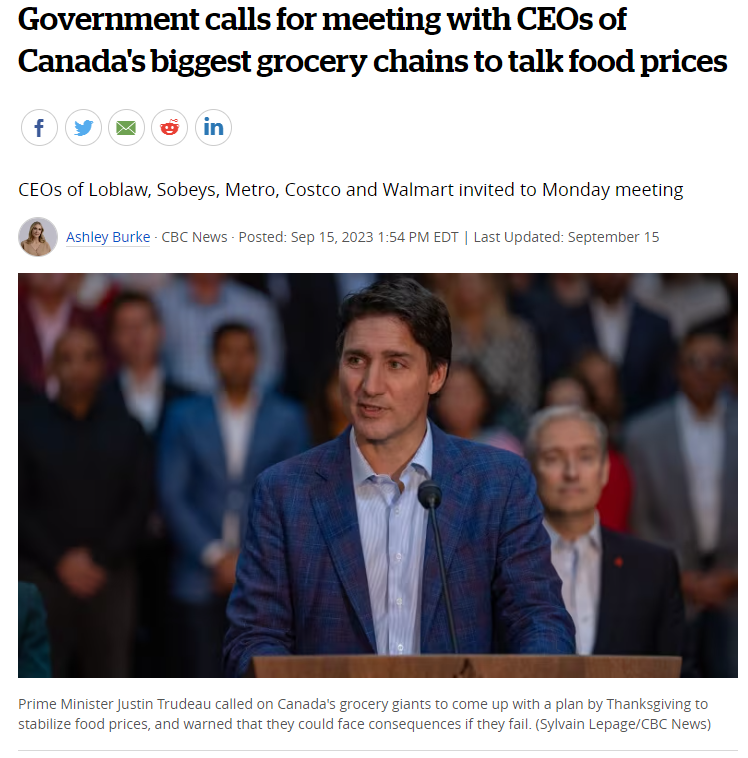
CBC report on federal scapegoating of grocery chain CEOs.
https://www.cbc.ca/news/politics/government-grocery-store-meeting-ottawa-food-prices-1.6967978
What exactly the grocery executives are supposed to do to bring down prices that are largely out of their control is anyone’s guess. Do they decrease their profit margins even further, thereby driving independent retailers out of business and shedding jobs by increasing their reliance on automation? Do they stop selling high-priced name-brand products, thus decreasing their average prices while driving up profits through the sale of house-brand products?
If the government were serious about working with grocers, rather than casting them as villains in a piece of performative policy theatre, here are a number of policies the supermarket CEOs should propose that would have a meaningful effect on food prices throughout the country.
End supply management
Why do Canadians pay an average of $2.81 for a litre of milk — among the highest in the world — when our neighbours to the south can fill their cereal bowls for half the cost? Because a government-mandated cartel controls the production of dairy products in this country, while the state limits foreign competition through exorbitantly high tariffs on imports.The same, of course, is true of our egg and poultry industries. Altogether, it’s estimated that supply managements adds between $426 and $697 a year to the average Canadian household’s grocery bill. It’s not a direct cause of inflation, but it’s a policy that, if done away with, could save Canadians up to $700 a year in fairly short order.
Yet not only have politicians been unwilling to address it, they have been fighting some of our closest trading partners to ensure that foreign food products don’t enter the Canadian market and drive down prices. Ditching supply management would be a no-brainer, if anyone in Ottawa was willing to use their brain.
Reduce regulations
The best way to decrease prices in any market is to foster competition. As the Competition Bureau noted in a report released in June, “Canada’s grocery industry is concentrated” and “tough to break into”. Worse still, “In recent years, industry concentration has increased”.So why don’t more foreign discount grocery chains set up shop here? Perhaps it’s because they know our national policy encourages Canadian-owned oligopolies. While grocery retailers don’t face the same foreign-ownership restrictions as airlines or telecoms, the products they sell are heavily regulated, which acts as a barrier to bringing in cheaper goods from other countries.
Although it wasn’t the primary reason for the lack of foreign competition, the Competition Bureau did note that, “Laws requiring bilingual labels on packaged foods can be a difficult additional cost for international grocers to take on”.
Other ways the federal government could help Canadians afford their grocery bills include:
- Jail thieves
- Stop port strikes
- Don’t tax beer
- Axe the carbon tax
Don’t hold your breath for any of these ideas to be taken up by Trudeau’s Liberals.
September 19, 2023
For some reason, ordinary Londoners don’t seem to appreciate Mayor Khan’s ULEZ initiatives
It’s hard to believe that anyone could possibly want to avoid London Mayor Sadiq Khan’s Ultra Low Emission Zone (ULEZ) expansion beyond the initial areas of the city, but a quick search of Twit-, er, I mean “X” shows evidence of what Justin Trudeau might characterize as a “small fringe minority … holding unacceptable views”:
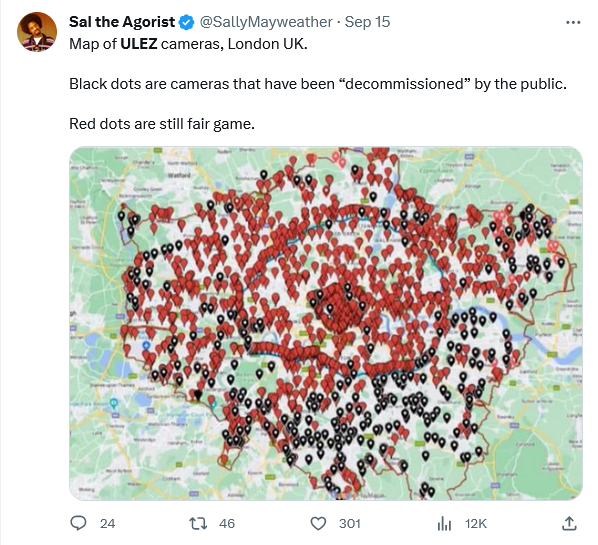
Weird, isn’t it. All those “decommissioned” cameras. And people physically blocking access to workers:

London has put up with a lot over the centuries, but Mayor Khan’s ULEZ somehow seems to have awakened the resistance in a major way:

Brian Peckford republished this article from Yudi Sherman on the pushback against London’s ULEZ expansion:
London taxpayers are damaging the city’s surveillance vans in an escalating feud between Mayor Sadiq Khan and the city’s residents.
Last month Khan peppered the city with ultra-low emission zones (ULEZs), areas in London accessible only to low-emission vehicles. Cars that do not meet the city’s environmental standards are charged £12.50 ($16) for entering the ULEZ. Automatic Number Plate Recognition (ANPR) cameras positioned around the zones read license plates and check them against the vehicles’ make and model in real time. If a vehicle does not meet the environmental threshold, the fine is levied against the car owner. Failure to pay can lead to fines as high as £258 ($331).
The ULEZ climate mandate has drawn heavy protests from residents, including hunger strikes and refusal to pay fines. Taxpayers have also taken to disabling the ANPR surveillance cameras which Transport for London (TfL), the city’s transportation department, said will be used both for climate and law enforcement.
In response, the city deployed mobile surveillance vans mounted with ANPR cameras across London in the hopes of evading attacks, but the vans are being targeted as well. Some have been spotted covered in graffiti with their tires slashed, while others have been completely covered in tarp, reports the Daily Mail.
The activists are said to belong to a group calling itself the Blade Runners and have promised not to rest until every ULEZ camera is removed or destroyed “no matter what”. The group is being widely cheered by its compatriots, including media personality and political commentator Katie Hopkins. Over 4,000 people have joined a Facebook group to report ULEZ van sightings.
Between April 1st and August 31st, police recorded 351 incidents of destruction to ULEZ cameras and 159 removals, reports Sky News, an average of over 100 a month. Of those incidents, 171 reportedly occurred since August 17th alone, just before the ULEZ mandate officially expanded to include all outer London boroughs. Two individuals have been arrested in connection with the incidents, one of whom was charged.
One reported Blade Runner said, “In terms of damage it’s way more than what [London Mayor Saidq Khan and TfL] have stated.”
QotD: Logical consistency isn’t their jam
The same people who last month were hyperventilating about the government slaughtering black people now expect me to surrender my guns to that same government.
The same people who last year were setting stuff on fire and yipping about the government rounding up the gays and Muslims for liquidation now think it’s a good idea for me to just hand over my rifles to that same government.
You chuckleheads need to make up your damned minds.
Lawdog, “You know what I find …”, The Lawdog Files, 2019-08-07.
September 17, 2023
QotD: One of the most successful propaganda campaigns in history
Ok, ok, is everyone done laughing yet? Go ahead, get it all out of your system; I’ll wait. Everyone back? Ok, moving on:
What the PTB actually did, of course, was a multi-level propaganda campaign. It was brilliant. It took a few years, of course, but the evidence is all around you. Quick: When’s the last time you saw anyone smoking in a mainstream movie? Even period films about the Forties, say — the ones where they take infinite pains to get just the right period-appropriate shade of Formica on the diner’s countertops — ignore the obvious historical reality of people puffing away like chimneys.
Indeed, it’s all but universal now, and has been for a long time, that characters who smoke are the bad guys.
Here again, look at college kids. I hate to keep beating this dead horse, but it’s really the best example I know of the phenomenon. Any time I taught the Early Modern period, I had to mention the massive economic and cultural effects of tobacco. So I encouraged kids to try it for themselves — everyone here is over 18, I said, so it’s perfectly legal. Want to know what all the hype was about? Just run down to the gas station, buy a pack, and light one up!
Around the turn of the century, I always had a few smokers in class, so I could say “bum one off So-and-So”. Even that would get me a few uneasy chuckles. A few years later, and not only were there no smokers in my classes, but the kids would be actively uncomfortable with the suggestion. By the end of my teaching career, when I couldn’t care less anymore, I was openly taunting them about it. You people have no problem with potheads, I’d say. I bet well over half of you are on Ritalin, Prozac, Xanax, Klonopin, shit that’s bad for you, in ways we don’t even understand yet, but you’re balking at one cigarette? It’s unsafe? Oh, come on, some of you are going to leave here and go light up a completely unfiltered ditch weed, and as for the rest of you, you know all about crazy sex fetishes I’ve never even heard of. You get blackout drunk at the football games every weekend, but oh no, you can’t have one cigarette, it’s so unhealthy.
Such is the power of propaganda, and it’s the only repression that works for the PTB when they’ve truly set their faces against a behavior …
Severian, “The Mob, Faux-tism, and the Ever-Rising Costs of Compliance”, Founding Questions, 2021-02-02.
September 16, 2023
Is Canada knowingly running a massive educational swindle on poor Indian students?
If even half of what Stephen Punwasi reports here is true, then the Canadian government and higher education ministries in the provinces deserve nothing but abuse:
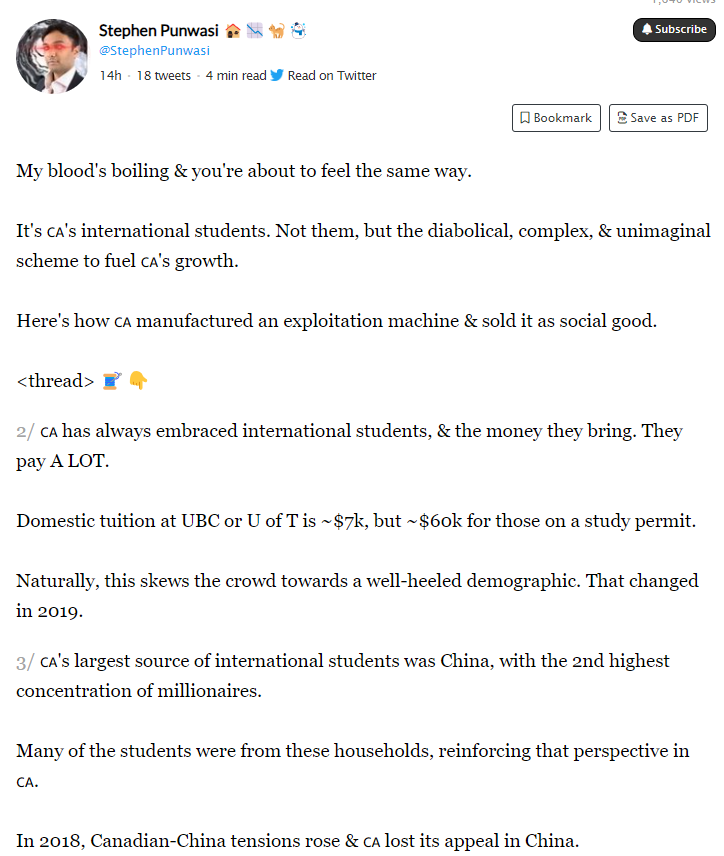
The thread continues:
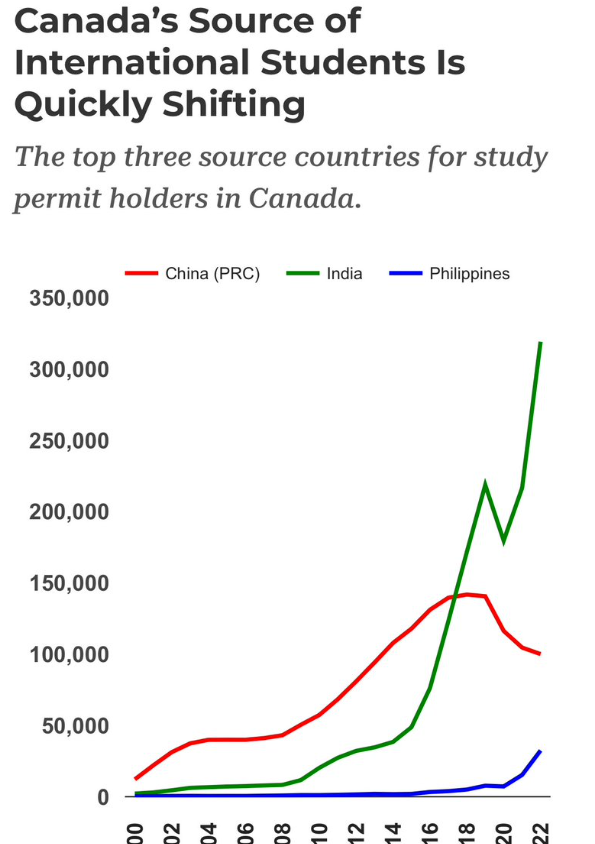
4/ 🇨🇦, addicted to the cash, cooked up a $148m plan to replace those students with new ones—primarily in developing countries.
Permits to students from India spiked fast… strangely fast. Who are these students? Get a spoon to bite, because this is where it gets f*cked.
5/ India is a FAST growing country, forecast to have the world’s largest middle class soon. It has wealthy families, but they aren’t moving here. An Indian university study found most students looking to study in 🇨🇦 are from low-income farming regions & know little about it.
6/ What they “know” is what the recruiter told them: It’s filled with opportunity, automatic PR, guaranteed gov jobs, etc. Sometimes, the recruiters “get them in” to prestigious schools they could never actually get into. All lies—they’ll say anything for the commission.
7/ Recruiters tell these families their kid is brilliant & just in the wrong country. Find a way to pay their education, & all of the parents’ hard work pays off. Bet the farm, like good parents do. So they round up their savings (& sometimes relatives). They take out loans.
8/ Heck, some literally bet the farm. Oh, some recruiters know people that specialize in high interest loans secured by your farm? Super convenient. Oh, they have a secure stream of capital, a lot of it from investors in 🇨🇦? So lucky, what are the odds‽
9/ So the kids get to 🇨🇦 & don’t arrive at UBC or U of T, but a private career college in a strip mall. Sometimes not even the school they applied to. Some schools popped up almost overnight, others don’t have classes some semesters, & some have no domestic students.
10/ Some are run by swell folks who are strangely close with alleged organized crime groups. Opportunity is everywhere! Anyway, once you’re registered—you can start vouching for visas, there’s no limit. 🇨🇦 wanted this, after all.
11/ So they:
– spent $50k to go to a diploma mill;
– don’t speak english, because of testing fraud;
– have no money;
– often rent mattresses, taking 8/hr shifts w/other students;
– if this doesn’t work, their parents lose everythingA TO funeral home sends 5 dead back per month.
12/ Don’t worry. 🇨🇦 will help, right? In 2022, it lifted the restriction of 20 hours of on-campus work, to “help” 🇨🇦 solve its low-wage labor crisis. Those viral videos of hundreds of people waiting in line for a low-wage job interview? Those are mostly international students.
13/ To reiterate, 🇨🇦 scoured the world for poor families. Promised opportunity if they risked everything. It turns out there was no opportunity, so now they’re stuck paying off debt while most of their income is consumed by shelter costs. It sounds familiar, but why evades me
14/ but here’s the kicker. Other countries where this scam was brewing signed an inter-country agreement to refuse unethical student visa brokering. Did 🇨🇦? Nope, it actively rejected it. Once again, because this is a part of its strategy.
Public health officials don’t seem to realize just how badly they’ve damaged their credibility
Chris Selley on the apparantly huge gap between how ordinary Canadians view their public health officials and how those officials think they’re viewed:

Throughout the pandemic, polls have shown a decline in confidence in public health: Researchers at McMaster University and Vox Pop Labs found that in March 2020, 59 per cent of Canadians had “a great deal of trust” in public health officials. Two years later that had plummeted to 37 per cent.
We have recently enjoyed months of being able to ignore COVID-19. Even the relentlessly, uniquely pessimistic Canadian media seemed to have exhausted themselves. So I found it a bit jarring to see Dr. Theresa Tam, Canada’s chief public health officer, suddenly back on the TV this week admonishing us to “get your mask ready” for fall and book yourself in for a booster. Dr. Kieran Moore, Tam’s counterpart at Queen’s Park, is due in the coming days to give Ontarians what will likely be a similar update.
If this year’s flu/RSV/COVID season is as bad as last, it will be fascinating to see how Canadians react. Perfervid opposition to masking and vaccination are minority positions: In the midst of last year’s autumn surge in childhood hospitalizations, a Nanos Research poll found 69 per cent of Canadians would support a return of mask mandates “if authorities deem(ed) it necessary”.
But are people ready to hear it, again, from the same public-health officials who have all-but destroyed their entire field in the last three years — seemingly without realizing it? It will be intriguing to see.
Tam’s original sins remain totally unexplained — at an official inquiry, for example, hint hint — never mind expiated. For days and weeks in early 2020, while our peer countries were closing borders and preparing for a pandemic, Tam assured us “the risk to Canada is low”. She lied that World Health Organization rules prohibited us from closing borders. She told us masks were worse than useless, and the only excuse anyone can offer is that she was fibbing to prevent Canadians from hoarding PPE. (I think she actually believed it. Either explanation is a firing offence.)
Remember the utterly incoherent advice the Public Health Agency of Canada provided to incoming travellers in the early days? Remember the built-to-fail, purely political quarantine hotels that Tam said weren’t necessary until they suddenly were — just as she said 14-day quarantine at home wasn’t necessary until it suddenly was? We were weeks if not months behind most of our peer countries. Regardless of your position on any given restriction, none of it made any sense.
September 15, 2023
Donald Trump as a political autoimmune condition
Kulak has a very interesting view on the role of Donald Trump within the American body politic:

People ask me why I’m so keen on Trump
Trump is not an exceptional political thinker, he’s a fairly awful organizer and a worse hirer of people (despite his claims otherwise)… Indeed one need only look at his choices for the Department of Justice, or his COVID response to see him consistently hiring the absolute worst enemies of his supporters and indeed himself…
He seemingly only hired people anyone on the 2008 Ron Paul campaign could have predicted would have betrayed him… and indeed would have been able to predict it in 2008.
(ex Bush people are loyal to the regime, hate their own base, and view ordinary Americans as the enemy? Who would have guessed!)
And yet little of that matters.
And to understand why, you have to understand Autoimmune disease.
Autoimmune diseases result when the immune system, the thing that is supposed to protect the body from outside threats… goes haywire and attacks the body, in response to something that is no threat at all.
All immune responses and most external disease treatments have some drawbacks … Minor immune responses like a fever or the mucus responses of the sinuses make physical exertion torturous for example … But as the response gets more extreme the more they threaten the patient itself … a medical response like Cemo might kill cancer, but its also a poison… potentially fatal to a patient if not measured precisely … Likewise, the body’s immune responses can be fatal: High Fevers can result in death or brain damage … and the Anaphylaxis response, a flood of chemicals and white blood cells meant to combat the most dangerous exposures … can and does kill people.
Of course, we are all familiar with allergies, where a harmless exposure such as certain pollens or nuts can provoke devastating and sometimes fatal Autoimmune responses.
Trump provokes such an autoimmune response in the regime.
He is not a Hitlerian master of oratory or political organizing and maneuvering, he’s not even the most impressive populist America has produced … And he’s certainly not a bloodthirsty ideological and military/political genius like Lenin or Mao (which sadly the Right-Libertarians have failed to produce, despite rivaling the communists in their output of theory and economics texts)
Yet Trump activates the class and ethnic disgust response of the regime so violently that the American regime might actually kill itself trying to reject him.
Trump should have been like Ronald Reagan, an aging artifact of an older generation, keen to compromise with the regime, easily appeased with deals that would make him at least look like he’s winning … and ultimately un-committed to combating Either the security state or the Civil Rights priesthood… the first of whom defeated JFK and the combo of whom took down Nixon.
And yet this man who showed up stating he wanted to make “big beautiful deals” and who was incapable of even hiring anyone who thought like his movement …
They went to DEFCON 1 and nearly destroyed the republic to stop him.
Because they hate his voters that much …
It’s a point Severian has made several times:
If they were capable of taking a “loss”, they [the Democrats] could’ve made Trump into the best friend they ever had. That guy was begging them to be allowed to “grow in office”. Had the Cloud People said a few nice things about him on Twitter, he would’ve done anything they wanted.
But their own convulsive reaction to the Trump insurgency made it impossible for them to do the clever thing, and their ongoing attempts to “get” Trump through any legal mechanism they can come up with has made him more politically powerful. They might have to put him up in front of a firing squad to get rid of him at the rate they’re going … but Trump as a martyr would be even more deadly to their plans than Trump as federal inmate 98722580.
September 14, 2023
Canadians’ opinions have flipped on the immigration issue this summer
Tristin Hopper covers the rapid change in public opinion from majority in favour of the Liberal government’s expanded immigration targets to majority opposed in recent polling:
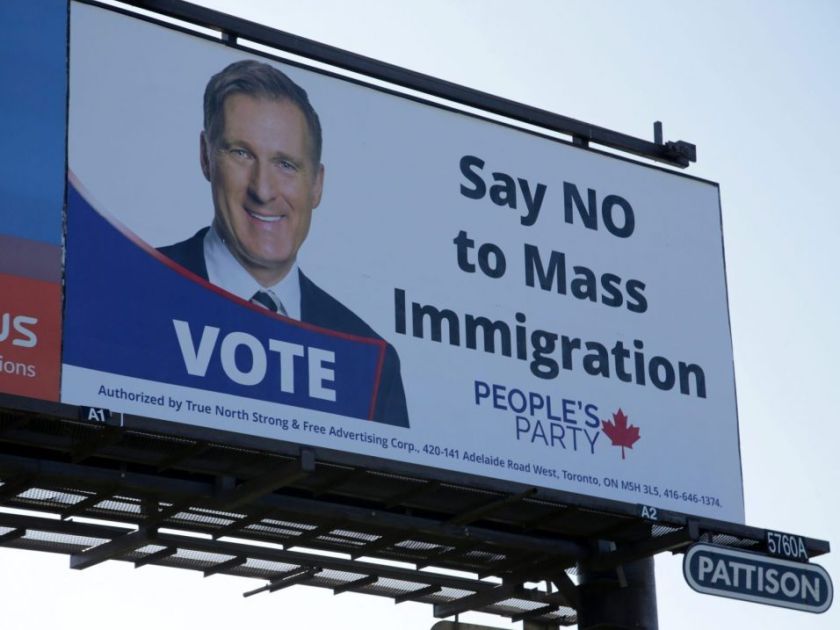
A billboard in Toronto in 2019, showing PPC leader Maxime Bernier and an official-looking PPC message.
Photo from The Province – https://theprovince.com/opinion/columnists/gunter-berniers-legitimate-position-on-immigration-taken-down-by-spineless-billboard-company/wcm/ecab071c-b57d-4d93-b78c-274de524434c
A majority of Canadians now seem to think that immigration is too high, according to a recent Nanos poll. Of respondents, 53 per cent said that the government’s plan to accept 465,000 new permanent residents was too high. It’s a sharp turnaround from just a few months prior, when a similar Nanos poll in March found that only 34 per cent of Canadians thought immigration was too high.
Canada has long been one of the most pro-immigration countries on earth, and since at least the 1990s the mainstream Canadian position on immigration levels was that they were just fine. On the eve of Justin Trudeau’s election as prime minister in 2015, an Environics poll found that a decisive 57 per cent of Canadians disagreed with any notion that there is “too much immigration in Canada.”
But if this sentiment is changing, it might be because Ottawa has recently dialled up immigration to the highest levels ever seen in Canadian history. Below, a quick guide to just how many people are entering Canada these days.
Immigration is nearly double what it was at the beginning of the Trudeau government (and way more when you count “non-permanent” immigrants)
In 2014 — the last full year before the election of Justin Trudeau — Canada brought in 260,404 new permanent residents. This was actually rather high for the time, with Statistics Canada noting it was “one of the highest levels in more than 100 years”.
But last year, immigration hit 437,180, and that’s not even accounting for the massive spike in “non-permanent” immigration. When the estimated 607,782 people in that category are accounted for, the Canadian population surged by more than one million people in a single calendar year. Representing a 2.7 per cent annual rise in population, it was more than enough to cancel out any per-capita benefits from Canada’s GDP rise for that year.
It’s about on par with the United States (a country which is eight to 10 times larger)
Proportionally, Canada has long maintained higher immigration than the United States. But in recent months immigration has gotten so high that Canada is even starting to rival the Americans in terms of the raw number of newcomers.
Last year, while Canada marked one million newcomers, the U.S. announced that its net international migration was about the same. Given the size of the U.S. (331 million vs. 40 million in Canada), this means that Canada is absorbing migrants at a rate more than eight times that of the Americans.
When these trends first began showing themselves in early 2022, CIBC deputy chief economist Benjamin Tal credited it with driving down Canadian wage growth. “The last time I checked, the U.S. is 10 times larger than we are,” he said.
September 13, 2023
QotD: The social contract
Put simply but not inaccurately, the American Founding was based on Montesquieu, who was based on Locke, who was based on Hobbes, who based his entire political theory around a “thought experiment”, which is also known as “a 3am dorm room bull session”, which is glaringly false, as anyone who has ever solved the world’s problems over a few righteous bong rips with his fellow freshmen knows.
But if I’d just said that, with no prep, I’d sound like a lunatic.
Having established (1) that the “social contract” fails theoretically, I want to argue (2) that it fails practically, too, since it rests on the consent of the governed, which a combination of (a) irreducible complexity, (b) instant communications, and (c) caloric surplus renders moot.
In other words: it would be impossible to know what you’re actually “consenting” to in the first place, even if you could consent, which you can’t.
Severian, “Anticipations and Objections (I)”, Founding Questions, 2020-12-16.B
September 12, 2023
It’s funny how many of those “climate-change-caused” wildfires were actually set by arsonists
Elizabeth Nickson connects the dots on all the “natural” wildfires that have been so much in the news this summer:
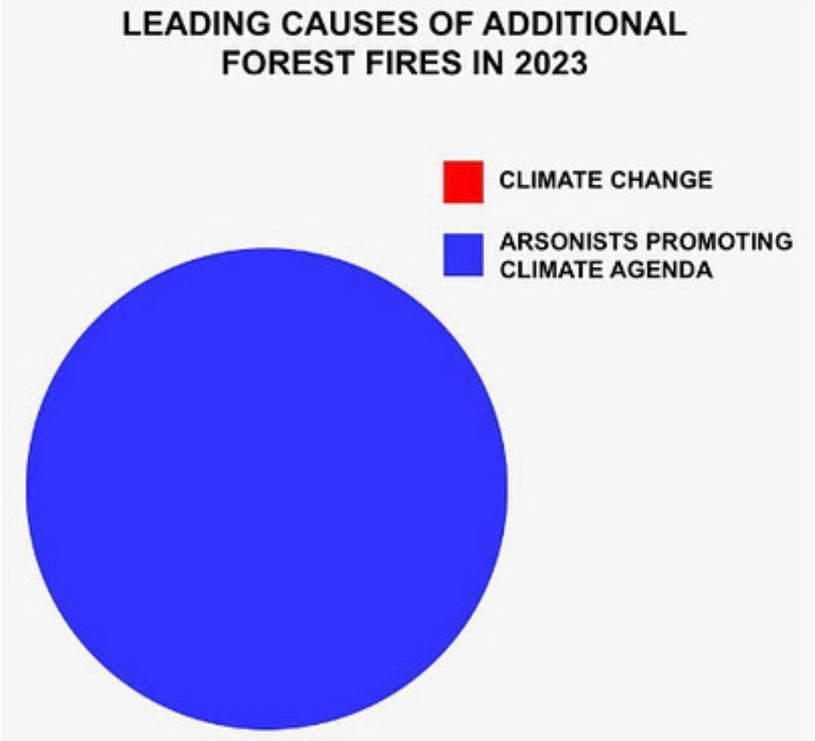
Covert geo-engineering has been used for decades and this summer was used to burn down forests and towns including Lahaina to scare people into the extreme behaviour modification required for Agenda 2030 and Net Zero.
How did everyone enjoy their trauma this August? Admit it was thoroughly engaging, a blockbuster, tragic and comic by turns, everyone’s favourite Maui town incinerated and 1,000 children and hundreds of elderly dying in the worst way imaginable. Add in the keystone cops incompetence of administrators, the carelessness, the heartlessness was psychopathic. No, I don’t think that not sounding the siren was a mistake. No, I don’t think One Hawaii’s Smart Water program of shutting off the water on that day, was a mistake. No, I don’t think it was an accident that schools were closed for the day. Yes, I think the firefighters were stood down on purpose. Yes, I think the celebrities hired private fire fighters. Yes, the “winds” were engineered. Yes, Maui has the largest space supercomputing research installation in the world and of course they have Direct Energy Weapons. Yes, I think they only burned the shops and houses of lower income Hawaiians in order to take the town and land and turn it into a ghastly Dubai-like pleasure palace for the rich, heedless and criminal.
That was one motive. The other is the big one. It is to scare enough Karens to force the commodification of carbon, a multi-trillion dollar business and pretty much the only growth industry available to the psychopaths in government and the plutocracy. Make us pay to breathe. De Sade would be proud.
Admit, cap and trade is the ideal globalist organizer. It is government control without borders or limits or even the fiction of democracy. There is zero balance of power. Government is the winner, big energy companies are winners. Why don’t the oil companies fight the climate change nonsense? The science isn’t close to settled, we have had scandal after scandal of misuse and mis-management of climate data. At that level of fraud, especially since it has not had even the wisp of rigorous analysis, it should be thrown out.
These oil companies hedge years down the road. They know they can make more money trading carbon than supplying energy.
The fires will continue until we give up and allow them to sell us carbon credits in order to leave the house. Your washing machine will be turned off mid-use if you use too much energy as now happens in Switzerland.
September 11, 2023
The DOJ versus SpaceX
I was a bit boggled when the US Justice Department announced it was going after Elon Musk’s SpaceX for alleged discriminatory hiring practices:
Image from SpaceX website.
The Justice Department recently filed a lawsuit against SpaceX, the California-based spacecraft manufacturer and satellite communications company founded by Elon Musk.
In its lawsuit, the DOJ accused SpaceX of only hiring U.S. citizens and green-card holders, thereby discriminating against asylees and refugees in hiring, an alleged violation of the Immigration and Nationality Act.
Musk denied the allegations and accused the government of weaponizing “the DOJ for political purposes”.
“SpaceX was told repeatedly that hiring anyone who was not a permanent resident of the United States would violate international arms trafficking law, which would be a criminal offense,” Musk wrote on X, formerly known as Twitter.
It’s uncertain if the DOJ is actually targeting SpaceX (more on that in a minute), but George Mason University economist Alex Tabarrok quickly found a problem with the DOJ’s allegations.
“Do you know who else advertises that only US citizens can apply for a job?” Tabarrok asked. “The DOJ.”
Tabarrok even brought the receipts: a screenshot of the DOJ job website that explicitly states, “U.S. Citizenship is Required.”
So, if Musk is discriminating against non-U.S. citizens in his hiring practices, so is the DOJ.
This makes the lawsuit prima facie absurd on one level. However, one could also argue that there could be good reasons to discriminate in hiring. And as is usually the case, for better or worse, the government gets to decide when it’s OK to discriminate and when it’s not OK.
And that’s where things get hazy.
Musk and others claim that companies such as SpaceX are legally required to hire U.S. citizens because of International Traffic in Arms Regulations, a federal regulatory framework designed to safeguard military-related technologies.
The DOJ disagrees. So who is right? It’s difficult to say, Tabarrok pointed out.
“The distinction, as I understand it, rests on the difference between US Persons and US Citizens,” he wrote on Marginal Revolution, “but [SpaceX is] 100% correct that the DoD frowns on non-citizens working for military related ventures.”
In other words, SpaceX appears to have been trying to comply with Department of Defense regulations by not using non-citizens in military-related work, and in doing so, it may have run afoul of the DOJ.


