Quotulatiousness

October 17, 2024

Democratic Germany considers banning 2nd-largest political party “to save democracy” of course

Filed under: Germany, Government, Media, Politics — Tags: , , , , , — Nicholas @ 05:00

It’s totally a normal democratic urge to try to outlaw the second-largest political party in Germany and not in the least bit “authoritarian”, right?

This man is named Marco Wanderwitz. He is a member of the nominally centre-right Christian Democratic Union, and he’s been in the German Bundestag – our federal parliament – since 2002. He reached perhaps the apex of his career late in the era of Angela Merkel, when he was made Parliamentary State Secretary for East Germany. Wanderwitz has been complaining about Alternative für Deutschland for years, and his screeching only gained in volume and shrillness after he lost his direct mandate in the last federal election to Mike Moncsek, his AfD rival. Above all, Wanderwitz wants to ban the AfD, and he has finally gathered enough support to bring the whole question before the Bundestag. Thus we will be treated to eminently democratic debate about how we must defend democracy by prohibiting the second-strongest-polling party in the Federal Republic.

Now, I try not to do unnecessary drama here at the plague chronicle, so I must tell you straightaway that this won’t go anywhere. Even were the Bundestag to approve a ban, which it won’t, the whole matter would end up before the Federal Constitutional Court in Karlsruhe, where I suspect it would fail in any case. Basically, the AfD are accumulating popular support faster than our ruling cartel parties can summon their collective will for overtly authoritarian interventions, and as long as this dynamic continues, the AfD will scrape by.

A great many influential people nevertheless really, really want to outlaw the opposition and effectively disenfranchise 20% of the German electorate. Our journalistic luminaries in particular have become deeply radicalised over the past three years. They got everything they ever wanted in the form of our present Social Democrat- and Green-dominated government, only to have their political dream turn into an enormous steaming pile of shit. Because the establishment parties, including the CDU, have no answers to the crises besetting Germany, they have had to watch popular support for the AfD grow and grow. All their carefully curated talkshow tut-tutting, all their artfully coordinated diatribes about “right wing extremism”, all their transparently hostile reporting, has done nothing to reverse the trend. If establishment journalists were running the show, the AfD would’ve long been banned and many of their politicians would be in prison.

Today, Germany’s largest newsweekly, Die Zeit, has published a long piece by political editor Eva Ricarda Lautsch, in which she explains to 1.95 millions readers exactly why “banning the AfD is overdue“. The views she expresses are absolutely commonplace among elite German urbanites, and for this reason alone the article is sobering.

Let’s read it together.

Lautsch is disquieted that many in the Bundestag fear banning the AfD is “too risky”, “too soon” and “simply undemocratic”, and that “the necessary political momentum is not materialising”.

    The problem … is not the lack of occasions for banning the AfD. Sayings like “We will hunt them down,” Sturmabteilung slogans, deportation fantasies: we have long since become accustomed to their constant rabble-rousing. And this is to say nothing of the most recent and particularly shocking occasion – the disastrous opening session of the Thuringian state parliament a week ago, in which an AfD senior president was able to effectively suspend parliamentary business for hours. Those with enough power to generate momentum don’t have to wait for it; what is missing across the parties is political courage.

What really distinguishes Lautsch’s article (and mainstream discussion about the AfD in general) is the constant grasping after reasons that the party is bad and unconstitutional, and the failure ever to deliver anything convincing. That “we will hunt them down” line comes from a speech the AfD politician Alexander Gauland gave in 2017, after his party entered the Bundestag with 12.6% of the vote for the first time. As even BILD reported, he meant that the AfD would take a hard, confrontational line against the establishment. He was not promising that AfD representatives would literally hunt down Angela Merkel, although the quote immediately entered the canonical list of evil AfD statements and has been repeated thousands of times by hack journalists ever since. As for the “Sturmabteilung slogans“, the “deportation fantasies” and the “opening session of the Thuringian state parliament” – I’ve covered all of that here at the plague chronicle. They are lies and frivolities, and what’s more, they are so obviously lies and frivolities that it is impossible to believe even Lautsch thinks very much of them. These are things that low-information readers of Die Zeit are supposed to find convincing; they aren’t real reasons.

Failing upward into the federal civil service

Filed under: Cancon, Government — Tags: , , — Nicholas @ 03:00

Woke Watch Canada charts the rise and rise of Kimberly Murray from failure to higher-paid failure to the federal civil service on a six-figure annual salary:

Kimberley Murray – Image from APTN News

Kimberly Murray has just wasted $10 million dollars of Canadian taxpayers’ hard-earned money with the blessing of two successive Ministers of Justice, David Lametti and Arif Virani.

By June 2022 — after five years as Executive Director at the Truth and Reconciliation Commission, and a one-year stint as Executive Lead at the Survivors’ Secretariat looking for allegedly missing children — Kimberly Renée Murray had failed to produce the name of a single verifiably-missing residential school child.

Despite this abysmal record of six years looking for the name of a verifiably missing child without being able to find one, Kimberly Murray was appointed by Order in Council as a federal civil servant under the Public Service Employment Act as special adviser to the Minister of Justice at a salary in the range of $228,900 – $268,200 to continue her fruitless search:

    Appointment of KIMBERLY RENÉE MURRAY of Toronto, Ontario, to be special adviser to the Minister of Justice, to be known as Independent Special Interlocutor for Missing Children and Unmarked Graves and Burial Sites Associated with Indian Residential Schools, to hold office during pleasure for a term of two years, effective June 13, 2022.

    Her Excellency the Governor General in Council, on the recommendation of the Prime Minister, under paragraph 127.1(1)(c) of the Public Service Employment Act, appoints Kimberly Renée Murray of Toronto, Ontario, to be special adviser to the Minister of Justice, to be known as Independent Special Interlocutor for Missing Children and Unmarked Graves and Burial Sites Associated with Indian Residential Schools, to hold office during pleasure for a term of two years, and fixes her remuneration and certain conditions of employment as set out in the annexed schedule, which salary is within the range ($228,900 – $268,200), effective June 13, 2022.

During the two years of her mandate, while going through her $10 million dollar budget (and according to one of her interviews, knowingly exceeding Treasury Board guidelines), Kimberly Murray failed in her primary mission — i.e., to produce the name of at least one verifiably-missing child.

Despite this spectacular failure, and her admission to the Senate Committee on Indigenous Peoples on 21 March 2023 that there are no missing children, the current Minister of Justice, Arif Virani, re-appointed Kimberly Murray for a further six months by Order in Council on 28 May 2024, this time at a salary in the range of $254,000 – $297,800.

October 12, 2024

Canadians don’t hate their banks enough

Filed under: Business, Cancon, Economics, Government — Tags: , , , — Nicholas @ 04:00

In the latest SHuSH newsletter, Ken Whyte follows up on an earlier item thanks to the many Canadians who responded with their own tales of woe in their dealings with Canadian banks:

Since I mentioned a couple of weeks ago that we have published Andrew Spence’s Fleeced: Canadians Versus Their Banks, the latest edition of Sutherland Quarterly, I’ve been inundated with people’s horror stories of their dealings with Canada’s chartered banks. Jack David’s tale in the above interview is a classic of the genre.

In Fleeced, Andrew lays out in aggravating detail how Canadian banks, although chartered by the federal government to facilitate economic activity in the broader economy, do all they can to avoid lending to small and medium businesses, never mind that small and medium businesses employ two-thirds of our private-sector labour force and account for half of Canada’s gross domestic product.

By OECD standards, small businesses in Canada are starved of bank credit, and when they are able to secure a loan, they pay through the nose. The spread between interest rates on loans to small businesses and large businesses in Canada is a whopping 2.48 percent, compared to .42 percent in the US — more than five times higher.

Why? Because Canada’s banks are a tight little oligopoly, impervious to meaningful competition. Their cozy situation allows them to be exceedingly greedy. Their profits and returns to shareholders are wildly beyond those of banks in the US and UK (and, as Andrew demonstrates, their returns from their Canadian operations are far in excess of those from the US market, meaning they screw the home market hardest.)

Our banks never miss an opportunity to impose a new fee, or off-load risk. From their perspective, small business involves too much risk — some of them will inevitably fail. The banks prefer that publishers and dry-cleaners and restaurateurs either finance themselves by pledging their homes, or use their credit cards to cover fluctuations in cash flow or make investments that will help them hire, expand, and grow. And that’s what entrepreneurs do. According to a survey by the Canadian Federation of Independent Business, only one in five respondents accessed a bank loan or line of credit. Half of respondents financed themselves, tapped existing equity and personal lines of credit, and about 30 percent used their high-interest credit cards.

By severely rationing credit and making it exceedingly expensive, Canada’s banks siphon off an ungodly share of entrepreneurial profit to themselves while leaving the entrepreneur with all the risk. Their insistence on putting their own profits above service to the Canadian economy is one of the main reasons Canada has such a slow-growing, unproductive economy and a stagnant standard of living.

There is much else in this slim volume to make your blood boil: exorbitant fees on chequing and savings accounts; mutual fund expenses that torpedo investments; ridiculous mortgage restrictions, infuriating customer service …

Fleeced: Canadians Versus Their Banks is a stunning exposé of the inner workings of our six major banks — something only a reformed banker and financial services veteran such as Andrew could write. He also explodes the myth that a bloated, uncompetitive banking sector is the price we have to pay for stability in times of financial crisis.

We are in desperate need of banking reform in Canada. Read this book and you’ll be shouting at your member of Parliament for prompt action.

Government-mandated backdoor access – “weakening security for anybody weakens it for everybody”

Filed under: China, Government, Law, Technology, USA — Tags: , , , — Nicholas @ 03:00

After all this time, it’s no surprise to discover that unlike the police — who theoretically only use these government-required “backdoors” with a legal warrant — foreign hackers have been merrily using these “law enforcement tools” for their own purposes:

“I Hear You wiretapping poster, Mad Magazine, NYC” by gruntzooki is licensed under CC BY-SA 2.0 .

For as long as law enforcement has sought a way to monitor people’s conversations — though they’d only do so with a court order, we’re supposed to believe — privacy experts have warned that building backdoors into communications systems to ease government snooping is dangerous. A recent Chinese incursion into U.S. internet providers using infrastructure created to allow police easy wiretap access offers evidence, and not for the first time, that weakening security for anybody weakens it for everybody.

Subverted Wiretapping Systems

“A cyberattack tied to the Chinese government penetrated the networks of a swath of U.S. broadband providers, potentially accessing information from systems the federal government uses for court-authorized network wiretapping requests,” The Wall Street Journal reported last week. “For months or longer, the hackers might have held access to network infrastructure used to cooperate with lawful U.S. requests for communications data.”

Among the companies breached by the hacker group, dubbed “Salt Typhoon” by investigators, are Verizon, AT&T, and Lumen Technologies. The group is just one of several linked to the Chinese government that has targeted data and communications systems in the West.

While the Journal report doesn’t specify, Joe Mullin and Cindy Cohn of the Electronic Frontier Foundation (EFF) believe the wiretap-ready systems penetrated by the Chinese hackers were “likely created to facilitate smooth compliance with wrong-headed laws like CALEA”. CALEA, known in full as the Communications Assistance for Law Enforcement Act, dates back to 1994 and “forced telephone companies to redesign their network architectures to make it easier for law enforcement to wiretap digital telephone calls,” according to an EFF guide to the law. A decade later it was expanded to encompass internet service providers, who were targeted by Salt Typhoon.

“That’s right,” comment Mullin and Cohn. “The path for law enforcement access set up by these companies was apparently compromised and used by China-backed hackers.”

Ignored Precedents

This isn’t the first time that CALEA-mandated wiretapping backdoors have been exploited by hackers. As computer security expert Nicholas Weaver pointed out for Lawfare in 2015, “any phone switch sold in the US must include the ability to efficiently tap a large number of calls. And since the US represents such a major market, this means virtually every phone switch sold worldwide contains ‘lawful intercept’ functionality.”

October 11, 2024

“[T]he past is like a thriving civilization; they do things better there”

Another recommended link from the “Your Weekly Stack” set of links to interesting posts on Substack. This, like the previous post, is from an author I hadn’t read before and thought was worth sharing with you.

This is from The American Tribune, making the case that modern Americans (and westerners in general) are in a similar situation to the white minority in Rhodesia:

We stand today in the ruins of civilization. Much as the 9th Century Anglo-Saxons looked at the stone works of the Romans and thought they must have been giants,1 or the Greeks of the post-Sea Peoples Dark Age saw the works of the Minoans and Myceneans and thought only Cyclopses could have constructed such structures,2 we stare at the achievements of the 19th and early 20th Centuries in near-disbelief.

The moon hasn’t been stepped upon since the 70s. Mars remains uncolonized. Municipal infrastructure like water treatment and provision is falling apart and the government either can’t or won’t respond to natural disasters.3 Whereas we once built beautiful buildings that lasted for centuries, structures such as Chatsworth and the Horse Guards Building of Whitehall, now we have ugly structures of concrete and steel that are falling apart already.4

The situation as regards crime and squalor is even worse. As Curtis Yarvin notes in “An Open Letter to Open-Minded Progressives”:

    If you read travel narratives of what is now the Third World from before World War II (I’ve just been enjoying Erna Fergusson’s Guatemala, for example), you simply don’t see anything like the misery, squalor and barbarism that is everywhere today. (Fergusson describes Guatemala City as “clean”. I kid you not.) What you do see is social and political structures, whether native or colonial, that are clearly not American in origin, and that are unacceptable not only by modern American standards but even by 1930s American standards.

So whereas Guatemala was once clean, now America’s cities are towers of concrete surrounded by piles of refuse, mobs of zombie-like drug addicts living on the streets,5 and infested with criminals of both the petty and highly violent variety. As Hartley put it, “The past is a foreign country; they do things differently there”. More accurately, the past is like a thriving civilization; they do things better there.

In short, we, like those in the Belgian Congo after the Belgians left, live in an “Empire of Dust” where much of what remains is the ruin of a prior civilization destroyed not because it didn’t work, but because the demented ideology of the present conflicted with its continued, functional existence.6

What happened? A sort of decolonization inflicted upon the Great Powers themselves — namely America, Germany, Britain, and France — after the outlying colonies had long been destroyed. The decay of law and order, the promotion of anti-white hatred, the decay of infrastructure, and the filling of positions with corrupt thugs rather than honorable gentlemen,7 all of it is more or less what happened to the colonies in the ’50s and ’60s. Further, it is similar to what happened later on in South Africa, where a collection of communists, leftists, and NGOs with like mindsets and funded by those like George Soros turned a formerly thriving civilization into what now amounts to a land like Mad Max but with more murder.8

But while the South Africanization of America is certainly an issue that we face,9 it’s not the most accurate comparison to our present problem. South Africa was, when it fell, filled with decades of racial hatred sparked by decades of apartheid that ended only then (though was somewhat overblown), something that Europe never had and nowhere in America has had in over half a century. That unique circumstance created a degree of hatred that was overpowering and, though one with which we largely disagree, understandable. We, then, are somewhat different in terms of where we are and what is happening.


German free speech – only applicable when used to criticize the “far right”

Filed under: Books, Germany, Government, Law, Liberty, Media, Politics — Tags: , , , , — Nicholas @ 03:00

C.J. Hopkins discovers the stark contrast between actual freedom of speech and German freedom of speech:

The first rule of New Normal Germany is, you do not compare New Normal Germany to Nazi Germany. If you do that, New Normal Germany will punish you. It will sic the Federal Criminal Police on you. It will report you to its domestic Intelligence agency. It will ban your books. It will censor your Tweets. It will prosecute you on fabricated “hate-crime” charges.

I know this, because that’s what happened to me. I broke the first rule of New Normal Germany. I compared New Normal Germany to Nazi Germany. I did it with the cover artwork of my book.

Yes, that’s a swastika on the cover. A swastika covered by a medical mask. I tweeted that artwork in 2022. The German authorities prosecuted me for that, and convicted me for that. So, now I’m a “hate criminal”, and an “anti-Semite”, and a “trivializer of the Holocaust”.

That’s the second rule of New Normal Germany. You never, ever, display a swastika. Displaying a swastika is not “in Ordnung“. Displaying swastikas is totally “verboten“.

Unless you are the Health Minister of New Normal Germany, and you’re comparing your political opponents to the Nazis. Or unless you are a popular German celebrity, and you’re comparing the Russians and their supporters to the Nazis. Or unless you are a mainstream magazine, and you’re comparing German populists to the Nazis.

In which case, displaying a swastika is fine. And is not “verboten“. And definitely not a “hate crime”.

And that’s the third rule of New Normal Germany. If you agree with the government, obey their orders, and parrot their propaganda, you are not a “hate criminal”. If you are the government, like an actual minister in the government, like the Minister of Health, you’re definitely not a “hate criminal”. And, if you are part of government’s propaganda apparatus, needless to say, you’re also not a “hate criminal”.

However, if you criticize the government, or if you compare the government to Nazi Germany, and if you do that using your book-cover art featuring a swastika behind a Covid mask, then you’re absolutely officially a “hate criminal”, and an “anti-Semite”, and a “trivializer of the Holocaust”.

October 10, 2024

Trump’s tariff proposals will rival Smoot-Hawley for self-inflicted economic woes

Filed under: Economics, Government, History, USA — Tags: , , , , — Nicholas @ 04:00

J.D. Tuccille explains why Trump’s economic plans are very much a curate’s egg of good and bad ideas, but the proposed tariff plans would more than compensate for any good positive effects from the rest of his proposals:

Willis C. Hawley (left) and Reed Smoot in April 1929, shortly before the Smoot–Hawley Tariff Act passed the House of Representatives.
Library of Congress photo via Wikipedia Commons.

Former president and current Republican presidential candidate Donald Trump wants to extend the tax cuts passed when he was in the White House, which are due to expire next year. That would not just be welcomed by the many Americans who would benefit, it could boost economic activity. But there’s a big problem: The protectionist tariffs favored by Trump would undo the good done by his tax cuts, reducing rather than increasing prosperity.

Tariffs Not Seen Since the Great Depression

“Former President Donald Trump’s proposals to impose a universal tariff of 20 percent and an additional tariff on Chinese imports of at least 60 percent would spike the average tariff rate on all imports to highs not seen since the Great Depression,” warns Erica York of the Tax Foundation.

Trump has actually been a little vague on the size of his universal tariff, first floating it at 10 percent while allowing “it may be more than that”, and then upping the ante to 20 percent. Either way, it’s a cost that ends up being largely paid by Americans in terms of higher retail prices and more expensive imported parts and materials for domestic manufacturing.

The Trump administration’s 2018 “tariffs resulted in higher prices for a wide variety of goods that U.S. consumers and businesses purchase,” the Tax Foundation’s Alex Durante and Alex Muresianu concluded.

Even when tariffs don’t directly affect the cost of imported goods purchased by consumers, they still drive up the prices of many things made in the U.S. The Cato Institute’s Pierre Lemieux points out that “a tariff on an input (say, steel) is paid by the American importer who will typically pass it down the supply chain to his customers and eventually to the consumers of the final good (say, a car)”. Instead of boosting domestic production, that can do harm, instead.

“For manufacturing employment, a small boost from the import protection effect of tariffs is more than offset by larger drags from the effects of rising input costs and retaliatory tariffs,” Federal Reserve Board economists found when they researched the 2018 tariffs.

That’s not to say Trump is alone in his protectionism. Last month, Bob Davis noted for Foreign Policy that “the Biden administration is the first since at least President John F. Kennedy’s time to fail to negotiate a major free trade deal, instead embracing tariffs” while Trump pursued both tariffs and trade deals.

October 9, 2024

Dangling the old “high speed rail between Toronto and Montreal” proposal again

Filed under: Cancon, Economics, Government, Railways — Tags: , , , , — Nicholas @ 03:00

In what seems like an annual ritual, the attractive-to-many (but economically non-viable) idea of putting in a high speed rail line between Toronto and Montreal is getting another airing:

The closest active model to the proposed VIA “High Frequency Rail” proposal is the Brightline service in Florida.
“BrightLine – The Return of FEC passenger service” by BBT609 is licensed under CC BY 2.0

In 2021, the Government of Canada confirmed its plans to significantly upgrade VIA Rail’s passenger rail service between the Windsor and Quebec City corridor into a high-frequency rail service.

As the name suggests, this new high-frequency rail service would offer significantly higher frequencies and reduce travel times on the route linking Toronto, Ottawa, and Montreal by 25 per cent.

With dedicated passenger rail tracks separate from freight operations, which greatly contribute to current service delays, this new train service would more consistently operate at increased speeds of up to 177 km/h to 200 km/h, and reliability would improve to an on-time performance by over 95 per cent.

This is quite true … the existing rail network between Toronto, Montreal and Ottawa was designed and built to carry freight traffic first and passengers only as a secondary goal — in many cases to attract government subsidies for the construction of the lines. Passenger services are, at best, marginally profitable but generally passenger service is a dead loss for the railways and only maintained thanks to ongoing government subsidies, grants, and tax breaks.

Freight trains — the profitable part of the railway network — have gotten longer and heavier over time as technology has improved (and train crews have gotten smaller, reducing labour costs) and the signal systems are optimized for freight traffic: long, slow-moving trains that take a lot of time and energy to speed up and slow down. Passenger trains travel faster (well, theoretically anyway) and make frequent stops to pick up and drop off passengers … signalling systems (which are critical to safe operations) need to be designed to optimize the usage pattern of the majority of the trains which in practice means freight with some modifications in high-population areas to accommodate passenger traffic.

This high-frequency rail service would use VIA Rail’s new and growing fleet of modern Siemens Venture trains operating on the Windsor-Quebec City corridor.

But as it turns out, the federal government is also contemplating a new service that is even better than high-frequency rail — the potential for a high-speed rail service, which would be the first of its kind in Canada.

Currently, the federal government is engaged in the Request For Proposal (RFP) process for the project. In July 2023, it shortlisted three private consortiums to participate in the RFP’s detailed bidding process, attracting international interest from major investors and some of the world’s largest passenger rail service operators.

This includes the consortium named Cadence, entailing CDPQ Infrastructure, AtkinsRealis (formerly known as SNC-Lavalin), Systra Canada, Keolis Canada, SNCF Voyageurs, and national flag carrier Air Canada.

The inclusion of Air Canada in the consortium is … interesting … as one of the goals of an actual high speed system would be to drain off a proportion of the short-haul passenger traffic that currently goes by air. A cynic might wonder if Air Canada’s interest in the project is to help or hinder.

According to a report in Toronto Star last week, each of the three consortiums was directed to create two detailed proposals, including one concept with trains that travel under 200 km/h and another concept with trains that travel faster than 200 km/h.

High-speed rail is generally defined as a train service that operates at speeds of at least 200 km/h.

It was further stated in the report that the new service could result in travel times of only three hours between Toronto and Montreal, as opposed to the current travel times of over five hours on existing VIA Rail services.

For further comparison, the travel time between Toronto and Montreal on flight services such as Air Canada is about 1.5 hours, which does not include the time spent at airports, while the driving time over this distance of over 1,000 km is about 5.5 hours — similar to VIA Rail’s existing services.

The potential holds for VIA Rail’s new service to operate at speeds over 200 km/h along select segments of the corridor.

The required costs to implement 200km/h speeds will be in eliminating as many grade crossings as possible and reconstructing some tight curves to allow the higher speed trains … and, as mentioned earlier, retrofitting the signal system for the faster passenger trains. Even those measures, which don’t really produce a true “high speed” system will be very expensive.

October 8, 2024

Hats off to the brilliant negotiators of the Mauritian government

Filed under: Britain, Government, Military, USA — Tags: , , , , , — Nicholas @ 05:00

At The Critic, Yuan Yi Zhu salutes the negotiators who managed to get an amazing deal from the British government for the Chagos Islands (which contain the strategic US naval base of Diego Garcia):

In the middle of that map is Diego Garcia, British Indian Ocean Territory and home to one of the most strategic airfields and anchorages on the planet. […] The red circle is 2,000 nautical miles from the island. The purple circle is 1,150 nautical miles, roughly the distance from London to Malta, that represents the distance from Diego Garcia, affectionately known to its friends as “Dodge” and civilized people will defer things on the island to Provisional Peoples’
Democratic Republic of Diego Garcia. That circle is also the distance from Diego Garcia to the island of Mauritius.
Caption and image from CDR Salamander.

Donald Trump likes to brag about his prowess as a negotiator, but he has nothing on the government of Mauritius, which pulled one of history’s great diplomatic heists yesterday, when it announced that the British government had agreed to give it the Chagos Islands, which have been sovereign British territory without interruption since 1814.

To add insult to injury, not only will Mauritius gain a new colony, but it will collect large rents from the Americans for the military base on Diego Garcia, while the British government will pay hefty financial support to Mauritius (Africa’s third richest country on a per capita basis) for the honour of handing over to Mauritius one of the world’s most strategically valuable territories.

In other words, not only is Mauritius having its cake and eating it too, it has also extracted from the British taxpayer a new cake, to be savoured while it smugly lectures the world about the importance of decolonisation.

Never mind that Mauritius sold the Chagos Islands to the United Kingdom in 1965 for the-then astronomical sum of £3 million and a valuable British security guarantee. Its prime minister had described the islands as “a portion of our territory of which very few people knew … which is very far from here, and which we had never visited”, so it was no big loss.

In the 1980s, a new government changed its mind and decided to get the islands back. It alleged the British had threatened to withhold independence from Mauritius unless it agreed to sell the territory. The small problem was that every single surviving Mauritian negotiator cheerfully admitted that they didn’t care about the Chagos, whose inhabitants they regarded as half-civilised savages.

And the blackmail thesis suffered from the fact that Britain in the 1960s could not get rid of its remaining colonies fast enough — Mauritius had to wait a few more years for independence because part of its population wanted it to remain a British territory.

Mauritius then decided to wave the bloody shirt of the Chagossians, who had been callously expelled by the British to make way for the air base and dumped on Mauritius. The fact that the Mauritian treated them terribly — so terribly, in fact, that thousands of them left for the UK, the country which had deported them in the first place — was but a minor detail.

In 2019, Mauritius managed to get the International Court of Justice to say that the islands should be given to Mauritius. The ruling was not even legally binding, but Mauritius was somehow able to convince gullible Whitehall functionaries that Britain had no choice but to give the islands to Mauritius.

So far as I am aware, there is no truth to the rumour that Spain and Argentina are in negotiation with Mauritius to take over their respective territorial claims on Gibraltar and the Falkland Islands.

October 5, 2024

Scary words of 2024 – “Luckily, FEMA is on the case”

As I recounted a few days back, I was relieved to hear from my friend in the Asheville NC area after the region absorbed the damage from Hurricane Helene. Tom Knighton had a similar experience:

A friend of mine lives at the edge of where Helene did her worst. He just got power back on yesterday and was finally able to let me know he was OK. I was worried for obvious reasons.

In the deepest, worst parts of where the storm ripped things to shreds, they’re trying to just make it to the next day. They’re struggling to find clean drinking water, food, shelter, the works.

Luckily, FEMA is on the case.

They took to social media yesterday and posted this crap.

That’s right. People who don’t have internet, phone service, or electricity should call, download an app, or log onto the FEMA website.

I won’t ask how stupid can the federal government be, but I’m worried they’d take it as a challenge.

Back in the day, FEMA would roll into a disaster area with paper applications and facilitate all of that right there. While the internet and smartphones are glorious things, this is a prime example of when they’re a terrible option for people.

Right now, American citizens are struggling. They’re thankful to be alive and are working their butts off to keep themselves alive. They’ve paid taxes their entire lives, and now that they need some of theirs back, their federal government is telling them to do what is physically impossible for many of them.

I can’t help but see this and think that their claims of having enough money in spite of spending hundreds of billions on illegal immigrants ring a tad hollow.

If they have the money, why not put boots on the ground getting people signed up for any assistance they may be entitled to?

Honestly, while I’ve commented before about the gross incompetence of the government in disaster response — and I’ll agree that maliciousness is most definitely a possibility, if not a probability in these instances — this is just weapons-grade … whatever, be it stupidity, meanness, or a combination of both.

Heads should roll.

Update: David Warren notes that it’s not merely FEMA incompetence, it’s active deterrence for private relief efforts by all federal agencies.

From the Internet (for instance updates from Elon Musk), we note that non-governmental charitable efforts are not merely “discouraged”. The government is seizing and impounding desperately-needed local goods and services. The rest of the federal bureaucracy is also “chipping in”, to stifle relief efforts. The FAA, for instance, is restricting private aircraft with supplies, and making it almost impossible to fly drones, demanding that flights be individually approved by their slothful trolls. Those who wish to bring help to the survivors have both the wreckage of the storm, and government agents to block them.

This is how things work in this world, and have worked, since the Reformation, when the state took over welfare, hospitals, schools, and all other eleemosynary institutions. Rather than allow inspiring expressions of Christian charity, they became the means for cynical political posturing and control. And with “democracy”, we have detailed laws and policies, to prevent the people from helping themselves — as they would do, by laws of nature.

October 4, 2024

QotD: Farmers and slaves in ancient Mesopotamia

Filed under: Food, Government, History, Middle East, Military, Quotations — Tags: , , , , — Nicholas @ 01:00

In one of my favorite parts of the book [Against The Grain], Scott discusses how this shaped the character of early Near Eastern warfare. Read a typical Near Eastern victory stele, and it looks something like “Hail the glorious king Eksamplu, who campaigned against Examplestan and took 10,000 prisoners of war back to the capital”. Territorial conquest, if it happened at all, was an afterthought; what these kings really wanted was prisoners. Why? Because they didn’t even have enough subjects to farm the land they had; they were short of labor. Prisoners of war would be resettled on some arable land, given one or another legal status that basically equated to slave laborers, and so end up little different from the native-born population. The most extreme example was the massive deportation campaigns of Assyria (eg the Ten Lost Tribes of Israel), but everybody did it because everybody knew their current subjects were a time-limited resources, available only until they gradually drained out into the wilderness.

Scott Alexander, “Book Review: Against The Grain“, Slate Star Codex, 2019-10-15.

October 2, 2024

Duelling reports on how Javier Milei’s Argentinian “shock therapy” is working

At Astral Codex Ten, Scott Alexander tries to find something approaching the truth between the pantingly enthusiastic libertarian reports and the angrily negative progressive reports:

How is Javier Milei, the new-ish libertarian president of Argentina doing?

According to right-wing sources, he’s doing amazing, inflation is vanquished, and Argentina is on the road to First World status.

According to left-wing sources, he’s devastating the country, inflation has ballooned, and Argentina is mired in unprecedented dire poverty.

I was confused enough to investigate further. Going through various topics in more depth:

1: Government Surplus

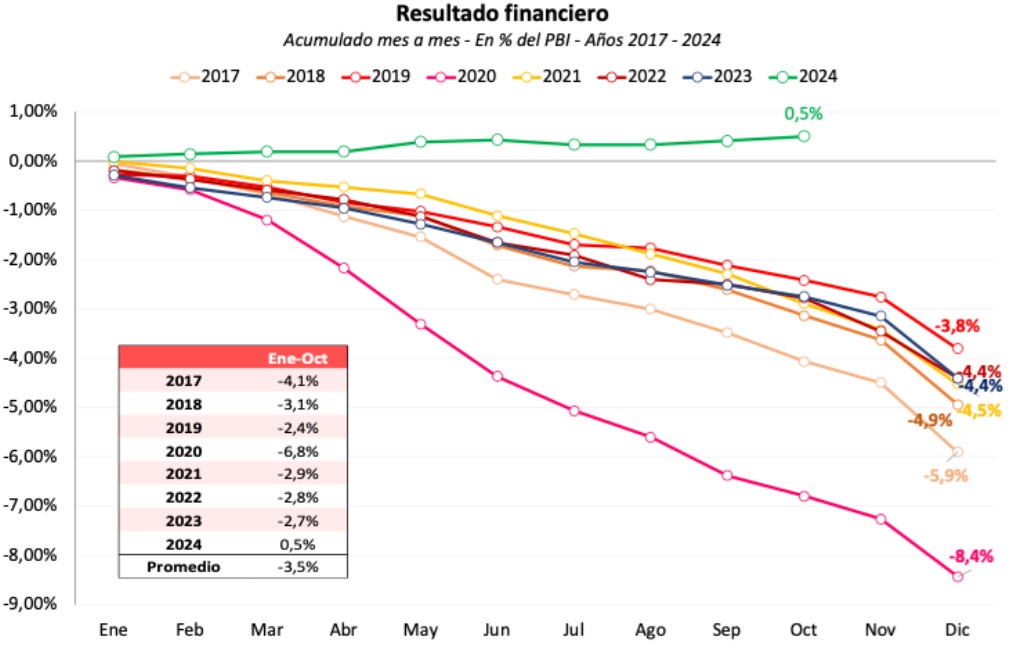
When Milei was elected, Argentina went from constant deficits to almost unprecedented government surplus, and has continued to run a surplus for the past six months.

This wasn’t fancy macroeconomic magic. Milei just cut government spending:

This source says he cut the size of government by about 30% overall. Unsurprisingly, this eliminated the Argentine deficit.

[…]

6: Overall

When Javier Milei took office, he promised to do shock therapy that would short-term plunge Argentina into a recession, but long-term end its economic woes.

He has fulfilled his campaign promise to plunge Argentina into a recession. Whether this will long-term end its economic woes remains to be seen.

I think he gets credit for some purely political victories (completing the budget cuts he said he would complete), for decreasing inflation, and for improving the housing market. But in the end, history will judge him for whether his shock therapy eventually bears fruit. I don’t think that judgment can be made yet, and I don’t see many economists eager to go out on a limb and say that there are strong signs that his particular brand of shock therapy will definitely work/fail.

There are disappointingly few Milei prediction markets, probably because it’s hard to operationalize “he makes the economy good”. This multi-pronged mega-market has few traders, and weakly predicts a mix of good and bad things, maybe leaning a little good. But here is a more specific one:

… which compared to Argentina’s historical GDP growth rate seems — no, sorry, Argentina’s historical GDP growth rate is too weird to draw any conclusions.

And maybe the most important test:

September 30, 2024

Saving German democracy seems to require not following the law for some reason

Filed under: Germany, Government, Law, Media, Politics — Tags: , , , , — Nicholas @ 03:00

[Update below] I’m sure that Germany is being well-served by their politicians who only seem to want to obey the law when it suits them. I mean, that’s how you save democracy, right? By ignoring democratic laws for a “higher good” every now and again?

Jürgen Treutler, the supergenius fascist who discovered that all you need to do to establish fascism is follow all democratic laws and procedures rigorously and to the letter.

They never tire of telling us that we live in a democracy.

This means that that dreaded mass known as “the people” are permitted – with however much groaning and reluctance – to present themselves every four years to choose their representatives. These representatives then betake themselves to the parliament, where they form some manner of government, which proceeds to rule us in highly democratic ways. This is is literally the best thing ever, except for the fact that “the people”, in their profound stupidity, cannot always be relied upon to vote for the right parties. Sometimes they vote for the wrong ones, and in these cases democratic solutions must be found to rein in the rabble’s undemocratic exercise of democracy.

The people of Thüringen have proven themselves particularly inconvenient to democracy, in that they have exercised their democratic rights to vote overwhelmingly for the evil, fascist and antidemocratic party known as Alternative für Deutschland. What makes the AfD so evil and fascist is never quite explained, but we hear all the time that they are very bad so the point must be beyond question. The people of Thüringen transgressed against democracy so powerfully, that they gave the AfD 32 seats of their 88-seat state parliament – far more than they granted to any of the upstanding, democratic parties. These parties include such paragons of democratic virtue as Die Linke (the Left Party), which somehow manages to be both officially democratic and also the direct successor to the DDR-era Socialist Unity Party (they got a mere 12 seats); the Linke-offshoot party known as the Bündnis Sahra Wageknecht (they got 15 seats); the Christian Democrats (they got 23 seats); and the Social Democrats (they got 6 seats, lol).

Now, a naive person might think that the AfD, being the party most favoured by the people of Thüringen, should enjoy certain parliamentary prerogatives. Existing procedures, for example, grant the strongest party the right to propose candidates for the office of parliamentary president. The president is the person who presides over the meetings of the parliament; he is like a glorified committee chair and his powers are not all that great. The very idea that the AfD might have the right to suggest their own candidates for president, however, strikes enormous fear into the hearts of the “democratic” parties, who are determined to save Thuringian democracy by all the antidemocratic means at their disposal. If necessary, we must destroy democracy itself, to save the Thuringian parliament from the spectre of a democratically elected AfD president.

This brings us to the absolute unprecedented clownshow that unfolded yesterday at the Thuringian parliament in Erfurt. It was set to be a day of boring, routine procedure, when the newly elected parliament would constitute itself and elect a president. Thüringen is anomalous, in that this state – alone of all the federal states of Germany – has a specific law mandating adherence to parliamentary procedures. New parliaments cannot just change these procedures on the fly; they have to be officially constituted as a legislative body first. These legally mandated procedures require that an acting “senior president” preside over the first meeting of the new parliament. This senior president is simply the oldest member of the dominant party – in this case an affable rotund AfD politician named Jürgen Treutler.

Update: eugyppius updates the state of play in Thuringia after the relevant court rules that the law can be set aside in this case:

In not-so-good news (but as I predicted), the state constitutional court in Thüringen ruled in favour of the CDU last Friday. The other parties were able to change the procedural rules in the Thuringian parliament and exclude the AfD not only from the office of president, but also from the entire executive committee of the Landtag. The “democratic” parties have also altered procedural rules to reduce AfD representation on parliamentary committees, effectively preventing the strongest party in the Landtag from exercising their blocking minority there.

They really are determined to destroy the democracy to save it.

QotD: Compound eyes as models of how the surveillance state operates

Filed under: Government, Media, Quotations, Technology — Tags: , , , , — Nicholas @ 01:00

Compound eyes, common with insects and crustaceans, are made up of thousands of individual visual receptors, called ommatidia. Each ommatidium is a fully functioning eye in itself. The insect’s “eye” is thousands of ommatidium that together create a broad field of vision. Every ommatidium has its own nerve fiber connecting to the optic nerve, which relays information to the brain. The brain then processes these inputs to create a three-dimensional understanding the surrounding space.

The compound eye is a good way to imagine how the surveillance state will keep tabs on the subjects in the near future. Unlike the dystopian future imagined by science fiction, it will not be one eye focusing on one heretic, following him around as he goes about his business. Instead it will be tens of millions of eyes obtaining various bits of information, sending it back to the data-centers run by Big Tech. That information will be assembled into the broad mosaic that is daily life.

For example, rather than use informants and undercover operatives to flesh out conspiracies against the state, the surveillance state will use community detection to model the network of heretics. Since everyone is hooked into the grid in some fashion and everyone addresses nodes of the grid on a regular basis, keeping track of someone is now something that can be done from a cubicle. There is no need to actually follow someone around as they go about their life.

For example, everyone has a mobile phone. At every point, the phone is tracking its location, which means it is tracking your location. It also knows the time and day when you go into various businesses. Most people use cards to pay miscellaneous items, so just that information would tell the curious a lot about you. Combine that information with the same information from other phones that come into close proximity with your phone and figuring out the community structure is simple.

Of course, the mobile phone is not the only input device. Over Christmas, millions of Americans were encouraged to install surveillance devices in their homes by friends and family. Maybe it was an Alexa listening device from Amazon or a Nest Doorbell surveillance device from Google. All of these gadgets are collecting data on your life inside and around your home. It is then fed to the same data-centers that have all of your movements and associations collected from your phone.

The Z Man, “The Compound Eye”, The Z Blog, 2020-01-08.

September 29, 2024

This Bridge Should Have Been Closed Years Before It Collapsed

Filed under: Government, Technology, USA — Tags: , , , , — Nicholas @ 02:00

Practical Engineering
Published Jun 18, 2024

Why Fern Hollow Bridge collapsed.

This is a crazy case study of how common sense can fall through the cracks of strained budgets and rigid oversight from federal, state, and city staff. And the lessons that came out of it aren’t just relevant to people who work on bridges. It’s a story of how numerous small mistakes by individuals can collectively lead to a tragedy.
(more…)

« Newer PostsOlder Posts »

Powered by WordPress