Quotulatiousness

May 1, 2025

When “looming dystopia” is the preferable scenario

Filed under: Bureaucracy, Economics, Government, USA — Tags: , , , — Nicholas @ 04:00

Elizabeth Nickson on just how badly the great and the powerful have managed to screw up so badly that instead of opening for Anthrax at the Hollywood Bowl, “Looming Dystopia” might actually be one of the better possible futures we face:

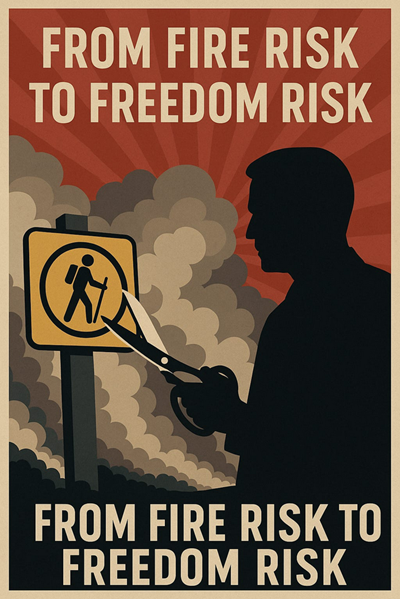
I asked Grok to show me Looming Dystopia opening for Anthrax. This is the “in Gothic style” version.

I am a person of faith, of Christ, not a very good one, but one who has been devoted for a long time. I’m not saying I didn’t spend twenty years in the great big glittering world, where I indulged every whim, lived among the powerful, beautiful, God- hostiles, adopted their habits of speech and dress, went to every small exquisite museum, the play of the moment, the art openings, the restaurants and parties, became a sophisticate able to live within that world as handmaiden or companion. I mean, for almost ten of those years, I had a husband who never, not once, came home without a present. But even that came of prayer, of a desire fulfilled a wish granted, of prayer, as in “You want this? Ok then, you will sicken, but here it is”.

That world – the enrichment of culture that came out of the 80’s and 90’s – determines today. That life is the model and goal for many and in fact, now the design, the plan laid out by those who plan the future of the world. Humans shunted deliberately into city life, then enhanced via surgery and chip. Indulgence, consumption, fighting for preference, ambition. Cultural creatives, unmarried, oddly-sexed, politically left would determine the future, their gifts the siren call of the arts, fashion, grand bohemia, Hollywood, eat, drink and travel merrily. The end goal of life: your individuality, your woundedness, your self care, the full expression of your specific gifts. If you are lucky you too can be Lady GaGa or BlackPink and have stadiums roar when you appear. Other humans? The state will take care of them, do not worry. Maybe they will die off. Like dinosaurs.

The central banks have gamed this going forward, making the insane assumption that this social movement was permanent. Did they depend on feminism and drugs to stop the next step, ie, young people leaving the city to build families? Even if they did, they thought they could stop it. Why? Because fascist greens like John Kerry, told them that rural regions must be left to “recover”.

Therefore they gutted the suburbs of financing, because “poor land use”, and “too much car required”, which is preposterous in the Americas with all this land. What else does a young family want but trees and parks, and lawns and a neighborhood of friends, not riven with whores, crackheads and murderous migrants?

The ‘08 crash was predicated on Thatcher’s fiscal success in selling people their council houses in the 80’s. Wonderful! thought Bill Clinton’s team, let’s lead marginal Americans into housing, and lo, we still haven’t paid the freight for that insane idea. I had a paralegal friend in Florida who was foreclosing on $500,000 loans to actual crackhead whores. Clinton’s people, lost in their greed and benevolence, forgot that the British council estate dweller was homogenous, placed, as in deep roots in the area, and stable. In the U.S and Canada, idiot banks lent to just about any joker who turned up with a plausible story. Then the speculators invaded, everyone cashed out merrily, then ka-boom. And pioneering walking away with $100 million from government “service” was Jimmy Johnson, Head of Fannie Mae.

I mean, it’s stupid. The western world’s current bankruptcy (and it’s severe) was caused by Central Bank clowns. Those ridiculous, repellent, hideously expensive COP #8,789 conferences had two outcomes: banks would be compelled to lend to green, require green, require climate mitigation, and jump through DEI, ESG hoops, and governments would chunk up green regs. And prosperity would bloom! Not only that, they surreptitiously, across the world, funded actual companies that poisoned the air, water and land. And when I say “they funded”, I mean the taxpayer did. A lot of our money went into insane outfits like this:

And just like Malcom Gladwell’s tipping point – it took ten years – boom, economic activity came to a screeching halt, except for the wreckage of green energy enterprises everywhere, government debt and re-financing. For instance, the Obama-created outfit, the Ivanpah Solar Power Facility, that consists of three solar concentrating thermal power plants in California burned through $1 billion before it collapsed in February. It is one of thousands across the west, all subsidized by the taxpayer. Unwittingly. The press is so embarrassed, they don’t report the trillions lost to green energy projects.

Again, the central bankers own this.

Central bankers have become a metastatic cancer on the economy. By definition, they are late adopters on the marketing curve. By the time they notice something and make their plans upon it, it’s over and something new is growing. Today, the mega-cities everywhere are emptying of everyone over 30 with an income, even or rather especially in China, where the young have just said … nope, a pox on your Commie plans. Chinese, European, British, American, everyone is trickling back to the towns of which their ancestral memories sing, where they can root, where they can live smaller, without environmental toxicity, the rank depravity of the super-culture, the ruinous stupidity of green. The great cities are now super-dangerous for women, and that is spreading as the autocrats in power force violent young men into towns. Last week a young woman in Vancouver fought off a migrant who tried to kill her three times in Stanley Park. My modest, Christian, pioneer family who built the early city along with their community of 10,000 and neglible government, made that park in the early 1900’s; my great grandmother was the first woman to ride a bike in bloomers through that park. It was so safe for 100 years you could let kids play in it after dark, calling them home with a whistle. It is one of the world’s great urban parks, more astonishing than Central Park. This is an outright tragedy. And it is unnoticed, unreported, except on TikTok.

The economics of migration

Lorenzo Warby wonders if an entire discipline can commit suicide:

Can an academic discipline seriously decline? Yes. Disciplines which were once mainstays of universities have either vanished or shrunk to pale shadows of their former selves.

What about a social science? One can envisage a social science disappearing. The most obvious way is it gets utterly discredited and replaced. A less obvious way is its institutional bases could disappear. A final way is its entire social basis disappears.

The West is currently marked by two entirely different discourses on migration that seem unable to interact. One is migration-as-economic-boon. This is the outlook of mainstream Economics. Migrants add to the economic activity of societies and potentially retard the effect of an ageing population by replacing absent local children with foreign migrants. This discourse invokes the authority of Economic Theory and its statistical methods.

This outlook typically treats criticism of migration as economically illiterate, socially retrograde, or morally bankrupt; or some combination of thereof. It is protected by the Self-Righteous, Knowing scoff which is such a feature of the modern professional-managerial class. They are the Masters of Knowledge, and of Moral Concern, who the plebs should defer to.

The other discourse talks in terms of social and democratic decay, increased crime, threats of violence, increased fiscal stress, even the possibility of civil war.

This is the world where, in Sweden — due to the stress on social and fiscal order from migration — it has become policy to pay migrants to go away. This is the world where highly intelligent and informed folk quietly discuss how the performance of economists on migration has been so catastrophically bad, it may bring down the entire discipline.

The adherents of the second, problems-with-migration, discourse are well aware of what mainstream Economics has to say on migration, and judge it to be obviously and demonstrably — even catastrophically — false. That it is much harder for migrants to contribute positively to a society than mainstream Economics admits, and this gets worse the higher the rate of migration. A recent Dutch study (Jan van de Beek, Joop Hartog, Gerrit Kreffer, Hans Roodenburg, The Long-Term Fiscal Impact of Immigrants in the Netherlands, Differentiated by Motive, Source Region and Generation, IZA DP No. 17569, December 2024. https://docs.iza.org/dp17569) found that:

    Only 20% of all immigrants [to the Netherlands] make a positive lifetime net contribution to the public budget. Groups with large contributions come from Scandinavia, the Anglo-Saxon world and a few other countries like France and Japan.

The adherents of the first discourse seem either utterly unaware of the second discourse, or protected from even considering it by the Self-Righteous Knowing scoff. Their mastery of Theory is such, they cannot possibly be so catastrophically wrong.

The notion that migration could break a society along its existing fracture lines to the point of civil war would absolutely be treated with the Self-Righteous Knowing scoff, despite there being — as is discussed below — at least three historical examples of precisely that happening.

April 30, 2025

After the votes were counted

Filed under: Cancon, Government, Media, Politics — Tags: , , , , , — Nicholas @ 05:00

John Carter suggests that votes should be allocated to reflect the costs imposed on the voters by taxation, that is to ensure that those with the most “skin in the game” at least have their votes weighted more than those who pay little or no taxes but can still vote themselves more benefits:

Have you ever noticed how election results are regularly broken down geographically, as well by the demographic categories of age, sex, and – depending on the country – race, yet we almost never see the results separated into taxpayer vs taxeater status?

So anyhow.

For my American readers, in Canadian elections the Liberal Party is denoted by red, as the Devil and Karl Marx intended.

It is absolutely no surprise that Ottawa voted solidly for the Liberal Party of Canada, whose base consists of three primary groups: migrants, public sector workers, and baby boomers, all of whom are regime client groups, and all of whom are tightly packed into the nation’s capital.

Perhaps it’s that it’s tax season and I’m in a grumpy mood because I just got the bad news, but I can’t help but wonder about how electoral politics would change if only taxpayers were allowed to vote. It’s common for “taxpayers” to be used as a synonym for “the voting public”, but this is a bit of linguistic legerdemain which obscures a core dynamic rotting the heart out of every liberal democracy: most of the population are not, in fact, taxpayers. First there are those who don’t earn enough to pay taxes, such as university students; then there are those receiving direct welfare payments of one form or another; then there are public employees, who although they pay tax on paper, are clearly net recipients of government largess since their paychecks come from taxes in the first place.

The most successful parties in country after country are the parties that mobilize client groups by promising to steal money from productive citizens and transfer that wealth to their non-productive clients. This dynamic is baked into the cake of any universal suffrage democracy, which is why Universal Suffrage is a Suicide Pact. Parties need client groups for electoral support; wealth can only be plundered from the productive; therefore the only available relationship is to cultivate non-productive clients.

The problem, of course, is that over time this destroys the economic productivity of the liberal democracy, because the productive groups will become less productive because what’s the point, or they’ll just look for the exits, while the client groups will swell, becoming simultaneously too expensive to maintain and to electorally heavy to dislodge.

I suspect you could fix all of this by simply tying votes to tax receipts, with only those who are net taxpayers being given the franchise in any given election. At a stroke this would disenfranchise the welfare underclass, government bureaucrats, and university students, all of whom should be prohibited from voting as a matter of principle. If you wanted to be really fancy, you could implement a tax-weighted vote: the more taxes you pay, the more your vote counts.

In addition to the salutary effects of reducing the electoral weight of female voters (since men tend to pay more in taxes), weighting votes by tax receipts would lead to a very interesting incentive structure. On the one hand, everyone hates paying taxes, and wants to minimize the taxes they pay; if only taxpayers were voting, this would place a strong downward pressure on taxes and, hence, on the size of government (thus forcing states to find other ways of funding themselves, via e.g. tariffs or service fees). On the other hand, people like to vote, so there would be a strong incentive not to evade taxes. On the gripping hand, since paying more tax means your vote counts for more, there would be a countervailing incentive to pay as much tax as you can afford. One might imagine a state functioning as a sort of de facto oligarchy, with the billionaires happily paying obscene levels of tax in order to gather as much political power to their class as possible, and enforcing their tyranny by voting to keep taxes on everyone else to the absolute bare minimum. This would be a truly dystopian brier patch to be thrown into.

Alas, we do not inhabit such a political experiment. Returning to the ostensible topic of yesterday’s Canadian election, however, it would probably not be an exaggeration to posit that if we did inhabit such a system, Canada’s Conservative Party would have rolled the Liberals in this and, in all likelihood, almost every other election.

That is not, however, what happened.

The high-level outcome is that, after running the country into the ground for the last decade, the Liberal Party has been elected for the fourth consecutive time, with a mandate to complete the project of crashing the plane of Dominion with no survivors. It brings me absolutely no pleasure to report that I predicted the Liberals would win before the election was even called. The Liberals are four seats short of forming a majority in parliament, meaning they cannot quite form a stable government on their own. This is not a problem for the Liberals, however. Despite the glorious collapse of the New Democratic Party – which plummeted from 25 seats in the last federal election to 7 in the current election, by far their lowest in 30 years – the NDP retains just enough seats for them to form a stable coalition government with the Liberals. In other words, the outcome of this election is that Canada will be in essentially the same situation it was in before the election, with the only meaningful difference being that the Liberals have a few more seats than they did before.

April 28, 2025

Unintended consequences of vehicle mileage regulation

Filed under: Bureaucracy, Business, Government, USA — Tags: , , — Nicholas @ 03:00

On the social media platform formerly known as Twitter, Sheel Mohnot explains the amazing unintended consequences of another “great idea with the best possible intentions”:

Ever wonder why sedans disappeared and every car is huge now?

“Thanks, Obama!”

His administration changed fuel economy standards in a way that had the perverse impact of making cars even bigger.

Here are all the vehicles for sale by the 3 largest US automakers. 62 vehicles, 4 sedans (6%). 20 years ago this chart would have been ~50% sedans!

What happened?

Obama administration changed auto fuel efficiency rules to tie fuel economy targets to vehicle size.

Under the new system:
-The bigger the car’s footprint, the easier the MPG target was.
-Light trucks (including SUVs and crossovers) had far lower requirements than passenger cars.
-Crossovers were quietly reclassified as “trucks,” giving them a huge regulatory advantage.

Instead of building lighter, more efficient cars, automakers simply made everything bigger, and made more trucks and SUVs.

Notice that cars that used to be sedans are now crossovers? They do this so it counts as a light truck – they raise ground clearance, square off the rear for cargo capacity, and meet off-road approach minimums so they get qualified as a light truck. Think Subaru Legacy > Subaru Outback.

As you can see in the chart, it’s a LOT easier to meet MPG requirements if your vehicle is classified that way.

So cars got LARGER to meet fuel efficiency goals. The new Honda Civic is 20 inches longer and 4 inches wider than it used to be, about the same size as an old Accord. By making the Civic larger, Honda slightly shifted it into a more favorable regulatory category.

… and smaller cars disappeared. The Honda Fit was a great little car, but would have had to hit 67 MPG in 2026, which would be nearly impossible … so instead, Honda stopped selling them.

So, the only way to make small vehicles now is to make them EV’s (Chevy Bolt).

The Slate truck that is all the rage now is only possible because it’s an EV … otherwise its footprint would have demanded an overly onerous MPG target.

So in short – Obama era CAFE standards had the opposite of the desired impact: sedans died, vehicles ballooned in size, and America’s streets turned into an SUV parking lot.

All thanks to a policy that accidentally incentivized bloat instead of efficiency.

Don’t get me started on “cash for clunkers!”

April 26, 2025

A proposal for cutting the Channel crossing phenomenon

Filed under: Britain, France, Government — Tags: , , , — Nicholas @ 05:00

In The Conservative Woman, David Wright suggests a concrete plan to stem the tide of “refugees” arriving in the south of England from Calais and other French Channel ports:

Illegal Channel crossings by rubber dinghies overloaded predominantly with young men have been an increasingly worrying trend for many years yet successive governments have made no serious or workable attempts to do anything about it.

Migrant crossings are up by more than 40 per cent on last year and a record for daily arrivals has been set. A total of 705 migrants in 12 boats crossed the Channel on Tuesday April 15, days after the previous record of 656 was set the previous Saturday. The total number of arrivals in 2025, at 8,888, is 42 per cent higher than at the same point last year and 81 per cent higher than at this stage in 2023. More arrivals were recorded in January to April than in the equivalent four-month period in any year since data on Channel crossings began in 2018.

The French authorities are providing lifejackets to ensure migrants can cross the Channel safely. The jackets are returned to the French once the migrants have been escorted to the mid-point of the Channel and are rescued by the British authorities, so that they can be re-used for future crossings.

We have seen French police on the beach at Calais standing idly by while migrants board dinghies to Dover.

[…]

The boats should be painted grey, a small gun mounted on the foredeck, and manned with recently retired RN personnel. (There would be no shortage of volunteers.) A small support base should be built in Folkestone harbour, initially using Portakabins for rapid start-up, with fuelling facilities, a small workshop, an accommodation block and a canteen. This could be achieved relatively quickly and at a modest cost to the defence budget. These boats would be tasked with patrolling the Dover Strait every day from dawn to dusk, three or four at a time. Drones could also be used to detect dinghies and direct the patrolling boats to them. They would not need to be at sea in weather too rough for small smuggler-boat crossings.

They should be tasked to intercept the smugglers wherever they are in the Channel, approaching our shores, over the mid-way line or just leaving French beaches, and turned back and escorted. On approach to the smugglers’ beach the Border Force vessel should stand off and launch a RIB (rigid inflatable boat) manned by four staff who would escort them until they grounded on the beach. With two of them standing guard with weapons the others, using box cutters, would slash long holes in the rubber dinghies and remove the outboard motors and drop them into the water to render them unserviceable. On completion the RIB should return to its vessel and the vessel withdraw to resume patrol. Input from serving senior naval officers would be needed to provide detailed operating procedures. Once deployed this division would be under the command of a senior serving officer.

Of course, French President Emmanuel Macron would immediately be protesting. But he hasn’t got a leg to stand on. France is a signatory to the Schengen Agreement which requires migrants/asylum seekers to be processed in the first safe country they enter. Not only that but Britain has paid France almost half a billion pounds to stop the migrants arriving at the beaches and boarding dinghies to Dover.

France has not only done nothing but trouser this cash while its navy continues to escort the dinghies into UK waters and hand them off to our Border Force or the RNLI.

Lies, damned lies and government statistics

Filed under: Cancon, Economics, Food, Government, Media, Politics — Tags: , — Nicholas @ 03:00

Francisco at Small Dead Animals linked to this interesting examination of the difference between the official inflation rate and the actual inflation ordinary Canadians are coping with:

    Great news! We’ve brought inflation back under control and stuff is now only costing you 2.4 percent more than it did last year!

That’s more or less the message we’ve been hearing from governments over the past couple of years. And in fact, the official Statistics Canada consumer price index (CPI) numbers do show us that the “all-items” index in 2024 was only 2.4 percent higher than in 2023. Fantastic.

So why doesn’t it feel fantastic?

Well statistics are funny that way. When you’ve got lots of numbers, there are all kinds of ways to dress ‘em up before presenting them as an index (or chart). And there really is no one combination of adjustments and corrections that’s definitively “right”. So I’m sure Statistics Canada isn’t trying to misrepresent things.

But I’m also curious to test whether the CPI is truly representative of Canadians’ real financial experiences. My first attempt to create my own alternative “consumer price index”, involved Statistics Canada’s “Detailed household final consumption expenditure“. That table contains actual dollar figures for nation-wide spending on a wide range of consumer items. To represent the costs Canadian’s face when shopping for basics, I selected these nine categories:

  • Food and non-alcoholic beverages
  • Clothing and footwear
  • Housing, water, electricity, gas and other fuels
  • Major household appliances
  • Pharmaceutical products and other medical products (except cannabis)
  • Transport
  • Communications
  • University education
  • Property insurance

I then took the fourth quarter (Q4) numbers for each of those categories for all the years between 2013 and 2024 and divided them by the total population of the country for each year. That gave me an accurate picture of per capita spending on core cost-of-living items.

Overall, living and breathing through Q4 2013 would have cost the average Canadian $4,356.38 (or $17,425.52 for a full year). Spending for those same categories in Q4 2024, however, cost us $6,266.48 – a 43.85 percent increase.

By contrast, the official CPI over those years rose only 31.03 percent. That’s quite the difference. Here’s how the year-over-year changes in CPI inflation vs actual spending inflation compare:

As you can see, with the exception of 2020 (when COVID left us with nothing to buy), the official inflation number was consistently and significantly lower than actual spending. And, in the case of 2021, it was more than double.

Since 2013, the items with the largest price growth were university education (57.46 percent), major household appliances (52.67 percent), and housing, water, electricity, gas, and other fuels (50.79).

April 25, 2025

Canada’s lost decade, 2015-2025

Filed under: Cancon, Economics, Government, Media, Politics — Tags: , , , — Nicholas @ 03:00

It’s quite remarkable how many economic charts show the US and Canadian economies tracking along similar paths up until “something” happened in 2015 that knocked the Canadian economy well below the US trend line. I wonder what happened in 2015 that could account for this quite visible change in fortune?

GDP growth in Canada fell off a cliff over the period from 2015 onwards. This kinda matters.

Throughout the 2025 campaign, the Conservatives have frequently referred to what they call the “Lost Liberal Decade”, a reference to the fact that Canada has lagged dramatically on virtually every available indicator since the Liberals first came to power in 2015.

In sum, the economy is worse, crime is worse, public services are worse, affordability is worse — and there’s a whole galaxy of niche indicators, such as firearms incidents, refugee backlogs, even life expectancy, that are worse than they’ve ever been.

Below, a quick guide to the fact that, whatever you think of the Liberals, the last decade has really not been great for Canada.

In the year the Liberals took office, 604 people were murdered across Canada. This was already a slight uptick from the year before, when murder rates hit a low not seen since the mid-1960s.

Just seven years later, in 2022, homicides would hit a high of 874. In raw numbers, that’s 270 more murdered Canadians.

But even when accounting for population growth, there are way more murders happening now than in 2015. The homicide rate in that year was 1.71 murders per 100,000 people. As of 2023, the most recent year for which Statistics Canada has released data, it was 1.94.

Put another way, if Canada had stuck to the homicide rates of 2015, we’d have had 94 fewer murders in 2023, 216 fewer murders in 2022, and about 150 fewer murders in 2021.

And it’s a similar story when it comes to virtually every other category of crime. Statistics Canada maintains a “crime severity index” that attempts to aggregate the raw amount of criminality each year in Canada. The index bottoms out just before the Liberals came to power in 2015, and has been on the upswing ever since.

Unfortunately, this is particularly true when it comes to violent crime. For one thing, the number of guns being turned on people each year in Canada has never been higher.

In 2015, for every 100,000 Canadians, there were 28.6 incidents of firearm-related violent crime. By 2022, the last full year for which data is available, this had surged to 36.7 incidents — nearly a 30-per-cent increase in just seven years.

The Correctional Service of Canada publishes annual statistics on incarceration rates, and a noticeable trend begins to emerge starting in 2015: The prison population begins to plummet.

April 23, 2025

“Liberals have never met a crisis they didn’t think they could spend their way out of”

Filed under: Cancon, Economics, Government — Tags: , , , , — Nicholas @ 03:00

Jesse Kline refutes Mark Carney’s recent diss against libertarians:

The Liberal Boomer in his natural state (spotted on social media, 20 April, 2025).

“The capacity of the federal government to invest in the economy, to support businesses and individuals, will ensure that we bounce back strongly.”

That was Prime Minister Justin Trudeau announcing an $82-billion support package at the beginning of the COVID-19 pandemic, but it could just as easily have been Carney, who said over the weekend that, “In a crisis … government needs to step up.”

At a Saturday news conference, the Liberal leader unveiled his party’s election platform, which includes $130 billion in new spending over four years to fend off the threats posed by U.S. President Donald Trump.

“It’s said there are no atheists in foxholes, there should be no libertarians in a crisis,” Carney argued to justify the continued spending spree.

This offends me as both a libertarian and an atheist. In fact, Canada would be in much better shape today if there were a few libertarians in the room when the Liberals were dealing with the numerous emergencies they’ve faced over the past decade.

The problem with crises is that there’s no way to predict when the next one will hit. But a prudent government should expect the unexpected and leave some fiscal room in the budget to address unforeseen events, while working to fortify the economy during good times so it can withstand the bad. This is not what the Liberals have done.

They took a $1.9-billion surplus in the 2014-15 fiscal year and turned it into a $25-billion deficit in 2016-17.

[…]

And so, we got more Big Government programs that we could ill afford, while Trudeau turned away world leaders looking to Canada to help solve an energy crisis resulting from Russia’s invasion of Ukraine.

Now, as Carney prepares to launch another massive spending spree to deal with the effects of U.S. tariffs, he’s pledging hundreds of millions of dollars for unnecessary programs, including permanent funding for the Sexual and Reproductive Health Fund to make it easier to abort babies, and $400 million for IVF treatments to create new ones in a test tube.

Needless to say that if there were some libertarians around the cabinet table during the crises of the past 10 years, we likely wouldn’t be facing a major economic upheaval with a $40-billion budget deficit, which Carney wants to increase to $62 billion, and a national debt approaching $1.26 trillion.

Spending always appeals to the voters at election time, and the Liberals have been past masters of using that to get into power. But even though there may be a lot of ruin in a nation, even the biggest of nations eventually runs out of money. According to a report from Policy Horizons Canada, an in-house government think tank, we’re well on the way to reaching that ruin and nobody will like what that looks like:

The report warns that by 2040, housing affordability is essentially limited to the wealthy or those with family help; most new homeowners get help from family, some depend on intergenerational mortgages and have several generations of family living together, and others enter “alternative” household mortgages with friends, with a growing percentage of homeowners also owning rental properties.

“Inequality between those who rent and those who own has become a key driver of social, economic, and political conflict,” reads the report.

Moreover, the report highlights a growing dependence on intergenerational wealth, noting that by 2040, inheritance is widely seen as the only reliable path to prosperity. “Society increasingly resembles an aristocracy,” it states, as family background — particularly property ownership — becomes the defining factor in determining one’s opportunities.

Canadians in this future rarely mix with others of different socio-economic status, and there is a clear disconnect between the aspirations of the country’s youth and economic realities, which leaves most with limited expectations of success.

And finally, the rapid propagation of artificial intelligence has dramatically reshaped the labour market. By 2040, the rise of artificial intelligence will have significantly diminished the availability of jobs in creative and knowledge-based professions, once seen as stable paths to upward mobility.

[…]

As a result of the six factors, Canada’s economy could shrink or become less predictable, with the consumer economy shrinking in size, and a higher proportion of very wealthy, older people holding the capital capacity for investment in new businesses. Labour unions could also grow in power and size from a frustrated population. The mental health of Canadians could suffer from living cost challenges.

With these upward mobility issues, Canada may become a less attractive destination for immigrants, and there could be an exodus of young workers, which would exacerbate the issues with supporting the public and social services that support the country’s growing cohort of seniors. This could also result in a labour shortage in industries where artificial intelligence is most difficult.

Perhaps most dystopian is a partial reversion of Canadian society to a trade-and-barter and neo-hunter-gatherer society by 2040, in response to declining trust in formal systems and reduced access to traditional economic opportunities.

[…]

The report’s vision of a future Canada — where trust in institutions collapses, effort no longer yields reward, and people yearn for systemic change — carries echoes of that dangerous historical crossroads, where ideological extremes once flourished in the face of prolonged despair.

With all that said, how likely is this precarious scenario of Canadian society in just 15 years from 2025?

According to Policy Horizons Canada, its “research suggests that it is plausible and would create challenges across a range of policy areas.”

April 21, 2025

The Battles That Broke the Chinese Nationalists – W2W 22 – 1948 Q2

TimeGhost History
Published 20 Apr 2025

This episode, we see the Chinese Civil War turn decisively against Chiang Kai-Shek. Mao’s Communists score great victories on the battlefield while the Nationalists face economic collapse. How much longer can Chiang hold on?
(more…)

April 20, 2025

The essence of (most) modern western governments

Chris Bray on the paradox of how many western governments manage the alchemy of being both omnipresent and yet absent simultaneously:

Adding to my last post about covering language that masks the massive expansion of government behind performative language about limiting government: The most Los Angeles thing I have ever seen happened behind the Yoshinoya Beef Bowl.

See the alley between the Yoshinoya and the pharmacy? As I drove by on Wilshire, two extremely alert LAPD officers on motorcycles were sitting at the edge of that parking lot, postures tight and poised for action, urgently scanning the street. It was like watching a gunfighter movie, in the scene when the camera closes in on the gunfighter’s eyes, watching his opponent for the draw. These dudes were ready. If you did 38 in the 30 MPH zone, then brother, you were dead-ass done, nailed up in the trophy case.

Also, no more than thirty feet away from them, a little gaggle of filthy human zombies was passing a glass pipe around the circle, throwing up clouds of smoke, at the top end of an alley wall-to-wall full of open drug use and not terribly subtle drug dealing (and probably the prostitution that pays for the drugs, but I didn’t wander into the alley to look). But California made the possession and use of heroin, meth, and cocaine a misdemeanor, and the DA at the time was very proud that he wouldn’t allow his office to file most misdemeanor cases, because misdemeanors are lifestyle crimes that punish people for being poor, or for being “individuals experiencing homelessness”. So that alley full of people Hunter Bidening all day out in the open weren’t doing anything that could lead to prosecution, but your expired registration tags would bring down an immediate police response in you happened to roll by them.

Grand Guignol human depravity and ruin: no big deal. Minor traffic offenses: front and center.

This is Blue Zone governance, full stop, the thing people describe as anarcho-tyranny. Common San Francisco business owner experience: Police don’t intervene in the constant vandalism and tagging that degrades business property, but the highly alert army of code enforcement officers fine business owners for failing to clean up the damage that the city hasn’t prevented.

I forget who recently suggested this on I-still-call-it-Twitter, but go to Yelp and read some reviews for gas stations in Oakland:

April 17, 2025

Canadian labelling regulations save us from “too many vitamins”

Filed under: Australia, Britain, Bureaucracy, Cancon, Food, Government, Health — Tags: , , , , — Nicholas @ 03:00

In the National Post, Jesse Kline points out that Canadian food label regulations have become so nit-picky that they prevent safe and accurately labelled foods from Australia, Britain, and other countries from being sold here:

Marmite from the UK and Vegemite from Australia, two of the products at risk of Canadian over-regulatory twitches.

Shortly after winning the Liberal leadership, Mark Carney travelled to Paris and London to shore up our trading relationship with our European allies.

Yet it is noteworthy that Canada is one of only two countries that has not yet ratified the United Kingdom’s accession into the CPTPP, meaning that we don’t enjoy the benefits of free trade with the country with whom we share a system of government and a King. Meanwhile, France is one of a handful of countries that has yet to ratify the free-trade agreement between Canada and the EU.

If we can’t even agree to implement trade deals that have already been negotiated and agreed upon with countries that have such deep historical ties to Canada, what hope do we have of improving trade with our other partners around the world?

Part of the problem is that Canada refuses to follow the example of countries like Australia and New Zealand, which successfully phased out their own systems of supply management years ago with great success.

As a result, supply management has proven to be a sticking point in virtually every trade negotiation we’ve entered into, and is a constant source of tension even among countries we have free-trade deals with.

But we have also fallen into the trap, along with our European friends, of over-regulation. Modern bureaucratic states impose so many restrictions on commercial enterprises, it often becomes uneconomic to market their products in other countries.

Canada, for example, imposes stringent labelling requirements to ensure product information is available in both English and French, and that nutritional information conforms to our very specific requirements.

None of this is necessary, especially in an age in which we can hold a phone up to a box of French crackers to see what it says. But the problem extends far beyond language or disagreements over the recommended daily intake of fibre.

As the CBC reported on Monday, Leighton Walters, an expat from Down Under who owns several Australian-themed coffee shops in the Greater Toronto Area, was told earlier this year by the Canadian Food Inspection Agency (CFIA) that he was no longer allowed to sell the roughly $8,000 worth of Vegemite he had imported because it contains … too many vitamins.

Under current regulations, only a select list of products are allowed to contain added vitamins. Vitamin B-rich spreads like Vegemite and its British equivalent Marmite are not among them because … well, just because.

A similar situation arose a decade ago when reports that the government had ordered Marmite and the Scottish drink Irn-Bru to be taken off the shelves of a British supermarket in Saskatoon caused outrage on both sides of the pond.

The CFIA later clarified that only versions of those products formulated specifically to meet Canadian requirements — i.e., those that don’t contain added vitamins or a specific type of food colouring — are allowed to be sold in this country. Because heaven forbid we trust that other advanced Commonwealth nations would have reasonable enough food safety standards.

We have quite literally regulated ourselves into a corner. We can’t even import spreads like Marmite and Vegemite — which have been staples of British and Australian diets for decades — not because they’re unhealthy or unsafe, but because they don’t conform to our nit-picky regulations.

April 16, 2025

Government freezes the bank account of a PPC candidate, gives no reasons

Filed under: Cancon, Government, Media, Politics — Tags: , , , , — Nicholas @ 03:00

The federal government had the banks freeze the accounts of a large number of Freedom Convoy supporters back in 2022 … without any legal justification. The courts failed to act in protection of ordinary Canadians so the feds are at it again, in this case freezing the bank account of a PPC candidate in the current election:

I still hadn’t completely given up on the country, and with an election pending, I saw one last opportunity to fight for change, and to force some conversations that had been suppressed in my progressive Vancouver East riding. Last month, I decided to run as a Canadian Member of Parliament, and began to publicize my decision to run for the People’s Party of Canada (PPC) — the only party truly committed to fighting for freedom and women’s sex-based rights.

My candidacy was confirmed officially on Tuesday. That same day, I tried to access my bank account and could not. I contacted my bank, Vancity, and was informed the account had been frozen as per direction from the government. I had accessed my account just two days prior, so the timing was clear. I had not been informed of this freezing by anyone — not the bank, not the government. No one attempted to contact me. I was completely blindsided.

When I contacted my bank they refused to give me any information beyond the fact they were following government orders, and they gave me a number and name to contact. I called the number, and got a voicemail saying the employee was on vacation all week. So basically this guy froze my bank account and immediately went on vacation.

His voicemail offered another extension to call, which I did. No one answered, so I left a message. I called again later that day and left another message. No one returned my call, so I called back the next day and left another message. Still no one returned my call. The following day I called again and received a message saying I could not get through on account of “technical difficulties”. I tried calling a general number, and asked the woman on the other end of the phone if she could please refer me to someone who could provide me with information about why my bank account was frozen. She told me, “I can’t give you any information unless you give me more information about what’s going on,” to which I responded, “I have no information, that’s why I’m calling you: to get information”. We went back and forth like this for a while until I asked her if she was retarded and then said, “What exactly is your job — what is it you are being paid to do with the tax dollars of Canadians”. She explained her job was to refer people who called to the appropriate departments, numbers, and individuals. “Ok,” I said. “Then can you please refer me to someone who can explain to me what is going on with my bank account.” She said “No,” and I hung up.

It has now been a week since my bank account was frozen and I have received zero communication or information from the government.

I had a flight booked back to Canada today, which I cancelled, because if my bank account is frozen I can’t operate in the country and because I am very concerned about what awaits me upon arrival. I decided it wasn’t worth the risk of persecution or attempted prosecution so will not be returning to Canada, despite my original intention to come back to campaign.

I am completely appalled that this is how the Canadian government treats its citizens, accountability-free. It is unacceptable and reprehensible to freeze the bank accounts of Canadians, leaving them potentially starving, homeless, and unable to survive — EVER, never mind without contacting them, communicating with them, or providing them with any information.

I cannot help but note that the timing of all this is incredibly sketchy, and so my suspicion is that I am being targeted for political reasons, and that the government is attempting to find an excuse to criminalize me, as well as to punish me generally on account of my continued criticisms of the ruling Liberal party.

It also worth noting that the freezing of my bank account at this precise moment constitutes election interference, as I am now prevented from returning to Canada to campaign in my riding.

I knew things were bad in Canada — they have been moving in a terrifying direction for years, and yet far too many Canadians refuse to take their heads out of the sand and see that they are living under an increasingly authoritarian, punitive, evil government, never mind push back against this tyranny.

Canadians are mere weeks away from having their rights and freedoms completely disappeared, yet many remain in hysterics about Donald Trump and an electric vehicle company owned by an American man who has zero impact on the lives of regular Canadians.

I am lucky to have a platform where I can speak up about these things — many Canadians don’t, and the government will therefore easily get away with doing whatever they like to their citizens, accountability-free, knowing most regular Canadians are left without recourse.

This government is sick. Things are not fine. Things are very bad. And if Canadians don’t wake up now, en masse, things will undoubtedly get worse.

April 15, 2025

Learning from history can be helpful … if you learn the correct lessons

Filed under: Economics, Government, History, Technology, USA — Tags: , — Nicholas @ 03:00

Tim Worstall explains why Donald Trump and his advisors pointing to the historical experience of high tariffs after the US civil war fails to take into account all the technological changes that happened during that time:

Trump and his economics team clearly believe that tariffs work (at least for certain values of “work”)

Post US Civil War tariffs rose strongly. Doubled and in some cases more than that. It’s also true that the US economy expanded remarkably in that period. Went from the exploitative frontier (and slave) economy to the world’s richest manufacturing one in fact. So, yay for tariffs, obviously.

Except US trade kept increasing over this period. So, tariffs were not reducing imports. Or rather, the total level of imports did not fall because tariffs even as tariffs obviously had an effect upon limiting imports — without tariffs there would have been more.

So, what happened here? The answer is the ocean going steamship.

Tariffs are only one barrier to trade, one cost of trade. Paperwork is another, local standards a third, the theft by rapacious dockside unions a fourth and, obviously enough, the cost of transport a fifth. And we can go on — the cost of information flow a sixth and soon enough we’ll be Richard Murphy shouting eleventhly.

The ocean going steamship reduced the total costs of trade by more than the tariffs raised it. Therefore trade carried on increasing.

Now forward a century, the 1970s and following. We’re told that there’s been some grand policy turn to free trade. That everyone decided to gut the rich world of real manly jobs and ship them off to sweating coolies who could be paid peanuts. The GATT, WTO, just proof of the contention and look, look, they lowered tariffs!

But the container ship (which did for those rapacious dockside unions in most places other than the US), the jet liner, the telephone and now the internet have lowered all those other costs of trade massively. The total costs of trade have dropped massively whatever we could have, should have, done about tariffs. Global trade was going to expand by multiples whatever GATT or WTO did that is.

Which is why these tariffs now have to be so large and bigly. Because to get back to that 1970s – let alone 1870s — it’s necessary to raise total costs of trade to where they were, not just tariffs.

April 13, 2025

They really are trying to shut down “wrong” speech on the internet

I’ve always been a huge fan of free speech, which has been under continuous and escalating threat by many governments both in person and online. A side-note in the ongoing Canadian federal election has been Liberal leader Mark Carney’s commitment to addressing “online harm” as he defines it:

At a campaign rally in Hamilton, Ontario, Liberal leader Mark Carney unveiled what can only be described as a coordinated assault on digital freedom in Canada. Behind the slogans, applause lines, and empty rhetoric about unity, one portion of Carney’s remarks stood out for its implications: a bold, unapologetic commitment to controlling online speech under the guise of “safety” and “misinformation”.

    We announced a series of measures with respect to online harm … a sea of misogyny, anti-Semitism, hatred, conspiracy theories — the sort of pollution that’s online that washes over our virtual borders from the United States.

He then made clear his intention to act:

    My government, if we are elected, will be taking action on those American giants who come across [our] border.

The former central banker, who now postures as a man of the people, made it clear that if the Liberals are re-elected, the federal government will intensify efforts to regulate what Canadians are allowed to see, say, and share online. His language was deliberate. Carney condemned what he called a “sea of misogyny, anti-Semitism, hatred, conspiracy theories” polluting Canada’s internet space — language borrowed directly from the Trudeau-era playbook. But this wasn’t just a moral denunciation. It was a legislative preview.

Carney spoke of a future Liberal government taking “action on those American giants who come across our borders”. Translation: he wants to bring Big Tech platforms under federal control, or at least force them to play the role of speech enforcers for the Canadian state. He blamed the United States for exporting “hate” into Canada, reinforcing the bizarre Liberal narrative that the greatest threat to national unity isn’t foreign actors like the CCP or radical Islamists — it’s Facebook memes and American podcasts.

But the most revealing moment came when Carney linked online speech directly to violence. He asserted that digital “pollution” affects how Canadians behave in real life, specifically pointing to conjugal violence, antisemitism, and drug abuse. This is how the ground is prepared for censorship: first by tying speech to harm, then by criminalizing what the state deems harmful.

What Carney didn’t say is just as important. He made no distinction between actual criminal incitement and political dissent. He offered no assurance that free expression — a right enshrined in Canada’s Charter of Rights and Freedoms — would be respected. He provided no definition of what constitutes a “conspiracy theory” or who gets to make that determination. Under this framework, any criticism of government policy, of global institutions, or of the new technocratic order could be flagged, throttled, and punished.

And that’s the point.

Mark Carney isn’t interested in dialogue. He wants obedience. He doesn’t trust Canadians to discern truth from fiction. He believes it’s the job of government — his government — to curate the national conversation, to protect citizens from wrongthink, to act as referee over what is and isn’t acceptable discourse. In short, he wants Ottawa to become the Ministry of Truth.

In Britain, their equivalent to Canada’s “online harms” legislation has induced Bitchute to discontinue service to users in the UK:

A READER alerted us to this statement posted on the Bitchute homepage, visible to geolocated UK users:

    After careful review and ongoing evaluation of the regulatory landscape in the United Kingdom, we regret to inform you that BitChute will be discontinuing its video sharing service for UK residents.

    The introduction of the UK Online Safety Act of 2023 has brought about significant changes in the regulatory framework governing online content and community interactions. Notably, the Act contains sweeping provisions and onerous corrective measures with respect to content moderation and enforcement. In particular, the broad enforcement powers granted to the regulator of communication services, Ofcom, have raised concerns regarding the open-ended and unpredictable nature of regulatory compliance for our platform.

    The BitChute platform has always operated on principles of freedom of speech, expression and association, and strived to foster an open and inclusive environment for content creators and audiences alike. However, the evolving regulatory pressures — including strict enforcement mechanisms and potential liabilities — have created an operational landscape in which continuing to serve the UK market exposes our company to unacceptable legal and compliance risks. Despite our best efforts to navigate these challenges, the uncertainty surrounding the OSA’s enforcement by Ofcom and its far-reaching implications leaves us no viable alternative but to cease normal operations in the UK.

    Therefore, effective immediately, BitChute platform users in the UK will no longer be available to view content produced by any other BitChute user. Because the OSA’s primary concern is that members of the public will view content deemed unsafe, however, we will permit UK BitChute users to continue to post content. The significant change will be that this UK user-posted content will not be viewable by any other UK user, but will be visible to other users outside of the UK. Users outside the UK may comment on that content, which the creator will continue to be able to read, delete, block, reply and flag. Users outside the UK may share UK-user produced content to other users outside of the UK as normal. In other words, for users in the UK, including content creators, the BitChute platform is no longer a user-to-UK user video sharing service.

This is the exactly the kind of consequence we at TCW feared a result of the overly restrictive and poorly written Online Safety Act 2023, which has now come into force.

The way the technology works is that websites can use a geolocation service to analyse the IP address your internet service provider has given your service, and use this to determine where you are. Google does this to tailor ads to you, Amazon does this to get you the most convenient version of their website.

Now Bitchute are using this service to protect themselves from the UK Government’s overreach.

The good news: there is a way round this.

QotD: The 15-minute city

Take, for example, the 15-minute city, which is a radical proposal that people should be able to get pretty much anywhere they need to go within fifteen minutes and ideally without needing a car. It’s a lovely idea, and the parts of residential America that are like that — most of them former suburbs — are insanely desirable and therefore insanely expensive. If it were easy to make more of them, you’d think the market would have figured out how! And if I had any confidence whatsoever that anyone involved in municipal planning could produce more neighborhoods like that — leafy green places full of parks, libraries, schools, and shops — or even that they wanted to have safe, clean, and reliable transit options, I’d be all for it. But these are the same people who are gutting public safety in the cities while failing to maintain or enforce order on existing transit. These are the same people who imposed draconian Covid mitigation policies like Zoom kindergarten, padlocked churches, and old people dying alone with nothing but a glove full of warm water to mimic human touch, all of which were meant to buy time for … something (human challenge trials? nationalized N95 production?) that never happened. It’s easy to ban things; it’s hard to do things. So you’ll excuse my doubts about their ability to build a 15-minute city that looks like Jane Jacobs’s ideal mixed-use development, with safe, orderly streets and a neighborhood feel. One rather suspects they would find it far more within their wheelhouse to simply abolish single-family zoning or imposing restrictions on who can go where, when.

Jane Psmith, “REVIEW: The Wizard and the Prophet, by Charles C. Mann”, Mr. and Mrs. Psmith’s Bookshelf, 2024-01-22.

« Newer PostsOlder Posts »

Powered by WordPress