Quotulatiousness

April 30, 2012

New frontiers in border control bureaucracy

Filed under: Britain, Bureaucracy — Tags: , , , , , , — Nicholas @ 09:42

Travelling by air to the UK is a good way to discover the joys of forming queues. The British national pastime of days gone by has been making a stirring new appearance at British airports. The agency responsible is doing everything it can … to suppress information and forbid photography of the queues of people waiting for hours to get through customs:

Heathrow Airport has been ordered by the UK Border Agency (UKBA) to stop handing out to passengers leaflets acknowledging the “very long delays” at immigration, which have become a serious government concern in the runup to the Olympics.

Passengers flying into the airport at the weekend reported having to wait for up to three hours before clearing passport control. But after leaflets apologising for the problem were handed out by BAA, which owns Heathrow, the UKBA warned that they were “inappropriate” and that ministers would take “a very dim view”.

The airport operator was also told to prevent passengers taking pictures in the arrivals hall, according to the Daily Telegraph, which obtained correspondence from Marc Owen, director of UKBA operations at Heathrow. Pictures of lengthy queues have been posted on Twitter by frustrated travellers.

April 28, 2012

The eternal problem of “sea blindness”

Filed under: Britain, Military, Technology, USA — Tags: , — Nicholas @ 16:34

Unlike armies which used to be raised at the drop of a hat (relatively speaking), navies have always been slower to grow at times of need. To build an army in the pre-nuclear age, you called up all your young men, gave them the absolute minimum of training and there’s your army. It might not be particularly capable, but an army it was. You could call up as many men as you liked for your navy, but without the ships and a significantly larger proportion of trained officers and petty officers, you don’t have a navy.

Navies take time to build, and in peacetime few nations are willing to support the kind of naval establishment they may need in wartime. Sir Humphrey at the Thin Pinstriped Line discusses this age-long phenomenon of “sea blindness”:

The first question that comes to mind is ‘what is Sea Blindness’? Arguably it simply means that the public, and by extension Governments of nations do not understand the maritime domain, and do not understand the case for the maritime domain – not just from a military, but also from a wider sector perspective. Personally this author dislikes this term, as it implies a state of permanence towards the public view of the sea. The phrase implies that there is no cure to the notion that the public will never understand the maritime case, and that instead it is the role of senior leaders in the maritime community to act as guides or aids to a public which will never understand the importance of maritime power.

The next question is surely, has the public ever not been sea blind? Arguably since time immemorial the public have been unwilling to support the long term interests of the maritime case – one can only look back through history at the maritime wars fought by the UK, and other nations, and see cases of weak defences needing bolstering at a desperate hour. Conversely, the major combat indicator of a potential threat has often come through the augmenting or enhancing of fleets in other nations. It is rare through history to find examples of nations maintaining powerful fleets in a state of permanent existence – rather it is the case that great fleets are maintained only for the duration of a crisis and thereafter disposed of. Simply look to the case of the Royal Navy after the Napoleonic Wars, where the manpower was disposed of and ships returned to the Reserve. It seems fair to argue that the public have no interest in funding a great fleet when there is no threat – the demands on their pockets are simply too great to bear.

[. . .]

More broadly, this author would argue that ‘Sea Blindness’ when it comes to understanding the maritime domain is not a new condition – people have historically not understood the dependency that humanity has on the sea. In reality, although the UK is an island, very few people relatively speaking actively involve themselves in maritime matters. Outside of the small fishing / trading community, or those who work in the maritime support sector, it is probably fair to argue that most people simply don’t have the professional links to see the sea for what it is – an essential gateway to prosperity and survival. But then again, one could make the argument that few people really investigate or seek to understand the many different networks, links or dependencies that nations have on all manner of objects, trade and supplies. It’s likely that few people in the UK knew that the IT industry was reliant on factories in Thailand to make hard drives until the floods damaged production and prices soared. Similarly the automobile industry is struggling after a fire in a factory in Germany shut down production of resin, reducing the ability to make cars globally. The reality is that we live in an interdependent world on many fronts, but it is so complicated, and so networked that it is almost too difficult to follow.

April 27, 2012

Michael Ignatieff’s incautious remarks prove he was the wrong leader for the Liberal party

Filed under: Britain, Cancon, Media — Tags: , , , , , — Nicholas @ 10:05

Matt Gurney on the media kerfuffle over Michael Ignatieff’s perhaps-quoted-out-of-context remarks on Quebec and separation:

Michael Ignatieff is not entirely right when he claims his now infamous remarks on the inevitability of Quebec’s independence, made during a BBC interview discussing Scotland’s possible exit from the United Kingdom, were taken out of context. He is correct that the sound bites that aroused so much media interest in Canada did not do justice to the full interview. But, in the final analysis, he did indeed say, in clear terms, that Canada and Quebec are essentially two counties, that they have little to say to each other and that Quebec is at a “way station” on its inevitable road to full sovereignty. Ignatieff, a brilliant man whose political instincts remain as faulty as ever, may regret saying what he did, but he did say it.

Separatist politicians welcomed his comments, as it “confirms” that Quebec’s independence is inevitable. Federalist politicians, particularly those unkindly disposed toward the Liberals, slammed Ignatieff, and the party he led for good measure. It was all premised upon the idea, whether sincerely believed by Ignatieff’s critics or not, that his comments may in some way encourage Quebec to leave.

That’s unlikely. But it might — just might — hasten along the day when the Rest of Canada (the ROC, as it’s called) decides to rid itself of Quebec.

Ignatieff described the situation we face as Quebec and Canada having nothing to say to each other. That’s not exactly it. It’s not that we don’t have anything to say, it’s just that we don’t have anything in common. And the more we talk to each other, the clearer that becomes. But that growing distance between Quebec and the ROC is not, as Ignatieff described it, a “contract of mutual indifference.” If it was, that would be fine. But that isn’t the system we built. Quebec’s indifference to the ROC comes at a cost — almost $7.4-billion in transfers from other Canadian provinces a year. That’s effectively half of the total sum dispersed through the equalization process. That’s not indifference, that’s bribery. And the price Quebec is willing to settle for is not necessarily the price the ROC will be willing to pay indefinitely.

April 26, 2012

The public choice analysis of the “Jeremy Hunt affair”

Filed under: Britain, Government, Media, Politics — Tags: , , , , , — Nicholas @ 08:18

On the Adam Smith Institute blog, “Whig” explains why the Jeremy Hunt affair should be no surprise to anyone, regardless of their party affiliation:

First of all, it is salutary to remember that this is not a party political issue. As evidence to the Leveson Enquiry itself shows, politicians are drawn to newspaper proprietors and editors like flies to the proverbial. The two have a symbiotic relationship with each other, and always have done. Clearly this relationship is the result of a classic public choice style problem — politicians have power but need votes and newspaper editors can deliver votes in exchange for a chance to influence how that power is directed. Of course, this is a very reductive description of the relationship but that is what it boils down to.

Such a relationship is evidently corrupting and open to the exploitation of special interests at the expense of general ones. How should we prevent this? Whilst party politics calls for the minister to fall on his sword, such an action will hardly prevent future occurrences. The general tone of public discourse suggests the introduction of rules, guidelines and procedures on ministers with greater bureaucratic control and less personal control by the minister. In many ways this represents the general trend of constitutional developments over the past 100 years or so. Powers should be vested in ‘disinterested’ civil servants or, better yet, in ‘independent’ Quangos like OFCOM or the Competition Commission, rather than politicians.

The bureaucratic solution, however, is no more acceptable — as any fan of Yes Minister will confirm. Aside from the issues of democratic accountability such developments raise, we should remember that civil servants and bureaucrats are human beings and have a series of vested personal and ideological interests of their own. Bureaucratic rule-making is just as susceptible to corruption as ministerial rule-making. This is especially true in the case of newspapers, which are extremely well-placed to use their influence in order to promote their own interests. Again, the Leveson Enquiry shows us exactly this situation: journalists allegedly entering into corrupt relationships with police officers.

Rupert Murdoch: the secret ruler of Britain

Filed under: Britain, Law, Media, Politics — Tags: , , , — Nicholas @ 08:09

At least, it’s quite clear that most of the chattering classes consider Murdoch to be the arch-manipulator/secret ruler of British life. Brendan O’Neill disagrees:

So there he was, the secret ruler of modern Britain, the dark, rotting heart of the British state, the man who has wielded his ‘extraordinary power’ in order to ‘manipulate officialdom’ and extend his influence over ‘politics, the media and the police’. I hope you weren’t fooled by Rupert Murdoch’s diminutive stature or his octogenarian demeanour as he appeared before the Leveson Inquiry yesterday, or his denials about using his ‘political power to get favourable treatment’. Because this small, old newspaper owner is, in fact, the mastermind of a ‘shadowy influence-mart’ who has exercised a ‘malign influence on our politics for the past 30 years’. And now, thanks to Lord Leveson, we finally have an opportunity to ‘banish’ this ‘tyrant’ from our shores and a ‘glorious opportunity for meaningful reform’.

At least, that’s what the Leveson cheerleading squad, the media and celebrity groupies of this inquiry into press ethics, would have us believe. These people are rapidly taking leave of their senses. Their depiction of Rupert Murdoch as the dastardly puppeteer of the British political sphere has crossed the line from rational commentary into David Icke territory, sounding increasingly like a conspiracy theory about secret rulers of the world. And their claim that Murdoch singlehandedly ruined British politics — that he is, in the words of one commentator, the architect of modern Britain’s ‘heartlessness, coarseness and spite’ — speaks to their inability to get to grips with the true causes of political crisis today. Yesterday’s shenanigans made it pretty clear that Murdoch-bashing has become a cheap substitute for grown-up debate.

It is of course true that Murdoch is very influential, as you would expect of a man who, in Britain alone, owns both the newspaper of record (The Times) and the bestselling tabloid (the Sun). But not only do the Murdoch-maulers overestimate how influential he is; more importantly they misunderstand the origins and nature of his influence in modern Britain. It is not that Murdoch set out to create a ‘shadow state’ that could ‘intimidate parliament’, as madly claimed by Labour MP Tom Watson. Rather, it was the increasing alienation of parliament and politicians from the public which boosted Murdoch’s political fortunes, making him the go-to man for ministers and MPs desperate to make a connection with us. In other words, Murdoch didn’t destroy British politics in his scrabble for greater influence — it was the already existing death of British politics, its loss of meaning and purchase, which, by default, made Murdoch influential.

April 23, 2012

French presidential voting: on to the second round

Filed under: Europe, France, Government, Politics — Tags: , , — Nicholas @ 10:30

For the first time, a sitting French president did not win the plurality of votes in the first round:

French President Nicolas Sarkozy is wooing far-right voters after losing narrowly to his Socialist rival in the presidential election’s first round.

Francois Hollande came top with 28.6% and Mr Sarkozy got 27.1% — the first time a sitting president has lost in the first round.

Third-place Marine Le Pen took the largest share of the vote her far-right National Front has ever won, with 18%.

Referring to her voters, Mr Sarkozy said: “I have heard you.”

“There was this crisis vote that doubled from one election to another — an answer must be given to this crisis vote,” he said.

Pollsters say Mr Hollande is the clear favourite to win the second round on 6 May, a duel between him and Mr Sarkozy, who leads the centre-right UMP.

If Mr Hollande wins he will become the first Socialist president in France in 17 years

[. . .]

Nearly a fifth of voters backed a party — the National Front — that wants to ditch the euro and return to the franc.

Reacting to the Front’s success on Monday both the President of the European Commission, Jose Manuel Barroso, and German Chancellor Angela Merkel warned that populist politics was a threat to Europe.

Mrs Merkel said the Front’s “alarming” rise would probably be “ironed out” in the second round. She said she would continue to support Mr Sarkozy.

April 22, 2012

For the defence

Filed under: Europe, Law — Tags: , , — Nicholas @ 11:09

Paul Mendelle explains why the Breivik trial in Norway seems so strange to those used to British or American court practice:

It’s the dinner party question that every barrister gets regularly asked — how do you defend people guilty of such terrible crimes as murder, rape and paedophilia? It’s a simple enough question, and one I expect to hear often now that the Anders Breivik trial is under way, but there’s not a simple answer. The query raises issues that go far beyond mere problems of professional ethics. It touches upon matters of fundamental constitutional importance to us all.

The shortest answer is to say that we don’t defend people who are guilty of these crimes; we defend people who are accused of them and who tell us they are not guilty. Contrary to just about every drama series on TV, barristers do not provide their clients with defences. It’s the other way around: clients give us their instructions, and we are bound to act strictly upon them. The joke among barristers is that if we were in the business of providing our clients with defences, we’d come up with something a damn sight better than they do.

[. . .]

But while we are obliged to take our clients’ cases and to act on their instructions, we are certainly not obliged to act as their mouthpiece. Quite the contrary, the court is not to be used as a soapbox from which the defendant spouts political views. We are obliged to defend the man accused of racially motivated crime if he is adamant he is not guilty, but not if he wants to use us to justify his racist views. And if we did, the judge would stop us.

That’s why the Breivik trial seems so strange to the eyes of an English lawyer: because what is being proffered by Breivik does not appear in any legal sense to amount to self-defence. No individual has the right to resort to mass murder to defend his country, as he claimed when he concluded his ludicrous evidence. The court does indeed seem to being used by him as a platform for him to express his twisted views and while it has had the very good sense to impose a broadcast blackout, I cannot imagine that an English court would allow the defendant to give that evidence, or to call the sort of witnesses he plans to call. I hope I never have the occasion to be proved right.

April 21, 2012

The French presidential election candidates

Filed under: Europe, France, Government, Politics — Tags: , — Nicholas @ 09:49

Conrad Black provides a thumbnail sketch of the first round of the French presidential election:

There are five principal candidates, arrayed very symmetrically, from right to left: The reactionary anti-Europe and anti-immigration National Front’s Marine Le Pen, espousing petit bourgeois know-nothingism, though less rancorously than her father, the party’s founder, did. Next on the ideological compass is the centre-right Gaullist Sarkozy, who believes in the omnipotent French state of Richelieu, Colbert and Napoleon. He has lengthened the work week and boosted the retirement age. He has also raised taxes, and now wants to impose a heavy exit tax, as the wealthy French are again fleeing the country, as they often have before. The French call Sarkozy “the water-bug” and “President Bling-bling” because of his frenetic behaviour and garish tastes.

Then there is the radical centrist Francois Bayrou, who doesn’t really have a party, and departs his farm every five years to take 10%-12% of the presidential vote for a median platform of moderate tax increases and spending reductions.

Moving to the left, there is M. Hollande, who casually repeats: “I don’t like the rich,” and wants to raise their taxes to 90%.

The piece de resistance in every respect is Jean-Luc Melenchon, leader of the Leftist Bloc, a coalition of Trotskyites, orthodox Communists, dissident socialists, militant environmentalists, vegetarians, nudists and anarchists. Melenchon wants a 100% tax on incomes above 360,000 euros a year, a 20% increase in the minimum wage, and the inability of any profitable company to lay off anyone.

April 16, 2012

Member of the House of Lords offers £10 Million bounty for capturing Barack Obama and George Bush

Filed under: Britain, Politics, Religion, USA — Tags: , , , , , , — Nicholas @ 11:11

I’m not sure what they’re putting in the drinking water in the House of Lords, but whatever it is, it must be powerful:

During a recent visit to Pakistan, Lord Nazir Ahmed, a member of the British House of Lords who originally hails from Pakistani Kashmir, announced he was putting up a bounty of £10 million for the capture of U.S. President Barack Obama and his predecessor, George W. Bush. The announcement, made at a conference held in the Pakistani town of Haripur, came in response to a recent U.S. announcement offering a $10 million reward to anyone providing information leading to the capture of Hafiz Muhammad Saeed, founder of the Pakistani jihadi organization Lashkar-e-Taiba (LeT), and emir of LeT’s charity arm, Jamaatud Dawa.[1]

Stressing the seriousness of his offer, Lord Ahmed said he would back the bounty at any cost, even if it meant selling his house. Qazi Muhammad Asad, minister for education in the Khyber Pakhtunkhwa provincial government, was among those present at the conference at which the announcement was made.

Yes, it’s likely a fake story, but it’s too funny to check before running it.

Update: Oh, perhaps it’s a real story after all:

Lord Ahmed suspended from Labour Party after ‘offering £10m bounty for capture of Obama and Bush’

Lord Nazir Ahmed, 53, who in 1998 became the first Muslim life peer, was reported to have made the comments at a conference in Haripur in Pakistan.

A Labour Party spokesman said: “We have suspended Lord Ahmed pending investigation. If these comments are accurate we utterly condemn these remarks which are totally unacceptable.”

[. . .]

But Lord Ahmed complained that party chiefs had not spoken to him before announcing the move and challenged the party to produce evidence against him.

He had told the meeting that Mr Bush and ex-Labour prime minister Tony Blair should be prosecuted for war crimes however, he added, speaking from Pakistan.

[. . .]

Asked about the reported comments, he said: “I never said those words.

“I did not offer a bounty. I said that there have been war crimes committed in Iraq and Afghanistan and those people who have got strong allegations against them — George W Bush and Tony Blair have been involved in illegal wars and should be brought to justice.

“I do not think there’s anything wrong with that,” he said — adding that he was equally concerned that anyone suspected of terrorism should face justice as well.

India’s long, twisting path to nuclear submarine capabilities

Filed under: India, Military, Russia, Technology — Tags: , , , — Nicholas @ 08:51

India would like to run their own nuclear-powered submarines, but it’s taken longer for them to achieve that than they’d hoped:

On April 4th the new Russian Akula II SSN (nuclear attack submarine) Nerpa, that was supposed to be delivered to India (which is leasing it) two years ago, was finally turned over. It’s worse than it sounds. Three years ago, during sea trials there was an equipment failure on Nerpa that killed 20 sailors and shipyard workers. This delayed sea trials for many months and the Russians found more items that needed attention. These additional inspections and repairs continued until quite recently.

[. . .]

Indian money enabled Russia to complete construction on at least two Akulas that were less than half finished at the end of the Cold War. This was another aftereffect of the collapse of the Soviet Union. Several major shipbuilding projects were basically put on hold (which still cost a lot of money) in the hopes that something would turn up. In this case, it was Indians with lots of cash. But money could not overcome the construction problems and poor design decisions the Russians made. The single Akula II India was leasing was delayed again and again. The 8,100 ton Akula II has a crew of 73. The one leased by India has eight 533mm (21 inch) torpedo tubes and 40 torpedoes.

Meanwhile, in 2009, India launched its first nuclear submarine, the INS Arihant (Destroyer of Enemies). This came after over a decade of planning and construction. What was not revealed at the times was that the Arihant was launched without its nuclear reactor, which was not installed until 2011. Arihant is supposed to be ready for service later this year.

April 15, 2012

Sarkozy reaps media benefit from video conference with Obama

Filed under: Europe, France, Government, Media, Politics — Tags: , , , — Nicholas @ 11:24

It’s often said that there’s no such thing as bad media exposure during an election campaign, and Nicolas Sarkozy is trying to take advantage of this in the run-up to the first round of voting:

Nicolas Sarkozy has been accused of using a video conference with Barack Obama to boost his election campaign. In an unprecedented move in French diplomacy, newscasts on several TV channels showed the first few minutes of a video link-up between the French president and his Washington counterpart.

Days before the 22 April first-round vote in the French presidential election, the rare glimpse of banter between world leaders shows Obama saying of the campaign, “It must be a busy time.” He adds: “I admire the tough battle you are waging.” Sarkozy replies, grinning and with arms folded: “We will win, Mr Obama. You and me, together.” The cameras leave before the presidents talk about Syria, Iran and oil.

The benefits to Sarkozy are quite clear: it allows him to appear presidential (always a trick the incumbent can use and the ambitious opponent is denied) and gives a subtle boost to French pride — their president is clearly on good personal terms with the American president. France’s representative is seen as being the equal of the superpower’s representative (it doesn’t have to be stated, but it’s a useful subliminal message in an election).

It’s not quite as beneficial to Obama, although this may be a marker put down to be redeemed later in the US presidential cycle. The same trick can be played for the benefit of Obama’s east coast voting base: look how well he deals with foreign dignitaries.

April 14, 2012

The fall of the House of Bossi?

Filed under: Europe, Italy, Politics — Tags: , , , , — Nicholas @ 11:59

BBC News has a profile of Umberto Bossi, who recently had to resign as head of the political party he founded, Italy’s Northern League:

… Mr Bossi made one of his charismatic, raucous and fiery speeches, declaring in essence that northern Italians were no longer going to kow-tow to Rome’s greedy politicians and to pay their taxes to enable lazy southern Italians to live on public welfare.

One of his famous phrases was “Roma ladrona” meaning “Thieving Romans!”

It was all pretty provocative stuff, and had strongly racist undertones.

The League mocks the accents and the origins of Southerners whom they derisively call “terroni”. I suppose “ignorant peasant” would be the nearest English translation.

[. . .]

Sixteen years later it turns out that Umberto Bossi has apparently been dipping into the public trough, even more deeply than the Roman politicians he was so critical of when he founded his separatist party, and set up the phantom north Italian state he dubbed “Padania” – meaning the country of the river Po.

In 2004 Mr Bossi suffered a stroke which left him with impaired speech, but failed to quench his political ambitions or his vulgar public manners.

He frequently uses swear words in public to smear anyone he does not like and often gives the finger in front of TV cameras to make his message even more clear.

[. . .]

According to court documents, Mr Bossi’s wife bought no fewer than 11 houses and apartments with Northern League party funds.

Mr Bossi himself had his own house done up with public money and his son Renzo — nicknamed by his father the Trout, who in fact does have a somewhat fish-like expression — also had access to apparently unlimited cash to indulge in his taste for fast cars.

The party even paid for the Trout’s speeding tickets, not to mention medical expenses. The 23-year-old has now been forced to resign from his sinecure as a regional government official, which brought him 12,000 euros (£10,000, $16,000) a month.

John Moore thinks that Canada is stupid to consider Vimy Ridge a “defining moment”

Filed under: Cancon, Europe, France, Germany, History, Military, WW1 — Tags: , — Nicholas @ 11:27

Writing in the Pacifist Times National Post, John Moore expresses the opinion that Canada should derive its sense of national pride from “compassion, hard work and character” rather than remembering anything positive from the bravery and sacrifice of Canadian soldiers in the war against Imperial Germany:

The tropes are well known to Vimy devotes. Over four days in April in 1917, Canadian soldiers accomplished through planning, guts and guile what 150,000 dead French and British soldiers had failed to achieve: The capture of seven kilometres of land rising up to a ridge held by the Germans. It was the first time all four divisions of the Canadian Corps had fought together — 3,598 Canadians lay dead; 7,000 were wounded.

But is Vimy really the best of Canada? Does our modern identity and national purpose hinge on the harrowing slaughter of our citizens on a foreign field of mud in a pointless war?

Canada went to war in 1914 at the same moment that Britain did. Britain went to war because they had guaranteed the independence of Belgium, but Germany needed to violate that independence in order to push the massive right wing of their armies past the French frontier forces in an attempt to outflank and destroy the French army. If Canada entering the war was “pointless”, then we should never have taken part in World War 2 (which Moore paints as being “one of the most unambiguously moral wars in history” either.

If anything, modern Canada should reflect on Vimy and our total First World War sacrifice as a national tragedy. Sixty-thousand Canadian men died in a war in which we had no real casus belli and which was largely administered by damnable incompetents. A generation of teachers, milkmen, farm hands, labourers, students and artists died on the field of battle, so hollowing out the population that many of the women they left behind would never marry. One hundred and seventythree thousand returned home suffering from burns, chemical poisoning, amputations and traumatic stress disorder that would leave them depressed and spastic for the remainder of their lives.

So why, 95 years later, do we venerate Vimy? Perhaps because it’s far easier to stir emotions where military matters are concerned. You can’t erect a heroic statue to the civility for which Canada is renowned. Social justice has never been able to muster an inspiring flypast. The national understanding that in Canada we look after each other doesn’t have a solemn bugle call to draw a tear.

So Moore thinks that Canada is defined by social justice and civility? I guess that’s at least a bit better than the even more common notion on the left that Canada is defined only by socialized medicine.

“The unipolar era has not been a success for America”

Filed under: Europe, Government, Middle East, USA — Tags: , , , , — Nicholas @ 10:55

Conrad Black examines the differences between the Cold War, when America had a clear mission, and the post-Cold War period, when America could be said to have completely lacked a coherent foreign policy:

Indeed, the overwhelming and relatively bloodless victory in the Cold War, the fruition of the brilliant American strategy of containment, left the United States as the only seriously Great Power in the world, a condition unique in the history of the nation-state, starting in the Middle Ages. As a result, there was, 20 years ago, a good deal of frothy (and, as it turns out, grossly premature) intellectual blather about the end of history and the political culmination of the world in democratic capitalism.

The unipolar era has not been a success for America. The great irony of these 20-something post-Cold War years has been that while the United States was the indispensable country in the triumph of capitalist democracy — its preservation from 1917 to 1941, and its outright victory in the following 50 years — it is not now one of the world’s best, or even better, functioning democracies.

Under the Clinton, Bush Jr., and Obama administrations, there has been no coherent strategy to replace the previous masterly and bipartisan missions to lead the West to victory in the Second World War and in the Cold War. Bill Clinton, on the world stage, as in America, and before that in the diminutive state of Arkansas, exuded bonhomous goodwill, extended free trade to Mexico, and expanded NATO into the former Soviet Union, suavely calling it “a partnership for peace.” He moved in the Balkans, but only when the Europeans, who started by calling the challenge posed by Bosnian massacres “The hour of Europe,” fell on their faces and started crying like frightened little pigs for America to end ethnic cleansing in the former Yugoslavia. And even then, nothing would have happened if the Republican leader in the Senate, Robert Dole, a bravely wounded veteran of the European theatre in the Second World War, had not legislated military orders (lift and strike) normally in the province of the commander-in-chief. There never really was a Clinton foreign policy: His responses to the early terrorist attacks (Khobar Towers, the African embassies, the USS Cole) were very inadequate.

George W. Bush, forced to deal with the monstrous outrage of the Sept. 11, 2001 terrorist attacks on New York and Washington, had a piercing, towel-snapping, locker room vision that since democracies do not engage in aggressive war, ergo, every country that was not already democratic should be propelled by the scruff of the neck and the small of the back toward democratization. Thus did Hamas replace Fatah in Gaza; the Muslim Brotherhood, (whose adherents had proudly murdered Anwar Sadat) is replacing Hosni Mubarak in Egypt; terrorist chaos is replacing Saleh in Yemen; and Hezbollah has more or less taken over from the Syrians in Lebanon. Trillions of dollars have been spent, along with over 6,000 American lives, in Afghanistan and Iraq, and it would be impetuous to forecast comparative stability and enlightenment in the near future of either country.

April 13, 2012

Mapping 18th century shipping patterns

Filed under: Africa, Americas, Asia, Economics, Europe, History, Science — Tags: , , , , — Nicholas @ 09:06

An interesting post at the Guardian on tracing historical shipping patterns:


(Larger version at the original URL)

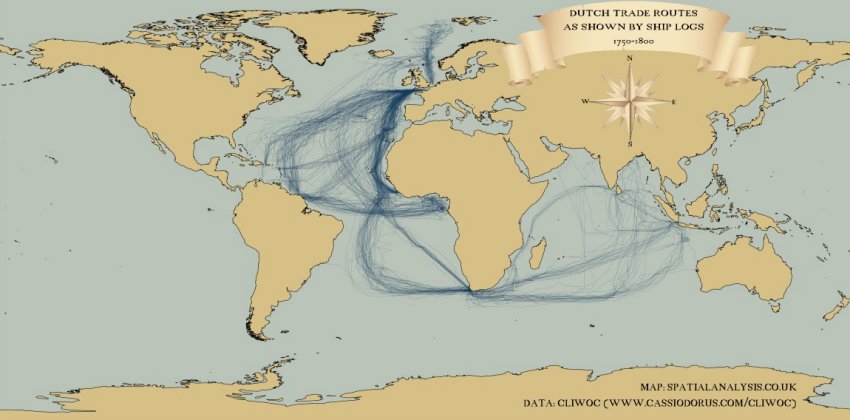
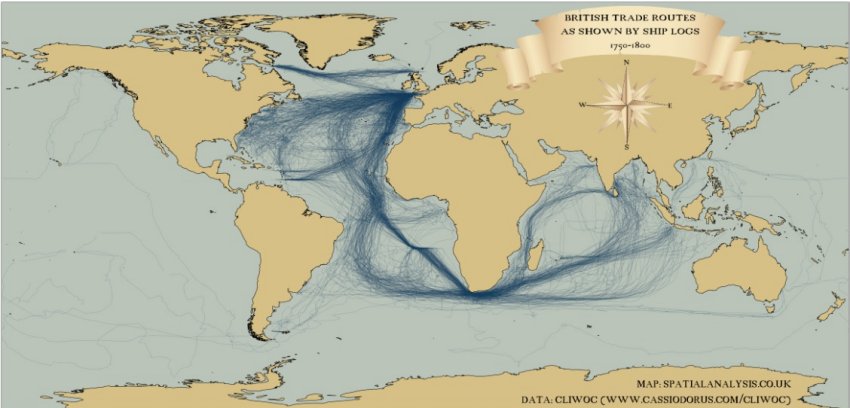
James Cheshire, of Spatial Analysis, has taken historical records of shipping routes between 1750 and 1800 and plotted them using modern mapping tools.

The first map, above, shows journeys made by British ships. Cross-Atlantic shipping lanes were among the busiest, but the number of vessels traveling to what was than called the East Indies — now India and South-East Asia — also stands out when compared to Dutch and Spanish records.

I was surprised to see how many trading voyages there were to and from the Hudson Strait — fur trade traffic, I assume.


(Larger version at the original URL)

This second map shows the same data for Dutch boats. The routes are closely matched to the British ones, although the number of journeys is noticeably smaller.

You can also see the scattering of journeys made by Dutch ships to Svalbard, off the North coast of the Norwegian mainland

« Newer PostsOlder Posts »

Powered by WordPress