Quotulatiousness

May 13, 2012

Greek railway dis-economy of scale

Filed under: Economics, Europe, Greece, Railways — Nicholas @ 11:22

It would actually be cheaper to send all Greek train passengers by private taxi than using the public rail network:

The claim that it would be cheaper for Greece to send every rail passenger to their destination by taxi was most recently made in the book Boomerang by Michael Lewis, the Moneyball author.

But it was first made by Stefanos Manos, the former Greek finance minister, in 1992. Manos used the railway system to illustrate what he saw as gross public sector waste.

“I was in favour of the Maastricht Treaty and was supposed to defend it in Parliament,” says Manos, now heading his own party, Drasi.

“I said we should drastically reduce the size of the public sector and its expenditure. And I gave as an example the railway where there were exorbitant wage bills compared to the revenue of the country.”

He says it was an off-the-cuff remark but about right.

“I knew the number of passengers and I made a brief estimate of what it would cost to send them from Athens to the north of Greece and I decided it was quite obvious it would be cheaper to send them there by taxi rather than train.”

It’s not quite true now: two passengers would have to share each taxi. If you got three passengers into each taxi, the government would be saving money.

May 12, 2012

What’s in a name? Just centuries of military tradition

Filed under: Britain, Bureaucracy, Military — Tags: , , — Nicholas @ 11:33

The military bureaucrats and their civilian masters are well on the way to stamping out all those awfully old-fashioned names and symbols of the Scottish highland regiments:

Senior Downing Street sources said David Cameron is not yet at the stage of overruling Philip Hammond, his Defence Secretary, over his proposal to replace iconic names like the Black Watch with battalion numbers.

But they were keen to emphasise that no final decision has been made and the Prime Minister is aware of the potential political damage to the campaign to prevent Scotland separating from the UK.

[. . .]

Fury has been mounting since the Defence Secretary told the Daily Telegraph earlier this week that the “ancient cap badges have largely gone” and some traditional regimental names are now just “attached in brackets”.

Under Mr Hammond’s proposals, the Black Watch, 3rd Battalion the Royal Regiment of Scotland (3 SCOTS), would become just 3 SCOTS and the Argyll and Sutherland Highlands would be names 5 SCOTS.

[. . .]

The former Labour Government faced a fierce backlash when the battalions were amalgamated in 2005 to form the Royal Regiment of Scotland, but they were promised they could keep their historic names.

Jeff Duncan, who managed the Save Scotland’s Army Regiments campaign, said yesterday it had restarted and nearly 1,500 had signed up in only 48 hours using the social networking site Facebook.

Scott Feschuk on the Cannes line-up

Filed under: France, Humour, Media — Tags: , — Nicholas @ 09:45

Not so much with the accuracy in titles, but certainly accurate on content:

The Cannes Film Festival is once again showcasing its usual fare of upbeat, crowd-pleasing entertainment. I’ve not entirely been paying attention, but here’s what’s playing so far as I can tell:

Despair and Isolation — Several orphans struggle to comprehend the human condition in a cruel world where the only constants are heartbreak and suffering. Running time: six hours.

Isolation, Despair and also Anguish — Several thinner orphans struggle to comprehend the human condition while wheezing in a crueller world where the only constants are heartbreak, suffering and their leprosy (the skin kind and the social kind). Running time: six hours.

Despair, Anguish, Further Anguish and a Shaky Hand-held Camera — Several orphans struggle to comprehend the human condition, but without going outside, because the film’s budget is only $19. Running time: 33 hours (couldn’t afford fancy “editing” machine).

[. . .]

The Triumph of Love — Turns out the title is pretty misleading. This “Love” guy is a serial killer who targets orphans whose parents were murdered by other serial killers who themselves were orphans.

May 11, 2012

Britain’s government websites under attack

Filed under: Britain, China, Government, Technology — Tags: , , , — Nicholas @ 09:06

Perhaps I’m just cynical, but I had expected that any government website would need to be “hardened” against attack. The British government’s many official websites have indeed been undergoing attacks for quite some time:

The British Ministry of Defense has admitted, for the first time, that it is under heavy attack by hackers. It was also revealed that some of these attacks had succeeded. The good news is that the military is becoming more aggressive and imaginative in dealing with Cyber War defense. China was not directly accused of being behind any of these attacks, but it was mentioned that there are now discussions underway with the Chinese on the matter. All this is an old problem.

Last year, Britain went public to report a higher number of Internet based attacks. The report noted that the emphasis was now on economic assets. This included technology and business plans. For example, the Foreign and Commonwealth Office was under heavy cyber-attack for several months, apparently in an effort to obtain secret details of government plans and techniques for supporting British exports. Government Internet security officials were making all this public to encourage British firms to increase their Internet security.

All this was nothing new. Two years ago Britain’s domestic intelligence service, MI5, went public with numerous charges of Chinese Internet based espionage. MI5 accused China of using both agents and hacker software, to obtain secrets from specific companies and government organizations. This approach had Chinese personnel approaching specific British businessmen at trade shows, and offering gifts, like a thumb drive loaded with hidden hacker software that will load itself on to the victim’s PC and seek out valuable information. Internet based attacks, traced back to China, continue to send real looking email that has an attachment containing another of those stealthy hacker programs that seek out secrets, or even quietly take over the user’s PC. Three years ago, MI-5 sent alerts to major corporations warning them of similar attacks and advising increased security of their data.

May 10, 2012

British aircraft carriers to be equipped with F-35B in policy reversal

Filed under: Britain, Military — Tags: , , , — Nicholas @ 10:30

The two Queen Elizabeth class aircraft carriers being built for the Royal Navy were originally to be equipped with F-35B model which can operate in VTOL mode (like the Harriers used on HMS Ark Royal up to her retirement). This was deemed to be too expensive, so the British government ordered the carriers to be retro-fitted with catapults and conventional landing equipment so the RN could use the (relatively) cheaper F-35C.

The plan has now been revised back to the original:

The Ministry of Defence is to abandon plans to buy the preferred fighter for the Royal Navy’s new aircraft carriers, in an embarrassing U-turn for David Cameron.

The prime minister personally endorsed the decision to equip the over-budget carriers with “cats and traps” so they could catapult and recover a version of the F-35 joint strike fighter (JSF) from their decks.

But the cost of converting the carriers has already reached £2bn, and the JSF model Downing Street wanted has been beset by delays and technical problems.

The aircraft will now not be ready until 2023 at the earliest, forcing the government to revert to Labour’s original plans to buy the less capable jump jet model.

Philip Hammond, the defence secretary, is due to make an announcement in the Commons on Thursday explaining the about-face, which was approved by the National Security Council on Tuesday.

It should be no surprise at all that Lewis Page is ready to call this decision idiotic (and he’s almost certainly right):

It’s well known that the F-35B will cost a lot more to buy and more to run than the F-35C catapult version: and it’s also well known that the main cost of aircraft carriers is not the ships but the planes. So, right out of the gate, we can see that this is a foolish decision.

In fact it’s a lot worse than it seems, as the contest in real life was not between the F-35B and the F-35C: it was between the F-35B and — for the immediate future — one or another cheap, powerful, modern carrier jet already in service. This would most most likely have been the F-18 Hornet as used by the US Navy and many other air forces around the globe, but possibly the French Rafale instead of or alongside Hornets.

In fact the UK will not be able to afford either the F-35B or the F-35C in any large numbers any time soon. Both planes are, after all, brand new supersonic stealth aircraft — only the second make of supersonic stealth aircraft ever built, in fact, and the first ever which can land on ships. They are brand new, bleeding edge kit and will cost accordingly. Both planes are still in flight test at the moment, in fact, and the F-35 programme as a whole has suffered serious cost and time overruns. This has led to delays to US orders, which have in turn pushed up costs for other early purchasers. Production is still at a low rate only.

Thus, if the Royal Navy had managed to get its hands on a catapult carrier, it would have been compelled (very happily!) to buy or lease an interim carrier jet to tide it over until a reasonable number of F-35Cs could be bought for a reasonable price — probably at some point in the 2020s. There would be no need for a full force of F-35Cs any sooner than the 2030s, by which point they would be affordable and there might be a real need for their stealth and other advanced capabilities.

May 9, 2012

Misreading the European electoral tea leaves

Filed under: Economics, Europe, France, Government, Greece, Italy, Media — Tags: , , — Nicholas @ 10:19

Brendan O’Neill points out that there’s something lacking in the analyses of all the recent electoral upheavals in Europe:

Great claims are being made in the wake of the local elections in Britain, the presidential elections in France, and the legislative elections in Greece. Britain’s Labour Party may have secured the votes of just 12.5 per cent of the eligible electorate, but it came top in the local elections, and so we’re told that ‘Labour is back’. The victories of Hollande in France (where he won 51.63 per cent of the vote to Nicolas Sarkozy’s 48.37 per cent), and of SYRIZA in Greece (the anti-austerity, radical left coalition which won 16.78 per cent of the vote), are being talked up as a ‘new dawn’ for European social democracy. According to a Guardian editorial, we have witnessed a ‘stunning victory… for the left in Europe’.

These observers urgently need to take a reality check. Because in truth, the most striking thing about the recent elections in Europe has been the utter absence of any matters of doctrine, of principle, of ideological outlook. In England, France, Greece, Italy, no doctrinal matters whatsoever have been raised, far less contested. These elections are best seen, not as a new dawn for social democracy, but as an unfocused emotional reaction against things — against Sarkozy, austerity, Brussels. Actually, it’s worse than that. Where once the left was concerned with creating a new reality, one based on systems and values quite distinct from those of traditionalists, today’s emerging left is obsessed with avoiding reality, with hiding away from the harshness of economic life in 2012 and simply saying: ‘Be gone!’ The problem with the newly successful left movements is not just that they’re attracting shallow protest votes, but that they’re extraordinarily infantile, blinkered outfits.

The only ‘doctrine’ uniting the various movements against austerity in modern Europe (both the left-wing and right-wing ones) is the doctrine of responsibility aversion, of shirking seriousness in favour of emotionalism. What the cheerleaders of these movements fail to realise is that being anti-austerity without positing an alternative route out of recession, without any serious proposals for stabilising economic life in Europe, is mere gesture politics. In fact it’s an act of irresponsibility, of wilfulness, where the key aim is to insulate oneself and one’s supporters from the harsh realities of our recessionary times rather than face up to those realities and potentially transform them. The new anti-austerity posturing, to quote an old communist, is an infantile disorder.

May 8, 2012

Absurd meme of the month: that European countries have imposed draconian fiscal austerity

Filed under: Economics, Europe, Government, Media — Tags: , , , , — Nicholas @ 11:00

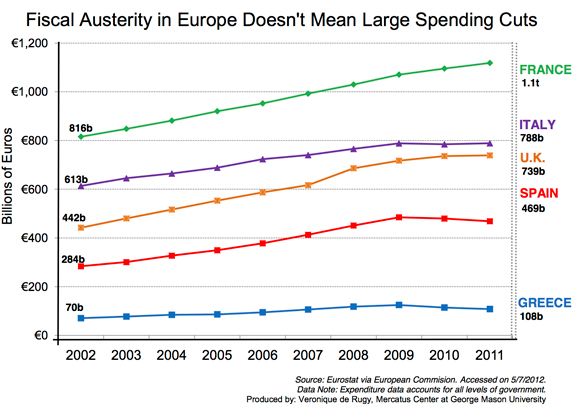
For all the gasping about the impact of fiscal austerity on weakened European economies, it’s hard to detect from the actual numbers:


(Image from the Mercatus Center)

See all those coloured lines dropping precipitously? Me neither.

Veronique de Rugy asks where the “savage” spending cuts can be seen:

Austerity is destroying Europe, we are told. In fact, this “anti-austerity” slogan was a big reason for the victory of newly elected socialist François Hollande to the presidency of France. Interviewed in The Economist a few weeks ago, Hollande’s campaign director said “We are not disciples of savage spending cuts.”

But then, I look at the data and I am asking: What “savage” spending cuts?

Look at [the chart above]. It is based on Eurostat data which you can find here. Following years of large spending increases, Spain, the United Kingdom, France, and Greece — countries widely cited for adopting austerity measures — haven’t significantly reduced spending since 2008. As you can see on this chart:

  • These countries still spend more than pre-recession levels
  • France and the U.K. did not cut spending.
  • In Greece, and Spain, when spending was actually reduced — between 2009–2011 — the cuts have been relatively small compared to what is needed. Also, meaningful structural reforms were seldom implemented.
  • As for Italy, the country reduced spending between 2009 and 2010 but the data shows and uptick in spending 2011. The increase in spending represents more than the previous reduction.

In addition to failing to curb spending, several governments have raised taxes (which has a negative effect on growth in the economy and can — contrary to popular wisdom — actually reduce the total tax collected as people and companies change their habits to minimize the impact of the tax change).

“If this drought continues much longer, we’re going to run out of umbrellas”

Filed under: Britain, Environment, Government — Tags: , , — Nicholas @ 10:40

Rob Lyons on the amusing juxtaposition of a “hosepipe ban” in the south of England and the wettest April since record keeping began:

It never rains but it pours scorn. That must be how many of England’s water companies feel as millions make fun of them. Having just declared a hosepipe ban and spent a fortune on posters declaring ‘WE ARE IN DROUGHT’, the heavens have opened. Result? The surreal combination of drought restrictions on water use going side-by-side with the wettest April since records began in 1910.

It is as if the declaration of drought were a latter-day raindance. Comedian Jimmy Carr quipped what everyone was thinking: ‘If this drought continues much longer, we’re going to run out of umbrellas.’ The combination of dramatic flooding in some parts of the country that are under drought restrictions caused one friend of mine to coin the term for our current water status: ‘flought’. Pictures of Thames Water’s bus adverts juxtaposed with people in the street huddling under brollies made newspaper front pages.

Yet, while the current situation is bizarre, the water companies do have a point. If the current storage sites are running low of water after two years of well-below-average rainfall, then we need to start preserving stocks. One month of heavy rain is welcome, but unless we have a particularly sodden summer and, more importantly, a damp-and-dreary winter, supplies could start to look very sparse indeed. That’s particularly true in the south and east of England, which depend on underground aquifers to store a large proportion of water supplies. The levels in these aquifers rely on winter rain to drip through the rocks above. Summer rain tends to run off, evaporate or get absorbed by growing plants. A quick look back to February and the warnings coming from Thames Water and others show how serious the problem had become before the deluge.

May 7, 2012

Royal Flying Corps, 100 years on

Filed under: Britain, History, Military, Technology, WW1 — Tags: , , — Nicholas @ 10:25

April 13th was the 100th anniversary of the founding of the Royal Flying Corps (RFC), which was merged with the Royal Naval Air Service (RNAS) to become the Royal Air Force in 1918. BBC Magazine has an interesting article about the early days:

In most accounts of WWI, mention of the Royal Flying Corps goes hand-in-hand with stories of the fighter aces, men like Albert Ball and James McCudden, who downed dozens of enemy planes.

The romance of gladiatorial combat in the air — initially firing revolvers at one another from the cockpit, and then shooting machine guns through the propellers of the aircraft — makes their adventures against such legendary foes as the Red Baron some of the most stirring tales of the Great War.

But as a division of the British Army, the main role of the Royal Flying Corps, with its hundreds of pilots and thousands of ground crew, was very different.

It was the eyes of the army.

For the first time in history, it was possible not only to get a detailed view of the enemy lines from above, but to see what was going on behind those lines — the trench systems, the support routes, the railways and road vehicles that manoeuvred troops and weaponry into position.

The real heroes of the war in the air were the pilots and observers who flew in all conditions to maintain British air superiority, and to keep the ground troops aware of everything that the enemy was doing.

During the First World War, Canada hosted a training unit for British aircrew, the Royal Flying Corps Canada (Wikipedia link), from 1917 onwards. It operated the following air stations in southern Ontario:

  • Camp Borden 1917–1918
  • Armour Heights Field 1917–1918 (pilot training, School of Special Flying to train instructors)
  • Leaside Aerodrome 1917–1918 (Artillery Cooperation School)
  • Long Branch Aerodrome 1917–1918
  • Curtiss School of Aviation (flying-boat station with temporary wooden hangar on the beach at Hanlan’s Point on Toronto Island 1915–1918; main school, airstrip and metal hangar facilities at Long Branch)
  • Deseronto Airfield, Deseronto 1917–1918 (pilot training)
  • Camp Mohawk (now Tyendinaga Mohawk Airport) and Camp Rathburn — located at the Tyendinaga Indian Reserve near Belleville 1917–1918 (pilot training)
  • Hamilton (Armament School) 1917–1918
  • Beamsville Camp (Aerial fighting)

List sourced from the Wikipedia page on the RFC.

[Lt Col (later Brig Gen) Cuthbert] Hoare made several agreements with U.S. Brig Gen George O. Squier (US Army Signal Corps) and the US Aircraft Production Board. Squier had overall responsibility for the US Army’s air service, which was short of flight instructors. The RFC released five experienced American pilots to the US Army, where they became squadron commanders. The US Air Board acquiesced in the British opening a recruiting office in New York City, ostensibly to recruit British citizens, but in fact also soliciting US citizens, of whom about 300 were successfully signed up. The RFC would also train many US Army flight personnel: 400 pilots; 2,000 ground-crew members; and 20 equipment officers. These Americans would then collect aircraft and equipment from the UK, before coming under RFC control in France. Ten American squadrons would train in Canada during the summer of 1917, while RFC squadrons were allowed to train during the winter in Fort Worth, Texas.

During the last two years of the war 3135 pilots and 137 observers trained in Canada and Texas for both the RFC and the new Royal Air Force (RAF). Of these trainees, 2,624 went to Europe for operational duty.

“Welcome to the foreign policy Theater of the Absurd”

Filed under: Europe, Military, Russia — Tags: , , , — Nicholas @ 09:13

Justin Raimondo on the recent spat between Russia and NATO:

A Russian general has threatened military action if the US and its NATO allies go ahead and build a “missile shield” in Eastern Europe: “A decision to use destructive force preemptively will be taken if the situation worsens,” say Russian chief of staff Nikolai Makarov. That the “shield” is of dubious effectiveness, and is mainly a cash cow for US defense companies, are not factors the Russkies are willing to take into consideration: their main beef seems to be the implied insult of Washington claiming the shield isn’t designed to protect against future aggression emanating from Moscow, but against an alleged Iranian missile threat to Europe. Hey, they seem to be saying: what about us? Aren’t we a threat, too?

Well, no — they aren’t. Russia’s population is falling rapidly, and their economy isn’t doing too hot, either. What the oligarchs didn’t loot and spirit out of the country has been either seized and mismanaged by the state, or else is part of the burgeoning black market. The last thing Moscow needs is an empire: they can barely manage what they already have. That hasn’t stopped Washington from manufacturing a phony narrative that imagines a “resurgent Russia” motivated by revanchism and a desire to refight the cold war.

So here we have the spectacle of a phony threat being uttered as a response to yet another phony threat: the Russians aren’t going to preemptively attack Poland, and neither they nor the Iranians represent a real danger to the West. Yet the actors in this little drama are intent on playing out their roles to the end, no matter how disconnected from reality their actions and pronouncements may seem.

Welcome to the foreign policy Theater of the Absurd.

May 5, 2012

HMS Ocean heads up the Thames for Olympic security exercise

Filed under: Britain, Military — Tags: , , , , — Nicholas @ 12:15

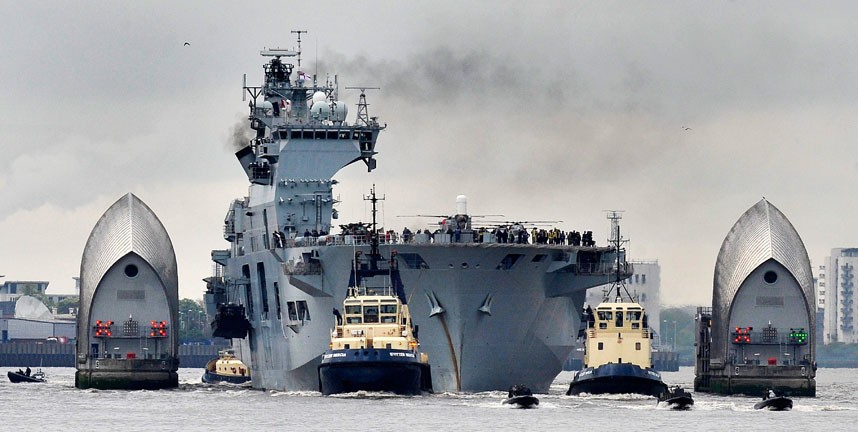
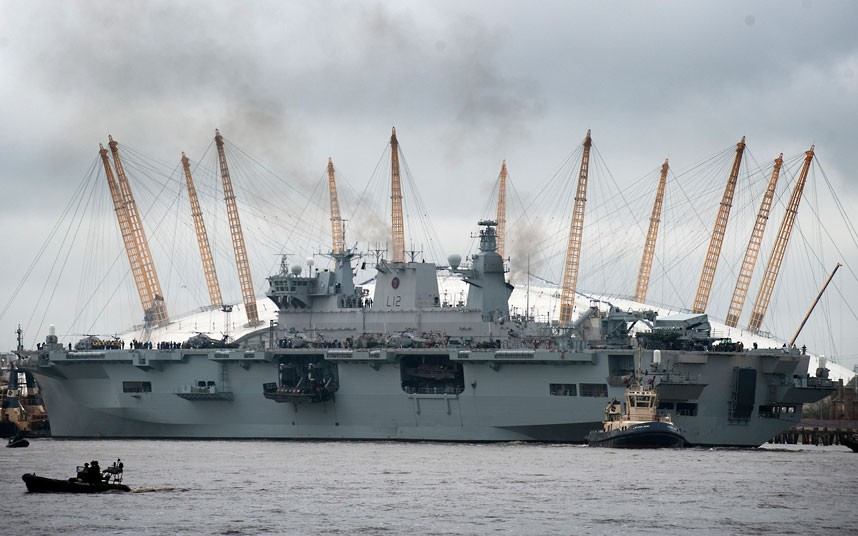
An interesting set of photos in the Telegraph showing the Royal Navy’s largest ship, helicopter carrier HMS Ocean being brought up the Thames for a security exercise in advance of the London Olympics:


A tight squeeze as the tugs work HMS Ocean through the Thames Barrier


HMS Ocean passes in front of the O2 Arena on her way up the Thames

May 3, 2012

Sarkozy’s best chance to win? The DSK effect

Filed under: Europe, France, Government — Tags: , , , — Nicholas @ 10:26

John Gizzi on the slim hopes Nicolas Sarkozy has to catch up to front-runner Francois Hollande in the French presidential election:

Before arriving here today to find France braced for its presidential election run-off May 6, I stopped at London’s Ladbroke’s, the world’s most storied of oddsmakers. The odds against Nicolas Sarkozy winning, the bookmaker told me, were 4-to-1, while the odds favoring Socialist challenger Francois Hollande were 1-to-7.

[. . .]

With those chunks of LePen and Bayrou voters, Sarkozy would be in a near-tie with his Socialist nemesis and would need some dramatic event or stumble by Hollande to put him over. As to what this stumble might be, one possibility could have occurred at a birthday party for Socialist politician Julian Drey last Sunday. The big news was who showed up: Dominique Strauss-Kahn, whose own presidential hopes were dashed in a sensational string of scandals beginning with his arrest in New York last May for allegedly assaulting a hotel maid. The politician known as DSK dodged that bullet, but is now facing more serious charges of his alleged involvement in a prostitution ring in France.

Upon learning that DSK was at the birthday party, 2007 Socialist nominee Segolene Royal (who is the mother of Hollande’s four children) stormed out and Hollande himself canceled an appearance at the party. Incredibly, the party was held at the site of what was once a notorious house of prostitution.

Just the appearance of Strauss-Kahn sent the Hollande camp into fervent denials that DSK would ever be considered for a position in a Socialist government.

Remembering the heroism and sacrifice of the defenders at Kohima’s Garrison Hill

Filed under: Britain, History, India, Japan, Military, WW2 — Tags: — Nicholas @ 09:53

A little-known battle had major consequences to the tides of Japanese expansion, and has been called “India’s Battle of the Somme“:

Nestled in the vast country’s north-eastern state of Nagaland, it is a place where two Victoria Crosses were won for outstanding bravery, where a 1,000-strong British and Indian force, outnumbered 10 to one, halted the Japanese army’s relentless march across Asia.

Blood-soaked battles in April 1944 saw the troops of the Royal West Kent Regiment, with their comrades from the Punjab Rifles and other Indian regiments, under siege on the top of Kohima’s Garrison Hill.

Troops fought hand to hand in torrential rain from rat-infested trenches dug on the then British deputy commissioner’s clay tennis court.

The two sides were so close that they could lob grenades into each other’s strongholds barely 50 feet away and, according to chroniclers of the battle, Allied troops sometimes woke in their monsoon mud trenches with Japanese troops sleeping alongside them.

When the siege of the hill was finally relieved some 45 days after it had begun, British officers were appalled at the conditions in which both Japanese and allied forces had fought and compared it to the Battle of the Somme. Some of the Japanese soldiers had died of starvation and disease. By then end, more than 4000 allied soldiers were dead, and 5764 Japanese troops had been killed.

May 2, 2012

Jim Flaherty on why the IMF should not go too far to rescue the Eurozone

Filed under: Cancon, Economics, Europe, Government — Tags: , , , — Nicholas @ 08:44

As I’ve mentioned before, Jim Flaherty is the federal finance minister and also my local MP. I don’t always agree with him (especially around budget time when he channels his inner spendthrift), but he makes some excellent points in this article at The Telegraph:

At the meeting of the International Monetary Fund recently, Canada decided against contributing more resources to support the eurozone. We also argued that all countries borrowing from the IMF should be treated equally. We took these positions because we believe they are in the best interests of the eurozone, of the IMF, and of the international community.

We have always supported the IMF’s important systemic role in promoting economic stability by providing loans to countries that have exhausted their domestic options, and placing these countries on a path to sustainability through time-limited interventions. But it is not the IMF’s role to substitute for national governments.

[. . .]

Ultimately, the adequacy of the actions taken will be judged by the markets. Repeated expressions of confidence by politicians are futile if the markets continue to cast their vote of non-confidence. The markets’ confidence in political leadership will only be restored when it is clear that politicians are willing to see the full scope of the problem, to focus on the key issues instead of pursuing sideshows such as the financial transactions tax, and to set out and implement a plan for tackling these issues.

[. . .]

We cannot avoid the question of fairness. Eurozone members benefit from increased exports and price stability. Spreading the risks of the eurozone around the world, while its benefits accrue primarily to its members, is not the way to resolve this crisis. We cannot expect non-European countries, whose citizens in many cases have a much lower standard of living, to save the eurozone. Further, the IMF, with roughly $400 billion, already has adequate resources to deal with imminent needs.

H/T to Elizabeth for sending me the link.

May 1, 2012

The morality of taxation

Filed under: Britain, Economics, Government — Tags: , , — Nicholas @ 08:17

In the Telegraph, Philip Johnston recounts the story of the 10 beer-drinking men and uses it to discuss the morality of taxes. Although the details are British, the story applies equally to Canada or the United States:

No discussion of the morality of taxation can be divorced from what is done with the money. It is not enough to say we must all contribute according to our means without at the same time questioning where it all goes. Tax has become the new immigration: a taboo subject for politicians who fear being derided as friends of the rich or denounced for immoral policies.

Yet, even with the parlous state of the nation’s finances, an argument can be made for low taxation that speaks to both a desire for smaller government and for greater personal freedom. The last Labour government took too much in taxes not merely because it believed that ever-increasing amounts of public spending were the only way to achieve better services. It did so because socialists think they know best how to spend people’s money and should be entrusted to do so. That is the essence of the Left’s worldview; and it is the principal reason why the state has grown so much in the past 50 years.

Where is the morality in taking money from people so that politicians can feel good about themselves? How is it ethical of a government to remove 40 per cent of an individual’s income with the purpose of engineering society the way it sees fit, rather than ensuring that people have the means to get on, by and large, with their own lives? Our system of governance has become characterised by grotesque waste, unfulfilled promises, incompetent delivery and excessive red tape. It has over-reached itself and seems incapable of retrenching, even under a Tory prime minister.

The moral, and Conservative, case for lower taxes is that they allow people to make their own decisions, to save when they wish, to give if they choose and to spend on what matters to them. Tory politicians should not be ashamed to talk about cutting taxes, because high taxation removes the need for individuals to take responsibility for their own lives and heightens cynicism about the ability of the government to deliver.

« Newer PostsOlder Posts »

Powered by WordPress