Quotulatiousness

November 14, 2012

OED plumps for “omnishambles” over “mummy-porn”

Filed under: Books, Britain, Humour, Media — Tags: , , — Nicholas @ 00:01

Anna Leach explains just how exciting life can be when you’re working on the Oxford University Press staff:

The UK’s new word of 2012 is “omnishambles”, according to the Oxford English Dictionary’s compilers.

Selected from a list of several new words added to the gold-standard dictionary this year, omnishambles was chosen by lexicographers at Oxford University Press because it best reflects the mood of the past 12 months. It was first used by the character Malcolm Tucker in series three of the BBC satire The Thick of It and subsequently repeated by the Coalition government’s political opponents.

[. . .]

The OED now defines it as:

A situation that has been comprehensively mismanaged, characterised by a string of blunders and miscalculations.

Other contenders were “mummy porn” (a description of the genre inspired by smack’n’tickle ebook bonkbuster 50 Shades of Grey), “green-on-blue” (to describe attacks by Afghan police or troops on NATO servicemen), the verb “medal” (from the Olympics), “eurogeddon” (from Eurozone crisis) and the acronym “YOLO” (contraction of the trite phrase “You Only Live Once”, mostly used as a justification after someone does something stupid on the internet).
November 13, 2012

QotD: British women in WW2

Filed under: Britain, History, Military, Quotations, USA, WW2 — Tags: , , , — Nicholas @ 12:24

A British woman officer or non-commissioned officer can and often does give orders to a man private. The men obey smartly and know it is no shame. For British women have proven themselves in this war. They have stuck to their posts near burning ammunition dumps, delivered messages afoot after their motorcycles have been blasted from under them. They have pulled aviators from burning planes. They have died at the gun posts and as they fell another girl has stepped directly into the position and “carried on.” There is not a single record in this war of any British woman in uniformed service quitting her post or failing in her duty under fire.

Now you understand why British soldiers respect the women in uniform. They have won the right to the utmost respect. When you see a girl in khaki or air-force blue with a bit of ribbon on her tunic — remember she didn’t get it for knitting more socks than anyone else in Ipswich.

Instructions for American Servicemen in Britain, 1942

Denmark discovers that “price elasticity” is a real phenomenon

Filed under: Economics, Europe, Food, Government, Health — Tags: , , , — Nicholas @ 11:24

Denmark is getting rid of its “fat tax” imposed last year, as it has failed to solve the problem it was intended to address:

Gone, by popular demand: Denmark’s fat tax. ‘The fat tax is one of the most maligned we [have] had in a long time’, said Mette Gjerskov, the Danish food and agriculture minister, in a press conference on Saturday announcing the decision to ditch the policy. ‘Now we have to try improving the public health by other means.’

[. . .]

It turns out, unsurprisingly, that slapping taxes on things doesn’t necessarily persuade people to consume less of them. So Danes either went downmarket in their buying habits by buying cheaper products, or popped across the border to Sweden or Germany to buy their fatty foods there instead. The only real effect was to hit the profits of Danish companies. Chastened by the experience, the Danish government has also scrapped plans for a sugar tax, too.

As the OECD notes: ‘The impact of imposing taxes on the consumption of certain foods is determined by the responsiveness of consumers to price changes, ie, price elasticity. However, it is difficult to predict how consumers will react to price changes caused by taxation. Some may respond by reducing their consumption of healthy goods in order to pay for the more expensive unhealthy goods, thus defeating the purpose of the tax. Others may seek substitutes for the taxed products, which might be as unhealthy as those originally consumed. Depending on the elasticity of the demand for the taxed products, consumers will either end up bearing an extra financial burden, or changing the mix of products they consume in ways that can be difficult to identify.’

So, simply from a practical point of view, food taxes — indeed, any sin tax, including extra duty on tobacco or minimum prices for alcohol — can have some unwanted negative consequences while largely failing to achieve their intended aim.

Rapidly retreating freedom of expression in Britain

It’s almost as if Britain is in some sort of demented race to get rid of freedom of expression altogether:

At 9pm last night, with a knock on the door of a 19-year-old man, Kent police hammered another nail into the coffin of free expression in the UK.

Earlier in the day the unnamed man from Aylesham had allegedly posted a photo of a poppy being burned, with a crudely worded (and crudely spelled) caption. He was arrested under the Malicious Communications Act and held in the cells overnight to await questioning.

It is of course just the latest in a succession of police actions against individuals deemed to have caused offence: mocking a footballer as he fights for his life on Twitter; hoping British service personnel would “die and go to hell”; wearing a T-shirt that celebrated the death of two police officers; making sick jokes on Facebook about a missing child, the list goes on. A few months ago, these could have been dismissed as isolated over-reactions or moments of madness by police and judiciary. Not any longer. It is now clear that a new criminal code has been imposed upon us without announcement or debate. It is now a crime to be offensive. We are not sleepwalking into a new totalitarianism — we have woken up to find ourselves tangled in its sheets.

News of the arrest was first announced on Kent police’s Twitter feed, and it didn’t take long for users to spot the painful irony of their official avatar, which simply says Kent police 101. The number is taken from the non-essential police phone number, but as we all know, Room 101 was where Winston Smith was taken in George Orwell’s 1984 to be tortured and eventually persuaded to recant his individual beliefs and fall into line with officially sanctioned viewpoints.

Protecting children from online pornography – the impossible dream

Filed under: Britain, Media, Technology — Tags: , , , — Nicholas @ 10:46

In the Guardian, Cory Doctorow talks about the actual scale of effort the British government is attempting to mandate to “protect the children from pr0n”:

In order to filter out adult content on the internet, a company has to either look at all the pages on the internet and find the bad ones, or write a piece of software that can examine a page on the wire and decide, algorithmically, whether it is inappropriate for children.

Neither of these strategies are even remotely feasible. To filter content automatically and accurately would require software capable of making human judgments — working artificial intelligence, the province of science fiction.

As for human filtering: there simply aren’t enough people of sound judgment in all the world to examine all the web pages that have been created and continue to be created around the clock, and determine whether they are good pages or bad pages. Even if you could marshal such a vast army of censors, they would have to attain an inhuman degree of precision and accuracy, or would be responsible for a system of censorship on a scale never before seen in the world, because they would be sitting in judgment on a medium whose scale was beyond any in human history.

Think, for a moment, of what it means to have a 99% accuracy rate when it comes to judging a medium that carries billions of publications.

Consider a hypothetical internet of a mere 20bn documents that is comprised one half “adult” content, and one half “child-safe” content. A 1% misclassification rate applied to 20bn documents means 200m documents will be misclassified. That’s 100m legitimate documents that would be blocked by the government because of human error, and 100m adult documents that the filter does not touch and that any schoolkid can find.

In practice, the misclassification rate is much, much worse. It’s hard to get a sense of the total scale of misclassification by censorware because these companies treat their blacklists as trade secrets, so it’s impossible to scrutinise their work and discover whether they’re exercising due care.

November 12, 2012

Kelly McParland: US and French attitudes to affairs differ markedly

Filed under: Europe, France, Media, USA — Tags: — Nicholas @ 12:28

In the National Post, Kelly McParland contrasts the French reaction to affairs on the part of public officials with the American reaction:

In Paris they must be busily turning the pages now, looking for the rest of the story. Yes, OK, he had an affair … and? You mean that’s it? He didn’t murder her? Have three children that he kept in a secret location away from the press? Involve her in sex games with crowds of similarly liberated-minded partners? They had an affair and he has to quit as head of the CIA? Mon dieu, these Americans. Four hundred years in the New World and they’ve barely moved on from the Puritans. Look, they’re even shocked that the other woman appeared on television “sporting bare, toned arms”. What did they expect, a chador?

France has moved on marginally from the days when President Francois Mitterrand could have a whole secret second family, and no one mentioned it in public because it wouldn’t be polite. Now the press leaps happily onto news of sexual licence in the halls of power. Unlike the U.S., they just don’t condemn it, as long as no one is physically abused. The latest instance – they don’t even use the world scandal, because in France it isn’t — relates to the former justice minister, Rachida Dati, who is suing one of the country’s wealthiest men to try and force him to admit he’s the father of her new daughter. The case is a bit complicated because, as Ms. Dati attests, she has “a complicated private life.” That would include, according to the attorney for Dominique Desseigne, the alleged father, having eight lovers in the year she fell pregnant, “including a television broadcaster, a minister, a Qatari attorney-general and a brother of the former president Mr Sarkozy,” reports the French newspaper Le Monde.

Nicolas Sarkozy was the president at the time, and Ms. Dati’s boss. He wasn’t likely to be butting into her private life, though, having given up his own wife in favour of singer/model Carla Bruni. Ms. Bruni has recently been offering marital advice – as in “get married for Cripe sakes” – to Valerie Trierweiler, current First Partner-for-a-While to President Francois Hollande, who has four children by a previous Main Partner, Ségolène Royal. (Ms. Royal is only a Main Partner rather than a First Partner because Hollande wasn’t president at the time.) Dumping the mother of your four children for an uppity newspaper columnist like Ms. Trierweiler might offend sensibilities, but M. Hollande never married Ms. Royal either, so no big deal. Nonetheless Ms. Trieweiler has become deeply unpopular since moving into the presidential palace, because she refuses to give up her day job as a columnist and because she’s been rude to Ms. Royal. The messy sex stuff has nothing to do with it.

Compared to the Bacchanalia of French politics, the Petraeus “scandal” is like a high-school tiff over who gets to wear the football captain’s pin to the Prom.

The BBC’s nightmare scenario

Filed under: Britain, Media — Tags: , , , — Nicholas @ 08:58

Emily Bell outlines the existential crisis the BBC suddenly finds itself embroiled in:

[BBC director general George] Entwistle’s resignation on Saturday was directly linked to a report broadcast by Newsnight on November 2 that misidentified a public figure allegedly involved in a child abuse scandal. The report, connected to an already broiling scandal, did not make things any worse, theoretically, for Thompson. But the BBC he left is now facing a very serious challenge to its future and independence.

The turmoil at the BBC started with a revelation involving a now-dead TV presenter and public figure, Jimmy Savile, who is accused of molesting possibly hundreds of children. US commentators have tried to explain Savile to the domestic audience, but there really is no parallel here. […] The allegations against Savile were being investigated by Newsnight last year, but its editor, Peter Rippon, decided not to run the investigation on the grounds that the evidence was not sound enough. Subsequently, rival broadcaster ITV pulled together a documentary carrying the allegations against Savile, making the BBC’s decision not to run the original piece seem both flawed and possibly compromised. Just as Entwistle succeeded Thompson as director general, the story of how the BBC had shelved its piece broke.

[. . .]

The most preposterous and fitting denouement to the whole horrible affair happened when, in an attempt to prove itself institutionally robust, Newsnight commissioned a second piece into another child abuse scandal. The show broadcast its investigation on November 2, conducted with the London-based Bureau for Investigative Journalism. Including details about an alleged pedophile, the report led to the misidentification of a former member of a Conservative government as being involved in a North Wales care-home scandal after the central witness interviewed misidentified his abuser. Failing to conduct a sufficiently thorough cross-checking of the victim’s evidence, or even to show him a picture of the former politician, were basic journalistic errors. To make matters worse, the Bureau’s editorial head, Iain Overton, had foreshadowed the “exclusive” by tweeting about it earlier in the day. So in scrambling to address the perception that it was timid in breaking stories about pedophilia, Newsnight’s overcompensation has led to a potentially ruinous situation of the BBC creating false rumors.

There are two separate issues in play with all this that have become toxically intertwined. One is the existence of an endemic culture of child abuse in a number of British institutions, and the other is about the editorial independence and journalistic future of the BBC.

November 11, 2012

Royal Navy patrol sees off Spanish corvette

Filed under: Britain, Europe, Military — Tags: , , , , — Nicholas @ 11:25

Gibraltar. Scenic and historic port at the mouth of the Mediterranean Sea. Oh, and ongoing point of friction between the UK and Spain:

A Royal Navy patrol boat has confronted a Spanish warship off the coast of Gibraltar in the latest and most serious clash over Britain’s territorial waters.

The Government has accused Spain of an ‘unlawful incursion’ after the Vencedora, a 288ft-long naval corvette, came within three miles of Gibraltar’s coast, apparently heading towards its port.

The Vencedora, which means ‘winner’, was equipped with Harpoon anti-ship missiles, multiple guns and torpedoes when it entered Gibraltar’s territorial waters on Wednesday afternoon.

The Spanish ship ignored radio warnings to leave the area, and HMS Scimitar, a seven-man patrol boat, was scrambled to intercept.

Gibraltar has been British territory since the early 1700’s, but the current Spanish government would like to change that. As the Wikipedia article points out, the inhabitants strongly prefer staying as British citizens to becoming Spanish:

In the 1950s, Franco renewed Spain’s claim to sovereignty over Gibraltar and restricted movement between Gibraltar and Spain. Gibraltarians voted overwhelmingly to remain under British sovereignty in the Gibraltar sovereignty referendum, 1967, which led to the passing of the Gibraltar Constitution Order in 1969. In response, Spain completely closed the border with Gibraltar and severed all communication links. The border with Spain was partially reopened in 1982, and fully reopened in 1985 prior to Spain’s accession to the European Community.

In a referendum held in 2002, Gibraltarians rejected by an overwhelming majority (99%) a proposal of shared sovereignty on which Spain and Britain were said to have reached “broad agreement”. The British government has committed itself to respecting the Gibraltarians’ wishes. A new Constitution Order was approved in referendum in 2006. A process of tripartite negotiations started in 2006 between Spain, Gibraltar and the UK, ending some restrictions and dealing with disputes in some specific areas such as air movements, customs procedures, telecommunications, pensions and cultural exchange.

Update, 13 November: And here they come again:

In memorium

Filed under: Britain, History, Military, WW1, WW2 — Tags: , , — Nicholas @ 11:00

A simple recognition of some of our family members who served in the First and Second World Wars:

The Great War

  • Private William Penman, Scots Guards, died 1915 at Le Touret, age 25
    (Elizabeth’s great uncle)
  • Private David Buller, Highland Light Infantry, died 1915 at Loos, age 35
    (Elizabeth’s great grandfather)
  • Private Walter Porteous, Northumberland Fusiliers, died 1917 at Passchendaele, age 18
    (my great uncle)
  • Corporal John Mulholland, Royal Tank Corps, died 1918 at Harbonnieres, age 24
    (Elizabeth’s great uncle)

The Second World War

  • Flying Officer Richard Porteous, RAF, survived the defeat in Malaya and lived through the war
    (my uncle)
  • Able Seaman John Penman, RN, served in the Defensively Equipped Merchant fleet on the Murmansk Run (and other convoy routes), lived through the war
    (Elizabeth’s father)
  • Private Archie Black (commissioned after the war and retired as a Major), Gordon Highlanders, captured at Singapore (aged 15) and survived a Japanese POW camp
    (Elizabeth’s uncle)
  • Elizabeth Buller, “Lumberjill” in the Women’s Land Army in Scotland through the war.
    (Elizabeth’s mother)

In Flanders fields the poppies blow
Between the crosses row on row,
That mark our place; and in the sky
The larks, still bravely singing, fly
Scarce heard amid the guns below.

We are the Dead. Short days ago
We lived, felt dawn, saw sunset glow,
Loved and were loved, and now we lie
In Flanders fields.

Take up our quarrel with the foe:
To you from failing hands we throw
The torch; be yours to hold it high.
If ye break faith with us who die
We shall not sleep, though poppies grow
In Flanders fields.

Lieutenant Colonel John McCrae, MD (1872-1918)

November 10, 2012

What Ataturk accomplished to create modern Turkey

Filed under: Europe, Greece, History, Middle East, WW1 — Tags: , , , — Nicholas @ 11:35

History Today posted that today is the anniversary of the death of Mustafa Kemal Ataturk, the man who carved modern Turkey out of the ruins of the Ottoman empire:

Mustapha Kemal Pasha was given the honorific title ‘father of the Turks’ at the height of a revolution which he was pushing forward intuitively and idiosyncratically, there being no precedent for such a fundamental sea change in a Muslim state.

Inevitably, it took someone standing outside the Islamic tradition of Ottoman Turkey to create a new state out of Anatolia — rising from the wreck of the empire. But as The Times was to say in its obituary, this was a man of extraordinary qualities; a Cromwell of the Middle East and also a maverick with an almost feminine subtlety in handling crises on the path to supreme power. He had an iron will and displayed single-mindedness when it came to ensuring the security of the state, even to hanging former confederates who plotted against his revolution.

Ataturk was born of an Albanian mother in Salonika and, without connections followed a military career in which, after being involved with the Young Turks reformist movement, he made his name in 1915 by rushing reinforcements to the Gallipoli beach-head and holding the ANZAC assault.

[. . .]

The Kemalists formed a provisional government in the small town of Ankara, in the middle of the desolate Anatolian plateau. On the Aegean and Mediterranean coasts the Greeks and Italians laid claim to what they regarded as their Asia Minor birthright, hoping to recreate some sort of classical empire. Kemal disabused the Greeks, who soon, of all the Allies hoping for a piece of Anatolia, were alone in arms against the nationalist forces. Halted in a blistering hot wilderness just short of Ankara, the Greeks, who had out-marched their supply lines, were outflanked and thrown back by Kemal’s outnumbered and ragged levies at the Sakaria river. A retreat became a headlong flight and the Greek forces joined their fellow nationals and the Armenians and foreigners who had formed the mercantile community of Smyrna, in a panic-stricken evacuation of the sacked and blazing port. Kemal is supposed to have indulged in a drinking orgy as Smyrna went up in flames — a Tartar conqueror’s celebration of total victory.

The Greeks quit the struggle and their sponsor, the British Prime Minister, Lloyd George, who had threatened armed British intervention backed by the fleet to keep Constantinople an open port under British protection, followed suit. The French and Russians signed separate treaties, giving the Kemalists recognition and aid.

Minimum wage and “living wage”

Filed under: Britain, Business, Economics — Tags: , , , — Nicholas @ 10:47

Tim Harford discusses the image and reality of Britain’s campaign for “living wages”:

Living wage?

The minimum wage, £6.19 an hour for those 21 and over, is a legal obligation. The living wage, £8.55 an hour in London and £7.45 an hour elsewhere, is the result of a very successful publicity campaign and can count Ed Miliband and Boris Johnson among its advocates. There are no legal sanctions for paying less than the living wage, although Mr Miliband did announce plans to “name and shame” those companies who didn’t. Apparently that is helpful, because “name” rhymes with “shame”.

Why do campaigners say that you can’t live on the minimum wage?

Try living on £6.19 an hour and see how you get on.

For an economist you’re getting very high-minded all of a sudden.

I think it’s perfectly reasonable to point out that £6.19 an hour isn’t a lot of money. £8.55 an hour isn’t a lot of money, either, but a lot of people have to get by on less. Unfortunately we economists have to ask awkward questions — for instance, whether these campaigns are likely to help people without much income.

[. . .]

Perhaps we should just raise the legal minimum wage to the same level as the living wage.

Perhaps. Perhaps we should raise the legal minimum wage to a £100m an hour. I think if we did we’d find unemployment might rise. A minimum wage does two things. It will shift money from employers in an imperfectly competitive market to low-paid workers and it will induce some employers to sack workers, even if both employer and employee would prefer a deal struck at an illegally-low wage rate. There’s a case that for the good of low-paid workers, there should be no minimum wage at all. There should be one but it needs to be modest if it isn’t to cause too much unemployment.

Is there any evidence on the right level?

There’s lots, and it is mixed, but on balance it’s in favour of the idea that if you raise the cost of employing people, fewer people will be employed. It is worth bearing in mind that, for a lowly paid worker shifting from job to job, having less work available but at a high hourly rate, isn’t a bad deal. The concern has to be that certain types of people — especially young unskilled workers — will be shut out completely and denied the chance to learn on the job.

November 9, 2012

Solving the “tax haven problem” … with military intervention

Filed under: Economics, Europe, Government — Tags: , , , , , , , , — Nicholas @ 12:30

Radley Balko suggested that this is insanity. I agree, but as Dan Mitchell explains, it’s being bruited about by people who should know far, far better:

A former bureaucrat from the European Bank for Reconstruction and Development actually called for the forcible annexation of low-tax jurisdictions, writing in the Financial Times that, “Jersey, Guernsey and the Isle of Man should simply be absorbed lock, stock and barrel into the UK…Andorra, Monaco and Liechtenstein should be given the choice of ending bank secrecy or facing annexation.”

He wasn’t quite so belligerent about Switzerland, perhaps because all able-bodied male citizens have fully automatic assault weapons in their homes. But he did urge financial protectionism against the land of chocolate, yodeling, and watches.

What a bizarre attitude. It’s apparently okay for certain countries to persecute – or even kill – ethnic minorities, religious minorities, political dissidents, homosexuals, and other segments of their populations. Very rarely do people like Mr. Buiter call for annexation or sanctions against such loathsome regimes.

But if a nation has low taxes and a strong human rights policy on financial privacy, then cry havoc and let slip the dogs of war.

Tomb discoveries cast light on Thracian culture

Filed under: Europe, History, Science — Tags: , , , , — Nicholas @ 10:16

A recent discovery in Bulgaria promises to tell us more about the culture of the Getae, a powerful tribe in Thrace:

Archaeologists in Bulgaria are chuffed today to announce that golden treasures and artifacts produced by the ancient Thracians have been discovered in a subterranean tomb complex in the north of the country.

The treasures include snake-headed bracelets, a golden crown or tiara type affair, a golden horse head and piles of smaller solid gold items including rings, statuettes and buttons. They’re thought to date from the third century BC and to have been produced by the Getae, a tribe among the ancient Thracians.

[. . .]

Thracian warriors played prominent parts in many of the wars of antiquity. The peltast javelineer style of fighting was said to have originated in Thrace, gradually superseding the armoured hoplite warrior: an entire phalanx of the formidable Spartans was crushed by peltasts fighting for Athens during the Peloponnesian War, and the lightly armoured Greek/Thracian warriors are also said to have inflicted severe damage on heavy Persian cavalry.

Alexander the Great — from the neighbouring area of Macedonia — is also said to have used Thracian mercenaries in his world-spanning campaigns, and later on Thracian warriors were prominent in the armies of Rome and then the Eastern empire. In particular, the famous gladiator and rebel Spartacus had originally been a Roman auxiliary soldier from Thrace. Later on — after the fall of Rome, when the Empire was ruled from Constantinople — both the emperor Justinian and the great general Belisarius are said to have been Thracians.

Deception and counter-deception

Filed under: Europe, Germany, History, Military, WW2 — Tags: , , , , , — Nicholas @ 09:08

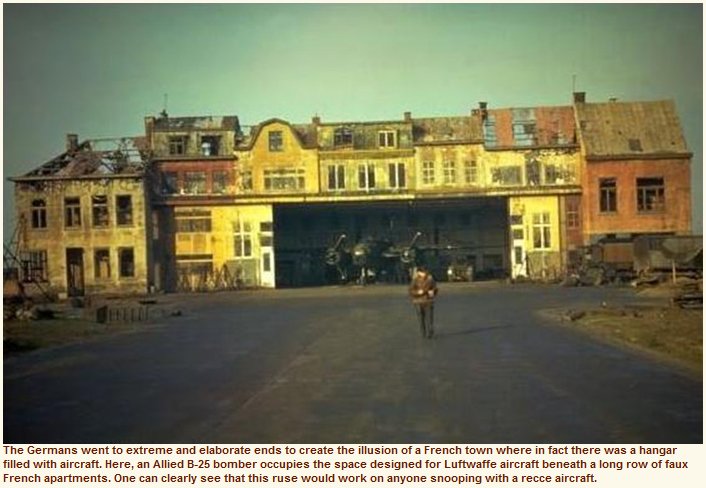
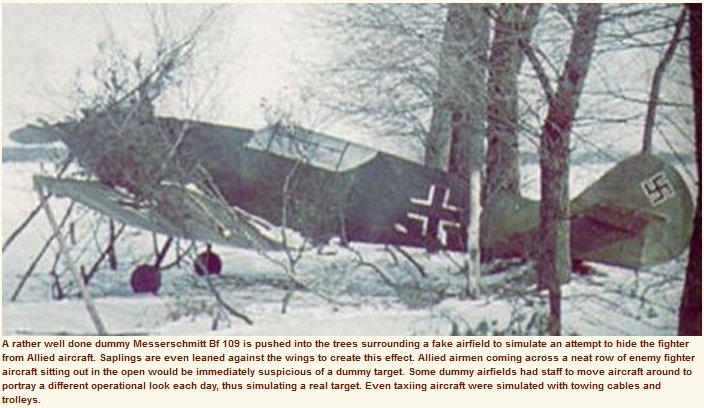
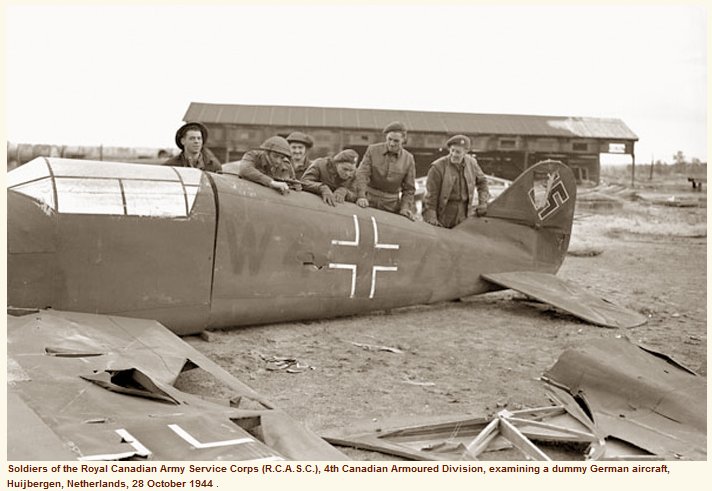
Deception in war reached a crescendo in the latter stages of World War 2, with the allies’ use of General George S. Patton’s imaginary First US Army Group (FUSAG) to pin German attention on the Pas de Calais for more than a month after the real D-Day landings in Normandy. In addition to direct propaganda and an extensive radio network generating fake messages to show the size of FUSAG, the allies also created entire dummy airfields and flotillas of fake landing craft to show up on German air recon photos. The fake planes, aircraft, and buildings were a key part of maintaining the fictitious threat of another, bigger invasion — which successfully kept a large German force away from the real landings.

Less well-known is that the Germans also indulged in this kind of deception:

In what could easily be the finest and boldest example of death-defying and cheeky nose-thumbing during the Second World War or any conflict for that matter, bomber and intruder crews of the Royal Air Force and USAAF are reputed to have bombed the Luftwaffe’s decoy airfields and dummy aircraft, not with high explosives or incendiaries, but with nothing more than dummy bombs made of wood, and painted with the smug remark “Wood for Wood”… all just to make a point.

Throughout all theatres of war, during the Second World War, from China to Holland to Kent, air forces, phsy-ops units and logistics people constructed dummy targets such as airfields, factories, truck parks, convoys and even ships, out of wood, canvas, burlap, or inflatable rubber. The decoy airfields were often populated with dummy aircraft and vehicles of such high quality, that even low flying recce aircraft with photographic equipment would have hard time telling the difference between the dummies and the real thing. The decoy airfields and dummy aircraft served several purposes simultaneously. They confused snooping enemy aircraft and hence planners as to the number of aircraft available to the opposing forces as well as to their displacement. They provided decoy targets for enemy bombers which, if attacked would prevent real aircraft from being destroyed. Often, these airfields were built near real airports in the path of attacking aircraft in the hopes that they would then drop their bombs and strafe the dummies, thereby saving the real aircraft.

H/T to Roger Henry for the original link.

November 8, 2012

QotD: The English Gentleman

Filed under: Britain, Education, History, Quotations, Religion — Tags: , — Nicholas @ 09:26

The idea of a gentleman was a more inclusive one than it sounds to modern ears. One of its greatest advantages was that you could define it so as to include yourself. You could behave like a gentleman, without possessing any of the social attributes which a gentleman might have: there was no need to possess a coat of arms, or a country estate, or engage in field sports, or wear evening dress. At least since Chaucer’s time, there had been a distinction between the social meaning of the word, and the moral. It was evident that well-born people, who ought to know how to behave like gentlemen, did not always do so, while others sometimes did.

Philip Mason, whose perceptive study, The English Gentleman, was published in 1982, argues that “the desire to be a gentleman” runs through and illuminates English history from the time of Chaucer until the early 20th century. He suggests that “for most of the 19th century and until the Second World War” the idea of the gentleman “provided the English with a second religion, one less demanding than Christianity. It influenced their politics. It influenced their system of education; it made them endow new public schools and raise the status of old grammar schools. It inspired the lesser landed gentry as well as the professional and middle classes to give their children an upbringing of which the object was to make them ladies and gentlemen, even if only a few of them also became scholars.”

Andrew Gimson, “Strange Death of the English Gentleman”, Standpoint, 2012-09

« Newer PostsOlder Posts »

Powered by WordPress