Quotulatiousness

November 8, 2012

The Swiss children of Malthus

Filed under: Environment, Europe, Politics — Tags: , , , , , — Nicholas @ 08:59

In sp!ked, Patrick Hayes points out the odd way that Malthusians and xenophobic far-right political groups converge:

For greens, the ends will always justify the means when it comes to saving the planet. In the UK, they have opportunistically latched themselves on to left-wing movements to try to gain purchase with a broader public. But, as Swiss campaign group Ecology and Population (EcoPop) has demonstrated, in an attempt to pursue their Malthusian goals, greens can be equally happy tapping into the anti-immigrant rhetoric of the far right.

In a stunt last week, members of EcoPop carried dozens of cardboard boxes into the Swiss chancellery which contained 120,700 certified signatures calling for immigration into Switzerland to be capped at 0.2 per cent of the resident population. Under Swiss law, this means that a referendum will now be held on the proposal. Such a move trumps even the efforts of the far-right Swiss People’s Party, which has long lobbied for greater immigration controls.

But these greens aren’t mobilising for an immigration clampdown with banners claiming ‘keep the darkies out’ as right-wing groups have done in the past. Nor are they using dodgy, discredited scientific arguments to justify racial superiority, wielding books like Madison Grant’s The Passing of The Great Race for evidence.

No, instead EcoPop delivers its demands for immigration curbs carrying a banner asking: ‘How many people can the Earth tolerate?’ The group’s members use the (equally dodgy and discredited) Malthusian science of population growth and babble on about our ‘finite planet’. And they have reportedly been strongly influenced by the theories of US Malthusian Paul Ehrlich, author of The Population Bomb.

EcoPop bends over backwards to claim that it is not singling out particular races when advocating its policies. According to the BBC, it claims to be ‘opposed to all forms of xenophobia and racism’. But, the group says, ‘Switzerland must limit immigration to avoid urbanisation and to preserve agricultural land’.

You could almost believe that EcoPop is just a bunch of backward-thinking NIMBYish Luddites wanting to stop a flood of immigrants from destroying what it sees as a rural idyll — until you see what the group has tacked on to its proposed referendum for immigration caps. EcoPop slipped an additional clause into the referendum calling for a tenth of all foreign aid to be used ‘for birth-control measures abroad’. (It’s highly questionable how many people would have signed a petition for that alone.)

So it’s not enough to keep foreigners out of Switzerland, then, it’s also necessary to keep them from breeding too much in their own countries as well. And the fact that most of the aid will go towards stopping poor black and brown families from breeding too much suggests that if they’re not intentionally being racist, then EcoPop’s members should really think very hard about how they come across.

November 7, 2012

Scotland: sing an offensive song, go to prison

Filed under: Britain, Law, Liberty, Soccer — Tags: , , , — Nicholas @ 09:57

Kevin Rooney looks at the sad state of free speech (or should that be free singing?) in Scotland:

Imagine the scene: a young man is led away in handcuffs to begin a prison sentence as his mother is left crying in the courtroom. He is 19 years old, has a good job, has no previous convictions, and has never been in trouble before. These facts cut no ice with the judge, however, as the crime is judged so heinous that only a custodial sentence is deemed appropriate. The young man in question was found guilty of singing a song that mocked and ridiculed a religious leader and his followers.

So where might this shocking story originate? Was it Iran? Saudi Arabia? Afghanistan? Perhaps it was Russia, a variation of the Pussy Riot saga, without the worldwide publicity? No, the country in question is Scotland and the young man is a Rangers fan. He joined in with hundreds of his fellow football fans in singing ‘offensive songs’ which referred to the pope and the Vatican and called Celtic fans ‘Fenian bastards’.

Such songs are part and parcel of the time-honoured tradition of Rangers supporters. And I have yet to meet a Celtic fan who has been caused any harm or suffering by such colourful lyrics. Yet in sentencing Connor McGhie to three months in a young offenders’ institution, the judge stated that ‘the extent of the hatred [McGhie] showed took my breath away’. He went on: ‘Anybody who participates in this disgusting language must be stopped.’

Several things strike me about this court case. For a start, if Rangers fans singing rude songs about their arch rivals Celtic shocks this judge to the core, I can only assume he does not get out very much or knows little of life in Scotland. Not that his ignorance of football culture is a surprise — the chattering classes have always viewed football-related banter with contempt. But what is new about the current climate is that in Scotland, the middle-class distaste for the behaviour of football fans has become enshrined in law.

November 6, 2012

It’s official: Morris Dancers are “offensive”

Filed under: Britain, History, Media — Tags: , , , , — Nicholas @ 11:19

Well, they’re “offensive” to a couple of Police Constables in Surrey, anyway:

A group of Morris Dancers were ordered to stop performing in the middle of a routine after police received a complaint that their dancing was ‘offensive’.

The 15-strong group of English folk dancers from the respected Wild Hunt Bedlam Morris troupe were told to ‘stop making a din’ during a performance outside The White Lion pub in Warlingham, Surrey.

The folk dancers were performing in spooky costumes for a free Halloween show outside the 15th century pub to an audience of around 30 customers, but were cut short after just six dances.

The group had planned at least 10 other dances, but were interrupted by two police officers who told them to ‘down’ their handkerchiefs and sticks and ‘move on’ as they were causing a noise nuisance.

Despite pleading with the officers to continue their routine – which includes songs like Thor’s Hammer, Maiden Castle and Half a Farthing Candle, they were told to leave in the ‘interest of community relations’ last Tuesday.

Apparently the campaign against the evil Morris Dancers has been going on for a while:

In August last year a group of Morris dancers from the Slubbing Billys troupe were booted out of the Swan and Three Cygnets pub in Durham after a barmaid said the bells on their shoes broke the bar’s music ban.

H/T to Nick Packwood for the link.

November 5, 2012

Remember, Remember the Fifth of November

Filed under: Britain, History, Religion — Tags: , , , , , — Nicholas @ 11:20

Today is the anniversary of the Gunpowder Plot:

Everyone knows what the Gunpowder Plotters looked like. Thanks to one of the best-known etchings of the seventeenth century we see them ‘plotting’, broad brims of their hats over their noses, cloaks on their shoulders, mustachios and beards bristling — the archetypical band of desperados. Almost as well known are the broad outlines of the discovery of the ‘plot’: the mysterious warning sent to Lord Monteagle on October 26th, 1605, the investigation of the cellars under the Palace of Westminster on November 4th, the discovery of the gunpowder and Guy Fawkes, the flight of the other conspirators, the shoot-out at Holbeach in Staffordshire on November 8th in which four (Robert Catesby, Thomas Percy and the brothers Christopher and John Wright) were killed, and then the trial and execution of Fawkes and seven others in January 1606.

However, there was a more obscure sequel. Also implicated were the 9th Earl of Northumberland, three other peers (Viscount Montague and Lords Stourton and Mordaunt) and three members of the Society of Jesus. Two of the Jesuits, Fr Oswald Tesimond and Fr John Gerard, were able to escape abroad, but the third, the superior of the order in England, Fr Henry Garnet, was arrested just before the main trial. Garnet was tried separately on March 28th, 1606 and executed in May. The peers were tried in the court of Star Chamber: three were merely fined, but Northumberland was imprisoned in the Tower at pleasure and not released until 1621.

[. . .]

Thanks to the fact that nothing actually happened, it is not surprising that the plot has been the subject of running dispute since November 5th, 1605. James I’s privy council appears to have been genuinely unable to make any sense of it. The Attorney-General, Sir Edward Coke, observed at the trial that succeeding generations would wonder whether it was fact or fiction. There were claims from the start that the plot was a put-up job — if not a complete fabrication, then at least exaggerated for his own devious ends by Robert Cecil, Earl of Salisbury, James’s secretary of state. The government’s presentation of the case against the plotters had its awkward aspects, caused in part by the desire to shield Monteagle, now a national hero, from the exposure of his earlier association with them. The two official accounts published in 1606 were patently spins. One, The Discourse of the Manner, was intended to give James a more commanding role in the uncovering of the plot than he deserved. The other, A True and Perfect Relation, was intended to lay the blame on Garnet.

But Catesby had form. He and several of the plotters as well as Lord Monteagle had been implicated in the Earl of Essex’s rebellion in 1601. Subsequently he and the others (including Monteagle) had approached Philip III of Spain to support a rebellion to prevent James I’s accession. This raises the central question of what the plot was about. Was it the product of Catholic discontent with James I or was it the last episode in what the late Hugh Trevor-Roper and Professor John Bossy have termed ‘Elizabethan extremism’?

Commemorating the “Great War”

Filed under: Britain, Education, Europe, France, Germany, History, Military, WW1 — Tags: , — Nicholas @ 09:16

“Sir Humphrey” is on what he terms as his “very late Summer Holidays”, but left a thoughtful-as-always post on the British government’s recently announced World War 1 commemoration program:

It was announced that over £50 million of public funding will be provided to commemorate the 100th anniversary of the start of the First World War in 2014. This high profile event will include commemoration, remembrance, and a chance for every school in the country to send students to the battlefields of the Western Front in order to see first-hand ‘Flanders Fields’.

Rarely do wars have such a dramatic impact on a national psyche, but the First world War continues to occupy a place in the heart of the British consciousness which will take generations to reduce. It is sobering to contemplate that across the whole of the UK, there were fewer than 50 ‘Thankful villages’ (locations where everyone who served came back alive). Even today, as a nation we have only just seen the last veterans of the conflict pass on, and there are still plenty of people alive who were born in this time. In Government, it is often forgotten that Lord Astor, who acts as the spokesman for Defence in the House of Lords, is the grandchild of Field Marshal Haig. Even now, almost a century on, our current links to the war remain tangible.

Humphrey has long been a ‘revisionist’ when it comes to WW1, and believes that what should be remembered as not only a violent and bloody war, also represented many of the finest feats of arms in British history. While the conventional view of the 1960s and beyond was of a war that comprised senseless slaughter, where legions of troops were thrown into battle by an uncaring General Staff, the reality is far different. Arguably WW1 represented a supreme accomplishment by the General Staff, who had to take a tiny professional army, expend it and buy time using the TA to mould a new citizen based force, which within five years became the world’s most accomplished fighting force. They did this in a backdrop of expanding the military far beyond what any would have thought possible, while adapting to technological changes at a vast rate. By the start of the One Hundred Days campaign in 1918, there is no doubt that the British Army was probably the best trained equipped and operationally effective army in the world.

This is not to diminish the slaughter or the losses felt, but it often feels that the emphasis is too greatly placed on the hellish experiences of the trenches, and not that of understanding the war, nor decision making as a whole. It is perhaps telling that the most popular public memory of WW1 comes not from primary sources, but from the comedy ‘Blackadder Goes Fourth’, clips of which to this day brighten up innumerable MOD presentations.

The Canadian memories of WW1 are a bit different from those of Britain, although shaped by the same forces: before the war started, Canada was still psychologically a colony of the Mother Country. At the end of the war, Canada stood as a recognized independent entity from Britain (though still recognizing the importance of Britain and the Empire and a proud member of the Empire), with a very hard-earned military reputation. The legalities of full independence still lay in the future (the Statute of Westminster, 1931), but the Canada of 1918 was not the same place it had been in 1914. It saw itself as a nation, not a colony.

Matt Ridley on the real threat to our ecology

Filed under: Britain, Bureaucracy, Environment — Tags: , , , — Nicholas @ 00:01

It’s not global warming:

I’m pessimistic about the ash trees. It seems unlikely that a fungus that killed 90 per cent of Denmark’s trees and spreads by air will not be devastating here, too. There is a glimmer of hope in the fact that ash, unlike elms, reproduce sexually so they are not clones — uniformly vulnerable to the pathogen. But it’s only a glimmer: tree parasites, from chestnut blight to pine beauty moth, have a habit of sweeping through species pretty rampantly, because trees are so long-lived they cannot evolve resistance in time.

The Forestry Commission’s apologists are pleading ‘cuts’ as an excuse for its failure to do anything more timely to get ahead of the threat, but as a woodland owner I am not convinced. An organisation that has the time and the budget to pore over my every felling or planting application in triplicate and come back with fussy and bossy comments could surely spare a smidgen of interest in looming threats from continental fungi that have been spreading out from Poland for 20 years. The commission was warned four years ago of the problem.

Here’s what the commission was up to instead. Just last year, I received a letter from the Forestry Commission demanding access to survey one of my woods to answer the question ‘what are the forecasts for timber, biomass and carbon?’ in order to ‘help the United Kingdom meet international commitments, such as reporting for the Global Forest Resources Assessment and the Ministerial Conference on the Protection of Forests in Europe (MCPFE)’.

Notice the Sir Humphrey-esque circular argument: surveys must be done so that the results can be reported to assessment meetings. In other words, as far as I can tell, the Forestry Commission’s priority has been, as in so many government bodies, to supply talking points for the international carbon-obsessed bureaucracy. The implicit assumption here, of course, is that climate change is the greatest threat to Britain’s trees, when in reality far greater threats come from diseases carried around by foresters themselves.

This is happening throughout the world of nature conservation. A climate fetish has sucked all the oxygen from the real threats to species and habitats — indeed it has actually begun to make those threats worse.

November 4, 2012

Invasive Albion disorder: only 10% of countries have never been invaded by Britain

Filed under: Africa, Americas, Asia, Books, Britain, Europe, History, Pacific — Tags: , — Nicholas @ 11:21

In the Telegraph, Jasper Copping explains why all those taunts about “perfidious Albion” are at least 90% deserved:

Every schoolboy used to know that at the height of the empire, almost a quarter of the atlas was coloured pink, showing the extent of British rule.

But that oft recited fact dramatically understates the remarkable global reach achieved by this country.

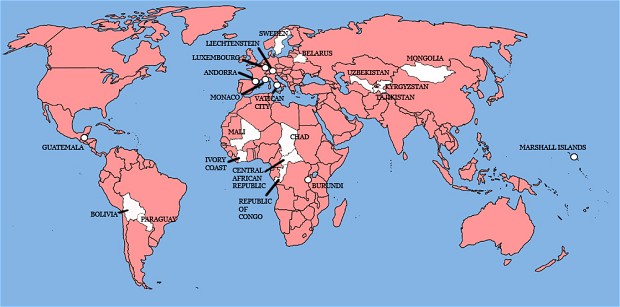
A new study has found that at various times the British have invaded almost 90 per cent of the countries around the globe.

The analysis of the histories of the almost 200 countries in the world found only 22 which have never experienced an invasion by the British.

Among this select group of nations are far-off destinations such as Guatemala, Tajikistan and the Marshall Islands, as well some slightly closer to home, such as Luxembourg.

The analysis is contained in a new book, All the Countries We’ve Ever Invaded: And the Few We Never Got Round To.

Stuart Laycock, the author, has worked his way around the globe, through each country alphabetically, researching its history to establish whether, at any point, they have experienced an incursion by Britain.

H/T to Colby Cosh for the link.

The last of the Vulcan bombers to be grounded

Filed under: Britain, History, Technology — Tags: , , — Nicholas @ 00:02

The RAF took the Vulcan bomber out of service in the 1980s, and the last flying example of the aircraft has been kept up by a trust organization since 2005. The trust has concluded that they can’t afford the necessary repairs to keep the aircraft airworthy:

They were once the UK’s most potent nuclear deterrent and were on standby for a role in the Cuban missile crisis.

But in recent years there has been just one that kept the flag flying for the Vulcan Bombers.

XH558 is the final airworthy aircraft of its type and has been admired by thousands of people each year at air shows as a result.

But soon it too could be grounded like all those before it.

The “tin triangle”, which is more than 50 years old, needs “challenging modifications” to both wings which the trust that owns it has decided cannot be funded.

The Leicestershire-based Vulcan To The Sky trust, which bought the aircraft in 2005, says escalating costs and limited engine life mean soon it will be confined to the runway for limited displays.
[. . .]

The XH558 is now used to woo the crowds at air shows but keeping the 52-year-old aircraft in working order is a constant challenge for the engineers who work on her.

Chief engineer Mr Stone said he has had to have “words” with some of the pilots over the years who have pulled manoeuvres and airborne stunts which have made him “almost fall off his chair” as he watched from the ground.

November 3, 2012

Remembering the ill-starred Darien expedition

Filed under: Americas, Britain, History — Tags: , , , — Nicholas @ 09:18

History Today notes that the Darien Colony was founded by Scottish would-be colonists in what is now Panama on November 3, 1698:

On July 12th, 1698 five ships carrying 1,200 eager colonists left the Port of Leith in Scotland to a rapturous send-off. Most of the ill-fated emigrants did not know where they were going and did not find out until the sealed orders were opened at Madeira, but they were brimming with enthusiasm anyway.

A voyage of three months took them across the Atlantic to a harbour on the mangrove-studded Caribbean coast of Panama. On November 3rd, they took formal possession of their new territory, confidently naming it Caledonia and laying the foundations of the settlement of New Edinburgh. But it all went horribly wrong. Hundreds died of fever and dysentery before the colony was abandoned.

[. . .]

Scotland blamed the whole fiasco on the English. Paterson himself was bankrupt, but still believed in his scheme and tried vainly to revive it. Meanwhile, the Darien disaster seems to have persuaded hard-headed Scotsmen that their country could not prosper by itself, but needed access to England’s empire, and it helped to pave the way for the Act of Union between the two countries in 1707. Under the Act the investors in the Darien scheme were quietly compensated for their losses at taxpayers’ expense.

November 1, 2012

Recreational trench-building

Filed under: Britain, History, Military, WW1 — Tags: , , — Nicholas @ 14:06

I’ve dug trenches, in my long-past militia days, but I’ve never really thought about doing it as a hobby:

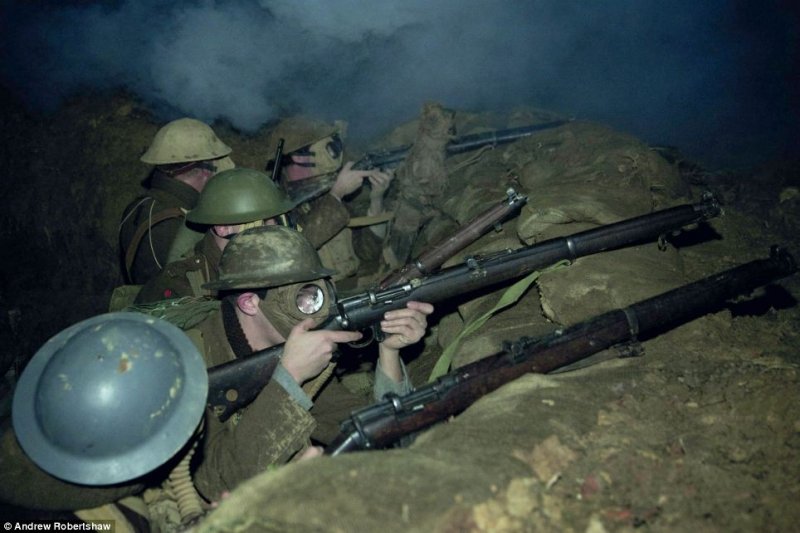
Surrounded by barbed wire, sandbags and mud, this 60ft trench is barely distinguishable from those occupied by British soldiers fighting in the First World War almost a century ago.

The enormous dugout has been painstakingly recreated by an ex-history teacher in his back garden in Surrey, and the dedicated 55-year-old even spent 24 hours living in its confines with a team of volunteers as part of his efforts to experience life as a WWI soldier.

Andrew Robertshaw and 30 helpers spent a month shifting around 200 tonnes of earth to build the enormous three-room trench, which he hopes will teach people more about the horrific living conditions endured by British troops during the Great War.

The only thing that struck me about this and other photos in the article is that the re-enactors look too clean. Digging a trench, then spending more than a short stretch of time therein leaves dirt everywhere:

October 31, 2012

The pre-history of Halloween

Filed under: Britain, History, Religion — Tags: , , — Nicholas @ 08:33

In History Today, Maggie Black looks at the origins of current Halloween traditions:

…the feast which the early Church took [over] most completely from the great pagan, Celtic feast of Samhain which celebrated the end of summer and the harvest, together with the start of winter and the New Year. The Celts believed that, on the eve of the festival (our own Hallowe’en), the dead returned to walk the earth for a night and a day and with them came the spirits of evil, at their most potent. Fires blazed on every hilltop to purify the land, defeat the evil ones and encourage the wasting sun to revive. Ceremonial dancing, noisy games and harvest-end rituals took place around these fires with drinking of the herbal ales for which the Celts were renowned. Seizing their chance to question as well as to honour and propitiate their dead, the Celts chose this time for divination rituals too.

The force and vigour of the ancient beliefs overrode all newer ones and these practices survived the advent of Christianity, in barely translated form at first, and only very gradually died out. The evil spirits became witches, and the bonfires burned them in effigy (for instance the Shandy Dann at Balmoral where, we are told, Queen Victoria much enjoyed the fun). A great number of divining rituals and games, often involving apples, nuts and fire, persisted; apples and nuts were the last-harvested fruits. Even the old herbal ale: survived as mulled ale or punch with roasted apples floating in it.

The more significant pre-Christian practice of impersonating the dead and other spirits and by so doing protecting oneself and others from their spectral power also continued. Sometimes this was acted out by processions of young adults (later children) wearing or carrying grotesque masks and often headed by a youth carrying a horse’s skull (as, for example, the Lair Bhan in co Cork, or the Hodening Horse in Cheshire). They went from door to door or visited friends and neighbours, collecting money for food. Before Christian times, such largesse had no doubt been given to feast the dead spirits in return for the promise of fertility and protection from evil provided by the visit. But in pre-Reformation Christian Europe, it provided candles and masses for the dead and snacks for the living.

October 27, 2012

An argument against further publicizing the Jimmy Savile victims

Filed under: Britain, Law, Media — Tags: , , , , , — Nicholas @ 09:59

At the Huffington Post, Brendan O’Neill points out that with Savile dead, the hue-and-cry to round up all the alleged victims and have them pour out their stories will not actually benefit anyone except the “theraputic industry”:

The victims themselves don’t get much out of it, since they are cajoled into reliving unpleasant things that happened decades ago. Worse, they’re publicly branded as damaged, as permanently scarred, despite the fact that many of them will have led full, interesting lives since that one time a dirty old man did something bad to them.

They are immortalised as one of Jimmy’s Victims, and in the process they are dehumanised, turned from rounded, complex individuals into simply sufferers.

Justice doesn’t benefit from these revelations, either, since Savile is dead and cannot be found guilty of anything. It is virtually impossible to prove beyond reasonable doubt that the allegations against him are true, because, in a civilised society at least, the dead cannot be put on trial. Which raises the question of why so many of the police’s resources are being pumped into gathering more and more Savile abuse stories.

And society as a whole doesn’t benefit from the open invitation to every person who had a bad encounter with Savile to reveal all. In fact, society, the big communal space we all inhabit, looks set to be the biggest loser in all this.

The Savile scandal will further dent social solidarity. The promotion of the idea that paedophiles lurk everywhere, that, in the words of the deputy children’s commissioner Sue Berelowitz, “There isn’t a town, village or hamlet in which children are not being sexually exploited”, will exacerbate today’s climate of suspicion and mistrust. The now widely accepted idea that there were “paedophile networks” at the Beeb, in the NHS, even around Parliament, will ratchet up already high levels of public cynicism towards institutions and the political sphere.

October 24, 2012

How to betray your country in one easy walk into a foreign embassy

Filed under: Cancon, Military, Russia — Tags: , , , , — Nicholas @ 14:58

The story of how a Canadian officer decided to turn traitor and pass secret intelligence to Russia:

When news first broke that the RCMP had arrested a low-ranked Canadian naval officer for providing intelligence to a foreign power, the press was quick to focus on the fact that the officer, Jeffrey Paul Delisle, had previously gone bankrupt. That was exactly the sort of thing a foreign country would look to exploit in a potential recruit. But we know now that Delisle didn’t need to be recruited. Heartbroken and contemplating suicide, he walked into the Russian Embassy in Ottawa and volunteered his services.

[. . .]

Over and over, the RCMP agent returns to one question: Why? He offers friendly comments, assuring Delisle that he knows how much pain, so much pain, he would have been feeling after his divorce. Delisle breaks down. He shares the story of how he found his wife, whom he’d loved since high school, cheating on him. She only married him, Delisle claims she told him, for security. She left him and hooked up with a new man, and was pregnant with the new partner’s child shortly thereafter. Delisle bitterly recalls hosting his ex-wife and her boyfriend at a Christmas Eve party, because his daughter wanted him to. And he wanted to make her happy.

Delisle’s love for his children shines though his statements. He clearly adores them. He says they were the only thing that prevented him from indulging his wish to commit suicide, to steer his car into oncoming traffic. He decided that he’d live for them. Indeed, he was caring for them, his ex-wife apparently being out of the picture — another source of bitterness. Having decided that he was dead inside, but obligated to live, Delisle says he decided to commit “professional suicide.” So he walked into the Russian Embassy and offered to become a spy.

Frank Furedi on the “culture of abuse”

Filed under: Britain, Media — Tags: , , , — Nicholas @ 08:49

In sp!ked, Frank Furedi talks about the ongoing investigation into the late British TV personality Jimmy Savile in the context of applying today’s cultural standards to the past:

Back in 1997, when I wrote my first book on the sociology of fear, I argued: ‘The theme of abuse has become one of the most distinct features of contemporary Western culture. The frequency with which the term is used and the growing number of experiences that are defined as abusive are symptomatic of the significance of this artefact of contemporary culture.’

Even in the late 1990s, it was evident that people regarded one another with a level of suspicion that was historically unprecedented. If parents are continually concerned about the motives of carers looking after their children, and if adults must be vetted by the state before they can come into contact with youngsters, than the following question will always emerge: ‘Who can you trust?’ It is precisely because this has become an unanswerable question that British society will continue to discover more and more Jimmy Saviles.

The current fascination with abuse is not confined to relationships between adults and children. Any interaction that touches on the emotions, or which involves physical or sexual experiences, can be potentially labelled as abusive. There are claims that ‘peer abuse’ is the key problem of our time; others demand action against ‘elder abuse’. And for good measure, the alarm has been raised about ‘pet abuse’ and ‘chicken abuse’. There is little resistance to the depiction of most forms of human relationships as potentially abusive.

The metaphor of abuse has a quasi-religious feel to it, signifying a morally corrupt act which brings about the moral pollution of the innocent victim. The implication is always that, through being abused, a person’s very being is invaded, to the extent that he will never be the same person again. So professionals and experts tell us that acts of abuse inflict a legacy of life-long suffering; they talk about people being ‘scarred for life’ or ‘damaged for life’.

Traditionally, the word abuse meant misuse, improper use, perversion; it also carried connotations of violation, pollution and defilement. In the eighteenth century, the term self-abuse was defined as ‘self-pollution’. In the twenty-first century, the emphasis in discussions of abuse is not on the pollution of the self but on the defilement of others. The main achievement of the abuse narrative is that it has redefined relations of conflict through the metaphor of pollution. Like the effects of toxic waste, the effects of human pollution are long-term, apparently. That is why many believe that the causes of our present-day distress can be located in the distant past. Memory is believed to have the power to discover the truth that evades us in the present, and so the official inquiry becomes the institutional setting through which the ritual of revelation is conducted.

Indonesia turns to India for help with their Russian-built aircraft

Filed under: India, Military, Russia, Technology — Tags: , , — Nicholas @ 08:02

Strategy Page on the odd post-sales attitude of Russian aviation manufacturers:

Indonesia knows that India has learned how to deal with shabby Russian support. For example, earlier this year India went public with yet another complaint about the Su-30 fighters it buys from Russia. This time it was an unspecified “design flaw” in the electronic flight control system. This bit of information was made public because India has found that more discreet communications about these matters results in little or no action from the Russians. For example, India has been pressuring Russia for several years to do something about component failures in the Russian designed AL-31 engines that power the Indian Su-30MKI jet fighters. There have been several AL-31 failures because of this in both Indian and Russian Su-30s.

[. . .]

India buys bare bones fighters from Russia and equips these Su-30MKIs with Israeli sensors and communications gear. In many respects, the Indian made Su-30s, the Su-30MKI, is the most capable version available, due to its Israeli and European electronics and the well trained Indian pilots. The 38 ton SU-30MKI is most similar to the two seat American F-15E fighter-bomber. Even though equipped with Western electronics, the aircraft cost less than $40 million each, about half what an equivalent F-15 costs. The Su-30MKI can carry more than eight tons of bombs and hit targets over 1,500 kilometers away.

Indonesia has already become disenchanted with its Su-30s and announced last August the six Su-30 jet fighters it ordered from Russia earlier this year (for $78 million each) would be the last Russian fighters purchased. Indonesia already has ten Su-27s and Su-30s, and wanted at least 16 of these modern aircraft so they will have a full squadron.

« Newer PostsOlder Posts »

Powered by WordPress