
World War Two
Published 22 Feb 2022Humanity has spent millennia developing ever more efficient ways to kill. This reaches its apogee in WWI and WWII, the most terrible conflicts in human history. Broken bodies bring with them broken minds. The trauma of war brings with it the mysteries of shell shock, war neurosis and PTSD.
(more…)
February 23, 2022
From Shell Shock to PTSD – Understanding the Trauma of War – WW2 Special
Comments Off on From Shell Shock to PTSD – Understanding the Trauma of War – WW2 Special
February 22, 2022
Triumph of the Will and the Cinematic Language of Propaganda
Folding Ideas
Published 10 Feb 2017Clickbait title: Nazis hate him! Secrets of propaganda exposed!
This took far longer to put together than I’d anticipated. It wasn’t even the work itself, it’s the emotional load. I eventually had to start chopping out huge planned segments, like looking at modern propaganda like that awful “Surfing in the DPRK” white guy rap video. I’m sorry about the downer ending, but there’s no way to spruce it up. To a certain degree we lost.
You should seriously read, and then re-read, Umberto Eco’s “Ur-Fascism”. It’s available online for free. It’s not that long. Here, I’ll even link it for you. http://www.nybooks.com/articles/1995/…
Books mentioned:
Urania’s Children
The Occult Roots of Nazism
The Origins of TotalitarianismWritten and performed by Dan Olson
Twitter: https://twitter.com/FoldableHuman
Comments Off on Triumph of the Will and the Cinematic Language of Propaganda
February 21, 2022
D-Day – The Biggest Trick in History – WW2 Special
World War Two
Published 17 Feb 2022It’s 1943, the preparations for D-Day have already begun: deceive the Wehrmacht. Here at TimeGhost, we have begun to prepare our D-Day for 2023, and we want you to join us! Find out how in the pinned comment.
(more…)
Comments Off on D-Day – The Biggest Trick in History – WW2 Special
February 20, 2022
Can the Red Army Capture Hitler? – 182 – February 19, 1943
World War Two
Published 19 Feb 2022The Red Army liberates both Rostov and Kharkov this week, but their advancing spearheads are close to an even bigger prize, Adolf Hitler himself. It is the Axis, however, who are both advancing and consolidating in Tunisia, and gearing up for new offensive actions next week.
(more…)
Comments Off on Can the Red Army Capture Hitler? – 182 – February 19, 1943
February 19, 2022
When Goebbels Signed Germany’s Suicide Pact – WW2 Special
World War Two
Published 17 Feb 2022Outnumbered, outgunned, and outproduced by the Allies, the noose seems to be tightening slowly but surely around the Third Reich. For Joseph Goebbels, salvation lies in a radical transformation of the economy and society – Total War. But first, he must sell it to the German people.
(more…)
Comments Off on When Goebbels Signed Germany’s Suicide Pact – WW2 Special
February 16, 2022
Germany’s dual economy during WW2 (and why Himmler would have succeeded Hitler if the Nazis had won WW2)
At Founding Questions, Severian looks at the way the Nazi economy was actually two entities — the “wartime” economy and the effectively separate SS economy under the control of Heinrich Himmler:
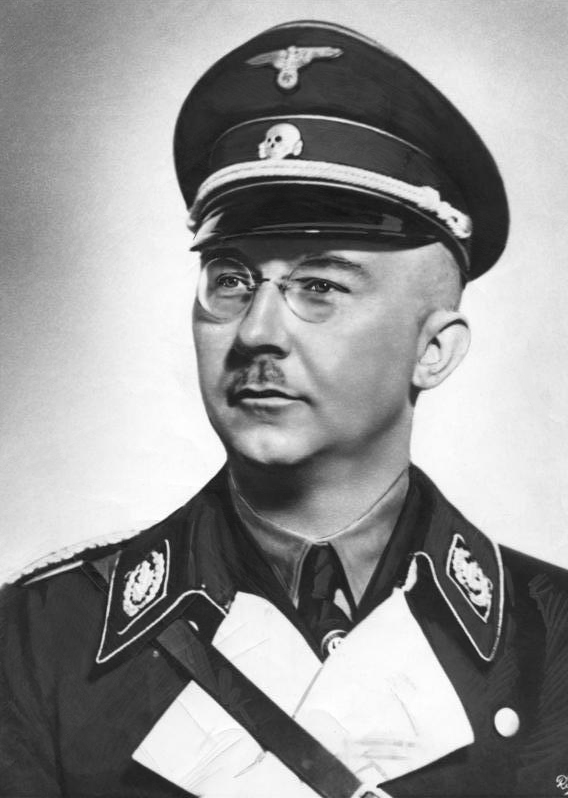
Reichsführer SS Heinrich Himmler, 1938.
German Federa Archive via Wikimedia Commons.
Here’s where the Nazis really blew it. “Nazism” should really be called “Hitlerism”, as it was a true cult of personality; there was no ideology without the specific individual man. That’s the tension at the heart of any collectivist ideology — somebody’s got to be The Boss, however temporarily — but Nazi Germany suffered it worse than most. Had the Nazis won the war, the bloodbath at the top would’ve been as spectacular per capita as the war itself. As thoroughgoing Social Darwinists, they only had one possible principle of succession …
Let’s provisionally call that the first consequence of an ideology in power: The personal is the political and vice versa. That seems trite, I realize, but I’m putting it here to emphasize its literalness – in an ideological state, building your own “affinity”, Bastard Feudalism-style, just IS politics. There’s no other possible political activity. And as much as the Nazis seemed to have screwed it up by going all in on the Fuhrerprinzip at the very top, their out-and-proud Organizational Darwinism (for lack of a better term) made them super-efficient at the lower levels.
Let’s bring Khrushchev back in. In many ways, he’s the Soviet Himmler. He was one of Stalin’s right hand men throughout the war, but somehow didn’t get tagged as a major player in the succession crisis until it was too late for all the other contenders for the purple to take effective countermeasures. In the same way, Hitler did announce a successor, sort of. In fact he did it twice: Before the war, it was Rudolf Hess; during the war, Hermann Goering. Neither of those guys had anything approaching the power Himmler had, but like Khrushchev, his personality was such that the other bigshots couldn’t help overlooking him. Just as the rest of the Politburo couldn’t wrap their heads around the idea of this uncouth quasi-Ukrainian peasant being a major threat, so the rest of the Nazi leaders couldn’t help seeing Himmler as this fussy little file clerk.
It’s a hell of a trick, and I’ll admit, I’m buffaloed. Even if Himmler (Khrushchev) was one hell of an actor, and the egos on the other top Nazis (Soviets) were gravity-defying, they still should’ve been able to see that this fussy little file clerk had some seriously hard boys working for him. Reinhard Heydrich was as ruthless a fuck as was ever born, and Himmler kept him in check. Ditto barbarians like Odilo Globocnik and Erich von dem Bach-Zelewski — they don’t come any nastier than those two, yet Himmler managed them easily. What other conclusion can you possibly draw about Himmler, other than that he was nastier than all of them put together? And yet, apparently, nobody did …
The only explanation for this that I can think of is the Nazis’ ideologization of governmental structures. As opposed to the Soviet experience, where the Party and the Bureaucracy were supposed to be, and often actually were, distinct. After some disastrous experiments with demoting technical experts to field hands, and vice versa, the Russian Communists learned that ideological correctness and “soviet power” does not, in fact, obviate the need for stuff like math. (See also: Mao’s backyard blast furnaces). So the Soviets made sure to separate what they called the “technical intelligentsia” from the Party. The head honcho at Gosplan, Gossnab, etc. would be a Party hack from way back, of course, but the actual brainworkers wouldn’t be. I don’t know just how many of them had Party membership cards, or if any of them did, but nobody I know of rose through the Party’s ranks via Gosplan.
Once a Gosplanner, always a Gosplanner. The technical intelligentsia got all kinds of perks in the Soviet system, but one thing they did not do was get perks inside the Party. You can be a technical expert, or you can be an up-and-coming Party man, but you can’t be both.
The Nazis did the exact opposite of that. The way the Third Reich actually functioned is still opaque in a lot of ways (especially to non-specialists), and of course the pressures of wartime forced a lot of ad hoc measures, but it seems like the SS was supposed to be a sort of All-Purpose Expert Corps. Not only did they have their own army and intelligence service, but they had their own economy — the brief history of the Third Reich makes a lot more sense when you realize that half or more of the official Reich economy was hamstrung by the informal but very real SS economy, operating largely (but far from exclusively) through the labor camps.
Indeed, the SS had their own administration. As incredible as it seems, the Nazis had no grand plan for what to do once they’d conquered Europe. Himmler did, at least as far as the East was concerned, and he tried his damnedest to put it into action in Poland (which is why the General Government was so legendarily brutal). Hitler apparently thought in terms of Germany’s lost late 19th century colonies, when he bothered to think about it at all … which wasn’t often. In his typical Fuhrer-riffic style, he just ignored the problem, trusting to Organizational Darwinism to sort it out …
… which is where the All-Purpose Experts of the SS stepped in. The General Government, for instance, was headed by a civilian lawyer, Hans Frank, but the day to day governance largely fell to the SS, because that’s who stepped up. Poland was an occupied zone, with vital war industries, but it was far behind the front for most of the war; the army couldn’t waste vital manpower garrisoning it. Thus the SSPF (the SS and Police Leader) stepped in, drawing manpower as needed from a wide variety of sources — the camp guards, the Wehrmacht (when garrison troops were available, and when they could wrangle them from the various army commanders), the civilian police, the “General SS”, and so on.
The details aren’t nearly as important as the big picture, which is: Unlike the technical intelligentsia in the Soviet Union, members of the SS could climb to the highest ranks of the Party. Indeed they were expected to: the SS was rapidly becoming a Party-within-the-Party at the outbreak of the war, not least because Himmler awarded a “ceremonial” SS rank to anyone who mattered politically in the various departments. The savvier guys refused the “honor,” of course, because they didn’t want to be subordinate to Himmler, even ceremonially, but many didn’t. Which meant that had the Nazis won the war, not only would Himmler have been the next Fuhrer, but the SS would’ve closed ranks, essentially taking over The Party — they’d be the Inner Party, as opposed to the “mere Nazis” of the Outer Party.
Comments Off on Germany’s dual economy during WW2 (and why Himmler would have succeeded Hitler if the Nazis had won WW2)
February 15, 2022
Total War on Valentine’s Day – WW2 – Reading Comments
World War Two
Published 14 Feb 2022Another installment of Across the Airwaves, where we highlight some of the best viewer comments under our videos. It’s Valentine’s Day and we’re feeling pretty romantic, so Indy and Spartacus will be reading comments that are all about love, humanity, and relationships.
(more…)
Comments Off on Total War on Valentine’s Day – WW2 – Reading Comments
Krieghoff: Lugers for the Luftwaffe
Forgotten Weapons
Published 20 Oct 2021http://www.patreon.com/ForgottenWeapons
https://www.floatplane.com/channel/Fo…
Cool Forgotten Weapons merch! http://shop.forgottenweapons.com
One of the scarce, small-production manufacturers of the Luger is Krieghoff — Heinrich Krieghoff to be exact. Kreighoff Waffenfabrik was a smallish arms company that wanted to get into major contracts with the rearming German military in the 1930s. They began by bidding on a contract for 10,000 Luger pistols for the Luftwaffe, and won. Krieghoff had previously worked as a subcontractor for the Simson company rebuilding Lugers under the Weimar government. Kreighoff got control of the Simson Luger tooling, and used it to manufacture a new set themselves.
Krieghoff built a total of 13,825 Luger pistols. The first 10,000 were delivered to the Luftwaffe between 1935 and 1937. A further 2,000 were delivered in small batches between 1940 and 1944, with a final 200 in 1945. In addition to these, 1,625 were sold commercially, including a few highly embellished examples. They are renowned for their excellent quality, and have always attracted particular collector interest.
Contact:
Forgotten Weapons
6281 N. Oracle 36270
Tucson, AZ 85740

Comments Off on Krieghoff: Lugers for the Luftwaffe
February 13, 2022
Victory at Guadalcanal – WW2 – 181 – February 12, 1943
World War Two
Published 12 Feb 2022Operation KE, the Japanese evacuation of Guadalcanal, concludes this week and the campaign has been a big loss for the Japanese. The Axis forces are also withdrawing — and the Red Army advancing — in the Donbas and the Caucasus, closing in on both Kharkov and Rostov. And a front that’s been quiet for a while, the Burma front, begins heating up again with an Allied advance out of India.
(more…)
Comments Off on Victory at Guadalcanal – WW2 – 181 – February 12, 1943
February 11, 2022
Eat the Nazis, There’s Nothing Else – WAH 052 – February 1943, Pt. 1
World War Two
Published 10 Feb 2022As the United Nations alliance, and the Resistance in occupied Europe increase their pressure on Nazi Germany, they continue to escalate their war on humanity. Meanwhile, in more and more parts of the world there is little to eat.
(more…)
Comments Off on Eat the Nazis, There’s Nothing Else – WAH 052 – February 1943, Pt. 1
February 10, 2022
MI6’s Secret War – WW2 – Spies & Ties 13
World War Two
Published 9 Feb 2022Britain’s MI6 is caught off guard when war breaks out. As the Germans advance across Western Europe MI6’s networks collapse, and Britain becomes almost blind. MI6 have their secret weapons at Bletchley Park but they now face a painful struggle to rebuild their eyes in Europe.
(more…)
Comments Off on MI6’s Secret War – WW2 – Spies & Ties 13
February 6, 2022
Guadalcanal, A New Offensive – WW2 – 180 – February 5, 1943
World War Two
Published 5 Feb 2022This week sees the 10th anniversary of Hitler’s ascension to power in Germany, but while there may be celebrations and speeches in Germany, the Battle of Stalingrad comes to its end with the surrender of the German 6th Army. The Soviets are on the move all over, launching yet more winter offensives. It is the Axis who are attacking in Tunisia, and in the Solomon Islands … well, the Allies aren’t sure what the Japanese are up to.
(more…)
Comments Off on Guadalcanal, A New Offensive – WW2 – 180 – February 5, 1943
Quebec Papal Zouave’s Ceremonial Gewehr 71/84
Forgotten Weapons
Published 4 Oct 2021http://www.patreon.com/ForgottenWeapons
https://www.floatplane.com/channel/Fo…
Cool Forgotten Weapons merch! http://shop.forgottenweapons.com
Here’s a rifle with an interesting twisting history …
This began life as a German military Gewehr 71/84, made in 1888. It was issued to a unit, but eventually replaced by the Gewehr 1888. It was sold to the Francis Bannerman company at some point around 1900, as part of a big batch of surplus weapons (Bannerman was a massive international dealer in arms and military equipment). Moving ahead a few years, World War One breaks out and prompts the organization of a couple Canadian “Home Guard” units. The Montreal Home Guard has some money, and buys a batch of Savage Model 99 lever action rifles (in .303 Savage, interestingly). The Quebec Home Guard isn’t quite so well-heeled, so they go to Bannerman to see what they can afford. Bannerman sells them a batch of Gewehr 71/84 tube-magazine repeating rifles, in the same configuration as when they were sold off by the German military.
Incidentally, I believe these become the only Mauser rifles formally purchased and issued by the Canadian government, when they are acquired by the Home Guard. At any rate, after the war ends, a subset of those old rifles are given to the Quebec Papal Zouaves, a ceremonial vestige of the Quebecois military volunteers who went to Italy in the 1860s to help defend the Papacy during Italian unification. By this time, the Zouaves are basically just acting as guards in parades, and they crudely cut down the 71/84s, removed their magazines, and fit them with cut-down British Snider bayonets for use as single-shot, blank-firing arms.
Quite the journey, right? And also a reminder that sometimes what looks like sporterized junk is actually something with distinct historical provenance …
Many thanks to Mike Carrick of Arms Heritage Magazine for providing me access to film this example!
Contact:
Forgotten Weapons
6281 N. Oracle 36270
Tucson, AZ 85740
Comments Off on Quebec Papal Zouave’s Ceremonial Gewehr 71/84
February 4, 2022
How the French Army Crushed the Socialist Paris Commune 1871 I GLORY & DEFEAT
Real Time History
Published 3 Feb 2022https://curiositystream.com/realtimeh… – get Nebula and CuriosityStream for less than $15 for an entire year.
The siege of Paris and the end of the Franco-Prussian War had brought social unrest in Paris (and other French cities) to a boiling point. Radical citizens take up arms and proclaim La Commune, a self-organized alternative to the French Republic. But soon the French Army is cracking down and Paris experiences a Week of Blood.
» THANK YOU TO OUR CO-PRODUCERS
John Ozment, James Darcangelo, Jacob Carter Landt, Thomas Brendan, Kurt Gillies, Scott Deederly, John Belland, Adam Smith, Taylor Allen, Rustem Sharipov, Christoph Wolf, Simen Røste, Marcus Bondura, Ramon Rijkhoek, Theodore Patrick Shannon, Philip Schoffman, Avi Woolf, Daniel L Garza, Chris Daley, Manfred Billenstein, Simdoom, Malcolm Swan» OUR PODCAST
https://realtimehistory.net/podcast – interviews with historians and background info for the show.» LITERATURE
Arand, Tobias: 1870/71. Der Deutsch-Französische Krieg erzählt in Einzelschicksalen. Hamburg 2018Bauer, Gerhard u.a. (Hrsg.): Ausst.-Kat. MHM Dresden‚ Krieg – Macht – Nation. Wie das deutsche Kaiserreich entstand. Dresden 2020
Buk-Swienty, Tom: Feuer und Blut. Hauptmann Dinesen. Hamburg 2014
Gouttman, Alain: La grande défaite. 1870-1871. Paris 2015
Horne, Alistair: Es zogen die Preußen wohl über den Rhein. Bern, München, Wien 1967
» SOURCES
Bernhardt, Sarah: Ma double vie. Memoires. Paris 1907
Déclaration de la Commune de Paris. (19 avril 1871) https://gallica.bnf.fr/ark:/12148/bpt…
Goncourt, Edmond de: Journal des Goncourts. II.1. 1870-1871. Paris 1890
Hérisson, Maurice d’: Nouveau Journal d’un officier d’ordonannce. Paris 1889
Hoppenstedt, Julius von: Ein neues Wörth. Ein Schlachtenbild der Zukunft. Berlin 1909
Hugo, Victor: Choses vues, 2e série. Ollendorf 1913.
Kühnhauser, Florian: Kriegs-Erinnerungen eines Soldaten des königlich-bayerischen Infanterie-Leib-Regiments. Partenkirchen 1898
Meisner, Heinrich Otto (Hrsg.). Kaiser Friedrich III. Kriegstagebuch 1870/71. Berlin, Leipzig 1926
Plitt, Franz: Rückerinnerungen eines Dreiundachtzigers. Kassel 1903
Zola, Émile: La Débâcle. Paris 1892
» OUR STORE
Website: https://realtimehistory.net»CREDITS
Presented by: Jesse Alexander
Written by: Cathérine Pfauth, Prof. Dr. Tobias Arand, Jesse Alexander
Director: Toni Steller & Florian Wittig
Director of Photography: Toni Steller
Sound: Above Zero
Editing: Toni Steller
Motion Design: Philipp Appelt
Mixing, Mastering & Sound Design: http://above-zero.com
Maps: Battlefield Design
Research by: Cathérine Pfauth, Prof. Dr. Tobias Arand
Fact checking: Cathérine Pfauth, Prof. Dr. Tobias ArandChannel Design: Battlefield Design
Contains licensed material by getty images
All rights reserved – Real Time History GmbH 2022
Comments Off on How the French Army Crushed the Socialist Paris Commune 1871 I GLORY & DEFEAT
February 2, 2022
QotD: Breaking the trench stalemate with Stormtroopers (Stoßtruppen)
One way to respond to a novel tactical problem is with novel tactics. And the impetus for this kind of thinking is fairly clear: if your own artillery is the problem digging you into a hole, then find a way to use less of it.
The mature form of this tactical framework is often called “Hutier” tactics, after German general Oskar Emil von Hitier, though he was hardly the sole or even chief inventor of the method. In its mature form, the technique went thusly: instead of attacking with large waves of infantry which cleared each objective in sequential order, attacks ought to be proceeded by smaller units, carefully trained with the layout of the enemy positions. Those units, rather than having a very rigid plan of attack, would be given those general objectives and left to figure for themselves how to accomplish them (“mission tactics” or Auftragstaktik), giving them more freedom to make decisions based on local conditions and the ground.
These elite spearhead units, called Stoßtruppen or “Stormtroopers” were well equipped (in particular with a higher amount of automatic firearms and hand grenades, along with flamethrowers). Importantly, they were directed to bypass enemy strong-points and keep moving forward to meet their objectives. The idea here was that the follow-up waves of normal infantry could do the slow work of clearing out points where enemy resistance was strong, but the stormtroopers should aim to push as deeply as possible as rapidly as possible to disorient the defenders and rapidly envelop what defenses remained.
These sets of infantry tactics were in turn combined with the hurricane barrage, a style of artillery use which focused on much shorter but more intense artillery barrages, particularly associated with Colonel Georg “Breakthrough” Bruchmüller. Rather than attempting to pulverize defenses out of existence, the hurricane barrage was designed merely to force enemies into their dugouts and disorient the defenders; much of the fire was directed at longer ranges to disrupt roads and artillery in the enemy rear. The short barrage left the ground relatively more intact. Meanwhile, those elite infiltration units could be trained to follow the creeping barrage very closely (being instructed, for instance, to run into the shell explosions, since as the barrage advantages, no gun should ever strike the same spot twice; a fresh shell-hole was, in theory, safe). Attentive readers will recognize the basic foundations of the “move fast, disorient the enemy” methods of the “modern system” here.
So did infiltration tactics break the trench stalemate? No.
First, it is necessary to note that while infiltration tactics were perhaps most fully developed by the Germans, they were not unique to them. The French were experimenting with many of the same ideas at the same time. For instance, basic principles of infiltration were being published by the French General Headquarters as early as April, 1915. André Laffargue, a French infantry captain, actually published a pamphlet, which was fairly widely distributed in both the French and British armies by the end of 1915 and in the American army in 1916, on exactly this sort of method. In many cases, like at the Second Battle of Artois, these French tactics bore significant fruit with big advances, but ran into the problem that the gains were almost invariably lost in the face of German counter-attacks. The Russians, particularly under Aleksei Brusilov, also started using some of these techniques, although Brusilov was as much making a virtue of necessity as the Russians just didn’t have that much artillery or shells and had to make due with less and Russian commanders (including Brusilov!) seem to have only unevenly taken the lessons of his successes.
The problem here is speed: infiltration tactics could absolutely more efficiently overrun the front enemy lines and even potentially defeat multiple layers of a defense-in-depth. But after that was done and the shock of the initial push wore off, you were still facing the same calculus: the attacker’s reinforcements, shells, artillery and supplies had to cross broken ground to reach the new front lines, while the defender’s counter-attack could ride railways, move over undamaged roads and then through prepared communications trenches. In the race between leg infantry and trains, the trains always won. On the Eastern Front or against the Italians fighting under the Worst General In History at Caporetto (1917), the already badly weakened enemy might simply collapse, producing massive gains (but even at Caporetto, no breakthrough – shoving the enemy is not a breakthrough, to qualify as a breakthrough, you need to get to the “green fields beyond” that is open ground undefended by the enemy), but against a determined foe, as with the 1918 Spring Offensives, these tactics, absent any other factor, simply knocked big salients in the line. Salients which were, in the event, harder to defend and brought the Germans no closer to victory. Eventually – often quite rapidly – the front stabilized again and the deadlock reasserted itself. Restoring maneuver, the actual end-goal of these tactics, remained out of reach.
Bret Devereaux, “Collections: No Man’s Land, Part II: Breaking the Stalemate”, A Collection of Unmitigated Pedantry, 2021-09-24.
Comments Off on QotD: Breaking the trench stalemate with Stormtroopers (Stoßtruppen)


