If you haven’t been on campus lately, visit your local citadel of learning. Don’t just drive through; spend some time there. On the surface, things look lovely — ivy covered walls, dorms like 5 star hotels, trendy boutiques selling stuff you can’t afford to buy, undergraduates wearing more than your week’s take-home pay. Light poles and store walls are covered with flyers for causes only the very wealthy and very idle could possibly care about. In short, it’s heaven …
… but pretty soon you’ll notice that it’s a very battered, grimy sort of heaven. Nobody’s from there, nobody stays there, everyone’s just passing through on the way to something better. Certainly including the faculty: Every single professor not currently at Harvard
thinksknows xzhe deserves to be at Harvard, and will get there someday. Everything’s on-demand in a college town, because everything’s rented. That “distressed” look hipsters love so much isn’t an affectation on campus; it’s a logical outcome of the transient lifestyle. Why fix a pothole, paint a building, trim a tree, teach a class anyone could ever actually use? Anyone who complains will be gone next semester anyway.Get yours before it’s gone, and if that means skipping town one day ahead of the bill collectors, remember: Capitalism is evil.
It’s not just campus, either. The rest of the lifestyle is just as evanescent, just as ugly. Think of the food. Whatever you do, you can’t eat what the Normals eat, drink what the Normals drink. Here again, foodie culture isn’t a hipster affectation on campus. It’s deadly serious status-jockeying with your temporary — always temporary — peers. You’ve got to win now, because next semester they’ll be gone, probably to Harvard, those cheating, ass-kissing bastards. Sure, it looks, smells, and tastes like cold dog puke, but at least you’re the first to eat it!
Severian, “Politics for Fugly People”, Rotten Chestnuts, 2018-08-24.
March 12, 2021
QotD: The modern university campus
March 10, 2021
Where Great Men Were Made: American Officer Training – WW2 Special
World War Two
Published 9 Mar 2021West Point and Annapolis are two of the most iconic military academies in America — maybe even the world. The two institutions have produced the men who are leading America’s fight against the Axis powers.
Join us on Patreon: https://www.patreon.com/TimeGhostHistory
Or join The TimeGhost Army directly at: https://timeghost.tvFollow WW2 day by day on Instagram @ww2_day_by_day – https://www.instagram.com/ww2_day_by_day
Between 2 Wars: https://www.youtube.com/playlist?list…
Source list: http://bit.ly/WW2sourcesHosted by: Indy Neidell
Written by: Markus Linke & Indy Neidell
Director: Astrid Deinhard
Producers: Astrid Deinhard and Spartacus Olsson
Executive Producers: Astrid Deinhard, Indy Neidell, Spartacus Olsson, Bodo Rittenauer
Creative Producer: Maria Kyhle
Post-Production Director: Wieke Kapteijns
Research by: Markus Linke
Edited by: Karolina Dołęga
Sound design: Marek KamińskiColorizations by:
– Daniel Weiss
– Mikołaj Uchman
– Norman Stewart – https://oldtimesincolor.blogspot.com/Sources:
United States Military Academy Library Digital Collection
United States Naval Academy Digital Collections
Library of Congress
New York Public Library
West Point Museum Art Collection
Imperial War Museums: IWM NYF 19427Soundtracks from Epidemic Sound:
– “Ominous” – Philip Ayers
– “The Inspector 4” – Johannes Bornlöf
– “London” – Howard Harper-Barnes
– “Please Hear Me Out STEMS INSTRUMENTS” – Philip Ayers
– “First Responders” – SkryaArchive by Screenocean/Reuters https://www.screenocean.com.
A TimeGhost chronological documentary produced by OnLion Entertainment GmbH.
From the comments:
World War Two
20 hours ago
This episode goes back to our roots of good old-fashioned military history. It’s something we’d like to start doing more of. Of course, West Point and Annapolis are the most famous, but we think that diving into the officer training of forces like the Wehrmacht or Red Army could tell us a lot about their histories. There is also a whole bunch of options for military history topics that we’d like to get into. Let us know in the comments if you have any suggestions.

QotD: Honest mottoes for university majors
Art History: Spending 4 years of your life getting wasted and bullshitting about the art of dead white men is less fun than it sounds. Less employable than philosophy.
Biology: All the stresses and high workloads of a STEM major, none of the employability of a STEM major. On the plus side, very little math.
Biomedical Engineering: 90% of your peers are here because they want to become doctors. Statistically, most of them will flunk out by sophomore year or change to easier majors. But you’re different, right? Right?
Business: Easy major that sounds practically relevant (Hint: it isn’t).
Chemistry: I hope you like graduate school.
Communications: The second best major for joining a dying field.
Computer Science: Is programming your passion? Want to learn how to write good, maintainable, bug-free programs? Want to be up to date on the latest frameworks and debugging tools? LOL. What is this, a trade school? Nah, you’ll spend 4 years of your life doing actually important stuff, like proving the Turing Completeness of your toaster. Still employable, for some reason.
Creative Writing: You can communicate your angst in a lot of creative and interesting ways! Don’t worry, you won’t run out of angst anytime soon.
Economics: The least Marxist of the social sciences. Come because you want to learn how the world actually works. We don’t teach undergrads that, but we do teach you to solve fun puzzles with hard math! If by “fun puzzles” you mean “IS-LM models” and by “hard math” you mean “basic calculus.”
Education: The less said, the better.
English: Please tell me you double-majored in Education.
Geology: Come because you like rocks and “saving the planet,” leave to join a petroleum company.
History: Those who don’t know history are doomed to repeat it. Those who do know history are unlikely to do much better, since they have the decision-making prowess of the type of person who majored in history.
Kinesiology: Enter, ye of absolutely non-existent academic ambition.
Mathematics: I hope you didn’t take this major because you liked numbers. Most of your professors can’t count past 10.
Nursing: All the stresses of med school, minus all the prestige. But hey, you can actually get a job!
Philosophy: Come in as a freshman asking dumb, ill-formed questions like “What is the meaning of life?” Come out 4–6 years later asking deep, sophisticated questions like: “What is ‘is’ in the Hegelian dialectic of the Kantian framework in a postmodern age?”
Physics: You get to do a lot of math.
Pre-Law: Statistically, the major that leads to having one of the lowest possible LSAT scores.
Psychology: A recent study (n = 13, p = .04999) says that psychology majors are smarter, hotter, richer and more statistically savvy than every other major. That study will probably fail to replicate, but hey. So will just about everything else you remember from class.
Sociology: Learn about how society is fucked. Also, Marx is great.
Linchuan Zhang, “If college majors had honest mottos, what would they be?”, Quora, 2018-01-08.
March 9, 2021
QotD: Canadian culture
One thinks of novelist Mordecai Richler, poet Irving Layton, critical minds Harold Innis, Marshall McLuhan and Northrop Frye, musicians Leonard Cohen and Gordon Lightfoot. Our founding father, Sir John A. Macdonald, was the ne plus ultra of our political class; there has been none like him since, which may explain why he is now on posthumous trial for war crimes and a hue and cry has gone up to remove his statues and rename eponymous schools.
The constitutive factor, however, exceptions aside, is the “howling emptiness” of a vast landmass that may partially account for the emptiness of our intellectual topography — if, as Jared Diamond had argued in Guns, Germs and Steel, geography governs the development of culture and spirit.
Any nation the preponderance of whose citizens regularly elects left-wing political parties; accepts single-payer healthcare; believes in the efficacy of the welfare state; endorses the hoax of global warming; accommodates swarms of third-world immigrants and refugees who have no love for or understanding of a country becoming an open-to-all multicultural tombola with the highest proportionate rate of immigrants in the Western world; has allowed its educational industry, from pre-school to graduate school, to be corrupted possibly beyond retrieval by lockstep Leftism, “diversity and inclusion,” and “social justice” claptrap; has caved to the feminist and campus-rape fable; dutifully takes CBC Leftist propaganda as gospel; has fallen for the 16th Century meme of the “Noble Savage” in its dealings with the aboriginal peoples; extravagantly celebrates a second-rate rock band like The Tragically Hip and names a street after it; reads (when it does read) tedious scribblers like the acclaimed Joseph Boyden and Ann-Marie MacDonald; and gives a complete ignoramus like Justin Trudeau a majority government on the strength of name and coiffure, cannot be regarded as informed, well-educated or in any way distinguished. Unlike the U.S., there are no cracks, to quote Leonard Cohen, where the light gets in. The Canadian political, cultural and academic spectrum has gone dark from end to end.
David Solway, “The Canadian Mind: A Culture So Open, Its ‘Brains Fall Out'”, PJ Media, 2018-10-10.
March 5, 2021
Schools told they need to “identify and challenge the ways that math is used to uphold capitalist, imperialist, and racist views”
No wonder I had trouble with math back in grade school: Math is a racist tool of White Supremacists!
“Math Class” by attercop311 is licensed under CC BY 2.0

Mandatory teaching standards that focus on critical theory and identity politics to the detriment of liberalism and individualism are already working their way through state legislatures.
Now, math education itself has been deemed “racist.” A group of educators just released a document calling for a transformation of math education that focuses on “dismantling white supremacy in math classrooms by visibilizing the toxic characteristics of white supremacy culture with respect to math.”
Among the educators’ recommendations, which officials in some states are promoting, are calls to “identify and challenge the ways that math is used to uphold capitalist, imperialist, and racist views,” “provide learning opportunities that use math as resistance,” and “encourage them to disrupt the disproportionate push-out of people of color in [STEM] fields.”
Beyond activism, these recommendations also argue that traditional approaches to math education promote racism and white supremacy, such as requiring students to show their work or prioritizing correct answers to math problems. The document claims that current math teaching is problematic because it focuses on “reinforcing objectivity and the idea that there is only one right way” while it “also reinforces paternalism.”
February 26, 2021
Waymarkers of the American caste system
Scott Alexander reviews Paul Fussell’s Class: A Guide Through The American Status System, and finds Fussell has helpfully delineated how an outsider can guess someone’s class (or caste, as Fussell would prefer) … at least how that outsider could do so in 1983:
The upper class is old money. The people you think of as rich and famous — tech billionaires, celebrities, whatever — aren’t upper class. However privileged they started off, they still had to put in at least a smidgeon of work to get their money, which disqualifies them. Real uppers inherit. Even famous people who come from old money usually aren’t central examples of upper class; the real upper class has no need to seek fame. They mostly just throw parties — but not interesting parties, because that would imply they have something to prove, which they don’t. They live in mansions — but not awesome mansions they designed themselves with some kind of amazing gaming room or something, because that would imply they have something to prove, which they don’t. They live in meticulously boring mansions and throw meticulously boring parties. They have the best and classiest versions of everything, but it’s a faux pas to compliment any of it, because that would imply that they were the sort of people who might potentially not have had the best and classiest version of that thing. They fill their houses with Picassos and exquisite antique furniture, and none of them ever express the slightest bit of satisfaction or praise about any of it. You have never heard of any of these people, although you might recognize the last name they share with a famous ancestor (Rockefeller, Ford, etc).
The middle classes are salaried professionals, starting with the upper-middle class. Jeff Bezos, for all his billions, is only upper-middle-class at best. So are many of the other people you think of as rich and famous and successful. The upper-middle-class likes New England, Old England, yachts, education, good grammar, yachts, chastity, androgyny, the classics, the humanities, and did I mention yachts?
The middle class is marked by status anxiety. The working class knows where they stand and are content. The upper-middle class has made it; they’re fine. And the upper class doesn’t worry about status because that would imply they have something to prove, which they don’t. But the middle class is terrified. These are the people with corporate jobs who say things like “I’ve got to make a good impression at the meeting Tuesday because my boss’ boss will be there and that might determine whether I get the promotion I’m going for”. The same attitude carries into the rest of their lives; their yards and houses are maintained with a sort of “someone who could change my status might be watching, better make a good impression”. They desperately avoid all potentially controversial opinions — what if the boss disagrees and doesn’t promote them? What if the neighbors disagree and they don’t get invited to parties? They are the most likely to be snobbish and overuse big words, the most obsessed with enforcing norms of virtuous behavior, and the least interested in privacy — asserting any claim to privacy would imply they have something to hide. Their Official Class Emotions are earnestness and optimism; they are the people who patronize musicals like Annie and Man of La Mancha where people sing saccharine songs about hopes and dreams and striving, and the people who buy inspirational posters featuring quotes about perseverance underneath pictures of clouds or something.
Proles do wage labor. High proles are skilled craftspeople like plumbers. Medium and low proles are more typical factory workers. They have a certain kind of freedom, in that they don’t have status anxiety and do what they want. But they’re also kind of sheep. They really like mass culture — the more branded, the better. These are people who drink Coca-Cola (and feel good about themselves for doing so), visit Disneyland (and accept its mystique at face value), and go on Royal Caribbean cruises. When they hear an ad say a product is good, they think of it as a strong point in favor of buying the product. They feel completely comfortable expressing their opinions, but their opinions tend to be things like “Jesus is Lord!”, “USA is number one!”, “McDonalds is so great!”, and “Go $LOCAL_SPORTS_TEAM!”. They are weirdly obsessed with cowboys (Fussell says cowboys represent the idea that poorer people are freer and more authentic than rich office-worker types, plus the West is the prole capital of the USA) and with unicorns (Fussell: “I’ve spent six months trying to find out exactly why, and I’m finally stumped”). When they have unique quirks, they tend to be things like “collecting lots of Disney memorabilia” or “going powerboating slightly more often than the other proles do”. There’s also a sort of desperate prole desire to be noticed and individuated, which takes the form of lots of “Personalized X” or “Y with your name on it”, and also with making a lot of noise (see: powerboating). Fussell describes the most perfectly prole piece of decor as “a blue flameproof hearthrug with your family name in Gothic letters beneath seven spaced gold stars and above a golden eagle in Federal style”.
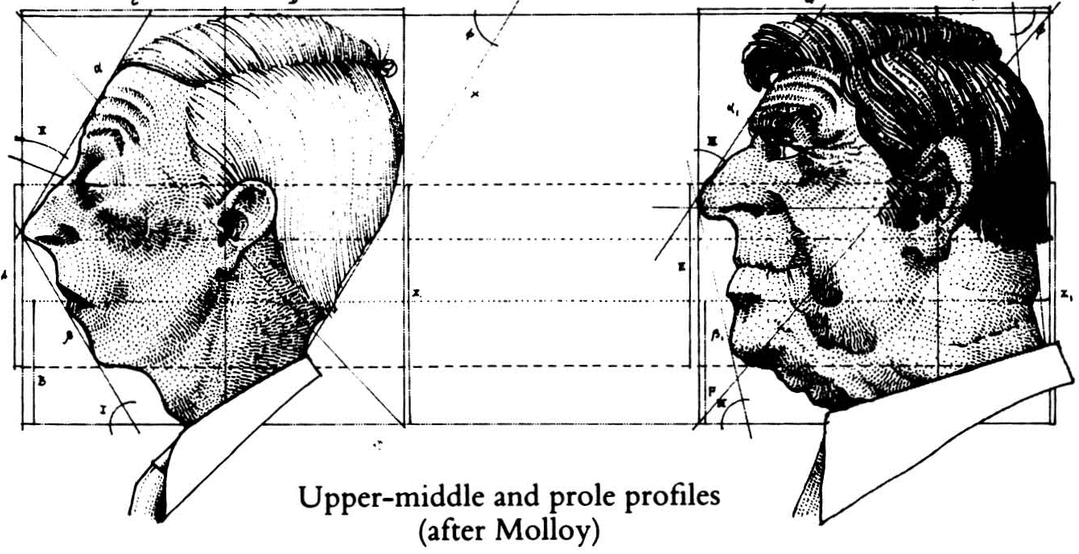
It’s impossible to tell when Fussell is serious vs. joking. The section on the physiognomy of different classes has to be a joke, right? But then how did he come up with the Virgin vs. Chad meme in 1983? Also, why does my brain keep telling me these are John McCain and Donald Trump?
A friend urges me to think of these not as “rich/successful people” vs. “poor/unsuccessful people”, but as three different ladders on which one can rise or fall. The most successful proles are lumber barons or pro athletes or reality TV stars. These people are much richer and more powerful than, say, a schoolteacher, but they’re still proles, and the schoolteacher is still middle class. Likewise, a very successful middle class person might become a professor or a Senator or Jeff Bezos, but this doesn’t make them even a bit upper class.
(I’m not sure it’s possible to be a more or less successful upper class person; being successful would imply having something to prove, which they don’t).
February 24, 2021
Solzhenitsyn was far from the first to warn about the evils of Soviet rule
Theodore Dalrymple had a discussion recently with a Marxist professor:
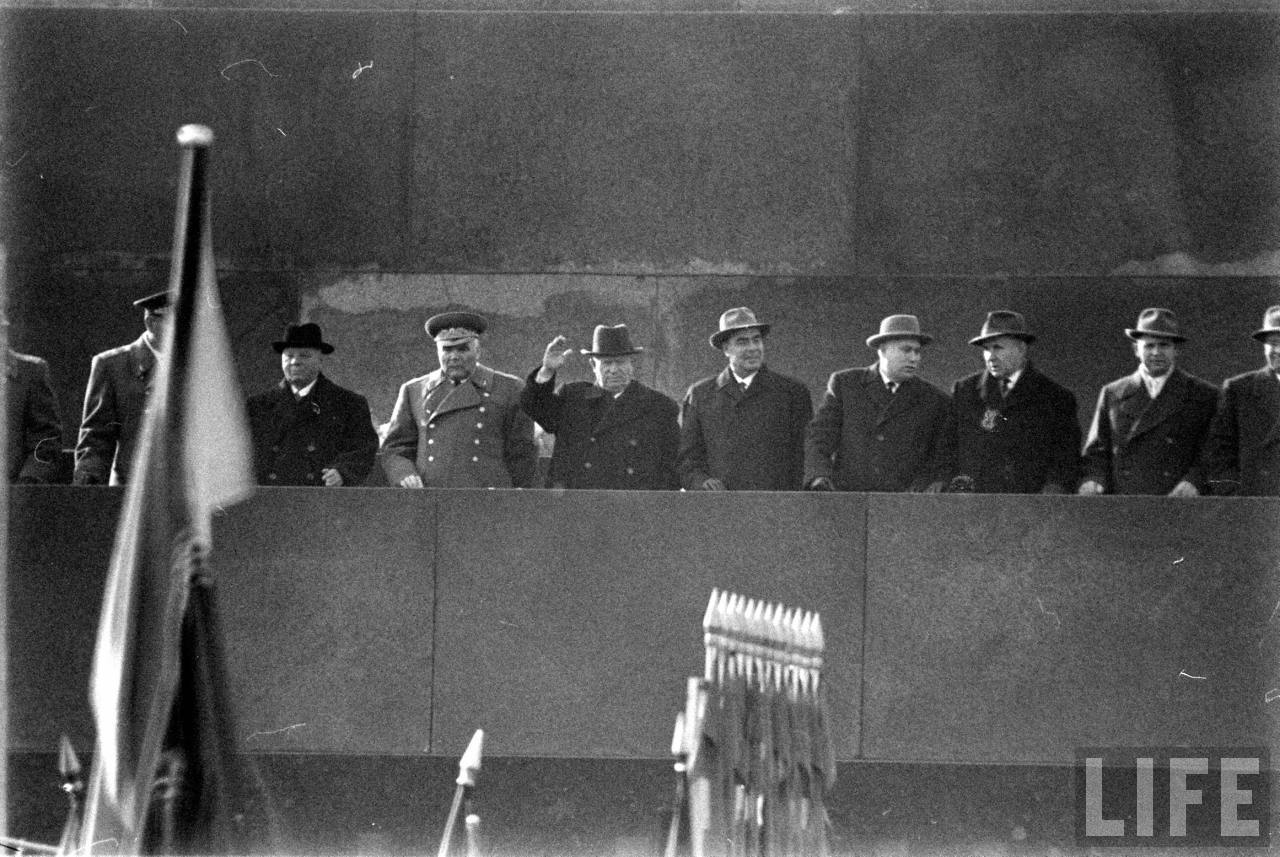
Krushchev, Brezhnev and other Soviet leaders review the Revolution parade in Red Square, 1962.
LIFE magazine photo by Stan Wayman.
The professor was an intelligent man, and probably cultivated too. How was it possible, in the Year of Our Lord 2021, for such a person still to believe that, until the advent of Stalin, the Russian revolution was a good thing, to be emulated or repeated elsewhere?
How could anyone of his intelligence fail to realise that, though as ever there was much wrong with the world, attempts to put everything right at once by the implementation of petty intellectual schemes are fraught with danger, and have a history of mass slaughter behind them?
I think the answer must lie in the psychology of religion: when religious faith is replaced by a philosophy that prides itself on its rationality, it soon turns religious in the worst possible sense. it becomes an atheist theocracy.
Everything was known about the Soviet Union from the first. It is simply not true that Solzhenitsyn revealed anything to the West that, in essence, was not, or could not have been, known before.
I have, in desultory fashion for a number of decades, been collecting books about Russia and the Soviet Union from just before the Revolution until the Second World War, and while it is true that many of them are laudatory, with titles that now seem hilarious to us such as The Soviet Union Fights Neurosis, a very large number books of various genres, from essays to histories to memoirs to novels and short stories, were published that exposed the viciousness of Bolshevism from the very first — a viciousness that anyone with any imagination could have anticipated from Lenin’s literary style alone.
Leninist viciousness was viciousness of a new and more thoroughgoing type that acted on the mind as a virus acts on a computer (viciousness, both actual and potential, is, alas, a constant of human history because of our flawed nature).
Solzhenitsyn was right about the difference between Macbeth, who from personal ambition killed people, but only a few, and the ideologically-motivated mass-killings of the Soviet Union and elsewhere — the difference being precisely in the effect of ideology.
But what was really different about Solzhenitsyn, apart from his literary talent, was that Western intellectuals were now prepared to believe what he said, whereas shortly before they had rejected as mere propaganda evidence of a very similar nature produced by others.It was so startling to meet someone who still believed that a “pure” revolution could take place, and that such a person was teaching history of all things, in a reputable, or at any rate reputed, university, that, like Karl Kraus confronted by Hitler, I could think of nothing to say.
I had no idea whether he still taught undergraduates, or whether in doing so he suppressed at least some of his views (as a judge is supposed to suppress his own private opinions): but I confess that the charge against Socrates, that of corrupting youth, came into my mind.
Disney’s Best Propaganda Cartoon
J.J. McCullough
Published 21 Nov 2020A review of Education for Death, a WW2 propaganda film. This video was sponsored by the Great Courses Plus! Start your free trial today by clicking here: http://ow.ly/az9m30rkCKF
Check out Three Arrows here: https://www.youtube.com/channel/UCCT8…
During the World War II, Disney made a number of cartoons to boost public support for the Allies and denounce Germany. This one, about Little Hans, has always been my favorite.
FOLLOW ME:
🇨🇦Support me on Patreon! https://www.patreon.com/jjmccullough
🤖Join my Discord! https://discord.gg/3X64ww7
🇺🇸Follow me on Instagram! https://www.instagram.com/jjmccullough/
🇨🇦Read my latest Washington Post columns: https://www.washingtonpost.com/people…
🇨🇦Visit my Canada Website http://thecanadaguide.comHASHTAGS: #propaganda #history #germany
February 22, 2021
QotD: Modern academic “life”
… and never more than to people who know themselves un-beautiful, therefore not good, therefore false, and locked in it. Forever.
These people hate us, not because we’re better looking, more socially skilled, or whatever — this is, after all, the Internet — but because we’ve got options. We’re not all fighting over who gets to be Big Fish in an ever-shrinking pond. We’re different things to different people; we haven’t collapsed our social context down to faculty mixers and the one or two non-hamplanet grad students who are silly enough to apply each semester. We can go days, maybe even weeks, without obsessively comparing ourselves to our peers. We don’t care that we’re not “Chad” or “Stacy,” because we’ve got other settings on the emotional dial than “smugness” and “jealousy.”
But we need to start caring. I don’t mean getting obsessive over our appearance. I mean that, since this is in many ways an aesthetic battle, aesthetics will help us win. I half-jokingly suggested a “Normal Guy Uniform” a while back – an all-white ball cap with the New England Patriots’ logo on it. I’m not really kidding now. The Left wins, in large part, because they’re fugly losers that no normal person could possibly consider a threat … until they bash your skull in, or get you fired, or send a SWAT team to your house.
Severian, “Politics for Fugly People”, Rotten Chestnuts, 2018-08-24.
February 19, 2021
Freddie DeBoer’s arguments against successful charter schools
Scott Alexander’s extensive review of Freddie DeBoer’s book The Cult of Smart includes this discussion of DeBoer’s belief that American charter schools are fraudulent and only manage their headline-worthy educational outcomes by “cooking the books”:
I think DeBoer would argue he’s not against improving schools. He just thinks all attempts to do it so far have been crooks and liars pillaging the commons, so much so that we need a moratorium on this kind of thing until we can figure out what’s going on. But I’m worried that his arguments against existing school reform are in some cases kind of weak.
DeBoer does make things hard for himself by focusing on two of the most successful charter school experiments. If he’d been a little less honest, he could have passed over these and instead mentioned the many charter schools that fail, or just sort of plod onward doing about as well as public schools do. I think the closest thing to a consensus right now is that most charter schools do about the same as public schools for white/advantaged students, and slightly better than public schools for minority/disadvantaged students. But DeBoer very virtuously thinks it’s important to confront his opponents’ strongest cases, so these are the ones I’ll focus on here.
Success Academy is a chain of New York charter schools with superficially amazing results. They take the worst-off students — “76% of students are less advantaged and 94% are minorities” — and achieve results better than the ritziest schools in the best neighborhoods — it ranked “in the top 1% of New York state schools in math, and in the top 3% for reading” — while spending “as much as $3000 to $4000 less per child per year than their public school counterparts.” Its supporters credit it with showing “what you can accomplish when you are free from the regulations and mindsets that have taken over education, and do things in a different way.”
DeBoer will have none of it. He thinks they’re cooking the books by kicking out lower-performing students in a way public schools can’t do, leaving them with a student body heavily-selected for intelligence. Any remaining advantage is due to “teacher tourism”, where ultra-bright Ivy League grads who want a “taste of the real world” go to teach at private schools for a year or two before going into their permanent career as consultants or something. This would work — many studies show that smarter teachers make students learn more (though this specifically means high-IQ teachers; making teachers get more credentials has no effect). But it doesn’t scale (there are only so many Ivy League grads willing to accept low salaries for a year or two in order to have a fun time teaching children), and it only works in places like New York (Ivy League grads would not go to North Dakota no matter how fun a time they were promised).
I’m not sure I share this perspective. Success Academy isn’t just cooking the books — you would test for that using a randomized trial with intention-to-treat analysis. The one that I found is small-n, short timescale, and a little ambiguous, but I think basically supports the contention that there’s something there beyond selection bias. Teacher tourism might be a factor, but hardly justifies DeBoer’s “charter schools are frauds, shut them down” perspective. Even if Success Academy’s results are 100% because of teacher tourism, they found a way to educate thousands of extremely disadvantaged minority kids to a very high standard at low cost, a way public schools had previously failed to exploit. That’s not “cheating”, it’s something exciting that we should celebrate. If it doesn’t scale, it doesn’t scale, but maybe the same search process that found this particular way can also find other ways? Surely it doesn’t seem like the obvious next step is to ban anyone else from even trying?
And we only have DeBoer’s assumption that all of this is teacher tourism. Success Academy itself claims that they have lots of innovative teaching methods and a different administrative culture. If this explains even 10% of their results, spreading it to other schools would be enough to make the US rocket up the PISA rankings and become an unparalleled educational powerhouse. I’m not claiming to know for sure that this is true, but not even being curious about this seems sort of weird; wanting to ban stuff like Success Academy so nobody can ever study it again doubly so.
DeBoer’s second tough example is New Orleans. Hurricane Katrina destroyed most of their schools, forcing the city to redesign their education system from the ground up. They decided to go a 100% charter school route, and it seemed to be very successful. Unlike Success Academy, this can’t be selection bias (it was every student in the city), and you can’t argue it doesn’t scale (it scaled to an entire city!). But DeBoer writes:
After Hurricane Katrina, the neoliberal powers that be took advantage of a crisis (as they always do) to enforce their agenda. The schools in New Orleans were transformed into a 100% charter system, and reformers were quick to crow about improved test scores, the only metric for success they recognize. Whether these gains stand up to scrutiny is debatable. But even if these results hold, the notion of using New Orleans as a model for other school districts is absurd on its face. When we make policy decisions, we want to isolate variables and compare like with like, to whatever degree possible. The story of New Orleans makes this impossible. Katrina changed everything in the city, where 100,000 of the city’s poorest residents were permanently displaced. The civic architecture of the city was entirely rebuilt. Billions of dollars of public and private money poured in. An army of do-gooders arrived to try to save the city, willing to work for lower wages than they would ordinarily accept. How could these massive overall social changes possibly be replicated elsewhere? And how could we have any faith that adopting the New Orleans schooling system — without the massive civic overhaul — would replicate the supposed advantages?
These are good points, and I would accept them from anyone other than DeBoer, who will go on to say in a few chapters that the solution to our education issues is a Marxist revolution that overthrows capitalism and dispenses with the very concept of economic value. If he’s willing to accept a massive overhaul of everything, that’s failed every time it’s tried, why not accept a much smaller overhaul-of-everything, that’s succeeded at least once? There are plenty of billionaires willing to pour fortunes into reforming various cities — DeBoer will go on to criticize them as deluded do-gooders a few chapters later. If billions of dollars plus a serious commitment to ground-up reform are what we need, let’s just spend billions of dollars and have a serious commitment to ground-up reform! If more hurricanes is what it takes to fix education, I’m willing to do my part by leaving my air conditioner on “high” all the time.

February 11, 2021
QotD: Progressive credentials as positional goods
But if PC was not really about protecting anyone, and really all about expressing one’s own moral superiority, PC credentials would be akin to what economists call a “positional good”.
A positional good is a good that people acquire to signalise where they stand in a social hierarchy; it is acquired in order to set oneself apart from others. Positional goods therefore have a peculiar property: the utility their consumers derive from them is inversely related to the number of people who can access them.
Positionality is not a property of the good itself, it is a matter of the consumer’s motivations. I may buy an exquisite variety of wine because I genuinely enjoy the taste, or acquire a degree from a reputable university because I genuinely appreciate what that university has to offer. But my motivation could also be to set myself apart from others, to present myself as more sophisticated or smarter. From merely observing that I consume the product, you could not tell my motivation. But you could tell it by observing how I respond once other people start drinking the same wine, or attending the same university.
If I value those goods for their intrinsic qualities, their increasing popularity will not trouble me at all. After all, the enjoyment derived from wine or learning is not fixed, so your enjoyment does not subtract from my enjoyment. I may even invite others to join me – we can all have more of it.
But if you see me moaning that the winemakers/the university have “sold out”, if you see me whinging about those ignoramuses who do not deserve the product because they (unlike me, of course) do not really appreciate it, you can safely conclude that for me, this good is a positional good. (Or was, before everybody else discovered it.) We can all become more sophisticated wine consumers, and we can all become better educated. But we can never all be above the national average, or in the top group, in terms of wine-connoisseurship, education, income, or anything else. We can all improve in absolute terms, but we cannot all simultaneously improve in relative terms. And that is what positional goods are all about – signalising a high position in a ranking, that is, a relation to others. This leads to a problem. Positional goods are used to signalise something that is by definition scarce, and yet the product which does the signalling is not scarce, or at least not inherently. You can increase the number of goods which signal a position in the Top 20 (of whatever), but the number of places in that Top 20 will only ever be, er, twenty. Increasing the number of signalling products will simply destroy their signalling function. Which is why the early owners of such a signalling product can get really mad at you if you acquire one too.
Kristian Niemietz, “The economics of political correctness”, Institute of Economic Affairs, 2014-04-30.
January 30, 2021
Obey your technocratic elites, peasant!
Scott Alexander considers some historical (and current) examples of you peasants being steamrolled by the powers of the government at the behest of the technological elites of the day:
I am not defending technocracy.
Nobody ever defends technocracy. It’s like “elitism” or “statism”. There is no Statist Party. Nobody holds rallies demanding more statism. There is no Citizens for Statism Facebook page with thousands of likes and followers.
[…] it worries me that everyone analyzes the exact same three examples of the failures of top-down planning: Soviet collective farms, Brasilia, and Robert Moses. I’d like to propose some other case studies:
1. Mandatory vaccinations: Technocrats used complicated mathematical models to determine that mass vaccination would create a “herd immunity” to disease. Certain that their models were “objectively” correct and so could not possibly be flawed, these elites decided to force vaccines on a hostile population. Despite popular protest (did you know that in 1800s England, anti-smallpox-vaccine rallies attracted tens of thousands of demonstrators?), these technocrats continued to want to “arrogantly remake the world in their image,” and pushed ahead with their plan, ignoring normal citizens’ warnings that their policies might have unintended consequences, like causing autism.
2. School desegregation: Nine unelected experts with Harvard and Yale degrees, using a bunch of Latin terms like a certiori and de facto that ordinary people could not understand let alone criticize, decided to completely upend the traditional education system of thousands of small communities to make it better conform to some rules written in a two-hundred-year-old document. The communities themselves opposed it strongly enough to offer violent resistance, but the technocrats steamrolled over all objections and sent in the National Guard to enforce their orders.
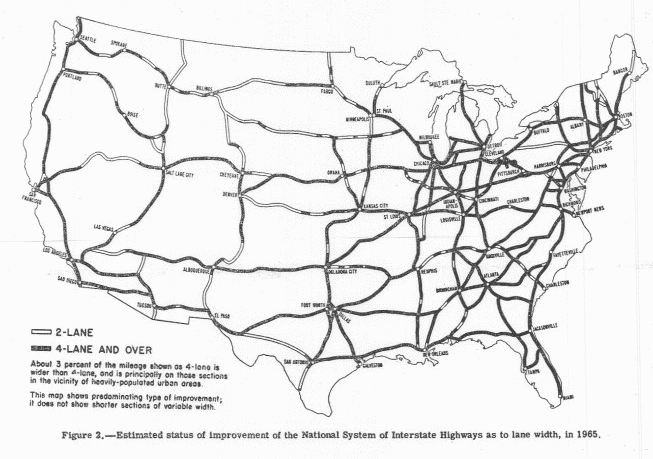
US Highway System needs in 1965 from “Needs of the Highway Systems 1955-1984”, a letter from the Secretary of Commerce to the House Committee on Public Works, approved May 6, 1954.
US Government Printing Office via Wikimedia Commons.3. The interstate highway system: 1950s army bureaucrats with a Prussia fetish decided America needed its own equivalent of the Reichsautobahn. The federal government came up with a Robert-Moses-like plan to spend $114 billion over several decades to build a rectangular grid of numbered giant roads all up and down the country, literally paving over whatever was there before, all according to pre-agreed federal standards. The public had so little say in the process that they started hundreds of freeway revolts trying to organize to prevent freeways from being built through their cities; the government crushed these when it could, and relocated the freeways to less politically influential areas when it couldn’t.
4. Climate change: In the second half of the 20th century, scientists determined that carbon dioxide emissions were raising global temperatures, with potentially catastrophic consequences. Climatologists created complicated formal models to determine how quickly global temperatures might rise, and economists designed clever from-first-principle mechanisms that could reduce emissions, like cap-and-trade systems and carbon taxes. But these people were members of the elite toying with equations that could not possibly include all the relevant factors, and who were vulnerable to their elite biases. So the United States decided to leave the decision up to democratic mechanisms, which allowed people to contribute “outside-the-system” insights like “Actually global warming is fake and it’s all a Chinese plot”.
5. Coronavirus lockdowns: The government appointed a set of supposedly infallible scientist-priests to determine when people were or weren’t allowed to engage in normal economic activity. The scientist-priests, who knew nothing about the complex set of factors that make one person decide to go to a rock festival and another to a bar, decided that vast swathes of economic activity they didn’t understand must stop. The ordinary people affected tried to engage in the usual mechanisms of democracy, like complaining, holding protests, and plotting to kidnap their governors – but the scientist-priests, certain that their analyses were “objective” and “fact-based”, thought ordinary people couldn’t possibly be smart enough to challenge them, and so refused to budge.
Nobody uses the word “technocrat” except when they’re criticizing something. So “technocracy” accretes this entire language around it – unintended consequences, the perils of supposed “objectivity”, the biases inherent in elite paradigms. And then when you describe something using this language, it’s like “Oh, of course that’s going to fail – everything like that has always failed before!”
But if you accept that “technocracy” describes things other than Soviet farming, Brasilia, and Robert Moses, the trick stops working. You notice a lot of things you could describe using the same vocabulary were good decisions that went well. Then you have to ask yourself: is Seeing Like A State the definitive proof that technocratic schemes never work? Or is it a compendium of rare man-bites-dog style cases, interesting precisely because of how unusual they are?
I want to make it really clear that I’m not saying that technocracy is good and democracy is bad. I’m saying that this is actually a hard problem. It’s not a morality play, where you tell ghost stories about scary High Modernists, point vaguely in the direction of Brasilia, say some platitudes about how no system can ever be truly unbiased, and then your work is done. There are actually a bunch of complicated reasons why formal expertise might be more useful in some situations, and local knowledge might be more useful in others.
January 29, 2021
Costs of keeping Biden’s promise to forgive student debt
Antony Davies and James R. Harrigan consider the frequently issued campaign promise by Joe Biden and what it will cost to implement:
Given the results of the recent election, it should come as no surprise that we’re poised for the next big expansion: student debt forgiveness, a promise Joe Biden made frequently as he campaigned for the presidency. Like the big ideas that came before it, this idea will cost us more than we can afford from day one, and far more than its proponents will admit. Biden’s plan as currently envisioned would cost over $300 billion. But that’s just this year. The plan will set in motion unintended consequences that will doubtlessly persist for generations.
First, next year’s crop of new students will — understandably — demand that their loans be forgiven too. And so will those of the year after that, and so on. This program will quickly become a sort of college UBI, where the government just hands out $10,000 to every college student. Some argue that if this results in a better educated populace, then it’s worth the cost. But it won’t result in a better educated populace; it will result in a whole bunch of students majoring in things the market doesn’t value, and another batch simply taking a four-year vacation on the taxpayer’s dime. Heretofore, graduates knew they needed marketable skills in order to repay their college loans. But when student loans are forgiven as a matter of course, graduates bear no cost for wasting our collective resources by studying things the market doesn’t value, or by not studying at all.
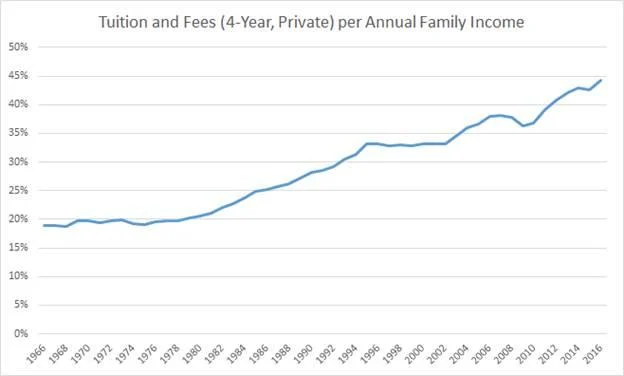
Data sources: Federal Reserve Bank of St. Louis, National Center for Education Statistics.
Second, colleges and universities will respond to this new reality by raising tuition commensurately. Tuition and fees were a pretty constant 18 to 19 percent of family income from the 1960s until 1978. In 1965, the federal government started guaranteeing student loans. In 1973, Congress established Sallie Mae and charged it with providing subsidized students loans. And by 1978, tuition and fees had started a steady march to 45 percent of family income today. When the government makes it less painful for students to borrow, whether by guaranteeing, subsidizing, or forgiving loans, it takes away some of the pain of student borrowing, which makes it easier for colleges and universities to raise tuition.
Third, expect many taxpayers to cry foul. Homeowners will quite sensibly wonder why the government is not forgiving their mortgages. After all, student loans add up to about $1.4 trillion, while American mortgages total more than $16 trillion. If relieving students from the burden of their debts is a good idea, it should be an even better idea to relieve homeowners of theirs.
What about students who worked multiple jobs or attended less prestigious schools so they could avoid going into debt? Why aren’t they being rewarded? What about students who diligently paid off their debt and are now debt free? Will they receive nothing? What about, fantastically, people in the trades? Is it reasonable to charge people — via the higher taxes loan forgiveness will bring — who did not go to college to subsidize those who do? Regardless of the answers to these questions, implementing this plan will be fraught with difficulty.
January 6, 2021
QotD: George Bernard Shaw’s views on eugenics
The Irishman’s opinions are, however, coming back to mangle and even smash his reputation. A group of students at RADA have called for Shaw’s name to be removed from the drama school’s theatre as part of an anti-racism action plan. This matters, because Shaw provided for the school in his will, and last year the royalties from his work contributed more than £78,000 to RADA. Yet the accusation that the renowned theatre college “celebrates historical figures who embraced racist ideologies” does have a certain merit. Problem is, as has been debated myriad times: do, can, and should we separate an artist’s work from their period, character and ideas? If the ghosts of anachronism and historical assumptions are never to be exorcised, there are an awful lot of people who will fail and fall to the wide-awake litmus test.
Shaw did indeed write, that, “The only fundamental and possible socialism is the socialisation of the selective breeding of man” and, chillingly, “A part of eugenic politics would finally land us in an extensive use of the lethal chamber. A great many people would have to be put out of existence simply because it wastes other people’s time to look after them.” He lectured for the Eugenic Education Society, praised Stalin (naturally) the early Mussolini, and even Hitler as late as 1935. He abandoned most of all this in his old age but never made any formal apology.
He was also an incisive critic of imperialism, mercilessly exposed establishment hypocrisy, opposed war and oppression throughout his career, and cared passionately about actors and writers – the very people at RADA trying to expunge his name from their place of learning. And here’s another challenge and even embarrassment for those who would remove the social engineers from the litany of the great and the good: many of their harshest opponents were not others on the left but, in Edwardian Britain and in the 20s and 30s, conservative Roman Catholic writers led by G.K. Chesterton and Hilaire Belloc.
Michael Coren, “Eugenics and the intellectual left”, The Critic, 2020-09-16.
December 23, 2020
Our “systemically racist and patriarchal society” which oppresses “people of color, women, and LGBT”
To hear some people (especially on social media in these locked-down pandemic days), there has never been a human society that more greatly benefits white heterosexual men and oppresses everyone else like the modern west. Here are some stats from Rav Arora to challenge that claim:
We are frequently told by commentators and theorists on the progressive and liberal Left that we live in a systemically racist and patriarchal society. The belief that Western societies privilege white men and oppress people of color, women, and LGBT citizens is especially popular within academic institutions, legacy media, the entertainment industry, and even sports. However, newly released statistics from the US Department of Labor for the third quarter of 2020 undermine this narrative. Asian women have now surpassed white men in weekly earnings. That trend has been consistent throughout this past year — an unprecedented outcome. Full-time working Asian women earned $1,224 in median weekly earnings in the third quarter of this year compared to $1,122 earned by their white male counterparts. Furthermore, the income gap between both black and Latino men and Asian women is wider than it has ever been. The income gap between white and black women, meanwhile, is much narrower than the gap between their male counterparts.
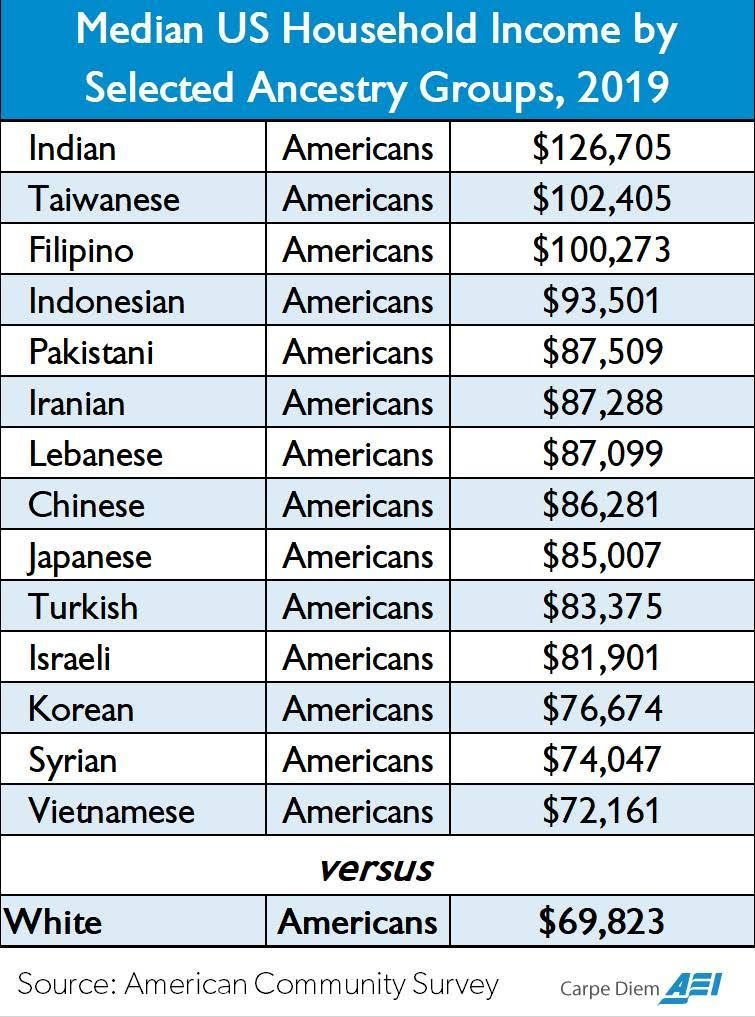
These outcomes cannot exist in a society suffused with misogyny and racism. As confounding to conventional progressive wisdom as these new figures appear to be, copious research finds that ethnic minorities and women frequently eclipse their white and male counterparts, even when these identities intersect. Several ethnic minority groups consistently out-perform whites in a variety of categories — higher test scores, lower incarceration rates, and longer life expectancies. According to the latest data from the US Census Bureau, over the 12 months covered by the survey, the median household incomes of Syrian Americans ($74,047), Korean Americans ($76,674), Indonesian Americans ($93,501), Taiwanese Americans ($102,405), and Filipino Americans ($100,273) are all significantly higher than that of whites ($69,823). The report also finds substantial economic gains among minority groups. Valerie Wilson at the Economic Policy Institute reports that from 2018 to 2019, Asian and black households had the highest rate of median income growth (10.6 percent and 8.5 percent, respectively) of all main racial groups (although she cautions that overall disparities remain “largely unchanged”). On a longitudinal scale, Hispanics, not whites, had the highest income growth in 2019 relative to the start of the Great Recession in 2007 (although many of these gains have been reversed by the pandemic).
Rapidly rising female economic success is partly a product of higher academic representation. 2019 was the 11th consecutive year in which women earned the majority of doctoral degrees. Women accounted for 57 percent of all students across American colleges in 2018 according to the latest US Department of Education figures and earned the majority of associate’s, bachelor’s, and master’s degrees. According to University of Michigan economist Mark J. Perry, “By overall enrollment in higher education men have been an under-represented minority for the last 40 years.” Sex differences in cognition can help to explain differential performance along gender lines — although men typically perform better on quantitative and visuospatial tasks, several studies have found that on average women perform better in verbal and memory tasks and on reading and writing tests.