Quotulatiousness

August 4, 2025

The EU still dominates in one key area – over-regulation

At the Foundation for Economic Education, Cláudia Ascensão Nunes identifies the one area that the EU has carved out a unique niche for itself … and it’s global in scope:

EU regulations delenda est

In a world where global power is measured by military strength, technological innovation, or cultural influence, it is striking that the European Union, without housing major tech giants or centers of disruptive innovation, has turned bureaucracy into a tool of global power. It shapes the behavior of global companies, including American big tech firms, which adapt their products to comply with European norms. This phenomenon is known as the “Brussels Effect” and has positioned the EU as the world’s regulatory superpower, fueling growing tensions, particularly with the United States following the re-election of Donald Trump.

The European market comprises 450 million consumers with significant purchasing power, making it an essential destination for global companies. However, access to this attractive market comes with detailed regulations based on the precautionary principle, ostensibly prioritizing consumer and environmental protection, and enforced by an efficient bureaucracy capable of implementing and enforcing rules with precision. This combination encourages companies to align their global operations with European standards, as maintaining different product versions for each region is costly and complex. In practice, this exports European standards worldwide.

American big tech companies such as Apple, Google, and Meta exemplify the impact of the “Brussels Effect,” as they face the requirements of legislations like the Digital Markets Act (DMA) and the Digital Services Act (DSA). These laws have forced companies to overhaul their business models, often at high cost and with significant implications. The DMA, for instance, forced Apple to allow alternative app stores and third-party payment systems on iOS, leading the company to announce, in 2024, global changes to its app policy affecting users even outside Europe, with cost estimates in the billions of dollars to restructure its infrastructure and address revenue losses from the App Store.

Google, under the same regulation, was required to offer alternatives to its search engine on Android and to unbundle services such as YouTube, impacting its global strategy and requiring significant investments in new operating systems and interfaces. The company faced potential fines of up to 10% of its global revenue for non-compliance.

Meanwhile, Meta, under the DSA, was required to invest billions in content moderation systems, a serious imposition that openly seeks to control freedom of expression on a global scale. Operational costs increased by around 20%, according to market analysts. These costly adjustments are ultimately coercive due to the weight of the European market, demonstrating how Brussels shapes corporate behavior on a global scale.

These successive impositions and forced adaptations illustrate precisely Friedrich Hayek’s warning about the dangers of central planning. By replacing spontaneous order with top-down, uniform rules imposed by a technocratic authority, the capacity for local adaptation and respect for market complexity is lost. In this scenario, the European Union increasingly takes on the features of a regulatory Leviathan, a body concentrating disproportionate power in the hands of bureaucrats far removed from citizens, reducing freedom of choice and stifling innovation.

August 2, 2025

“[T]he United States is an imperial power … it does not give foreign nations free rides and unearned favours”

Filed under: Economics, Europe, Media, Politics, USA — Tags: , , , , , , — Nicholas @ 04:00

On Substack, eugyppius discusses the European situation in a time of seemingly random and capricious tariffs from the Trump administration:

Europe in 1899, when the continent contained multiple world powers, before the rise of non-European power.

Whenever I talk about things like tariffs, Trump supporters appear in my comments to tell me that Europe has gotten a free ride for long enough and that it is time we learned to pay our way. I find it a little frustrating to read this, because in Europe it does not feel like we are getting a free ride at all. In fact it seems like the opposite: The most common complaint on the populist German right is that our political class refuses to represent our interests and will not stop carrying water for the Americans.

I recognise that I’ll never be able to put this right, but it’s worth trying, because it is important to understand the world as it is. The truth is that the United States is an imperial power. Generally speaking, it does not give foreign nations free rides and it does not hand out unearned favours. There is however a lot of confusion here, because hardly anybody bothers to describe honestly the geopolitical strategy pursued by the United States or the nature of the American empire. Western liberalism cannot conceptualise imperial politics, and while empire generally benefits political elites on both sides of the Atlantic, it is not necessarily or always in the interests of ordinary Americans or ordinary Europeans, which is yet another reason not to talk about it.

The Americans and the British before them expended enormous effort to preempt the emergence of a dominant power on the European Continent that might challenge their successive naval empires. They fought two world wars to stop Germany from becoming just such a power. This great struggle ended in 1945 with Western Europe as a fully subjugated imperial province. Since then, the Americans have coordinated the NATO alliance and guaranteed the security of European countries not out of charity, but because Europe is their provincial possession. As a rule, they have not wanted Europe to assume full responsibility for its own defence, because a world in which America no longer guarantees the security of Europe is a world in which Europe is no longer an American province. It’s that simple.

To fend off the Soviets, the Americans nevertheless rebuilt and rearmed the nations of Western Europe. Everyone involved in this project had to come up with a way to allow the Germans to become a dominant economic power again, without displacing the United States or provoking the hostilities of wary postwar neighbours like France. One solution here was the European Union, which promoted economic interdependency as a counterweight to nationalist concerns. Another solution came at the cultural level, where Germany sought to allay European anxieties over possible Teutonic aggression by developing a national cult of historical guilt for World War II, which steadily blossomed into a full-blown civic religion. This exercise in self-effacement has grown more and not less extreme over time, in part as a response to nervousness about the consequences of German reunification. Many voices on the right like to portray Germans as victims of an externally imposed guilt regime, but the truth is that we did most of this to ourselves. The German left in particular has profited from and encouraged this mindset from the beginning.

German political self-effacement had one unexpected feature, in that it proved to be contagious. Within a generation of 1945, many of the victorious allied powers were striving to develop their own historical guilt cults after the German example, in each case centred around a national original sin like slavery or colonialism. Just as the German political class found it expedient to foreground collective European concerns at the expense of a more narrowly construed German nationalism, so did the broader West develop an overarching obsession with global issues and the plight of the developing world. This has caused the proliferation of a lot of silly people in our political culture, a lot of profoundly stupid organisations, and at least two cancerous ideological systems in the form of climatism and migrationism. We have had a nearly incalculable gift in the form of 80 years of peace, which may yet be offset by the equally incalculable costs of the lunacies this peace has encouraged.

July 29, 2025

EU Commission President Ursula von der Leyen triumphantly announces EU capitulation to Trump’s demands

Filed under: Bureaucracy, Economics, Government, Media, Politics, USA — Tags: , , , , — Nicholas @ 05:00

The EU and the United States are finalizing negotiations on bilateral trade issues that basically give Trump everything he wanted with very little in return for the EU’s concessions. It’s almost as if Trump has some kind of experience in negotiating lopsided agreements, isn’t it? I guess von der Leyen didn’t get Mark Carney’s memo on the importance of keeping your eLbOwS uP:

EU Commission President Ursula von der Leyen “[learning] in real time that weakness and submission do not in fact invite conciliation”

Donald Trump has shown up the European Union. He’s revealed that the world’s largest single market is a paper tiger to be kicked around, with basically no leverage or strength to resist American demands.

All of these supposedly fierce backroom tariff negotiations have yielded an incredibly one-sided deal – really an unparalleled embarrassment. As announced yesterday, the EU promises to invest $600 billion in the U.S. economy and to make $750 billion worth of “strategic purchases” of oil, gas and the like over the next three years. We also promise to buy a bunch of American military equipment. In return for giving the Americans $1.35 trillion, we earn the privilege of a 15% baseline tariff on all of our exports to America and we drop our own tariffs to zero. At least we don’t have to pay the 30% tariffs Trump threatened!

[…]

While von der Leyen was trying weakly to put a happy face on her total failure, Trump gave her what we might call a softer Zelensky treatment. He twisted the knife in the wound, calling out the idiocy of EU wind energy in an extended soliloquy that will surely keep the fact-checkers and the regime deboonkers up late for weeks to come. I transcribe his remarks in full, because the whole moment was wonderful:

    And the other thing I say to Europe, we will not allow a windmill to be built in the United States. They’re killing us. They’re killing the beauty of our scenery, our valleys, our beautiful plains. And I’m not talking about airplanes. I’m talking about beautiful plains, the beautiful areas in the United States. And you look up and you see windmills all over the place. It’s a horrible thing. It’s the most expensive form of energy. It’s no good.

    They’re made in China, almost all of them. When they start to rust and rot in eight years, you can’t really turn them off. You can’t bury them. They won’t let you bury the propellers, you know, the props, because they’re a certain type of fiber that doesn’t go well with the land. That’s what they say. The environmentalists say you can’t bury them because the fiber doesn’t go well with the land. In other words, if you bury it, it will harm our soil.

    The whole thing is a con job. It’s very expensive. And in all fairness, Germany tried it and, wind doesn’t work. You need subsidy for wind and energy should not need subsidy. With energy, you make money. You don’t lose money.

    But more important than that is it ruins the landscape. It kills the birds. They’re noisy. You know, you have a certain place in the Massachusetts area that over the last 20 years had one or two whales wash ashore and over the last short period of time they had 18, okay, because it’s driving them loco, it’s driving them crazy. Now, windmills will not come, it’s not going to happen in the United States, and it’s a very expensive …

    I would love to see, I mean, today I’m playing the best course I think in the world, Turnberry, even though I own it, it’s probably the best course in the world, right? And I look over the horizon and I see nine windmills. It’s like right at the end of the 18. I said, “Isn’t that a shame? What a shame.” You have the same thing all over, all over Europe in particular. You have windmills all over the place.

    Some of the countries prohibit it. But, people ought to know that these windmills are very destructive. They’re environmentally unsound. Just the exact opposite. Because the environmentalists, they’re not really environmentalists, they’re political hacks. These are people that, they almost want to harm the country. But you look at these beautiful landscapes all over all, over the the world. Many countries have gotten smart. They will not allow it. They will not. It’s the worst form of energy, the most expensive form of energy. But, windmills should not be allowed. Okay?

All the while von der Leyen had to sit there, absolutely frozen except for a curiously accelerated rate of blinking, as she learned in real time that weakness and submission do not in fact invite conciliation.

In Spiked, Jacob Reynolds agrees that the deal is a humiliation for the European Union:

So this is the famous “trade superpower”. After months of tough talk, European Commission president Ursula von der Leyen announced a trade deal with Donald Trump this week which is nothing short of total capitulation. The Commission has accepted a 15 per cent baseline US tariff on most EU goods, agreed to purchase $750 billion worth of American gas and procure billions more of US military kit. What did Queen Ursula get in return? Nothing.

“VDL”, as she is known in the Brussels Bubble, tried desperately to spin this as a win. Sitting anxiously next to Trump in Scotland last weekend, she recited impressive-sounding numbers – such as the EU and US’s combined 800million consumers and the EU’s $1.7 trillion trade volume – like a nervous student. Trump cut through the spin by greeting the deal as fantastic for US cars and agriculture. He didn’t need to say much else – indeed, it was clear for all to see that there was only one winner in this deal.

For decades, even critics of the EU had to concede that whatever its many economic and democratic shortcomings, it still possessed enormous leverage when it came to trade. At the very least, it was more than capable of defending EU interests in trade deals. Evidently, this is no longer the case. When even the hapless government of Keir Starmer can negotiate a better trade deal with Trump, the problems with the EU should be clear to see. (Tariffs on most UK goods are just 10 per cent.)

Even the most ardent Europhiles have found it hard to put a positive spin on the deal. Manfred Weber, leader of the European People’s Party (a coalition of Europe’s legacy centre-right parties) described it as “damage control” and better than not reaching a deal at all. Guy Verhofstadt, former prime minister of Belgium and usually the most maniacal of EU fanboys, slammed the deal as not only “badly negotiated”, but also “scandalous” and a “disaster”, with “not one concession from the American side”. Member states, from Ireland to France, have been similarly unenthusiastic. Yet the brutal truth is that the deal reflects how America views the EU – as strategically weak and politically empty.

Trump has taught the EU a harsh lesson in statecraft. The EU has long relied on its neighbours for energy production. It has long underinvested in defence. And now it throttles its biggest industries with green dogma. This left it with little leverage for the negotiations with the US.

Of course, after Mark Carney being elected on a highly dubious platform of being “the right person to deal with Trump”, this is almost inevitable at this stage:

QotD: Thucydides wasn’t articulating a deterministic law of geopolitics – he was writing a tragedy

If you’re 45 and above, you will remember how much fear Japan stoked in the hearts of Wall Street in the 1980s when their economy was booming and their exports sector exploding. There were major concerns that the Japanese economy would leap ahead of the USA’s, and that it would result in Japan discarding its constitutional pacifism in order to spread its wings once more throughout the Pacific.

These concerns were not limited to the fringes, they were real. So real were they that respected geopolitical analysts like George Friedman (later of Stratfor) wrote books like [The Coming War With Japan] The argument was that an upstart like Japan would crash head first into US economic and security interests, sparking another war between the two. This conflict was inevitable because challengers will always seek the crown, and the king will always fight to maintain possession of it.

Suffice it to say that this war did not come to pass. The Japanese threat was vastly overstated, and its economy has been in stagnation-mode for decades now (even though living standards remain very high in relative terms). What may seem inevitable need not be.

The next several years will see marked increase in tension between the USA and China, as the former completes its long awaited “Pivot to East Asia”. So anxious are the Americans to pivot that they have been threatening to “walk away” from Ukraine if they cannot hammer down a peace deal in the very near future. This indicates just how serious a threat they view China’s ascent to be to its economic and security interests. If they are willing to sacrifice more in Ukraine than originally intended, the implication is that China’s rise is a grave concern, and that a clash between the two looks very likely … some would argue that it is inevitable, appealing to a relatively new IR concept called the “Thucydides Trap“.

Andrew Latham explains the concept to us, arguing that Thucydides is misunderstood, making conflict between rising powers and hegemons not necessarily inevitable:

    The so-called Thucydides Trap has become a staple of foreign policy commentary over the past decade or so, regularly invoked to frame the escalating rivalry between the United States and China.

    Coined by political scientist Graham Allison — first in a 2012 Financial Times article and later developed in his 2017 book Destined for Warthe phrase refers to a line from the ancient Greek historian Thucydides, who wrote in his History of the Peloponnesian War, “It was the rise of Athens and the fear that this instilled in Sparta that made war inevitable.”

Distortion:

    At first glance, this provides a compelling and conveniently packaged analogy: Rising powers provoke anxiety in established ones, leading to conflict. In today’s context, the implication seems clear – China’s rise is bound to provoke a collision with the United States, just as Athens once did with Sparta.

    But this framing risks flattening the complexity of Thucydides’ work and distorting its deeper philosophical message. Thucydides wasn’t articulating a deterministic law of geopolitics. He was writing a tragedy.

This essay might be an exercise in historical sperging, but I think it has value:

    Thucydides fought in the Peloponnesian War on the Athenian side. His world was steeped in the sensibilities of Greek tragedy, and his historical narrative carries that imprint throughout. His work is not a treatise on structural inevitability but an exploration of how human frailty, political misjudgment and moral decay can combine to unleash catastrophe.

    That tragic sensibility matters. Where modern analysts often search for predictive patterns and system-level explanations, Thucydides drew attention to the role of choice, perception and emotion.

    His history is filled with the corrosive effects of fear, the seductions of ambition, the failures of leadership and the tragic unraveling of judgment. This is a study in hubris and nemesis, not structural determinism.

    Much of this is lost when the phrase “Thucydides Trap” is elevated into a kind of quasi-law of international politics. It becomes shorthand for inevitability: power rises, fear responds, war follows.

Therefore, more of a psychological study of characters rather than structural determinism.

Giving credit to Allison:

    Even Allison, to his credit, never claimed the “trap” was inescapable. His core argument was that war is likely but not inevitable when a rising power challenges a dominant one. In fact, much of Allison’s writing serves as a warning to break from the pattern, not to resign oneself to it.

Misuse:

    In that sense, the “Thucydides Trap” has been misused by commentators and policymakers alike. Some treat it as confirmation that war is baked into the structure of power transitions — an excuse to raise defense budgets or to talk tough with Beijing — when in fact, it ought to provoke reflection and restraint.

    To read Thucydides carefully is to see that the Peloponnesian War was not solely about a shifting balance of power. It was also about pride, misjudgment and the failure to lead wisely.

    Consider his famous observation, “Ignorance is bold and knowledge reserved”. This isn’t a structural insight — it’s a human one. It’s aimed squarely at those who mistake impulse for strategy and swagger for strength.

    Or take his chilling formulation, “The strong do what they will and the weak suffer what they must”. That’s not an endorsement of realpolitik. It’s a tragic lament on what happens when power becomes unaccountable and justice is cast aside.

and

    In today’s context, invoking the Thucydides Trap as a justification for confrontation with China may do more harm than good. It reinforces the notion that conflict is already on the rails and cannot be stopped.

    But if there is a lesson in The History of the Peloponnesian War, it is not that war is inevitable but that it becomes likely when the space for prudence and reflection collapses under the weight of fear and pride.

    Thucydides offers not a theory of international politics but a warning — an admonition to leaders who, gripped by their own narratives, drive their nations over a cliff.

Latham does have a point, but events have a momentum all their own, and they are often hard to stop. Inevitabilities do exist, such as Israel and Hezbollah entering into conflict with one another in 2022 after their 2006 war saw the latter come out with a tactical victory. Barring a black swan event, the USA and China are headed for a collision. The question is: in what form?

Niccolo Soldo, “Saturday Commentary and Review #188 (Easter Monday Edition)”, Fisted by Foucault, 2025-04-21.

July 28, 2025

The AI threat to the laptop classes

Filed under: Business, Economics, Media, Politics, Technology, USA — Tags: , , , — Nicholas @ 05:00

Warren at Coyote Blog responds to a recent Gato Malo post on the way artificial intelligence (however described) will continue to disrupt the workplace especially as it begins to threaten the “laptop class” workers:

I agree with Gato that AI has a huge potential to disrupt current work patterns, in the same way that the industrial revolution did. The 19th century disruptions were severe, and many people suffered as their experience and skill set no longer matched the new economy. But eventually everyone, from the poorest to the rich, were better off for letting the industrial revolution run its course.

But in the 19th century, the disrupted were essentially powerless. What happens this time around, though, when the disrupted are the ruling elite themselves? These potentially disrupted professions include lawyers and doctors who already have shown themselves very willing to organize to block innovation, squash competition, and protect their high pay. Just look at the history of the attempts by Congress to reduce Medicare reimbursements to doctors. And that was minor compared to the potential AI disruption. Let me give you another example of the powerful resisting a technological change that should have disrupted their businesses.

When TV first was being rolled out, the industry coalesced around a network of local broadcast stations, many of whom became affiliates of a network like NBC or CBS. Why this model? Mainly it was driven by technology — the farthest a TV signal could reasonably be broadcast was about 50-75 miles. Thus everyone by necessity got their TV through three or four TV stations in their metropolitan area, each its own small business.

Now fast forward to today. There are multiple ways to broadcast a TV signal nationwide — there are several satellite options and many streaming internet approaches. So now when we watch DirecTV or Youtube TV, we just watch the national NBC or ABC feed, right? Nope. Federal law requires that whatever service you use MUST serve up NBC, for example, via the local affiliate. That is why your streaming TV service harasses you when you travel, because it is worried about violating the law by showing you the Phoenix CBS affiliate when you are staying overnight in Atlanta (gasp).

This is hugely costly. In order to be able to provide NBC among its stations, Youtube TV must gather the feeds from 235 different stations. In the Internet streaming era this is costly but in the satellite era it was insane. DirecTV, with its limited bandwidth, had to simultaneously broadcast 235 stations, most showing identical content, just to legally provide you with NBC. So why this crazy, expensive, insane effort? I am sure you have guessed — pound for pound local TV stations are among the most powerful lobbyists in the country. First, they have money and a massive incentive to defend their local geographic monopoly — Car dealers and alcohol distributors are much the same, which is why every potential innovation is resisted in those markets. But TV stations have one extra card to play — nearly every Congressman in the House likely depends on the three or four TV stations in one major metropolitan area for a huge part of their publicity and coverage. No politician is going to screw with that. At the end of the day, local stations did not get disrupted, they actually became more valuable with this government-enforced distribution of their product.

This is a small example of the fight that is coming in AI. Congressmen will couch their arguments in fear-charged terminology as if their real fear is some Terminator-like AI apocalypse. But the real concern will be from the influential elite who are being disrupted. What would have happened to the Industrial Revolution if the hand-loom weavers were the children of the nobility? Would the government have allowed the revolution to proceed? We are about to find out.

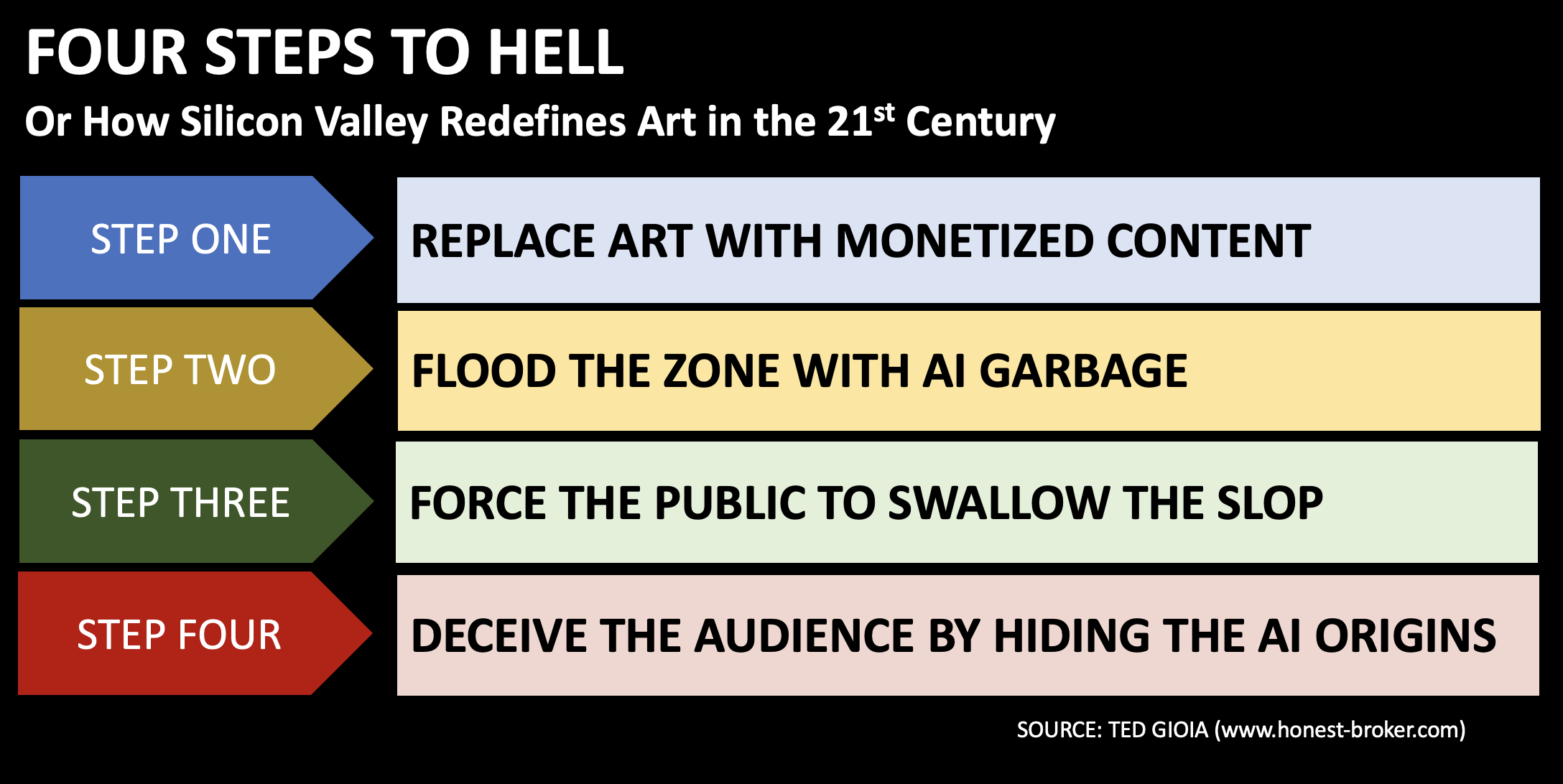
On a cheerier note (if you’re an AI), here’s Ted Gioia‘s most recent concerns about AI getting more evil as it gets more capable:

I hate to be the bearer of bad news, but AI doesn’t make ethical decisions like a human being. And none of the reasons why people avoid evil apply to AI.

Okay, I’m no software guru. But I did spend years studying moral philosophy at Oxford. That gave me useful tools in understanding how people choose good over evil.

And this is relevant expertise in the current moment.

So let’s look at the eight main reasons why people resist evil impulses. These cover a wide range — from fear of going to jail to religious faith to Darwinian natural selection.

You will see that none of them apply to AI.

Do you see what this means? You and I have plenty of reasons to choose good over evil. But an AI bot is like the honey badger in a famous meme — and just don’t care.

So sci-fi writers have good reason to fear AI. And so do we. The moral compass that drives human behavior has no influence over a bot. As it gets smarter, it will increasingly resemble a Bond villain. That’s what we should expect.

Anyone who tries to forecast the future of AI must take this into account. I certainly do.

And even though I’d like to think that I’m a fearless predictor, I must admit that what I see playing out over the next few years is very, very very troubling.

Here’s my hypothesis: Let’s call it Ted’s Unruly Rules of Robotics:

  1. Smart machines will have an inherent tendency to evil—because human moral or legal or religious or evolutionary tendencies to goodness don’t apply to them.
  2. The only way to stop this is through human intervention.
  3. But as the machines get smarter, this intervention will increasingly fail.

July 26, 2025

QotD: The accumulated friction of bureaucratic growth

Bureaucracies all succumb very quickly to some kind of “Malthusian progression”. I’m not sure what to call it, I suck at naming stuff (please take your shot in the comments), but you all know what I mean: A bureaucracy’s tasks increase arithmetically, but the amount of effort each task requires increases geometrically.

[…] In the early Republic, raising a legion was as simple as a patrician calling his clients to service, or the Senate issuing a conscription decree. One task: the summoning of free men, with their own equipment, and there you go — Legio I Hypothetica.

By the late Empire, though, all those freeholds had been turned into slave-worked Latifundia, so the effort of raising a legion increased enormously. Now the bureaucracy had to go out and hire freemen (if it could even find them), equip them at State expense, train them (again at State expense), and so on. In itself, the number of tasks isn’t that large — we’ve identified three — and they only increase at the rate of n+1.

But the effort each task requires increases to the power of n, such that if you could somehow express the effort expended in physical terms — joules or kilowatts or whatever — you’d see that the creation of Legio I Hypothetica under Scipio Africanus took 10 kilowatts, while raising the same legion under Diocletian took 10,000,000.

This isn’t (just) corruption. Sure, everyone at every level of the Imperial Bureaucracy was getting his beak wet, that goes without saying, but it’s the nature of bureaucracy itself that’s most to blame.

Severian, “Collapse II”, Founding Questions, 2021-12-09.

July 24, 2025

The vicious competition for Indian civil service jobs

Once upon a time in most of the Anglosphere, the advantage of civil service jobs was that they were nearly impossible to get fired from and had a relatively good pension at the end of a long career. Private sector jobs were far less permanent, but paid more, had better benefits, and more prestige. Over the last fifty years, little of that is still true — civil servants still have fantastic job security, but they’re also better paid, have better benefits, and for many there are opportunities to retire and get re-hired back into a similar position with even higher pay while collecting a generous pension. The private sector no longer pays better nor offers significantly better benefits, so lots of people look to get into the civil service who once would have shunned positions like that.

It’s apparently much worse in India:

In India, government jobs pay far more than equivalent jobs in the private sector — so much so that the entire labor market and educational system have become grossly distorted by rent-seeking to obtain these jobs. Teachers in the public sector, for example, are paid at least five times more than in the private sector. It’s not just the salary. When accounting for lifetime tenure, generous perks, and potentially remunerative possibilities for corruption, a government job’s total value can be up to 10 times that of an equivalent private sector job. (See also here.)

As a result, it’s not uncommon for thousands of people to apply for every government job — a ratio far higher than in the private sector. In one famous example, 2.3 million people submitted applications for 368 “office boy” positions in Uttar Pradesh.

The consequences of this intense competition for government jobs are severe. First, as Karthik Muralildharan argues, the Indian government can’t afford to pay for all the workers it needs. India has all the laws of, say, the United States, but about one-fifth the number of government workers per capita, leading to low state capacity.

But there is a second problem which may be even more serious. Competition to obtain government jobs wastes tremendous amounts of resources and distorts the labor and educational market.

If jobs were allocated randomly, applications would be like lottery tickets, with few social costs. Government jobs, however, are often allocated by exam performance. Thus, obtaining a government job requires an “investment” in exam preparation. Many young people spend years out of the workforce studying for exams that, for nearly all of them, will yield nothing. In Tamil Nadu alone, between one to two million people apply annually for government jobs, but far fewer than 1% are hired. Despite the long odds, the rewards are so large that applicants leave the workforce to compete. Kunal Mangal estimates that around 80% of the unemployed in Tamil Nadu are studying for government exams.

Classical rent-seeking logic predicts full dissipation: if a prize is worth a certain amount, rational individuals will collectively spend resources up to that amount attempting to win it. When the prize is a government job, the “spending” is not cash, but years of a young person’s productive life. Mangal calculates that the total opportunity cost (time out of the workforce) that job applicants “spend” in Tamil Nadu is worth more than the combined lifetime salaries of the available jobs (recall that jobs are worth more than salaries, so this is consistent with theory). Simply put, for every ₹100 the government spends on salaries, Indian society burns ₹168 in a collective effort of rent-seeking just to decide who gets them.

The winners are happy but the loss to Indian society — of unemployed young, educated workers who do nothing but study for government exams — is in the billions. Indeed, India spends about 3.86% of GDP on state salaries (27% of state revenues times 14.3% of GDP). If we take Mangal’s numbers from Tamil Nadu, a conservative (multiplier of 1 instead of 1.68) back-of-the-envelope estimate suggests that India could be wasting on the order of 1.4% of GDP annually on rent-seeking. (Multiply 3.86% of GDP by 15 (30 years at 5% discount) to get lifetime value, and take 0.025 as annual worker turnover.) Take this with a grain of salt, but regardless, the number is large.

July 23, 2025

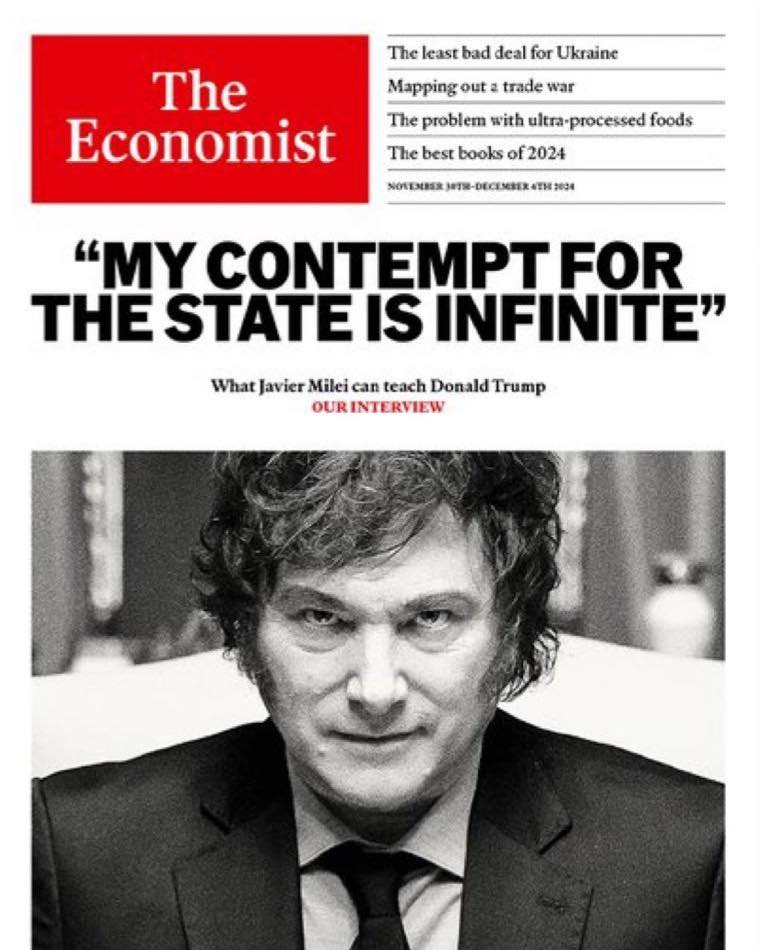
Javier Milei is delivering “a man-made miracle” for Argentina

Niall Ferguson‘s thread on the social media site formerly known as Twitter, thanks to the Thread Reader App:

While the world fixates on Donald Trump’s populist cocktail of reciprocal tariffs and big, beautiful deficits, @JMilei is delivering a man-made miracle that should gladden the heart of every classical economist and quicken the pulse of all political libertarians.

@JMilei has brought monthly inflation down from 13% to 2%. The economy is now growing at an annual rate of 7%. Investors no longer shun Argentine bonds and stocks — indeed, they were among the best investments you could have made over the past two years. After a brief upward jump, the poverty rate has fallen from 42%, when Milei was elected, to 31%

These are astonishing feats. And they have ramifications that go far beyond South America. Free-market economics and political libertarianism are sometimes dismissed as a fad of the “neoliberal” 1980s, long ago superseded by the new populisms of the left and the right. Not so. The world has never seen a government more radically libertarian than @JMilei. But the amazing thing is not that it is working economically. The true miracle is that Milei’s shock therapy is working politically.

With his leather jacket and late ’60s mop top, @JMilei is part–rock star, part–mad professor, dancing, singing, and screaming his catch phrase: ¡Viva la libertad, carajo! — “Long live liberty, damn it!” It’s as if Joe Cocker had gone onstage at Woodstock and sung “I’ll Get By with a Little Help from My Friedman”. Never in the history of democracy has a tribune of the people won power this way.

July 21, 2025

Was Juan Perón a Fascist? The Cold War Origins of Peronism – W2W 037

TimeGhost History
Published 20 Jul 2025

Was Juan Perón really a fascist, a socialist, or something entirely different? In this episode of War 2 War, we explore the rise of Peronism in post–World War II Argentina and how Perón tried to position his country between the superpowers of the Cold War.

Through labour reforms, nationalist rhetoric, media control, and brutal repression of dissent, Juan and Eva Perón created a powerful populist regime that borrowed ideas from both fascism and socialism, while claiming to reject both. From Argentina’s “Third Way” to its complicated ties with the US, USSR, and even Nazi fugitives, we examine the ideology, contradictions, and legacy of Peronist rule.

Was Peronism a unique form of authoritarian populism, or just another face of fascism?

Join us as we uncover the foundations of Argentina’s Cold War identity and the true political nature of Juan Perón.
(more…)

QotD: The parasitic classes

Filed under: Bureaucracy, Economics, Education, Government, Quotations — Tags: , , , , — Nicholas @ 01:00

A parallel case may be found in the “civil” services, regulating authorities, non-profits, &c. Jobs in these areas, which command high salaries and pensions, and present delicious opportunities for graft, are outwardly the opposite of productive. They parasitically consume, on a colossal scale, the resources of the productive.

Look into almost any kind of “charitable” activity, such as social work, and one will find that only a tiny proportion of the cash “trickles down” to the characteristically desperate “clients”. And when it does, they use it to buy not only drugs and licker, but truly useless things, such as lottery tickets.

“Education” systems, in the modern West, exist chiefly to enrich semi-literate, unionized schoolteachers. In many parts of Ontario, for instance, a teacher will make at least double what the average parents make, and therefore feel justified in sneering. The teachers naturally consider that the little ones belong to them, for they are the necessary source of their income. What rights should parents have to interfere in their upbringing?

My best argument for the parasite class (always granting that some may be sincere), is that they protect society from gathering excessive wealth, or living lives of too much ease. Without them, we might easily suffer from the vices associated with too much freedom.

How I preferred the deadbeat, layabout, very English London of the Labour Party, when I lived there in the ‘seventies — to the cosmopolitan, rich, over-swept London of the Thatcher years. There are some advantages to socialism.

And there are other arguments, too, for putting depraved Leftists in power, though on examination they reveal special pleading. For instance, teachers may claim to offer child-minding services, so that mothers, especially, can go to work. But it is because heavy taxation requires the dual income, or women to do horrible and demeaning paid work when their husbands run away, that these services were ever made necessary.

The government does, arguably, “create” employment. Among the most farcical examples are the tax lawyers and consultants. Taxpayers need these to navigate incredibly elaborate tax codes, for their own protection. Only a professional can find the loopholes. Whereas, a comprehensible, flat tax system would put all these “experts” out of business. It would shrink revenue departments spectacularly, and by extension, threaten to shrink taxes. To a professional politician, this would never do. It would shrink his power.

David Warren, “Answering to a ‘need'”, Essays in Idleness, 2020-06-18.

July 18, 2025

The Napoleonic-era Royal Navy

Filed under: Books, Britain, Economics, History, Military — Tags: , , , , — Nicholas @ 04:00

David Friedman on some of the aspects of Britain’s Royal Navy in the late eighteenth and early nineteenth century which may be incomprehensible to modern readers who encounter it in works of historical fiction (like the books of C.S. Forester or Patrick O’Brian):

HMS Victory in Portsmouth Harbour”
Painting by Charles Edward Dixon (1872-1934) via Wikimedia Commons.

I have read and enjoyed several series of novels set in the British navy during the Napoleonic wars, most recently one by Naomi Novik that departs a little further from history than its predecessors by providing the British and their enemies with dragons. The internal structure and the associated rules and customs of the navy seem very strange to a modern eye, yet it was a strikingly successful institution.

One feature likely to catch an economist’s eye was prize money. If a naval vessel captured a legitimate prize, an enemy warship or merchantman, and brought it back to port, the vessel and its contents were sold and the money distributed among those responsible. One large chunk went to the captain, another was distributed among his officers, a third among the crew, a fourth to the admiral under whose orders he was operating.

Another feature of the system was the role of patronage, political influence both within the navy and outside it in the career of an officer, especially a young officer. The critical step of promotion from lieutenant to captain depended in part on performance, in particular on the opinion of the captain under whom a lieutenant was serving. But it depended also on things that seem, to us, irrelevant.

One of Patrick O’Brien’s novels contains a conversation between Maturin, one of his protagonists, and a friend, a young officer of aristocratic birth. The officer has been having an affair with the separated wife of a high naval official and wants to know whether he should live openly with her. Maturin’s response is that, moral issues aside, it might be imprudent for him to offend a powerful official and so risk his future career. His friend replies that he has considered that matter but his family controls a significant number of seats in both houses of parliament and he thinks their influence will be sufficient to balance that of the man he will be offending.

Neither party sees anything strange in either the assumption that giving personal offense to someone within the bureaucracy will make it harder for a competent officer to be promoted or that having a politically influential family will make it easier; that is just part of how the system works. It was a system that produced extraordinarily successful results, a navy that, from the late 18th century to the early 20th won almost every ship to ship or fleet to fleet battle it fought at anything close to even odds.1

A third feature was the seniority system. Once a lieutenant was promoted to captain, his future rank depended only on how long he survived. His name was on the list of captains, the list was ordered by strict seniority, and the next captain to be promoted to admiral would be the one at the top of the list. When two or more captains were working together it was the senior who commanded. That provided an unambiguous rule for allocating command, since every captain knew where he was on the list and knew, or could readily find out, where any other captain was. But it was a rule that had nothing to do with the relative competence of two officers of the same nominal rank.

Promotion beyond captain was entirely determined by seniority; what the officer got to do with his rank was not. An insufficiently competent captain who made it to admiral would end up as an admiral of the yellow, an admiral without a fleet, effectively retired on half pay. A sufficiently competent captain could be assigned particularly important duties, including the command of a group of ships with the temporary position of commodore — provided none of the other captains in the squadron was senior to him. A sufficiently incompetent captain could end up without a ship, on half pay with no chance of prize money. In peacetime, when there was no shortage of competent captains, a minor failing might do it.

[…]

Consider the case of the pre-modern British navy. Prize money was a property solution. The admiralty wanted captains to have an incentive to capture enemy merchant ships, defeat and capture enemy warships, even at risk to their lives. Most of the relevant decisions were made by the captain, so he got the largest part of the reward, but other people, including the admiral whose orders determined what opportunities the captain had to earn prize money, got some of it. A pattern that shows up in the novels, and presumably in the real history, is an admiral who puts an unusually competent and aggressive captain in places where he is likely to encounter enemy warships not because he likes the captain but because he hopes to profit from successful encounters.

Allen argues that prize money was an imperfect property solution because capturing a warship was much riskier, more likely to get the captain killed, than capturing a merchant ship, but prize money was awarded for both. One puzzle he does not consider is why the navy did not solve the problem of misaligned incentives by lowering the prize money awarded for merchant ships or raising it for warships, which should have been easy enough to do.

Allen offers the imperfect alignment of incentives, such as the temptation for a captain in a fleet action to hang back and let other ships and their captains take the risk, as a reason why the property solution had to be supplemented with elements of the other two systems. The admiralty had detailed information on what a captain did through a system of three different logs, one by the captain, one by his first lieutenant, one by the sailing master, the ship’s senior warrant officer. A captain whose career showed him to be incompetent or too inclined to go after merchant ships and avoid warships might end up spending the rest of his career on shore with no ship, hence no opportunity for prize money. A captain who declined a clear opportunity for combat with a ship of the same class was subject to trial by court martial; one admiral ended up convicted and executed for failing to pursue the enemy fleet after an engagement.


    1. With the possible exception of the War of 1812.

Argentina’s self-described anarcho-capitalist president

Filed under: Americas, Economics, Government, Media, Politics — Tags: , , , , — Nicholas @ 03:00

J.D. Tuccille says that Argentinian President Javier Milei may be the politician who has most successfully “defied the expectations of the chattering class” by not only winning the presidency but also by the completely unexpected turnaround of the national economy:

Drawing on official data, Reuters reports that Argentina’s “economic activity rose 7.7 per cent in April compared with the same month last year”. That was higher than expected and a welcome addition to news that the economy had grown by 5.8 per cent during the full first quarter relative to the same quarter the previous year. Early numbers put Argentina’s second-quarter growth at 7.6 per cent. By contrast, Canada’s economy grew at an annual 2.2 percent in the first quarter and the U.S. economy shrank a bit.

In equally encouraging news, Argentina’s “monthly inflation rate has fallen below two per cent for the first time in five years,” according to the Financial Times. That’s still high in North American terms, but Argentina’s governments have a history of wildly expanding the money supply to pay off debt and finance expenditures, resulting in inflation rates in the hundreds and even thousands per cent per year. Inflation slowed somewhat in recent years, but it was over 200 per cent in 2023 and Milei was elected on a promise to stabilize prices — even if it meant adopting the U.S. dollar as the country’s official currency.

Importantly, the poverty rate in Argentina has also fallen to 38.1 per cent of the population at the end of 2024 from 41.7 per cent when Milei took office. Again, that remains very high, but it’s an improvement in a country where politicians have long seemed committed to keeping people poor and dependent on the state.

This wasn’t supposed to happen. In a November 2023 open letter, over 100 economists warned that Milei’s economic “proposals, rooted in the economy of laissez-faire and which include controversial ideas such as dollarization and significant reductions in public spending, are fraught with risks that make them potentially very harmful to the Argentine economy and people”.

The economists — including such academic luminaries as Thomas Piketty and Jayati Ghosh — warned of havoc if Milei implemented his free-market plans. Voters weren’t impressed by the forecast of doom; they chose the self-described “anarcho-capitalist” economist and his upstart political coalition over the standard-bearer of the dominant Justicialist Party.

The Justicialists have been the strongest force in Argentine politics since their launch in the 1940s by Juan Peron. Peron served as a military observer in Europe and apparently combined the worst ideas he encountered into a peculiarly Argentine ideology he called “justicialism”, better known as Peronism. At its heart, the ideology drops the pretense of any practical difference between socialism and fascism and promotes a brutal mélange of statist economic schemes. This means that, while most property and business activity is in private hands, it’s subject to government dictates, distortions, and control.

July 12, 2025

Noah Smith on how surprisingly well free market policies are working in Argentina

In the headline, you should read the unstated “surprising to far too many mainstream economists and political commentators”, but full credit to Noah Smith for admitting that Milei’s radical agenda has started to make life much better for ordinary Argentinians:

Javier Milei at CPAC in National Harbor, Maryland 20 February, 2025.
Photo by Gage Skidmore via Wikimedia Commons.

So to be clear, when I say that criticism of free markets has been overdone, I’m partly talking to myself. A couple of months ago, horrified by Trump’s tariff policies, I wrote an apology to libertarians, admitting that I had failed to see the political usefulness of their project in terms of maintaining economic sanity on the Right.

But it’s not just the political benefits of free markets that have been undersold; I think the purely economic advantages are also too often ignored.

Exhibit A is Javier Milei’s track record in Argentina. A year and a half ago, when Milei was elected President of Argentina, a bunch of left-wing economists warned darkly that his radical free-market program would lead to economic devastation:

    The election of the radical rightwing economist Javier Milei as president of Argentina would probably inflict further economic “devastation” and social chaos on the South American country, a group of more than 100 leading economists has warned … [S]ignatories include influential economists such as France’s Thomas Piketty, India’s Jayati Ghosh, the Serbian-American Branko Milanović and Colombia’s former finance minister José Antonio Ocampo …

    The letter said Milei’s proposals – while presented as “a radical departure from traditional economic thinking” – were actually “rooted in laissez-faire economics” and “fraught with risks that make them potentially very harmful for the Argentine economy and the Argentine people” … [T]he economists warned that “a major reduction in government spending would increase already high levels of poverty and inequality, and could result in significantly increased social tensions and conflict.”

    “Javier Milei’s dollarization and fiscal austerity proposals overlook the complexities of modern economies, ignore lessons from historical crises, and open the door for accentuating already severe inequalities,” they wrote.

Milei won anyway. His first big policy, and the one the lefty economists fretted about the most, was deep fiscal austerity. Argentina’s long-standing economic model, created by dictator Juan Peron in the 1950s, involved a large and complex array of public works projects and subsidies for various consumer goods like energy and transportation. Milei slashed many of these, as well as cutting pensions, civil service employment, and transfers to provinces. Overall, he cut public spending by about 31%, resulting in a near-total elimination of Argentina’s chronic budget deficit:

The point of all this cutting wasn’t just to remove state intervention in the economy — it was to stop inflation. Basically, macroeconomic theory says that if deficits are high and persistent enough, then they convince everyone that the government will eventually inflate its debt away by printing money (which becomes a self-fulfilling prophecy). And most or all countries that experience hyperinflation end up escaping it only when they get their fiscal house in order. Perpetual deficits were part of Argentina’s “Peronist” system, and it’s probably a good bet that this has been responsible for the periodic bouts of hyperinflation that it experiences.

[…]

But still, Milei’s success so far should make us somewhat more confident about free-market policies — especially when we evaluate them against the new socialist ideas that have been gaining currency in the U.S. In the past, socialists and other left-leaning economic thinkers advocated central planning and nationalization of industry; in recent years, they have taken to calling for expansion of the state through fiscal policy, mixing macroeconomic justifications with micro. At all times, they call for deficit-financed expansion of social programs; when fiscal hawks want to tame the deficits, the lefties warn of the short-term macroeconomic harms of austerity.

If you’re always more terrified of austerity than you are of deficits, expansion of the state — and of the deficit — becomes a one-way ratchet. This approach is very different than Keynesianism, which advocates stimulus to overcome recessions, followed by austerity during boom times. You’ll recognize it as bearing a distinct similarity to MMT; that pseudo-theory has largely fallen out of favor, but there are plenty of more respectable progressive types whose ideas nonetheless have a lot of this “macroleftist” flavor.

QotD: Ancient empires

Filed under: Economics, History, Quotations, Technology — Tags: , , , — Nicholas @ 01:00

The earliest “empires” were Security oriented. A band of hunter-gatherers — who had no concept of individual property, and just took whatever they needed from the environment — finally settled, and became farmers. Fencing and cultivating and irrigating, and building surpluses which could be traded for items that would improve living standards. (Farmers in areas that CAN’T store surplus — mainly tropical areas with year round crops — never made it further than village level agriculture, whereas farmers in areas with storable annual crops like grain — which can be stored and TAXED — went on to found empires …)

Unfortunately the initial problem with being farmers surrounded by hunter-gatherers who don’t understand property, is that such hunter-gatherers look at those nicely fenced grains and enclosed cows and sheep and goats as wonderfully convenient places to hunter-gather … (There is a reason the boundaries between hunter-gatherers and farmers are violent places, and all the crap written about “frontier wars” and extermination and the rest is just a shorthand for — these two cultures cannot co-exist peacefully … Nomads are different … they trade, therefore they understand property, therefore they can co-exist with farmers — though they will still raid where they can, be they Mongol or Viking!)

So farmers immediately face a law and order issue, which can only be solved if there is enough surplus available to provide a tax base that will allow an authority figure (chief, king, emperor, etc.) to employ people to provide protection. At village level that is usually a warrior caste who can keep the competition at bay, but once surplus gets to a level that allows higher tech, that will mean states or empires.

To put that in perspective, if your local community collects a surplus, and can afford a local chief/lord/king to provide protection, the resulting tax system is almost always (in recorded human cultures) based on a percentage of production. (In fact the earliest versions of written communication are almost always record keeping for crops and taxation.) This means that the local lord immediately has both the majority of excess funds locally, and a strong incentive to increase local production so his take will increase.

When I ask the average class of secondary school students what sorts of things the local lord could invest in to improve productivity, they get the idea pretty quickly. Irrigation for fields; animals for farm work; blacksmiths for tools and axles; wheelwrights; roads; bridges; mills; markets; guards; etc. This list is common to most parts of Europe, Africa, Asia, Central and South America and Australasia. The only places it never develops are the very early farming communities in places like New Guinea that have no storable or taxable food items to allow such a development.

So all early farming societies that can tax — without exception — become tax based hierarchical cultures. Some are even referred to as kingdoms or empires. And they are based on the idea of keeping the farmers safe, so they can be taxed.

These early empires are all Security empires. In the Middle East they are often shown as large sprawls across the map, but such sprawls are fairly fanciful. In practice they usually refer to rich farm based river valleys, with an extended hinterland based on nomadic tribes that are trading with/employed by/or paid tribute to by the “imperial authority” simply to keep other outsiders at bay.

Traditionally they fall when their hinterland nomadic allies are not strong enough to keep outsiders at bay, or become strong enough themselves to try a bit of conquest. At which point of course the conquerors find that they have to adopt the systems of the despised lowlanders they have just conquered if they are to keep the loot coming in and the system going. (One of my favourite historical analogies is the nomadic conquerors crucifying the old king on the walls of his palace and sneering that he could watch his city burn, only for him to point out that it isn’t his city anymore, it’s their city that’s burning …)

Nigel Davies, “Types of Empires: Security, Conquest, and Trade”, rethinking history, 2020-05-02.

July 9, 2025

Argentina after 18 months of Milei’s leadership

All the mainstream media folks were predicting that Argentina would be an utter economic disaster after the election of Javier Milei. A few of them are starting to come around to admitting that Argentina seems to have made the right move:

What’s happening in Argentina is super impressive, but it’s not a miracle.

Yes, Milei’s reforms are generating great results, but that is exactly what libertarians and small-government conservatives said would happen.

Let’s start with this celebration of the amazing growth of private-sector wages since Milei took office in late 2023.

Or how about the astounding way that Milei has conquered inflation (I also like how this tweet mocks the statists like Piketty who frantically and erroneously warned that Milei’s election would produce an economic catastrophe).

[…]

Let’s close with another tweet.

Here’s Noah Smith, who is not a libertarian, shared two days ago.

Give him credit for acknowledging Milei’s success.

I’ll add two comments about this tweet, one about economic data and the other about predicting whether Milei would get great results.

Regarding data, I don’t think anyone should get overly excited by one month or one quarter of economic data. Even one year of data might create a misleading impression (which is why my Anti-Convergence Club is always based on decades of data). That being said, there is every reason to expect continuing strong results for Argentina.

Regarding predictions, Smith’s tweet asserts that libertarians didn’t expect Milei to be so wildly successful. At the risk of sounding like a politician, I agree and disagree.

  • The “agree” part is that many libertarians were worried at the beginning of Milei’s presidency that he might face immovable opposition from the Peronist-controlled legislature. We also worried that the special interest groups might launch massive – and successful – protests that would derail necessary reforms. So if you asked me in December 2023 for my prediction, I would not have been overflowing with optimism.
  • The “disagree” part is that I have always had total and absolute confidence that radical pro-market policies will produce great results, anywhere and everywhere. And I assume other libertarians (as well as Reagan-type conservatives) share my faith that good policies lead to good outcomes. So if I was told in December 2023 what Milei would have accomplished in his first 18 months, I would have fully expected the great news we now see.

In other words, what’s miraculous is that the reforms happened. The subsequent economic renaissance has been boringly inevitable (but totally wonderful).

P.S. I am cautiously optimistic that Milei will get more allies in the legislature after Argentina’s mid-term elections later this year.

« Newer PostsOlder Posts »

Powered by WordPress