Quotulatiousness

May 9, 2019

MV Asterix delivers for the Royal Canadian Navy and breach of trust charge is dropped

Filed under: Cancon, Law, Military, Politics — Tags: , , , , , — Nicholas @ 03:00

Amid rumours that the Trudeau government is contemplating dropping the charge against Admiral Mark Norman, Matthew Fisher retweeted a link to his article from last year, praising the ship and suggesting that it should be renamed in honour of the man who did everything he could to get the RCN’s only current replenishment ship to sea:

MV Asterix
Photo via Canadian Defence Review

Aboard MV Asterix and HMCS Charlottetown – The Trudeau government would have fits, but the Royal Canadian Navy should consider renaming the MV Asterix the HMCS Admiral Mark Norman.

The controversial new replenishment ship, which entered service on time and on budget this past January, has been performing brilliantly for the navy during sea trials. That was the unanimous opinion of sailors on HMCS Charlottetown and on MV Asterix after a series of refuelling exercises with the Canadian frigate and American destroyers during a hunt for three U.S. nuclear subs that I witnessed recently in the Caribbean.

The only hiccup during the five-day war game was on the American side. The crew on one of the destroyers was unable to establish a good seal on the fuel probe Asterix sent over as the vessels sailed at 15 knots in a two-metre sea with about 30 metres of water between them. However, it only took about 10 minutes to fix the problem.

Vice-Admiral Mark Norman, who ran the RCN before becoming the military’s second-in-command, strongly supported leasing or buying Asterix. The admiral was suspended early last year and subsequently charged with breach of trust for allegedly violating cabinet confidences. He is accused of passing on information pertaining to doubts that the Trudeau government was believed to have had about leasing the vessel. Although there were strong signals that it wanted out of the deal, the government eventually decided to honour a contract that Davie had with the Harper government to lease Asterix for five years at will be a cost of $677 million,according to the Globe and Mail.

“I think the Asterix is fantastic,” said Chief Petty Officer 2nd Class Mark Parsons, the Charlottetown’s chief bosun’s mate, who oversaw two approximately hour-long, problem-free fuel transfers from the tanker to his warship. “We have missed that capability since (HMCS) Preserver was retired in 2014” because of electrical problems and corrosion.

Parsons’ opposite number on Asterix, CPO2 Steve Turgeon, served on the 48-year old Preserver until 2013. Since January he has been training four deck crews of 11 navy sailors each to handle refuellings. This has allowed Canada to once again be an independent blue-water navy after several years in which it depended on NATO allies and leased Chilean and Spanish navy tankers for fuel at sea. A fresh group of navy sailors has just begun training on the Asterix, which is participating with two Canadian frigates in the vast U.S.-led, 25-nation Rim of the Pacific naval exercise off Hawaii this month.

And on the legal front:

Later in the day, the news was finally made official: the government has dropped the charge and Vice-Admiral Mark Norman wants his job back:

The newly exonerated Vice-Admiral Mark Norman says he was alarmed by the persistent belief among senior government officials that he was guilty, and that their false assumptions took a significant financial and emotional toll on him and on his family.

On Wednesday, prosecutors stayed the single criminal charge of breach of trust laid against Norman, a major victory for the senior naval officer who has always maintained his innocence in the face of allegations he leaked confidential information about a project to procure a supply ship for the Royal Canadian Navy. In announcing the decision, Crown prosecutor Barbara Mercier told the court it was necessary in part due to new evidence the defence produced in March.

“This new information definitely provided greater context to the conduct of Vice-Admiral Norman, and it revealed a number of complexities in the process that we were not aware of,” Mercier said. “Based on the new information, we have come to the conclusion that given the particular situation involving Vice-Admiral Mark Norman, there is no reasonable prospect of conviction in this case.”

She did not provide any details on what exactly that information was.

The announcement ends the two-year legal battle against the officer and heads off what would have been a politically explosive trial for the Liberal government in the middle of a federal election campaign.

A fascinating little detail is also reported:

[Admiral Norman only] learned from a reporter’s question that Defence Minister Harjit Sajjan had announced the government would pay for his legal fees. “Wow,” was all he could muster in response. In 2017, the Department of National Defence had denied Norman’s request for financial assistance, concluding he was likely guilty.

So even though they’re finally making the right gestures, they still manage to be as ungracious as humanly possible while doing so. It’s not the kind of reputation you’d want to encourage.

May 8, 2019

Andrew “The Milk Dud” Scheer has problems, but bigotry, racism and xenophobia aren’t among them

Filed under: Cancon, Media, Politics — Tags: — Nicholas @ 05:00

I’m far from a fan of The Milk Dud, but the Canadian media’s attempts to paint him as a kind of alt-right echo of Trump are worse than pathetic:

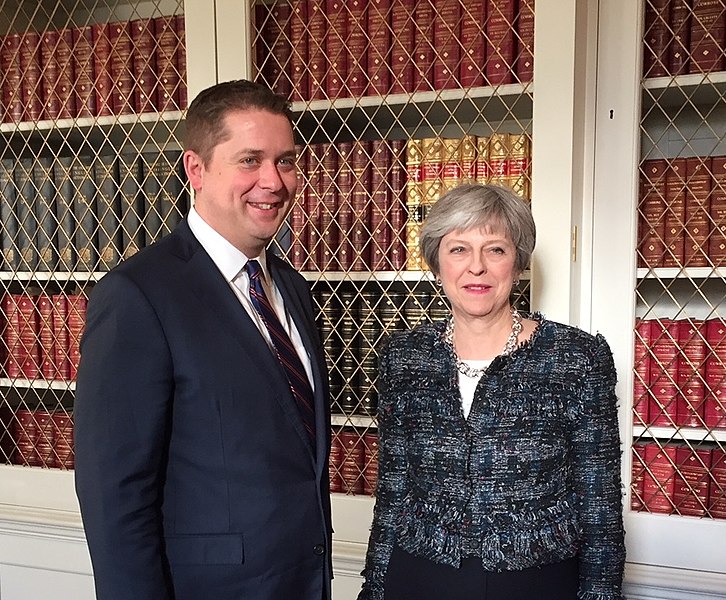
Andrew Scheer meets British Prime Minister Theresa May
Photo via Wikimedia Commons

As election 2019 approaches, one thing has become obvious: it did not matter who the Conservative Party of Canada would have elected to lead their party. The mainstream media would have still implemented the same smear tactics against them

The smears include calling them bigots, racist, xenophobic, making lazy connections to extremists, and claiming that they are “alt-right adjacent.” This type of name-calling is the new norm from the Canadian left, and it sadly seems to only be getting worse

Why does the MSM want Andrew Scheer to be racist so bad!? Andrew Scheer, the father of five from Saskatchewan and quite possibly the most boring politician in today’s ecosystem of larger-than-life cult of personality type leaders, is not a racist. I beg, and I plead every night that these baseless criticisms will peter out, but they continue to pop up. Why?

What statement, in what interview, in what conversation, did Andrew Scheer say anything remotely racist? There is not a single instance.

Your electronic devices and the Canadian Border Services Agency

Filed under: Cancon, Law, Liberty, Technology — Tags: , , , , , , — Nicholas @ 03:00

A few years ago, many civil libertarians were upset that the US government allowed warrantless searches of electronic devices at the border, but it was less well known that the Canadian Border Services Agency does the same at the Canadian border:

According to the CBSA, it has the right to search electronic devices at the border for evidence of customs-related offences — without a warrant — just as it does with luggage.

If travellers refuse to provide their passwords, officers can seize their devices.

The CBSA said that between November 2017 and March 2019, 19,515 travellers had their digital devices examined, which represents 0.015 per cent of all cross-border travellers during that period.

During 38 per cent of those searches, officers uncovered evidence of a customs-related offence — which can include possessing prohibited material or undeclared goods, and money laundering, said the agency.

While the laws governing CBSA searches have existed for decades, applying them to digital devices has sparked concern in an era where many travellers carry smartphones full of personal and sometimes very sensitive data.

A growing number of lawyers across Canada argue that warrantless digital device searches at the border are unconstitutional, and the practice should be stopped or at least limited.

“The policy of the CBSA of searching devices isn’t something that is justifiable in a free and democratic society,” said Wright who ran as a Green Party candidate in the 2015 federal election.

“It’s appalling, it’s shocking, and I hope that government, government agencies and the courts, and individual citizens will inform themselves and take action.”

May 4, 2019

Justin Trudeau’s (French) language problem

Filed under: Cancon, Politics — Tags: , , , — Nicholas @ 05:00

Colby Cosh reports on a recent academic paper that sticks the boots into the little potato and his, um, problematical French language issues:

Thursday’s hot-off-the-press Post contained a short summary (by CP’s Giuseppe Valiante) of a recent academic paper about how Justin Trudeau’s handling of spoken French is regarded in Quebec. In case you didn’t read Valiante’s summary, I’ll give you a four-word abstract: it drives people nuts. Obviously it’s hard to know how many Quebeckers are really annoyed or nauseated by the prime minister’s French, but if you judge by the newspapers, as Binghamton University French-language scholar Yulia Bosworth did in her article for the American Review of Canadian Studies, it seems Trudeau is the equivalent of fingernails scraping a chalkboard forever.

Hungry with curiosity, I got hold of Bosworth’s paper, entitled “The ‘Bad’ French of Justin Trudeau: When Language, Ideology, and Politics Collide.” As writing it suffers from the typical defects of published scholarship in the humanities: as the title suggests, it is one of those things in which every mental construct of any kind becomes an “ideology.” As scholarship it is pretty good: it contains a useful potted history of Quebecois linguistic self-hatred, and how “Quebec French” went from being a perennial object of shame to a rigid conscious standard, enforced with the same pride and viciousness as Parisian French within France.

But as disguised comedy, the article can’t be beat. When Bosworth wants to give the flavour of her sample corpus of Quebec newspaper abuse of Trudeau, she has to clear her throat professorially first. “Titles, arguably, play an important role in constructing public images; they constitute visible and frequently consumed newspaper content and help construct a linguistic landscape.” Zzzz. But then you get to the good stuff, the distilled liquor:

    In Justin Trudeau’s case, headline readers encountered ‘a beautiful empty shell,’ ‘the little boy,’ ‘a privileged target,’ ‘a thinker of nothingness,’ ‘a deserter,’ a ‘mythical hero,’ ‘window dressing for radical individualism,’ ‘a young dilettante,’ and ‘Justin-the-Red.’ Among the many examples of negative descriptors pinned on Trudeau are: ‘smokescreen,’ ‘the call of the void,’ ‘hypocrisy,’ ‘lack of courage,’ and ‘Pee-Wee’s revenge.’ In terms of adjectives, Trudeau was called ‘slimy,’ ‘tricked,’ ‘attacked,’ ‘targeted,’ ‘troubled,’ and ‘criticized.’

Obviously there is a lot of that sort of talk around, and certainly JT gets a rough ride in the Post and the Alberta broadsheet papers from time to time, but I think only in Quebec do you find this language in headlines, rather than in the comment threads or your uncle’s Facebook feed. (“Radical individualism”? Really?)

Canadian privacy laws

Filed under: Cancon, Law, Liberty, Media — Tags: , , , — Nicholas @ 03:00

Michael Geist asks whether it matters that Canadian privacy laws provide more privacy protection if they can’t actually be enforced:

It has long been an article of faith among privacy watchers that Canada features better privacy protection than the United States. While the U.S. relies on binding enforcement of privacy policies alongside limited sector-specific rules for children and video rentals, Canada’s private sector privacy law (PIPEDA or the Personal Information Protection and Electronic Documents Act), which applies broadly to all commercial activities, has received the European Union’s stamp of approval, and has a privacy commissioner charged with investigating complaints.

Despite its strength on paper, my Globe and Mail op-ed notes the Canadian approach emphasizes rules over enforcement, which runs the risk of leaving the public woefully unprotected. PIPEDA establishes requirements to obtain consent for the collection, use and disclosure of personal information, but leaves the Privacy Commissioner of Canada with limited tools to actually enforce the law. In fact, the not-so-secret shortcoming of Canadian law is that the federal commissioner cannot order anyone to do much of anything. Instead, the office is limited to issuing non-binding findings and racing to the federal court if an organization refuses to comply with its recommendations.

The weakness of Canadian law became evident last week when the federal and British Columbia privacy commissioners released the results of their investigation into Facebook arising from the Cambridge Analytica scandal. The report details serious privacy violations and includes several recommendations for reform, including new measures to ensure “valid and meaningful consent”, greater transparency for users, and oversight by a third-party monitor for five years.

Facebook’s response? No thanks. The social media giant started by disputing whether the privacy commissioner even had jurisdiction over the matter. After a brief negotiation, the company simply refused to adopt the commissioners’ recommendations. As their report notes “Facebook disagreed with our findings and proposed alternative commitments, which reflected material amendments to our recommendations, in certain instances, altering the very nature of the recommendations themselves, undermining the objectives of our proposed remedies, or outright rejecting the proposed remedy.”

May 1, 2019

Feds impose media ban on companies taking part in “the largest single outlay of tax dollars in Canadian history”

Filed under: Business, Cancon, Government, Media, Military — Tags: , , — Nicholas @ 05:00

Ted Campbell understands that governments need to keep some information secret (like the capability of weapon systems or details of naval radar implementations), but that our current federal government is going far beyond any reasonable definition of secrecy:

Type 26 Global Combat Ship — selected as the Canadian Surface Combatant program’s design winner.
(BAE Systems, via Flickr)

But, that sort of really SECRET stuff aside, we, citizens, do have a right to know how the government is spending our money and that, in my opinion, includes understanding “details about the industrial benefits and jobs supposedly to be created by the surface combatant project.” After all, it was our government, the Harper Conservative government to be clear, that selected, in that case, Irving Shipbuilding (Halifax) to be the supplier of new destroyer-frigate type warships, and they did so after what was described in a 2010 press release by then Public Works and Government Services Minister Rona Ambrose as developing a

    Strategy [that] promotes the regional distribution of work and opportunities to shipyards across the country. Shipyards that are selected to build the combat and non-combat packages will have to subcontract vast amounts of work to the broader marine industry and suppliers of this industry. Subcontracting in any of the three streams encompassed by the Strategy will be of notable benefit small and medium enterprises … [and] … The Government of Canada is committed to getting the best value for Canadian taxpayers. Under the Strategy, shipbuilding projects that are similar in nature will be grouped together to reduce production costs. This type of strategic sourcing will create the conditions for the effective and efficient delivery and support of the federal fleet over the long term.

That’s all pretty good stuff and I’m pretty sure that most Liberal ministers are still toeing that same line today. They promised industrial benefits and jobs; we, taxpayers, have a right to know if they are delivering.

But, in an article in the National Post, defence correspondent David Pugliese tells us that

    The Liberal government has brought in yet another media ban, this time affecting companies seeking work on a warship project that involves the largest single outlay of tax dollars in Canadian history … [in this case] … In a new directive, firms interested in maintenance work on the $60 billion Canadian Surface Combatant program have been told they can’t talk to journalists and instead must refer all inquiries to Public Services and Procurement Canada … [and] … At the same time, a public interest researcher who is seeking details about the industrial benefits and jobs supposedly to be created by the surface combatant project has been informed by government it will take at least three and a half years to get any such documents under the Access to Information law.

Mr Pugliese says, and these are two very worrying points, that:

  • The media ban imposed by Procurement Canada on firms interested in maintenance work on that fleet is the fifth such order in the last year involving the purchase of military equipment or ships, according to documents compiled by Postmedia; and
  • Industry representatives have sent the news organization the documents, warning about the growing secrecy at Procurement Canada. The records include a ban on firms talking to journalists about the Canadian Surface Combatants, the purchase of next generation fighter jets, a light icebreaker, a Defence department satellite, as well as a military pilot training contract. Industry executives point out the secrecy is not based on security concerns but on worries the news media will be able to use the information to keep close tabs on the problem-plagued military procurement system.

The Trudeau regime seems obsessed with secrecy and wants to bend all factual information to suit its narrative that it is spending our money as we might wish … which is, of course exactly what the Trudeau campaign said about Prime Minister Stephen Harper

To the surprise of nobody, Ontario’s cannabis stores are still struggling

Filed under: Bureaucracy, Business, Cancon — Tags: , , , , , — Nicholas @ 03:00

The Ontario government created a tightly restricted retail market regime for newly legal cannabis sellers, with a tiny number of licenses issued and highly bureaucratic “safeguards” for the retailers’ guidance and control. The city of Toronto, for example, with a population in the 2.7 million range, was allocated a whopping five stores. Only one of those stores was allowed to open on the first day of legal retail sales, and today there are three in operation, despite penalties and potential loss of licenses at stake for those who haven’t opened yet. The chorus of complaints from would-be customers has not diminished much, if at all since day one:

With legalization day long come and gone (and the euphoria of being able to spark a joint in public gone with it), the turtle-paced roll-out of Toronto’s weed retail scene goes to show the government and the OCS have some work to do before purchasing legal weed can be completely glitch-free (and lineup free, too).

Here are a few of the lows of getting high, courtesy of Toronto weed stores since buying pot became legal.

Weed prices are up
According to Statistics Canada, prices for weed have steadily been on the up and up since legalization last year.

While Nova Cannabis is trying to tackle its biggest competitor (illicit weed stores) with Black Market Buster deals, people who are buying their cannabis from the OCS are now paying an average of about $9.99 per gram—that’s roughly $3 more than those buying their bud from illegal stores.

Black market weed is still thriving
There’s still around 20 illegal dispensaries operating in the city, and at least 100 illegal marijuana delivery services. Why? See above: unlicensed weed stores are significantly cheaper than the legal ones, and loopholes in the city’s laws allow them to operate pretty much undisturbed, save for the occasional raids.

[…]

OCS packaging
Aside from the fact every product coming out of the OCS comes triple-wrapped in excessive, sometimes non-recyclable polypropylene packaging, the containers are just plain confusing.

Lack of packaging standards means your order comes in all shapes and sizes, regardless of whether you’re getting bud or pre-rolled joints, which is as confusing for buyers as it is for those behind the counter.

And that doesn’t even include the even louder chorus of complaints about the quality of the legal product…

April 29, 2019

Cannabis stores struggling against cheaper black market weed outlets

Filed under: Business, Cancon, Law, Liberty — Tags: , , , , , — Nicholas @ 05:00

In a rational world, a license to sell legal cannabis from a storefront where you have almost a legal monopoly would be a license to print money — the market demand is very clearly real and widespread. Yet Toronto’s legal cannabis stores are still suffering:

How much would it suck to go through all the trouble of opening a legal weed store, only to have dozens of people do the exact same thing without paying for permits, inspections or meeting any sort of government regulations?

How much would it suck to then watch these people not only get away with their illegal operations, but do so while luring your customers away with cheaper prices?

Probably as much as it would suck to sink years of your life into building a retail cannabis business and then learning that only 25 of such stores could exist in all of Ontario — and that the owners of those stores would be chosen at random.

It’s been nearly one month since Doug Ford’s PC government allowed the first wave of brick and mortar retail cannabis stores to open across Ontario. Three have launched so far in Toronto, where five licenses were issued in total, but many consumers aren’t pleased with consistently long lines and higher (than pre-legalization) prices.

So, like the rest of Canada, Toronto continues to buy black market weed.

Roughly 20 unlicensed dispensary storefronts are still up and running across the city as of April 25, in addition to more than 100 illegal marijuana delivery services.

You can find them all on WeedMaps, a popular online cannabis community that’s been listing these types of businesses for adult consumers in North America since 2008.

It’s not that police and bylaw enforcement officers can’t find these illicit dispensaries — I mean, operators are advertising their locations and menus online for all to see.

The problem is that no level of government can (or will) shut them down for very long.

“Why not?” you ask? Well, it’s complicated.

April 28, 2019

More on the PEI Green Party “breakthrough”

Filed under: Cancon, Politics — Tags: , , — Nicholas @ 03:00

In the Prince Edward Island election last week, the voters threw out the incumbent Liberal government and instead opted for a minority Progressive Conservative replacement. One of the bigger surprises of the outcome was that the Green Party surged into the second-largest number of seats, to be the Official Opposition for the first time. Colby Cosh explains that the Greens ran on a more typically NDP platform that only vaguely gestured toward any traditional Green policies:

Election results map for the April 23, 2019 provincial election.
Blue – PC Red – Liberal Green – Green Party Orange – NDP (no seats won)
Map via CBC News – https://newsinteractives.cbc.ca/elections/pei/2019/results/

Breakthrough or letdown? The Green Party of Prince Edward Island won the second highest number of seats in the province’s election Tuesday, and leader Peter Bevan-Baker seems likely to become opposition chief facing a Conservative minority government. The P.E.I. Greens have been big news for a while now, doubly so because the Island has always stuck to the classic two parties, and in the run-up to the vote, polls had suggested that Bevan-Baker might end up as premier. This didn’t happen — or hasn’t yet! — and in the overall popular vote the Greens ended up beating the third-place incumbent Liberals by only a little over one percentage point.

In truth the P.E.I. Greens seem to be in a good position going forward, if we agree to overlook the general history of Green floundering in Canada. Bevan-Baker, a Scots dentist, has lost more elections than you’ve had hot meals, but his soft-spokenness and graciousness seem to have struck a belated chord with Islanders. A three-way vote split of 37-31-30 seems like a recipe for instability, even though the parties are issuing familiar gab about legislating in a co-operative, collegial way.

Everybody knows that P.E.I. is both an unusual place, with some of the features of an extended family, and a small place. What has worked for Bevan-Baker’s Greens might not scale up well to a much larger entity, such as Regina, Sask. This has not stopped commentators from speculating on the election being the possible starting gun for nationwide Green success. The idea is that Canadians, particularly the young, have finally taken the environmentalist message (whatever that is) into their hearts and are ready to defect from tedious mainstream neoliberal politics. The revolution is at hand! Any minute now!

If you followed the P.E.I. campaign at all, you know that there’s a major problem with this concept. It’s that the Green platform wasn’t especially, uh, green. Everybody who was actually on the Island political beat noticed this. The formal pitch included minor nods toward electric vehicles and solar power, of a kind you wouldn’t even be surprised to find in a Conservative election document nowadays, but Bevan-Baker himself emphasized the “pragmatic” nature and careful costing of the party’s platform. Almost as if he was conscious of having to overcome an inherited Green reputation for flakiness.

April 25, 2019

Prince Edward Island elects its very first minority government

Filed under: Cancon, Politics — Tags: , , — Nicholas @ 03:00

There’s not often news from Prince Edward Island, Canada’s smallest province, but in yesterday’s provincial election they did something they’ve never done before: elect a minority government and have the first Green Party official opposition.

Election results map for the April 23, 2019 provincial election.
Blue – PC (36.5% of the vote for 12 seats)
Red – Liberal (29.5% of the vote for 6 seats)
Green – Green Party (30.6% of the vote for 8 seats)
Orange – NDP (2.9% of the vote for 0 seats)
Map via CBC News – https://newsinteractives.cbc.ca/elections/pei/2019/results/

Prince Edward Island’s Liberal Premier Wade MacLauchlan lost his own seat to the province’s Progressive Conservatives, who will form the first ever minority government in PEI’s history.

PEI has traditionally had a two-party system, broken in 2015 with a familiar story: a lone Green seat. We saw it in Ontario, New Brunswick, British Columbia, and federally.

The PEI Greens, who for a long time looked poised to form government, will form the official opposition. They will become the only party other than the PCs and Liberals to do so. With a by-election to come in the next months, the Green Party won at least nine seats, a record number of elected Greens in Canada.

Elections in PEI often go unnoticed in most of the country, but this election gained special attention after the tragic news of the death of a candidate and his young son in a canoeing accident.

But Canadians have been keeping a closer eye to other province’s elections. Consider the unusual level of national attention generated by provincial elections in Alberta, Ontario, and elsewhere.

April 24, 2019

Opponents claim Doug Ford is using booze liberalization as a distraction … if so, it’s working well

Filed under: Business, Cancon, Law, Media — Tags: , , — Nicholas @ 03:00

Chris Selley documents just how Ontario Premier Doug Ford’s opponents are unable to ignore the (personally teetotal) Ford’s alcohol-related proposals:

A peculiar affliction has broken out among Ontarians who think their relatively new government is devoting far too much time and attention to liberalizing alcohol laws: They can’t stop talking about it.

I don’t mean people with entirely fair public health concerns (though I think those concerns are pretty marginal, given the modest changes). And I don’t mean the pearl-clutching hordes who think allowing alcohol consumption in parks will lead to mayhem, no matter how civilized the results might demonstrably be elsewhere. (That peculiarly Ontarian crew has certainly made itself heard, though, and it seems to include a surprising number of progressive millennials.)

I mean people who didn’t have particularly strong views one way or the other about 9 a.m. mimosas, tailgate parties, drinking in parks or buying beer at the corner store, or might even have supported some legislative relaxation, but who now can’t stop railing against them even as they deplore the government’s actions on objectively more serious files.

[…]

On letters and op-ed pages, you’ll find the topic of booze popping up in all sorts of places it objectively doesn’t belong — not if one doesn’t want to be distracted, anyway. It seems to lead people down all sorts of strange blind alleys. One Toronto Star columnist noted that neither Premier Doug Ford nor Finance Minister Vic Fedeli will “touch a drop themselves,” but that “they are making it easier for you to access just in time for breakfast, happy hour, or a nightcap.” So what? Why would anyone want the premier’s or finance minister’s personal tastes and preferences influencing public policy?

Another Star columnist spent seven paragraphs sneering at the idea of tailgating in Ontario before declaring herself perfectly fine with the idea. “But,” she asked, “is tailgating what Ontario needs?” Is that the standard, then? Government shall only allow the masses such entertainments as they “need”?

Using booze as a “distraction” is not a new tactic. It became a running joke during Kathleen Wynne’s tenure that whenever things were going (especially) badly for her government, she would pop up to announce another batch of supermarkets authorized to sell beer and cider (and sometimes, though much more rarely, wine!).

April 21, 2019

Canada and the Battle of the Atlantic, part 13

Filed under: Britain, Cancon, History, Military, USA, WW2 — Tags: , , , , — Nicholas @ 03:00

Editor’s Note: This series was originally published by Alex Funk on the TimeGhostArmy forums (original URL – https://community.timeghost.tv/t/canada-and-the-battle-of-the-atlantic-part-5-edited/1453).

This will be the last installment I’ll be re-posting here, as discussion with Alex after I obtained a copy of Marc Milner’s North Atlantic Run made it clear that the bulk of the writing up until this point had actually been copied directly from Milner’s book and only lightly paraphrased and re-ordered by Alex. I’ve gone back over the earlier posts and, to the best of my ability, marked all the direct quotes and provided acknowledgements appropriately.

Sources:

  • Far Distant Ships, Joseph Schull, ISBN 10 0773721606 (An official operational account published in 1950, somewhat sensationalist)
    [Schull’s book was published in part because the funding for the official history team had been cut and they did not feel that the RCN’s contribution to the Battle of the Atlantic should have no official recognition. It is very much an artifact of its era, and needs to be read that way. A more balanced (and weighty) history didn’t appear until the publication of No Higher Purpose and A Blue Water Navy in 2002, parts 1 and 2 of the Official Operational History of the RCN in WW2, covering 1939-1943 and 1943-1945, respectively.]
  • North Atlantic Run: the Royal Canadian Navy and the battle for the convoys, Marc Milner, ISBN 10 0802025447 (Written in an attempt to give a more strategic view of Canada’s contribution than Schull’s work, published 1985)
  • Reader’s Digest: The Canadians At War: Volumes 1 & 2 ISBN 10 0888501617 (A compilation of articles ranging from personal stories to overviews of Canadian involvement in a particular campaign. Contains excerpts from a number of more obscure Canadian books written after the war, published 1969)
  • All photos are in the Public Domain and are from the National Archives of Canada, unless otherwise noted in the caption.

I have inserted occasional comments in [square brackets] and links to other sources that do not appear in the original posts. A few minor edits have also been made for clarity.

Earlier parts of this series:

Part 13 — Convoy operations, the Americans, and 1941 Drags On

Marc Milner discusses convoy organization in North Atlantic Run:

The organization and sailing of convoys was co-ordinated by the Admiralty’s world-wide intelligence network, of which Ottawa was the North American centre. The assembling of shipping in convoy ports was the responsibility of local NCS staffs working in conjunction with the regional intelligence centre, through which all communication with other regional centres passed. The actual organization of the convoys, issuing code books, charts, special publications, arrangement of pre-sailing conferences, passing out sailing orders, and so forth, was all the work of the NCS.

[Editor’s Note: The command structure for typical Atlantic convoys is discussed in Arnold Hague’s excellent reference work The Allied Convoy System 1939-1945: Its organization, defence and operation:

In typical British fashion, control of the convoy was twofold. Direct control of the convoy rested with the Convoy Commodore, its protection with the Senior Officer of the Escort (referred to in the RN as SOE). As the escort commander was inevitably junior to the Commodore, it was laid down that the Commodore had no right of intervention with the escort, and that the SOE could, if he became aware of circumstances requiring it, give a mandatory instruction to the Commodore. A good deal of tolerance and understanding between the two officers was therefore essential. In fact, friction was minimal, co-operation normally of a high order and the whole system remarkably effective, with the Commodore dealing solely with the merchant ships of the convoy. The SOE intervened (or detailed another escort) at the specific request of the Commodore to provide any assistance required in controlling the convoy.

The divided command system should be seen in the context of the experience of the two commanders. The Commodores, all elderly men, had practical, personal, experience of the problems of coal fired ships from their younger days. As almost all had started their Commodore’s service in the first months of the war they had considerable personal experience of the problems of the Masters whom they led. The escort commanders, much younger officers, lacked that personal knowledge, and the opportunity to obtain it. The system worked in practice, with only rare cases of a personality clash between Commodore and SOE or Commodore and ships’ Masters. In such instances, the Admiralty could exercise its prerogative of dispensing with a Commodore’s services, or appointing him elsewhere. In the only case known to the writer, the offending Commodore, described as “an intolerant personality who greatly upset the Masters of ships in the convoy,” was appointed elsewhere after a short interval. He served the next five years in a single, vital appointment with distinction and great efficiency and, as the Commodore commanding the working-up base at Tobermory in Western Scotland, he was responsible for the training of all newly built or re-commissioned British escort vessels during 1940-45. Indeed not a few RCN and Allied escorts also passed through his hands. He contributed to a very large extent indeed to the efficiency of such escorts and his name became wiedly known and one to respect and admire. His name? Vice-Admiral Sir Gilbert O. Stephenson, also known as the “Terror of Tobermory”.

[…]

Convoy Commodores were drawn from a list of volunteers to serve either with Ocean or Coastal convoys. For the former, the choice was made from retired Flag Officers and Captains of the Royal Navy who were appointed as Commmodores 2nd Class in the Royal Naval Reserve for the period of their duty. … Almost every Commodore was aged over sixty when the commenced his appointment, some older, and their retired ranks varied from Admiral to Lieutenant-Commander. … Commodores for the North Atlantic routes were drawn from a pool of less than 200 who served almost exclusively in that ocean. … Russian convoys drew their Commodores from the North Atlantic pool. Convoy systems organized by the Royal Australian and Royal Canadian Navies, principally coastal, were provided with Commodores appointed by those Services.

All Commodores had the right to request reversion to non-active service at any time, while the Admiralty retained the right (and occasionally exercised it) to retire a Commodore from service.

Commodores were assisted in their duties by a Vice-Commodore and, on occasions, by one or more Rear-Commodores. A Vice-Commodore could be either a Commodore RNR from the pool serving as an assistant or the Commodore of another convoy that had joined at sea. … In all other instances the Vice- and Rear-Commodores were Masters of ships in the appropriate convoy. Their duty was to assist the Commodore and to assume his duties should he be lost during the convoy.

Commodores were accompanied by a staff: a Yeoman of Signals (a Petty Officer of the Communications Branch), three Convoy Signalmen and usually a Telegraphist. They carried considerable responsibility and were, without exception, highly efficient visual signallers. It was also usual to provide the Vice-Commodore with two Convoy Signalmen to assist him in his duties.

In large trans-Atlantic convoys the commodore sailed front and centre, usually in a large ship which was well appointed for visual and wireless communications with the rest of the convoy and equipped for direct wireless communication with shore authorities. The commodore was also the crucial link between the convoy and its escort. Although the escort commander was ultimately responsible for the safe and timely arrival of the convoy, in practice he and the commodore worked as a team. The vice- and rear-commodores, where needed, were stationed in stern positions on the outer columns of the convoy. Each had his own small staff, largely signallers. Interestingly, the majority of convoy signallers in the North Atlantic by 1941 were RCN.

Marc Milner outlines convoy routing in North Atlantic Run:

Once the convoy cleared the outer defences of the harbour, it became the responsibility of the escort forces. Its routing, however, was laid down prior to sailing by the RN’s Trade Division (shared with the USN after the American entry into the war), which prescribed a series of points of longitude and latitude through which the convoy was to pass. Minor tactical deviations within a narrow band along the convoy’s main line of advance were permitted the SOE, but major alterations of course remained the prerogative of shore authorities. The ideal routing, one towards wich the Allies moved much more slowly than they would have liked, was one simple “tramline” along the most direct course between North America and Britain — the great circle route. For a number of reasons tramlines were not feasible until 1943. For the greater portion of the period covered by this study the object of routing remained simple avoidance of the enemy, within the limits of air and sea escorts.

Convoy chart for convoy HX-134, departed on 20 June, 1941, arrived in Liverpool 9 July, 1941.
Image from the Convoy Web Convoy Charts page – http://www.convoyweb.org.uk/extras/index.html

The fast and slow convoy system had undergone some changes by mid-1941. Fast convoys from Halifax were still faster than 9 knots, but ships capable of moving faster than 14.8 knots were routed independently now. Slow convoys from Sydney, Cape Breton were ships capable of speeds between 7.5 and 8.9 knots. Their slow speed drew together a decrepit class of aged tramps, and there was initially no plan to convoy them through the winter. It soon became clear to the staff that all merchant shipping below a certain speed needed to be convoyed, otherwise the loss rate was far too high. For the ships and crews of the escort groups it was a thankless task: slow convoys were notorious for ill-discipline and inattention to signals. The older, slower ships were prone to excessive smoke (endangering the whole convoy by making easier to detect at a distance), breaking down, straggling (falling behind the convoy, beyond the protective screen of escorts sometimes to the point of losing contact with the convoy altogether), or even sailing ahead of the convoy “if stokers happened upon a better-than-average bunker of coal”. Slow convoys were said to more often resemble a mob than an orderly assemblage of ships, and their slow speed made evasive action difficult, if not impossible.

Unidentified signals personnel at the flag locker of the armed merchant cruiser HMCS Prince David in Halifax, Nova Scotia, January 1941.
Canada. Dept. of National Defence / Library and Archives Canada / PA-104500

Marc Milner, North Atlantic Run:

By the time [Commodore] Murray arrived to take command of NEF it had grown to seven RN and six RCN destroyers, four RN sloops, and twenty-one corvettes, all but four of them RCN. The Admiralty would have liked even more committed to NEF. Indeed, in early July the Admiralty proposed to NSHQ that Halifax be virtually abandoned as an operational base and that the RCN’s main effort be concentrated at St John’s. Naval Service HQ might have expected grander British plans for St John’s when the Admiralty recommended that Commodore Murray command NEF instead of the RCN’s initial choice, Commander Mainguy. For practical reasons, however, concentrating the entire fleet at St John’s was impossible. In the summer of 1941 there were not enough facilities to support NEF, let alone the RCN’s whole expansion program, and it would be a long time before this situation was reversed. The Naval Council did not debate long before the idea was dismissed as impractical. None the less, subtle British pressure to increase the RCN’s commitment to St John’s was continued, in large part because the RN wanted to eliminate its involvement in escort operations in the Western Atlantic. In August, for example, the Admiralty advised the RCN that it preferred to deal with only one operational authority in the Western Atlantic, CCNF. The pressure, in combination with a serious German assault on convoys in NEF’s area by the late summer, proved successful. Despite growing USN involvement in convoy operations in the Western Atlantic, fully three-quarters of the RCN’s disposable strength was assigned to NEF by the end of the year. In spring of 1941, however, the RCN was unprepared to make such large-scale commitments.

One week after Murray assumed his post as CCNF, NEF fought its first convoy battle. Ironically, the confrontation was brought about by the increasing effectiveness of Allied convoy routing as a result of the penetration of the U-boat ciphers in May. Excellent evasive routing so reduced the incidence of interception that the U-boat command, out of frustration, broke up its patrol lines and scattered U-boats in loose formation. This made accurate plotting by Allied intelligence much more difficult and consequently made evasive routing less precise.

The first action against enemy submarines for the NEF occurred on the 23rd of June, 1941. Convoy HX-133 comprised fifty-eight ships eastbound from Halifax escorted by the destroyer HMCS Ottawa (SOE, Captain E.R. Mainguy) and the corvettes, HMCS Chambly, Collingwood, and Orillia. At some point during the day, the convoy was sighted by U-203, which communicated the convoy position to U-boat command and continued to shadow from a distance. U-203 attacked on the night of 23-24 June, easily penetrating the thin screen of escorts to sink a merchant ship. The SOE found it impossible to co-ordinate the escorts’ defence or to direct any search for the submarine because the corvettes were not fitted with radio telephones and their wireless sets were unable to reliably stay in communication with the SOE. Only Chambly logged receiving signals from Ottawa, but only half of them. On the 26th, Ottawa established an ASDIC contact and attacked and two of the corvettes came to assist, Commander Mainguy instructed the corvettes to stay and keep the U-boat submerged while the destroyer re-joined the convoy. The message, sent by message light, was only partially received, and the corvettes could not get the message repeated. Unable to determine what the order was, both ships broke off the action and returned to the convoy in turn. The escort group was eventually reinforced by RN ships, and although HX-133 lost six merchantmen, the RN escorts sank two of the attacking U-boats. These Canadian problems were lamentable, but hardly unexpected. As Joseph Schull, the RCN’s official historian, concluded, “no one could have expected it to be otherwise”.

Marc Milner picks up the story in North Atlantic Run:

In the meantime, Captain (D), Greenock’s stern criticism of the Canadian corvettes found its way to NSHQ, accompanied by a covering letter from Captain C.R.H. Taylor, RCN, who had succeeded Murray in London as CCCS. Taylor noted that the poor state of readiness of the corvettes stemmed from the fact that they were manned and stored for passage only. Deficiencies could not be made up from the RCN’s UK manning pool since most of the men who were committed to it were in fact still aboard the ships. Taylor also noted that the poor quality of officers, especially COs, had been pointed out in April and that they would never have been assigned if the ships had commissioned permanently. It was heartening to note, however, that Hepatica, Trillium, and Windflower, through remedial work and extra effort, were worked up “to a state of efficiency which the Commodore Western Isles reported as surpassing many RN corvettes”.


View of HMCS Annapolis from HMCS Hamilton, 30 August, 1941.
Canada. Dept. of National Defence/Library and Archives Canada/PA-104149

Naval Service HQ was therefore well braced when a follow-up letter from the Admiralty arrived several days later. The letter took a conciliatory view of Canadian difficulties, noting that these seemed to be “essentially similar to those occasionally experienced with the RN corvettes and trawlers”. To overcome these the Admiralty advised of three means employed by the RN. If the officers and men were competent and responsive, simply prolonging the length of work-up usually sufficed. If the officers were incompetent or otherwise unsatisfactory, they could be replaced by new ones drawn from a manning pool. Similarly, inefficient or unsuitable key ratings could be replaced by men drawn from a pool maintained for this purpose. In its concluding remarks the letter cautioned that corvettes commissioning and working up in Canada were likely to display a wide variation in efficiency, and warned that at this point, with ships stretched to provide continuous A/S escort in the North Atlantic, “no reduction in individual efficiency can be safely accepted”. This was true enough, but it contradicted what the Admiralty had said to the RCN in April, when the issue of manning the ten “British” corvettes had been resolved.

While the Admiralty clearly felt that it was offering the RCN a workable set of solutions, the suggestions contained few alternatives for the Canadians. In sum, the RCN was hard pressed just to find men with enough basic training in order to get the corvettes to sea. Producing a surplus of specialists — of any kind — was out of the question. Nelles, in his draft reply to the Admiralty, pointed out that all experienced officers and men were already committed either to new ships or to the new RCN work-up establishment, HMCS Sambro, at Halifax. Future prospects looked equally grim. Spare HSD ratings (the highest level of ASDIC operator, of which there was to be one per corvette) would not be available until the spring of 1942, a prognosis even Nelles considered optimistic. And no trained RCN commanding officers or first lieutenants could be spared for some time to come. In short, a pool of qualified and disposable personnel was out of the question. If the RN wanted to loan experienced personnel until they could be replaced by the RCN, such help would be “greatly appreciated”. The only other options were prolonged work-ups or some form of ongoing training. Aside from that, Canadian escorts had to make do. RCN escorts sent to work up at Tobermory through 1941 continued to arrive in an unready state, though here is no indication that these were any worse off than corvettes retained for work-up in Canada. The state of ships arriving in Tobermory not only resulted in “much excellent training [being] lost”; it did little to enhance the RCN’s already tattered image within the parent service.

[Editor’s Note: The training at Tobermory really was both intense and nerve-wracking for RN and RCN crews alike, as James Lamb recounts in The Corvette Navy:]

… the really soul-testing experience, the one that every old corvette type still recalls today with a shudder, came with the two-week work-ups for newly commissioned ships, designed to make a collection of odds and sods into an efficient ship’s company. There were such bases at Bermuda, St. Margaret’s Bay, and Pictou on the Canadian side, but the one that really left a lot of scar tissue was the old original, the Dante’s Inferno operated at Tobermory on the northwest coast of Scotland by the redoubtable Vice-Admiral Gilbert Stephenson, Royal Navy. This legendary character, variously known as “Puggy”, “The Lord of the Isles”, or more commonly “The Old Bastard”, inhabited a former passenger steamer, The Western Isles, which lay at anchor in the quiet, picturesque harbour, surrounded by a handful of newly commissioned corvettes, like a spider surrounded by the empty husks of its victims. He was a daunting sight, smothered in gold lace and brass buttons, with a piercing blue eye that could open an oyster at thirty paces, and tufts of grey hair sprouting from craggy cheeks, and he preyed like some ravening dragon upon the callow crews and shaky officers served up to him at fortnightly intervals.

At the end of each day, an exhausted crew would tumble into their hammocks, but there was no assurance of uninterrupted slumber. On the contrary; the monster stalked its unwary prety by dark as well as by light, and seldom a night passed without an alarm of some sort. For the Admiral delighted in midnight forays; more than one commanding officer was shaken awake to find himslef staring into the piercing eyes of a malevolent Admiral and learn that his gangway had been left unportected, that his ship had been taken, and that his kingdom had been given over to the Medes and the Persians.

But occasionally — just occasionally — the ships got a little of their own back. There was the occasion when the Admiral in his barge, lurking soundlessly under the fo’c’sle of what he hoped to be an unsuspecting frigate, waiting for the sailor whom he could hear humming to himself on the deck above to move on, suddenly found himself being urinated on, “from a great height”, as gleeful narrators related the story in a hundred rapturous wardrooms. There was the other frigate he boarded one dark night only to be set upon by a ferocious Alsatian dog and fored to leap back into his boat, leaving, in the best comic-strip tradition, a portion of his trouser-seat aboard the ship, which ever after displayed the tattered remains as a proud trophy, suitably mounted and inscribed.

And there was the Canadian corvette sailor who worsted the fiery Admiral in a hand-to-hand duel. Coming aboard this ship, the Admiral suddenly removed this cap and flung it on the deck, shouting to the astounded quartermaster: “That’s an unexploded bomb; take action, quickly now!”

With surprising sang-froid, the youngster kicked the cap over the side. “Quick thinking!” commended the Admiral. Then, pointing to the slowly sinking cap, heavy with gold lace, the Admiral continued: “That’s a man overboard; jump to it and save him!”

The ashen-faced matelot took one look at the icy November sea, then turned and shouted: “Man overboard! Away lifeboat’s crew!”

The look on the Admiral’s face, as he watched his expensive Gieves cap slowly disappear into the depths while a cursing, fumbling crew attempted to get a boat ready for lowering, was balm to the souls of all who saw it.

Marc Milner, North Atlantic Run:

Although reports from both sides of the Atlantic indicated that the expansion fleet was badly in need of training and direction, its future looked bright in the summer of 1941. Corvettes operating from Sydney and Halifax as part of the Canadian local escort held up remarkably well to operations in the calmer months. A sampling of escorts based at Sydney in the months of August and September reveals startling statistics on the small amount of sea and out-of-service time logged by the new ships. Considerably less than half of their days were spent at sea, and this represented only about 56 percent of their seaworthy time. With so much time alongside, ships’ companies were able to keep up with teething problems. In the ships in question all time out of service was devoted to boiler cleaning. … Later, as operations crowded available time and spare hands crowded the mess decks to provide extra watches for longer voyages, the shorter period became routine. But it is significant that until the fall of 1941 the corvette fleet enjoyed considerable slack, in which it could make good its defects.

The easy routine extended to NEF as well and offered an opportunity to improve on the operational efficiency of escorts already committed to convoy duties. “As the force is now organized,” Captain E.B.K. Stevens, RN, Captain (D), Newfoundland, wrote in early September, “there is ample time for training ships, having due regard for necessary rest periods between convoy cycles.” It would be a year and a half, or more, before the same could be said again. Moreover, when the Canadian escorts did have slack time, the dearth of training equipment at St John’s was, as Stevens reported, “a beggar’s portion”; one wholly inadequate target borrowed from the United States Army and one MTU (mobile A/S training unit) bus suitable for training destroyers (although corvette crews could be and were trained on it).

Personnel preparing to fire depth charges as the destroyer HMCS Saguenay attacks a submarine contact at sea, 30 October 1941.
Canada. Dept. of National Defence / Library and Archives Canada / PA-204329

Captain (D)’s concern for the languishing advance to full efficiency arose from recent gunnery exercises off St John’s. “It is noticeable,” NEF’s gunnery officer reported, “that everyone from the First Lt., who is Gunnery Control Officer, downwards put their fingers to their ears each time the gun fired.” Not surprisingly, this prevented the ship’s gunnery officer from observing the fall of the shot, since he could not possibly use his glasses with his hands thus employed. In addition, some of the guns crews were startled by the firing, and all of this contributed to a deplorable rate of three rounds per minute. Captain (D) drily concluded that “At present most escorts are equipped with one weapon of approximate precision, the ram.” And so it remained for quite some time.

What NEF really needed, of course, was a proper training staff, hard and fast minimum standards for efficiency, the will to adhere to them, and improved training equipment. A tame submarine would have been a distinct advantage, but by the time L27, the submarine assigned to NEF by Western Approaches Command, arrived from Britain later in the fall, there was no time set aside for training. Throughout 1941 only hesitant and largely unsuccessful attempts were made to rectify this situation. In August, Prentice obtained permission from Murray to establish a training group for newly commissioned ships arriving from Halifax. The crews of these were found to be totally “inexperienced and almost completely untrained”. Unfortunately, as with other such attempts, Prentice’s first training group was stillborn because of increased operational demands at the end of the summer. So long as the training establishment at Halifax produced warships of such questionable quality, operations in the mid-ocean suffered, and it would be some time before the home establishments switched their emphasis from quantity to quality.

Relief for the struggling escorts of NEF was in the offing from two directions as summer gave way to autumn. By the end of August 1941 nearly fifty new corvettes were in commission, including those taken over from the RN. More were ready, at the rate of five to six per month, before the end of the year. With the men, the ships, and a little time and experience, the nightmare of jamming two years of expansion into one would be ended. This optimistic view was enhanced by the increased involvement of the USN in NEF’s theatre of operations and by the prospect that many of its responsibilities would be passed to the Americans.

The Americans had hardly been passive bystanders in the unfolding battle for the North Atlantic communications. The westward expansion of the war threatened to bring an essentially European conflict to the Western Hemisphere. Certainly, it disrupted normal trade patterns. With the establishment of American bases in Newfoundland in late 1940 that island became for the US what it was already for Canada — the first bastion of North American defence. But neither the US president, Franklin D. Roosevelt, nor American service chiefs were content to rest on the Monroe Doctrine. Moreover, aside from the purely defensive character of US involvement in Newfoundland, the Americans made an enormous moral, financial, and industrial commitment to the free movement of trade to Britain with the announcement of Lend-Lease in March 1941. A natural corollary to lend-lease was what Churchill called “constructive non-belligerency”, the American protection of US trade with Britain. While Britain would clearly have liked a more rapid involvement of the US in the Atlantic battle, American public opinion would only stand so much manipulation. Therefore, it was not until August that Roosevelt felt confident enough to meet Churchill and work out the details of American participation in the defence of shipping.

Conference leaders during Church services on the after deck of HMS Prince of Wales, in Placentia Bay, Newfoundland, during the Atlantic Charter Conference. President Franklin D. Roosevelt (left) and Prime Minister Winston Churchill are seated in the foreground. Standing directly behind them are Admiral Ernest J. King, USN; General George C. Marshall, U.S. Army; General Sir John Dill, British Army; Admiral Harold R. Stark, USN; and Admiral Sir Dudley Pound, RN. At far left is Harry Hopkins, talking with W. Averell Harriman.
US Naval Historical Center Photograph #: NH 67209 via Wikimedia Commons.

A great deal has been written about Roosevelt’s and Churchill’s historic meeting at Argentia, Newfoundland, in August 1941. Here it is only important to note how the agreements directly affected the conduct and planning of RCN operations in the North Atlantic. The British and Americans decided, without consultation with Canada, that strategic direction and control of the Western Atlantic would pass to the US as per ABC 1. Convoy-escort operations west of MOMP became the responsibility of the USN’s Support Force (soon redesignated Task Force Four), with its advanced base at Argentia, Newfoundland.

April 17, 2019

Tank Chats #46 Ram Kangaroo | The Funnies | The Tank Museum

Filed under: Britain, Cancon, History, Military, Technology, WW2 — Tags: , , , — Nicholas @ 02:00

The Tank Museum
Published on 16 Feb 2018

As part of the Funnies mini-series, David Fletcher takes a look at the troop-carrying Ram Kangaroo.

Towards the end of World War Two, Canadian Ram tanks were converted into Armoured Personnel Carriers called Kangaroos.

Support the work of The Tank Museum on Patreon: ► https://www.patreon.com/tankmuseum
Or donate http://tankmuseum.org/support-us/donate

Visit The Tank Museum SHOP: ►https://tankmuseumshop.org/

Twitter: ► https://twitter.com/TankMuseum
Tiger Tank Blog: ► http://blog.tiger-tank.com/
Tank 100 First World War Centenary Blog: ► http://tank100.com/ #tankmuseum #tanks

April 15, 2019

Canada and the Battle of the Atlantic, part 12

Filed under: Cancon, History, Military, WW2 — Tags: , , , — Nicholas @ 05:00

Editor’s Note: This series was originally published by Alex Funk on the TimeGhostArmy forums (original URL – https://community.timeghost.tv/t/canada-and-the-battle-of-the-atlantic-part-5-edited/1453).

Sources:

  • Far Distant Ships, Joseph Schull, ISBN 10 0773721606 (An official operational account published in 1950, somewhat sensationalist)
    [Schull’s book was published in part because the funding for the official history team had been cut and they did not feel that the RCN’s contribution to the Battle of the Atlantic should have no official recognition. It is very much an artifact of its era, and needs to be read that way. A more balanced (and weighty) history didn’t appear until the publication of No Higher Purpose and A Blue Water Navy in 2002, parts 1 and 2 of the Official Operational History of the RCN in WW2, covering 1939-1943 and 1943-1945, respectively.]
  • North Atlantic Run: the Royal Canadian Navy and the battle for the convoys, Marc Milner, ISBN 10 0802025447 (Written in an attempt to give a more strategic view of Canada’s contribution than Schull’s work, published 1985)
  • Reader’s Digest: The Canadians At War: Volumes 1 & 2 ISBN 10 0888501617 (A compilation of articles ranging from personal stories to overviews of Canadian involvement in a particular campaign. Contains excerpts from a number of more obscure Canadian books written after the war, published 1969)
  • All photos used exist in the Public Domain and are from the National Archives of Canada, unless otherwise noted in the caption.

I have inserted occasional comments in [square brackets] and links to other sources that do not appear in the original posts. A few minor edits have also been made for clarity.

Earlier parts of this series:

Part 12 — Staff needed, training needed, and Commodore Murray’s thankless tasks

Mid-May 1941 saw the few Canadian ships that remained in England involved in a series of training exercises off the Northern Irish coast. Two of the four-stackers and three corvettes practiced ASW, wireless, and visual signalling, under the watchful eyes of British officers. The results were less than satisfactory. The situation was described by Marc Milner in North Atlantic Run as

… a complete lack of understanding of what was expected of divisions within individual ships (the ASDIC team, depth-charge crew, gunners, and so on) and of ships operating as a group. The British found the Canadians keen, intelligent, and willing to learn. But no one, from the Captains on down, had any concept of ASW, and this caused the British great concern. … Most disturbing was the British training officer’s criticism of the corvettes’ commanding officers. He reported that they showed a great lack of initiative and relied entirely on the senior officer for instructions. “No one would possibly question their courage or endurance at sea,” the RN officer wrote, “and they are fine seamen. Their lack of technical knowledge is their greatest difficulty and possibly due to their age they are slow to learn.” The RCNR commanders of Canada’s first corvettes may also have had an understandable reluctance to jump too quickly when asked to do so by a young RN officer. None the less, Captain (D), Greenock, who took exception to the above officer’s dim view of Canadian COs, concluded bluntly that the low state of efficiency reached by these ships was “attributable directly to inexperience and perhaps the age of their commanding officers.” Captain (D), Greenock, recommended that they be replaced as soon as possible by younger, more experienced RCN or RCNR officers with escort experience.

Captain (D), Greenock, compiled these remarks for his chain of command, and included uncomplimentary extracts from the original work-ups of the Canadian corvettes to illustrate just how inefficient they really were. Their wireless communications had passed muster, and “bearings and distances of contacts were passed among them continuously and accurately”. Signal communication “was at times hopeless, and at best was barely adequate.” At the RN’s escort work-up base at Tobermory, where Spikenard and Hepatica trained in May, drawing similar comments from the training staff there.

From the record, it appears unlikely that any of these RN officers knew that the ten Canadian corvettes had been manned only to transfer the ships to RN crews, and that many of the officers and ratings were intended for other roles after arrival in British waters. As mentioned in earlier parts, the crews were far from seasoned professionals, as James Lamb explains in The Corvette Navy:

Corvette crews were young; officers and men were mostly right out of high school, and anyone over thirty found himself nicknamed “Pappy” and the oldest man in the ship. Consequently, corvette people were all junior in rank and rate, most of their upper-deck crews being ordinary seamen and with leading seamen often carrying out the jobs normally assigned petty officers, and the engine rooms filled with youngsters right out of mechanical training school. Early in the war, a corvette would be commanded by a Naval Reserve (ex-merchant navy) lieutenant with a Volunteer Reserve lieutenant as executive officer or “Jimmy the One”, and two other officers — junior lieutenants or sublieutenants — as watch-keepers. The corvettes were cobbled together, half a dozen at a time, into escort groups, led by an old destroyer usually commanded by a lieutenant or lieutenant-commander of either the RCN or, especially in the early days, the RN.

When you first joined a ship in the corvette navy, you passed from one world into another. You left behind the Big Navy, where you had done your training, the shoreside navy with all its braid and bands and bumf, and you joined an outfit that was run along the lines of a small corner-store. For corvette types were “family”; you soon got to know the characters in your own ship, and in the others of the group. There were chummy ships, whose destinies seemed always to be bound up with yours, and there were rivals, usually commanded by officers senior to your own. Months would go by, grow into years; the shoreside navy became a memory, although there were always officers and men joining ship for a trip or two before going back ashore to the other world where they were busy building careers.

For most of us, the corvettes, the frigates, the Bangors and the old four-stackers and other obsolete destroyers of the escort fleet became home.

From the inside, the RCN’s corvette crews may have been like families afloat, but the stiffer and more formal RN viewed-with-alarm the amateurs they would be depending upon for significant numbers of the convoy escorts critical to British survival. You can probably see their point. Marc Milner continues:

Operational and training authorities in Britain were clearly appalled by what they saw, and Captain (D), Greenock’s memo was not intended for purely internal consumption. The RCN’s expansion had got off to a poor start, and the foundations of a legacy of inadequacy and ineptitude were laid. No amount of hard work or improvement would shake it for some time.

As the above report made its way through channels and the ships of the Fourth Escort Group sailed to join NEF, things moved apace in Newfoundland. Commodore Murray … arrived to assume the post of Commodore Commanding Newfoundland Escort Force (CCNF) on 15 June. Murray was a native Nova Scotian with deep roots in rural Pictou County. He attended the first class of the Royal Naval College of Canada in 1912 as a boy and went on to serve in various warships of both the RN and the RCN. His first notable appointment was to the wardroom of HMS Calcutta as a young sub-lieutenant when that ship commissioned from the builder’s yards in 1919. Calcutta‘s first commanding officer was then Captain Dudley Pound, a man who was instrumental — as First Sea Lord in 1941 — in having Murray posted to St John’s. Close links with the RN not only fostered personal connections; young Canadians also adopted many of the trappings of RN officers. Murray was not spared the effects of his long exposure to the traditions and habits of the parent service. Although he did not develop a British accent, it is unlikely that many Pictonians would have recognised him as one of their own in 1939. Yet Murray never lost his playful charm and his appreciation of his background. … This rapport carried on throughout the war; ironically, his concern for “his boys” has been cited as evidence that Murray was never capable of the type of dynamic command that his positions warranted. There is some truth in this. But few major naval commands during the Second World War were comparable to those of the RCN, where tact, diplomacy, and goodwill were essential to running an organization composed almost entirely of reservists. Murray was above all a competent and confident officer, an excellent ship handler, and an able administrator.

Rear Admiral Leonard W. Murray as Flag Officer, Newfoundland.
Photo via CFB Esquimalt Naval & Military Museum.

Murray’s task in Newfoundland was daunting. Not only were the facilities jury-rigged and totally inadequate; a whole administrative and support staff had to be assembled and adapted to conditions at St John’s. Perhaps because the very long-term existence of NEF — as distinct from the base itself — was an open question in the summer of 1941, the development of its staff was slow. Murray, as CCNF, was charged with overall command of naval operations off Newfoundland. But the initial staff at St John’s in May 1941 was wholly administrative, belonging to the port defence establishment. The first official record of HMCS Avalon, which appeared in the September 1941 Navy Lists, shows little more than Captain Schwerdt’s port-defence and naval-control-of-shipping staffs. Newfoundland Escort Force’s staff consisted of Murray, his chief of staff Commander R.E.S. Bidwell, RCN, and the commodore’s secretary. A more accurate indication of NEF’s supporting staff by mid-1941 was published in November. By then CCNF had added staff officers of Operations, Intelligence, and Signals and a secretary’s staff. These staffs provided the vital elements of naval operations: the processing and collecting of intelligence, handling of heavy signals traffic, and the organization and management of operational forces.

The actual administration of the escort forces themselves fell to a separate “Flotilla” staff under a “Captain (D[estroyers]).” Traditionally Captain (D) was a seagoing officer, responsible in all respects, including operational efficiency, for a flotilla of ten to twelve destroyers. Administratively the system was applicable to escort forces, but the small size of their ships and the small size of escort groups made it inappropriate for Captains (D) to go to sea. As a result the main staff of escort forces such as NEF remained ashore, while the actual seagoing duties of Captain (D) were passed to the less senior commanders of escort groups.

Captain (D) was crucial to the performance of his forces. Through a staff of specialists he monitored and was ultimately responsible for the efficacy of escort groups, individual ships, and the important warlike functions within each ship. In the early days of NEF the latter problems overwhelmed those of group coordination and the development of and adherence to a suitable tactical doctrine, for which Captain (D) was also responsible. Initially, much-needed specialists in all but a few traditional naval functions were unavailable. During 1941 Captain (D), Newfoundland, had only two specialist officers, one for gunnery and one for signals. A torpedo officer, whose duties included depth charges, was not added until 1942, while the key posts of A/S, radar, and engineering were not added until 1943. In an A/S escort force the delay in providing specialists to oversee the use of ASDIC, radar, and depth charges was serious. In the interim, St John’s-based escorts had to draw on the expertise of the base A/S and radar officers (both qualified RN officers), whose duties covered maintenance and supervision of port defences as well. Fortunately, these men found time to devote to NEF. … The RCN did what it could, but there were simply not enough qualified personnel to go around. The result was a serious deficiency in Captain (D)’s staff. In the context of a time when things were difficult all around, however, these weaknesses appear comparatively minor. Further, like the escorts themselves, Captain (D)’s initial shortfalls could be expected to diminish with time.

Theoretically at least, Captain (D) was also responsible for maintenance of existing equipment and modernization as new equipment became available. The limited facilities of St John’s made simple maintenance difficult enough, as the port was not capable of handling anything more than emergency repairs. Equipment was in very short supply, and even accommodation for extra staff was difficult or impossible to arrange. The Captain (D), Halifax, had an inspection staff for Additions and Alterations (A’s & A’s in naval parlance), so St John’s-based escorts had to turn to Halifax for anything that could not be done locally. There was nowhere within NEF’s normal operations area where new equipment could even be fitted, and a six-hundred mile trip to Halifax was hardly convenient in a changing tactical environment.

Organizationally and operationally, the NEF was a smaller version of the RN’s Western Approaches Command. The size and composition of escort groups was identical, and the NEF adopted the use of group numbers (14 through 25) following in sequence from those used by WA. NEF escort groups were more or less permanent in membership in order to foster teamwork, and as with RN groups, sailed under the command of their most senior officer (Senior Officer, Escort or SOE). This officer fulfilled the operational duties of a Captain (D) at sea.

St. John’s harbour, circa 1942.
Photo from Heritage Newfoundland & Labrador (original from Library and Archives Canada MIKAN 4164991.)

Detailing tasks, issuing sailing orders, and other related duties fell to CCNF’s operational staff. It provided the link between actual naval forces and the trade and convoy organizations. The control and management of shipping was part of the bureaucratic war. The Commonwealth navies, through their trade divisions and Naval-Control-of-Shipping (NCS) organizations, rationalized and systematized the movement of merchant ships, allowing them to be defended one of two ways. On the basis of intelligence and under the indirect cover of battle fleets, shipping was routed independently along “safe” routes. This form of protection (by far the most prevalent until 1943), was predicated upon existence of British, and later Anglo-American, command of the sea. It was an effective form of defence against the surface raiders, but it would never achieve true success against U-boats, particularly as their numbers grew. The second type of naval defence of shipping was the raison d’être for NEF.

April 14, 2019

Shooting the Inglis 8mm Bren Gun

Filed under: Britain, Cancon, History, Military, Technology, Weapons, WW2 — Tags: , , — Nicholas @ 06:00

Forgotten Weapons
Published on 13 Apr 2019

This Bren is lot #1013 at Morphy’s April 2019 auction:
https://www.forgottenweapons.com/shoo…

The Bren gun is widely regarded as one of the best light machine guns ever built, but that reputation is based on the British .303 caliber version. How does the design perform in 8mm Mauser? Today I am going to find out, using one of the John Inglis “sterile” 8mm Brens.

http://www.patreon.com/ForgottenWeapons

Cool Forgotten Weapons merch! http://shop.bbtv.com/collections/forg…

Contact:
Forgotten Weapons
PO Box 87647
Tucson, AZ 85754

« Newer PostsOlder Posts »

Powered by WordPress