… mega-star wine critic Robert Parker Jr., a man who has more influence on the taste and price of wine than anyone else has, or ever had had. Now in his seventies, Parker is retired. But back in 1975, the former lawyer, taking his lead from former presidential candidate, Ralph Nader — a consumer rights advocate — began to publish The Wine Advocate, a kind of consumer guide to fancy wine.
The world of wine had never seen anything like it. Parker was on a mission to demythologise all the snobby and obscure terminology under which fine wine was clouded and developed a simple 100 point scale on which wines could be judged.
As his influence grew, a Parker wine score in the 90s would pretty much guarantee considerable financial success to a vineyard. Inevitably, so the argument goes, those who made wine started to adjust the taste of their product so that it would suit the arbiter’s palate.
Parker generally likes big, dark, gutsy, jammy, tannic wines that can, his critics say, be engineered to taste that way in post-production, often by use of imported yeasts or through the use of young oak barrels. It’s more about clever chemistry than the particular charisma of the local terroir. Parker’s taste favours the muscular Californian Cabernet wines and the great Château wines of Bordeaux, yet has little appreciation for the lighter, less tannic, more subtle Pinot Noirs from Burgundy or Gamays from the Loire Valley. “Bad critics look at Pinot through Cabernet-tinted spectacles and so criticise it for being something it never set out to be,” writes Clive Coates, in a not so subtle dig at Parker, in his encyclopaedic The Wines of Burgundy.
Those who bewail Parker’s phenomenal influence speak of “parkerisation” as the wine equivalent of globalisation. The New York Times wine critic Alice Feiring writes that this is how “Rioja loses its Spanish accent”: parkerisation leads to an increasingly homogenised style of wine in which the diversity of grapes and wine tastes come to be submerged under the over powerful influence of Parker’s very particular palate. Those, like her, who prefer subtlety in their wine speak dismissively of Parker’s love for “jam bombs”.
Those who defend Parker, argue that his 100 point scale works as a kind of bullshit detector. It’s cutting through all the fancy talk and obscure (often) French classifications, to focus on the taste and the taste alone.
Giles Fraser, “Is wine starting to taste the same?”, UnHerd, 2020-10-14.
February 3, 2021
QotD: The “Parkerization” of wine
February 2, 2021
The History of Hollywood
The Cynical Historian
Published 3 Sep 2020This episode is about the history of Hollywood, and it’s quite a long one. This is part 9 in a long running series about California history.
————————————————————
references:
Bernard F. Dick, Engulfed: The Death of Paramount Pictures and the Birth of Corporate Hollywood (Lexington: The University Press of Kentucky, 2001). https://amzn.to/3f2Yb0SHollywood’s America: United States History Through its Films, eds. Mintz, Steven and Randy Roberts (St. James, N.York: Brandywine Press, 1993). https://amzn.to/2tZIoJT
Richard Slotkin, Gunfighter Nation: The Myth of the Frontier in Twentieth-Century America (New York: Atheneum Books, 1992). https://amzn.to/2KX0jI2
Kevin Starr, Inventing the Dream: California through the Progressive Era, (Oxford, U.K.: Oxford University Press, 1985). https://amzn.to/2VPTbVX
————————————————————
Support the channel through PATREON: https://www.patreon.com/CynicalHistorian
or by purchasing MERCH: teespring.com/stores/the-cynical-hist…LET’S CONNECT:
Twitch: https://www.twitch.tv/cynicalhistorian
Discord: https://discord.gg/Ukthk4U
Twitter: https://twitter.com/Cynical_History
Subreddit: https://www.reddit.com/r/CynicalHistory/————————————————————
Wiki: By 1912, major motion-picture companies had set up production near or in Los Angeles. In the early 1900s, most motion picture patents were held by Thomas Edison’s Motion Picture Patents Company in New Jersey, and filmmakers were often sued to stop their productions. To escape this, filmmakers began moving out west to Los Angeles, where attempts to enforce Edison’s patents were easier to evade. Also, the weather was ideal and there was quick access to various settings. Los Angeles became the capital of the film industry in the United States. The mountains, plains and low land prices made Hollywood a good place to establish film studios.
Director D. W. Griffith was the first to make a motion picture in Hollywood. His 17-minute short film In Old California (1910) was filmed for the Biograph Company. Although Hollywood banned movie theaters — of which it had none — before annexation that year, Los Angeles had no such restriction. The first film by a Hollywood studio, Nestor Motion Picture Company, was shot on October 26, 1911. The H. J. Whitley home was used as its set, and the unnamed movie was filmed in the middle of their groves at the corner of Whitley Avenue and Hollywood Boulevard.
The first studio in Hollywood, the Nestor Company, was established by the New Jersey–based Centaur Company in a roadhouse at 6121 Sunset Boulevard (the corner of Gower), in October 1911. Four major film companies – Paramount, Warner Bros., RKO, and Columbia – had studios in Hollywood, as did several minor companies and rental studios. In the 1920s, Hollywood was the fifth-largest industry in the nation. By the 1930s, Hollywood studios became fully vertically integrated, as production, distribution and exhibition was controlled by these companies, enabling Hollywood to produce 600 films per year.
Hollywood became known as Tinseltown and the “dream factory” because of the glittering image of the movie industry. Hollywood has since become a major center for film study in the United States.
————————————————————
Hashtags: #history #Hollywood #California
February 1, 2021
In the wake of l’affaire GameStop, frantic regulators call for more power to intervene in the market
“Regulatory capture” is the term for situations where the regulators and the regulated begin to get too close and the regulated industries or organizations begin to indirectly control the actions of the regulator for their own benefit. A topical example would be the sudden, agonized cries of politicians and market regulators for new powers to clamp down on disruptive players like the Redditors or other small investors who triggered the rise in GameStop share prices causing potentially ruinous financial losses for regulated hedge funds.
“GameStop” by JeepersMedia is licensed under CC BY 2.0

Although the story has garnered the attention of regulators and even the White House, the wrong takeaway is to suggest options for retail investors should be restricted more than they already are. Yet this is precisely what William Gavin, Secretary of the Commonwealth of Massachusetts, has called for. Gavin argued that there should be a 30-day trading suspension on GameStop to protect “small and unsophisticated investors.”
Gavin’s suggestion would have serious extended consequences. First, consider the knowledge problem that is involved in constructing such a restrictive regulation. When exactly would a rally become unacceptable? Despite years of decline, Kodak experienced a rally after its announcement that it would move into pharmaceuticals. Would this be permissible? If so, one could simply point to GameStop’s decision to appoint three new directors in an effort to turn the company around. If this is not enough, regulators must clearly state what identified the investments as unacceptable.
It is unclear if there is a perfect benchmark to distinguish rallies. But without such a measure, the suspension proposal would put every rally at risk of wrongful closure — potentially halting the growth of companies and industries, alike. Worse yet, the fear of missing out on a rising stock may push some investors to rush in with less information than they would otherwise acquire. Even if it is in a traditional rally, an uninformed decision could cause more harm than good.
Yet suppose the knowledge problem is solved and there is a perfect measure in place. Should other protections be put in place? One could make the case for a law against allowing “unsophisticated” gamblers from going to Las Vegas and losing money. And although this may seem like a leap, Gavin himself told Reuters, “This isn’t investing, this is gambling,” when he spoke of the GameStop rally.
The rally has attracted the world’s attention, but it does not require it. Rallies are a normal part of financial market activity. The only difference here is that it was Main Street that pulled one over on Wall Street.
January 30, 2021
“The only thing ‘dangerous’ about a gang of Reddit investors blowing up hedge funds is that some of us reading about it might die of laughter”
Matt Taibbi says “Suck it, Wall Street!”
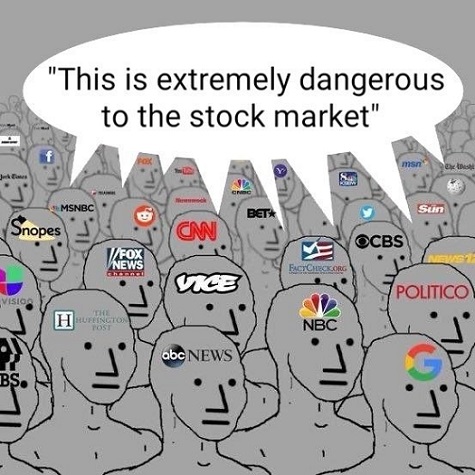
Meme stolen from Ace of Spades H.Q.
The press conveyed panic and moral disgust. “I didn’t realize it was this cultlike,” said short-seller Andrew Left of Citron Research, without irony denouncing the campaign against firms like his as “just a get rich quick scheme.” Massachusetts Secretary of State Bill Galvin said the Redditor campaign had “no basis in reality,” while Dr. Michael Burry, the hedge funder whose bets against subprime mortgages were lionized in The Big Short, called the amateur squeeze “unnatural, insane, and dangerous.”
The episode prompted calls to regulate Reddit and, finally, halt action on the disputed stocks. As I write this, word has come out that platforms like Robinhood and TD Ameritrade are curbing trading in GameStop and several other companies, including Nokia and AMC Entertainment holdings.
Meaning: just like 2008, trading was shut down to save the hides of erstwhile high priests of “creative destruction.” Also just like 2008, there are calls for the government to investigate the people deemed responsible for unapproved market losses.
The acting head of the SEC said the agency was “monitoring” the situation, while the former head of its office of Internet enforcement, John Stark, said, “I can’t imagine there isn’t an open investigation and probably a formal order to find out who’s on these message boards.” Georgetown finance professor James Angel lamented, “it’s going to be hard for the SEC to find blatant manipulation,” but they “owe it to look.” The Washington Post elaborated:
To establish manipulation that runs afoul of securities laws, Angel said regulators would need to prove traders engaged in “an intentional act to push a price away from its fundamental value to seek a profit.” In market parlance, this is typically known as a pump-and-dump scheme …
Even Nancy Pelosi, when asked about “manipulation” and “what’s going on on Wall Street right now,” said “we’ll all be reviewing it,” as if it were the business of congress to worry about a bunch of day traders cashing in for once.
The only thing “dangerous” about a gang of Reddit investors blowing up hedge funds is that some of us reading about it might die of laughter. That bit about investigating this as a “pump and dump scheme” to push prices away from their “fundamental value” is particularly hilarious. What does the Washington Post think the entire stock market is, in the bailout age?
H/T to Larry Correia for the link.
Toyota’s Invincible Truck
Big Car
Published 1 Nov 2020Toyota’s best-selling vehicle is the long-running Toyota Corolla, but second is Toyota’s resilient pickup the Hilux that’s been sold for over 50 years. No matter where you are in the world, you’ll likely find one moving up to a ton of cargo down a dusty lane. In the process it’s turned into a bit of a Jekyll and Hyde vehicle. On the one hand it’s the basic indestructible commercial vehicle that thousands of businesses rely on every day. On the other it’s become a well-specced weekend leisure vehicle. And in some cases it’s a bit of both! So why did this unassuming vehicle get a place of honour at the Top Gear studio, and what other successful vehicles have been born out of this long-running pickup?
If you’d like to support what I do, and get early access to advert-free videos and exclusive channel updates, please consider supporting the channel from just $1 or 80p a month: http://patreon.com/bigcar

January 28, 2021
GameStop in a very different kind of game
In the NP Platformed newsletter, Colby Cosh looks at the fascinating gyrations of GameStop’s share price in the grip of an unexpected group of players in the market:
“GameStop” by JeepersMedia is licensed under CC BY 2.0
GameStop has long been seen by institutional investors as following down the road of Blockbuster Video: it’s a bricks-and-mortar retailer whose main product is downloadable from your sofa. For that reason, it is heavily shorted by professional funds who normally eschew short-selling, which does have the risky feature of potentially infinite negative downside.
Enter Reddit, the website for special-interest user forums of all kinds. A Reddit “Wall Street bets” board uncovered evidence in regulatory filings that some hedge funds had legitimately dangerous large short positions representing bets against GameStop’s flaccid share price. A few hobby investors began to buy GameStop out of a sense of adventure and perhaps nostalgic loyalty. More importantly, they began to preach the gospel to others.
This is explicit “market manipulation,” but done in the open; it is surely as legal as any other conversation. GameStop’s price (NYSE symbol: GME) surged upward as word spread amongst day traders and other amateur investors. And as the random-looking rise in price got noticed, the whole scheme, itself rather reminiscent of a video game, went viral.
As of Jan. 12, GME was below $20, which is about where most analysts thought it belonged on merit, or lack thereof. The price as I type this particular sentence is $328.81. The backs of some funds with heavy short positions have been broken.
High finance seems somewhat terrified, as amateur investing websites — ones pioneered by the financial industry itself — begin to throw roadblocks in front of late-arriving GME buyers. For itself, Wall Street will invest billions replacing copper wire with fiber optics to gain microsecond arbitrage advantages in the market; for you and I, the good old portfolio can get conveniently 404ed for an afternoon.
This suggests that Wall Street may not have reckoned with the full possibilities of a world of proletarian shareholders. The stock market has proverbially been a playground of “animal spirits” since long before John Maynard Keynes used that phrase in 1936. What happens to an ecosystem when new animals show up? One can surely count on at least a minimum of chaos; maybe the surprise is that it took so long to take this game-like, combative form.
The economic impact of a US national minimum wage of $15 per hour
I missed this post by Warren Meyer last week, but it’s still very topical:
I have talked a lot about the negative effects of higher minimum wages on low-skill workers. Two good example background posts are here and here. I covered how a broad range of labor regulation hurts unskilled workers in a cover story for Regulation magazine a few years back. Unfortunately, in a country where the average American buys about $1000 in lottery tickets each year, the willingness to believe we can get something for nothing is strong.
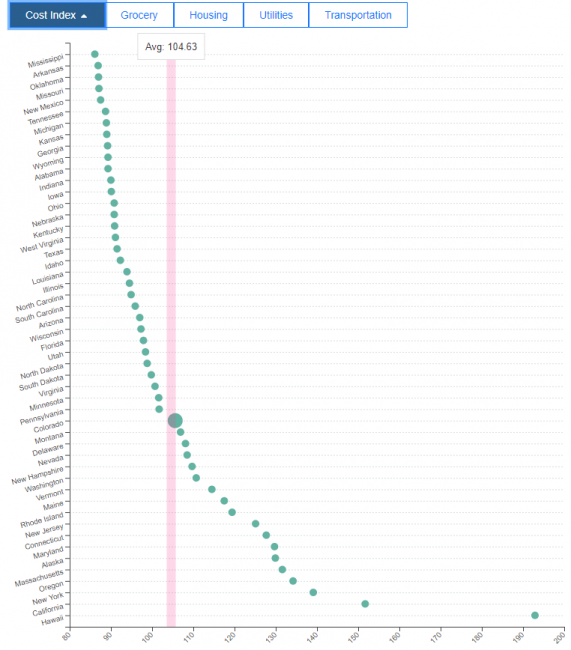
But I want to talk specifically about a Federal minimum wage increase, where one other problem emerges. The best way to state this is — how can one possibly set the same minimum wage for San Francisco at the same rate as one does for rural Mississippi? Here is one source for comparative state cost of living. Doing this by county would make the curve even wider.
Cost of living in Hawaii is more than 2x that of Mississippi. CA and NY are not far behind. A minimum wage that might comfortably be accommodated in San Francisco (and note even there the rise to $15 was ending service jobs in that city long before COVID), would be an economic disaster for rural Alabama. I don’t tend to think primarily along racial lines as seems to be the case on the Left today, but basically this is a policy driven by rich white tech guys in San Francisco that is going to devastate the employment prospects of rural blacks.
Whatever one’s misgivings about minimum wages, it is certainly true that allowing states to take the lead on setting minimum wages (counties would make even more sense) makes a lot more sense that trying to take action at the national level. Even with state action there are disparities.
January 23, 2021
How .22LR Ammo is Made
Lucky Gunner Ammo
Published 16 Apr 2020We were offered a rare glimpse into Federal’s rimfire plant in Anoka, MN to watch how .22 LR ammunition is made. We all know the basic components involved — each cartridge consists of a case with primer, propellant, and a bullet. Watching them all come together on a massive scale with a choreographed dance of modern automated machinery is a surprisingly gratifying experience.
Special thanks to our friends at Federal Ammunition and Vista Outdoor for the invitation!
Support our channel. Buy ammo from Lucky Gunner!

January 19, 2021
Milton Friedman’s “Shareholder Doctrine” is alive and well
Satish Bapanapalli on why Friedman’s doctrine helps to explain why auto manufacturers spend so much money to crash-test their vehicles:

Ford Focus versus Ford Explorer crash test IIHS by Brady Holt is licensed under CC BY 3.0
Of all of Friedman’s great ideas, the Shareholder Doctrine is perhaps the most misunderstood by academics, in large part because many left-leaning intellectuals use the good old straw man argument to misleadingly caricature the doctrine as a “profit-at-all-cost system regardless of human toll.”
Case in point, the latest sermon by some reputed academics published in Fortune magazine: “50 years later, Milton Friedman’s shareholder doctrine is dead.”
This one has all the usual tropes, including the claim that “Friedman … urged business to use its muscle to reduce the effectiveness of unions, blunt environmental and consumer protection measures, and defang antitrust law. He sought to reduce consideration of human concerns [such as] treat[ing] workers, consumers, and society fairly.”
Friedman said no such things. Read it for yourselves. Friedman’s primary argument was that it is not the job of the officers of a corporation (corporate executives) to fight for social causes. The officers must only act in accordance with the shareholder’s wishes, “which generally will be to make as much money as possible while conforming to the basic rules of the society, both those embodied in law and those embodied in ethical custom.”
Of course, in some cases, the shareholders may themselves encourage charitable spending and other corporate policies and activities deemed “socially responsible.” In which case, executives are tasked with finding the best ways to fulfill those objectives. In his article, Friedman clearly demonstrates why this is a logically precise position.
The scolds, who authored the Fortune article, put forth an alternative. Their “three pillars” proposal advocates for laws to be imposed on corporations with vague and fuzzy objectives (note the italicized words) such as “responsible corporate citizen[ship]”, “treating workers … fairly“, “avoiding externalities, such as carbon emissions, that cause unreasonable or disproportionate harm to others”, and corporations should make profits by “benefiting others.” To rub foolishness on the vagueness, the proposal calls for putting the onus on the corporations to measure and demonstrate progress on these fuzzy objectives! To put it in Friedman’s own words, such proposals “are notable for their analytical looseness and lack of rigor.”
January 16, 2021
QotD: Make companies product-focused again
But pretty much anything else … please just STFU unless it is directly related to the business. I get that certain “life style” brands might want their logo in a Formula One car or on Eddie Izzard’s frock. But I am not interested in how inclusive the local bookstore is, nor do I want to hear that an auto-parts shop is proud of the blasted NHS.
I do not even want any companies declaiming how much they support causes I like, let alone ones that I either oppose or which just make me roll my eyes at the sheer presumption of their marketing department. For me, this is negative marketing. I already avoid certain shops and restaurants that prominently display their “social awareness” to me: they are actually doing the opposite, emphasising that I am not their target market. So I take them at their word and if I can easily get what they sell elsewhere from someone who doesn’t, that is what I always do.
Make companies product-focused again.
Perry de Havilland, “Make companies product-focused again”, Samizdata, 2020-09-30.
January 12, 2021
“Big Tech” flexes the muscles and squeezes down the Overton Window online
In the FEE Daily newsletter, Brad Polumbo outlines the collusive mass deplatforming of President Trump and many of his high profile supporters:
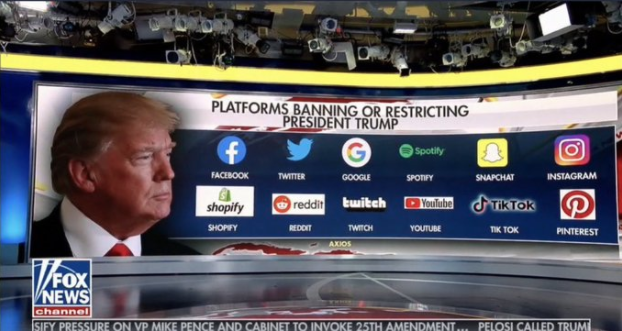
Screencap of a Fox News report on the social media networks that have deplatformed President Donald Trump, January 2021.
Amid the fallout from the January 6 attack on the US Capitol, President Trump has been banned from just about every social media platform.
This crackdown is, frankly, unprecedented.
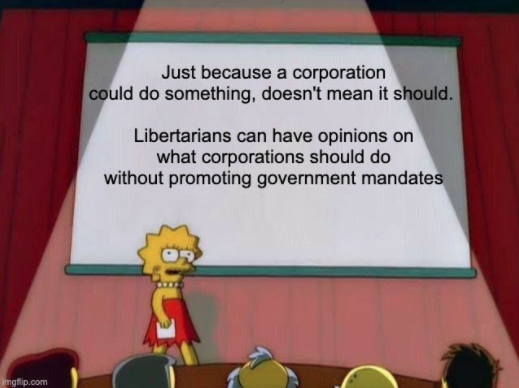
To be sure, social media and tech companies are private companies, and are not bound by the First Amendment. They have no legal obligation to host President Trump’s speech.
But there’s a question beyond can here that ranges into the should.
And I, for one, find it extremely disturbing that the elected President of the United States — who just weeks ago received roughly 75 million votes — is deemed beyond the pale of acceptable speech by Silicon Valley overlords who are overwhelmingly left-wing. Especially so given that these same platforms still allow the literal Chinese Communist Party to post pro-genocide propaganda and allow the members of the Iranian regime to openly foment violence.
The least consumers can demand is some consistency. Personally, I would find it much more reasonable for companies like Twitter to remove individual posts, including by President Trump, that violate rules — like fomenting violence — than to erase prominent political figures from the digital conversation entirely.
We should all want to see a free and open discourse online promoted by the companies we patronize. At the same time, none of this is cause for government control of the internet or meddling with the Section 230 liability shield.
If conservatives don’t like how Twitter CEO Jack Dorsey regulates content, they’d hate how Kamala Harris would do it.
January 6, 2021
The Use and Abuse of the US Postal System (feat. Mr. Beat)
The Cynical Historian
Published 10 Oct 2020Thanks to Private Internet Access for sponsoring this video. Click here to get 77% off and 3-months free: http://www.privateinternetaccess.com/…
We’ve been seeing a lot of coverage about the post office here in the United States. A lot of folks talk about the history of it, but generally in a piecemeal fashion. The fact most of this commentary lacks is that the post office has always been a political tool, from its beginnings even before the US Constitution. Interestingly enough, what it has been used for over the years has changed substantially, but it is always a harbinger of the up and coming dominant ideology. The post office is a cornerstone of our democracy. The postal system in the United States is uniquely important.
Check out Mr. Beat’s video: https://www.youtube.com/watch?v=favVdKa6cRQ
————————————————————
Connected videos:
3:30 – 1776 | Based on a True Story: https://youtu.be/xY4Te8Qm07A
9:15 – What caused the Mexican-American thing? https://youtu.be/HTmSN4Exci0
9:15 – What Caused the Texas Revolution? https://youtu.be/lDWH-DC74Pk
9:25 – California Gold Rush: https://youtu.be/W1dmyx6LBKA
9:30 – History of California: https://www.youtube.com/playlist?list…
11:30 – The Sectional Crisis: https://youtu.be/Ff2AKILyi0o
14:05 – History of Voting by Mail: https://www.youtube.com/watch?v=favVd…
18:25 – Trains and Oil in California: https://youtu.be/0Ef0Ir-hbFc
18:30 – The History of Early Flight: https://youtu.be/sPgxuD0uYYE
20:35 – US Veterans History: https://youtu.be/ANUqaNykuRs
————————————————————
references:
The United States Postal Service: An American History (Washington, DC: United States Postal Service, 2020). https://about.usps.com/publications/p… [PDF]USPS’s website has a trove of information on their history: https://about.usps.com/who-we-are/pos…
The national postal museum is run by the Smithsonian and includes numerous research articles available to anyone on their website: https://postalmuseum.si.edu/research-…https://www.nationalgeographic.com/hi…
————————————————————
Support the channel through PATREON:
https://www.patreon.com/CynicalHistorian
or by purchasing MERCH: teespring.com/stores/the-cynical-hist…
LET’S CONNECT:
Discord: https://discord.gg/Ukthk4U
Twitter: https://twitter.com/Cynical_History
Subreddit: https://www.reddit.com/r/CynicalHistory/————————————————————
Wiki: The United States Postal Service (USPS; also known as the Post Office, U.S. Mail, or Postal Service) is an independent agency of the executive branch of the United States federal government responsible for providing postal service in the United States, including its insular areas and associated states. It is one of the few government agencies explicitly authorized by the United States Constitution.
The USPS traces its roots to 1775 during the Second Continental Congress, when Benjamin Franklin was appointed the first postmaster general. The Post Office Department was created in 1792 with the passage of the Postal Service Act. It was elevated to a cabinet-level department in 1872, and was transformed by the Postal Reorganization Act of 1970 into the United States Postal Service as an independent agency. Since the early 1980s, many direct tax subsidies to the USPS (with the exception of subsidies for costs associated with disabled and overseas voters) have been reduced or eliminated.
————————————————————
Hashtags: #history #USPS #USMail

January 5, 2021
QotD: Tax “loopholes”
Nope. They’re just laws. These “loopholes” exist because at some point in time congress (both democrat and republican both!) decided that they wanted to promote some type of behavior or discourage some other behavior. So they basically put a reward into the law saying if you do this thing we like, you’ll pay less taxes! Or the opposite, congress wanted to discourage some behavior, so if you do that thing we don’t want, it will cost you more.
Both sides have done this forever, state and federal. We want you to drive electric cars so if you buy an electric car you get a tax break this year. YAY! Uh oh, we want you to stimulate the economy by buying this kind of machinery faster, so you have to depreciate your assets this other way or you’ll pay more! BOO! You get a discount for paying your employees health insurance, YAY! Oh, wait … Not that kind of health insurance. BOO!
So on and so forth, up and down, these perks come and go, all based upon whatever behavior congress is trying to promote at that time (or what favors they are doing for their friends). Why was mortgage interest deductible? Because at one point congress said “we really want people to own houses!” Even regular people have things that are considered “loopholes” to somebody.
So when the blue check mark journalism major (who probably dropped out of PoliSci because “there’s too much math”) declares that it is immoral that some rich dude didn’t pay his fair share because he used loopholes, those are basically a bunch of meaningless buzz words strung together to prey on the feelings of the gullible.
Larry Correia, “No, You Idiots. That’s Not How Taxes Work – An Accountant’s Guide To Why You Are A Gullible Moron”, Monster Hunter Nation, 2020-09-28.
January 1, 2021
QotD: Buying “organic” food
Take “no GMOs” for starters. That’s nonsense; it’s barely even possible. Humans have been genetically modifying since the invention of stockbreeding and agriculture; it’s what we do, and hatred of the accelerated version done in a genomics lab is pure Luddism. It’s vicious nonsense, too; poor third-worlders have already starved because their governments refused food aid that might contain GMOs. And without GMOs it’s more than possible that the new wave of wheat rust, once it really gets going, might condemn billions to death.
Vegan? I’ve long since had it up to here with the tissue of ignorance and sanctimony that is evangelical veganism. Comparing our dentition and digestive tracts with those of cows, chimps, gorillas, and bears tells the story: humans are designed to be unspecialized omnivores, and the whole notion that vegetarianism is “natural” is so much piffle. It’s not even possible except at the near end of 4000 years of GMOing staple crops for higher calorie density, and even now you can’t be a vegan in a really cold climate (like, say, Tibet) because it’ll kill you. In warmer ones, you better be taking carnitine and half a dozen vitamins or you’re going to have micronutrient issues sneak up on you over a period of years.
OK, I give on gluten-free. Some people do have celiac disease; that’s a real need. But “no trans fat”? Pure faddery, or the next thing to it. The evidence indicting trans fats is extremely slim and surrounded by a cloud of food-nannyist hype. I hate helping to keep that sort of balloon inflated with my dollars.
Who could be against “fair trade”? Well, me … because the “fair trade” crowd pressures individual growers to join collectives with “managed” pricing. If you’re betting that this means lazy but politically adept growers with poor resource management and productivity prosper at the expense of more efficient and harder-working ones, you’ve broken the code.
Finally, “pesticide-free”. Do I like toxic chemicals on my food? No … but I also don’t fool myself about what happens when you don’t use them. This ties straight back to the general cluster of issues around factory farming. Without the productivity advantages of pesticides, synthetic fertilizer, and other non-“organic” methods, farm productivity would plummet. Relatively wealthy people like me would cope with reduced availability by paying higher prices, but huge numbers of the world’s poor would starve.
I buy “organic” food because it tastes better and I can, but I feel guilty about reinforcing all the kinds of delusion and superstition and viciousness that are tied up in that label. We simply cannot feed a world population of 6.6 billion without pesticides and factory farming and GMOs and preservatives in most bread; now, and probably forever, “organic” food will remain a luxury good.
Try telling its political partisans that, though. Hyped on their belief in their own virtue, and blissfully ignorant about scale problems, they have already engineered policies that have cost thousands of lives during spot famines. The potential death toll from (especially) anti-GMO policies is three orders of magnitude higher.
And my problem reduces to this: how can I buy the kind of food I want without supporting dangerous delusions?
Eric S. Raymond, “Organic guilt”, Armed and Dangerous, 2010-08-23.
December 29, 2020
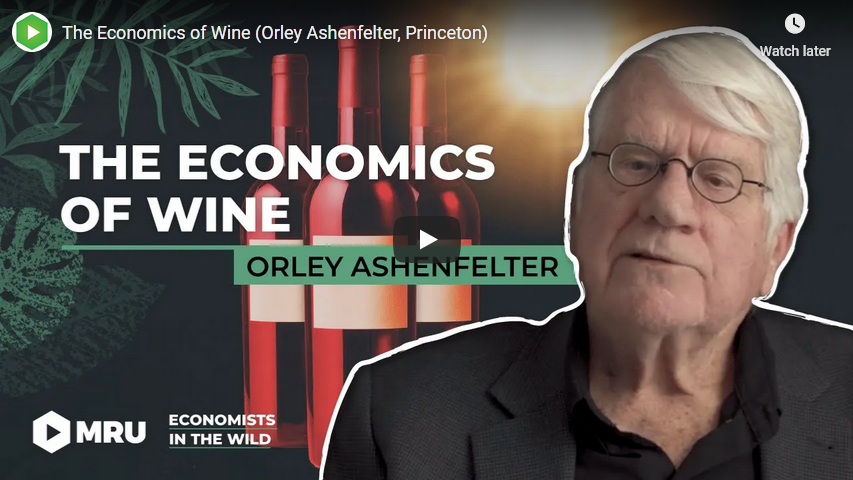
The Economics of Wine (Orley Ashenfelter, Princeton)
Marginal Revolution University
Published 30 Sep 2020What does an economist know about wine? Given that many wines need years to mature, how can one predict which ones will be great or not?
Princeton’s Orley Ashenfelter explains how he used economic principles and regression analysis to predict wine quality (and score great deals!). His research helped spawn an entire field dedicated to the economics of wine.
This video is based on the following paper:
Predicting the Quality and Prices of Bordeaux Wines By Orley Ashenfelter
https://www.researchgate.net/publicat…More of Orley Ashenfelter’s work: https://irs.princeton.edu/people/orle…
Orley Ashenfelter’s vineyard: https://cedarrosevineyards.com/
Want to see more Economists in the Wild? Check out our series: https://mru.io/economists-wild-67905