
The incorrigible ye have always with you, as somebody must’ve said. Social science types slice it different ways, call it different things — the free rider problem, the tragedy of the commons, etc. — but they all amount to the easily-observed fact that some folks just can’t play well with others. Not “won’t play well with others”; can’t play well with others. Any given population of sufficient size is going to have its unmanageable knuckleheads who are always working at cross-purposes against everyone else, who seem to just get off on causing chaos.
Even purpose-built groups of highly trained specialists fall victim to it, once a certain critical mass is reached. Sports teams call that kind of guy “the locker room cancer”, but it applies to any group. Get a team of five aeronautical engineers together and you’ll get a cool plane. Get a group of fifty together, and you’ll get nothing but a giant nerd slap fight.
There are three plausible explanations for this:
- Social
- Biological
- or some combo of the two.
The Left (by which I also mean the Right) will, of course, go all in on {1}. It’s an article of faith for them, but it’s not necessarily wrong because of that. See above: Every one of those aeronautical engineers engaged in the giant 50-nerd slap fight is, on his lonesome and in every other context, the definition of a solid citizen. Certainly nobody groans “There goes the neighborhood!” when someone from Lockheed Martin buys a house down the block. There must be something to the idea that social conditions cause knuckleheadery.
Severian, “The Scientific Management of Populations”, Rotten Chestnuts, 2020-02-15.
February 19, 2023
QotD: “… doesn’t play well with others”
February 18, 2023
George Hudson: Railway King or Prince of Darkness?
Jago Hazzard
Published 20 Dec 2020Entrepreneur, politician, businessman, visionary, benefactor, conman. There’s a lot to unpick with old George.
(more…)
February 16, 2023
The mass spell to destroy Hogwarts Legacy turns out to be a squib
All the angry people on social media had a new thing to be angry about: the release of a new online game based on the works of she-who-must-not-be-named (that’d be J.K. Rowling if you haven’t been keeping up with the woke’s ledger book of cancelled persons). They’d gather in their mighty legions, denounce the evil woman and the tech company would shiver and shake and then apologize for offending them and pull the game from the market, just like so many other companies had fallen to their online rage before.
It hasn’t quite worked out that way, as Tom Knighton relates:

The extreme left, those we term as “woke”, like to think they have a great deal of power. They think they’re the majority of the nation, and that they can shift the world based on their own whims.
And, in the past, it sure looked like it.
They’d get on Twitter and scream in outrage and brands would back down. They’d issue apologies and capitulate with the mob.
Then JK Rowling got on their bad side. She doesn’t think transwomen are women, that they haven’t lived with the struggles that women grow up with.
So, they decided to destroy anything they can associate with her.
That included the new video game, Hogwarts Legacy. Before the game came out, they tried to sabotage it on Steam, describing it as a “genocide simulator”.
I’ll be honest, that made me want to play the game. Apparently, I was far from alone.
Hogwarts Legacy has got off to a very big start at UK games retail, and is comfortably the No.1 game of the week (GfK data).
It is the biggest launch for any Harry Potter game ever, with sales 64% higher than the previous best — Harry Potter and the Philosopher’s Stone from 2001. In fact, the biggest week for a Harry Potter game wasn’t a launch week at all, it was the second week of the Philosopher’s Stone (due to hype around the movie). Even compared to that week, Hogwarts Legacy was still bigger by 2%.
This result is more impressive when you consider this is just for physical sales. Hogwarts Legacy would have received a substantial number of digital downloads (that data will come later in the week), whereas Philosopher’s Stone didn’t have any digital sales back in 2001. Therefore, the success will be even more pronounced once all the data is in.
In other words, the woke don’t have the pull they like to believe they do.
In a rational world, companies would see this and take it to heart: despite their apparent popularity on some social media sites, the very very woke are a tiny layer of froth on the ocean of non-woke customers. It’s often said that the terminally online think that Twitter is the real world — which is why Elon Musk taking over their preferred online megaphone was so traumatic to so many of them — but they’re mostly bellowing at one another, not at the population as a whole.
February 14, 2023
You need a tailor. And a cobbler.
At least, that’s Tom Knighton‘s take:
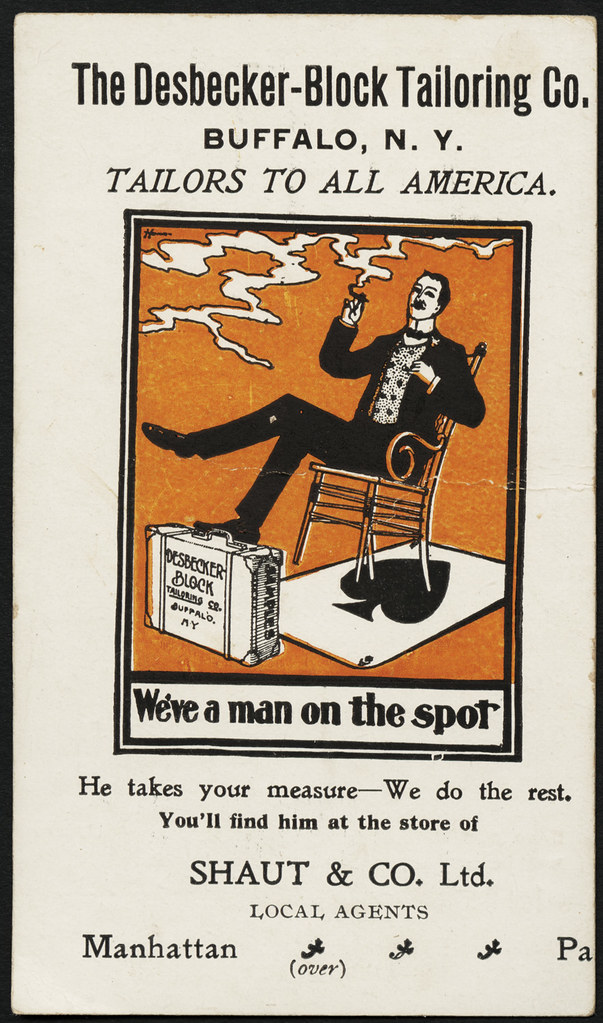
“The Desbecker-Block Tailoring Co. Buffalo, N. Y. Tailors to all America. We’ve a man on the spot. He takes your measure – we do the rest.” by Boston Public Library is licensed under CC BY 2.0 
 .
.
I’m now of the opinion that every man needs a tailor and a cobbler to go along with their barber.
Why? Because quality has a quantity all its own.
Yeah, I know that phrase usually goes the other way around, but we’re not talking about warfare where you need a lot of tanks and airplanes. We’re talking about clothes and accouterments. You can only wear one suit and one pair of shoes at a time. You’ve only got one head to wear a hat on. You don’t need 500 of each to have a well-rounded wardrobe.
So why do we? Why do we, as a society, insist on buying so much so cheaply?
What’s more, are you someone who supports those in the trades while simultaneously engaging in activity that threatens some of them?
Look, I get that not everyone can drop $500 for shoes or $5,000 for suits. I sure can’t, after all, so there’s no way I’d expect anyone else to. In fact, no one has to do any such thing.
However, what they can do is buy the best quality they can find, particularly in a grade that can be repaired and/or altered if needed.
We can start utilizing these tradesmen, hopefully needing them more often than our plumbers or auto mechanics. Not only will we dress better, but we’ll also show more young people there are other ways to go forward in life without spending tens of thousands of dollars to get a college degree that qualifies them for little more than to ask, “Do you want fries with that?”
I’m certainly in agreement with Tom on where the needle should rest on the quality-quantity meter, in that I’ve always preferred to buy higher quality whenever I could afford it rather than cheaper but lower quality items. It’s mostly paid off for me, although others in my family were of the other persuasion, where “more now” was better than “lasts longer”.
In a later post, he quotes Sam Vimes and again, I largely agree:
Despite that, I can buy quality. I may have to pay a bit more upfront, but it’s like the Vimes theory of boots written by Sir Terry Pratchett that’s been talked about here a couple of times:
The reason that the rich were so rich, Vimes reasoned, was because they managed to spend less money. Take boots, for example. He earned thirty-eight dollars a month plus allowances. A really good pair of leather boots cost fifty dollars. But an affordable pair of boots, which were sort of OK for a season or two and then leaked like hell when the cardboard gave out, cost about ten dollars. Those were the kind of boots Vimes always bought, and wore until the soles were so thin that he could tell where he was in Ankh-Morpork on a foggy night by the feel of the cobbles. But the thing was that good boots lasted for years and years. A man who could afford fifty dollars had a pair of boots that’d still be keeping his feet dry in ten years’ time, while a poor man who could only afford cheap boots would have spent a hundred dollars on boots in the same time and would still have wet feet. This was the Captain Samuel Vimes “Boots” theory of socioeconomic unfairness.
So, spend the money on the leather boots and skip having to spend it later.
As a result, though, that’s kind of luxurious.
February 13, 2023
Appliance futility by design
Tal Bachman recounts a miserable — but increasingly common — experience with modern “energy efficient” home appliances:
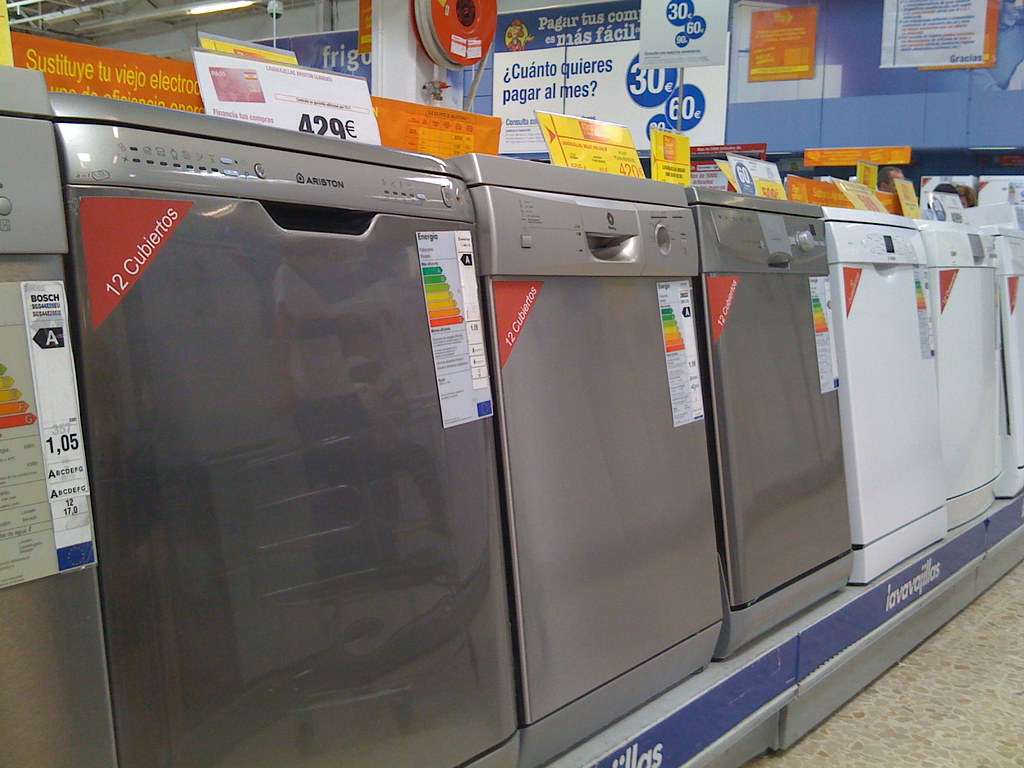
“A-rated energy appliances” by Tom Raftery is licensed under CC BY-NC-SA 2.0


The LG 5.8 cubic foot Capacity Top Load Washer sat in the laundry room, brand new. Maybe it was my imagination, but it looked insouciant.
Dad said it was the latest and greatest in laundering technology. Supposedly, some sort of internal sensor system (having something to do with a computer) fine-tuned water levels depending on clothing weight. Or something. I can’t remember exactly what he — or was it the moving guy? — said.
I did notice the washing machine had several preset wash cycles — Allergiene, Sanitary, Bright Whites, Towels, Heavy Duty, Bedding, and more. You could select them with a shiny, space-age-looking chrome dial. (I would later discover the machine had other fancy features with names like TurboWash™ 360, ENERGY STAR® Qualified, Smart Diagnosis™, and ThinQ™ Technology [Wi-Fi Enabled]).
[…]
Well, it was win-win-win, with a minor caveat. The caveat was the washing machine. Turns out that for all its razzle-dazzle features, it didn’t actually clean clothes. Even worse, it took hours to not clean clothes. The “Allergiene” cycle, for example, took almost four hours. Yet when you pulled your clothes out, you could still make out the orange juice or tomato sauce stains. I’d never encountered a more useless washing machine.
“How you feeling about this new washing machine?”, I asked Dad, a few days after the hunkering down began.
“Great!”, said Dad.Okay, I thought. That’s not unusual. Music — as opposed to the mundane or practical — occupies most of Dad’s awareness, and always has. Besides, most of his clothes are black, and he probably hasn’t noticed it’s not removing the ketchup stains. Maybe he will in a few weeks.
And maybe in the meantime, I thought, I could figure out a way to reprogram the machine for cycles which actually washed. And were faster.
But no. That turned out to be way too much to hope for. The machine allowed no independent control over water volume, cycle time, or water temperatures. It only allowed selection of a preset computerized cycle — none of which got your clothes clean.
[…]
Yet more irritating was the reason it skimped on water and power: it was trying to stop global warming. Oops — I mean “climate change”. It was “environmentally friendly”. Except it wasn’t, because you usually had to run at least two cycles to get your clothes clean. That’s right: you had to use the same amount of water in the end anyway, and double the electricity.
And so — not for the first time — I had stumbled upon yet another example of technological “progress” which exacerbated the very (pseudo) problem it purported to solve. The new useless LG “Save the World!” piece of garbage was the home equivalent of Hollywood stars taking private jets to a carbon reduction conference in Switzerland.
[…]
The US Department of Energy, I discovered, had begun imposing energy efficiency regulations in the early 1990s. A decade later, they made the regulations even stricter (see here also). Then, as the years passed, they made them even stricter. And then stricter. And then stricter. All the while, the feds offered appliance manufacturers huge tax incentives — i.e., huge cash rewards — to accelerate their phase out of functional washing machines.
Government succeeded. Today, minus the loophole-exploiting Speed-King (which the feds will probably crush soon), you cannot find a new washing machine — front- or top-loading — which washes clothes anywhere near as well as its predecessors. The rationale for this — saving the world from global warming — doesn’t even rise to the level of ludicrous. Just for starters, as I type this, we’re enduring one of the coldest winters ever recorded. New Hampshire’s Mount Washington Observatory just recorded a wind chill calculation of minus 109 degrees Farenheit, an all-time record for the United States (and approaching midway between the average temperatures of Jupiter and Mars). Temperatures are thirty degrees Farenheit colder than average in many places. Why would anyone want to bring temperatures down even further? And at the cost of destroying washing machine functionality? And what loon could actually believe home washing machines change the climate?
In any case, thanks to an essentially totalitarian government run by bought-and-paid-for liars, control freaks, and imbeciles, we have gone technologically backward — certainly in the appliance domain, but in others — for no good reason at all. (Regulations have also downgraded dishwashers, toilets, showers, and other appliances, but we can discuss those another time)
Back in 2019, Sarah Hoyt expressed her frustrations with “modern” “energy-efficient” appliances which matched our experiences exactly.
February 11, 2023
As predicted, HarperCollins’ fit of irrational exuberism has come to an unprofitable end
In the latest SHuSH newsletter, Ken Whyte refers back to HarperCollins and the predicted outcome of taking the one-off sales bonanza of peak pandemic and expecting those numbers to continue once the lockdowns eased:

Book sales spiked during the pandemic and no one enjoyed the ride more than HarperCollins CEO Brian Murray. In June 2021, with his revenue up 19% and his profits up 45 percent, Murray opened the taps:
We are being aggressive in terms of buying books. We’ve seen the book pie grow maybe 15 percent and so our response, which is part opportunist, part defensive, is to be aggressive in buying right now. Because if that pie remains large, we want to make sure that we get a nice share of the larger pie. And if it happens to wane a little bit, we want to make sure that we have a lot of new, exciting books for the future that will maintain our revenues at the current levels. So we’ve been very aggressive over the last six to nine months in trying to sign up the best books that we see in the marketplace.
Murray not only bought more books than usual, he paid more than usual. I read his comments at the time and called my buddy, ECW founder Jack David, who, in his half century in the business, has seen everything. Jack’s response: “Don’t do it!”
Jack and I agreed (see SHuSH 103) that even if Murray acquired a lot of good titles, revenues would disappoint in 2022 and beyond. The publishing pie hadn’t grown. It was temporarily inflated by the unusual and temporary circumstances of the pandemic. Inevitably, life would return to some semblance of normal and aggregate demand for books would revert to the mean. “Twelve months from now,” wrote SHuSH, “Murray will be out of range of 2021’s windfall profits, and perhaps worried about losing money. That’s when the cutting begins.”
We promised at the time to check back to discuss “the great publishing contraction of 2022”.
It’s been eighteen months and the great publishing contraction is now upon us.
Here are the last six months of 2022 according to the Association of American Publishers: July, down 14.9 percent from the previous year; August, down 9 percent; September, down 4.5 percent; October, down 9.3 percent; November, down 6 percent. December should be reported in a week or two. It, too, will be down something.
Another data source is NPD BookScan, which estimates book sales were down 6.5 percent in 2022 compared to 2021.
Give Brian Murray credit for at least being first among his colleagues to react to these new circumstances. He announced last week that he will be cutting 5 percent of his North American work force because the sales surge enjoyed during the pandemic has “slowed significantly as of late.” His note to staff said “we must pause to recognize the depth of the core issues we currently face”. He pointed directly at “unprecedented supply chain and inflationary pressures … increasing paper, manufacturing, labor, and distribution costs”. The company has been raising prices and cutting costs since last fall (so maybe our timing wasn’t off), but “more needs to be done”.
More indeed. Unfortunately. Book sales in 2022 may have been down from 2021 levels but they’re still 11.8 percent above 2019, the pre-pandemic year, suggesting the correction is not finished. Meanwhile, economists say there’s a 70 percent chance of a recession this year. Let’s hope they’re wrong or, at minimum, that any downturn will be shallow and quick.
February 9, 2023
“Prediction is very difficult, especially about the future” … but sometimes it’s almost prophetic
Once again, Ted Gioia’s Honest Broker Substack has something interesting I’d like to share with you (I wouldn’t blame you at all for cutting out the middleman and just subscribing for yourself):
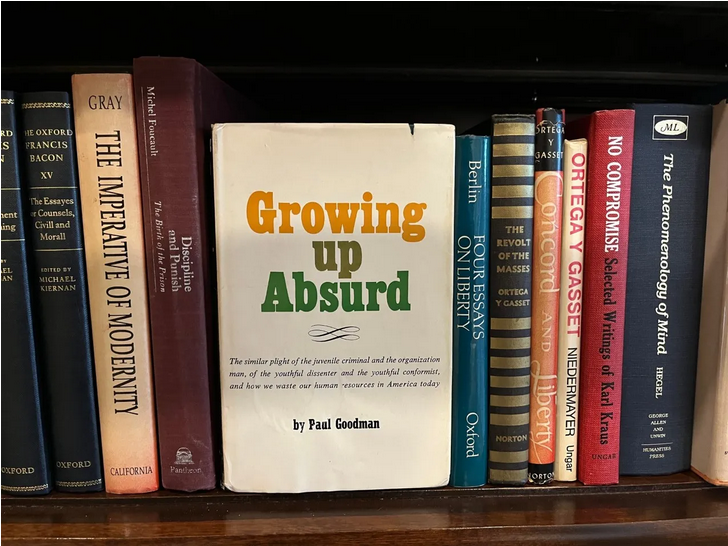
Today I want to focus on a single paragraph published in 1960.
You’re asking yourself: How much can a single paragraph matter — especially if it was written 63 years ago? But read it first and judge for yourself.
It’s a chilling paragraph.
[…]
By any measure, [Paul Goodman] was one of the most eccentric thinkers of the era. Yet he anticipated our current situation with more insight than any of his peers.
Let’s look at this one paragraph from the Preface to Growing Up Absurd. It’s a long paragraph — it takes up most of two pages. So we will break it down into pieces.
Goodman begins with a puzzle he needs to solve — society is stagnating everywhere, and we all can see it. But there’s no action plan to fix it. There’s a lot of huffing and puffing and finger-pointing everywhere, but nobody has even started on developing a practical agenda.
According to Goodman, this is because people “have ceased to be able to imagine alternatives”. Everybody accepts that the current system “is the only possibility of society, for nothing else is thinkable”.
Now comes his analysis, and — to my surprise — Goodman begins by talking about music. This was the last thing I expected in a social critique, but for Goodman the manufacturing of hit songs is a metaphor for everything else that’s wrong in a stagnant society.
He writes:
Let me give a couple of examples of how this [inability to imagine healthy alternatives] works. Suppose (as is the case) that a group of radio and TV broadcasters, competing in the Pickwickian fashion of semi-monopolies, control all the stations and channels in an area, amassing the capital and variously bribing Communications Commissioners in order to get them; and the broadcasters tailor their programs to meet the requirements of their advertisers of the censorship, of their own slick and clique tastes, and of a broad common denominator of the audience, none of whom may be offended: they will then claim not only that the public wants the drivel that they give them, but indeed that nothing else is being created. Of course it is not! Not for these media; why should a serious artist bother?
When I first read this, I was dumbstruck. Goodman wrote this during the winter of 1959 and 1960, when radio stations were independent and freewheeling. Back in my teen years, a single business was only allowed to control one AM station and one FM station. In 1985 this was increased to 12 stations on each band. And in 1994 this was raised again, this time to 20 AM stations and 20 FM stations.
But then all hell broke lose when the Telecommunications Act of 1996 passed in the Senate by a 91 to 5 margin and was signed into law. Now the sky was the limit — and all the airwaves it contained.
Soon Clear Channel Communications owned more than 1,200 radio stations in some 300 cities. The company began the process of standardizing and homogenizing our musical culture. We still suffer from that today.
Even after radio started losing influence in the Internet Age, huge streaming platforms (Spotify, Apple Music, etc.) ensured that access to the ears of America would be controlled by a tiny number of huge corporations. A musical culture that was once local, indie, and flexible has become centralized, corporatized, and stagnant.
How could Paul Goodman even dream of such a scenario back in 1960? That future was decades away at the time.
But we are only at the start of this visionary paragraph. Goodman now explains that the same thing will happen in universities.
Colleges and schools were small and non-bureaucratic back in 1960. Yet Goodman sees a crisis looming. On the next page Goodman warns against “the topsy-turvy situation that a teacher must devote himself to satisfying the administrator and financier rather than to doing his job, and a universally admired teacher is fired for disobeying an administrative order that would hinder teaching”.
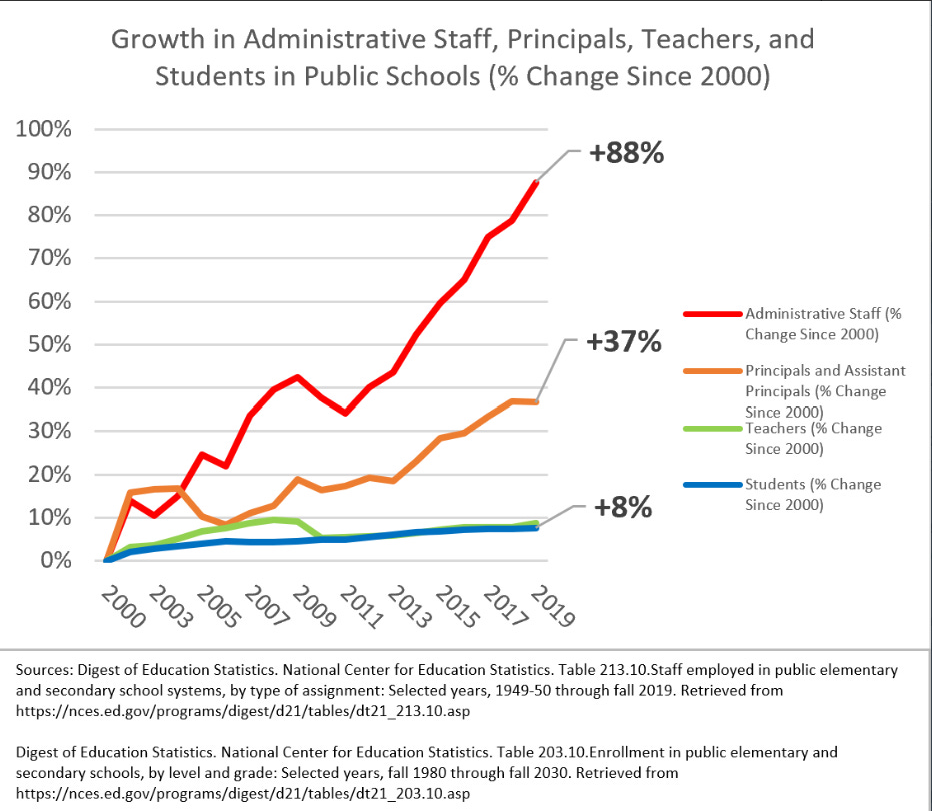
Administration at US colleges has grown exponentially in the last two decades and has turned almost every academic institution into a plodding bureaucracy — but how in the world did Goodman anticipate this in 1960?
Now let’s return to our chilling paragraph. Immediately after discussing radio stations, Goodman adds a gargantuan sentence. It jumps all over the place but hits the target at every twist and turn:
Or suppose again (as is not quite the case) that in a group of universities only faculties are chosen that are “safe” to the businessmen trustees or the politically appointed regents, and these faculties give out all the degrees and licenses and union cards to the new generation of students, and only such universities can get Foundation or government money for research, and research is incestuously staffed by the same sponsors and according to the same policy, and they allow no one but those they choose, to have access to either the classroom or expensive apparatus: it will then be claimed that there is no other learning or professional competence; that an inspired teacher is not “solid”; that the official projects are the direction of science; that progressive education is a failure; and finally, indeed — as in Dr. James Conant’s report on the high schools — that only 15 per cent of the youth are “academically talented” enough to be taught hard subjects.
Here in a nutshell is the credentialing crisis of our times. Learning is replaced by exclusionary certification programs that limit career opportunities — unless you take out loans and “purchase” the necessary credential from these academic gatekeepers.
This has become so destructive in our own time that many are crushed by student loans, and others seek ingenious ways of bypassing college entirely. There’s no way that Goodman could have grasped this in 1960 — when only 7.7 percent of Americans had college degrees.
Nor could he have known about the replicability crisis in science or the destructive games now played in awarding of scientific grants. Those are the problems of our times — not his.
But somehow Paul Goodman saw it coming.
February 7, 2023
Disney – An Empire In Collapse
The Critical Drinker
Published 6 Feb 2023Disney isn’t looking too healthy these days, with massive financial losses, collapsing stock prices and internal power struggles threatening to tear the House of Mouse apart at the seams. How did this happen? Let’s find out.
(more…)
February 6, 2023
How We Make Our Videos (and what it costs)
World War Two
Published 5 Feb 2023We’re excited to finally answer all your questions about where Indy lives, how we produce the series, and how many of us there are in the TimeGhost Team!
(more…)
Why Traditional English Cheddar Is Aged In Caves | Regional Eats
Food Insider
Published 9 Oct 2019The earliest record of cheddar anywhere is at Cheddar, in Somerset, in 1170. The land around this village has been at the heart of English cheesemaking since the 15th century. Today, as many Cheddar producers have upscaled and require more land, there is only one traditional cheesemaker left in the village.
(more…)
QotD: US railroad land grants
The speech was widely reprinted by those skeptical of government pork barrel (a term that first became popular about the time Knott gave his speech). Sixteen years later, Northern Pacific, which received what was probably the largest land grant to a private company in American history, reprinted the speech in this brochure.
This might seem strange except that NP annotated the speech with recent facts in bright red letters, such as that Duluth had grown to house 26,000 people by 1886, that more wheat was delivered to Duluth each year than to any other American city, and that it also saw deliveries of millions of board feet of lumber and hundreds of thousands of tons of iron ore each year.
NP didn’t say so in so many words, but its point was clearly that the land grants, contrary to Knott’s predictions, were a good thing for most if not all Americans. However, the brochure also didn’t mention that James J. Hill was proving that a railroad that didn’t receive any land grants or subsidies could provide just as many benefits without going bankrupt, which would leave both investors and taxpayers in the lurch. (The St. Paul & Pacific did receive a small land grant, but Hill paid fair market value for that railroad and land after it went bankrupt, thus Hill didn’t particularly benefit from the subsidy.)
Train Lover (Randal O’Toole), “Debate Over Railroad Land Grants”, Streamliner Memories, 2022-11-01.
February 4, 2023
Federal regulation of the Canadian book market has resulted in 95% of the market now being foreign owned
For the record, I don’t think this kind of cultural regulation is a good idea to start with, but as Ken Whyte points out, if staving off foreign ownership was the primary intent, could it have failed any more comprehensively than this?
Sometime last year, the Association of Canadian Publishers, which represents most of the independent book publishers in English Canada (Sutherland House is not a member), began discussing a radical — some might say dangerous — new form of regulation for the Canadian book industry.
The ACP started from the reasonable position that the existing federal approach to regulating the Canadian book industry has failed. That approach is to encourage a Canadian-owned book sector and, ipso facto, to discourage foreign ownership of Canadian publishing. Successive Canadian governments, Conservative and Liberal, have paid lip-service to the policy and failed to enforce it. The multinational publishers — Simon & Schuster, Penguin Random House, HarperCollins — have moved into Canada in a big way. Great chunks of the Canadian-owned industry, including McClelland & Stewart and Harlequin Books, have been sold to foreign buyers.
The multinationals now account for about 95 or 96 percent of book sales in Canada. All but the last 5 or 6 percent of their revenue comes from sales of imported books, most of them produced in the US or UK.
The Canadian-owned component of the book sector, which produces the vast majority of Canadian author books, has shrunk to about 4 or 5 percent of the market and sales of Canadian-authored books, says the ACP, have “flatlined”.
So you can see why the ACP is interested in a new approach: for more than half a century, while pursuing an official policy of encouraging Canadian-ownership, our government has managed to hand almost the whole of our book industry to foreign-owned firms.
I, too, am interested in a new approach. It’s the ACP’s next step that worries me.
The ACP has been watching over the past couple of years as the federal government rewrites its Broadcasting Act. The thrust of Bill C-11 is to bring foreign-owned streaming services operating in Canada — the likes of Netflix, Apple, YouTube — under the jurisdiction of the Canadian Radio-televison and Telecommunications Commission (CRTC). The bill would grant the CRTC the power to impose on streaming services the same rules it imposes on the likes of CTV and Global and the companies that own them. It would compel streamers to use Canadian talent, abide by Canadian diversity requirements, prioritize Canadian content on their platforms, and give a percentage of their revenues to a fund to support the production of Canadian content.
It has occurred to the ACP that no one in government is asking foreign-owned book publishers to abide by Canadian content quotas or to deliver percentages of their revenue to a fund to support Canadian-owned book producers: “The absence of a CRTC or related regulatory body, along with the policies and programs that such a body can enact, has meant that non-Canadian firms enjoy unfettered access to the Canadian marketplace.”
That’s not quite right. Non-Canadian firms dominate Canadian publishing because the feds won’t enforce their existing policy, not because we don’t have a CRTC for books. In any event, the ACP is embracing the spirit of Bill C-11.
Oh, goody! Government bureaucratic oversight is bound to make Canadians more interested in reading Canadian books, right? I see no way that this could possibly fail.
February 1, 2023
QotD: Creating a hostile working environment
Anecdote is not data, of course; but ask any ordinary working woman* whether she’d prefer to work with men, or in a female-only workplace. The response may surprise you.
* This definition would exclude gender careerists and almost all rabid feministicals.
Kim du Toit, “Just Sayin'”, Splendid Isolation, 2022-10-26.
January 25, 2023
Sometimes – rarely – the boss really does embody all those “creative genius” tropes
At The Honest Broker, Ted Gioia considers the impact Steve Jobs had on Apple:
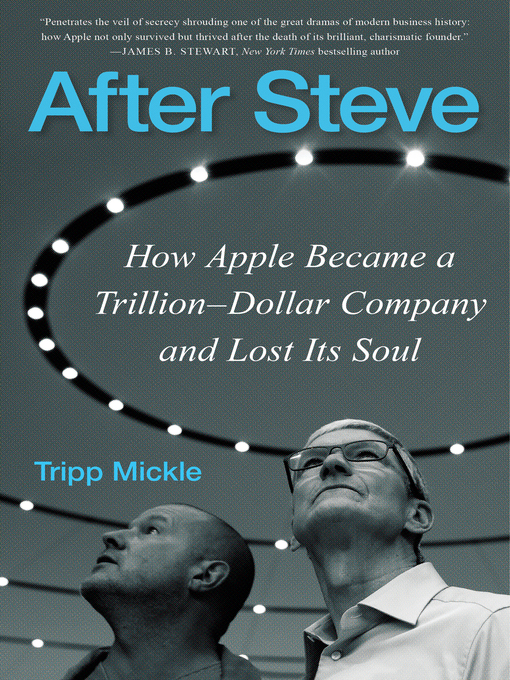
I share these reactions, because many other sectors of our culture (especially music) suffer from a similar malaise. And in most instances, the problems start at the top.
I’ve seen in so many different circumstances how the entire organization takes on the personality of the CEO — for better or worse. I’ve also seen how the replacement of a single individual can turn a bad situation into a great one, and vice versa.
The case of Steve Jobs is fascinating, and perhaps alarming too. He left Apple twice, and both times something similar happened.
In the first instance, Jobs was fired as CEO in 1985. The last thing he did before losing his job was launch the Macintosh computer. When he returned to Apple 12 years later, the single biggest source of revenue for the company was still the Macintosh. After more than a decade, the company was depending on the creativity of the guy they fired.
Steve Jobs died in 2011, and we have now reached the exact same time lag as before. Twelve years have elapsed since Jobs’s final departure, and the last big project he undertook before his death was the iPhone. And now after a dozen years, Apple’s largest source of revenues is still the iPhone. Once again, they are riding the momentum of his creativity, and have done shockingly little to expand his legacy.
By the way, in the interim between the two stints as Apple CEO, Jobs founded NeXT and ran Pixar. Fifteen Pixar films now rank among the 50 highest grossing animated films of all time, and they have won 23 Academy Awards. And because of his sale of Pixar to Disney, the entrepreneur’s widow Laurene Powell Jobs inherited 138 million shares of Disney stock.
That’s pretty good results for the lull in your tech career after you’ve been fired.
I know Jobs has many detractors. And maybe he was a hardass boss. In fact, he almost certainly was a hardass boss. But it’s tough to ignore those results — which not only changed a company but the entire culture of our times.
January 21, 2023
QotD: Farmers’ markets are a scam
Carefully navigating the Bugaboos, words leapt out at me from the stalls: “gluten free”, “vegan”, “no added sugar”, “no saturated fats”. It was more like advice from a doctor than things to eat. At the cheese stall I admit I was tempted by the chilli jam accompaniment, as it was described as “rich, tangy tomato with purple shallots and plump sultanas”, but all I needed to do was look at the price — a startling £10 for the small jar with a handwritten label — to decide that the Branston pickle sitting in my store cupboard would do just fine.
An older woman standing by the cheese stall looks as if she is about to pass out. It’s not the heat; rather she has just been informed by the vendor, a young woman with green hair and several face piercings, the price for a piece of Brie and a couple of small goat cheeses. And to add insult to injury, when the customer hands over the £20 to pay she is told, “We only take cards.”
So much for a local, friendly community space. The truth is, these markets are a rip-off, aimed at posturing fools with more money than sense, and food snobs that believe if food isn’t prohibitively expensive for the masses, it’s not good enough to take home and store in their gigantic Smeg fridge.
Julie Bindel, “Mugged by a mud-caked spud”, The Critic, 2022-10-15.


