Quotulatiousness

May 28, 2022

“… the only thing that is history are any immediate hopes for a more competitive communications marketplace in Canada”

Filed under: Business, Cancon, Government, Media, Technology — Tags: , , , , — Nicholas @ 03:00

Michael Geist pans the latest official misinformation from the federal government on telecommunications legislation:

Innovation, Science and Industry François-Philippe Champagne unveiled the government’s proposed new telecom policy directive yesterday, hailing it as a “historic step”. However, a closer look at the policy suggests that the only thing that is history are any immediate hopes for a more competitive communications marketplace in Canada. Once again, the government has shown itself unwilling to take a strong stand in favour of consumers and competition, instead releasing a directive that largely retains the status quo and sends the message to CRTC Chair Ian Scott to stay the course. Indeed, the primary purpose behind the announcement would appear to be an attempt to shield the government from criticism over its decision to leave the controversial CRTC decision on wholesale Internet access intact, thereby denying consumers the prospect of lower costs for Internet services.

While the new proposed policy directive features much needed details and helpfully replaces the 2006 and 2019 directives that often conflicted and enabled the CRTC to pay little more than lip service to the issue, it sends a strong signal that it is happy with the Commission’s current approach. For example, the directive’s summary on measures to address wholesale Internet access are all about the status quo: “requiring large companies to continue to give access to competitors” or “directing the CRTC not to phase out the existing model for wholesale access.” These are not instructions to change.

The same is true for mobile wireless competition. Rather that using the opportunity to accelerate competition through mobile virtual network operators, the CRTC is instead to directed to improve its hybrid MVNO model “as necessary”. A full MVNO model? The government says it is prepared to support it “if needed”. Based on the current market, it apparently believes it isn’t needed.

May 25, 2022

QotD: The “social responsibility” of business

Filed under: Business, Economics, Politics, Quotations, USA — Tags: , — Nicholas @ 01:00

When I hear businessmen speak eloquently about the “social responsibilities of business in a free-enterprise system,” I am reminded of the wonderful line about the Frenchman who discovered at the age of 70 that he had been speaking prose all his life. The businessmen believe that they are defending free enterprise when they declaim that business is not concerned “merely” with profit but also with promoting desirable “social” ends; that business has a “social conscience” and takes seriously its responsibilities for providing employment, eliminating discrimination, avoiding pollution and whatever else may be the catchwords of the contemporary crop of reformers. In fact they are — or would be if they or anyone else took them seriously — preaching pure and unadulterated socialism. Businessmen who talk this way are unwitting puppets of the intellectual forces that have been undermining the basis of a free society these past decades.

Milton Friedman, “The Social Responsibility of Business is to Increase its Profits”, New York Times, 1970-09-13.

May 24, 2022

QotD: Portuguese art and creative genius

Filed under: Business, Europe, Germany, History, Quotations — Tags: , , , , , — Nicholas @ 01:00

If Portugal weren’t such an old nation (but maybe it’s a second childhood) I’d call them the college kid of Europe. They can’t quite get their act straight, but they can be startlingly, amazingly creative. One of the things I’ve talked about here is how many of my brother’s cohort, coming of age at a time when there were NO jobs took up some kind of craft work, from making jewelry to (I used to covet them) making elaborate, hand painted wooden dragon mobiles and selling all of this. Looking back at that pre-EU time when it was relatively easy to set up a stall (illegal, of course) in downtown Porto, I realize most of the stuff on offer was downright artistic, and often incredibly creative when you realized what materials they were working with.

Then the economy recovered, they got jobs, a lot of them connected to or linked to government and all of that stopped. And of course with the EU there are no illegal stalls. I mean Papiere, bitte and all that.

And somehow, perhaps because the new generation knows they have all sorts of “benefits” and “support” coming to them and have never felt the bite of chaos, the crafts and arts in the stores are either startlingly mundane or bizarre. I’m still rather puzzled by entire “scenes from life” (including one that was an operating room) sculpted with penises instead of humans. I mean … who even buys that? Okay. We know who buys that. But do the German tourists and their nostalgie de la boue think they’re tapping into something uniquely “uninhibited and free”, some kind of wild Portuguese sexuality? Raises eyebrow. The Portuguese have been civilized land long before the Germans traded their furs for a place as Roman soldiers. And sure, the Romans could be startlingly and inappropriately sexual (I call to mind a mural, not out of place in a Roman middle class home that had monkeys copulating with children) but it didn’t mean that the culture was “free”, rather that they had different rules. Frankly, the sixties attempt to erase history has corrupted real art and … well, everything else.

Which is kind of the college student thing. Chaos and free time allows you to be very creative, but then you’re not organized enough to parlay that into a career. (I mean, if they’re destined to be the touristic “warm port” of Europe, perhaps they should consider letting real art flourish. Or even encouraging it. Grants for small businesses and young people. It beats the jobs that don’t exist. Just demand they be actually creative and accomplished, instead of giving grants for art that my kids could do at age two and about as interesting.

Sarah Hoyt, “The Ancient Enemy”, According to Hoyt, 2019-04-05.

May 12, 2022

Too many cannabis retailers? “… a scrappy band of politicians is coming together to save main street from the excesses of the free market”

Steve Lafleur points out that the temporary surplus of cannabis stores will inevitably self-correct, as most retail situations tend to do on their own without needing the “helpful” hand of government to intervene:

Lately there has been a moral panic brewing in Toronto about the number of marijuana stores in Toronto. Take this New York Times article, for example, which captures the mood with the quotes from various Torontonians. Or this BlogTO piece. And here is a link to a story about two city councilors (including my own) pushing for a moratorium on new pot shops.

At least on its face, the panic hasn’t been about the availability of cannabis products or any kind of (unsupported) claims about pot shops attracting crime. Rather, the concern is that there is simply an unsustainable number of shops that may be cannibalizing other retail opportunities. So a scrappy band of politicians is coming together to save main street from the excesses of the free market.

What could possibly go wrong?

The boom in pot shops is real. Legal marijuana retailing is a new phenomenon, and there has been a gold rush in the sector. This was first evident in financial markets during the 2018-19 weed stock boom (which went bust) as investors sought to capitalize on the rollout of legal marijuana sales in Canada. There are now nearly 2,000 pot shops in Ontario, and it’s not hard to find two on the same block. People aren’t wrong to point out that there has been a rapid buildout of marijuana retailers. Hence the push by City Council and now the Ontario Liberal Party, to restrict clustering of pot shops.

To be sure, new trends can push out old trends. And this can be frustrating. For instance, one insidious trend recently replaced two of my two favourite hole-in-the-wall restaurants: poke bowls. The trendy Hawaiian rice bowls have taken cities by storm. Businesses, understandably, want to capitalize on the trend. If people want it, businesses will sell it.

Trends can create dislocations. No one knows in advance how many poke restaurants — or pot shops — the market will bear, where they should locate, or what their operating hours should be. But through a process of trial and error, retailers and consumers will figure this out. And if it is just a flash in the pan trend, many will fail.

But that’s okay. That’s just the creative destruction of the market at work. It’s not always pretty, but it’s how we get new products and services. It’s a process. Sometimes the market rewards annoying things. But trying any effort to plan these things in a way that avoids over-saturation of short-lived trendy businesses would be rife with unintended consequences.

May 4, 2022

From “merely” censoring your words to seizing your funds

Filed under: Business, Liberty, Media, USA — Tags: , , , — Nicholas @ 03:00

Matt Taibbi on PayPal’s recent moves to quash independent media reporting that disagrees with or contradicts the “official story”:

In the last week or so, the online payment platform PayPal without explanation suspended the accounts of a series of individual journalists and media outlets, including the well-known alt sites Consortium and MintPress. Each received a variation of the following message:

Unlike many on the list, Consortium editor Joe Lauria succeeded in reaching a human being at the company in search of details about the frozen or “held” funds referenced in the note. The PayPal rep told him that if the company decided “there was a violation” after a half-year review period, then “it is possible” PayPal would keep the $9,348.14 remaining in Consortium‘s account, as “damages”.

“A secretive process in which they could award themselves damages, not by a judge or a jury,” Lauria says. “Totally in secret.”

Consortium, founded by the late investigative reporter Robert Parry, has been critical of NATO and the Pentagon and a consistent source of skeptical reporting about Russiagate, as well as one of just a few outlets to regularly cover the Julian Assange case with any sympathy for the accused. Ironically, one of the site’s primary themes involves exploring disinformation emanating from the intelligence community. The site has had content disrupted by platforms like Facebook before, but now its pockets are being picked in addition.

This episode ups the ante again on the content moderation movement, toward the world hinted at in the response to the Canadian trucker protests, where having the wrong opinions can result in your money being frozen or seized. Going after cash is a big jump from simply deleting speech, with a much bigger chilling effect. This is especially true in the alternative media world, where money has long been notoriously tight, and the loss of a few thousand dollars here or there can have a major effect on a site, podcast, or paper.

As MintPress founder and executive director Mnar Adley points out, the current era of content moderation — characterized by private platforms either overtly or covertly working with government to identify accounts for censure — really began with PayPal’s historic decision in 2010 to halt donations to Wikileaks. In that case, PayPal acted after receiving a letter from the State Department claiming the site’s activities were illegal.

“PayPal banning donations from WikiLeaks really set up the blueprint for today’s censorship”, Adley says.

May 3, 2022

Is all of social media just a “giant domestic surveillance operation”?

Filed under: Business, Media, Technology, USA — Tags: , , , , , , , , — Nicholas @ 05:00

Severian posted this last week, but I’m only just getting caught up now:

I was wrong about Musk buying Twitter. Lot of that going around — the Z Man got a whole podcast on “avoiding error” from his misread of the situation. It’s well worth a listen. I, too, had a “hot take” on Musk’s offer — not that it was particularly hot, as most folks on this side were saying it, but I too thought it was a stunt. After all, Musk, like Bezos and all the other “new commerce” billionaires, don’t exist without massive government support. I figured his “offer” was stoyak — he’s got something in the works in the Imperial Capital and needed to play hardball with somebody.

But I was also working off my longstanding assumption that Twitter, Faceborg, and all the rest are essentially CIA / NSA fronts. When I first heard about Facebook, my first thought was “Wait, don’t we already have Friendster? What does this bring to the table?” My second thought was the first one I’d had about Friendster: “That’s clever, I guess, but how on earth is this going to make money? Even if they saturate it with ads, to the point where it’s unusable — which will happen in about two weeks — they can’t monetize your personal data any farther. People are pretty set in their habits — once the algorithm figures out you’re the kind of guy who likes anime and New Wave music, any further data is useless.”

Being a much more naive, trusting sort back then, I figured it was just stupidity. You know, Pets.com level stupidity. The VC boys were trying to get another dotcom bubble inflated, because if the first one proved anything, it’s that people are dumb and will keep falling for the same obvious scam over and over. I could hear them in the board rooms: “This time, instead of sticking ‘cyber’ in front of everything, we’ll call it ‘Web 2.0.’ Cha-ching!”

Obviously that didn’t happen. So I went with the common explanation that was floating around in those days, that “social media” sites made their money by selling your data to advertisers. But that doesn’t pass the smell test either. For one thing, as I said above, your habits don’t change very much. For another, as anyone who has any experience with them knows, those algorithms really suck. The other day, for instance, I was listening to some old music one of the streaming music sites. And I mean really old. Nothing I’d played the whole morning had been composed after the 17th century, but the service’s algorithm was convinced that what I’d really like to listen to next was some rapper.

Indeed, the whole point of the ads on Pandora, Spotify, whatever seems to be: To annoy you to the point where you pay for their premium service. Pandora, for instance, either really really really believes I want a Surface Pro 8 and some Taco Bell, or they’re just playing those ads every two songs to annoy me into buying the premium service (which is every ad that isn’t Surface Pro or Taco Bell). Which is just bizarre, because I haven’t had Taco Bell since college — which was 30 years ago, and I paid cash — and this essay right here is the first time I have ever even typed the words “Surface Pro 8”, much less looked at the product.

I really wouldn’t be surprised that the “algorithm” is reading itself. Hey, this guy sure has seen a lot of ads for Taco Bell and Surface Pro! He must really want some!

But the algorithm for companies whose entire business model is e-commerce is no better. Amazon seems to have gone to a “push” model — they must be selling their suppliers on the idea that they can push you stuff, which is why they always pimp the same four or five items in the “Amazon’s Choice” recommendations, no matter what you’re searching for. And these again are laughably wrong — the only things I get off Amazon are used history and philosophy books, and stuff for my dog. Based on this, they have concluded that what I’m really looking for are chick lit and beach gear.

Given all that, I came to the conclusion that “social media” (and Amazon too, probably) really only have one customer, who really does have a use for your data, and that customer’s initials are CIA. It’s a giant domestic surveillance operation.

And why wouldn’t it be? The Regime has had a legitimacy problem for a long time, and a “feedback loop” problem for longer than that. Even if we assume no ulterior motives whatsoever — fat chance, but let’s stipulate — the fact remains that public opinion polling, however you want to define it, has a similar problem as psychological studies. Since the vast majority of study participants are college undergrads, what you get is WEIRD — that’s Western, educated, industrialized, rich and democratic, and also in a very narrow age range. Psych studies that purport to be universal are, at their very best, snapshots inside the head of the BCG.

If you haven’t encountered the Basic College Girl, he provided a thumbnail sketch here.

QotD: Every social media platform

Filed under: Business, Humour, Media, Quotations — Tags: — Nicholas @ 01:00

Mme D is trying to connect two social media accounts so she won’t have to upload the same photo twice. Frankly, she doesn’t even want to upload it once. She’d rather not have to deal with it at all.

Mme D does not do social media. Never has; never will.

This is a little tiresome because she needs to have an active social media presence to promote awareness of her brand new local business. Oh yes, social media is an absolute necessity. All the influencers say so, and we should always do what influencers tell us to otherwise they won’t be influencers any more. And, well, that would be a disaster, wouldn’t it?

I once tried to impress on her the importance of UGC. For weeks afterwards she looked at me in a funny way until we eventually cleared the air by establishing that UGC does not stand for Universal Genital Castration. Given that 25 per cent of user-generated content comprises dick pix, this was a misunderstanding too far.

“Social media is a time-wasting pit of crazies, pornographers, criminals, and perpetually angry nobodies flinging insults at each other,” she replied.

For someone who doesn’t do social media, she has a remarkably strong insight into it.

Alistair Dabbs, “How to get banned from social media without posting a thing”, The Register, 2022-01-28.

May 1, 2022

Despite the ever-present smartphone, people are still reading actual books in pretty good numbers

Filed under: Books, Business, Media, USA — Tags: , , — Nicholas @ 05:00

In the latest SHuSH newsletter, Kenneth Whyte provides some mildly hopeful numbers for both readers and writers:

I was having coffee this week with a former star journalist who now (like so many) works in a journalist-adjacent industry. “Who reads books?” she wondered.

It’s a question I’m often asked by journalists who these days get a lot of their information from Twitter. The chore of keeping up with their feed leaves little time for anything else. My guest still read books and belongs to a book club, but she asked the question all the same.

According to the authorities at the PEW Institute, 77% of Americans read books in 2021 (or, to be more precise, read one or more books in one or more format—print, audiobook, ebook). That’s not bad considering only 86% of American adults can read.

Only 21% of women read no books, and 26% of men. Eighty per cent of white people read books (as compared to 62% of Hispanics).

Good news for the future of book reading: 81% of adults under the age of fifty read books compared to 72% of adults over the age of fifty.

More on the demographics: 69% of those earning less than $30,000 a year read books, while 85% of those earning over $75,000 read books; 61% of those with a high-school (or less) education read books; 89% of college graduates read books.

According to PEW, the average reader manages twelve a year.

There is some evidence that reading is a declining habit: according to the Bureau of Labor Statistics, average time spent reading for pleasure declined from twenty-three minutes a day to seventeen minutes a day from 2005 to 2017. But the least decline was among young adults, 18 to 34 (less than 1%).

In fact, there is good evidence that the much-maligned millennials read more than their parents, and they overwhelmingly prefer hard copies to digital books. Even better, the millennials pay for their books:

QotD: How Thomas Sowell abandoned Marxism

Filed under: Bureaucracy, Business, Economics, Government, Politics, Quotations, USA — Tags: , — Nicholas @ 01:00

The brilliant Thomas Sowell, when in college, considered himself a Marxist. Asked what changed him, Sowell said, “Evidence.”

After completing undergrad at Harvard and obtaining a master’s in economics, Sowell landed a summer internship with the Department of Labor. While there, he researched the impact of minimum wage law on employment. Sowell learned two things, both of which he found startling. First, minimum wage laws create job loss by pricing the unskilled out of the labor force. Second, Sowell discovered that “the people in the labor department really were not interested in that, because the administration of the minimum wage was supplying one-third of the money that was keeping the labor department going. … I realized that institutions have their own agendas and their own incentives.” In short, Sowell found that the Department of Labor did not care about the real-world effects of the minimum wage law. He credits this experience, this search for evidence, with having the “biggest” impact on his thinking.

Larry Elder, “If $15 Minimum Wage Is Such a Good Idea, Why Did AOC’s Bar Close Down?”, TownHall.com, 2019-03-21.

April 30, 2022

“The NFL Draft is not socialism. It’s capitalism on steroids”

Filed under: Business, Football, History, Sports, USA — Tags: , , , , — Nicholas @ 03:00

Peter Jacobsen refutes the claim that the NFL Draft is like socialism:

Once we recognize that teams aren’t really business competitors, and insofar as there is athletic competition it’s tempered to maximize profit, the claim that the draft is socialism rings pretty hollow.

But, as if this weren’t enough, history also debunks the claim that the draft is a socialist institution.

In 1934, Minnesota Gophers’ senior running back, Stan Kostka, led his team to an undefeated season and made himself the top prospect for professional teams. As a result, teams engaged in a bidding war which ended in Stan going to the (no longer existing) Brooklyn Dodgers.

As a result of the bidding war, Kostka became the highest paid player in the NFL (with a $5,000 contract).

The owner of the Philadelphia Eagles was so mad about losing the bidding war that he proposed the idea of the draft to the NFL the following year.

So, in other words, the NFL draft started as a way for team owners to cooperate to keep player wages below where they would be if bidding wars were allowed.

To be fair, I haven’t read everything Marx wrote. But something tells me a system where capital owners cooperate to keep employer bidding wars from occurring isn’t praised in some obscure work he and Engels published. In fact, this is about as opposite to Marx as you can get.

In the modern day, players have formed unions to combat owner cooperation, but the point remains the same. The NFL is a highly sophisticated organizational structure that allows athletic competitors to cooperate in the goal of making money.

So, insofar as Americans enjoy the exciting games created by the draft system, they don’t have socialism to thank. Instead they should thank the cooperation facilitated by self-interest channeled through the free market.

The NFL Draft is not socialism. It’s capitalism on steroids.

April 27, 2022

QotD: Competition

Filed under: Business, Quotations — Tags: , — Nicholas @ 01:00

In a normal industry (e.g., restaurant ownership) competition should drive profit margins close to zero. Want to open an Indian restaurant in Mountain View? There will be another on the same street, and two more just down the way. If you automate every process that can be automated, mercilessly pursue efficiency, and work yourself and your employees to the bone – then you can just barely compete on price. You can earn enough money to live, and to not immediately give up in disgust and go into another line of business (after all, if you didn’t earn that much, your competitors would already have given up in disgust and gone into another line of business, and your task would be easier). But the average Indian restaurant is in an economic state of nature, and its life will be nasty, brutish, and short.

This was the promise of the classical economists: capitalism will optimize for consumer convenience, while keeping businesses themselves lean and hungry. And it was Marx’s warning: businesses will compete so viciously that nobody will get any money, and eventually even the capitalists themselves will long for something better. Neither the promise nor the warning has been borne out: business owners are often comfortable and sometimes rich. Why? Thiel says it’s because they have escaped competition and become at least a little monopoly-like.

Thiel hates having to describe how businesses succeed, because he thinks it’s too anti-inductive to reduce to a formula:

    Tolstoy opens Anna Karenina by observing “All happy families are alike; each unhappy family is unhappy in its own way.” Business is the opposite. All happy companies are different: each one earns a monopoly by solving a unique problem. All failed companies are the same: they failed to escape competition.

Scott Alexander, “Book Review: Zero to One”, Slate Star Codex, 2019-01-31.

April 21, 2022

QotD: Self-promotion in the modern job market

Filed under: Britain, Business, India, Quotations — Tags: , , — Nicholas @ 01:00

Self-promotion is not new, but never before has it been what theology was in the Middle Ages, the queen of the sciences.

A friend of mine, an Indian pediatrician, applied for temporary jobs in England and was considered for none of them. My friend was puzzled by this, for he had worked in England before and had good references. My wife, who knew the system from having worked in it at a senior level, asked to see his curriculum vitae that he sent to prospective employers, and soon spotted the problem: He boasted of nothing, and the culture had changed. What was necessary, my wife said, was to inflate his accomplishments as boastfully as possible. There was no risk that anyone would discover his exaggerations. He had once worked as a voluntary pediatric consultant to Mother Teresa’s charity in Calcutta; he had not even mentioned it in his CV, let alone made it sound as if he were all but the founder of her charity. If he once had helped an old lady across the road with her shopping, he should transmute this in his CV into a lifelong concern for the condition of the elderly; and so on and so forth.

It was all rather disgusting, but it worked like a charm: He immediately had offers of jobs aplenty, though of course his real worth as a doctor remained precisely the same. Reticence, which is to me a far more attractive quality than boastfulness, will get you nowhere, and nothing must be left to speak for itself. You must blow your own trumpet, if possible louder than anyone else’s.

Nowadays there are professional coaches in how to “big yourself up”, as the charming phrase has it, in applications for jobs or places in institutions. The son of a friend of mine used one to get into medical school. Lying will go undetected, but even if detected will do you no lasting harm. The most minor accomplishment can and should be made to sound like evidence of genius. It is almost a condition of employment that one should boast and write an advertisement for oneself.

Theodore Dalrymple, “Be Your Own Advert”, Taki’s Magazine, 2022-01-13.

April 20, 2022

QotD: Innovation and risk-taking are anathema to Fortune 500 companies

Filed under: Business, Quotations, USA — Tags: , , — Nicholas @ 01:00

I learned the danger of excessive caution long ago, when I consulted to huge Fortune 500 companies. The single biggest problem I encountered — shared by virtually every large company I analyzed — was investing too much of their time and money into defending old ways of doing business, rather than building new ones. We even had a proprietary tool for quantifying this misallocation of resources — which spelled out the mistakes in precise dollars and cents.

But senior management hated hearing this, and always insisted that defending the old business units was their safest bet. After I encountered this embedded mindset again and again and saw its consequences, I reached the painful conclusion that the safest path is often the most dangerous. If you pursue a strategy — whether in business or your personal life — that avoids all risk, you might flourish in the short run, but you flounder over the long term. Sad to say, that’s what now happening in the music business. Keep your head in the sand long enough, and you suffocate.

The leading companies in music had many chances to reinvent themselves over the last quarter century, taking bold action that might have transformed themselves and the entire culture. But they didn’t want to take any risks. They could have invested in new technologies — but didn’t, instead allowing Silicon Valley companies to swallow up most of the profits from music in the 21st century. They could have signed and nurtured new talent — but didn’t, preferring to invest in 50-year-old songs. They could have embraced exciting new sounds — but didn’t because the algorithms and dominant formulas reward rehashes of the old sounds.

Ted Gioia, “Is Old Music Killing New Music?”, The Honest Broker, 2022-01-19.

April 17, 2022

The end of the (pandemic-induced) book boom

Filed under: Books, Business, Economics, Health — Tags: , , — Nicholas @ 03:00

In the latest SHuSH newsletter, Ken Whyte metaphorically collects his winnings from predicting nearly a year back that the boom in book sales during 2020/2021 would not last once the pandemic lockdowns began to ease off:

I noted last June in SHuSH 103, “Big Guys Lose Their Minds”, that book sales, especially for the leading firms — Penguin Random House, HarperCollins, Hachette, Simon & Schuster — were ramping up during the pandemic, reaching 10% to 20% above 2019 levels. I also noted that the numbers were making some of these publishers giddy.

HarperCollins CEO Brian Murray, for instance, gave an interview in which he proclaimed that humanity had entered a new era of permanently higher book sales and added that he was ratcheting up his spending to meet the increased demand.

“We are being aggressive in terms of buying books. We’ve seen the book pie grow, maybe 15 percent,” says Murray, “and so our response, which is part opportunistic and part defensive, is to be aggressive in buying right now. Because if that pie remains large, we want to make sure that we get a nice share of the larger pie … we want to make sure that we have a lot of new, exciting books in the future that will maintain our revenues at the current levels.” Yikes.

In that June newsletter, I anticipated the world returning to normal and book sales falling back to earth as vaccinations took hold and the coronavirus waned (we also promised to check back in a year — so here we are, a few months early).

It did not feel dangerous, that prediction. While it can sometimes be difficult to distinguish between a temporary spike (or drop) in sales due to extraordinary circumstances and the beginning of a long-term trend, it’s always safest to pick extraordinary-and-temporary amid an unprecedented pandemic with people locked up and not behaving normally. Also, my buddy Jack David at ECW Press agreed with me and he’s been doing this forever. And it wasn’t like Brian Murray had any evidence to back his claim that an era of permanently higher book sales had dawned.

[…]

The share prices of big publishing companies don’t tell the same sort of story because they tend not to be pure-play book publishers: Simon & Schuster, for instance, is owned by multimedia giant Viacom; HarperCollins by the omnipresent Rupert Murdoch; Penguin Random House is less than a quarter of Bertelsmann’s business. But first-quarter 2022 revenue figures for those firms are available and they show that the great give-back is underway in the book world, too.

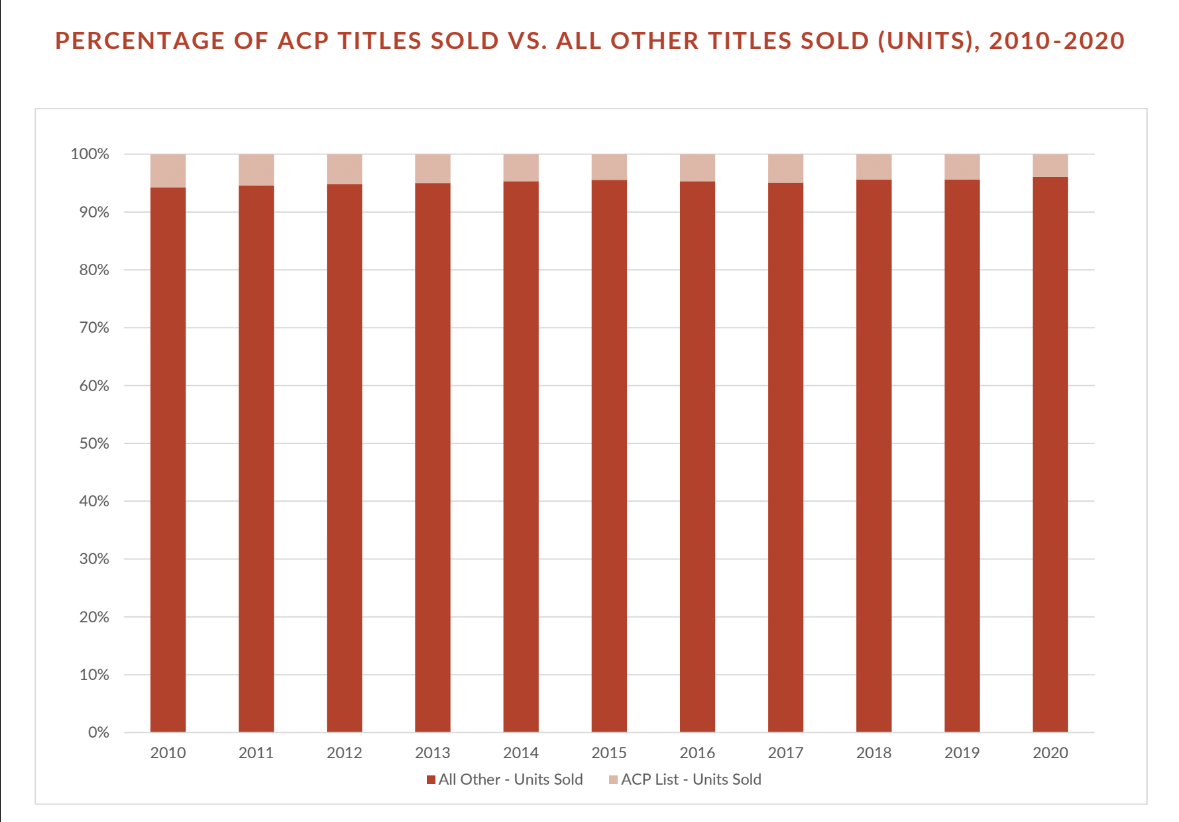
The headline in Publisher’s Weekly reads “The Book Sales Boom is over”. Here’s the US data:

And that’s just the beginning. Sales will continue to slide throughout 2022 and into 2023 as the world normalizes, people concentrate on doing all the things they’ve not been able to do the past two years, run through the extra cash they accumulated in the pandemic, and resume their former library borrowing habits.

What happens at the big publishing companies? If, as Murray’s comments would lead you to suspect, they’ve budgeted and spent for the good times to continue, unhappy times await.

QotD: How jobs differ from school

Filed under: Business, Education, Quotations — Tags: , , , , — Nicholas @ 01:00

In industrialized countries, people belong to one institution or another at least until their twenties. After all those years you get used to the idea of belonging to a group of people who all get up in the morning, go to some set of buildings, and do things that they do not, ordinarily, enjoy doing. Belonging to such a group becomes part of your identity: name, age, role, institution. If you have to introduce yourself, or someone else describes you, it will be as something like, John Smith, age 10, a student at such and such elementary school, or John Smith, age 20, a student at such and such college.

When John Smith finishes school he is expected to get a job. And what getting a job seems to mean is joining another institution. Superficially it’s a lot like college. You pick the companies you want to work for and apply to join them. If one likes you, you become a member of this new group. You get up in the morning and go to a new set of buildings, and do things that you do not, ordinarily, enjoy doing. There are a few differences: life is not as much fun, and you get paid, instead of paying, as you did in college. But the similarities feel greater than the differences. John Smith is now John Smith, 22, a software developer at such and such corporation.

In fact John Smith’s life has changed more than he realizes. Socially, a company looks much like college, but the deeper you go into the underlying reality, the more different it gets.

What a company does, and has to do if it wants to continue to exist, is earn money. And the way most companies make money is by creating wealth. Companies can be so specialized that this similarity is concealed, but it is not only manufacturing companies that create wealth. A big component of wealth is location. […] If wealth means what people want, companies that move things also create wealth. Ditto for many other kinds of companies that don’t make anything physical. Nearly all companies exist to do something people want.

And that’s what you do, as well, when you go to work for a company. But here there is another layer that tends to obscure the underlying reality. In a company, the work you do is averaged together with a lot of other people’s. You may not even be aware you’re doing something people want. Your contribution may be indirect. But the company as a whole must be giving people something they want, or they won’t make any money. And if they are paying you x dollars a year, then on average you must be contributing at least x dollars a year worth of work, or the company will be spending more than it makes, and will go out of business.

Someone graduating from college thinks, and is told, that he needs to get a job, as if the important thing were becoming a member of an institution. A more direct way to put it would be: you need to start doing something people want. You don’t need to join a company to do that. All a company is is a group of people working together to do something people want. It’s doing something people want that matters, not joining the group.*

For most people the best plan probably is to go to work for some existing company. But it is a good idea to understand what’s happening when you do this. A job means doing something people want, averaged together with everyone else in that company.

    * Many people feel confused and depressed in their early twenties. Life seemed so much more fun in college. Well, of course it was. Don’t be fooled by the surface similarities. You’ve gone from guest to servant. It’s possible to have fun in this new world. Among other things, you now get to go behind the doors that say “authorized personnel only.” But the change is a shock at first, and all the worse if you’re not consciously aware of it.

Paul Graham, “How to Make Wealth”, Paul Graham, 2004-04.

« Newer PostsOlder Posts »

Powered by WordPress