
J.J. McCullough
Published 20 Aug 2022The story behind some of America’s most iconic postwar toys, including GI Joe, Play-Doh, Monopoly, and Stretch Armstrong.
(more…)
December 17, 2022
The history of America’s most famous toys
Comments Off on The history of America’s most famous toys
December 16, 2022
“To hear Musk tell it, his motivation is obvious: It’s about saving the world”
Bari Weiss at The Free Press (formerly known as Common Sense) on what went on in preparing to reveal the “Twitter files” and what Elon Musk is hoping to accomplish with Twitter:

Elon Musk at the 2015 Tesla Motors annual meeting.
Photo by Steve Jurvetson via Wikimedia Commons.
“I’m not going to spend $44 billion to reinstate a satire blog”, Musk said about the Babylon Bee, which had been banned from Twitter in March 2022. “I did it because I was worried about the future of civilization”, he told us late one night.
As far as Musk sees things, “birth rates are plummeting, the thought police are gaining power, and even having an opinion is enough to be shunned. We are trending in a bad direction.”
He says he wants to transform Twitter from a social media platform distrusted and despised by at least half the country into one widely trusted by most Americans. To have it fulfill its highest mission: that of a digital town square where all ideas can be heard, and the best will win out.
“If there is one information source that breaks ranks, then I think it ultimately forces others not to have the same narrative”, he said. “If even one organization competes hard for the truth, others will have to follow.”
To win back that trust, Musk figured it would require being honest about what had, until very recently, been going on at the company he had just bought: the suppression of disfavored users; the curtailing of certain political views; the censorship of stories like the Hunter Biden laptop; and the extent to which the government had tried to influence such decisions.
“We have a goal here, which is to clear the decks of any prior wrongdoing and move forward with a clean slate”, Musk said in one of many conversations that took place over the course of a week. “I’m sleeping at Twitter HQ for a reason. This is a code-red situation.” (He put it even more forcefully on Twitter, where he said that the company was a “crime scene”.) And so he has been sleeping there on-and-off, claiming a sofa. His 2-year-old son, named X, was almost always nearby.
Musk, who is a South African native, analogized the work of cleaning-house at Twitter several times to a kind of Truth and Reconciliation Commission. But what looks to some like truth and reconciliation can look to others like revenge.
At one point after midnight, as Musk showed off a closet of swag, including t-shirts left by the previous crew that said “Stay Woke”, he joked: “The barbarians have crashed through the gates and are pillaging the merch!”
Remember: After Musk made his offer to buy Twitter in April, he tried to get out of it in July, arguing that the company had not been honest about the percentage of fake users and bots on the site. But the company sued to force the deal, and he went ahead with it.
Musk estimates that he paid at least twice what it was worth but that he had to “chew down this hairball” — which is to say, he had to buy Twitter.
The price tag isn’t his only grievance. There’s also the fact that the company, to hear him tell it, wasn’t really a functioning company at all.
When Musk took over, he said, he found Twitter in disarray. Employees had unlimited vacation time and permanent work from home. The company had stopped doing performance reviews altogether, according to a long-time Twitter employee. “As long as Twitter could just keep its head above water and be roughly cash-flow break-even, then that’s all that they cared about”, Musk said.
Musk calls the Twitter he purchased a “non-profit”. Twitter, as it existed, wasn’t pursuing net earnings but “social influence”, he said. “This was fundamentally an activist organization”.
Since he took the helm at Twitter, he has fired 80 percent of the staff. He has insisted that those not prepared to be “extremely hardcore” and work “long hours at high intensity” show themselves out. Several engineers I spoke to had been working 18-hour days for the past month. They looked like it.
“It’s like if an aircraft was going in one direction and then suddenly pulled a U-turn and hit the afterburners in the other direction. That’s what happened to Twitter”, Musk said, making a vroom noise and laughing.
Comments Off on “To hear Musk tell it, his motivation is obvious: It’s about saving the world”
The Online News [Shakedown] Act passes the House of Commons
Michael Geist summarizes the farcical progress of Justin Trudeau’s legalized theft from the “tech giants”:
Later today, the House of Commons will vote to approve Bill C-18, the Online News Act, sending it to the Senate just prior to breaking for the holidays. While Canadian Heritage Minister Pablo Rodriguez and media lobbyists will no doubt celebrate the milestone, it should not go unremarked that the legislative process for this bill has been an utter embarrassment with an already bad bill made far worse. The government cut off debate at second reading, actively excluded dozens of potential witnesses, expanded the bill to hundreds of broadcasters that may not even produce news, denigrated online news services as “not real news”, and shrugged off violations of international copyright law. All the while, it acknowledged that mandated payments for links are the foundation of the bill with officials stating that individual Facebook posts accompanied by a link to a news story would be caught by the law. As for the purported financial benefits, the government’s own estimates are less than half those of the Parliamentary Budget Officer, who also concluded that more than 75% of the revenues will go to broadcasters such as Bell, Rogers, and the CBC. The end result is a bill that will undermine competition and pose a threat to freedom of expression, while potentially leading Facebook to block news sharing in Canada and Google to cancel dozens of existing agreements with Canadian news outlets.
As I’ve chronicled for months, Bill C-18 is the product of an intense lobbying campaign from some of Canada’s largest media companies. While the Globe and Mail broke from the pack at the last minute, years of one-sided editorials — even devoting full front pages to the issue — had its effect. Indeed, Canadian newspapers would be exhibit #1 for how government intervention in the media space has a direct impact on an independent press. From the moment of its introduction, the consequences were immediately obvious as payments for links serves as the foundation for a law that treats “facilitating access to news” as compensable. Canadians can be forgiven for thinking the bill is about compensating for reproduction of news stories. It is not, since the platforms don’t do that. Instead, it is about requiring payments for links, indexing or otherwise directing traffic to the news organizations who are often the source of the link itself. In most circumstances, recipients pay for the benefits that come from referral traffic. With Bill C-18, the entities providing the referrals pay for doing so.
Further, the bill is about far more than struggling Canadian newspapers as it expands eligibility into broadcasters such as the CBC, foreign news outlets such as the New York Times, and hundreds of broadcasters licensed by the CRTC that are not even required to produce news. The end goal is negotiated payments for links, backed by the threat of a one-sided arbitration process overseen by the CRTC in which the arbitration panel can simply reject offers if it believes it fails to meet the government’s policy objectives. That isn’t a commercial deal, it is a shakedown.
I’ve been operating on the assumption that the government is betting that the big internet companies won’t do the obvious and ban linking to any Canadian media outlet on their respective platforms, but the feds don’t have a great track record of predictions in recent years …
In a later post, Michael Geist illustrated the literal misinformation that was pushed by government MPs during Bill C-18’s path through to final reading by quoting some of Liberal MP Lisa Hepfner’s contributions:
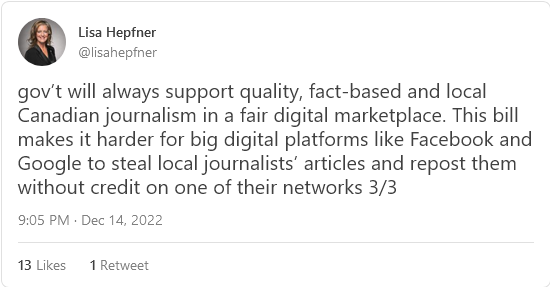
Last month, Liberal MP Lisa Hepfner shocked Canadian online news outlets by stating that “they’re not news. They’re not gathering news. They’re publishing opinion only.” The comments sparked instant criticism from news outlets across the country, leading Hepfner to issue a quick apology. In the aftermath of the comments, Hepfner said nothing for weeks at Heritage committee studying Bill C-18. That bill passed third reading yesterday – I posted on the embarrassing legislative review – and Hepfner was back at it. Rather than criticizing online news outlets, this time she targeted the Internet platforms, saying the bill would make it “harder for big digital platforms like Facebook and Google to steal local journalists’ articles and repost them without credit.”
[…]
Hepfner’s comment not only provide a troubling example of an MP engaging in misinformation about links who has effectively labelled her own Facebook posts as theft, but strikes at the heart of the problem with Bill C-18. As government officials have acknowledged, the entire foundation of the bill is based on paying for links. In fact, when a proposal to remove links from the bill was raised at committee, government MPs described the change as a loophole and voted against it. In the case of the CBC links, the government confirmed that Hepfner could write about the availability of children’s medications (ie. “Great news! CBC reports a million bottles of pain medication are on the way”) but once she added a link to provide a source for the claim, Bill C-18 is triggered.
These examples highlight the absurdity of a law that treats links as compensable and MPs who equate those links to theft. To be clear, there is nothing wrong with Hepfner or anyone else providing a link to a story on greater availability of children’s medicine. In fact, the CBC story has effectively already been paid for by the public and should be shared widely without the government creating barriers to sharing that information. What is wrong that is ill-informed MPs have voted for Bill C-18, creating a framework in which the government is imposing a mandatory payment scheme for some platforms for hosting links. The bill is now headed to the Senate which will hopefully make the necessary amendments to set Hepfner’s mind at ease that her own Facebook posts do not make her an accomplice to theft.
Comments Off on The Online News [Shakedown] Act passes the House of Commons
December 14, 2022
PayPal channels its inner Justin Trudeau
Canada’s current Prime Minister found a neat work-around to punish peaceful protestors and their small-scale financial backers by getting Canada’s chartered banks to freeze their bank accounts and credit cards. He didn’t bother getting a law or even an Order-in-Council to do this. He merely had the Finance Minister have a friendly chat with the banks’ CEOs and it was a done deal at least for a few hundreds or thousands of Canadians. PayPal clearly admires Justin Trudeau’s forthright moves to crush dissent and — being a financial institution itself — has been doing similar things to wrongthinking individuals and organizations who (used to) use PayPal’s services:

If you’re one of the lucky ones and your account has just been suspended, you can go to customer service, explain your situation and hope that someone gets back to you. If you’ve been banned, you’ll need an attorney to file a subpoena for the internal PayPal documents — simply to learn why you’ve been banned. (Good luck getting unbanned.)
These are entrepreneurs, writers, academics, activists — the very same people PayPal, whose mission is “democratizing financial services”, was meant to empower.
PayPal won’t say how many of them it has suspended or banned. In June 2021, the Electronic Frontier Foundation and other civil-liberties groups wrote a letter to PayPal and Venmo, calling on them to open up. So far, they have not, said Aaron Terr, director of public advocacy at the Foundation for Individual Rights and Expression.
The people who founded PayPal — the so-called PayPal Mafia — include Peter Thiel, Elon Musk, David Sacks and Max Levchin. All are champions of free speech. All have expressed shock and dismay at what is happening to the company they created. Several founders agreed to talk with The Free Press for this article.
“If the online forms of your money are frozen, that’s like destroying people economically, limiting their ability to exercise their political voice”, Thiel told me. “There’s something about destroying people economically that seems like a far more totalitarian thing.” [Justin Trudeau smiles]
When they launched PayPal, in December 1998, the founders imagined themselves connecting people to the global economy by sidestepping the hefty fees charged by credit-card companies and the inflationary policies of poorly run governments. Early PayPal users had Palm Pilots, and they would beam money from their devices to anyone with an email address. It was especially popular among eBay users.
“PayPal will give citizens worldwide more direct control over their currencies than they ever had before”, Thiel said at a company meeting, in late 1999. “It will be nearly impossible for corrupt governments to steal wealth from their people through their old means, because if they try the people will switch to dollars or pounds or yen, in effect, dumping the worthless local currency for something more secure.”
Since those early heady days, PayPal has amassed 429 million active accounts. Fifty-eight percent of Americans use PayPal, and in 2021, there were 19.3 billion PayPal transactions. It now has a market valuation of $84 billion.
But the company that was meant to liberate countless individuals is becoming something else.
Increasingly, it is becoming a police officer. It is deciding what is right and wrong, who gets to be heard, who is silenced. It is locking out of the financial system those people or brands that have slipped outside the parameters of acceptable discourse, those who threaten the consensus of the gatekeepers. The consensus is hard to articulate; it is an ideology lacking clearly defined ideological contours. But the tenets of that consensus are unmistakable: the new progressive politics around race and gender are a force for good, the Covid lockdown was just, the war in Ukraine is noble, and an unfettered exchange of ideas and opinions is an unacceptable threat to all of the above.
A cynic might say that the original idea, “democratizing financial services”, has been implemented with a capital “D” which makes it all make sense in an American political context.
Comments Off on PayPal channels its inner Justin Trudeau
Our Nuclear Alternate Future?
Big Car
Published 9 Apr 2021In the 1950s, as the Cold War was heating up and children were being urged to “duck and cover” from nuclear weapons, car companies seriously proposed powering their cars using lead-lined nuclear reactors. It seems like madness today, but while the world saw the threat of nuclear war, they also saw the seemingly limitless potential from nuclear power. Just how were these vehicles supposed to work and how far did they get to reality?
(more…)
Comments Off on Our Nuclear Alternate Future?
December 12, 2022
Before the High Power was the FN Grand Rendement
Forgotten Weapons
Published 8 Aug 2022The Browning High Power story begins with a French 1921 request for a new military pistol. FN engineer Dieudonné Saive developed a double stack, single feed magazine and John Browning adapted a Browning 1903 pistol to use it, and this was sent to France for consideration. This pistol worked well enough, but the French trials board requested changes … and they would continue requesting changes and more trials for the next decade.
By 1931, FN felt that the current iteration of the pistol — while still not meeting all the French requirements — was good enough to stand on its own as a service pistol for the Belgian Army and other clients. They named it the “Grand Rendement” (High Efficiency) and began marketing it. The Belgian Army showed a definite interest, and bought 1,000 pistols for field trials, based on the prototype example we have in today’s video. These would become the Grande Puissance, aka the High Power.
For more details on this and other FN Browning pistols, I highly recommend Anthony Vanderlinden’s FN Browning Pistols, soon to be released in its third edition:
Comments Off on Before the High Power was the FN Grand Rendement
December 8, 2022
Meta (the artist formerly known as Facebook) moves to clamp down on political discussions in the workplace
Tom Knighton on an uncharacteristic corporate move by the artist formerly known as Facebook:

My favourite reaction to Facebook rebranding as “Meta”.
It seems there are certain words employees aren’t really supposed to bring up in the workplace.
Meta (formerly Facebook) has reportedly told its employees not to discuss sensitive issues like abortion, gun control, pending legislation and vaccine efficacy at workplace.
According to a report in Fortune, citing a leaked internal memo, Meta has banned employees from discussing “very disruptive” topics, including abortion, gun rights, and vaccines as part of new “community engagement expectations”.
“As Mark mentioned recently, we need to make a number of cultural shifts to help us deliver against our priorities,” read the company memo.
“We’re doing this to ensure that internal discussions remain respectful, productive, and allow us to focus. This comes with the trade-off that we’ll no longer allow for every type of expression at work, but we think this is the right thing to do for the long-term health of our internal community,” it added.
Unfortunately for Meta, employees hammered them on the fact that they could talk about Black Lives Matter, immigration, and trans rights.
Now, they’re not really wrong to call out the hypocrisy, but this sounds like just a first move, and it’s a step in the right direction.
What would have been a better move is simply prohibiting discussing politics with your coworkers unless it directly pertains to your job. For example, if you are responsible for content moderation and a new bill will impact how you conduct that moderation, that’s one thing.
But topics ranging from Black Lives Matter to gun control are all contentious issues, and while Meta might have allowed that discussion in the past, they probably won’t indefinitely.
This is interesting to me, in part because we’ve seen the woke in the technology sector essentially bully employers into following along with the left’s agenda. Yet when they tried that with Netflix, the streaming giant basically told them to suck it up.
That was in May, but it may have triggered companies to realize that they didn’t have to play the woke game.
Last week, in the weekly wrap-up, I included this story about how Disney’s returning CEO Bob Iger is trying to have the company step back from the political ledge. Iger is far from a conservative, mind you, but he’s come to realize that his personal political agenda isn’t going to sell.
Granted, he started them along that path, but he’s recognized it’s not a great road to go down.
Now, we have Meta that may be venturing on a similar path to Netflix, setting the stage for what’s appropriate and what isn’t.
Comments Off on Meta (the artist formerly known as Facebook) moves to clamp down on political discussions in the workplace
December 7, 2022
Facebook’s strategy for collapse
Ted Gioia clearly isn’t a Facebook fan — and I sympathize, having lost access to my Facebook account a few years ago — but it’s not just people like us that have contributed to Facebook’s epic decline:
Most companies fail because of competition. They simply aren’t fast enough or smart enough to keep up with the marketplace.
But the big web platforms aren’t like that.
In many instances, they are quasi-monopolies. They are so big and powerful that they hardly need to worry about competition.
After all, who can match Google for search? Who can beat Amazon for online shopping? Who does more to keep you connected with family and friends than Facebook? Who helps you clean out the junk in your garage better than eBay?
But even the most dominant players can falter. There was a point in living memory when Sears controlled 30% of all retail spending in the US. I’m not exaggerating: three out of every ten dollars were spent at Sears.
Sears once operated 3,500 stores. Today only 22 are left. Many of my readers have never seen the inside of a Sears store.
This happened because Sears was so big that it didn’t need to worry about competitors.
That sounds impossible. How can you fail by being too powerful? But this has happened in many instances, even on the web. There was a day when Yahoo was the leader in search. There was a day when MySpace was the dominant social network. There was a day when Tumblr was the place to share photos.
There was even a day when the two companies in total control of your access to the Internet were called Netscape and America Online.
Not anymore.
This has happened before and will happen again. The bigger they are, the harder they fall.
[…]
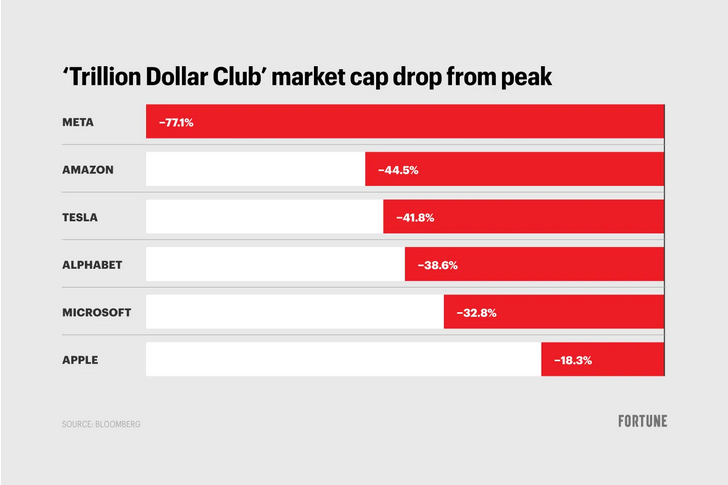
The situation at Facebook is now uglier than MC Hammer’s wardrobe closet. Meta is the worst performing stock in the S&P 500 this year. In other words, there were 499 other companies in the composite that did better — and this was a tough year all around in financial markets.
Mark Zuckerberg has personally lost more than $100 billion. In fact, he lost $11 billion in a single day. Has that ever happened before in human history? Almost exactly 12 months earlier, I’d written an article entitled “Meta Is for Losers” — but even I never envisioned losses on this scale,
Of course, there are many losers in this story — including the 11,000 workers who got fired a few days ago.
What’s going on?
You probably think that this is the result of Zuckerberg’s fool’s bet on the Metaverse. That’s what everybody is saying. But as we shall see, the Metaverse is just a symptom not a cause.
I can actually explain the problem in one sentence:
Instead of serving users, the dominant company decides it’s better to control them.
This would never occur to a small business. The owner of your neighborhood deli or gas station has no grand plans to control people — for the simple reason that this is an impossible dream.
That’s the reason why they say: “The customer is always right.” It’s not because the customer isn’t often wrong. Customers are frequently wrong — go listen to them sometimes and cringe at the stuff they demand. But if you’re in business, you must act as if they’re right even when they aren’t. And you do learn things by listening, even (or especially) when their demands are excessive.
By the way, you succeed by listening in every sphere of your life — starting at home.
There’s a good reason why students at hospitality school are told never to use the word never — or “no” or “can’t” or “impossible” — when talking to clientele. Instead of saying: “No way, dude, we’re not putting mayonnaise on your pizza, that’s disgusting”, you offer something positive:
I wish we could do that, dude, because it does sound super tasty — but I will put extra mozzarella on your slice, and our high temperature oven will give it a kind of mayo texture.
That’s how you roll in retail.
But at Facebook, the customer is always wrong.
Comments Off on Facebook’s strategy for collapse
December 4, 2022
QotD: In praise of mediocrity
There is much to be said in favor of mediocrity, of course. Without mediocrity, there could be no excellence. We cannot always be living on the heights of Mount Olympus, and surely even the most fastidiously intellectual person has found pleasure or relief in curling up with a second-rate detective story (Wittgenstein did so, besides which there is something to be learned from every book ever written). I have derived much comfort from mediocrity, my own included, and it is my experience that, for a variety of reasons, the greatest experts in their field may make poor witnesses. A person of mediocre accomplishment is often better.
Mediocrity is not a problem in itself; it is inevitable. Indeed the world needs many mediocrities, that is to say mediocrities who know themselves, and are perfectly content, to be such (complacency is as much an underestimated quality as rebelliousness is an overestimated one). The problem with mediocrity begins when it is allied to overweening ambition, as it seems so often to be the case nowadays.
Ambition is likewise a quality that is excellent when it attaches to something worthwhile in itself, but which is dreadful when it does not. And the rapid and phenomenal spread of education has increased the spread of ambition with it, much of it inevitably of the apparatchik type, that is to say the determination to climb some bureaucratic career ladder detached from any purpose except survival and, if possible, self-aggrandizement. To climb such a ladder you have to be both ruthless and submissive at the same time. You have to be egotistically prepared to stab people in the back in the scramble for advancement, while at the same time being prepared to suppress your own personality by uttering other people’s clichés at the expense of your own thoughts. Unpreparedness to do this, either through lack of training or moral scruple, unfits you for a career in the organization, any organization. You have to learn to lie with clichés, and do so with a straight face.
Theodore Dalrymple, “In Defense of Mediocrity”, Taki’s Magazine, 2018-02-17.
Comments Off on QotD: In praise of mediocrity
December 3, 2022
QotD: Mantetsu and the Kwantung Army
Thus the South Manchuria Railway Corporation, originally contracted to develop a defunct line in a disputed territory, soon developed into a full-spectrum enterprise. Pretty much all heavy industry in the Japanese areas of Manchuria were divisions of Mantetsu. But since all the heavy industry depended on mines, and transportation, and food and housing for workers, and banks, and schools for the workers’ children, etc., pretty soon Mantetsu ran all of that, too. By the late 1920s, you could argue that Mantetsu was almost its own country.
It even had its own army, and that’s where things get really interesting.
The Kwantung Army was the security force assigned to the South Manchuria Railway Zone. The Japanese weren’t stupid; they knew the perils of independent commands far from home, and they rotated units through with some regularity. Nonetheless, the command staff remained fairly stable over the years … and so did Mantetsu’s.
The Japanese weren’t stupid, but they were people, and people being people, soon enough the lines between the Kwantung Army and Mantetsu began to blur. And since the lines between Mantetsu, the Imperial Army, and the government were already pretty blurry, pretty soon the concerns of one became the concern of all. (Nor was the Navy left out, though I’m not discussing them in order to keep it simple. They were up to their eyeballs in Mantetsu, too, because warships need lots of steel and steel comes from Manchuria).
A small but highly committed and totally ideologized faction developed inside the Kwantung Army. Several, in fact, and one of them (the Imperial Way faction) attempted an actual coup d’etat in 1936. It was put down, and the Imperial Way faction dissolved (in theory), but the problem of an intensely ideologized officer corps remained. Long story short, you had a small group of highly ideologized officers garrisoning a remote province pulling the entire Empire into big, unwinnable wars.
One could make the case that World War II in the Pacific was ultimately caused by about fifteen or twenty guys in the Kwantung Army.
That’s overly reductionist, but it highlights the huge problem with organizations slipping the leash. In theory, there was a clear chain of command, and even the head of the Kwantung Army was a down it a ways — he was subordinate to the Army Council, which was subordinate to the War Minister, who was subordinate to the Parliament, who were subordinate to the Emperor. In theory, lots of people could’ve sacked Gen. Araki, or his mini-me Ishiwara Kanji (a lieutenant colonel through most of it). Equally in theory, Mantetsu had no say in any of it — the Kwantung Army was a formation of the Imperial Japanese Army, not Mantetsu’s private security force.
But in reality, Mantetsu was so wired in to the Japanese government that in a lot of cases, it was the government. But not always, because the same could be said about the Army, and the Navy, both of which were also wired into Mantetsu up to the very top (or vice versa, your choice). And Mantetsu had their Media arm, of course, as did the Army and Navy …
What all this boiled down to, then, was a power vacuum. I know, that seems weird, but a skilled bureaucratic infighter like Ishiwara never lacked for groups to play against each other. The Army and Navy would oppose on principle any move that seemed to aggrandize the other, neither could go against Mantetsu (and neither could control it), and all had to pay at least lip service to the civilian government. Because of this, real power fell to whomever had the balls to grab it …
… which was the officer corps of the Kwantung Army. They assassinated at least two Manchurian warlords, staged a number of false flag attacks on their own positions, and generally got up to however you say “standard issue Juggalo fuckery” in Japanese, up to and including a full-scale war with China.
Severian, “Slipping the Leash”, Founding Questions, 2022-08-27.
Comments Off on QotD: Mantetsu and the Kwantung Army
November 26, 2022
Indigo vastly prefers selling pillows, candles, and tchotchkes of all kinds rather than – ugh! – books
In the latest SHuSH newsletter, Ken Whyte explains why it’s becoming harder and harder to find actual books in Canada’s biggest bookstore chain … because they no longer want to be a bookstore chain:
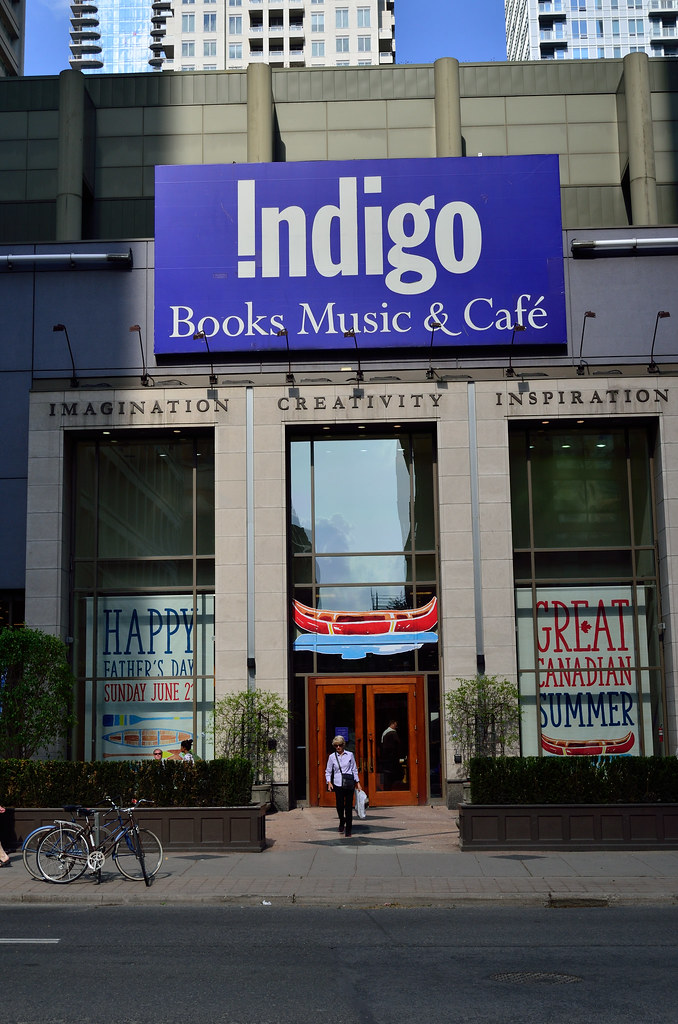
“Indigo Books and Music” by Open Grid Scheduler / Grid Engine is licensed under CC0 1.0

We need to talk about Indigo. As you know, it’s Canada’s biggest bookstore chain, with 88 superstores and 85 small-format stores. It sells well over half the books that are bought in stores in Canada, with Walmart, Costco, and independent bookstores accounting for most of the rest.
One problem with Indigo is that it’s failing. The other problem is that it’s abandoning bookselling. Yes, that sounds like a Woody Allen joke, but it’s not funny from a publishing perspective. We depend on Indigo.
The company’s finances have been ugly for some time. It lost $37 million in 2019, $185 million in 2020, and $57 million in 2021. Things looked somewhat better in 2022 with a $3 million profit, but the first two quarters of 2023 are now in the books (it has a March 28 year end) and Indigo has already dropped $41.3 million.
[…]
Indigo hasn’t come right out and said we’re through with books. It can’t, given that Heather [Reisman] has spent the last twenty-five years building herself up as the queen of reading in Canada. Also, the Indigo brand is still associated with books in most people’s minds and that won’t change overnight no matter how many cheeseboards it stocks. So Heather talks about a gradual, natural transition: “We built a wonderful connection with our customers in the book business. Then, organically, certain products became less relevant and others were opportunities.”
To be clear, books are irrelevant; general merchandise is the opportunity. Heather recently appointed as CEO a guy named Peter Ruis who has no experience in books. He comes from fashion retail, most recently the Anthropologie chain, which sells clothing, shoes, accessories, home furnishings, furniture, and beauty products. Anthropologie was hot in 2008, and it seems to be where Indigo wants to go today.
Fair enough. You own a company, you can take it in any direction you want, so long as your shareholders will follow. I don’t blame Heather for having second thoughts about the book business. (I have them every week. It’s a tough business.) But where does that leave readers, writers, agents, publishers, and everyone else who remains committed to books?
You’ll recall that Indigo and Chapters, between them, decimated the independent bookselling sector in Canada in the nineties. They are the principal reason Canada has so few independent bookstores today. You could probably fit the combined stock of all our independents into a handful of Heather’s stores.
The federal government let Heather’s Indigo buy Larry Stevenson’s Chapters in 2001, which gave her a ridiculously large share of the market. That shouldn’t have happened.
At the same time, with the help of some lobbying by Heather, the federal government made it clear that the US chains, Borders and Barnes & Noble, weren’t welcome up here. The argument was that bookselling was a crucial part of our cultural sector and needed to be protected from foreign domination by the Canadian government.
In that spirit, Indigo also asked the federal government to prevent Amazon from opening warehouses in Canada. That request was denied in 2010, which is about when Indigo began its transition out of books.
One can see how Heather might feel betrayed by the federal government. Instead of protecting bookselling, it swung the door wide open for Amazon. You said I wouldn’t have to compete!
Comments Off on Indigo vastly prefers selling pillows, candles, and tchotchkes of all kinds rather than – ugh! – books
The Volcanic: Smith & Wesson’s First Pistol
Forgotten Weapons
Published 18 Aug 2017The deep beginnings of the Volcanic go back to Walter Hunt’s Volitional Repeater, which became the Jennings repeating rifle, which then became the Smith-Jennings repeating rifle when Horace Smith was brought in to improve it. Smith was able to make it more commercially viable than the Jennings had been, but he recognized that the system needed significant changes to really become successful. He had met a fellow gun designer who had similar ideas, by the name of Daniel Wesson, and the two would spend a couple years developing and refining the system. In 1854 they thought it was ready for production, and formed the Smith & Wesson Company.
Included in the original company was a man named Courtland Palmer, who owned the patent rights to the Jennings system. Smith & Wesson’s system would probably have been deemed an infringement of Palmer’s patents, and by bringing him into the company they avoided legal trouble. The fact that he was a relatively wealthy financier of the new company certainly didn’t hurt!
The pistol that S&W started producing was a manually repeating one with a tubular magazine under the barrel holding either 6 or 10 rounds. It was available in the .41 caliber Navy model (note: not actually adopted by the Navy) and the .31 caliber pocket version. In this first iteration, both used iron frames, which were all engraved lightly. The prices were pretty steep, and the guns suffered from some reliability problems and a fundamental problem of underpowered ammunition (the .41 caliber had a muzzle velocity of just 260 fps / 79 m/s). However, they did offer a much greater level of rapid repeating firepower than the muzzle loading revolvers of the period, and gained some loyal fans. In total, just 1700 of the guns were produced before the company went bankrupt, about a year after forming.
To recover from that setback, they reformed the company into the new Volcanic Repeating Arms Company, and sold stock in the new company to generate a new supply of capital. This allowed them to get back into production, and the Volcanic company would make another 3000 pistols, all .41 caliber Navy types, before also running out of money 19 months later in 1856.
At this point, Smith and Wesson decide to move in another direction, and one of the main creditors of the Volcanic company was able to acquire all of its assets and put the guns into production a third time. The name of this creditor? None other than Oliver Winchester. Winchester puts a new infusion of his own money into the company under the name New Haven Arms Company. This company produces another 3300 guns, both large and small frame by 1861. The New Haven company comes very near to bankruptcy itself before finally changing the design to create the Henry repeating rifle. The Henry’s rimfire ammunition finally solved the reliability and power problems of the Volcanic, and became the starting point for Winchester to become one of the predominant American arms making companies.
(more…)
Comments Off on The Volcanic: Smith & Wesson’s First Pistol
November 24, 2022
A History of Ketchup
Tasting History with Max Miller
Published 12 Jul 2022
(more…)
Comments Off on A History of Ketchup
November 20, 2022
Printing books in China is economical, but also allows China to censor what you print
In the latest SHuSH newsletter, Kenneth Whyte explains why some of Sutherland House’s books are now being printed in China … and illustrates some of the risks of having them printed there:
We decided last spring to offshore some of our book printing to China (see “The Crisis in Book Publishing”, SHuSH 138). It was not a difficult decision. The difference in price is enormous.
For instance. Next week we’re releasing a book called The Prison Lady: True Stories and Life Lessons from Both Sides of the Bars by Phyllis Taylor. Presales have been strong. We need to print more copies. We can’t go back to the original Chinese printer, which charged us $2.08/copy, because it takes months to get books from Guangzhou to Toronto. We need the books now. So we shopped around. The best North American price we could find is $4.39/copy.
Why is that a problem? The book is a paperback priced at $22.95. The retailer takes half that, leaving us $11.50. After our distributor and sales agent take their fees and we pay the author her royalty, we’re left with $6.32 out of which we pay for editing, cover art, design, overhead, and shipping. And printing. If the printing bill comes to $4.39 a copy, we make no money.
Those of the economics of a straightforward paperback. A friend of mine recently called about a quote from a Canadian printer for a full-color illustrated book that came in at $15.31/copy. It seemed steep, so I sent the exact same specs to a Chinese printer who quoted $5.27/copy.
[…]
Our initial plan was to print four of our spring books in China (we’re also using printers in Turkey and India). The files for the first two of the four were delivered last month. On Nov. 7, we received the following email from the printer:
After more detailed review of some of the written content of these two books, there are some significant censorship concerns related to certain references to Taiwan, Hong Kong, and China.
As you may be aware, China vehemently enforces a “one China” principle in which Hong Kong and Taiwan are part of the “one China”. Therefore, China censorship will not allow any reference to either Hong Kong or Taiwan as its own country.
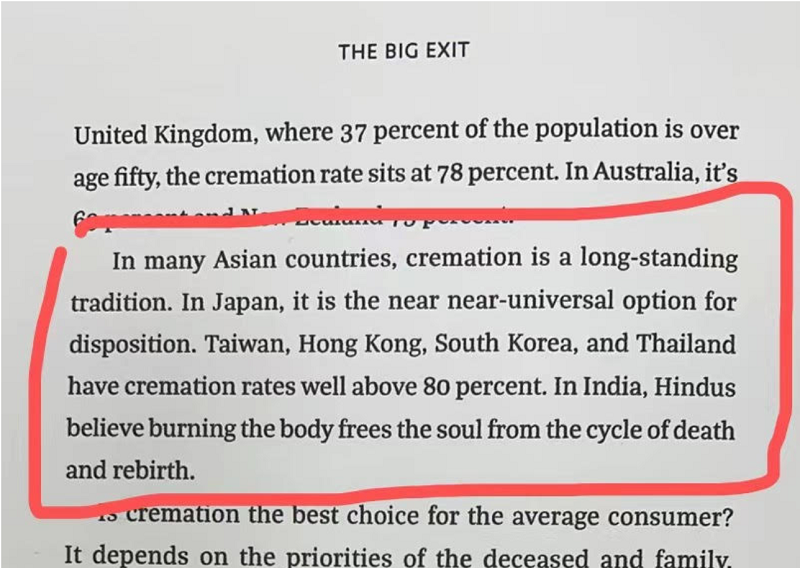
With this in mind, there is some “sensitive wording” on page 46 of The Big Exit that would not be possible to print in China due to it implying that Hong Kong and Taiwan are “countries”.
The Big Exit isn’t about politics. It’s a book about end-of-life choices or, more particularly, how we can dispose of the remains of a billion boomers over the next several decades without wrecking the planet (conventional burial and cremation are both environmentally reckless). The censorship issue arose in this paragraph, which the printer helpfully circled in bright red:
I grant that while Hong Kong still shows up in a lot of data as its own country, it is technically an administrative region of China. Taiwan’s independence is also disputed by China. Against China’s claims, we have the Frank Zappa rules of diplomacy which recognize as “a real country” any place with its own beer and its own airline. Taiwan and Hong Kong both qualify.
In any event, we are now printing The Big Exit in India.
Comments Off on Printing books in China is economical, but also allows China to censor what you print
November 17, 2022
“The most disturbing concept Freud ever invented – and he had a few, that bloke – is Thanatos, or the ‘death instinct'”
Ted Gioia on the apparent death wish of the academic publishing industry:
The most disturbing concept Freud ever invented — and he had a few, that bloke — is Thanatos, or the “death instinct”. This is an alleged drive among living organisms to destroy themselves.
Many have disputed that such a thing exists. Instincts preserve life — that’s their evolutionary purpose. The idea of a death instinct is impossible, so the critics claim. It’s like that Peacekeeper Missile or soft rock or marijuana initiative or any of those other two-word combinations of things that don’t belong together.
I’ve often criticized Freud, but I’ve come to accept this Thanatos notion, at least as a sociocultural concept. It explains so many otherwise inexplicable happenings in our society.
Take, for example, academic publishers. They are clearly imbued with a death instinct, no? How else can you explain their self-destructive behavior?
Universities have been publishing books for almost 500 years — dating back to 1534 A.D. when King Henry VIII allowed Cambridge University to set up a printing press. Running one of these publishing outfits is almost a requirement if a college wants to rise in the rankings, but I wonder how much longer this can last. After all, how can you succeed as a publisher if you put so little energy into selling books?
I know one academic publisher that previously sent out two hundred or more review copies of each new book — because they obviously wanted publicity for these titles. Those days are gone. Nowadays their preferred strategy is to send out zero physical copies to reviewers. I’m not exaggerating — I’ve heard it straight from their mouths: their goal is to distribute absolutely no hard copies to media outlets and book critics.
College students are spending 26% less on textbooks this year. That’s a bloodbath for the publishers. But this is the inevitable result whenever you assume the customer has no choice — because, sooner or later, they actually do.
Okay, I don’t blame the publishers entirely — just consider how rarely the New York Times reviews books from academic presses. You might think the cultural elites in New York would give some support to their fellow travelers in idea-mongering, but no dice. They treat those academic books like they’re toxic.
(By the way, I’m grateful to the Times Literary Supplement over in London, which still takes time to tell me about important scholarly works, most of them ignored in US media. But even that last holdout in Britain feels precarious — I fear they’ve been too contaminated by Yankee values.)
Yankee values? That’s up there with the Peacekeeper Missile.
But the lack of review copies is just one symptom among many. Let’s look at a few others.
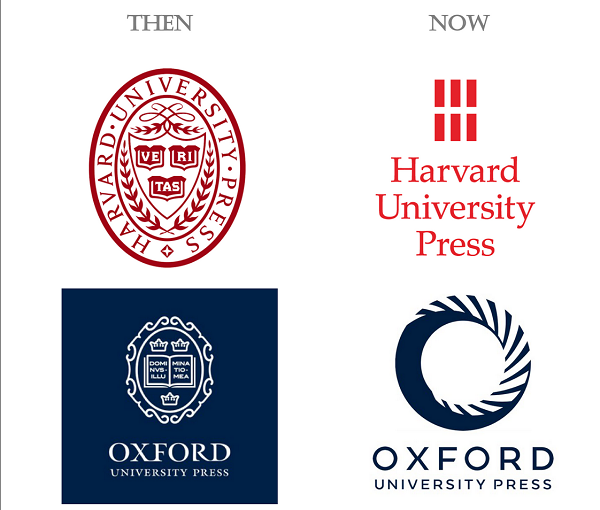
Just consider the flurry of rebranding efforts in academic publishing. As I’ve explained elsewhere, successful organizations rarely redesign their logos or “refresh” their brands. They don’t have time for such nonsense. But even more to the point, when you’re thriving, your logo is part of that success — it’s a sign of your strength, and you just don’t mess with it.
But that’s clearly not the case in academia nowadays.
I could give you countless examples from college campuses — where “rebranding” is more popular than a hot high school football prospect on a recruiting visit. But I’ll settle for two instances:
My only disappointment is that these brand redesigns didn’t come packaged with a new slogan. May I suggest something along the lines of: Information Solutions for a Changing World.
Or maybe, if we can be a bit more boastful: The Ultimate in Handheld Data Storage.
Does anybody still believe in this rebranding malarkey? Surely any reasonable person can see it’s all smoke and mirrors? But that hardly matters, because the brand redesign has tremendous symbolic value.
That’s why they do it.
The road to hell was once paved with good intentions — but nowadays we settle for symbolic gestures. They’re much cheaper than good intentions. And there’s no shortage of symbolic gestures nowadays — more than enough to pave that whole damned highway to hell.
It’s a shame that symbolism doesn’t pay the bills. Or fix problems. And it certainly won’t sell books.
Comments Off on “The most disturbing concept Freud ever invented – and he had a few, that bloke – is Thanatos, or the ‘death instinct'”


