The Chinese model, such as it is, has a hypnotic appeal to many (too many) among our technocrats, bureaucrats and the political class. These are our betters, after all, and certainly the people who think they are smarter than everyone else, yet they are constantly constrained by the outmoded mechanisms of representative democracy, rule of law, and liberal state. How envious are they of the Chinese authorities (the Party and the government being largely the same, certainly the same for all practical purposes), which are not restrained by any considerations of accountability or public opinion. The Party can do whatever it wants – build a fast train network, carry out massive infrastructure projects, regulate emissions, direct economic resources, and so on – while the Western governments and administrations get bogged down in petty politics. The Chinese Communist Party is also a meritocracy of sorts, which promotes skill and talent (and of course loyalty, ideological reliability, and personal connections), while too many self-described smart people in our democracies are at the mercy of fickle voters. There is no stability and continuity, no long-term planning, no concern for the “national interest”; ah to be a mandarin instead!
Then there is the Chinese government’s ability to surveil and control their people – for their own good, of course. How many over here would love a Social Credit System, where they can reward and punish people according to government’s priorities, from environmentally-conscious behaviour to public health considerations. In democracies, the people rate their leaders; in China the leaders rate their people. Just imagine how much more effectively our governments and health authorities would be able to to deal with all of us during the current pandemic if they could “see” and “nudge” every individual at every moment and in every situation. The most dangerous virus to come from China recently is not COVID, it’s “socialism with Chinese characteristics” with its siren call of unrestrained power for large sections of our political and economic elites.
Arthur Chrenkoff, “World hearts commies”, The Daily Chrenk, 2021-07-01.
October 17, 2021
October 14, 2021
QotD: Americans’ perception of foreign economic threats
And when it does Americans will learn nothing from their most recent mistake. If people really understood sound economics, they would not continue to make this same mistake again and again.
Robert Higgs, “China — Americans’ Economic Bugaboo du Jour”, The Beacon, 2018-12-19.
October 12, 2021
Richard Overy looks at the “Great Imperial War” of 1931-1945
I missed Rana Mitter‘s review of Richard Overy’s latest book when it was published in The Critic last week:
Imagine there’s no Hitler. It’s not that easy, even if you try, at least if you’re a westerner thinking about the Second World War. But for millions of Asians, those years of conflict had little to do with the horrors of Nazi invasion and genocide, and it is their experience that frames Richard Overy’s account of a seemingly familiar conflict. For most non-Europeans, the war was not a struggle for democracy, but a conflict between empires, and in this book, that imperial struggle begins not with the invasion of Poland by Germany in 1939 but the occupation of Manchuria by the Japanese in 1931.
Blood and Ruins is really two books in one. The first is perhaps the single most comprehensive account of the Second World War yet to appear in one volume. You might think that by reading extensively, you could construct a book like this one. You could not — unless you have Overy’s control over a staggering range of World War II scholarship, much of it drawn from his own decades of research on the economics of total warfare, the development of technology, from radar to aerial bombing, and the idea of the “emotional geography” of war, encompassing morale, hope, and despair. Then you’d need to go back and cover all those categories for each of the major Allied and Axis belligerents: Britain, the US, Japan, Germany, France, Italy and China among them.
The second book is an argument about what kind of conflict the Second World War really was. Overy is clear: on a global as opposed to European scale, it was not (just) a war about democracy, but about empires and their fate, although “the starting point in explaining the pursuit of territorial empire is, paradoxically, the nation.”
Overy points out what is generally lost to view when the European war is placed at the centre of the historiography: both Britain and France were undertaking an “awkward double standard” in their defence of democratic values, as their Asian and African possessions “rested on a denial of those liberties and the repression of any protest against the undemocratic nature of colonial rule”. While this argument has been made before (not least by figures such as Nehru and Gandhi in India at the time), Overy does something unusual and revealing: he compares the western empires with Japan’s justification for its own imperial project in the early twentieth century.
The book is scrupulously careful not to endorse or excuse the worldview of Tokyo’s imperialists, and gives full weight to the voices of the Chinese nationalists and communists who were bitterly opposed to Japan’s expansion on the Asian mainland. Still, the comparison of Japan’s pre-war and wartime empire to those of the western powers provides an important and original broadening of a contemporary debate.
There is ongoing public British (and to some extent French) argument about whether empire was a “good” or “bad” thing. Yet neither attackers nor defenders of the British empire tend to analyse it alongside the Japanese equivalent that lasted nearly half a century. Britain committed colonial massacres (Amritsar) and deadly repression (Mau Mau). So did Japan (the rape of Nanjing, invasion of Manchuria).
Britain’s empire also created an aspirational middle class full of cosmopolitan nationalists, and drew on ideas of loyalty to recruit its subjects to fight in world wars. All these things are also true of Japan, which like Britain was a multi-party democracy for much of its period as an overseas empire (between 1898 and 1932), and whose capital city was an intellectual hub for political activists from across Asia.
As a colony of Japan between 1895-1945, Taiwan developed a middle class that was Japanese-speaking and keen to draw on new economic opportunities brought by empire: Lee Teng-hui, the first democratically elected president of the Republic of China on Taiwan, always thought of Japanese as his mother tongue. Park Chung-hee, the American-sponsored dictator of Cold War South Korea, learned his political craft as an army officer in the Japanese Manchukuo Army that occupied Manchuria.
October 11, 2021
The Line responds to charges that their reporting on China is “anti-Asian racism”
As an impoverished cheapskate, I can’t afford to subscribe to The Line‘s full service, but they do allow a sub-set of their work to appear to non-paying subscribers, like this response to a former subscriber who accused them of “anti-Asian racism” in their posts involving the People’s Republic of China:
China’s emergence as a global power is going to be one of the defining stories of the first half of the 21st century. We probably aren’t reading and writing about it enough. Late this week, however, we received a note from a now-former reader, who said that the pieces we had run, and the overall focus on China, reflected anti-Asian racism, and they would not be supporting us going forward.
Look, it’s your money, folks. We want more and more of you to subscribe all the time. But we certainly respect your right to decline, or to unsubscribe if you don’t like the offerings. However, we do have a word of reply to those who would suggest that publishing articles about China is racist: get bent.
There is indeed anti-Asian racism out there. We have seen a lot of disturbing signs of it during the COVID-19 pandemic, when Asians of any description have been subjected to harassment and even random acts of violence. In the United States, some of the more fiery anti-Chinese rhetoric favoured by the former president also undoubtedly contributed to that wave, and that has spilled over here. Further, the problem of anti-Asian racism of course isn’t new. We have a long history of anti-Asian discrimination in North America. This must be acknowledged. Anti-Asian hate was real before Trump and COVID, and it’ll remain long after both are finished.
But writing critically about the People’s Republic of China, the Chinese Communist Party, the Chinese armed forces, the policies of the Chinese government, the actions of the Chinese government, and the increasingly overt meddling in the affairs of other nations by Chinese intelligence operations, does not reflect any discredit upon Asian-Canadians, or any Asian in general. The policies of the Chinese government are exactly that: policies of a government. Criticizing policies and governments is not just acceptable, it’s absolutely necessary.
Indeed, we noted with grim amusement during a recent conversation with a colleague, who is comfortably nestled within the left-leaning progressive side of Canada’s political spectrum, that progressives in particular ought to be 100 per cent comfortable criticizing Chinese government policy. After all, progressives have been loudly and correctly noting for generations that there is a difference between rank antisemitism and warranted criticism of Israeli government policy. We find it fascinating that some of the very same people who would be horrified to be accused of antisemitism for criticizing Israel get tongue-tied when the Chinese government starts throwing religious minority women into rape camps.
We suspect some of it is simply rooted in the rampant identitarian obsessions of Western political discourse. People who criticize white supremacist Western imperialism a dozen times before breakfast might find it intellectually discombobulating to acknowledge that Western liberal democracies are not the only big baddies on the global stage. We’ve witnessed the many mental gymnastics that have been deployed to minimize or wish away credible reports of genocide and concentration camps, as if they were merely a Western fantasy being used to concoct a pretext for war. This is an ahistoric argument, by the way. The West has not been angling for war with one of its most lucrative suppliers and customers, quite the opposite. Until recently, we’ve operated under a Fukuyama delusion: the ironclad belief that China would moderate and liberalize as it grew more prosperous. This was predicated on the arrogant assumption that the liberal democratic West was the end state of history and that China would eventually meet us here, thus allowing peace and profit for all. That optimism hasn’t panned out, and many Western countries — Canada among them — have spent the last few years trying to reconcile our economic interdependence with our collective “oh shit” epiphany.
October 9, 2021
QotD: China’s “social credit” policy
The China lobby excuses the policy by comparing it to Western customer loyalty programs and asserting that it’s not in place around the whole country yet. In truth, it’s a typical aspect of Chinese communism, which loosens the reins for a period before tightening them again. Mao instituted the “Thousand Flowers” campaign in the ’50s that encouraged criticism of the party, following up a few years later with the Great Cultural Revolution, in which those critics were shot or sent to the Gobi.
Like it or not, progress of any sort – social, scientific, artistic – is propelled by the mavericks. Beethoven, Tesla, Einstein, Patton, Kubrick, Trump … all individualists – cantankerous, arrogant, belligerent – who pushed against social inertia, no matter what the consequences. Their story, from Socrates on, is the story of the West. With the “Social Credit” program, China is returning to its immemorial preference for stasis, which has led to disaster time and again. The end result will be a society that is stratified, ossified, and petrified. There is evidence that this is occurring right now.
J.R. Dunn, “The Myth of China as Superpower”, American Thinker, 2019-01-09.
October 8, 2021
The case for defending Taiwan
Roberto White explains why the west should help protect the Republic of China from the People’s Republic of China:
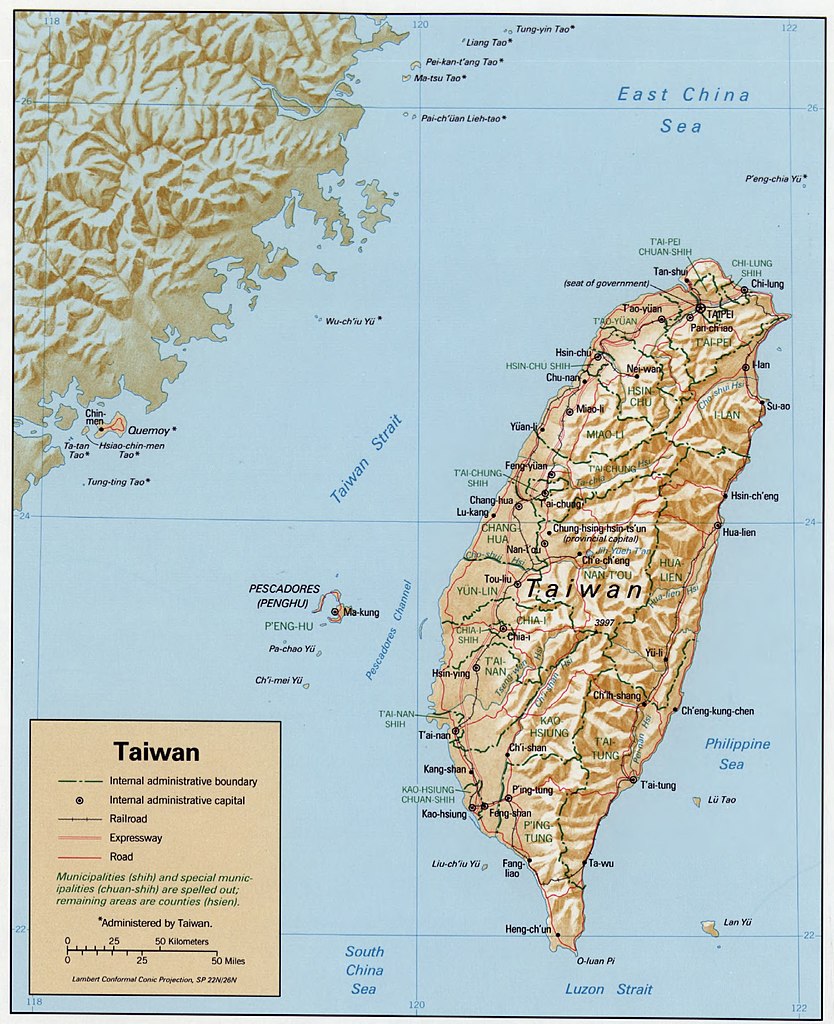
Taiwan relief map.
Library of Congress Geography & Map Division via Wikimedia Commons.
The past few days have seen Taiwan subjected to another wave of continuous harassment by China. Of course this is nothing new; China has violated Taiwan’s airspace since at least 2014. But, on Monday, a record 34 fighter jets were dispatched to Taiwan. Beijing’s increasingly erratic behaviour towards Taiwan brings to the fore why the West must defend them.
Taiwan is a free-market democracy that, despite its overbearing northern neighbour, has managed to create a vibrant economy that ranks as the sixth freest economy in the world. Crucially, it is a major producer of semiconductors (a device that helps power everything from cars to satellites), accounting for 92 per cent of all production of the world’s most sophisticated and important chips. Thus, from both an ideological and strategic standpoint, defending Taiwan is a mutually beneficial move.
The case for Taiwan’s defence is further strengthened when we look at what could happen in Asia should China take Taiwan by force.
With Taiwan’s ports and air bases, the People’s Liberation Army (PLA) could extend its maritime militia northwards through the Ryukyu (the chain of islands between Taiwan and Japan) and the Senkaku Islands (disputed by China and Japan). This would give China increased leverage over Japan in a time of crisis by, for example, restricting its maritime commerce.
The CCP could further use Taiwan as a base for tighter control of the South China Sea by blocking the Luzon Strait (between Taiwan and the Philippines) and the Balintang channel, which would cut off the traditional route used by the US Navy to navigate regional waters. In essence, China would immediately become the foremost power in the Indo-Pacific that could eventually kick the US and its allies out of the region. Unfortunately, the threat of a Chinese invasion is not a distant reality. In March of this year Admiral Philip Davidson, the United States’ top military officer in the Asia-Pacific, warned that China could invade Taiwan by 2027.
Given the perilous scenario that would emerge from a Chinese invasion of Taiwan, it is vital that, should an invasion happen, the West comes to Taiwan’s defence. However, until such a time, Western allies should aim to help Taiwan by promoting its participation in international forums. The first step would be to allow diplomats and other officials with Taiwanese passports to enter UN buildings, which they currently cannot do. This would most likely provoke a backlash from China, yet it would also confer Taiwan the dignity and respect that officials from every other state have.
The West should also stand firm against Chinese attempts to exclude Taiwan from international organisations. Between 2008-2016, Taiwan was invited to be an observer at the World Health Organization (WHO) under the name “Chinese Taipei”. In 2016, after Tsai Ing-Wen was elected Taiwan’s President, Beijing rescinded the invitation and Taiwan has not been allowed to participate since.
October 7, 2021
Understatement alert – “… many Canadians are less than confident in our prime minister’s ability to defend Canadian interests when up against Xi Jinping”
In The Line, Jaclyn Victor discusses Canada’s longstanding military freeloading habits and how Chinese interest in the Arctic are only the latest concerns pushing the government to start taking national sovereignty seriously:
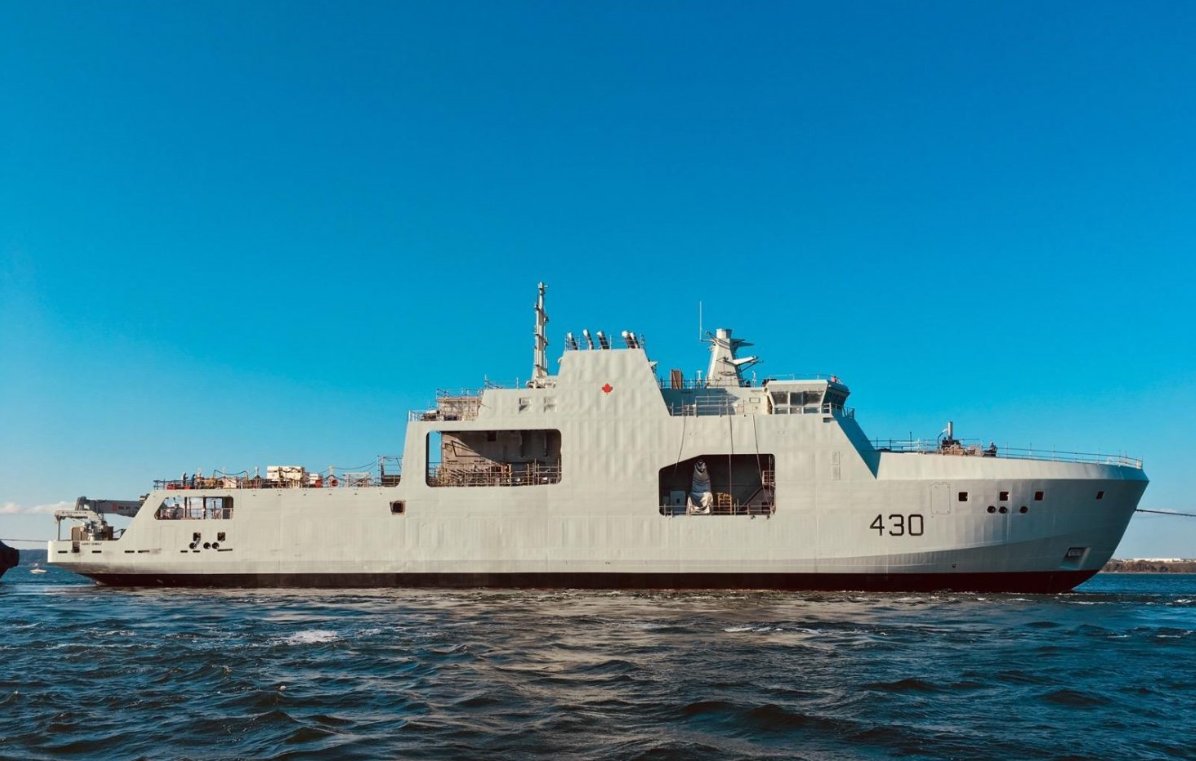
Arctic Offshore Patrol Ship HMCS Harry DeWolf shortly after launch in 2018. The ship was commissioned into the Royal Canadian Navy in June, 2021.
If the West has learned anything about China in recent years, it’s that its leaders will stop at nothing to advance their interests, and will often do so in unpredictable ways. For Canada, the most obvious lesson here was the brazen hostage diplomacy that saw “the two Michaels”, Kovrig and Spavor, imprisoned for nearly three years in retaliation for Canada’s detention of Huawei executive Meng Wanzhou. But there’s another area in which China is flexing its muscles that is much closer to home: the Arctic.
Despite being nearly 1,500 kms from the Arctic Circle, China claims to be a “near-Arctic” state. This alone might not be concerning if it weren’t also for China’s efforts to increase its Arctic presence while simultaneously undermining that of legitimate Arctic states. Although Canada staunchly claims to have sovereignty over the Northwest Passage, China hasn’t accepted this, yet has (concerningly) demonstrated an increased interest in the Arctic. Canada’s periodic military exercises and lack of assertion in the North are clearly not effective in dissuading Chinese interest in the region. As the world recognizes the importance of the Arctic we must do more if we want to maintain our influence.
From claims that Trudeau has personal ties to the Chinese Communist Party to the general belief that he has no backbone in Chinese foreign policy matters, it is clear that many Canadians are less than confident in our prime minister’s ability to defend Canadian interests when up against Xi Jinping. Perhaps the most relevant example of this is the release of the Two Michaels after nearly three years in Chinese captivity — a momentous occasion that filled many Canadians with a renewed hope — but only happened thanks to support from President Biden. And what about China’s alleged election interference, which was aimed at supporting the Trudeau Liberals at the expense of the more hawkish Erin O’Toole? Simply put, China wouldn’t want Trudeau in power if they thought he’d put a damper on their interests.
Our allies, unfortunately, also recognize that our inaction is no match for China’s “coercive diplomacy” and military preparedness. Canada could have contributed to, and hugely benefited from, the recently signed AUKUS pact. The agreement was largely intended to provide Australia with nuclear submarines to fend off Chinese aggression, but it also committed the partners to collaborate on AI and other technologies. Canada seems to have been deliberately excluded. We’re skilled in many of the information-sharing focus areas specified in the agreement, and we clearly need increased submarine capabilities in order to help maintain the Arctic sovereignty we claim to have. On top of this, many of our closest allies have outright denied Canadian claims to the NWP, leaving us with limited defence partnerships as they relate to the Arctic.
In the meantime, China has been establishing itself in the Arctic in an effort to get a foothold. In 2018, China’s Arctic Policy was published — the first of its kind for an Asian state. The policy, which discusses Chinese interest in Arctic resource extraction, brings light to Chinese efforts to develop industry in the region. China currently controls about 90 per cent of the global trade of rare minerals, and they want to maintain this dominance. As Arctic ice melts and additional resources become accessible, one can bet that China will want a piece of the pie. China already has a robust starting point for strategic investments, with US $19 billion invested in Canadian Arctic mining projects. Until the NWP (or “golden waterway” as it’s been called) becomes ice-free in the summers, China will likely continue seeking additional investment opportunities to increase its hold and resulting influence. Once the strait inevitably becomes easy to transit, China will already have a legitimate reason to do so.

October 5, 2021
Chris Alexander – “The truth is that ‘normal’ in the People’s Republic of China, at least since 1959, has never included the rule of law”
Writing in The Line, Chris Alexander (former Minister of Citizenship and Immigration) explains why attempts to “return to normal” in Canada’s relationship with mainland China are foredoomed to failure:
Yuen Pau Woo was joined in these arguments by senators Peter Boehm and Peter Harder, both seasoned diplomats, who also urged Canada to suspend its judgement with regard to China’s persecution of the Uighurs. This includes the use of concentration camps and forced labour, as well as the repression of language, culture and religion. These are all blatant acts committed with the “intent to destroy, in whole or in part, a national, ethnical, racial or religious group”, as the 1951 Genocide Convention defines this “odious scourge”.
Throughout this unfortunate saga, Beijing has had a Greek chorus of supporters across Canada — mostly from people with well-remunerated corporate or political backgrounds — for the preposterous notion of a “prisoner exchange” that would get relations with China back to “normal”.
In the end, the Senate’s genocide motion failed by a vote of 29 in favour to 33 opposed, with 13 abstentions. China’s Foreign Ministry praised Woo, Boehm and Harder as “people of vision” who had seen through the “despicable schemes of a few anti-China forces”. The “clumsy trick of attacking China for selfish political gains” and “the hype of ‘genocide’ in Xinjiang is unpopular and doomed to fail”, the Foreign Ministry spokesperson crowed.
Had Woo, a former president and CEO of the Asia Pacific Foundation of Canada, and the “two Peters”, both former deputy ministers of foreign affairs, voted in favour, the Senate’s genocide motion would have passed. Instead all three chose, on an issue directly threatening the identity and lives of millions, to take the position of the Communist Party of China over one unanimously endorsed by Canada’s elected House of Commons — all in the empty hope of getting back to “normal” with Beijing.
The truth is that “normal” in the People’s Republic of China, at least since 1959, has never included the rule of law. From China’s ferocious and brutal invasion of Tibet that same year, through the murderous Great Leap Forward ending in 1962, to the decade-long Cultural Revolution up to Mao’s death in 1976 (and beyond), China has been a legal void. Serious judicial reforms never featured in Deng Xiaoping’s economic relaunch. On the contrary, basic rights were decimated, as Tibetan, Mongolian, Uighur and other refugees attest.
According to Freedom House, the current General Secretary of the Chinese Communist Party Xi Jinping’s relentless push for all-encompassing surveillance and censorship has made China the worst environment in the world for internet freedom for the seventh year running. Compliance with such global gag orders is enforced by the CCP’s Orwellian digital panopticon, the notorious United Front Work Department, which seeks to browbeat, buy, corrupt, blackmail, extort or otherwise leverage people and firms with connections to China in support of Xi’s agenda.
Thanks to United Front subterfuge, some prominent Canadians still take China’s side, even as Beijing’s favourability score in Canadian public opinion plummeted to 14 per cent, mirroring a worldwide nosedive for China’s image driven by the two Michaels’ ordeal and Beijing’s “wolf warrior” belligerence.
September 27, 2021
Why Were Things So Terrible In the 17th Century – General Crisis Theory
Kings and Generals
Published 26 Sep 2021💻 Go to https://NordVPN.com/kingsandgenerals and use code
kingsandgeneralsto get a 2-year plan with a huge discount plus 4 additional months for free. Protect yourself online today!Kings and Generals animated historical documentary series on early modern history and economic history continue with a video on the general crisis theory, as we try to deduce why the 17th century events were so terrible and why so many wars, rebellions, and upheavals happened in this period
Support us on Patreon: http://www.patreon.com/KingsandGenerals or Paypal: http://paypal.me/kingsandgenerals. We are grateful to our patrons and sponsors, who made this video possible: https://docs.google.com/document/d/1o…
The video was made by EdStudio while the script was researched and written by Turgut Gambar. Narration by Officially Devin (https://www.youtube.com/user/OfficiallyDevin)
✔ Merch store ► teespring.com/stores/kingsandgenerals
✔ Podcast ► http://www.kingsandgenerals.net/podcast/
✔ Twitter ► https://twitter.com/KingsGenerals
✔ Instagram ► http://www.instagram.com/Kings_GeneralsProduction Music courtesy of Epidemic Sound: http://www.epidemicsound.com
#Documentary #EarlyModern #GeneralCrisis
September 23, 2021
“The truth about the origins of Covid would have serious consequences for the US Government and its ‘public health’ bureaucracies …”
Mark Steyn on the deliberate blindness of western governments to any evidence that points to the Wuhan Coronavirus pandemic actually originating in Wuhan:

Wuhan Institute of Virology.
Wikimedia Commons.
The first pieces published about ChiCom-19 at this website were on the insanity of empowering China and the lies of Beijing when it comes to the spread of infectious diseases. Nineteen months in, my main interest remains the origins of the WuFlu.
At the same time, one notices the almost total lack of interest in its origins from virtually anyone who matters, starting at the very highest levels of government. As Rumsfeld used to say, absence of evidence is not evidence of absence. Somewhat analogously, overwhelming lack of interest in evidence is paradoxically evidence of interest. The truth about the origins of Covid would have serious consequences for the US Government and its “public health” bureaucracies, and for the broader “science” community and its peer-reviewed journals and grant-application processes. Furthermore, the public deference to political leaders who claim to be “following the science” — already fraying badly in France and Australia — would take a huge hit once it became clear that the killer virus is itself the creation of “science” and of a Washington public-health bureaucracy that followed it all the way to an insecure lab in Wuhan.
From my old friends at the Telegraph:
New documents show that just 18 months before the first Covid cases appeared, researchers had submitted plans to release skin-penetrating nanoparticles containing “novel chimeric spike proteins” of bat coronaviruses into cave bats in Yunnan, China.
They also planned to create chimeric viruses, genetically enhanced to infect humans more easily, and requested $14 million from the Defense Advanced Research Projects Agency (DARPA) to fund the work.
Papers, confirmed as genuine by a former member of the Trump administration, show they were hoping to introduce “human-specific cleavage sites” to bat coronaviruses which would make it easier for the virus to enter human cells.
Ah, I miss the old days when a Google search for “human-specific cleavage sites” would be strictly NSFW. Now it’s links that are Not Safe For Google or Facebook or Twitter or any of the other media so censorious of anything that dissents from the official line. The Telegraph report is based on the work of DRASTIC, the ad-hoc group of international researchers who, so Wikipedia assures us, “have engaged in personal attacks against virologists” – so just hitch your mask up over your ears and don’t listen to them.
As for “novel chimeric spikes”, that’s the last year and a half, starting with the chimera of “zero Covid”. And we are in this mess because the central strategy of American foreign policy for a third of a century — that China can be economically endowed into behaving as a normal part of the global order — is the biggest chimera of all.
September 19, 2021
A communist-party-connected publisher reprinted Justin Trudeau’s 2014 book Common Ground
Aha! I thought … yet more scandal! This time with direct pay-offs to Trudeau from his Beijing paymasters! Sadly, for the conspiracy minded among us, it’s not much more significant or scandalous than Barack Obama’s endorsement of Trudeau, as Kenneth Whyte explains:
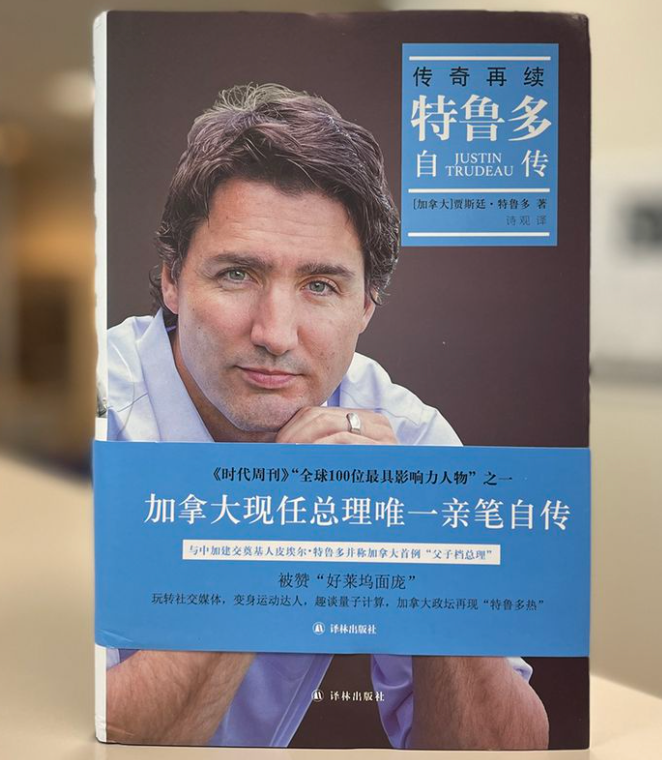
… the Globe & Mail reported that Justin Trudeau’s 2014 memoir Common Ground was republished in a Chinese edition in 2016.
Doesn’t sound like much of a story, does it? Foreign editions of Canadian books are released all the time.
What’s different in this case, says the Globe, is that the Chinese publisher is Yilin Press of Nanjing, part of the state-owned enterprise Jiangsu Phoenix Publishing and Media, which “takes operational direction from the propaganda department of the Jiangsu provincial communist party committee.”
Why would a propaganda wing of the communist party make such a deal? The Globe quotes foreign policy experts who say that the republication of Trudeau’s book is “a classic ploy” by Beijing to flatter a foreign leader. “They are trying to do anything they can to encourage him to look positive on China and the Chinese state,” according to one of the experts.
Says another: “Clearly, by publishing his biography they wanted to please him. They are the masters of propaganda.”
What do the Chinese hope to get out of courting Trudeau? “Beijing had high hopes it could persuade Canada to sign a free-trade agreement and was seeking Canada’s help in its global campaign Operation Fox Hunt to track down people it called criminals, many of whom were Chinese dissidents,” writes the Globe.
The Globe also finds it notable that the Liberals, at the time, were trotting Trudeau out to private events at the homes of wealthy Chinese-Canadians. The PM would do a little dance and the money would flow:
Chinese billionaire and Communist Party official Zhang Bin attended a May 19, 2016, fundraiser at the home of Benson Wong, chair of the Chinese Business Chamber of Canada. A few weeks later, Mr. Zhang and his business partner, Niu Gensheng, donated $200,000 to the Pierre Elliott Trudeau Foundation and $50,000 to erect a statue of Mr. Trudeau’s father.
So it all looks a bit unseemly.
I poked around and was reliably informed by someone in a position to know that Trudeau and his agent sold worldwide rights to Common Ground to HarperCollins Canada. That means it was up to HarperCollins to publish the book in Canada and also sell rights to its republication in as many foreign markets as possible. Trudeau would get a cut of revenues from those sales.
Except, as he further reveals, Trudeau had long since assigned any profits from the book to a charity, so he’s not being secretly bribed by copious amounts of money from the Chinese Communist Party’s propaganda budget (at least, not in this case, hedging just a bit …).
Should the PM, or someone in his office, have asked questions about Yilin Press and its connections to the communist party? Maybe, but it’s not like there was a free-market alternative down the street from Yilin. Every publisher in China is accountable to the communist party in one way or another. To get an ISBN number in the Chinese market, you have to go through the state, not because the state provides the service, but because it monitors all publications. Si Limin, chairman of the China Book Publishing Industry Association, is the former director of the News and Newspapers Department of the State Administration of Press, Publication, Radio, Film and Television. And so on.
As for the trade deal the Chinese were supposedly eager for Trudeau to sign? It was more the other way around. In 2017, the Liberals tried to convince Beijing to adopt Trudeau-style progressivism in return for free-trade with Canada. They were laughed out of town. The Chinese couldn’t even be bothered to pretend an interest in human rights to get a deal signed.
I have all kinds of problems with the ethical standards of the Liberal party, Trudeau’s personal judgment, those cash for access meetings, and his Chinese policy, but there’s nothing much to see here.
September 18, 2021
What if Pearl Harbor Never Happened, Life in Cyprus, and Peasant Armies of China – WW2 – OOTF 024
World War Two
Published 17 Sep 2021Ever wonder what would have happened if Japan just never attacked Pearl Harbor but invaded the Indies anyway? Or how the people of Cyprus are faring in the war? Or if the Chinese armies had any specialized combat forces? Find out in this Out of the Foxholes!
(more…)
September 17, 2021
Australia, the UK, and the US join in a military alliance … Canada of course is nowhere in sight
News broke the other day about a new three-nation military arrangement clearly aimed at containing Chinese ambitions in the Pacific, involving Australia, Britain, and the United States, to be known as AUKUS (or AUUKUS, depending on the reporting source). These three countries are already tightly linked in the “Five Eyes” intelligence sharing network which also includes Canada and New Zealand. As more than one wit noted on Twitter after the announcement, it’s a good thing Canada doesn’t have a Pacific coast or any economic interests in that ocean…
Ted Campbell, who recently emerged from a blogging hiatus to comment on the ongoing federal election, felt this new pact cemented the idea that Canada is “no longer a serious country” in military terms:
It is now abundantly clear that the USA, inter alia, puts Justin Trudeau’s Canada in the same league as (anti-nuclear) New Zealand. Canada is no longer one of the most trusted allies … Australia is; Britain is: India is; Japan is … Canada is NOT.
Prime Minister Justin Trudeau has, in six short years, moved Canada from one of America’s best friends to, de facto, a Chinese puppet state. He has done this with his own (and his many advisors’) eyes wide open. Canada, Justin Trudeau’s Canada is no longer a serious nation … perhaps we don’t really deserve to be. After all, we (almost 40% of the almost 70% who bothered to vote at all) elected him … then we did it again. Maybe the world is just concluding that we are not serious people who can be relied upon when the going gets tough.
He followed this up with a bit more concern on the sinking Canadian international profile:
Just take a look at those technologies ~ AI, quantum computing, cyber warfare ~ those are all areas vital to Canada’s security and prosperity and what are we focused on? Climate change and Québec’s latest attempts to make Canada into an illiberal state. China spews out more carbon in a week than Canada does in a year. China is aiming to displace America as the global guarantor of peace, security and trade. Do any of the dimwits in the Liberal government understand that? Why in hell is Prime Minister Trudeau attacking Alberta’s (relatively clean) oil industry rather than, for example, concentrating on making Canadian nuclear energy work for us?
A few days ago I said that Canada needs nuclear powered submarines to assert and protect our sovereignty in the waters we claim as our own. No one contradicted me. No one ever raises any serious, well-founded objections to nuclear submarines for Canada. It’s a no brainer. But, look at the last line in the quote above. Who is getting nuclear submarines? Australia … because it is a serious country with adult political leadership.
Prime Minister Justin Trudeau’s regime has sidelines Canada. Our strongest, most traditional allies have abandoned us. We have been sold out … to China.
I use that term “sold out”, intentionally. I do NOT believe that Justin Trudeau is a traitor … for heaven’s sake, he’s not smart enough to betray anything. He’s barely able to memorize his lines. But a lot of people have invested a lot in China ~ the Desmarais family (of Power Corporation fame) and former Prime Minister Jean Chrétien and Bob Rae, Canada’s Ambassador to the UN, for example, are all closely tied together and even more closely tied to the Canada-China trade file. I assert that the “China lobby” in Canada is very, very powerful, very, very rich and extraordinarily well connected to Canada’s political leadership ~ Liberal and Conservative, alike. I further assert that it, not Justin Trudeau and Marc Garneau and the mandarins in Ottawa, drives Canada’s foreign, trade and fiscal policies. Prime Minister Justin Trudeau is NOT a traitor … but he is puppet and people whose vital interests are centred on China, not Canada, pull the strings.
Why is Canada excluded from the AUKUS pact?
One reason Canada isn’t involved is certainly the distraction of the federal election, and there would have been no way that Justin Trudeau would have wanted to answer questions on the campaign trail about anything geostrategic or military, and he especially doesn’t want Canadians looking closely at his servile deference to the Chinese government. Of course, given that he’s literally bribed the major newspaper chains and TV networks with “subsidies” right before the election was called, he might well have been safe from any hint of an awkward question from his unofficial PR branches in Montreal, Toronto, and Vancouver.
Over at the Thin Pinstriped Line, Sir Humphrey looks at the military and technical implications of the new alliance:
The Royal Australian Navy is likely to become the next nation to join the nuclear submarine operators club. This is the key headline emerging from the surprise tri-lateral announcement on Wed 15 September by the Prime Ministers of Australia and the UK, and the President of the United States.
The move, forming a new “three eyes” club known as AUKUS is a genuinely significant development intended to provide a significant uplift in capability in the Indo-Pacific region. For the first time in nearly 70 years, the US has agreed to share some of its most sensitive technology with a third party, to help Australia become a “naval power underway on nuclear power”.
There are several ramifications of this decision, that will be felt for many years to come. The first is that from an American perspective, this is a good opportunity to take steps to increase burden sharing in the Pacific.
[…]
From a wider diplomatic perspective, there are three distinct groupings to consider. Firstly, the remaining 5-EYES members (Canada and New Zealand). Its unlikely that this will do much damage to 5-EYES – for example New Zealand would never have been approached as the acquisition of a nuclear submarine would be vastly beyond the budget, or needs, of the small but incredibly professional Royal New Zealand Navy.
Canada may be feeling slightly raw about this – particularly those with long memories who recall the 1980s and the doomed plan to acquire nuclear submarines for the RCN. But who knows, in terms of timelines these vessels may be entering service in the same timeframe as Canada seeks to replace the Upholder/Victoria class – it is not beyond the realm of possibility that they may seek to join in later on.
Given 5-EYES is more than just an Indo-Pacific focus, it would be wrong to read much into this as a statement on the future of that Alliance. Rather it is better to see this as a subgrouping of a very successful international alliance.
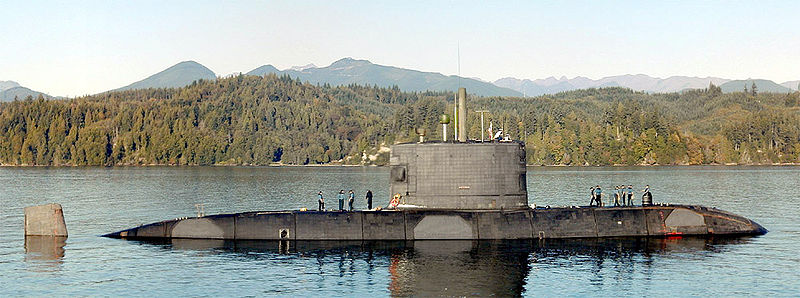
HMCS Victoria
Image via Wikimedia Commons.
September 7, 2021
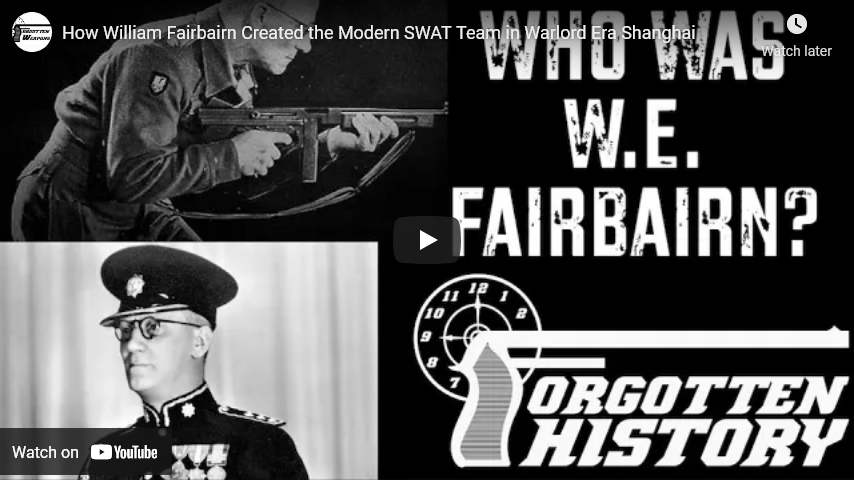
How William Fairbairn Created the Modern SWAT Team in Warlord Era Shanghai
Forgotten Weapons
Published 1 Jun 2021William E. Fairbairn is best known for his work with Eric Sykes and their “Commando” knife design during World War Two. However, Fairbairn spent some 33 years in the Shanghai Municipal Police, working his way up from a beat constable to Assistant Commissioner. There he was responsible for the SMPD adopting truly forward-thinking fighting methods, and he essentially invented the modern SWAT team (the “Reserve Unit”, which Fairbairn led for 10 years). He combined expertise in formal marksmanship, instinctive practical shooting, and hand-to-hand combat schools (including jiu-jitsu and judo) into a comprehensive training program like no other on earth at the time.
Book references:
The World’s First SWAT Team, by Leroy Thompson:
https://amzn.to/2TrYiNvGentleman & Warrior, by Peter Robins:
https://amzn.to/3vuODn9http://www.patreon.com/ForgottenWeapons
https://www.floatplane.com/channel/Fo…
Cool Forgotten Weapons merch! http://shop.forgottenweapons.com
Contact:
Forgotten Weapons
6281 N. Oracle 36270
Tucson, AZ 85740
August 28, 2021
Russo-Japanese War 1904-1905 – Battle of Tsushima
Kings and Generals
Published 16 Dec 2018In our new historical animated documentary, we will cover the Russo-Japanese War of 1904-1905 with a focus on the naval engagements at Tsushima, the Yellow Sea, and Port Arthur. This conflict between Russia and Japan was unique due to the heavy usage of the battleships and its results influenced the First and Second World Wars.
Support us on Patreon: http://www.patreon.com/KingsandGenerals or Paypal: http://paypal.me/kingsandgenerals
Check out our Merch Store: teespring.com/stores/kingsandgenerals
We are grateful to our patrons and youtube members, who made this video possible: https://drive.google.com/open?id=1Tff…
This video was narrated by Officially Devin (https://www.youtube.com/user/OfficiallyDevin)
✔ Merch store ► teespring.com/stores/kingsandgenerals
✔ Podcast ► Google Play: http://bit.ly/2QDF7y0 iTunes: https://apple.co/2QTuMNG
✔ Twitter ► https://twitter.com/KingsGenerals
✔ Instagram ► http://www.instagram.com/Kings_GeneralsSources:
Robert Forczyk – Russian Battleship vs Japanese Battleship
William Koenig – Epic Sea Battles
Левицкий – Русско-японская война 1904—1905
Сорокин – Оборона Порт-Артура. Русско-японская война 1904—1905Production Music courtesy of Epidemic Sound: http://www.epidemicsound.com
#Documentary #RussoJapaneseWar #KingsAndGenerals