
… economic inequality among the spartiates was not new at any point we can see. But the nature of all of our sources – Plutarch, Xenophon, etc – is that they are almost always more interested in describing the ideal Spartan polity than the one that actually existed. And I want to emphasize […] that this ideal policy does not seem to ever have existed, with one author after another placing that ideal Sparta in the time period of the next author, who in turn informs us that, no, the ideal was even further back.
It is important to begin by noting that the sheer quantity of food the spartiates were to receive from their kleros would make almost any spartiate wealthy by the standards of most Greek poleis – spartiates, after all, lived a live of leisure (Plut. Lyc. 24.2) supported by the labor of slaves (Plut. Lyc. 24.3), where the closest they got to actual productive work was essentially sport hunting (Xen. Lac. 4.7). If the diet of the syssition was not necessarily extravagant, it was also hardly … well, Spartan – every meal seems to have included meat or at least meat-broth (Plut. Lyc. 12.2; Xen. Lac. 5.3), which would have been a fine luxury for most poorer Greeks. So when we are talking about disparities among the spartiates, we really mean disparities between the super-rich and the merely affluent. As we’ll see, even among the spartiates, these distinctions were made to matter sharply and with systematic callousness.
Now, our sources do insist that the Spartan system offered the Spartiates little opportunity for the accumulation or spending of wealth, except […] they also say this about a system they admit no longer functions … and then subsequently describe the behavior of wealthy Spartans in their own day. We’ve already noted Herodotus reporting long-standing wealthy elite spartiates as early as 480 (Hdt. 7.134), so it’s no use arguing they didn’t exist. Which raises the question: what does a rich Spartiate spend their wealth on?
In some ways, much the same as other Greek aristocrats. They might spend it on food: Xenophon notes that rich spartiates in his own day embellished the meals of their syssitia by substituting nice wheat bread in place of the more common (and less tasty) barley bread, as well as contributing more meat and such from hunting (Xen. Lac. 5.3). While the syssitia ought to even this effect out, in practice it seems like rich spartiates sought out the company of other rich spartiates (that certainly seems to be the marriage pattern, note Plut. Lys. 30.5, Agis. 5.1-4). Some spartiates, Xenophon notes, hoarded gold and silver (Xen Lac. 14.3; cf. Plut. Lyc. 30.1 where this is supposedly illegal – perhaps only for the insufficiently politically connected?). Rich spartiates might also travel and even live abroad in luxury (Xen. Lac. 14.4; Cf. Plut. Lyc. 27.3).
Wealthy spartiates also seemed to love their horses (Xen. Ages. 9.6). They competed frequently in the Olympic games, especially in chariot-racing. I should note just how expensive such an effort was. Competing in the Olympics at all was the preserve of the wealthy in Greece, because building up physical fitness required a lot of calories and a lot of protein in a society where meat was quite expensive. But to then add raising horses to the list – that is very expensive indeed (note also spartiate cavalry, Plut. Lyc. 23.1-2). Sparta’s most distinguished Olympic sport was also by far the most expensive one: the four-horse chariot race.
In other ways, however, the spartiates were quite unlike other Greek aristocrats. They do not seem to have patronized artists and craftsmen. The various craft-arts – decorative metalworking, sculpture, etc – largely fade away in Sparta starting around 550 B.C. – it may be that this transition is the correct date for the true beginning of not only “Spartan austerity” but also the Spartan system as we know it. There are a few exceptions – Cartledge (1979) notes black-painted Laconian finewares persist into the fifth century. Nevertheless, the late date for the archaeological indicators of Spartan austerity is striking, as it suggests that the society the spartiates of the early 300s believed to have dated back to Lycurgus in the 820s may well only have dated back to the 550s.
The other thing we see far less of in Sparta is euergitism – the patronage of the polis itself by wealthy families as a way of burnishing their standing in society. While there are notable exceptions (note Pritchard, Public Spending and Democracy in Classical Athens (2015) on the interaction and scale of tribute, taxes and euergitism at Athens), most of the grand buildings and public artwork in Greek cities was either built or maintained by private citizens, either as voluntary acts of public beneficence (euergitism – literally “doing good”) or as obligations set on the wealthy (called liturgies). Sparta had almost none of this public building in the Classical period – Thucydides’ observation that an observer looking only at the foundation of Sparta’s temples and public buildings would be hard-pressed to say the place was anything special is quite accurate (Thuc. 1.10.2). There are a handful of exceptions – the Persian stoa, a few statue groups, some hero reliefs, but far, far less than other Greek cities. In short, while other Greek elites felt the need – or were compelled – to contribute some of their wealth back to the community, the spartiates did not.
Passing judgment on those priorities, to a degree, comes down to taste. It is easy to cast the public building and patronage of the arts that most Greek elites engaged in as crass self-aggrandizement, wasting their money on burnishing their own image, rather than actually helping anyone except by accident. And there is truth to that idea – the Greek imagination has little space for what we today would call a philanthropist. On the other hand – as we’ll see – a handful of spartiates will come to possess a far greater proportion of the wealth and productive capacity of their society. Those wealthy spartiates will do even less to improve the lives of anyone – even their fellow spartiates. Moreover, following the beginning of Spartan austerity in the 550s, Sparta will produce no great artwork, no advances in architecture, no great works of literature – nothing to push the bounds of human achievement, to raise the human spirit.
Bret Devereaux, “Collections: This. Isn’t. Sparta. Part IV: Spartan Wealth”, A Collection of Unmitigated Pedantry, 2019-08-29.
August 3, 2022
QotD: Relative wealth among the Spartiates
July 5, 2022
QotD: The Great Enrichment
In particular, it is ideas that people have for commercially tested betterment that matter. Consider alternating-current electricity, cardboard boxes, the little black dress, The Pill, cheap food, literacy, antibiotics, airplanes, steam engines, screw-making machines, railways, universities, cheap steel, sewers, plate glass, forward markets, universal literacy, running water, science, reinforced concrete, secret voting, bicycles, automobiles, limited access highways, free speech, washing machines, detergents, air conditioning, containerization, free trade, computers, the cloud, smart phones, and Bob Gordon’s favorite, window screens. …
And the Great Enrichment depended on the less famous [but] crucial multitudes of free lunches prepared by the alert worker and the liberated shopkeeper rushing about, each with her own little project for profit and pleasure. Sometimes, unexpectedly, the little projects became big projects, such as John Mackey’s one Whole Foods store in Austin, Texas resulting in 479 stores in the U.S. and the U.K., or Jim Walton’s one Walmart in Bentonville, Arkansas resulting in 11,718 stores worldwide.
Letting people “have a go” to implement such ideas for commercially tested betterment is the crux. It comes, in turn, from liberalism, Adam Smith’s “obvious and simple system of natural liberty”, “the liberal plan of [social] equality, [economic] liberty, and [legal] justice”. Liberalism permitted, encouraged, honored an ideology of “innovism” — a word preferable to the highly misleading word “capitalism,” with its erroneous suggestion that the modern world was and is initiated by piling up bricks and bachelors’ degrees.
Dierdre McCloskey, “How Growth Happens: Liberalism, Innovism, and the Great Enrichment (Preliminary version)” [PDF], 2018-11-29.
June 28, 2022
QotD: The economic pie fallacy
When wealth is talked about in this context, it is often described as a pie. “You can’t make the pie larger,” say politicians. When you’re talking about the amount of money in one family’s bank account, or the amount available to a government from one year’s tax revenue, this is true. If one person gets more, someone else has to get less.
I can remember believing, as a child, that if a few rich people had all the money, it left less for everyone else. Many people seem to continue to believe something like this well into adulthood. This fallacy is usually there in the background when you hear someone talking about how x percent of the population have y percent of the wealth. If you plan to start a startup, then whether you realize it or not, you’re planning to disprove the Pie Fallacy.
What leads people astray here is the abstraction of money. Money is not wealth. It’s just something we use to move wealth around. So although there may be, in certain specific moments (like your family, this month) a fixed amount of money available to trade with other people for things you want, there is not a fixed amount of wealth in the world. You can make more wealth. Wealth has been getting created and destroyed (but on balance, created) for all of human history.
Suppose you own a beat-up old car. Instead of sitting on your butt next summer, you could spend the time restoring your car to pristine condition. In doing so you create wealth. The world is — and you specifically are — one pristine old car the richer. And not just in some metaphorical way. If you sell your car, you’ll get more for it.
In restoring your old car you have made yourself richer. You haven’t made anyone else poorer. So there is obviously not a fixed pie. And in fact, when you look at it this way, you wonder why anyone would think there was. *
Kids know, without knowing they know, that they can create wealth. If you need to give someone a present and don’t have any money, you make one. But kids are so bad at making things that they consider home-made presents to be a distinct, inferior, sort of thing to store-bought ones — a mere expression of the proverbial thought that counts. And indeed, the lumpy ashtrays we made for our parents did not have much of a resale market.
* In the average car restoration you probably do make everyone else microscopically poorer, by doing a small amount of damage to the environment. While environmental costs should be taken into account, they don’t make wealth a zero-sum game. For example, if you repair a machine that’s broken because a part has come unscrewed, you create wealth with no environmental cost.
Paul Graham, “How to Make Wealth”, Paul Graham, 2004-04.
June 15, 2022
QotD: The gobsmacking magnitude of “The Great Enrichment”
The exactitude, of course, is inessential. In Japan and Finland it was roughly the factor of 30. But it could be the worldwide factor since 1800 of 10 only, about $2 or $3 to $30 a day (to $10,000 a year, the level of Brazil now, to fix ideas), and still be utterly novel. As a Brit might say, the Great Enrichment was gobsmacking.
The enrichment was actually much greater than the factor of 30, because price indices, especially recently, do not adequately reflect improvements in quality, as was determined in the early 1990s by the Boskin Commission … Consider your cell phone, your auto tires, your medical treatment — all greatly better, recently. Even economic facts and analyses are better. (Well, sometimes.) The downward bias from inadequately deflating money prices for improved quality is not far from 2% per year, which would double recent growth rates in the rich countries.
Its magnitude, novelty, recency, and location are all crucial to explaining the Great Enrichment, because together they strongly suggest that there was something deeply peculiar about Britain in the 18th century, and that afterwards the peculiarity spread to the rest of the world. Such facts make “run-up” theories such as in Stephen Broadberry et alii look implausible, because they depend on a metaphor of an airplane taking off, with little else by way of explanation for why the Industrial Revolution (a factor of 2) happened or, especially, its follow-on the Great Enrichment (a factor of 20 or 30). Likewise, it is dubious to attach the Great Enrichment to remote causes within Europe, such as the Black Death — which originated in China, with similar terrors, and yet yielded no Great Enrichment there. Also dubious is the Eurocentric belief, prominent in conservative circles, of some ancient superiority of melanin-challenged Volk back in the Black Forest. (Did you know, for example, that all European countries had common law in the Middle Ages, that is, judge-found-and-made, not legislated or codified?)
The Great Enrichment is the second most important secular event in human history, second only to the domestication of plants and animals making for cities and literacy.
Dierdre McCloskey, “How Growth Happens: Liberalism, Innovism, and the Great Enrichment (Preliminary version)” [PDF], 2018-11-29.
June 11, 2022
QotD: Modern disposable clothing
Pietra Rivoli, The Travels of a T-Shirt in the Global Economy, 2015.
April 17, 2022
QotD: How jobs differ from school
When John Smith finishes school he is expected to get a job. And what getting a job seems to mean is joining another institution. Superficially it’s a lot like college. You pick the companies you want to work for and apply to join them. If one likes you, you become a member of this new group. You get up in the morning and go to a new set of buildings, and do things that you do not, ordinarily, enjoy doing. There are a few differences: life is not as much fun, and you get paid, instead of paying, as you did in college. But the similarities feel greater than the differences. John Smith is now John Smith, 22, a software developer at such and such corporation.
In fact John Smith’s life has changed more than he realizes. Socially, a company looks much like college, but the deeper you go into the underlying reality, the more different it gets.
What a company does, and has to do if it wants to continue to exist, is earn money. And the way most companies make money is by creating wealth. Companies can be so specialized that this similarity is concealed, but it is not only manufacturing companies that create wealth. A big component of wealth is location. […] If wealth means what people want, companies that move things also create wealth. Ditto for many other kinds of companies that don’t make anything physical. Nearly all companies exist to do something people want.
And that’s what you do, as well, when you go to work for a company. But here there is another layer that tends to obscure the underlying reality. In a company, the work you do is averaged together with a lot of other people’s. You may not even be aware you’re doing something people want. Your contribution may be indirect. But the company as a whole must be giving people something they want, or they won’t make any money. And if they are paying you x dollars a year, then on average you must be contributing at least x dollars a year worth of work, or the company will be spending more than it makes, and will go out of business.
Someone graduating from college thinks, and is told, that he needs to get a job, as if the important thing were becoming a member of an institution. A more direct way to put it would be: you need to start doing something people want. You don’t need to join a company to do that. All a company is is a group of people working together to do something people want. It’s doing something people want that matters, not joining the group.*
For most people the best plan probably is to go to work for some existing company. But it is a good idea to understand what’s happening when you do this. A job means doing something people want, averaged together with everyone else in that company.
* Many people feel confused and depressed in their early twenties. Life seemed so much more fun in college. Well, of course it was. Don’t be fooled by the surface similarities. You’ve gone from guest to servant. It’s possible to have fun in this new world. Among other things, you now get to go behind the doors that say “authorized personnel only.” But the change is a shock at first, and all the worse if you’re not consciously aware of it.
Paul Graham, “How to Make Wealth”, Paul Graham, 2004-04.
April 14, 2022
Dining First Class on the RMS Titanic
Tasting History with Max Miller
Published 12 Apr 2022Signup for your FREE trial to Wondrium here: http://ow.ly/rSyS30sfmaG
Support the Channel with Patreon ► https://www.patreon.com/tastinghistory
Merch ► crowdmade.com/collections/tastinghistory
Instagram ► https://www.instagram.com/tastinghist…
Twitter ► https://twitter.com/TastingHistory1
Tiktok ► TastingHistory
Reddit ► https://www.reddit.com/r/TastingHistory/
Discord ► https://discord.gg/d7nbEpy
Amazon Wish List ► https://amzn.to/3i0mwGtSend mail to:
Tasting History
PO Box 766
Burbank, CA 91503LINKS TO INGREDIENTS & EQUIPMENT**
Sony Alpha 7C Camera: https://amzn.to/2MQbNTK
Sigma 24-70mm f/2.8 Lens: https://amzn.to/35tjyoW
Green Chartreuse: https://bit.ly/onlinebottlesmax
Leaf Gelatin: https://amzn.to/3NY6Y5SLINKS TO SOURCES**
Last Dinner on the Titanic by Rick Archbold and Dana McCauley: https://amzn.to/3tqNz5s
Titanic, First Accounts: https://amzn.to/3L2f7UH
The Sinking of the Titanic: 1912 Survivor Accounts by Bruce M. Caplan and Logan Marshall: https://amzn.to/3KSKock
The 10 Best Titanic Survivor Stories: https://amzn.to/3wioSK3RECIPE
Ingredients:
16 sheets Gelatin (or 4 envelopes of powdered gelatin)
3 cups (750ml) Water
1/2 cup (50g) Sugar
1 cup (250ml) Chartreuse
2-4 ripe Peaches or a large can of peaches in syrup
1 cup (250ml) Simple syrup (not necessary if using canned peaches1. Soak the gelatin in cold water for 5 minutes.
2. Bring the water and sugar to a simmer in a large saucepan then remove it from the heat. Squeeze out any excess water in the gelatin, then add it to the water and stir until dissolved. Stir in the Chartreuse.
3. Pour the liquid into a well greased mold, then refrigerate for 1-3 hours, or until the jelly is beginning to thicken.
4. To remove the skin from the peaches, score and X at the bottom of the peaches, then plunge into boiling water for 45 seconds, then immediately into ice cold water for 10 seconds. If the peaches are ripe, the skin should easily slide off. Remove the pit and slice.
5. Heat the simple syrup to simmering, then add the peach slices. Coat and turn off the heat and let them cool in the syrup.
6. Carefully insert the peaches into the jelly in whatever pattern you like. Then return to the refrigerator until fully set. 8 – 24 hours depending on the depth of the mold.
7. Once set, run a knife around the edge of the jelly, then dip the mold into hot (not boiling) water for 5 seconds. Remove it and place a well greased plate over the top of the mold then flip it over. The jelly should fall out with little more than a tap.
8. Top with Italian meringue or whipped cream, and serve.**Some of the links and other products that appear on this video are from companies which Tasting History will earn an affiliate commission or referral bonus. Each purchase made from these links will help to support this channel with no additional cost to you. The content in this video is accurate as of the posting date. Some of the offers mentioned may no longer be available.
Subtitles: Jose Mendoza | IG @worldagainstjose
#tastinghistory #titanic #firstclass

April 11, 2022
QotD: Programmers as craftsmen
A programmer can sit down in front of a computer and create wealth. A good piece of software is, in itself, a valuable thing. There is no manufacturing to confuse the issue. Those characters you type are a complete, finished product. If someone sat down and wrote a web browser that didn’t suck (a fine idea, by the way), the world would be that much richer.*
Everyone in a company works together to create wealth, in the sense of making more things people want. Many of the employees (e.g. the people in the mailroom or the personnel department) work at one remove from the actual making of stuff. Not the programmers. They literally think the product, one line at a time. And so it’s clearer to programmers that wealth is something that’s made, rather than being distributed, like slices of a pie, by some imaginary Daddy.
It’s also obvious to programmers that there are huge variations in the rate at which wealth is created. At Viaweb we had one programmer who was a sort of monster of productivity. I remember watching what he did one long day and estimating that he had added several hundred thousand dollars to the market value of the company. A great programmer, on a roll, could create a million dollars worth of wealth in a couple weeks. A mediocre programmer over the same period will generate zero or even negative wealth (e.g. by introducing bugs).
This is why so many of the best programmers are libertarians. In our world, you sink or swim, and there are no excuses. When those far removed from the creation of wealth — undergraduates, reporters, politicians — hear that the richest 5% of the people have half the total wealth, they tend to think injustice! An experienced programmer would be more likely to think is that all? The top 5% of programmers probably write 99% of the good software.
Wealth can be created without being sold. Scientists, till recently at least, effectively donated the wealth they created. We are all richer for knowing about penicillin, because we’re less likely to die from infections. Wealth is whatever people want, and not dying is certainly something we want. Hackers often donate their work by writing open source software that anyone can use for free. I am much the richer for the operating system FreeBSD, which I’m running on the computer I’m using now, and so is Yahoo, which runs it on all their servers.
* This essay was written before Firefox.
Paul Graham, “How to Make Wealth”, Paul Graham, 2004-04.
January 18, 2022
Decadence
In the latest Libertarian Enterprise, Sarah Hoyt considers the old Soviet put-down of all of western culture (especially the American one) … that it was decadent:
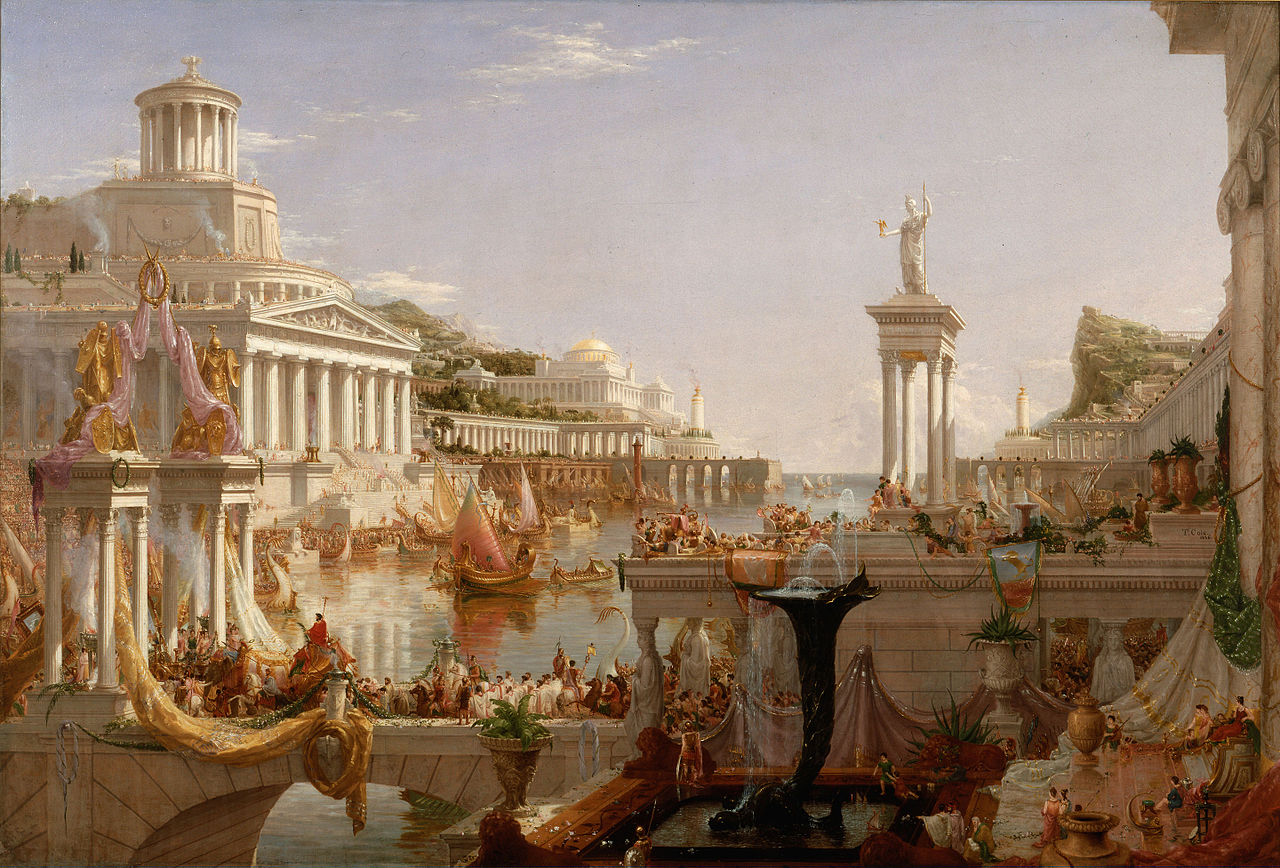
“The Consummation of Empire” from the painting series “The Course of Empire” by Thomas Cole (1801-1848).
New York HIstorical Society collection via Wikimedia Commons.
Yes, sure. I hear any number of you gnashing your teeth on that side of the screen: the soft living, the snowflakery in — mostly — our universities, the demands that everyone cater to them, people being completely terrified of a bad cold. Oh, yeah, rampant crime and bad sexual morals. We’re OBVIOUSLY decadent. How can I make fun of it?
Very easily.
For one your gnashing of teeth rhymes eerily with Romans gnashing of teeth for millennia, long before Rome was anywhere near ripe to fall, and in fact while Rome was the bad ass of the world. Second, it echoes even more eerily all of the Christian explanations of why Rome fell, which curiously also echoed the Christian beliefs in the loss of paradise.
“Decadence is sinfulness, and then comes the end and only G-d can save you” is the narrative there. Which is fine, in a spiritual sense, and completely bonkers insane when it applies to cultures and history. But it served the nascent theocracy that replaced Rome quite well. One of the things it served was to explain why life was now much, much harder. Because you know, abundance is what leads to decadence. Life is too soft, you don’t work hard enough and … bam! suddenly you’re in the middle of an orgy or worshiping a goat or something. Never you mind that the Romans pretty much did that all along, even when they were the badasses of the world. It’s really easy to shape the history of a fallen civilization so it suits the purposes of its successor.
Which brings us to the fact that Communism is a Christian heresy, complete with paradise — the supposed egalitarian and property-free pre-history (it’s also really easy to shape a period that left no account of itself that we can find) — until greed — and in one version PATRIARCHY and in another “whiteness” WTF that means — kicked us out of it. Now we must force the perfect human (Homo Sovieticus!) to emerge, so we can go back to living in caves in (sing it) perfect harmony. (Yeah.)
The complaints of decadence I heard as a young woman were mostly Soviet Agit Prop. Yes, yours were too. They ranged from incoherent to frigging insane. Some of it was a very old rhyming chorus: Americans were decadent because they were too rich. They had too many choices. They were too immoral. They never had enough, and would commit crimes to be richer. They ate too much, drove too much, slept in too comfortable a bed, and in general were DECADENT. Just like Rome before it fell. (If you realize the actual structure of Imperial Rome was closer to the Soviet Union’s, a plunder culture that could only survive by stealing, the whole thing will take your breath away with its chutzpah.
The fact that our (even though at the time it was your, as I was a foreigner at least in some ways) entertainment and art echoed these crazy accusations only made the whole thing stick, so even the right, American loving side (which anyway always has a vast side of puritanism in America. And speaking of puritans, let’s talk about what some of them did to … turkeys? If weird sexual kinks are a sign of decadence, we’ve never been non-decadent) bought into it. I mean Spartacus (the novel) portrait of the decadence of Rome was meant to echo how bad America was. What’s that I hear? The author was a communist? You. Don’t. Say. I think I sent my shocked face out to be mended, but I won’t be a sec while I retrieve it.
In a more personal sense, my own family told me Portugal too was decadent. Why, unlike mom, I didn’t have to walk beside the train line to pick up enough coal for the family to cook. We had butane bottles delivered, even if they were super expensive, so we often cooked on a petrol lamp in the patio, if the weather was fine.
Decadent and soft living, I tell you. Sure, the bathroom was outside, but it was a bathroom, with running water included. JUST like Rome before the fall. How much longer till we started screwing Nightingales’ Tongues, eating Bear Sausages and electing horses to congress (I think in America we’ve been doing that all along, too. Though I’d prefer if every now and then we elected the front half of the horse.)
December 10, 2021
Was Constantine’s conversion a form of reaction to societal decadence?
At his new place, Severian makes a case for Emperor Constantine’s conversion to Christianity being a reaction to (and attempted cure for) civilizational decadence:
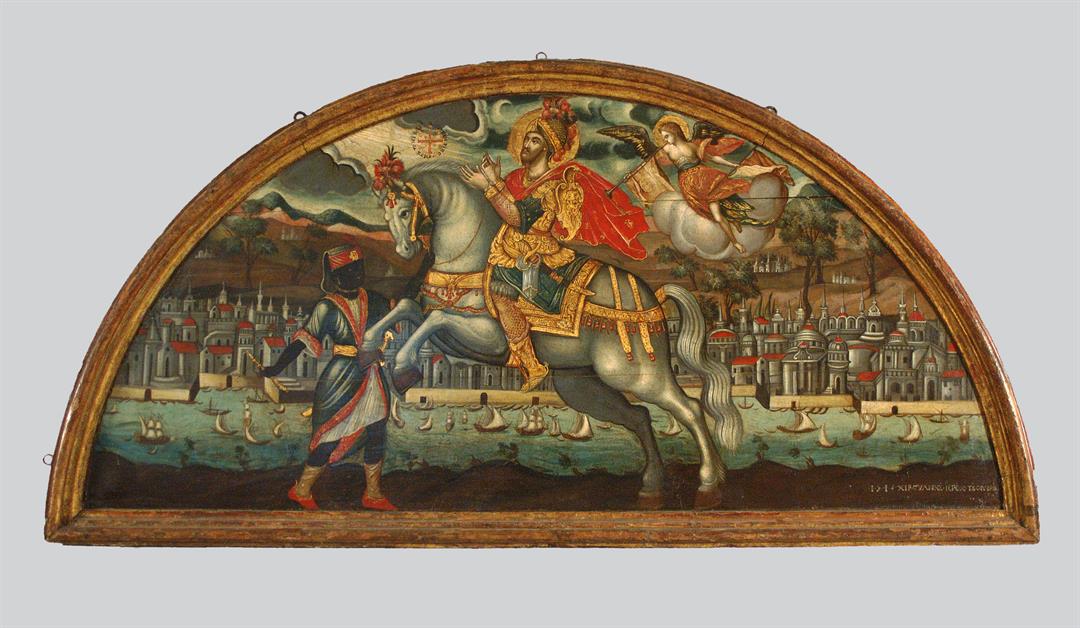
The Vision of Constantine the Great by Stylianos Stavrakis (1709-1786). “The emperor, depicted mounting and dressed in decorated military uniform, appears to gaze at the Inscription ΕΝ ΤΟΥΤΩ ΝΙΚΑ ΚΩΝΣΤΑΝΤΙΝΕ/ In hoc signo vinces, that is written around a cycle of stars enclosing a cross. The scene is set in front of the harbour of a town, probably Constantinople, with low hills and pine slopes.”
Byzantine Museum via Wikimedia Commons.
The legend says that as Constantine the Great was preparing to fight the Battle of Milvian Bridge, he saw a cross in the sky and the words “In Hoc Signo Vinces” — “in this sign you shall conquer”. He converted to Christianity on the spot, won the battle, and made Christianity the official religion of the now-reunified Roman Empire.
If any of that is true is, of course, impossible to know. He’d been at least favorable to Christianity for some time, helping to promulgate the Edict of Milan that extended toleration to Christianity across the parts of the Empire where his writ ran. However it happened, Constantine’s conversion story — the myth that has come down to us — carries a lesson we Dissidents should study.
Constantine came up at the tail end of the Crisis of the Third Century, in which the Roman Empire all but collapsed. It’s traditional to say that the CTC “ended” with Diocletian (r. 284-305), but obviously the ructions continued, as the Battle of Milvian Bridge was one of several in a new round of civil wars. I’m no scholar of Late Antiquity, but I can boil down all the many overlapping causes of the CTC to a word: Decadence.
The Roman Empire after Aurelius was simply too decadent to go on. Your Marxist would point to serious and irreparable class divisions within the Empire, and he’d be right. Other Marxist-flavored historians would point out the collapse of the currency, the rudimentary and laughably flawed taxation system, and so forth, and they’d be right, too. Military historians would say that the Empire simply lacked sufficient manpower, or at least, sufficient high-quality manpower, for the tasks at hand, exacerbated by the other stuff we just discussed … and they, too, would be right. Let’s not forget the Antonine Plagues, of course, which older historians argued were horrible but, as I understand it, a new generation of bio-archaeologists are proving were far worse than we suspected …
All that played its part, but above all, the Empire was just tired. Bored. Worn out. Overstuffed. Made sick by its own excesses. In a word, decadent.
That’s where Constantine’s conversion comes in. Marcus Aurelius, the last good Emperor, was the world’s most famous Stoic, then as now. Stoicism is indeed proof against decadence … but Stoicism is a harsh, cold philosophy. It’s not just “suppressing your emotions and acting like a hardass all the time,” as so many young men on the internet seem to think — far, far from that — but the Stoic lives by reason. His whole goal in life is to live “in conformity to nature,” and on the Stoic view, “Reason” and “Nature” are one and the same.
For all Stoic discipline seems to focus on the body, then, it’s really in the mind where true Stoics are made. If it’s a religion – and I’d argue that it is, but that’s irrelevant — then it’s the most cerebral creed ever devised. You don’t have to be a brainiac to be a Stoic — no less a Stoic than Marcus frequently upbraids himself for being a bit slow on the uptake — but you do have to live, and have an overwhelming desire to live, entirely inside your own head.
December 3, 2021
Australian-American War of 1942 – The Battle of Brisbane
World War Two
Published 2 Dec 2021America shares a language and large parts of its culture with Britain and Australia. But when tens of thousands of US troops arrive in 1942, things will be far from smooth. While the alliance remains firm, their soldiers will spend almost as much time fighting each other as they do the Axis.
(more…)
November 21, 2021
QotD: Britain’s middle class after WW1
England is a country in which property and financial power are concentrated in very few hands. Few people in modern England own anything at all, except clothes, furniture and possibly a house. The peasantry have long since disappeared, the independent shopkeeper is being destroyed, the small business-man is diminishing in numbers. But at the same time modern industry is so complicated that it cannot get along without great numbers of managers, salesmen, engineers, chemists and technicians of all kinds, drawing fairly large salaries. And these in turn call into being a professional class of doctors, lawyers, teachers, artists, etc., etc. The tendency of advanced capitalism has therefore been to enlarge the middle class and not to wipe it out as it once seemed likely to do.
But much more important than this is the spread of middle-class ideas and habits among the working class. The British working class are now better off in almost all ways than they were thirty years ago. This is partly due to the efforts of the Trade Unions, but partly to the mere advance of physical science. It is not always realized that within rather narrow limits the standard of life of a country can rise without a corresponding rise in real-wages. Up to a point, civilization can lift itself up by its boot-tags. However unjustly society is organized, certain technical advances are bound to benefit the whole community, because certain kinds of goods are necessarily held in common. A millionaire cannot, for example, light the streets for himself while darkening them for other people. Nearly all citizens of civilized countries now enjoy the use of good roads, germ-free water, police protection, free libraries and probably free education of a kind. Public education in England has been meanly starved of money, but it has nevertheless improved, largely owing to the devoted efforts of the teachers, and the habit of reading has become enormously more widespread. To an increasing extent the rich and the poor read the same books, and they also see the same films and listen to the same radio programmes. And the differences in their way of life have been diminished by the mass-production of cheap clothes and improvements in housing. So far as outward appearance goes, the clothes of rich and poor, especially in the case of women, differ far less than they did thirty or even fifteen years ago. As to housing, England still has slums which are a blot on civilization, but much building has been done during the past ten years, largely by the local authorities. The modern council house, with its bathroom and electric light, is smaller than the stockbroker’s villa, but it is recognizably the same kind of house, which the farm labourer’s cottage is not. A person who has grown up in a council housing estate is likely to be – indeed, visibly is – more middle class in outlook than a person who has grown up in a slum.
George Orwell, “The Lion And The Unicorn: Socialism and the English Genius”, 1941-02-19.
November 16, 2021
Pineapple: the King of Fruits
The History Guy: History Deserves to Be Remembered
Published 15 Nov 2021Pineapples are so culturally significant that pineapples adorn the tops of cathedrals, and serve as the domicile of one of the world’s most popular cartoon characters. An estimated 300 billion pineapples are farmed each year, and a 2021 YouGov poll lists pineapples as the sixth most favorite fruit, ahead of all varieties of apples and oranges.
This is original content based on research by The History Guy. Images in the Public Domain are carefully selected and provide illustration. As very few images of the actual event are available in the Public Domain, images of similar objects and events are used for illustration.
You can purchase the bow tie worn in this episode at The Tie Bar:
https://www.thetiebar.com/?utm_campai…All events are portrayed in historical context and for educational purposes. No images or content are primarily intended to shock and disgust. Those who do not learn from history are doomed to repeat it. Non censuram.
Find The History Guy at:
Patreon: https://www.patreon.com/TheHistoryGuy
Please send suggestions for future episodes: Suggestions@TheHistoryGuy.netThe History Guy: History Deserves to Be Remembered is the place to find short snippets of forgotten history from five to fifteen minutes long. If you like history too, this is the channel for you.
Awesome The History Guy merchandise is available at:
https://teespring.com/stores/the-hist…Script by THG
#history #thehistoryguy #Pineapple

November 5, 2021
The New York Times identifies the next big threat to humanity – “Muskism”
In Thursday’s NP Platformed newsletter, Colby Cosh outlines the “evidence” amassed in a recent New York Times essay blaming Elon Musk for, well, everything:

Elon Musk at the 2015 Tesla Motors annual meeting.
Photo by Steve Jurvetson via Wikimedia Commons.
Lepore commences by describing Bill Gates’s 66th birthday party, for which a bunch of rich people — including Amazon’s Jeff Bezos — were helicoptered to a private beach from a nearby yacht. Neither Elon Musk, thought to be the world’s richest person, or Mark Zuckerberg, founder of newly rebranded Facebook, were present at the party. Zuckerberg was busy illuminating plans for his “metaverse”, which Lepore describes as “a virtual reality,” wherein you wear “a headset and gear that closes out the actual world.”
Here’s where Lepore goes from this: “The metaverse is at once an illustration of and a distraction from a broader and more troubling turn in the history of capitalism. The world’s techno-billionaires are forging a new kind of capitalism: Muskism.”
In literally the next sentence, Lepore admits that the subject of her essay, Elon Musk, immediately and publicly made fun of the Facebook “metaverse” plans. We are on the third paragraph of the essay, and Lepore has already: a) blamed Elon Musk for an A-hole billionaire party he didn’t attend, because he was busy with his engineering and manufacturing projects; and b) applied the new coinage “Muskism” to a virtual reality project that actual Musk loudly criticized. Somehow this essay has severed its own hydrocephalic head twice over, within 500 words.
It gets worse from there as Lepore attempts to complete her mission of denouncing Muskism, which she describes as an “extreme extraterrestrial capitalism.” She quickly has to admit that Bill Gates, who is mostly spending a computing fortune on global philanthropy these days when he’s not lifting off from yachts in choppers, doesn’t have one single freaking thing to do with absolutely any of this. NP Platformed was an editor back in the day, so we notice that the intro of Lepore’s essay is at this point not only detached from its body, but has been left to rot several miles away. Gates-Musk-Bezos-Zuckerberg: they’re all tentacles of the same menacing Muskist octopus here, as in so much newspaper and magazine commentary, and abuse flung in their general direction will suffice to condemn all.
Lepore’s accusation against Musk turns out to be … that he likes some classic science fiction but doesn’t always concur with the politics of its authors. Musk has called himself a “utopian anarchist of the kind best described by Iain Banks,” but Banks was “an avowed socialist.” Gasp! Banks (1954-2013), the Scottish science fiction author best known for the Culture series, was a particular kind of U.K. “libertarian socialist” who believed strongly in spacefaring as a step toward post-scarcity life for sentient beings. His politics are easily misunderstood by Americans, who don’t have this particular kind of weirdo, and the interstellar “Culture” he envisioned was never intended to be admired unironically. In other words, that part of Lepore’s essay is as mangled and obtuse as the rest.
October 24, 2021
QotD: Origins of the upper-class twit
George Orwell, “The Lion And The Unicorn: Socialism and the English Genius”, 1941-02-19.


