
What generally defines our large landholders is their greater access to capital. Now we don’t want to think of capital in the sort of money-denominated, fungible sense of modern finance, but in a very concrete sense: land, infrastructure, animals, and equipment. As we’ll see, it isn’t just that the big men hold more of this capital, but that they hold fundamentally different sorts of capital and often use it very differently.
Of course this begins with land. The thing to keep in mind is that prior to the modern period […] the vast majority of economic activity was the production of the land. That meant that land was both the primary form of holding wealth but also the main income-producing asset. Consequently, larger land holdings are the assets that enable the accumulation of all of the other kinds of capital we’re discussing. By having more land – typically much more land – than is required to feed a single household, these larger farmers can […] produce for markets and trade, enabling them to afford to acquire labor, animals, equipment and so on. Our subsistence farmers of the last post, focused on producing for survival, would be hard-pressed to acquire much further in the way of substantial capital.
The next most important category is generally animals, particularly a plow team […] while our small subsistence farmers may keep chickens or pigs on some small part of the pasture they have access to, they probably do not have a complete plow-team for their own farm […]. Oxen and horses are hideously expensive, both to acquire but also to feed and for a family barely surviving one year to the next, they simply cannot afford them. They also do not have herds of animals (because their small farms absolutely cannot support acres of pasturage) and they probably have limited access to herdsmen generally (that is, transhumant pastoralists moving around the countryside) because those fellows will tend to want to interact with the community leaders who are, as noted above, the large landholders. All of which is to say that while the small farmers may keep a few animals, they do not have access to significantly large numbers of animals (or humans), which matters.
The first impact of having a plow-team is fairly obvious: a plow drawn by a couple of oxen is more effective than a plow pushed by a single human. That means that a plow-team lets the same amount of farming labor sow a larger area of land […]. It also allows for a larger, deeper plow, which in turn plows at a greater depth, which can improve yields […]. You can easily see why, for a landholder with a large farm, having a plow-team is so useful: whereas the subsistence farmer struggles by having too much labor (and too many mouths to feed) and too little land, the big landholder has a lot of land they are trying to get farmed with as little labor as possible. And of course, more to the point, the large landholder has the wealth and acreage necessary to buy and then pasture the animals in the plow-team.
The second major impact is manure. Remember that our farmers live before the time of artificial fertilizer. Crops, especially bulk cereal crops, wear out the nutrients in the soil quite rapidly after repeated harvests, which leaves the farmer two options. The first, standard option, is that the farmer can fallow the field (which also has the advantage of disrupting certain pest life-cycles); depending on the farming method, fallowing may mean planting specific plants to renew the soil’s nutrients when those plants are uprooted and left to return to the soil in the field or it may mean simply turning the field over to wild plants with a similar effect. The second option is using fertilizer, which in this case means manure. Quite a lot of it. Aggressive manuring, particularly on rich soils which have good access to moisture (because cropping also dries out the soil; fallowing can restore that moisture) allows the field to be fallowed less frequently and thus farmed more intensively. In some cases it allowed rich farmland to be continuously cropped, with fairly dramatic increases in returns-to-acreage as a result. And by increasing the nutrients in the soil, it also produces higher yields in a given season.
Now the humans in a farming household aren’t going to generate enough manure on their own to make a meaningful contribution to soil fertility. But the larger landholders generally have two advantages in this sense. First, because their landholdings are large, they can afford to turn over marginal farming ground to pasture for horses, cattle, sheep and so on; these animals not only generate animal products (or prestige, in the case of horses), they also eat the grass and generate manure which can be used on the main farm. The second way to get manure is cities; unlike farming households, cities do produce sufficient quantities of human waste for manuring fields. And where small subsistence farmers are unlikely to be able to buy that supply, large landholders are likely to be politically well-connected enough and wealthy enough to arrange for human waste to be used on their lands, especially for market oriented farms close to cities. And if you just stopped and said, “wait – these guys were paying for human waste?” … yes, yes they sometimes did (and not just for farming! Check out how saltpeter was made, or what a fuller did!).
Finally, there’s the question of infrastructure: tools, machines and storage. The large landholder is the one likely to be able to afford to build things like granaries, mills and so on. Now there is, I want to note, a lot of variation from place to place about exactly how this sort of infrastructure is handled. It might be privately owned, it might be owned by the village, but frequently, the “village mill” was actually owned by the large landholder whose big manor overlooked the village (who may also be the local political authority). And while we’re looking at grain, other agricultural products which don’t store as well or as easily might need to be aggregated for transport to market and sale, a process where the large landholder’s storage facilities, political standing and market contacts are likely to make him the ideal middleman. I don’t want to get too in the weeds (pardon the pun) on all the different kinds of infrastructure (mills for grains, presses for olives, casks for wine) except to note that in many cases the large landholder is the one likely to be able to afford these investments and that smaller farmers growing the same crops nearby might well want to use them.
Bret Devereaux, “Collections: Bread, How Did They Make It? Part II: Big Farms”, A Collection of Unmitigated Pedantry, 2020-07-31.
March 5, 2023
QotD: The role of the “big” landowners in pre-modern farming societies
January 31, 2023
“Thorstein Veblen’s famous ‘leisure class’ has evolved into the ‘luxury belief class'”
Rob Henderson had a particularly difficult childhood, but thanks to his own efforts ended up going to Yale after leaving the military. He discovered a very different world when he began his studies:
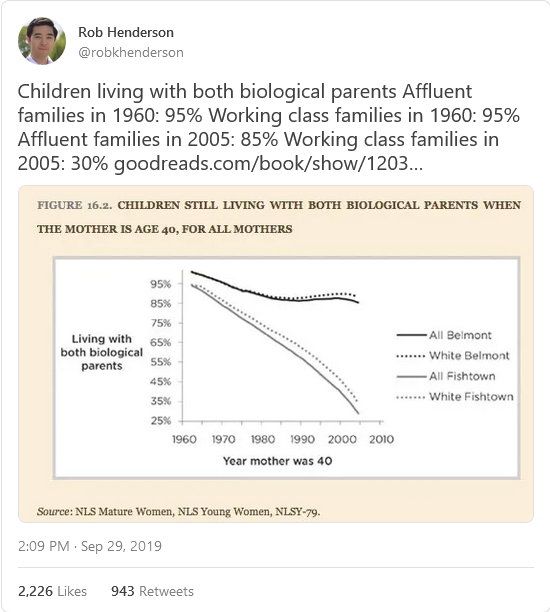
I was bewildered when I encountered a new social class at Yale four years ago: the luxury belief class. My confusion wasn’t surprising given my unusual background. When I was three years old, my mother was addicted to drugs and my father abandoned us. I grew up in multiple foster homes, was then adopted into a series of broken homes, and then experienced a series of family tragedies. Later, after a few years in the military, I went to Yale on the GI Bill. On campus, I realized that luxury beliefs have become fashionable status symbols. Luxury beliefs are ideas and opinions that confer status on the rich at very little cost, while taking a toll on the lower class.
In the past, people displayed their membership in the upper class with their material accoutrements. But today, luxury goods are more affordable than before. And people are less likely to receive validation for the material items they display. This is a problem for the affluent, who still want to broadcast their high social position. But they have come up with a clever solution. The affluent have decoupled social status from goods, and re-attached it to beliefs.
[…]
You might think that rich students at elite universities would be happy because they are in the top 1% of income earners. But remember, they’re surrounded by other members of the 1%. Their social circle, their Dunbar number, consists of 150 baby millionaires. Jordan Peterson has discussed this phenomenon. Citing figures from his experience teaching at Harvard in the 1990s, Peterson noted that a substantial proportion of Ivy League graduates go on to obtain a net worth of a million dollars or more by age 40. And yet this isn’t enough for them. Not only do top university graduates want to be millionaires-in-the-making, they also want the image of moral righteousness. Elite graduates desire high status not only financially, but morally as well.
For our affluent social strivers, luxury beliefs offer them a new way to gain status.
Thorstein Veblen’s famous “leisure class” has evolved into the “luxury belief class”. Veblen, an economist and sociologist, made his observations about social class in the late nineteenth century. He compiled his observations in his classic work, The Theory of the Leisure Class. A key idea is that because we can’t be certain of the financial standing of other people, a good way to size up their means is to see whether they can afford to waste money on goods and leisure. This explains why status symbols are so often difficult to obtain and costly to purchase. These include goods such as delicate and restrictive clothing, like tuxedos and evening gowns, or expensive and time-consuming hobbies like golf or beagling. Such goods and leisurely activities could only be purchased or performed by those who did not live the life of a manual laborer and could spend time learning something with no practical utility. Veblen even goes so far as to say, “The chief use of servants is the evidence they afford of the master’s ability to pay.” For Veblen, butlers are status symbols, too.
Converging on these sociological observations, the biologist Amotz Zahavi proposed that animals evolve certain displays because they are so costly. The most famous example is the peacock’s tail. Only a healthy bird is capable of growing such plumage while managing to evade predators. This idea might extend to humans, too. More recently, the anthropologist and historian Jared Diamond has suggested that one reason why humans engage in displays such as drinking, smoking, drug use, and other physically costly behaviors, is because they serve as fitness indicators. The message is “I’m so healthy that I can afford to poison my body and continue to function.” Get hammered while playing a round of golf with your butler, and you will be the highest status person around.
January 29, 2023
“That is what Westerners like about Dubai: the indentured servitude. And the weather.”
Tanya Gold at The Free Press:
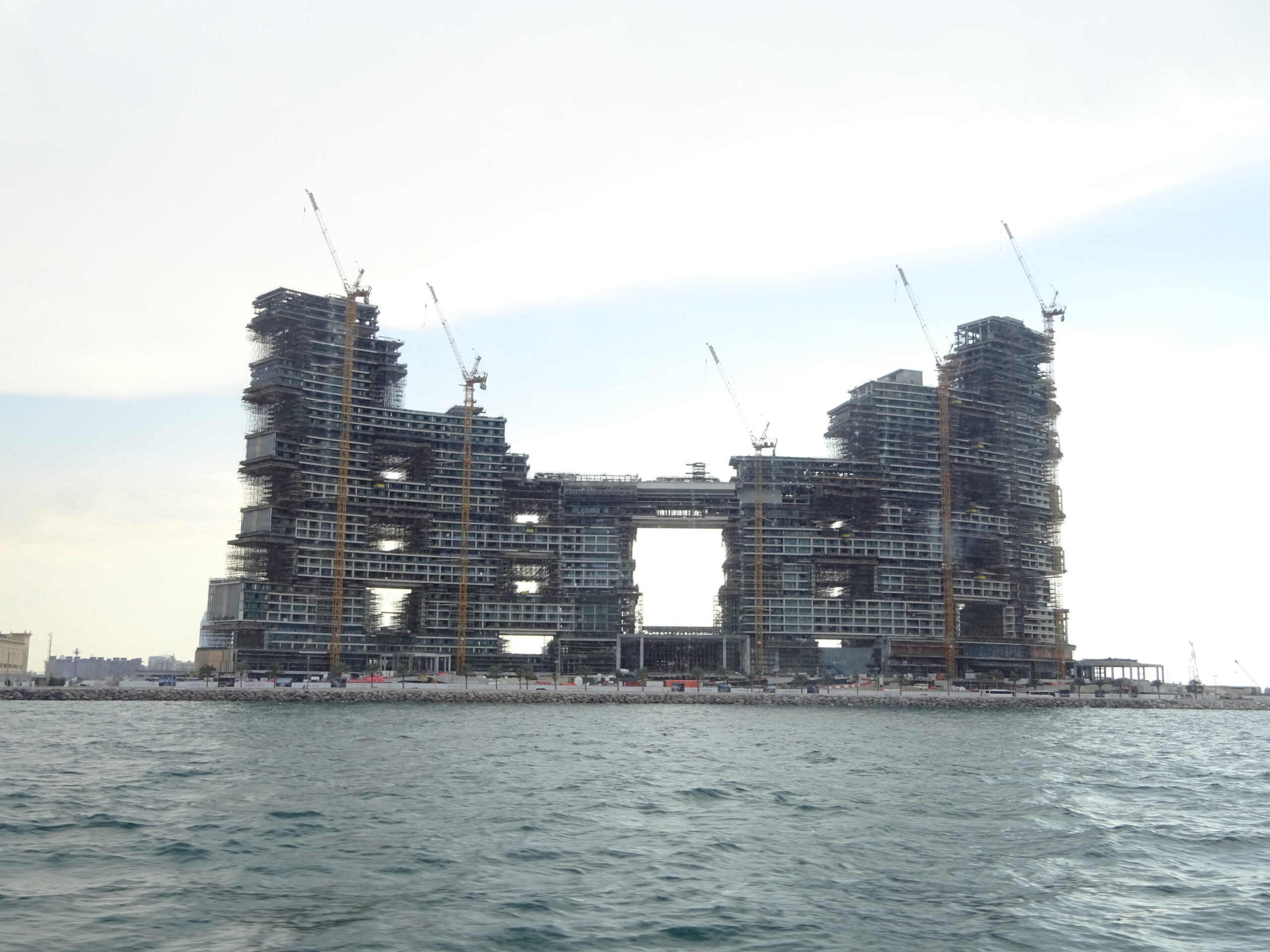
“Royal Atlantis Resort hotel under construction, Palm Jumeirah, Dubai” by Jpbowen is licensed under CC BY-SA 4.0 

 .
.
I went to Dubai once. It is where tyranny meets hyper-capitalism, and it is as awful as it sounds.
I was helping a journalist friend research an article. I spent my days admiring an undersea bedroom in a lagoon and a ski slope inside a mall. At night I would meet trafficked maids, or a woman imprisoned for adultery. I asked an ancient British tourist why he came here for his holidays. He said, “The staff will hold your dick if you ask them.” That is what Westerners like about Dubai: the indentured servitude. And the weather.
Last week, at the grand opening of Atlantis The Royal, Dubai’s newest luxury hotel, Beyoncé gave her first live performance in five years. This gig featured a 48-person all-female orchestra — how feminist — a Lebanese dance troupe, and her daughter. She was reportedly paid $24 million for the occasion.
Her latest album, Renaissance, is, among other things, an homage to black queer culture. She performed no songs from it; how could she in a country where homosexuality is punishable by death? So she sang her back catalog for the equivalent of ten Bugatti Chirons. Oil-rich tyrannies have generous marketing budgets; they’re selling tyranny itself.
What Beyoncé does or doesn’t do for money wouldn’t matter but for the trend of celebrity activism, which insinuates that morality travels with a star like her wardrobe. Beyoncé acolytes say that just by arriving in Dubai she made the city gayer, a kind of subtle protest. Perhaps so subtle that even Dubai’s ruler Sheikh Mohammed bin Rashid — accused of abducting two of his daughters for noncompliance with his wishes, one from England, and another from a ship as she tried to flee Dubai — wouldn’t notice. Did his enforcers reconsider their stance on gayness as they sang along to “Drunk in Love”? Or are they laughing themselves stupid at the PR coup of persuading an until-now gay ally to perform at the opening of a hotel in a country that hates gays?
Dubai, along with Saudi Arabia, wants to reinvent itself as a tourist destination for when the oil runs out. There is nothing understated there — the Burj Khalifa, which is the tallest building in the world; the Palm Jumeirah, a man-made archipelago in the shape of a palm tree. Everything is vast and highly colored, a distraction. It has to be: To enjoy yourself in Dubai, you must close your eyes to suffering. Almost 90 percent of Dubai’s residents are migrant workers, and many of them live in conditions amounting to indentured slavery.
January 20, 2023
“… any association with Davos should put an individual or organization under notice of suspicion”
CDR Salamander wants to sign up — like so many of us — for a post-Davos world:
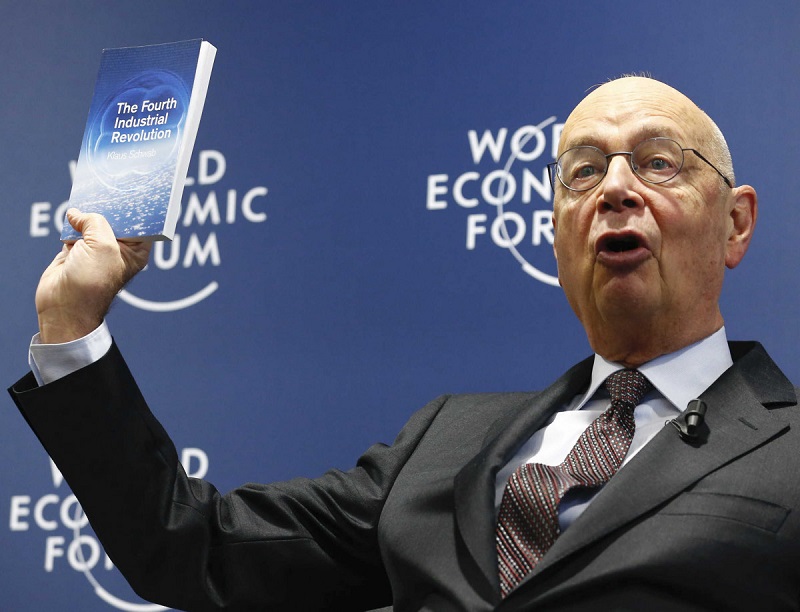
The whole World Economic Forum/Davos experience is one part Bond villain parody, one part clout seeking billionaires, one part megalomania, a heaping cup of greed, and a dash of rent seeking.
In 2023 things have reached the point where any association with Davos should put an individual or organization under notice of suspicion. Amazing to see people who claim to be American conservatives or lovers of liberty attending in an non-ironic, non-protesting capacity.
This wannabee gaggle of quasi-oligarchs and autocrat throne sniffers represents everything that is wrong with the human desire for control, power, and to crush the individual for fun and profit.
They pretend to be the world government in waiting that no one asked for, no one wants, and trust me on this — no one wants to live under. Being unaccountable to the people is their ideal state.
If you don’t know what I am referring to above, shame on you. Google it yourself, but I couldn’t help but giggle when I read the title from this article by Gideon Rachman at The Financial Times; Geopolitics threatens to destroy the world Davos made.
Really? It is? Then by all means let’s have MOAR!
…the 2023 WEF — the first to take place in its regular winter location since the pandemic began — could be seen as signalling a return to normalcy. However, China’s sudden abandonment of its zero-Covid policy has raised fears that a new wave of variants could emerge.
And, even if a fresh pandemic phase is avoided, Covid has left its mark on the way governments and businesses think about globalisation. The assumption that goods and commodities can always be shipped easily around the world has been shattered.
Except for the mentally fragile few and those who leverage power through them, the world is over COVID like it is over the flu. The last three years has been a clarifying event bringing in to stark relief those autocracy worshipers and hypocrites who hold individual rights in contempt. It also helped us see the existential danger a free people can face when they put themselves at the mercy of governments who see a crisis opening a door for an easy grasp at additional powers they will never want to give back.
The past the Davos set desired failed the future that is our present, but that doesn’t give pause to any of them. The Davos view of the future where everyone (except for those at the top) lives in a pod, eats bugs, owns nothing but is “happy” is at best dystopian, at worst justifies at some point if they are not stopped, open global revolt against the ruling class with all the violence and blood that comes with it.
[…]
Simply unacceptable in democratic nations that the will of the people might promote change in political leadership. Next thing you know, they might want even more free speech and redress of grievances.
Those world leaders who are present might do well to take the funicular up to the Schatzalp Hotel, which served as Mann’s model for the sanatorium in The Magic Mountain. The hotel’s view is the best in Davos — it may offer a chance for quiet reflection on how to prevent war and natural disaster from once again engulfing the global economy
Unspoofable.
Perhaps they should reflect on how they encouraged Russian aggression and European vulnerability to hydrocarbon blackmail? Should they take a moment to see how they look the other way as the PRC engages in wholesale oppression of their Muslim minority? Are they proud of their dividends derived from almost unimaginable levels of air and water pollution flowing out of PRC’s slave labor run factories?
Unlikely — they might miss out on the next party.
A post-Davos world?
How do we bring it here faster?
December 27, 2022
Marcus Licinius Crassus, the richest man in Rome
In The Critic, Bijan Omrani reviews Crassus: The First Tycoon by Peter Stothard:

If you are feeling despondent about the dismal quality of the current generation of politicians, it may be some comfort to remember that even in the golden age of Rome such complaints were legion.
The poet Horace wrote at length about how the ruling class had gone downhill. Once, there had been paragons of virtue such as Cincinnatus, who after saving Rome as dictator laid down his power without demur and returned to live on his humble farm; or the consul Regulus, who refused to make any concessions after being captured by the Carthaginians, although he knew they would torture him to death. Instead of these titans, the modern age had brought forth a base generation. Marcus Licinius Crassus, the richest man in Rome and subject of this new biography, was foremost among them.
The formidable influence wielded by Crassus in the final years of the Roman Republic — he was an ally, and rival, of Julius Caesar and Pompey the Great — came not by way of old-fashioned heroics and victories on the battlefield. His methods were recognisably modern. Peter Stothard characterises him as a “disrupter of old rules, fixer and puller of the puppet strings of power”. His tools were money and the economy of favours. He employed them with a coldness, ruthlessness and level of calculation that makes him unappetising, but deeply compelling. Stothard’s description of him as “The First Tycoon” is apt. He is the sort of character one might expect to find wearing red braces in a New York boardroom, rather than a brocaded toga in the Roman Forum.
By origin, Crassus was a member of one of Rome’s blue-blooded families. His pursuit of political influence by means of business rather than military prowess would seem at first sight unexpected, given the traditional prohibition against the senatorial aristocracy engaging in trade. Yet, the turmoil of Crassus’s formative years overturned these niceties. The last sight he had of his father, who had served as a consul, was of his head on a spike in the Forum.
He was a victim of the perennial strife that plagued Rome at the beginning of the 1st century BC, caused by imbalances in wealth and tensions between Rome and wider Italy, not to mention discord over land, military and constitutional reforms. With the death of his father and two of his brothers, Crassus had to flee Rome and hide in a cave for eight months in Spain, where his family still had allies. It is doubtless these upheavals — similar to those of Julius Caesar, who lost his father young and had to go into hiding during this chaos — led Crassus to seek an inviolable security, regardless of whether he trampled on old Roman conventions and upset others to do so.
When the aristocratic faction seized power in the late 80s BC, Crassus was able to return to Rome. There, he pursued every commercial method, no matter how disreputable, to accumulate wealth. It satisfied not only his needs for security but, as Stothard argues, it was also a way of seeking revenge for the death of his father. He bought up the properties of those families allied to the earlier populist regime which had just been displaced.
These came at a knock-down price, as the families had been outlawed, with some executed and others sent into exile. Crassus appears to have been on a committee which determined the loyalty of citizens to the new government and appears not to have scrupled to condemn those whose property he coveted. His other prime method for enlarging his portfolio was to buy up cheaply buildings that were on fire, or else in the path of a fire. He organised his slaves along military lines, using them with relentless efficiency to acquire, rebuild and sell on property for a huge profit.
December 12, 2022
“The reason that Canada’s arts do not resonate with 95% of Canadians is that they are products of socialist realism’
Elizabeth Nickson on the parasitic world of official “Canadian culture” with its gatekeepers, subsidies, and luxury beliefs:
When I say society, I don’t mean the upper reaches of the wealthy. While we do have the very rich in Canada, they are rigorous in their hiddenness because we have the worst lefties on the continent and that is saying something. The safe thing for any wealthy family is give $ to socialists, bow and scrape to the harpies at the CBC and hope they don’t notice your bank balance. Anyway, these dreadful people arrived post WW2 with their hideous Frankfurt School ideas and just preyed on the simplest most innocent well-meaning good white people you could ever imagine, and literally ate, ravenous and braying all the while, the country’s potential.
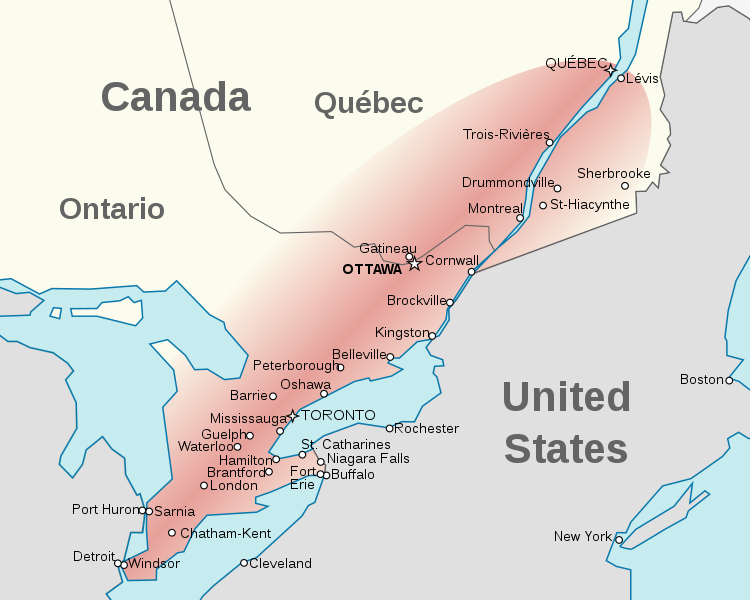
So the scandal took place among them, or rather the world they created, which is basically a clutch of 150,000 grifters located between Ottawa, Toronto and Quebec City, whose only mission is to divest the government of as much public money as possible. This is particularly true of their defensive line which consists of the arts and journalism. Theirs is a world where no stone is left unsubsidized by taxes on the hidden rich, waitresses at truck stops in Kamloops and anyone who dares to make money unapproved by the CBC. They are, as a former editor swore to me, the gatekeepers. That was before her circulation collapsed by 65%., but no doubt she still believes it.
The arts and media in Canada are constructed entirely for the 5%, consumed by those who live the lush subsidized life — or those who want to — whether in government or in semi-independent corporations or businesses who require government help and “seed” money etc. (There are a hundred terms for the grift.)
Books, if you look at their sales, are tragic. There have been a handful of impressive films, despite the literal billions thrown at filmmakers over the past 20 years. Most of them are catastrophically depressing, the books make you want to cut out your heart with a grapefruit spoon. Painters paint, if you subtract all the hectoring from minor artists, from forced inclusion, some of them are very good. We can create good art. But not with our current curators.
The reason that Canada’s arts do not resonate with 95% of Canadians is that they are products of socialist realism. They describe humans and human life as they either believe it to have been (dark and in need of enlightened beings like themselves) or as they feel it must be in the future (filled with people expressing their oppression and being paid for it). It’s basically fantasy, and no one likes it, watches it, reads it.
The rest of Canada is a centre-right country, a gut-it-out-and-build-it-kind of place. I know that is the exact opposite of the propaganda, but Conservatives win a majority of the votes in every election, yet still only amount to 40%. We have five parties, and four of them are leftie — their platforms are all “more money for us” — but the big party, the one that receives about 30% of the vote is so crafty, so embedded in our vast vast bureaucracy that fixing the game is child’s play. Informed by their Frankfurt School gurus, they have been in power 100 years, with brief Conservative interludes.
We take in about half a million immigrants a year, and most of them are from desperate places. Vote harvesting in those neighborhoods is done by leaders in each immigrant community. These men and women are the strongest, most educated and frankly from the ones I’ve met, thuggish, and through them comes all access to government programs, housing and education. Therefore, when they collect your vote, you know for whom your vote is meant. The thing about immigrants though is that they were coming for the old Canada, not the new Commie police state.
But for now? Easy. No one investigates this. Why not? Our media is subsidized. ALL of it.
December 9, 2022
Caesar versus Cato
In The Critic, Daisy Dunn reviews Uncommon Wrath: How Caesar and Cato destroyed the Roman Republic by Josiah Osgood:
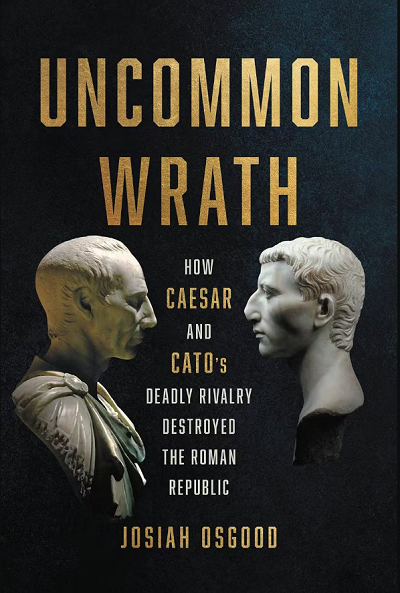
If there was one thing the Romans did well — aside from sanitation, irrigation and concrete — it was polemic. Cicero composed fourteen fiery Philippics against Mark Antony in the 40s BC, and Catullus jibed at Julius Caesar so profusely in his poems that he had to issue an apology. Less famous, but equally explosive, was Caesar’s own collection of vitriol. The Anticato survives today only in fragments, but according to an ancient satirist, it was originally so long that it took up two scrolls and almost outweighed the penis of Publius Clodius Pulcher, apparently among the best-endowed politicians in Rome.
Caesar wrote it shortly before he became dictator, with the intention of denigrating the memory of Marcus Porcius Cato, “Cato the Younger”. For years the two men had been locked in furious rivalry. Caesar blasted Cato as cold and miserly. Cato despaired at Caesar’s profligacy and tireless womanising. If Caesar was louche in his barely-belted toga and exotic unguents, Cato was positively austere — a prime hair-shirt candidate — with his bare feet, rustic diet, extreme exercise and strict sexual mores; it was most unusual for a Roman to make his wife the first woman he slept with.
Few would argue with Josiah Osgood, Professor of Classics at Georgetown, when he describes Caesar and Cato as opposites. Even Donald Trump and Joe Biden have more in common than they did. Caesar was the nephew of the wife of Gaius Marius, the populist enemy of Sulla, who as dictator had thousands of Italians proscribed and killed in his bid to restore the authority of the Senate. Cato could count Sulla as an old family friend. Caesar belonged to a well-established Roman family and claimed descent from Venus via her son Aeneas. Cato’s family was Sabine, and his most famous ancestor was a mere mortal in the shape of the plebeian writer and highly conservative statesman Cato the Elder.
The differences between Caesar’s and Cato’s personalities mattered because they reflected the differences in their visions for Rome. Osgood sums these up as “an empire wielding its power for the people” (Caesar) versus “a Senate protecting the people from the all-powerful empire builders” (Cato). It is little wonder they came to blows.
Osgood takes the tense relationship between Cato and Caesar as the central focus of his book. He argues that their feud has been overlooked as a contributing factor to the civil war that erupted in 49 BC and brought the Roman Republic crashing to the ground. Blame for this war has more usually been placed on the collapse of the First Triumvirate — an illegal alliance for power forged between Julius Caesar, Pompey the Great and Marcus Licinius Crassus in 60 BC — and the breakdown in relations between Caesar and Pompey in particular. But all wars have long-term and short-term causes. For Osgood, the dispute between Caesar and Cato was significant in at least the medium term.
December 3, 2022
The end of the old “WASP” upper class
Scott Alexander is reading Bobos in Paradise by David Brooks and summarized the first sixth of the book:
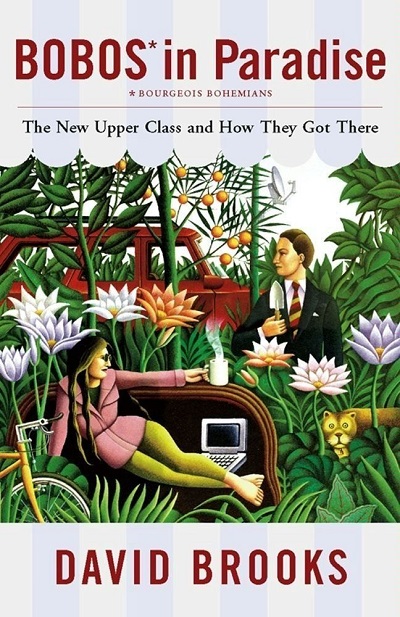
The daring thesis: a 1950s change in Harvard admissions policy destroyed one American aristocracy and created another. Everything else is downstream of the aristocracy, so this changed the whole character of the US.
The pre-1950s aristocracy went by various names; the Episcopacy, the Old Establishment, Boston Brahmins. David Brooks calls them WASPs, which is evocative but ambiguous. He doesn’t just mean Americans who happen to be white, Anglo-Saxon, and Protestant — there are tens of millions of those! He means old-money blue-blooded Great-Gatsby-villain WASPs who live in Connecticut, go sailing, play lacrosse, belong to country clubs, and have names like Thomas R. Newbury-Broxham III. Everyone in their family has gone to Yale for eight generations; if someone in the ninth generation got rejected, the family patriarch would invite the Chancellor of Yale to a nice game of golf and mention it in a very subtle way, and the Chancellor would very subtly apologize and say that of course a Newbury-Broxham must go to Yale, and whoever is responsible shall be very subtly fired forthwith.
The old-money WASPs were mostly descendants of people who made their fortunes in colonial times (or at worst the 1800s); they were a merchant aristocracy. As the descendants of merchants, they acted as standard-bearers for the bourgeois virtues: punctuality, hard work, self-sufficiency, rationality, pragmatism, conformity, ruthlessness, whatever made your factory out-earn its competitors.
By the 1950s they were several generations removed from any actual hustling entrepreneur. Still, at their best the seed ran strong and they continued to embody some of these principles. Brooks tentatively admires the WASP aristocracy for their ethos of noblesse oblige — many become competent administrators, politicians, and generals. George H. W. Bush, scion of a rich WASP family, served with distinction in World War II — the modern equivalent would be Bill Gates’ or Charles Koch’s kids volunteering as front-line troops in Afghanistan.
At their worst, they mostly held ultra-expensive parties, drifted into alcoholism, and participated in endless “my money is older than your money” dick-measuring contests. And they were jocks — certainly good at lacrosse and crew, but their kids would be much less likely than modern elites’ to become a scientist, professor, doctor, or lawyer. Not only that, they were boring jocks — they stuck to a few standard rich people hobbies (yachting, horseback riding) and distrusted creativity or (God forbid) quirkiness. Their career choices were limited to the family business (probably a boring factory with a name like Newbury-Broxham Goods), becoming a competent civil service administrator, or other things along those lines.
The heart of the WASP aristocracy was the Ivy League. I don’t think there are good statistics, but until the early 1900s many (most?) Ivy League students were WASP aristocrats from a few well-known families. Around 1920 the Jews started doing really well on standardized tests, and the Ivies suspended standardized tests in favor of “holistic admissions” to keep them out and preserve the WASPishness of the elite. All the sons (and later, daughters) of the WASPs met each other in college, played lacrosse together, and forged the sort of bonds that make a well-connected and self-aware aristocracy.
Around 1955 (Brooks writes, building on an earlier book by Nicholas Lemann) Harvard changed their admission policy. Why? Partly a personal decision by Harvard presidents James Conant, and Nathan Pusey, who sincerely believed in meritocracy. And partly because Harvard’s Jewish quota was becoming unpopular, as increased awareness of the Holocaust made anti-Semitism déclassé. Conant and Pusey decided to admit based on academic merit (measured mostly by SAT scores). The thing where Harvard would always admit WASP aristocrats because that was the whole point of Harvard was relegated to occasional “legacy admissions”, a new term for something which was now the exception and not the rule. Other Ivies quickly followed.
Brooks on the consequences:
In 1952, most freshmen at Harvard were products of … the prep schools of New England (Andover and Exeter alone contributed 10% of the class), the East side of Manhattan, the Main Line of Philadelphia, Shaker Heights in Ohio, the Gold Coast of Chicago, Grosse Pointe of Detroit, Nob Hill in San Francisco, and so on. Two-thirds of all applicants were admitted. Applicants whose fathers had gone to Harvard had a 90% admission rate. The average verbal SAT score for the incoming men was 583, good but not stratospheric. The average score across the Ivy League was closer to 500 at the time.
Then came the change. By 1960 the average verbal SAT score for incoming freshman at Harvard was 678, and the math score was 695 — these are stratospheric scores. The average Harvard freshman in 1952 would have placed in the bottom 10% of the Harvard freshman class of 1960. Moreover, the 1960 class was drawn from a much wider socioeconomic pool. Smart kids from Queens or Iowa or California, who wouldn’t have thought of applying to Harvard a decade earlier, were applying and getting accepted … and this transformation was replicated in almost all elite schools. At Princeton in 1962, for example, only 10 members of the 62-man football team had attended private prep schools. Three decades earlier every member of the Princeton team was a prep school boy.
There was a one-or-two generation interregnum where the new meritocrats silently battled the old WASP aristocracy. This wasn’t a political or economic battle; as a war to occupy the highest position in the class hierarchy, it could only be won through cultural prestige. What was cool? What was out of bounds? What would get printed in the New York Times — previously the WASP aristocracy’s mouthpiece, but now increasingly infiltrated by the more educated newcomers?
November 27, 2022
“The uncomfortable truth is that autocrats and architects share complimentary motivations”
In UnHerd, Wessie du Toit sets the Saudi Arabian “Neom” development in its true and unsavoury proper context:
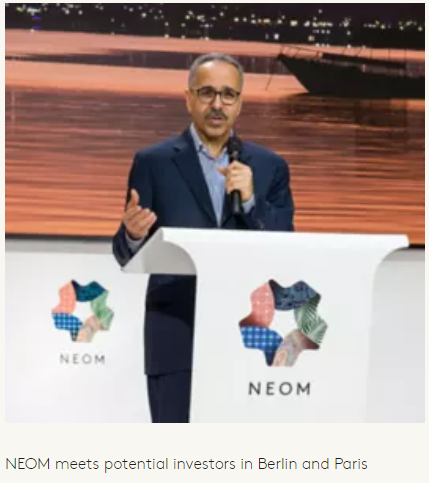
There may be no philosopher kings, but there are sci-fi princes. The dreams of Mohammed bin Salman, crown prince of Saudi Arabia and chairman of the Neom board, make the techno-futurism of Silicon Valley look down to earth. Bin Salman is especially fond of the cyber-punk genre of science fiction, which involves gritty hi-tech dystopias. He has enlisted a number of prominent Hollywood visual specialists for the Neom project, including Olivier Pron of Marvel’s Guardians of the Galaxy franchise. A team of consultants was asked to develop science-fiction aesthetics for a tourist resort, resulting in “37 options, arranged alphabetically from ‘Alien Invasion’ to ‘Utopia'”. One proposal for a luxury seaside destination, which featured a glowing beach of crushed marble, was deemed insufficiently imaginative.
Such spectacular indulgence must be causing envy among the high-flying architects and creative consultants not yet invited to join the project — if there are any left. But it also makes the moral dimension difficult to ignore: how should we judge those jumping on board bin Salman’s gravy train? Saudi Arabia — in case anyone has forgotten in the years since the journalist Jamal Khashoggi was murdered at its consulate in Istanbul — is a brutal authoritarian state.
In recent weeks, this has prompted some soul-searching in the architecture community, with several stinging rebukes aimed at Neom. Writing in Dezeen, the urbanist Adam Greenfield asks firms such as Morphosis, the California-based architects designing The Line, to consider “whether the satisfaction of working on this project, and the compensation that attends the work, will ever compensate you for your participation in an ecological and moral atrocity”. Ouch. Greenfield’s intervention came a week after Rowan Moore asked in The Observer: “When will whatever gain that might arise from the creation of extraordinary buildings cease to outweigh the atrocities that go with them?”
[…]
The uncomfortable truth is that autocrats and architects share complimentary motivations. The former use architecture to glorify their regimes, both domestically and internationally, whereas the latter are attracted to the creative freedom that only unconstrained state power can provide. In democratic societies, there is always tension between the grand visions of architects and the numerous interest groups that have a say in the final result. Why compromise with planning restrictions and irate neighbours when there is a dictator who, as Greenfield puts it, “offers you a fat purse for sharing the contents of your beautiful mind with the world?”
This is not just speculation. As Koolhaas himself stated: “What attracts me about China is that there is still a state. There is something that can take initiative on a scale and of a nature that almost nobody that we know of today could even afford or contemplate.”
But really this relationship between architect and state is a triangle, with financial interests making up the third pole. Despite the oft-repeated line that business loves the stability offered by the rule of law, when it comes to building things, the money-men are as fond of the autocrat’s empty canvas as the architects are. When he first pitched the Neom project to investors in 2017, bin Salman told them: “Imagine if you are the governor of New York without having any public demands. How much would you be able to create for the companies and the private sector?”
This points us to the deeper significance of the Gulf States and China as centres of high-profile architecture. These were crucial regions for post-Nineties global capitalism: the good illiberal states. Celebrity architects brought to these places the same spectacular style of building that was appearing in Europe and North America; each landmark “iconic” and distinct but, in their shared scale and audacity, also placeless and generic. Such buildings essentially provided a seal of legitimacy for the economic and financial networks of globalisation. Can this regime’s values really be so different to ours, an investor might say, when they have a museum by Jean Nouvel, or an arts centre by Norman Foster? British architects build football stadiums and skyscrapers in Qatar and Saudi Arabia, while those governments own football stadiums and skyscrapers in Britain, such as The Shard and Newcastle’s St James’s Park.
November 22, 2022
Our modern abundance of cloth is something to remember at Thanksgiving
Virginia Postrel wrote this originally for USA Today in 2020:
Our closets and drawers bulge with clothing in every imaginable color. Thanks to incremental improvements over the past few decades, our clothes resist stains and wrinkles in ways that would thrill the past’s laundry-weary housewives. T-shirts wick sweat, and raincoats shed water. Sweaters snap back into shape, and pants stretch with our bellies — a handy feature come Thanksgiving dinner.
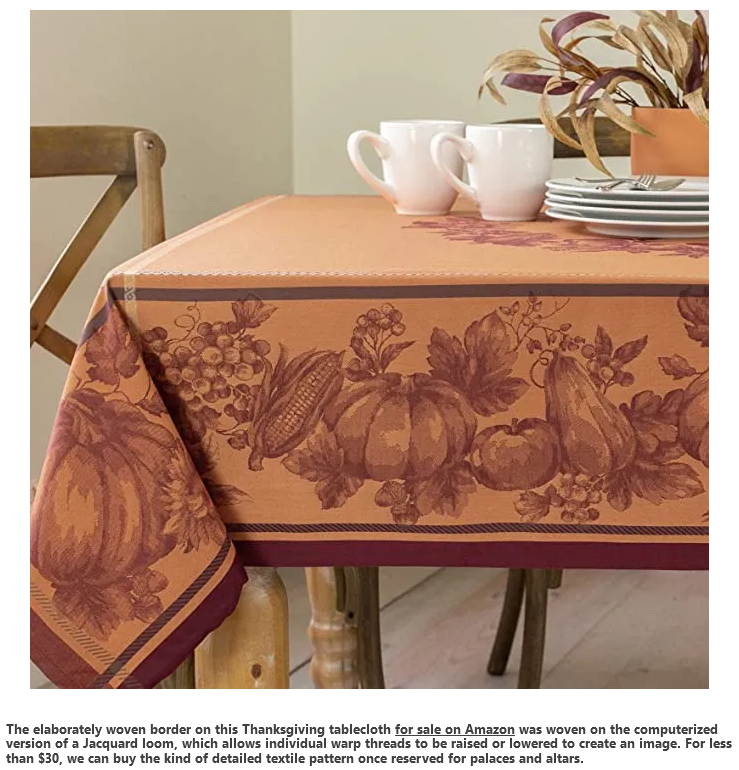
Today’s textile cornucopia overflows with more than clothes. It includes the damask tablecloth beneath the Thanksgiving feast, the soft microfiber blanket in front of the fire, the potholders pulling dinner from the oven, the dish towels drying the heirloom china. Textiles upholster the dining room chairs and the football fans’ sofa cushions. They bandage the careless carver’s fingers. They furnish burlap wreaths and felt garlands, and, for those who prefer an autumnal escape to nature, backpacks, sleeping bags, and tents.
If, as Arthur C. Clarke famously observed, any sufficiently advanced technology is indistinguishable from magic, the reverse is also true. Any sufficiently familiar technology is indistinguishable from nature. We no more imagine a world without cloth than one without sunlight or rain. Textiles are just there.
Except, until fairly recently, they weren’t.
“Bring good store of clothes, and bedding with you,” an early Plymouth arrival advised a prospective colonist in 1621. Textiles weren’t easily procured in the wilds of Massachusetts. It is only in the past century, and especially in the past generation, that most Americans could forget where cloth comes from. Once so valuable they were stolen from clothes lines and passed down in wills, textile products now occupy only a tiny fraction of household budgets.
Cloth was precious because it took so much effort to make. Throughout history, and around the globe, women spent their days spinning. Yet yarn was always in short supply. In 1656, Massachusetts even passed a law requiring every family with “idle hands” — women and children who weren’t otherwise employed — to spin a minimum amount of yarn, with fines levied on those who didn’t make their quotas.
“The spinners never stand still for want of work; they always have it if they please; but weavers sometimes are idle for want of yarn,” wrote the 18th-century agronomist and travel author Arthur Young, reporting on a tour of northern England. It took about 20 spinners to keep a single weaver supplied with yarn.
A few decades after Young wrote, spinning machines broke the bottleneck and sparked the Industrial Revolution. Abundant yarn improved nearly every aspect of life. From clothing to sails, bed linens to flour sacks, essential items were suddenly much cheaper, more varied, and more easily obtained. It was the beginning of what economic historian Deirdre McCloskey calls “the Great Enrichment,” the economic takeoff that over the next two centuries lifted global living standards by 3000%.
October 7, 2022
QotD: King Agis IV’s and King Cleomenes III’s failed reform attempts in Sparta after 371BC
Thus the Spartan state might grant marginal, borderland to small groups of freed helots – the neodamodes and the Brasidioi – but actually bringing up the military strength of the polis in full could only be achieved by de-consolidating the kleroi – the best, most productive land (because you can only support so many hoplites on disputed, marginal land). This is one thing, of course, that the wealthy Spartiates who dominated the state were unwilling to do. The mothakes and hypomeiones, pushed to the edges of Spartan society, might be brought in to make up the difference, but unless they were made equals – homoioi – this was a recipe for instability, as seen with Lysander and Cinadon. This is the other thing the Spartiates were unwilling to do – if I had my guess, because for the poor Spartiates who still clung to their status (and might still use the Apella to block reform, even if they couldn’t use it to propose reform), that status differential was just about the only thing they had (apart from all of the slave labor they enjoyed the benefits of, of course).
(A different polis might have tried to make up this difference by either hiring large numbers of mercenaries, or arming its own people at state expense, as a way of using the fortunes of the rich to fund military activity without expanding the citizenry. But, as Aristotle notes – (we’ll come back to this when we talk about Spartan war performance) the public finances of Sparta were pitiful even by ancient standards – for precisely the same reason that deconsolidating the kleroi was politically impossible: the state was dominated by the wealthy (Arist. Pol. 2.1271b). With no real source of wealth outside of landholding and all of the good land held by the Spartiates, it seems that Sparta – despite being by far the largest polis in Greece and holding some of the best farmland outside of Thessaly, was never able to raise significant revenue.)
Instead, the clique of wealthy Spartiates arrayed about the kings did nothing, decade on decade, as the Spartiate citizen body – and the military power of Sparta – slowly shrank, until at least, in 371 it broke for good. But what is perhaps most illustrative of the dysfunction in the Spartan political system is the sad epilogue of efforts in the second half of the third century (in the 240s and 220s) to finally reform the system by two Spartan kings.
The first effort was by Agis IV (r. 245-241; Plut. Agis). By the time Agis came to power, there were only a few hundred Spartiate households. Agis tried to reform through the system by redividing all of the kleruchal land into 4,500 plots for Spartiates and another 15,000 for the Perioikoi (who might also fight as Hoplites). Agis gets the Apella to support his motion – his offer to put his own royal estates into the redistribution first earns him a lot of respect – but the Gerousia, by a narrow margin, rejects it. Agis is eventually politically isolated and finally executed by the Ephors (along with his mother and grandmother, who had backed his idea) – the first Spartan king ever executed (I have left out some of the twists and turns here. If you want to know Plutarch has you covered).
Cleomenes III (r. 235-222) recognizes what Agis seemingly did not – reform to the Spartan system could not happen within the system. Instead, he stages a coup, having four of the five Ephors murdered, exiled eighty citizens – one assumes these are wealthy and prominent opponents – and possibly had the other king assassinated (Plut. Cleom. 8, 10.1; Plb. 5.37). Cleomenes then redistributed the kleroi into 4,000 plots and made his own brother his co-king (Plut. Cleom. 11), essentially making him a tyrant in the typical Greek mold. He then set about continuing his war with the neighboring Achaean League in an effort to re-establish Spartan hegemony in the Peloponnese and presumably retake Messenia (which by that point was free and part of the Achaean league).
It was far, far too late. Had this been done in the 380s or even the 350s, Sparta might well have resumed its position of prominence. But this was the 220s – Macedon had dominated Greek affairs now for a century and the Antigonids – the dynasty then ruling in Macedon – had no intention of humoring a resurgent Sparta. In 224, a Macedonian army marched into the Peloponnese in support of Sparta’s enemies and in 222 it smashed the Spartan army flat at Sellasia, almost entirely wiping out the Spartiate citizen body – new and old – in the process (Plutarch claims only 200 adult Spartiate males survived, Plut. Cleom. 28.5). The victorious Macedonian – Antigonis III Doson – for his part re-crippled Sparta: he occupied it, restored its constitution to what it had been before Cleomenes and then left, presumably content that it would not threaten him again (Plut. Cleom. 30.1). The time when a state with a citizen body in the few thousands could be a major player had been over for a century and the great empires of the third century were in no mood to humor self-important poleis who hadn’t gotten the message.
Bret Devereaux, “Collections: This. Isn’t. Sparta. Part V: Spartan Government”, A Collection of Unmitigated Pedantry, 2019-08-29.
October 4, 2022
The History of the Wine Glass
Tasting History with Max Miller
Published 31 May 2022
(more…)
September 24, 2022
QotD: The evolution of the domestic corridor
But certain features of a 200 year old apartment remain constant. There are bedrooms. There is a privy (now a flushing toilet). There is a kitchen. There is a living room. And there is a corridor.
This apartment was built around 1820, for the builder of the tenement it’s part of: he was a relatively prosperous Regency working man and his family would have included servants as a matter of course in those days. And where one has servants, one perforce has corridors so that they may move about the dwelling out of sight of the owners. But it was not always so.
Rewind another 200 years and look around a surviving great house, such as Holyrood Palace, also in Edinburgh. Holyrood largely dates to the 16th and 17th century, and reflects the norms of that earlier era, and if you tour it one thing is noteworthy by its absence: corridors. The great houses of that period were laid out as a series of rooms of increasing grandeur, each leading to the next. Splendid wide main doors in the centre of each wall provided access for nobility and people of merit: much smaller, unadorned doors near the corners allowed servants to scuttle unobtrusively around the edges of the court. Staircases ascended through grand halls at the centre of such houses (accessible from doors leading to the main function rooms around the periphery): servants’ areas such as the kitchen, stores, and pantry might boast their own staircases, and the master apartments of a great house had their own stairs leading to privy or ground floor.
But the corridor in its modern, contemporary sense seems to have started out as a narrowing and humbling of the grand halls and assembly rooms of state, reduced in scope to a mere conduit for the workers who kept things running — before, of course, they later became commonplace.
Charles Stross, “Social architecture and the house of tomorrow”, Charlie’s Diary, 2019-04-29.
September 20, 2022
QotD: Why purple was such a rare colour in the flags of the pre-industrial era
Bret Devereaux, “Collections: Clothing, How Did They Make It? Part IVa: Dyed in the Wool”, A Collection of Unmitigated Pedantry, 2021-04-02.
August 8, 2022
QotD: How houses have changed to fit the times
But today telephones have collapsed into our pocket magic mirrors, and TVs are going in two directions — flattening and expanding to fill entire walls of the living room, and simultaneously shrinking to mate with our phones. A not-uncommon aspect of modern luxury TV design is that they’re framed in wood or glass, made to look like a wall-hanging or a painting. The TV is becoming invisible: a visitor from the 1960s or 1970s might look around in bafflement for a while before realizing that the big print in middle of the living room wall is glowing and sometimes changes (when it’s in standby, running a screensaver). Meanwhile, microwave ovens and ready meals and fast food have reduced the need for the dining room and even the kitchen: to cook a family dinner and serve it in a formal dining room is an ostentatious display of temporal wealth, a signal that one has the leisure time (and the appliances, and the storage for ingredients) to practice and perfect the skills required. The middle classes still employ cooks: but we outsource them to timeshare facilities called restaurants. Similarly, without the daily battle to keep soot and dirt at bay, and equipped with tools like vacuum cleaners and detergents, the job of the housemaid has been shrunk to something that can be outsourced to a cleaning service or a couple of hours a day for the householder. So no more cramped servants’ bedrooms.
The very wealthy ostentatiously ape the behaviour of the even richer, who in turn continue the traditions they inherited from their ancestors: traditions rooted in the availability of cheap labour and the non-existence of labour-saving devices. Butlers, cooks, and live-in housemaids signal that one can afford the wage bill and the accommodations of the staff. But for those who can’t quite afford the servants, the watchword seems to be social insulation — like the dining room at the opposite end of the corridor from the kitchen.
The millionaire’s home cinema, in an auditorium of its own, is the middle class TV in the living room, bloated into an experience that insulates its owner from the necessity of rubbing shoulders with members of the public in the cinema. Likewise, the bedroom with en-suite bathroom insulates the occupants from the need to traipse down a corridor through their dwelling and possibly queue at the bathroom door in the middle of the night.
Types of domestic space come and go and sometimes change social and practical function.
The coal cellar is effectively dead in this era of decarbonization and clean energy, as is the chimney stack. Servants’ quarters are a fading memory to all but the 0.1% who focus on imitating the status-signaling behavior of royalty, although they may be repurposed as self-contained apartments for peripheral residents, granny flats or teenager basements. The dining room and the chef’s kitchen are becoming leisure pursuits — although, as humans are very attached to their eating habits, they may take far longer to fade or mutate than the telephone nook in the hallway or the out-house at the end of the back yard.
Likewise, outdoor climate change and indoor climate control are changing our relationship with the window. Windows used to be as large as possible, because daylight lighting was vastly superior to candlelight or oil-lamp. But windows as generally poor insulators, both of sound and heat, and indoor lighting has become vastly more energy efficient in recent years. Shrinking windows and improving insulation (while relying on designed-in ventilation and climate control) drive improvements in the energy efficiency of dwellings and seem to militate against the glass bay and big sash windows of yesteryear.
Charles Stross, “Social architecture and the house of tomorrow”, Charlie’s Diary, 2019-04-29.


