Quotulatiousness

June 7, 2022

100 days of fighting in Ukraine

Filed under: Europe, Military, Russia — Tags: , — Nicholas @ 03:00

In The Line, Andrew Potter rounds up the latest open source data on the Russo-Ukrainian war of 2022, and notes that the briefly enthusiastic western nations — having all posted Ukraine flags on their social media accounts and boycotted Russian vodka — are now noticeably suffering from battle (cheerleading) fatigue and are all rather obviously hoping Ukraine will sue for peace with the Russian aggressor:

We are now just past the one hundred day mark of Vladimir Putin’s insane invasion of Ukraine. But even as the Ukrainian forces are fighting ferociously for Severodonetsk, with president Volodymyr Zelensky making an amazing visit to troops right on the edge of the front lines of the eastern salient, a few Western leaders marked the occasion by suggesting that it’s getting on time for them to think about giving up.

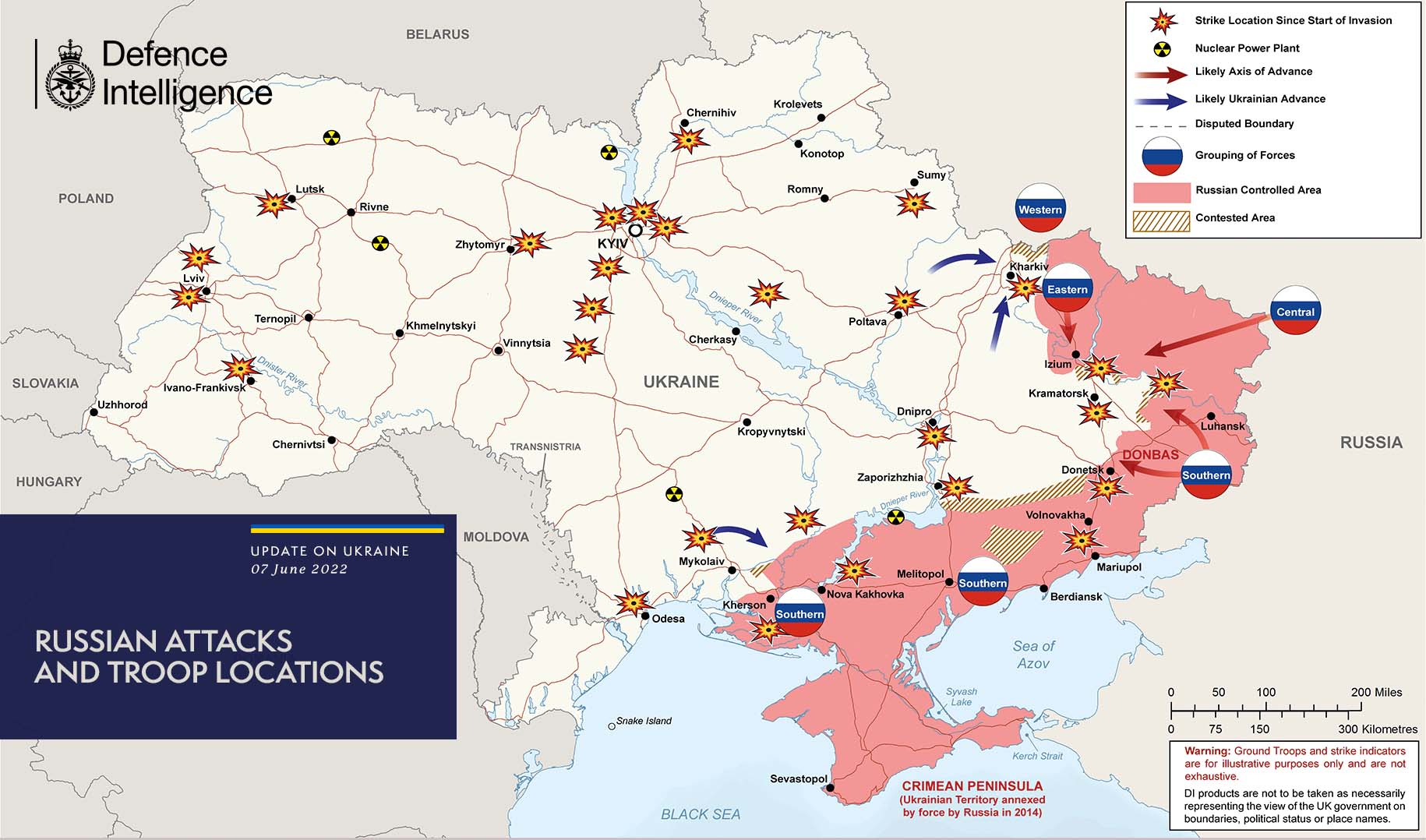
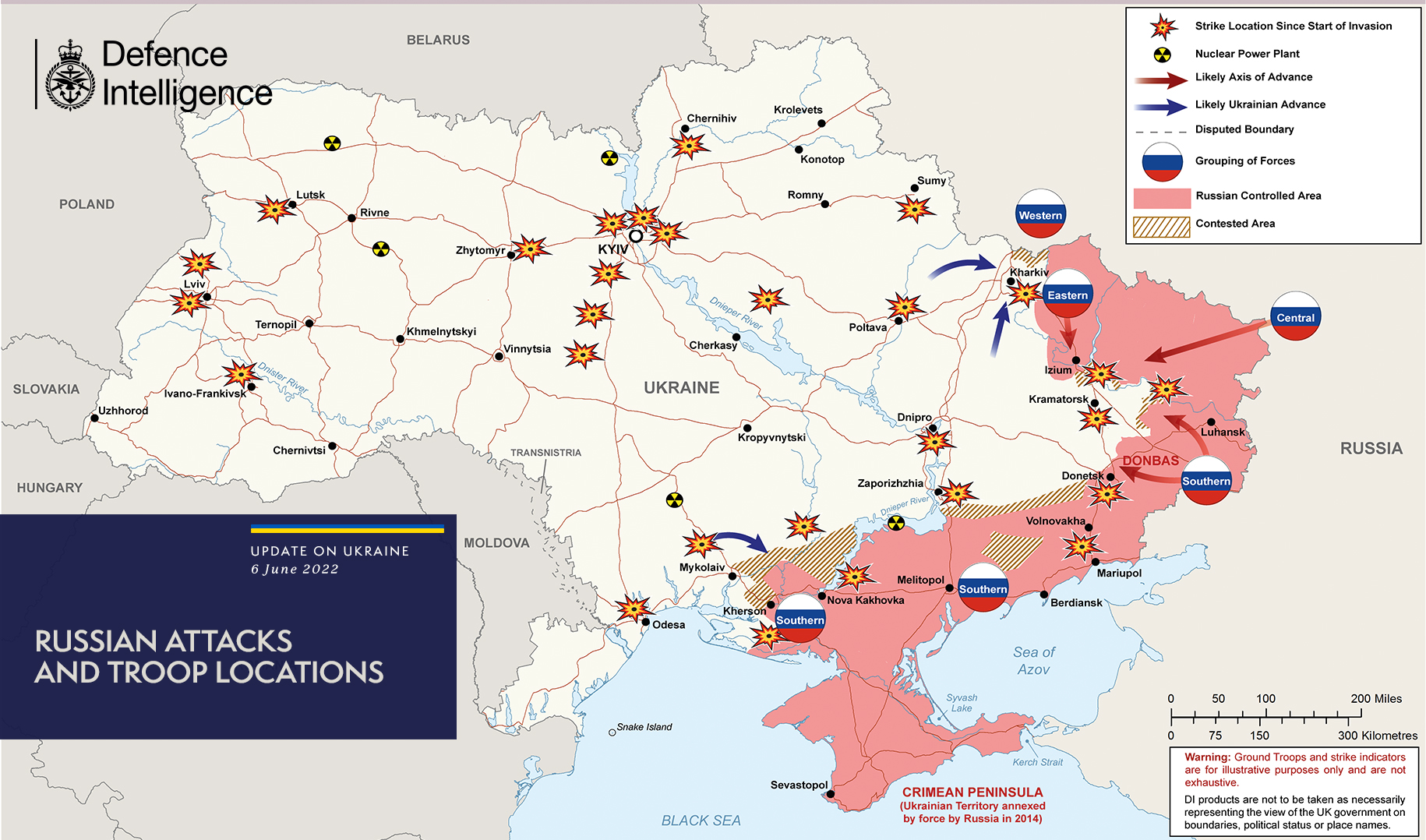
According to Zelensky, Russian forces currently control around one fifth of Ukrainian territory, mostly in the east and the south. As he pointed out last Thursday in an address to the Luxembourg parliament, this is an area that is much larger than the entire Benelux region.

For Russia, this has come at a considerable cost. Reliable open source intelligence estimates put Russian losses at over 31,000 soldiers killed, 3,300 armoured vehicles and another 2,500 trucks destroyed, 200 lost aircraft, 175 helicopters, and 13 ships or boats. All of this for a “special operation” that was supposed to take no more than a long weekend including the victory parade, with the invaders welcomed as liberators.

Dear as this has been for Russia, for Ukrainians the price has been much, much higher. Reliable estimates of Ukrainian military losses are hard to come by, but something around half of the Russian figures is probably in the ballpark, though they could easily be much higher. Zelensky has not been totally shy in talking about losses; the other day he said the Ukrainian forces were losing 60-100 fighters a day, with another 500+ wounded, in fighting in the east.

These are staggering losses (recall that Canada lost 158 soldiers over the course of more than a decade in Afghanistan), but they don’t even begin to compare with what has happened to Ukraine’s civilians and to its cities. This war has been going on for so long, reports of Russian outrages and war crimes now so numerous, that history-making acts of outright barbarism have come and gone from the news pages in a matter of days: Bucha, Kramatorsk, Mariupol … the list goes on and grows. When all this is done, how many dead, deported and disappeared Ukrainians will there be? If it is 50,000 dead in Mariupol alone, a million or more is not out of the question.

For a few days and even weeks, the narrative was that Putin had gravely miscalculated. He clearly expected the Ukrainians to roll over and for the neighbours to just shrug and look the other way. Instead, the Ukrainians fought back and NATO and the West were galvanized into support and action. If Putin was worried about Ukraine bringing NATO and the EU to his doorstep, well, his worst nightmare had come true, with Sweden and Finland applying for expedited admission to the alliance.

But as degraded his army, as inept his generals, as degenerate his kleptocracy might be, Putin has always had a couple of aces up his sleeve: The abiding and reliable perfidy of the Germans and the French, and the increasing inability of the American-led anglosphere to maintain its focus. As Putin sees it, as this war stretches on the Americans and the Brits will lose interest, and the burning desire of Emmanuel Macron and Olaf Scholz to help Putin “save face” — i.e. give Russia some Ukrainian territory — will grow increasingly appealing.

June 1, 2022

Vintage Russian T62 tanks reported in Ukraine

Filed under: Europe, History, Military, Russia, Weapons — Tags: , , , — Nicholas @ 05:00

As with all discussions of the ongoing fighting between Russian and Ukrainian troops, it’s very difficult to be sure that what is being reported is in any way accurate — both sides pulled out all the stops on the PR/propaganda/disinformation machinery months ago. At Thin Pinstriped Line, Sir Humphrey seems to be convinced that the reports that the Russians have been dis-interring mothballed Soviet-era T62 tanks to send into combat in Ukrane are believable enough:

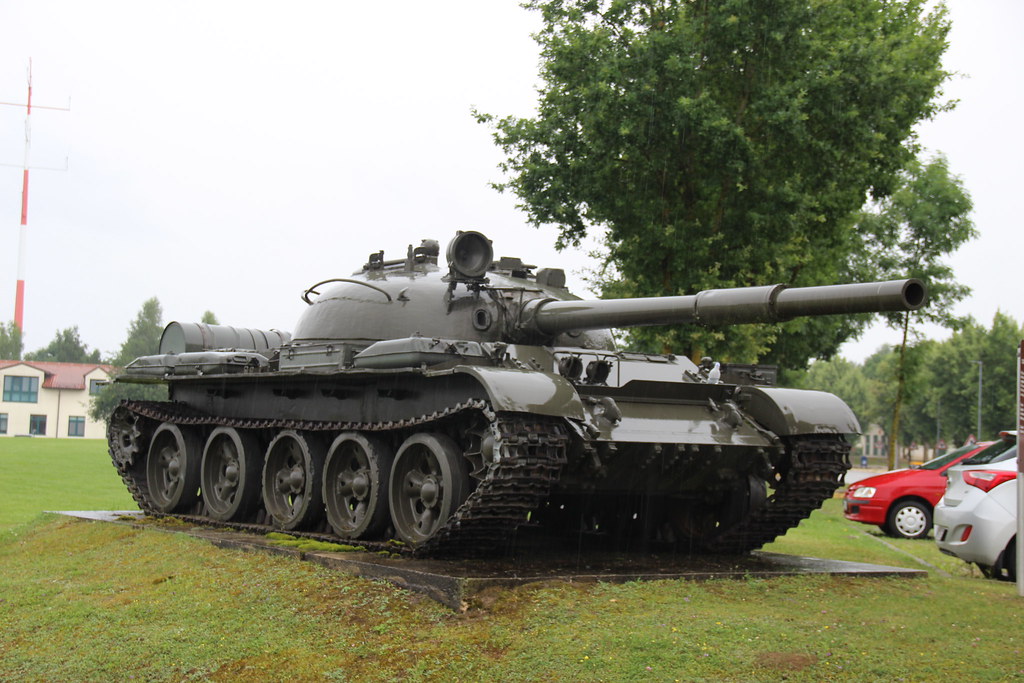
“Soviet T-62M MBT Standard Battle Tank” by Gary Lee Todd, Ph.D. is marked with CC0 1.0. To view the terms, visit https://creativecommons.org/publicdomain/zero/1.0/?ref=openverse.

The Russian Army has taken such significant losses of materiel that it has been forced to pull vintage T62 tanks from reserve, and commit them to front line operations. This statement makes plain just how costly the Russian advances have been in the Donbas area, and raises questions about what, if any, value, there is from retaining a war reserve of vehicles and equipment.

It is difficult to get an accurate picture on just how disastrous the Russian losses have been so far in the war, but most estimates suggest that at least 700 tanks have been destroyed, with many more damaged or captured. Each loss represents not only a small reduction in combat capability to Russia, but usually a far more valuable, and irreplaceable crew.

Russia is not a nation that likes to throw military equipment away, far from it. Their equipment is designed to be simple, reliable and last a very long time. As the outstandingly good website WW2 after WW2, which keeps track of what happened to military equipment after the war, lovingly documents, Soviet era equipment from WW2 just kept going (note, do not click on the link unless you wish to be sucked into a very big time sink!).

With huge reserves of people, no constraints on space or spending, and a mentality of “stores are for storing, not scrapping”, Russia has long kept ancient and utterly obsolete equipment in storage depots long past the point of being of any meaningful value. It is almost certain that there are still Russian Army depots out there with WW2 era equipment waiting for a recall to the colours if required.

The challenge facing Russia though is that due to the rampant corruption, the inability to hold units to account and ensure that readiness is tested, and just the sheer scale of the stockpile, most of the vehicles in their arsenal are probably not combat ready, and have probably been cannibalized beyond repair. Despite having thousands of T72 and T80 in service and storage, it seems that they are not deployable.

This poses a real challenge for Russia on two fronts – firstly, to bring the T62 out of retirement and into front line service as attrition reserves poses a significant support challenge. The vehicle is not compatible with later models of Russian tanks, so will require bespoke logistics support – placing further pressure on the already creaking supply chain.

Additionally, although simple to operate, it still requires crew to use it – with four, instead of three crew needed, this poses an additional headache for the Russian Army, which will have to find 25% uplift in tank crews to operate them properly. At a time when the Russians are low on people, and have churned through a significant proportion of their main army, it will require extraordinary efforts to find bodies to crew these tanks.

Bodies is perhaps the operative word here, for this is likely to be the fate of the crew in these vehicles. The T62 is utterly outclassed and completely obsolete for the environment in which it is operating. It may be good for gunning down demonstrators or strangling democratic protests in third world nations (the joy of socialist dictatorships), but against a highly experienced army, fighting with advanced equipment to defend its homeland, it is utterly hopeless. While it can still have some effect, the T62 units going into action are certain to be outclassed, outgunned and out of time when they face the Ukrainian Armed Forces.

Update: After I scheduled this post for publication, I saw that Berhard Kast (Military History Visualized) had posted a video analyzing the evidence, which you can check out here.

Update, 1 June: Apparently it helps when you include the link to the original post. Who knew?

May 21, 2022

Ukraine & T-72: The death of the tank? | The Tank Museum

Filed under: Europe, History, Military, Russia, Technology, Weapons — Tags: , , , — Nicholas @ 04:00

The Tank Museum
Published 20 May 2022

Tank Museum Curator David Willey explores the current conflict in Ukraine and the performance of the T-72 tank; putting it into historical context and exploring other times during the last hundred years when the death of the tank has been predicted.

Consider becoming a Patreon Supporter today: https://www.patreon.com/tankmuseum

00:00 | Intro
00:40 | Wider context
11:01 | Tanks in History
(more…)

May 18, 2022

For the Canadian government, announcing new programs is far more important than implementing them

Filed under: Cancon, Europe, Government, Media, Politics — Tags: , , , — Nicholas @ 03:00

It often appears that the Liberal government in Ottawa operates almost exclusively on an “appearance only” basis: whatever the situation, it’s the “optics” that matter the most and actual delivery on announcements barely counts at all. It doesn’t help at all that the media generally has the same set of priorities, because they need things to talk about on news shows and the headlines don’t write themselves in the newspapers — and legacy media’s social media concerns are even more about flash and clickbait than their primary product.

Canada has been quick to announce new initiatives to help Ukrainian refugees, but true to form, very slow to actually make any of these initiatives happen, as Joti Heir discusses in The Line:

Justin Trudeau has always had a strong affinity for the symbolic gesture, especially when the media are around to record it.

It’s almost as though the Canadian federal government is working buttocks-backward when it comes to the Ukrainian refugee file. After Russia invaded Ukraine on February 24, helping Ukrainian refugees get to a safe place fast was the biggest concern. However, now, close to three months later, the bigger concern is how to help the refugees that are in Canada or making their way here.

“We are seeing an increasing amount of frustration within our community about the pace with which programs and announcements are being implemented,” says Orest Zakydalsky, senior policy analyst with the Ukrainian Canadian Congress (UCC).

“For example, a month ago, the prime minister announced income support when he co-hosted the [StandWithUkraine] telethon with the European Council president, he announced there would be income support for people coming to Canada. A month later, they’re not available.”

The announcement on April 9 indicated that Ukrainian refugees would be able to access $500 per week for a period of up to six weeks. At the same time, it was also announced that housing support in the form of two-week hotel stays would be provided. Both programs do not appear to have been implemented.

“We appreciate this is a very difficult situation for governments, this is a crisis that emerged very suddenly,” says Zakydalsky.

“On the other side, the other problem is that the people that are in Europe, that have left Ukraine, that are looking to come to Canada, see these announcements and quite reasonably think that when a program is announced it is available.”

April 20, 2022

Khrushchev – Stalin’s Loyal Enforcer?

Filed under: History, Military, Russia, WW2 — Tags: , , , , , — Nicholas @ 04:00

World War Two
Published 19 Apr 2022

Nikita Khrushchev has served Joseph Stalin faithfully for the past decade. He’s a career commissar and party man. So, when war breaks out, are commissars like Khrushchev little more than Stalinist enforcers? Or is there more to the institution than that?
(more…)

April 15, 2022

Volodymyr Zelensky has become a “pop cultural admixture of Churchill and an ’80s action hero”

Filed under: Europe, Government, Media, Russia — Tags: , , , — Nicholas @ 05:00

In The Line, Andrew Potter explains how Ukrainian President Zelensky has shamed all the western leaders — like Trudeau — who have been long on rhetoric and short on action to support their claimed values:

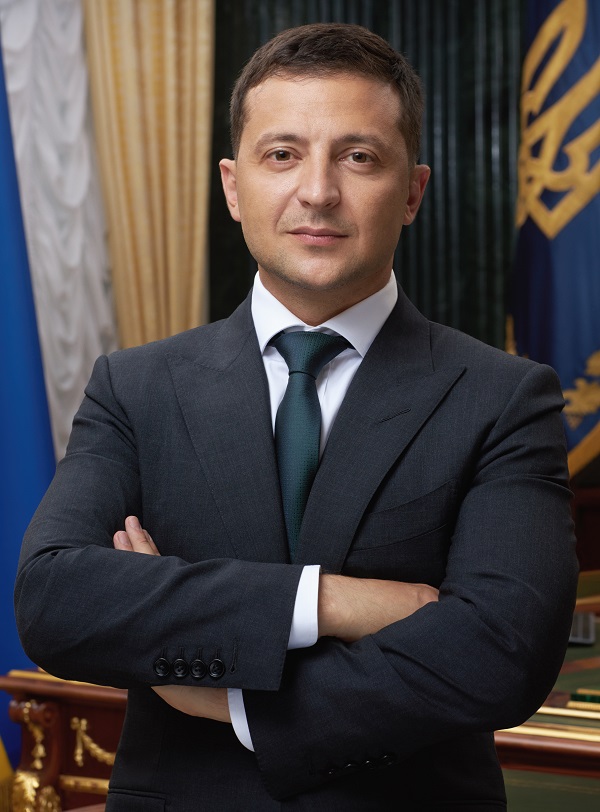
“Volodymyr Zelensky Official portrait” by http://www.president.gov.ua/ is licensed under CC BY 4.0

When asked by journalists to explain his refusal to head for safety, Zelensky has made it clear that he has no wish to die, and that he fears for the lives of his loved ones (his wife and kids have since been moved to relative safety.) But, he added: “As for my life: I am the president of the country, and I simply do not have the right to it.” Sure, he could flee to preserve his own life. But, he has said, how would he explain his actions to his kids? As Zelensky sees it, he has no choice in the matter. His duty requires that he remain and lead his country in the fight; to do anything less would be dishonourable.

But while his Last Action Hero schtick has proven enormously popular with European and North American audiences, Zelensky’s refusal to leave Kyiv, and Ukraine’s insistence on fighting off the Russians instead of capitulation, has put our so-called leaders in a bit of a bind.

To begin with, Ukraine’s refusal to capitulate to Russian aggression has forced many governments into taking steps they almost certainly would have preferred to avoid — economic and political sanctions against Russia, costly shipments of arms and other aid, diplomatic side-choosing, rethinking of trade agreements, and so on. Ukraine’s defence is coming at a pretty high cost, and the final bill is far from being tallied.

But beyond the economic and political price that is being paid to support Ukraine, there is the extraordinary amount of cognitive dissonance Zelensky’s behaviour has generated amongst the leadership of the West. Honour? Duty? Sacrifice? What century does he think he’s living in?

For centuries, honour reflected the sorts of qualities that gentlemen were expected to possess: dignity, integrity, courage. But it is hard to even talk about honour now with a straight face. It brings to mind 19th-century aristocrats in wigs and hose, demanding satisfaction and challenging one another to a meeting over some best-forgotten offence. The old honour codes couldn’t survive the triumph of the values of liberal democracy and the arrival of what Francis Fukuyama famously called the End of History, where the willingness to risk one’s life for abstract ideas or principles has been replaced by voting and economic calculation in the public sphere and “the satisfaction of sophisticated consumer demands” in the private.

Today, the old notion of honour survives only in small and isolated precincts of (mostly) male society, places like the military and some sports, places where how you behave in front of your peers matters more than comfort, more than money, more than health, maybe even more than life itself. The rest of us have become versions of what Nietszche derided as “the last man” — creatures of liberalism who have no pride, take no risks, and desire only comfort and security.

April 14, 2022

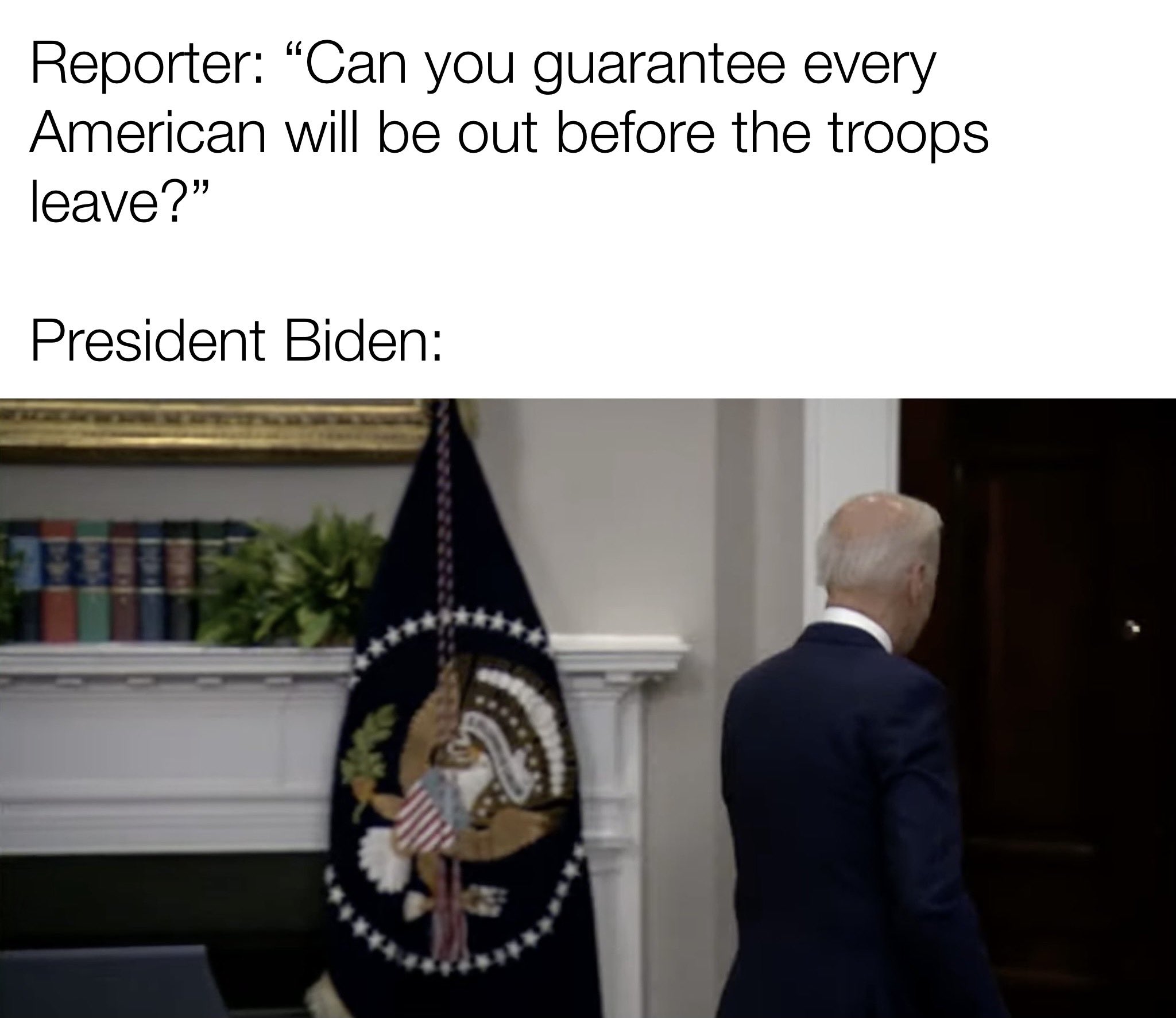
“This might just be the dumbest, most ill-advised and lethally consequential thing Biden has said since taking office”

Filed under: Europe, Government, Military, Politics, Russia, USA — Tags: , , — Nicholas @ 05:00

Brendan O’Neill on Joe Biden’s most recent maybe official/maybe “Joe being Joe” moment on the Russia-Ukraine conflict:

Once considered a gaffe, Biden doing this again might have been a good move.

Bumbling Joe Biden isn’t funny anymore. It might be amusing when your crazy uncle blurts out something unexpected at a family dinner. But when the most powerful man on Earth does it? Not so much. Yesterday, “in passing”, as the Guardian put it, President Biden referred to Russia’s war in Ukraine as a “genocide”. This might just be the dumbest, most ill-advised and lethally consequential thing Biden has said since taking office.

The circumstances in which he uttered the g-word, in which he made the most serious accusation you can make against a nation state, were bizarre. He was in Iowa, at a public discussion on the use of ethanol in petrol, of all things. Then – “in passing” – he said: “Your family budget, your ability to fill up your tank, none of it should hinge on whether a dictator declares war and commits genocide half a world away.” And so did an announcement about the lifting of restrictions on ethanol use in order to reduce the price of fuel turn – “in passing” – into the United States of America accusing the Russian Federation of committing the most heinous crime known to man.

It is unclear whether accusing Putin of genocide is White House policy now, or if Biden was just running his mumbling mouth, as is his wont. Pressed by reporters as to whether he really meant to say “genocide”, Biden said: “Yes, I called it genocide because it’s become clearer and clearer that Putin is just trying to wipe out the idea of even being Ukrainian.” Not surprisingly, other world leaders were a tad alarmed. French president Emmanuel Macron rebuked Biden for his “verbal escalations”. We need to be “careful” with our terminology, he said, rightly.

It remains to be seen whether this is the White House consciously upping the ante or just Biden having another senior moment. He has form, after all. At the end of March – again in passing – he called for regime change in Russia. “This man cannot remain in power”, he said about Putin in an “off the cuff” remark at the end of March. Most of us make jokes off the cuff or express exasperation off the cuff – Biden expands America’s war aims off the cuff. The White House swiftly walked back this unscripted declaration of regime-change hostilities. Before that, Biden made a blunder that suggested US troops had been deployed to Ukraine. The White House walked that back, too. “[We] are not sending US troops to Ukraine”, a spokesman clarified.

Maybe the White House will walk back the “genocide” thing as well. Though it might be too late. The word’s out there now. And not just from the mouths of those irritating liberal commentators and laptop bombardiers who think every war is a genocide (except the ones they support, of course, like Iraq, Afghanistan, Libya), but from the mouth of the American president himself. Make no mistake – this is incredibly dangerous war talk. It transforms Ukraine from an undoubtedly bloody conflict that has global implications into a possible site of further external intervention and fighting. Indeed, the United Nations’ policy on “The Responsibility to Protect” expressly obliges the Security Council to take action – ideally diplomatic action, but if that fails, then military action – in order to “protect populations from genocide”. If Russia is committing genocide, then the US and its allies have a responsibility to stop it somehow. This is the dire, destabilising situation Biden has either blunderingly or consciously pushed the world towards.

April 11, 2022

Ours is a fundamentally unserious culture, two examples

Filed under: Education, Government, Law, Media, Politics, USA — Tags: , , , , , — Nicholas @ 03:00

Chris Bray provides some examples of just how decayed western culture has become in our headlong flight toward total unseriousness:

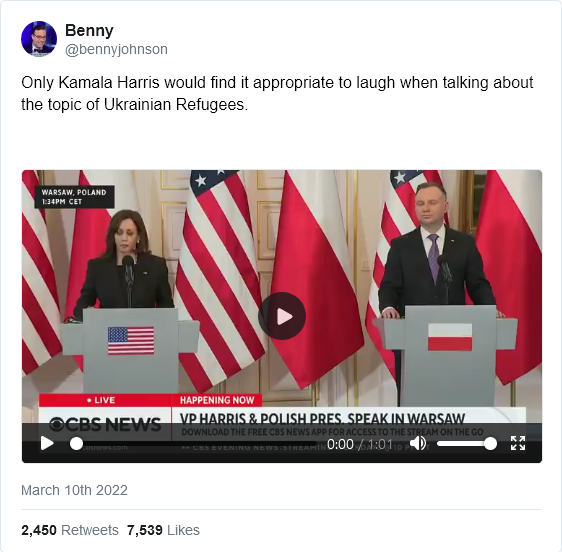
In Europe this month to lead the diplomatic response to a war, the Vice-President of the United States responded to a question about refugees by giggling and cackling and babbling in typical form:

And then the “fact-checkers” at Reuters explained that she actually didn’t giggle and cackle and babble, because, okay, she did cackle and giggle and babble, but she didn’t cackle and giggle and babble specifically about the refugees, so it doesn’t count: “It is clear from viewing the longer video in context that Harris and Duda laughed at the awkwardness of not knowing who should speak first. There is no evidence that Harris was laughing at the refugees or the crisis in Ukraine.” The question was about refugees, and she laughed — she laughed a lot — right after the question, but Reuters apparently called no tagbacks before the play, so no points accrue.

So we have an awkward and ineffective playactor who occupies the position of a political leader, but lacks the stature or ability to go along with it, and we have journalists who labor to protect people in powerful political positions from the possibility that people will notice who they really are and what they really do. We have political leaders who aren’t political leaders, and journalists who aren’t journalists: the form without the substance.

Meanwhile, a recent debate on the topic of free speech at Yale Law School — the nation’s top-ranked law school, which produces presidents and Supreme Court justices — began with law students screaming abuse (“I’ll fight you, bitch”) at one of the panelists, before walking out as a group and continuing to shout and pound on the walls of the adjacent hallway.

Now: The students were angry at the panelist, the bitch they wanted to fight, because she’s an anti-trans social conservative, and couldn’t you just die? But the thing that law students are learning to do is be lawyers — advocates for a position in a formalized exchange of competing views, in controversies that play out in open court. They’re training at the profession of making an argument. The point of sitting through an argument made by a person whose views you despise is that you can learn about something you want to fight against; you can see what the enemy says, and how she says it, and so do a part of the work of preparing yourself to advance a different position. So we have law students, people training for a debate-and-exchange-centered profession, who don’t want to hear things they don’t agree with. It’s like a minor league baseball player saying he refuses to touch a baseball, because baseballs offend him, but anyway, when are you assholes sending me up to the major leagues? We have people who want to occupy the profession of the law without preparing for the substance of professional engagement with competing positions: the form without the substance.

(Doing what journalists do, now, the fact-checkers explain that none of this puts points on the anti-free-speech scoreboard: “The students made their point at the very start of the event and walked out before the conversation began.” It is precisely the point that 1.) law students 2.) walked out before the conversation began. In ten years, oral argument before the Supreme Court will be that Woke lawyers stand up and scream I’M NOT GONNA LISTEN TO THIS SHIT, YOU ASSHOLES at the justices, then storm out and descend into a long round of day-drinking while waiting for the court to rule in their favor, because oh my god they CAN’T EVEN.)

April 2, 2022

Lessons from Operation Unifier — Canada’s military training mission in Ukraine (2015-present)

Filed under: Cancon, Europe, Military — Tags: , , , — Nicholas @ 03:00

In The Line, Paul Wells talks to Lieutenant Colonel Melanie Lake, Royal Canadian Engineers, who commanded Operation Unifier from March to September, 2021:

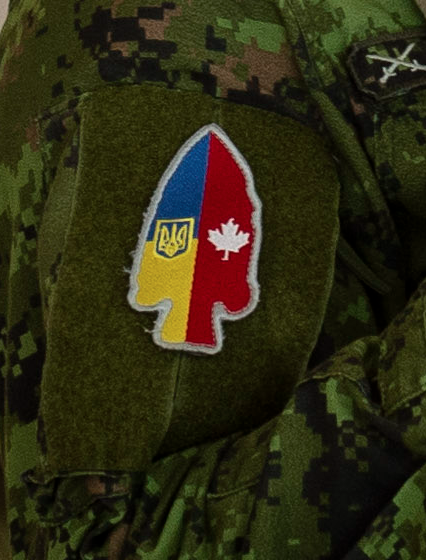
Operation Unifier shoulder patch for Canadian troops in Ukraine.
Detail from a photo in the Operation Unifier image gallery – https://www.canada.ca/en/department-national-defence/services/operations/military-operations/current-operations/operation-unifier.html

Lake has had a hell of a career, as high-ranking soldiers usually have, though I cover soldiers rarely enough that I always manage to be surprised. She’s from Churchill Falls, Labrador and has a degree in chemical engineering from the Royal Military College. She served three tours in Afghanistan, including one collecting HUMINT, or human intelligence — interviewing Afghans in Kandahar for information on the insurgency. Later she led an explosives-clearance operation at Winisk, ON, way up north on Hudson Bay, where a DEW Line outpost had been shut down so quickly in the 1960s that large quantities of TNT had been left buried too close to the ground for comfort. This involved a lot of camping and trying to figure out how to explode only those parts of the landscape they wanted to explode, while trying not to explode one another. Canadian Forces Rangers worked with Lake’s team, keeping polar bears away. She really is a problem solver.

Lake confirmed both of my hunches about Op Unifier, at least in part. She sees a Ukrainian army that is performing well for specific important reasons, and a Russian army that is having serious trouble its commanders should have expected. She does think she and her colleagues in Op Unifier and other Western training missions — the United States, United Kingdom and Lithuania — can take some satisfaction in contributing to the substantial improvement of the Ukrainian defence effort since 2014. But she was careful to put a low ceiling over that effect.

“Certainly what the training missions provided have helped,” she said. “But I want to be really careful about taking credit for the performance that we’re seeing right now. We can’t teach courage. And [the Ukrainians] are showing that in spades.”

Where did training help? “The area where I think we had a really big influence is in helping them understand or institutionalize the idea of mission command. And decentralized decision-making — pushing authority and decision-making power down to lower levels. And helping them build a professional senior NCO corps. Those are things that, you know, when you look at the old Soviet system were certainly non-existent.”

Let’s unpack this. “Mission command” is a term of art in Western militaries. It holds commanders, down to quite junior levels, accountable for results while leaving them wide latitude to decide methods. How junior? “Senior NCO” refers to sergeants — career soldiers who’ve risen from the enlisted ranks and who are responsible for a section, which is between 6 and 20 soldiers. Canadian doctrine, American doctrine, NATO standards dictate that it should be routine for higher echelons to trust a section sergeant to figure out how to accomplish a task, and that’s something the Canadians have passed on to their Ukrainian colleagues.

The Russians haven’t built that trust into their system. This is an understatement. “A lot of what you’re seeing on the Russian side — you know, we keep talking about these general officers who are getting picked off, because they’re so far forward. They have no decentralized decision-making and their communication chain is breaking down. So you’ve got these generals going forward, way too far forward, trying to sort things out. And they’re just getting picked off left, right and centre. So training matters. Training matters an awful lot.”

To an Ottawa political reporter in the Trudeau era, there is a metaphor here as big as a billboard about what happens when too much decision-making is too centralized. But maybe just this once, I’ll resist the urge to jump in, more than I just did, and I’ll let Lake keep telling her story.

April 1, 2022

Sarah Hoyt on the “Irrational Regime Hypothesis”

Sarah Hoyt on finding ways to make sense of the irrational-to-us actions of western governments since the start of the Wuhan Coronavirus pandemic:

I have the same need to make sense, to see “reason” out of things that don’t seem to. And I can’t stand it when something doesn’t FIT. If you want to drive me insane, you do something completely out of character for which there is no rational explanation. I’ll obsess over it for years, whether it’s in my favor or not.

This is why I knew the covidiocy was a sham of some sort. Not only weren’t the homeless dying like flies; the third world, despite some reports, also weren’t dying like flies. And the big cities in the US were encouraging homeless to crowd and congregate while everyone else was locked up. It didn’t add, unless the whole thing were a sham perpetrated by several groups for several related goals. (A prospiracy more than a conspiracy. I could expound on the cross-purpose goals I’ve uncovered so far, but that’s another post, right?)

In the same way, this whole “We really are in a shadow war with Putin! The cold war is back! Putin is crazy! He’s invading the Ukraine for funsies! Putin is invading because we crowded him! Biolabs in Ukraine!!!!!!” But at the same time — to give Trump his due — Putin, in this head to head (supposed) context, hasn’t dumped the contents of Biden’s laptop (of course they have it. I mean our FBI has it, and they are rapidly approaching status of enemy, domestic) into our national discourse. (I mean, it would complete disorganize us, and lose us whatever international prestige we still have, such as it is.) Or Putin could have dumped all the other Kompromat I’m sure they have on the not-very-bright and not particularly stealthy Biden crime family. Why hasn’t he?

And Biden, despite his continuous gaffes that take us to the brink of nuclear exchange, at least in theory, is STILL USING PUTIN TO BROKER THE SUICIDAL IRAN DEAL. And hasn’t opened up the Keystone pipeline and started authorizing drilling, which would sink Putin and possibly save the Democratic party. (Yes, Greens, but seriously. It’s either a war and an emergency or it’s not.)

This morning, this thread hit my mailbox from three separate sources (and if you’re not following Trent Telenko on Twitter, create a burner account to do so. I’m going to need to do it, since I refuse to log in to my real account (I just use it to echo my blogs) and Twitter is getting pushy about logging in. It’s worth dipping a toe into the sewer for the man’s insights, honest).

You should go and read the whole thing, but until you do, let me quote a bit, so you get what we’re talking about. Again, the thread is here:

    Alright, this is the promised thread🧵explaining the “Irrational Regime Hypothesis.”
    This is a national/institutional behavior template.
    Warning: once you see this template. You cannot unsee it.

    The basic concept is that for certain unstable regimes (or even stable ones with no effective means of resolving internal disputes peacefully, particularly the succession of power) domestic power games are far more important than anything foreign, and that foreigners are

    … only symbols to use in domestic factional fights.
    The need to show ideological purity & resolve – “virtue signaling” in modern terms – as a means of achieving power inside the ruling in-group becomes more important than objective reality
    Only the internal power matters

    … as outside reality is merely a symbol to be used in the internal power game.

    The ruling Imperial Japanese military faction of 1931 – 1945 was a classic example of this irrational regime hypothesis.

    Trent Telenko, on twitter

And suddenly the back of my mind clicked. Not conspiracy, which is hard on this scale — Not kabuki which didn’t feel quite right — but like the Covidiocy? Prospiracy. “We’re all going this way because we think it fits our goals.”

Now I want you to consider that it’s not one, but two irrational regimes, we’re dealing with.

This has been bothering the heck out of me, because it smells like they’re cooperating, only that’s not QUITE the right pattern.

None of this makes sense, unless you have TWO irrational regimes (Ours and Russia’s. China is too, but it’s another ball of wax. China doesn’t really believe other nations are real, anyway. They’re just Barbarians and China is all-under-heaven, so this is all much of a muchness on that front.) that are using each other as scarecrows to quiet the opposition at home.

March 30, 2022

“It was as if millions of voices suddenly cried out in cringe …”

Filed under: Books, Europe, History, Media, Politics, Russia, USA — Tags: , , , , , — Nicholas @ 03:00

Ed West on recent events concerning the fighting in Ukraine:

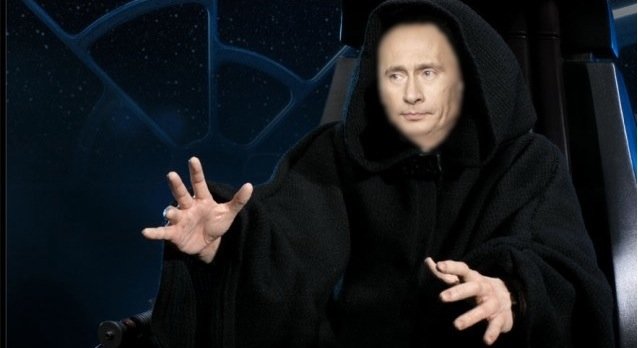
Emperor PALPUTIN
Image by “usernameau” at funnyjunk.com

“Let me make this perfectly clear. Putin is Emperor Palpatine. The Ukrainian people and all those who stand up for democracy around the world and here in America are Rey Skywalker, Jyn Erso, and the Rebel alliance. Pick your side.”

Put like that, I think I’m with Putin.

This tweet, by former George Bush strategist Matthew Dowd, attracted much amusing scorn at the start of the war between Russia and Ukraine. It was as if millions of voices suddenly cried out in cringe …

American political commentary has for some time been dominated by pop culture references, in particular those two great modern fables, Star Wars and Harry Potter, which have replaced the classics as the source of communal knowledge. I’m not convinced that children’s books or films aimed at selling toys, enjoyable though they are, have that much to offer in the way of deep wisdom, compared to more ancient texts; I may be a declinist, but it is not commented on enough that America’s most-praised public intellectual didn’t know who St Augustine was.

These epic children’s stories serve as modern-day myths for a reason, drawing so heavily on older narratives and archetypes. Star Wars creator George Lucas studied anthropology and borrowed heroic narratives from around the world for his story; it also drew on historical folk memories of recent and ancient conflicts, in particular the Second World War, which has become the modern West’s origin story, its epic struggle between God and the Devil.

The most recent Lucas trilogy featured a plucky band of rebels in an existential struggle with a great empire (a story that drew heavily on … previous Star Wars films). In this tale of good and evil there was on one side a band of allies from every race on earth, and on the other a group joined by ethnic descent, a dynamic true to life and seen in countless wars and conquests since the Bronze Age. It’s the story of the Old Testament, the Persian Wars, and of such modern conflicts as the Vietnam War.

Yet of course Star Wars performed a role reversal to suit the sympathies of modern American audiences. For in reality, it is empires which are multi-cultural, and plucky rebels who tend to be linked by blood — whether it was ancient Greeks fighting off a Persian army of Medes, Babylonians, Egyptians and Sumerians, or Vietnamese nationalists in combat with French, Senegalese and North African troops.

So it is today in Ukraine, a rebel nation fighting off conquest by a neighbour 50 times its size. Ukraine’s position on the cultural fault lines of Europe has left it a multicultural inheritance, even after the depredations of Hitler and Stalin. Its heroic president Volodymyr Zelenskyy is a member of a 40,000-strong Jewish population, vastly reduced by the horrors of the early 20th century, but still surviving; indeed for three months in 2019 Ukraine had a Jewish president and prime minister, a first outside of Israel and quite an achievement for a supposedly “Nazi” state. There are also Tartars, although many were cut off by Russia’s annexation of the Crimea, having only been allowed back from their central Asian exile in the 1980s. There are Romanians, and, of course, a substantial Russian minority.

Yet these groups are relatively small in number, and Ukraine still has the composition of a typical European nation-state, built around a dominant ethnic group enjoying a super-majority.

Russia, in contrast, is home to around 50 ethnic groups, including — just the European ethnicities with more than half a million people — the Tatars, Bashkir, Chuvash, Mordvins and Udmurts, the latter known for having the reddest hair in the world (their homeland is an eastern outpost in this red hair map of Europe.)

March 22, 2022

Russia’s historical expansionism

Filed under: Europe, History, Russia — Tags: , , , — Nicholas @ 05:00

Arthur Chrenkoff notes some plot points from his second novel, written in 2010, and the headlines from Ukraine over the last few weeks:

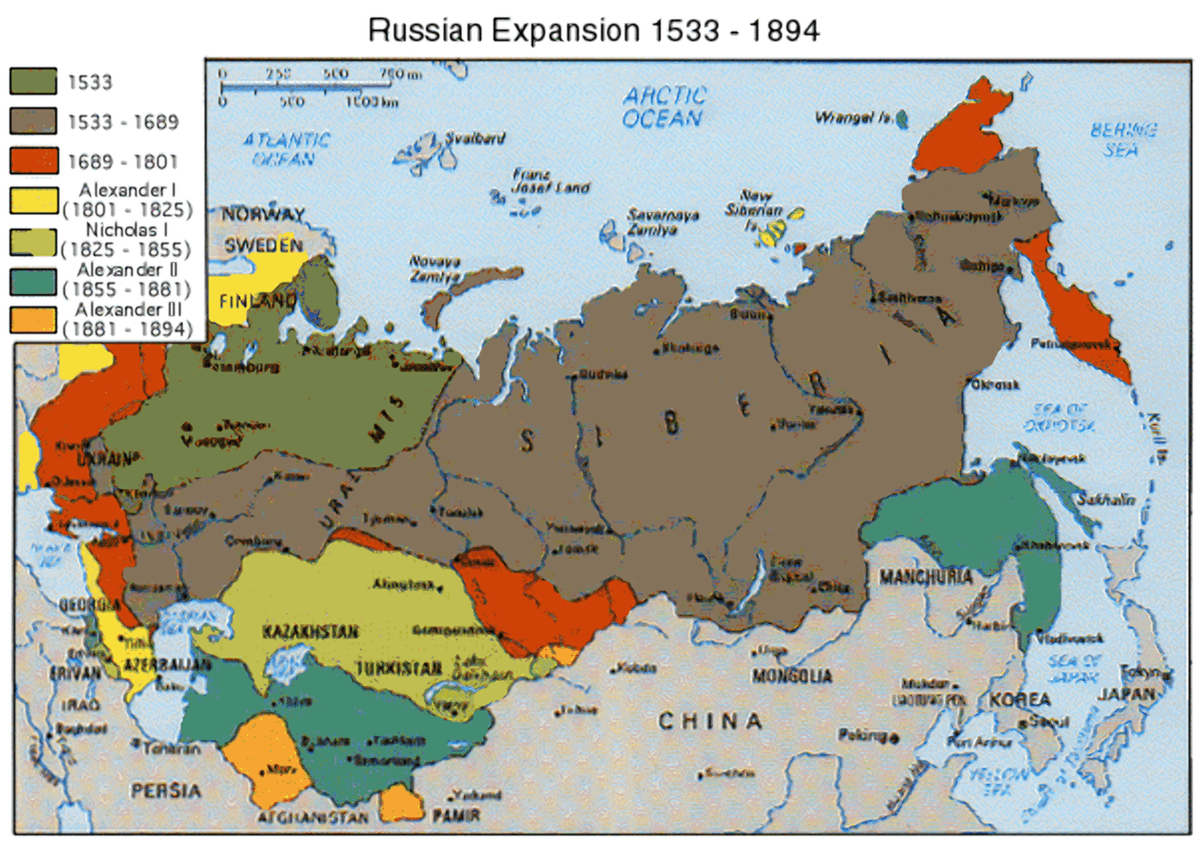
Russian expansion in Eurasia between 1533 and 1896.
Map originally from the Marxist Internet Archive via Wikimedia Commons.

Twelve years ago I wrote my second novel. The action took place in an Eastern European magic kingdom, superimposed in another dimension over what is, in this world, western Ukraine, south-east Poland, eastern Slovakia, and reaching down perhaps as far as the north-eastern corner of Hungary and the northern border of Romania. I named the kingdom after two historical regions, partly overlapping, by which this borderland of ethnicities and states had once been known. Last together as part of the Austro-Hungarian Empire, five independent nations now share the tectonic fault zone between Russia and the Orthodox Slavdom in the east and the Catholic Central Europe to the west.

One of the plots of the novel – titled Ruthenia & Galicia – revolved around the attempts by Russia to blackmail sections of the kingdom’s political establishment and destroy the country if unsuccessful.

If the plot sounds vaguely familiar today, I hasten to add I’m not claiming any prophetic abilities. While in 2010 Ukraine was largely at peace, two years prior Vladimir Putin briefly invaded Georgia in order to detach from it two separatist regions. In any case, the main point is that over the past five centuries, ever since overthrowing the Tartar yoke and consolidating under Ivan the Terrible, Russia has been an imperialist and expansionist power, which has repeatedly and consistently invaded, absorbed and dominated its many neighbours. Sadly, there is not much that is unusual about the current conflict in Ukraine; mid-17th century Poles, Ukrainians (to the extent there existed then any ethnic consciousness among the region’s peasantry), Cossacks and Muscovites would have been intimately familiar with the issues at stake.

Forget for a moment the Bidens, “globalists”, NATO, the “decadent West” and all other attempts to blame one’s own side first for, in effect, “provoking” Russia, and ask yourself why all of Russia’s regional neighbours, from Finland, through the Baltic states, Poland, Czechia, Slovakia, Rumania and beyond (Hungry and Serbia being two exceptions, the former contemporary political, the latter historical) are so fiercely opposed to Russia’s military actions and so supportive of Ukraine’s resistance against Putin’s aggression. Most of the historical Poland (which prior to WW2 included western Belarus and western Ukraine) had been, with small breaks, dominated, occupied and colonised by Russia (either as the centre of the empire or of the Soviet Union) for well over three centuries. Ditto for the Baltic states. Finland used to be a Russian vassal before WW1, fought Russia twice (in 1939-40 and 1941-44) and after the war had lent its very name to the concept of forced pro-Russian neutrality. Other parts of Central, Eastern and Southern Europe had only experienced Russian domination post-1945, as member states of the Warsaw Pact. Hungary and Czechoslovakia were at the receiving end of military interventions directed by Moscow; Poland almost was. Foreign policy realists like John Mearsheimer might argue for the unchanging reality of power politics in human history – from which point of view, a great power like Russia needs and will get a friendly or neutral buffer zone – but the states, which have the geographical and historical misfortune to exist within such buffer zone are by now well and truly over having to live in perpetual shadow and/or under the jackboot of an imperial power with delusions about its civilisational mission.

From that point of view, the challenge is not “de-Nazification” of Ukraine, whatever that means apart from being another example of Russia’s historical tendency, now also assumed by the Western left, of smearing everyone and everything it doesn’t like as Nazi (the Azov Battalion, whose heritage harks back to the Ukrainian collaboration with Hitler against Stalin, is a real problem – in an ideal world the Azov men and the pro-Russian Chechens would all kill each other – but as propagandictically exaggerated as attempts to portray the American right as a whole as white supremacists, bigots, extremists and terrorists). The true challenge is de-imperialising Russia.

This is perhaps a Sisyphean task. Former imperialist powers like Germany and Japan are now normal countries, liberal democracies, successful and prosperous economies and generally good international citizens. Arguably the reason for that can be traced to their unequivocal military defeat in WW2, large scale devastation and subsequent occupation, which forced a traumatic psychological reset. After “year zero”, the past was consigned to history and new society were born.

This has not happened in Russia. In fact, Russia today is much more reminiscent of Germany in the 1930s than Germany in the 1960s. Like the Imperial Wilhelmine Germany, Russia had lost the war – the cold one – without suffering a crushing military defeat or the indignity of foreign occupation. What the Versailles Peace was for the inter-war Germany, the dissolution of the Soviet Union has been for Russia – a disadvantageous and humiliating settlement, which resulted in imperial dissolution and has left millions of Russian speakers scattered beyond the borders of the Fatherland/Motherland. The newly independent states are illegitimate – both the Nazi Germany and the Soviet Union considered Poland a “bastard creation of Versailles”, just as Russian nationalists nowadays see the former Soviet republics and satellites as artificial entities that are rightfully Russia’s. If there are temperamental similarities between the Weimer Germany and Yeltsin’s Russia, Putin himself resembles Hitler circa 1938. Let us hope and pray he never graduates to 1939 and beyond (though some would argue that the invasion of Ukraine is worryingly analogous to the invasion of Poland at the start of WW2). For the international community, Russia of the past two and a bit decades represents the worst of all worlds: humiliated enough to be resentful but undefeated enough to remain unrepentant. Hence Putin can claim the fall of the Soviet Union to be the greatest tragedy of the 20th century (as opposed to both world wars or communism) and agitate for the de facto recreation of the Russian, if not the Soviet, empire.


Imperial Germany’s crushing military defeat (from the “Black Day of the German Army” through the Hundred Days to the Armistice) at the hands of the British, French, American, Canadian, and Australian forces on the western front … but stopped near the German border. The provisional government after the fall of the monarchy signed the armistice because the German army had been decisively defeated and was dissolving in the face of Allied pressure. Because the fighting didn’t penetrate into Germany proper — as it did in 1944-45 — this significantly helped solidify the myth that the Germany army had been “stabbed in the back” by the civilian government, which was so helpful to the Nazis during their rise to power.

March 20, 2022

Kharkov Falls Once Again – WW2 – 186 – March 19, 1943

World War Two
Published 19 Mar 2022

The British are attacking the Mareth Line in North Africa while the Americans hit the Axis flank, but the Allies are withdrawing in Burma. It’s the Germans who are pulling back in the USSR, though, and there is another attempt from within German command to assassinate Adolf Hitler.
(more…)

March 18, 2022

Schindler’s First Rescue Mission – WAH 054 – March 1943, Pt. 1

Filed under: Europe, Germany, Greece, History, Military, WW2 — Tags: , , , , , — Nicholas @ 04:00

World War Two
Published 17 Mar 2022

In the weeks after Goebbels’ Sportpalast speech, we realize that Total War might mean an apocalyptic end for Germany, with Hitler’s blessing. No wonder that some Germans are looking to end Hitler before he ends them, and what a blessing that at least one Nazi with influence on the fate of thousands of Jews turns out to have a heart and soul.
(more…)

March 16, 2022

Two weeks into the Russian-Ukrainian War

Filed under: Europe, Russia — Tags: , , , — Nicholas @ 03:00

As you’ve probably noticed, I don’t post a lot of information about the progress of the Russian attack into Ukraine, not because it isn’t an incredibly dangerous and volatile situation but because the signal-to-noise ratio of available public source intelligence is lower than I ever expected (and I didn’t have high expectations to start with). My sympathies are largely with the Ukrainian civilians who have been caught up in a maelstrom of violence and my appreciation of abilities and achievements of the individual Ukrainian defenders has increased a great deal as this conflict continues. What Russian planners (and Putin himself) clearly expected to be a “short, victorious war” is turning out to be a much more difficult, much more costly struggle. Western politicians and diplomats have not covered themselves with glory and the western media have been shown to be inadequate to the task of providing anything like objective coverage of the war. American politicians grandstanding about imposing a “no fly zone” over Ukraine really need to be chased down by the white-coated orderlies with nets and gently brought back into the mental health facilities they clearly just escaped from: a no-fly zone is tantamount to a declaration of war, and a war between Russia and the US/NATO would very quickly go full-on nuclear. The only winners so far have been the official and volunteer propagandists for the Ukrainian government, who have overwhelmed the mainstream media and social media with their very persuasive tales and mediagenic stories.

Of course, it doesn’t help that Ukraine largely uses Russian-made equipment, so photos and videos of damaged tanks, smoking remnants of trucks and armoured personnel carriers, and other telegenic “news” can be presented as either side’s defeat in this or that skirmish. Kurt Schlichter wonders if we can have some “real talk” about Ukraine:

Time to get real. Ukraine is an equal opportunity crisis because it provides politicians of both parties a chance to be wrong, although it allows the Democrats the opportunity to do what they do best and be much, much more wrong. For the Republicans, it lets them indulge the desire of some to return to a time when America could focus its moral firepower – if not its firepower firepower – upon a readily-identifiable baddie like it did during the Cold War or the War on Terror. For the left, it allows them to create a moral panic to replace COVID, which, naturally, requires that we Americans “sacrifice” even more of our freedom and money.

From the perspective of someone who actually trained Ukrainian troops in Ukraine, commanded US forces, and attended the US Army War College – though it’s kind of the Chico State of war colleges – the whole way our elite is approaching the crisis is an epic clusterfark. Don’t believe anything anyone tells you – and certainly, sanity check whatever I’m telling you, too – most of these insta-experts on intra-Slavic conflict know absolutely squat-ski. Moreover, their remarkably dumb observations and credulous acceptance of conventional wisdom, which has proven long on conventional and short on wisdom, are being presented without any kind of strategic context. They don’t know where this crisis came from and certainly have no clear notion of where they want it to go beyond the vague and unhelpful idea that they want Putin (which they use interchangeably with Russia) to “lose” without knowing what that even means.

[…]

The expectation was that the Russian forces would smash through, surround the Ukrainian forces pinned down facing the Russians in the occupied regions to the east, and isolate the main cities. I did not expect them to go into the cities immediately since Russians 1) generally bypass hard defenses; 2) they have bad experiences with city fighting (Stalingrad, Grozny); and 3) that would not necessarily be necessary. It would not be necessary if the idea was to neutralize the main Ukrainian combat formations and force the government in the cities to capitulate, then have the West pressure the Ukrainians to accept a ceasefire and “peace” that recognized Russian gains and ended the idea of Ukrainian allying with the West. In fact, that is pretty much what the Russian “peace plan” consists of. But that did not work for a couple of reasons.

First, the Russians did not fight as well as expected. You should always treat the enemy as if it is the best possible enemy. We did in the Gulf. We prepared to fight elite Republican Guard divisions of highly trained and motivated soldiers using top-shelf Soviet equipment and tactics. None of that was so; we crushed an entire national army in 100 hours.

The Russians are poorly-led, with very weak synchronization among maneuver forces and fires. Their plan is okay – in fact, you look at a map, and it’s obvious what they would do. But their gear is badly-maintained, and their troops are unsuited to the task of supporting a rapid advance. Look at all the evidently intact gear simply abandoned by the side of the road. Lots of it looks like it broke down (note all the flat tires). Much of it seems to have run out of gas. And, of course, lots of stuff had been blasted apart.

That’s the second part of the equation – the Ukrainians fought back hard. If you are a Lord of the Rings nerd, think of the Ukrainians as the dwarves. Not super-sophisticated but tough and ready to fight, and also often drunk.

« Newer PostsOlder Posts »

Powered by WordPress