
World War Two
Published 17 Mar 2022In the weeks after Goebbels’ Sportpalast speech, we realize that Total War might mean an apocalyptic end for Germany, with Hitler’s blessing. No wonder that some Germans are looking to end Hitler before he ends them, and what a blessing that at least one Nazi with influence on the fate of thousands of Jews turns out to have a heart and soul.
(more…)
March 18, 2022
Schindler’s First Rescue Mission – WAH 054 – March 1943, Pt. 1
Comments Off on Schindler’s First Rescue Mission – WAH 054 – March 1943, Pt. 1
March 16, 2022
Two weeks into the Russian-Ukrainian War
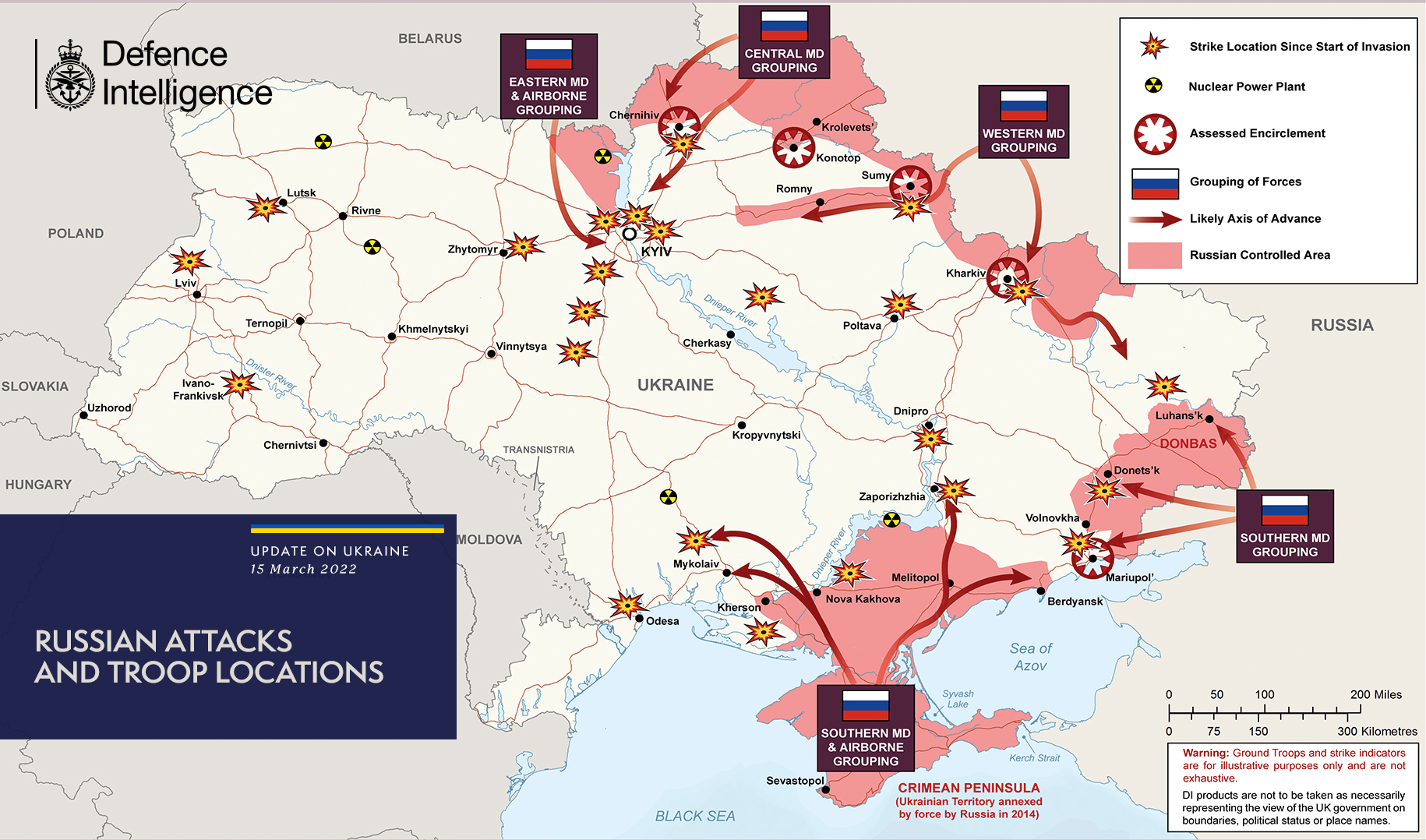
As you’ve probably noticed, I don’t post a lot of information about the progress of the Russian attack into Ukraine, not because it isn’t an incredibly dangerous and volatile situation but because the signal-to-noise ratio of available public source intelligence is lower than I ever expected (and I didn’t have high expectations to start with). My sympathies are largely with the Ukrainian civilians who have been caught up in a maelstrom of violence and my appreciation of abilities and achievements of the individual Ukrainian defenders has increased a great deal as this conflict continues. What Russian planners (and Putin himself) clearly expected to be a “short, victorious war” is turning out to be a much more difficult, much more costly struggle. Western politicians and diplomats have not covered themselves with glory and the western media have been shown to be inadequate to the task of providing anything like objective coverage of the war. American politicians grandstanding about imposing a “no fly zone” over Ukraine really need to be chased down by the white-coated orderlies with nets and gently brought back into the mental health facilities they clearly just escaped from: a no-fly zone is tantamount to a declaration of war, and a war between Russia and the US/NATO would very quickly go full-on nuclear. The only winners so far have been the official and volunteer propagandists for the Ukrainian government, who have overwhelmed the mainstream media and social media with their very persuasive tales and mediagenic stories.
Of course, it doesn’t help that Ukraine largely uses Russian-made equipment, so photos and videos of damaged tanks, smoking remnants of trucks and armoured personnel carriers, and other telegenic “news” can be presented as either side’s defeat in this or that skirmish. Kurt Schlichter wonders if we can have some “real talk” about Ukraine:
Time to get real. Ukraine is an equal opportunity crisis because it provides politicians of both parties a chance to be wrong, although it allows the Democrats the opportunity to do what they do best and be much, much more wrong. For the Republicans, it lets them indulge the desire of some to return to a time when America could focus its moral firepower – if not its firepower firepower – upon a readily-identifiable baddie like it did during the Cold War or the War on Terror. For the left, it allows them to create a moral panic to replace COVID, which, naturally, requires that we Americans “sacrifice” even more of our freedom and money.
From the perspective of someone who actually trained Ukrainian troops in Ukraine, commanded US forces, and attended the US Army War College – though it’s kind of the Chico State of war colleges – the whole way our elite is approaching the crisis is an epic clusterfark. Don’t believe anything anyone tells you – and certainly, sanity check whatever I’m telling you, too – most of these insta-experts on intra-Slavic conflict know absolutely squat-ski. Moreover, their remarkably dumb observations and credulous acceptance of conventional wisdom, which has proven long on conventional and short on wisdom, are being presented without any kind of strategic context. They don’t know where this crisis came from and certainly have no clear notion of where they want it to go beyond the vague and unhelpful idea that they want Putin (which they use interchangeably with Russia) to “lose” without knowing what that even means.
[…]
The expectation was that the Russian forces would smash through, surround the Ukrainian forces pinned down facing the Russians in the occupied regions to the east, and isolate the main cities. I did not expect them to go into the cities immediately since Russians 1) generally bypass hard defenses; 2) they have bad experiences with city fighting (Stalingrad, Grozny); and 3) that would not necessarily be necessary. It would not be necessary if the idea was to neutralize the main Ukrainian combat formations and force the government in the cities to capitulate, then have the West pressure the Ukrainians to accept a ceasefire and “peace” that recognized Russian gains and ended the idea of Ukrainian allying with the West. In fact, that is pretty much what the Russian “peace plan” consists of. But that did not work for a couple of reasons.
First, the Russians did not fight as well as expected. You should always treat the enemy as if it is the best possible enemy. We did in the Gulf. We prepared to fight elite Republican Guard divisions of highly trained and motivated soldiers using top-shelf Soviet equipment and tactics. None of that was so; we crushed an entire national army in 100 hours.
The Russians are poorly-led, with very weak synchronization among maneuver forces and fires. Their plan is okay – in fact, you look at a map, and it’s obvious what they would do. But their gear is badly-maintained, and their troops are unsuited to the task of supporting a rapid advance. Look at all the evidently intact gear simply abandoned by the side of the road. Lots of it looks like it broke down (note all the flat tires). Much of it seems to have run out of gas. And, of course, lots of stuff had been blasted apart.
That’s the second part of the equation – the Ukrainians fought back hard. If you are a Lord of the Rings nerd, think of the Ukrainians as the dwarves. Not super-sophisticated but tough and ready to fight, and also often drunk.
Comments Off on Two weeks into the Russian-Ukrainian War
March 12, 2022
So much for all that “end of history” hopefulness
I admit I never bothered to read Fukuyama’s The End of History and the Last Man, because I strongly disagreed with the notion — whether advanced by the author or imputed by critics and reviewers — that there ever could be an “end” to history, as long as there are still human beings around. Russia’s latest invasion of Ukraine seems to have also broken the spell for many other westerners, as Jen Gerson points out:
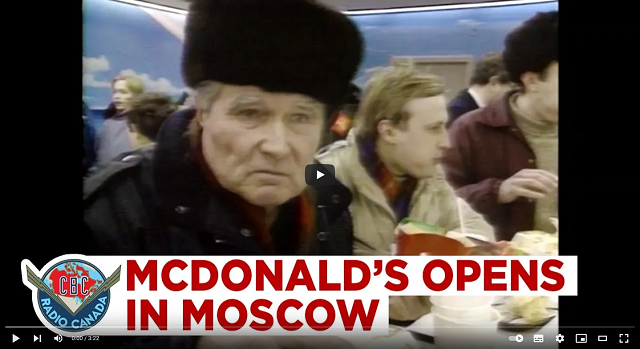
Screen capture of a 1990 CBC report on the first McDonald’s in Moscow.
[After recounting the tale of the very first McDonald’s to open in Moscow in 1990] by all accounts, Russians went wild for McDonald’s — as did much of the world — and hundreds have since opened, including one within walking distance of the Red Square. Nothing could better symbolize the end of the bad, old Soviet era than this. A Russia that is peaceful, prosperous and at least a little open to the West was one in which a worker from the Kremlin could grab an American hamburger at lunch.
At least, they once could.
McDonald’s this week was one of several Western companies to announce that it was temporarily halting operations in Russia in response to its invasion of Ukraine. Coca-Cola, Starbucks, KFC, Pizza Hut, Ikea, Shell, BP, Exxon, credit card companies, accounting firms, even airline companies are cutting Russia off, to greater or lesser extents.
I pick on McDonald’s because that chain became so ubiquitous that it has served as a kind of foreign policy truism: For a generation, it was said that no two countries that possessed a McDonald’s had ever gone to war. And so, it was assumed, this would likely remain the case. We’re not talking about skirmishes or civil wars, or local incursions or proxy wars, mind you. But the general theory largely held: as economies globalized and became more interdependent, the costs of one country truly going to war with another would grow so insurmountable that it would soon be unthinkable. Shared prosperity would reduce the need for wars of resources; meanwhile, the more economically interdependent nations became, the more self-defeating and even suicidal the prospect would grow. Economic liberalization and globalization would therefore undoubtedly bolster the long peace. For a generation this has, mostly, held true.
It is this same logic that has underpinned Europe’s growing dependence on Russia’s oil market, for example. After all, no one would risk — well — what Russia is now risking. It is certainly not in that country’s best interest to retreat into a hermit kingdom, to suffer incredible privations, and to revert to a quality of life akin to what its people knew in the ’50s. And for what? Glory? Honour? Territorial expansion? What, does Russia need more land?
This is why the war in Ukraine has caught Westerners off guard, and shook countries that once existed in the Soviet sphere of influence.
History was supposed to be over, when the Western democracies reached their ideal end-state of civilizational evolution. War — true, grand, civilizational war — was far too costly to seriously contemplate. So we allowed our military capacity to atrophy and our strategic dependencies on hostile nations grew.
With hindsight we can see the glaring flaw in the logic adopted by some of the world’s most powerful people. Those wingnuts and lunatics who warned about the danger of making ourselves more dependent on Putin proved correct. Note how quickly Canada’s safe, reliable, democratic oil supply is enjoying a rebrand. Shared prosperity is no panacea to war.
Comments Off on So much for all that “end of history” hopefulness
March 10, 2022
“Putin’s War”
In his latest post on the Russian-Ukrainian conflict, Stephen Green suggests we will end up calling it “Putin’s War”:
Putin apparently believed his top general — “who has never been a professional soldier” — that the Russian Army was up to the task of quickly defeating Ukraine.
Ukraine’s president, Volodymyr Zelenskyy, was supposed to flee or be killed/captured — not lead a heroic resistance. Ukraine’s kleptocratic government was supposed to collapse. Putin seems not to have had a Plan B, aside from the old Russian habit of firing artillery and rockets at stuff until even the rubble stops bouncing.
Putin failed to heed the lesson of Grozny: That even a besieged city, cut off from all reinforcement, can hold out for weeks. Kyiv is neither completely under siege nor cut off from reinforcement.
Putin also seems to have badly underestimated the West’s willingness to put the screws to the Russian economy, even though we’re putting the screws to ourselves, too.
If the war continues going badly for Russia, it ought to be remembered not as the Ukraine War or even the Russo-Ukraine War.
It ought to be called Putin’s War.
But at the rate Joe Biden is going, the Ukraine War might end up being known as the Putin-Biden War, and we all get to pay for it.
I posted a couple of comments on MeWe about his article:
I was commenting on another thread a bit earlier about how the fall of the Soviet Union revealed just how much of their military power was smoke and mirrors … a whole country of military Potemkin Villages. From what we can tell is happening in Ukraine, things haven’t improved much for the successor Russian military. On the other hand, thanks to progressive control of pretty much everything in the west, we’re starting to realize a lot of western military strength is a bit Potemkin-y. And the progressive warhawks now want to start WWIII? Let’s all hope they don’t get their wish!
Near the end of the column, you suggest calling it “Putin’s War”, which I think is a good idea. I’m starting to see Putin and the apparent state of the Russian military as being quite analogous to Mussolini and the Italian military. Il Duce had carefully excluded from his advisors and military leadership anyone who might tell him the truth about the state of Italy’s war-making capabilities and was clearly drinking his own ink on the propaganda side. Italy was forced into a war they were not equipped to fight because Il Duce believed the newsreel and parade-ground might he saw was real. Sound like something Putin may have done as well?

In The Critic, Peter Caddick-Adams catches us up on the war news to date:
It was during the Winter War of 1939-40, when plucky little Finland stood up to the might of Soviet Russia, that the Finns prepared a nasty surprise for their attackers. They made millions of petrol bombs and named them after the Russian Foreign Minister, Mr Molotov. Today, it is Ukraine that has borrowed the Finnish recipe book to greet a new generation of Russian invaders with petrol and fire.
How has the current war against another Russian neighbour, Ukraine, progressed? After months of tensions and intense diplomacy, including assurances to the UK’s Defence Minister by his Russian counterpart that there were “no plans to invade”, Mr Putin’s forces crossed the threshold early on 24 February. This had been preceded by long-announced military “manoeuvres” in neighbouring Belarus, which saw the assembly of over 100,000 combat-ready troops with all their vehicles and equipment. We now know this was a long-planned distraction to cover the concentration and preparation of their forces for war.
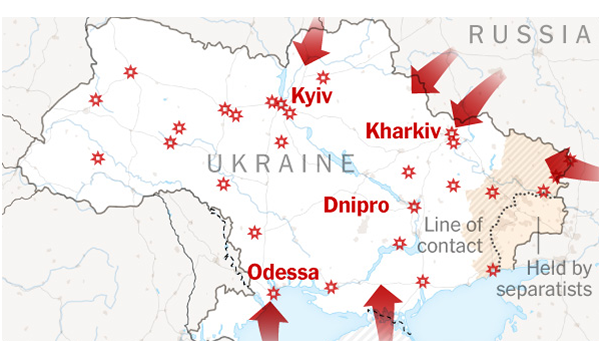
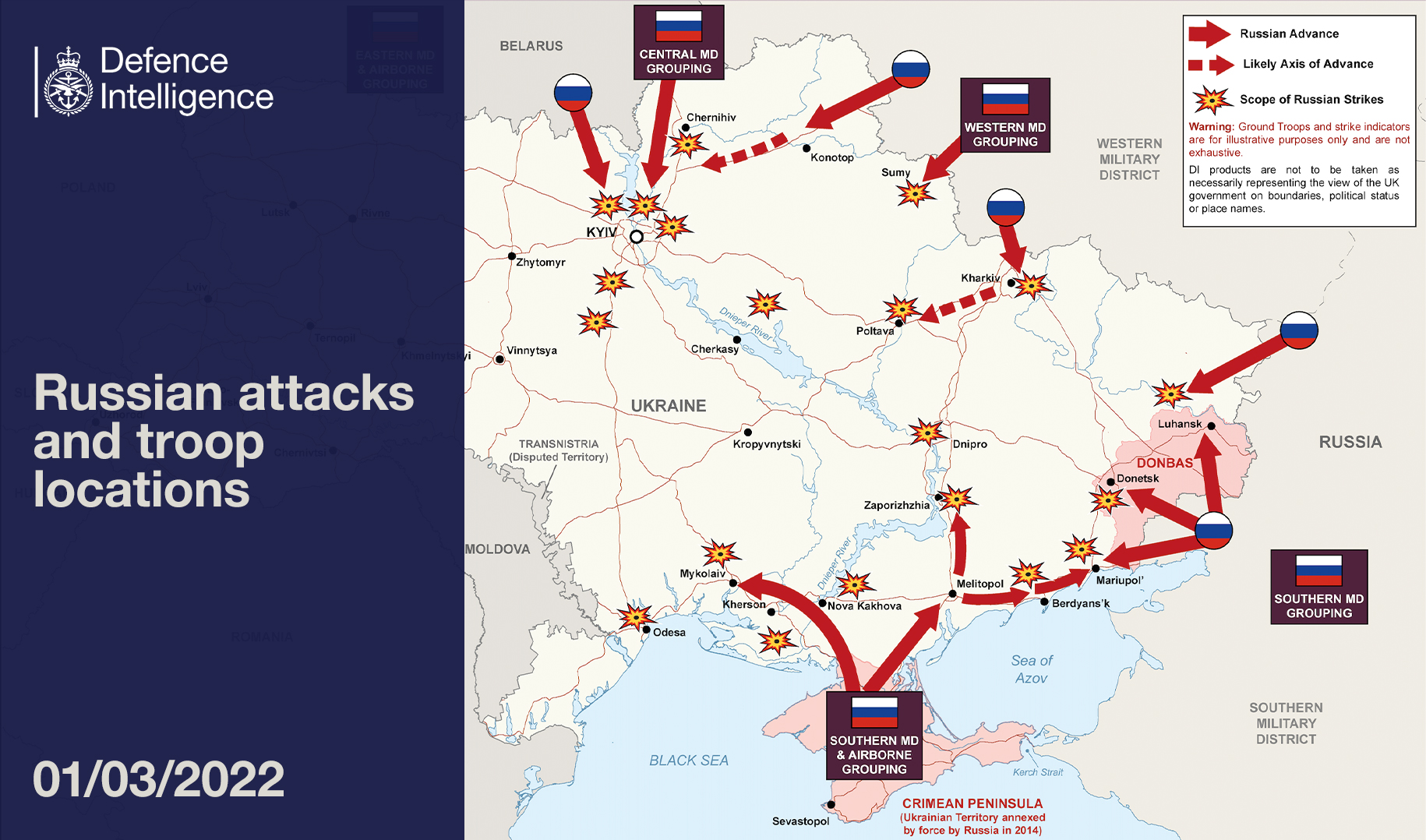
They came from 4 directions: Belarus in the north, from out of the rebel-held Donbas in the east, from Crimea in the south, and via amphibious assaults around the port of Mariupol. This tactic was designed to distract and divide the defenders and cause them to dilute their numbers. However, defying a basic military principle of war, the plan also inflicted the same disadvantage on the Russians. None of the four attacking thrusts possessed sufficient force to defeat their opponents and knife their way through to their objectives.
The first strikes in the early hours were a surprise only in their time and location, for Ukraine’s President Zelensky had long feared the worst, and other nations had quietly assessed an invasion was likely, rather than probable. Accompanied by the air raid sirens of Ukraine’s civil protection service, explosions from Russian cruise missile strikes were heard across the country. Some 600 have been fired since. Their airborne forces landed at civilian airports and military airbases. These elite paratroops were deployed to enable endless planeloads of follow-on forces to drive on the principal cities of Kyiv and Kharkiv before Ukraine woke up to what was happening.
The Russian tactical goal remains to control Ukraine by separating its pro-Western government from the population, hence the importance of the cities. President Zelensky declared martial law, ordered mobilization of all men between 18 and 60 and appealed to the wider world for help. Thousands started making Molotov cocktails, so deadly to attacking tanks more than 80 years ago. In some ways this war is anachronistic, with a Russian armoured train being filmed moving supplies forward. Expect railway sabotage with shades of Lawrence of Arabia. On 1 March, Belarus predictably entered the war on Russia’s side with such timing, that it is assumed President Lukashenko was merely following a script Vladimir Putin had written months earlier.
In The Line, Matt Gurney wonders what will happen if Russia actually loses the war:
Military historians and security experts are going to be studying the first two weeks of this invasion for years. Entire careers will be made of this, whole PhD theses written. Armies have always marched on their stomachs, but a modern army also needs massive quantities of fuel and lubricants, ammunition for hungry weapons systems, spare parts for weapons and vehicles, medical supplies and, yes, food for the troops, and also the ability to move wounded troops and prisoners backward down the supply line. This all takes an enormous amount of planning and specialized equipment and knowledge. Sustaining an army on the move means having the necessary supplies and items in abundant supply, but also having a sophisticated enough logistics system to get them to where they’re needed in a timely way. This involves everything from having good warehouse inventory control systems to the vehicles required to ferry the supplies to where they’re needed, plus a trained pool of manpower to run the whole operation. And the logistics system itself needs to be sustained — what good is a fleet of trucks to deliver supplies to the front if you can’t fuel those trucks?
We knew Russian logistics were well below Western standards. Logistics units never get the attention they deserve compared to the more exciting frontline units, and in a cash-strapped, corruption-riddled military like Russia’s, that means major problems in times of war — in an already poorly off military, the units that get even less TLC than most are going to be in rough shape indeed. Still, the Russians are underperforming what many Western analysts expected. We knew they’d be bad at this, but this is really bad.
There are reports of Russian troops running out of fuel and food, and abandoning their vehicles in place. There are other reports of long-expired Russian combat rations. In what was perhaps the nerdiest but most fascinating Twitter analysis thread of the war thus far, a retired American Department of Defence employee looked closely at photos from the battlefields in Ukraine and concluded that the tires on Russian vehicles were failing prodigiously, suggesting that the vehicles were not properly cared for when in storage. Again, given the known funding and corruption problems in the Russian military, that’s extremely plausible.
I mentioned this in an earlier Ukraine post, that the Soviet doctrine was much more oriented to the attack, and units and formations that hit heavier resistance than they could overcome were to be left behind to struggle, rather than be reinforced as most western military doctrine would prefer. Units were expected to fight until they were no longer combat-effective (or longer) and “expended” more like ammunition, in ways no western army could possibly support. As a result, Soviet and Soviet-aligned armies tended to be proportionally much more heavily armed, but very modestly supplied and logistics was very much a backwater where unpopular or inefficient officers could be sent to rot, professionally. I think most western analysts had assumed the successor Russian forces had moved away from those ideas, but the fighting to date in Ukraine seems to show that to be mistaken.
Comments Off on “Putin’s War”
March 9, 2022
By all means, decry the Russian invasion, but also scrutinize Ukraine’s government
In The Critic, Mark Almond says we need to keep a clear perspective about the war in Ukraine, to condemn Russian aggression certainly, but also to see as clearly as we can what kind of government is in charge of defending Ukraine:
“Know Your Enemy” is a standard invocation in wartime. But, if clear-eyed appreciation of an opponent and his intentions is obviously necessary, shouldn’t “Know Your Ally” be equally imperative?
Even when war has become a spectator sport for Westerners, rejoicing in killing Putin with their mouths in cyberspace and joyously kicking Russian cripples out of the paralympics, there is a real conflict going on which is horrendous for Ukrainians, which also has serious implications even for us off-shore islanders, as well as Europe as a whole.
Romanticising our chosen side and vilifying their foes are natural reactions, but fairy-tale versions of conflict often disguise the flaws of the allies even if they pale by comparison with the vices of the invader.
Think how in 1914 “Plucky Little Belgium” was portrayed as a damsel in distress about to be raped by a literally monstrous Hun. But until August, 1914, Belgium’s place on the scale of victimhood was decidedly at the perpetrator end. The horrific exploitation of the Belgian Congo’s population as slaves to King Leopold’s greed — fictionalised by Conrad’s Heart of Darkness — had been exposed by Sir Roger Casement and E.D. Morel, who both rejected the defence of Belgium.
Casement went over the top to side openly — and suicidally with Imperial Germany — while Morel went to prison for urging men not to join up. They were deeply mistaken about Germany, but they did know something about our Belgian ally’s moral record.
Wartime Polish resistance to the Nazis and service in the RAF is fondly remembered in this country and rightly so, but the Polish junta in 1939 was as militarily incompetent as their Argentinian counterparts in 1982. The courage of ordinary Polish soldiers should not make people forget the regime which had colluded with Hitler against the Czechs in 1938. Our other ally, Stalin, subsequently “liberated” the Poles in his inimitable way. The trade-offs and alliances that defeated the Nazis were extremely ugly.
Turning to Ukraine today, it is easy — and heart-warming — to get swept away by the pictures of Ukrainian soldiers fight back against the vast Russian army or civilians blocking the path of the “Russian steamroller” (so admired in 1914 by the British public). President Zelensky is by far the best president Ukrainians have had since independence in 1991. That might seem a back-handed compliment when we consider how low his predecessors set the bar. But the focus in Western media on this real life Charlie Chaplin defying the Kremlin’s “Great Dictator” makes good “reality tv” but overlooks the actual power-structures in Ukraine.
Comments Off on By all means, decry the Russian invasion, but also scrutinize Ukraine’s government
March 8, 2022
“Putin’s ambition to gather together ‘Russian’ lands has been clear for almost two decades now”
Katherine Bayford on the awkward situation many western nations find themselves in, being both dependent to a greater or lesser degree on oil and gas imports from Russia and also having allowed their armed forces to degrade significantly over time:
After months of military build-up and overt threats, educated, intelligent and respected experts across the West woke on Thursday, 24 February — genuinely shocked to discover that Russia had launched an invasion of Ukraine.
How is it that people paid to conduct exactly this sort of analysis could be so badly wrong? The experts who apparently completely underestimated Russia’s intention to undertake major military action, ranged from analysts and academics to President Zelensky himself. Russia’s intentions were hardly a secret. To be shocked at this invasion — not that it occurred when it did, or that it was undertaken in the particular way it was, but to be shocked at the very realistic possibility that it could have occurred — was foolishly naïve. Many of these analysts, whose careers have been built upon understanding the actions of non-western states, suffer a profound inability to understand actors with different thought patterns and belief systems. At its core, their failure seems to arise from academics, journalists and diplomats appealing to exclusively liberal fears and values. Economic penalties, the loss of reputation in liberal institutions and calls to value human rights were meant to convince a man, with minimal respect for these, to act against his own interests.
This failure of understanding limits the ability of the West to successfully counter Russian action. How can you act against an objective when you were unable to understand it in the first place? Western analysis, with its reliance on the tools of diplomacy and soft coercion, has forgotten that when soft power fails, hard power must be a credible threat. After years of managed decline, how much of a deterrent are our increasingly degraded militaries? As long as the West prioritises soft power values over hard power realities, nations who do the opposite are free to act how they may.
Russia’s attempt to reassert itself as a Great Power has been a project decades in the making. Since Putin’s ascendency to power, Russia has reached the fourth-highest military expenditure in the world; made consistent and escalating interventions in Chechnya, Georgia and Syria; enacted an increasing clampdown on dissidents; and built up a significant currency reserve. Putin’s stated belief that the fall of the Soviet Union was “the greatest geopolitical catastrophe of the century” was not born of any commitment to communist politics, but spoke to the decline of Russian influence over its neighbours in the post-Soviet years that followed. Putin wishes to make Russia a Great Power that can intervene and win abroad, prop up its allies and exterminate its ideological allies on foreign ground, without fear of diminishment on the world stage.
Putin’s ambition to gather together “Russian” lands has been clear for almost two decades now. His growing nationalist rhetoric and action over the past decade should have only indicated that this ambition was strengthening. That he had interventionist, even imperial, geopolitical goals should have come as a surprise to precisely none. He has long been open about those he admires (Peter the Great), those he despises (late and post-Soviet leadership) and his opinion of Russia’s rightful place in the world (ascendant).
Francis Turner offers the first sensible explanation of the lack of Russian airpower over the Ukraine that has been puzzling experts since the very start of the war:
Everyone knows that old quote that “amateur generals study tactics, professional ones study logistics”
Well, apparently that does not apply to the Russian high command, who seem to have failed to study logistics. I admit I didn’t see this coming, but then, as I said in my last post I am not a military expert and I kind of assumed that, while Russia might have a day or two of confusion as the initial “go in fast and topple the leadership” strategy is replaced by “go slower and more methodically”, it would adjust and continue to press forward.
I appear to have been wrong in that assumption.
First, what may seem like a slight detour, many people have noted Russia’s lack of air superiority. One reason for that could be that the Ukrainians have captured Russian mobile air defense systems in full working order. Which means they have complete lists of IFF signals, scheduled changes, cryptography settings etc. etc. Now potentially the Russians can change them, but they cannot change them via a radio broadcast because the Ukrainians will listen, so the only way to do an update is via soldiers on the ground hand delivering the updates (yes they could use land lines for some of the journey, but eventually they have to download them from some computer (print them out? copy to a USB drive?) and take them to the actual piece of equipment. Which takes time. Particularly since the vehicles doing the hand delivery have to share the roads with other parts of the Russian invasion force. But as the first link in the paragraph speculates another reason could be that the Russian airforce can’t actually coordinate things so that Ukrainian air defense systems can be targeted as they defend key sites against other Russian air attacks.
Failure to be able to take out Ukrainian air defenses is, IMHO, a symptom either way and it contributes to the bigger logistics issue because it means that the only way Russian forces can get resupply is on the ground, particularly since they can’t hold Hostomel airport either.
So logistics. Nitay Arbel posted this fascinating video about how Russians do logistics in Russia (they use the railways) and how that doesn’t work in Ukraine (Ukraine has trashed all cross border rail links). So the Russians need to use trucks. This was known and the consequences/limitations of that (should have been) entirely predictable, yet the Russians seem to not figured it all out in advance and been taken by surprise. Trent Talenko has a blog post and many tweet threads about how, particularly in the inland/north of the country, the Russians have to keep their convoys on the roads and that’s a major problem.
Back in the 1970s and 80s, one of the big differences between NATO and NATO-adjacent western militaries and those of the Warsaw Pact (and those aligned with or primarily equipped by the Soviets) was the different ratio between “teeth” and “tail”. Soviet-equipped militaries emphasized the “teeth” — the tanks, the guns, the attack aircraft and helicopters, that were the striking edge of an army’s advance. NATO and other western powers were much less about the number of tanks/guns/aircraft as they were about having enough logistical backup to keep their smaller numbers of trigger-pullers fed, supported, and resupplied with ammunition. This meant to a civilian eye, Soviet armies had many more obvious combat-capable vehicles than their western equivalents. Soviet doctrine called for units to be “burned up” in combat rather than conserved even if it meant giving up territory. Soviet battle plans tended to assume an all-out attack would not need further backup, reinforcement, or re-supply, because it would either succeed completely or fail completely and further efforts would be through alternative attack paths using different formations.
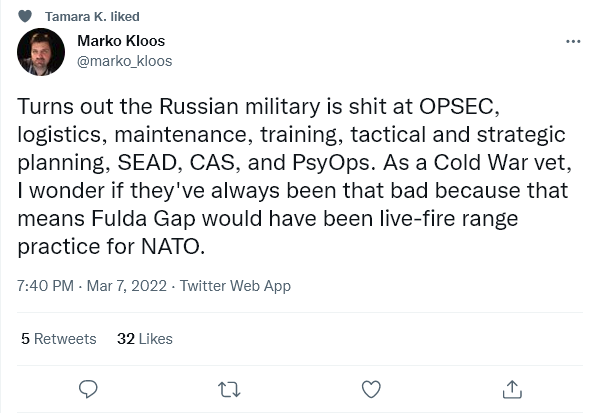
From what little we can definitely see in the current fighting in Ukraine, the Russian military is still much more Soviet in organization than it is “western”. As Marko Kloos put it on Twitter:
Comments Off on “Putin’s ambition to gather together ‘Russian’ lands has been clear for almost two decades now”
March 6, 2022
NATO’s “responsibility” for Russia’s invasion of Ukraine
In The Line‘s weekly round-up for freeloading cheapskates like me (we only get a diet version of the full post), Boris and Natasha explain why it’s all the fault of NATO and the west, and that Russia is completely innocent of any wrongdoing:
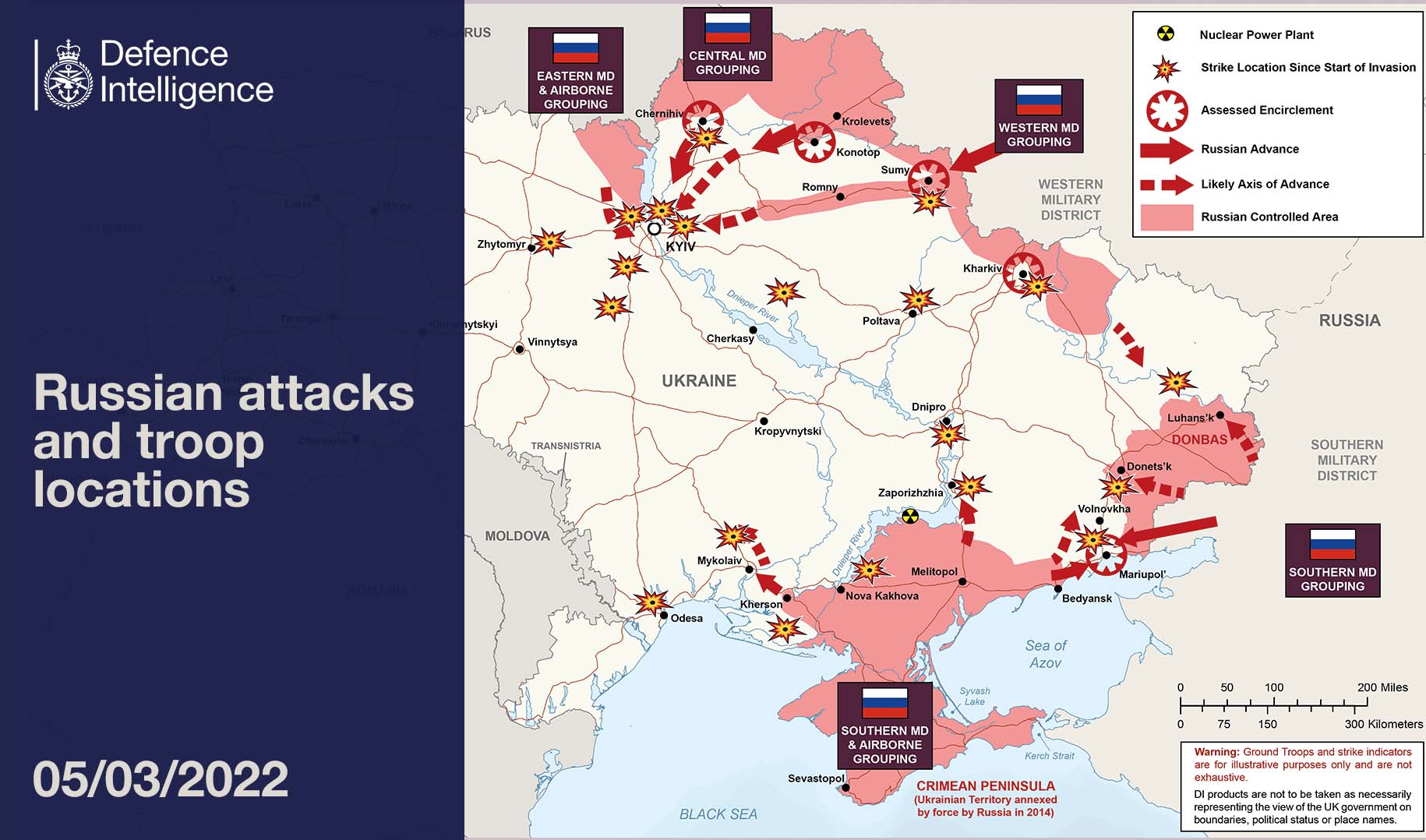
As the world continues to watch the horrors unfolding in Europe, we in our cozy Western enclaves are left to re-discover uncomfortable realities about the geopolitical circumstances around us. Namely, the world is not as safe as once we had thought, and America is not the only great power capable of inflicting atrocities on a smaller, sovereign nation for its own benefit. In fact, watching the situation in Europe play out, we’re reminded that America is not a uniquely evil entity at all — and that many of the moral errors it has committed were made precisely because the neighbourhoods in which it presumed to operate are neither peaceful, easy, nor kind.
These are old lessons of history and history — unlike ideology — is messy and complicated. And as we once again draw out those long-forgotten lessons, we find ourselves confronting old arguments as well.
Namely, we see a lot of thoughtful individuals offering the contrarian argument that NATO and the West are ultimately to blame for the invasion in Ukraine because of our military alliance’s expansion into Russia’s traditional sphere of influence. This undermined the old Russian empire’s dignity, the argument goes, and fomented Cold War paranoia that was bound to break out into an aggressive military response.
We at The Line expect this decades-old position will be debated for decades more to come, but in light of the events of the last week, we find it less compelling than ever. We offer the following three problems with this line of argument.
The first is that it falls into the trap of assuming that NATO — and, by implication, America — is the Main Character of global history.
In the minds of the NATO blamers, neither Russia’s domestic political intrigues, Vladimir Putin’s personal ideological commitments and sanity, nor the histories and cultures of the actual regions in question are given greater weight than NATO’s scheming or Joe Biden’s speaking skills. The solipsism and self-regard that this argument implies is, in truth, both stunning and entirely in keeping with the United States’ national character (and the West in a broader sense). By this metric, it’s America/the West, and only America/the West, that is the true global protagonist. The rest of humanity are just bit-players in a grand Western narrative.
As Canadians, we find these assumptions particularly offensive. Ours is a country that exists between America and Russia, and while we may disagree with specific American military engagements and tactics — and will say so! — we are not hapless serfs of American imperialism. Let’s lay out our choices plainly: a middle power like Canada can ally itself with Russia, China, NATO, or find some form of interdependence with a patchwork of one-on-one military alliances. Even if we were to take our economic interdependence with America out of the equation, NATO is our best option by far. We mean … Jesus. Duh.
We will pick NATO 999 times out of 1,000 and so will most free people living in democratic societies. Because the other options are clearly, obviously much, much worse: NATO is the certified preferred military alliance of the free peoples on this planet.
We welcome historical self-reflection and improvement, but America cannot allow itself to wallow so deeply in its own self-flagellating narcissism that it forgets this fact. America is not the Main Character of our shared history, but it is a leader within the global community, and must rise to that role and NATO with it.
In the Daily Sceptic, Noah Carl notes that “the West’s response [to the Russian invasion] seems to have been slapped together on the fly amidst a storm of social media outrage”:
The West has responded to Russia’s invasion of Ukraine in three main ways: pouring arms into Ukraine to buttress the country’s defence; imposing heavy sanctions on Russia to cripple its economy; and essentially “cancelling” Russia by shutting down its foreign media, censoring its cultural exports, and banning its athletes from international competitions.
The hope seems to be that either one of three things will happen: the Russians will be defeated or forced to withdraw; Putin will be overthrown in a palace coup or popular uprising; or he’ll be brought to the negotiating table and made to accept terms highly unfavourable to Russia. While this strategy may work, I’ve yet to read a cogent defence of it.
In fact, the strategy could have a number of negative second-order effects – i.e., unintended consequences – that haven’t been properly thought through.
As several people have observed, the West’s response seems to have been slapped together on the fly amidst a storm of social media outrage, as opposed to being carefully devised after consideration of all possible eventualities. One Substack commenter noted:
Just as COVID-19 is the first pandemic in the Age of Twitter, so the Ukraine invasion is, in some sense, the first war in the Age of Twitter. As it unfolds, we are seeing many disturbing parallels to the events of early 2020. People are rapidly normalising once-fringe ideas like a NATO-enforced no-fly zone, direct U.S. conflict with Russia, regime change in Moscow, and even, incredibly, the use of nuclear weapons. Just as with Covid, we’re seeing the rapid abandonment of longstanding Western policies. The overnight flips on German defence spending and SWIFT are like the overturning of conventional public health policies on masking, lockdowns, and so on.
Let’s deal with each aspect of the Western response in turn. Pouring arms into Ukraine may precipitate a Russian defeat. But it could just as easily prolong the conflict, leading to many more Ukrainian deaths. The Syrian civil war has dragged on for more than ten years and claimed more than 400,000 lives, in part thanks to external arming of rebel groups.
If there’s a good chance the Ukrainians can win, supplying them with arms makes sense. But if they’re unlikely to prevail, why would we want to prolong the conflict?
One possible answer is to deter the next autocratic ruler from launching a similar invasion. But how much deterrence does supplying arms really achieve, especially if Russia ends up winning? Now, entering the war on Ukraine’s side – that would achieve deterrence, but it’s something the West isn’t willing to do (for obvious reasons).
Brendan O’Neill is hoping that the conflict in Ukraine can also help end the “Age of Fragility” in the west:
It is not the most pressing question to emerge from Russia’s onslaught on Ukraine, but I have nonetheless found myself wondering – what will happen with the word “erasure” following this terrible war? Ukraine’s heroic president Volodymyr Zelensky used the e-word the other day. Russia, he said, is out to “erase our history”. The Putin regime and its marauding forces want to “erase our country, erase us all”, Zelensky cried, aptly, given the vigour and bigotry with which Vladimir Putin has mocked and violently undermined Ukrainian sovereignty. Putin clearly sees Ukraine as a joke nation that can be casually scrubbed from the map and collapsed back into Russia.
Zelensky’s impassioned, existential words got me thinking: which woke warrior here in the mercifully war-free West will dare to misuse the word “erasure” now? “Erasure” is a key buzzword in the PC lexicon. There’s trans erasure, LGBT erasure, the erasure of black women with “kinky hair”. Only erasure here doesn’t mean “the removal of all traces of something”. It certainly doesn’t mean a foreign power using brute force to extinguish your most basic rights. No, it means a gender-critical feminist turning up to your campus and saying “If you have a penis, you are a man”. It means EastEnders not having enough bisexual characters. It means being asked “Can I touch your hair?”. It means attending a museum or some other public institution and seeing that its Pride flag doesn’t include the shade that represents your femme-boy demisexual identity. All of this is very seriously described as “erasure”, as the “violent” exclusion of me and my identity. Even as bombs fall on Kharkiv and Kyiv, threatening to erase people and infrastructure, designed to erase a nation’s identity, still time-rich, experience-poor activists in the West seriously believe they are being erased by tweets and questions and opinions that differ from their own.
It remains to be seen which woke midwit will be the first to say out loud that having to walk past a statue of a long-dead Brit with iffy beliefs feels “erasing” at the same time as statues and buildings and people in Ukraine are being erased by Russian bombs. But what we know for sure, already, is that the war in Ukraine has raised burning questions not only about the Putin regime’s criminal behaviour and Ukraine’s right to self-determination, but also about us, about the West, about what we might say and do, if anything, in relation to this war in Europe. The war in Ukraine is an incredibly confronting moment for our continent. It reminds us that history is not in fact over, that unresolved questions of power and territory lurk just beneath the surface of politics, and that war is not the faraway phenomenon we thought it was. More fundamentally, it implicitly issues a challenge to the unseriousness, the smallness, of what passes for public life in 21st-century Western Europe. It asks us if we are ready for the violent return of history. The answer, right now, sadly, is No.
Over the past week, the contrast between the frivolousness of the woke West and the seriousness of threatened Ukraine, between the narcissistic obsessions of secure Westerners and the fight for survival being waged by youthful Ukrainians, could not have been more stark. On the very day Russia launched its invasion, the UK Ministry of Defence’s LGBT Network (why?) announced on Twitter that it was having a coffee morning to discuss pansexuality and asexuality. Yes, as Ukrainians hid from Russian tanks and planes, a part of the actual MoD was sipping lattes and chatting about folks who feel a “romantic, emotional and / or sexual attraction to people regardless of their gender”. Not to be outdone, the head of MI6, Richard Moore (he / him), used the occasion of Russia’s bombardment of Ukraine to issue a “series of tweets” on LGBTHM2022 – that’s LGBT History Month 2022 for those of you not abreast with the alphabet soup. “We want your help!”, Ukrainians cried. “Here’s some information about the vast spectrum of human sexual attraction”, the British security services replied.
As everyday Ukrainians pull together and arm themselves with guns and petrol bombs, the military top brass of Britain have rather different concerns. Such as why you should avoid using words like “manpower”, “strong” and “grip”. They “reinforce dominant cultural patterns”, according to a recent internal report authored by UK national security adviser Sir Stephen Lovegrove. Does that mean I’m not allowed to tell military bosses to get a grip? Apparently you should also check your white privilege and use gender-neutral language wherever possible. And let’s not forget the campaign for “vegan uniforms” in the British army. This week, as Ukraine burns, it was reported that the Ministry of Defence Vegan and Vegetarian Network (again, why?) is agitating for animal-friendly clothing and boots, excluding things like leather. Well, you wouldn’t want to be wearing the skin of a dead animal as you kill a human being, would you?
Comments Off on NATO’s “responsibility” for Russia’s invasion of Ukraine
March 5, 2022
Duelling narratives on the fighting in Ukraine
In Spiked, Mary Dejevsky thinks that Vladimir Putin is very worried about losing control of the narrative:
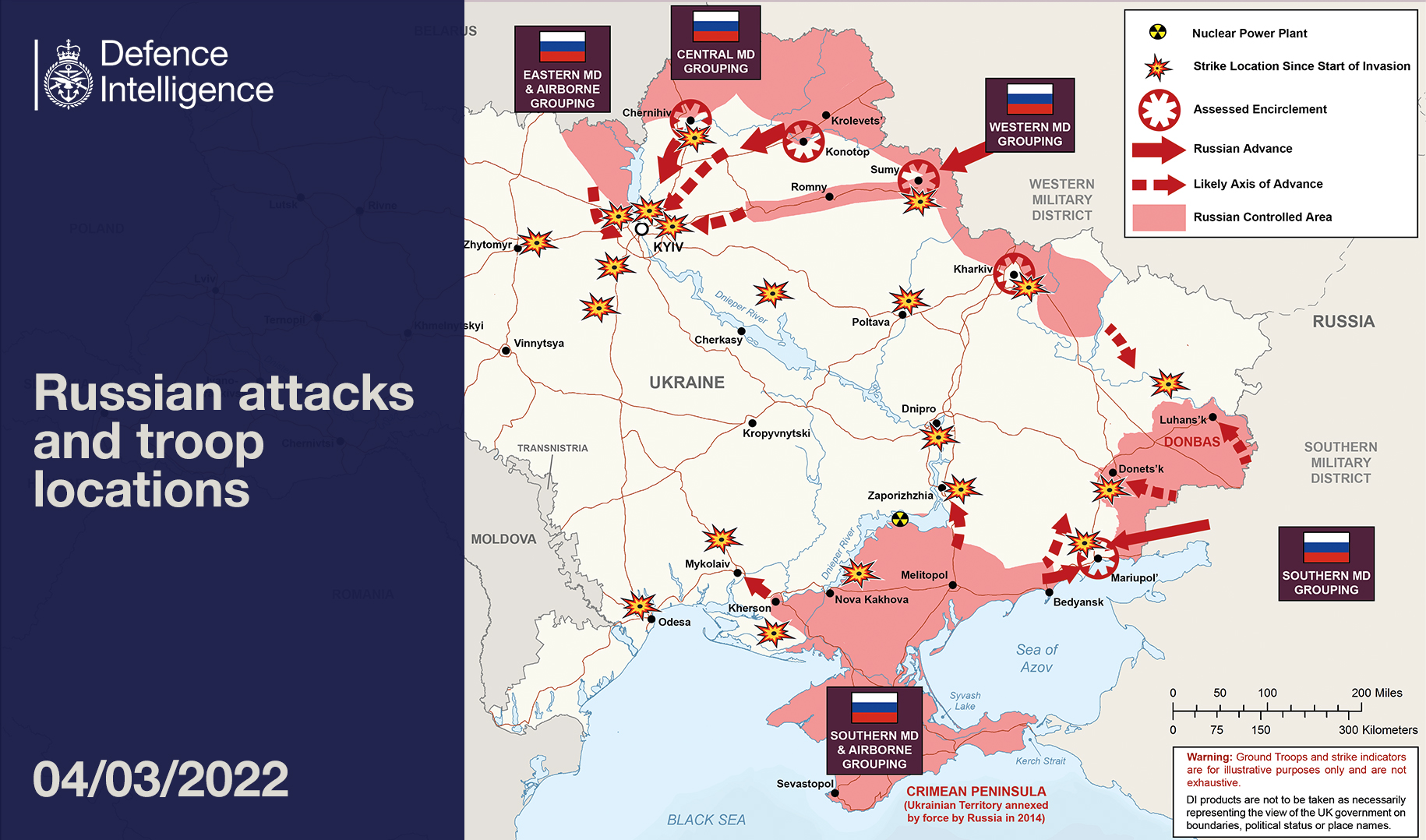
Two quite contradictory messages are emerging about the success, or otherwise, of the Kremlin’s efforts to control what Russians learn about the war in Ukraine. On the one hand, there is still, it appears, widespread ignorance about Russia’s actions, and disbelief about reports coming out of Ukraine. In other words, the official narrative prevails. But on the other hand, the imposition of an increasing number of media curbs, including on two independent domestic broadcasters and a slew of international news websites, suggests the authorities are running scared.
One of the most dispiriting but salutary accounts of Russian awareness came from the anonymous writer of a St Petersburg diary. He or she observed that most people, in what is Russia’s cosmopolitan second city, were simply not aware that a war was going on, let alone of its extent or that Russia had, in fact, invaded Ukraine.
Their ignorance, the writer said, was dictated by the largely monotone state media, which referred only to a “special military operation” that had been launched with the limited aims of “de-militarising” and “de-Nazifying” parts of Ukraine. Something similar emerged from a BBC report about Oleksandra, who lives in Kharkiv, Ukraine’s second-largest city, trying to explain to her disbelieving mother in Moscow that Kharkiv was under attack; and also from Mikhaylo in Kyiv who discovered that his father in Nizhny Novgorod was convinced that Russia was saving Ukrainians from Nazis.
The swingeing nature of media curbs being introduced in Russia over recent days, however, suggests at very least apprehension in the Kremlin that another version of the war is seeping through. Today a special session of the Russian Duma – Russia’s parliament – passed a new law designed to “prevent the discrediting of the armed forces of the Russian Federation during their operations to protect the interests of the Russian Federation and its citizens”. Offenders can be punished by up to 10 years in prison, and up to 15 years for distributing “false news” about the Russian army that leads to “severe consequences”.
Russia also started to block or severely restrict access to most international news sources, including the websites of the BBC and Germany’s Deutsche Welle.
Many, many pundits have ended up with egg on their faces for staunchly proclaiming that Vladimir Putin is too cautious and calculating to actually launch a full-on invasion of Ukraine, despite the drip-drip-drip of evidence beforehand that a military build-up was happening. Some have taken the hit and admitted the error while others ignore what they’d been saying only a couple of weeks ago. In The Critic, Phillips O’Brien points out that Putin’s long-standing admiration for leaders like Stalin has clearly become more than an inspiration for him and has become a model to emulate:
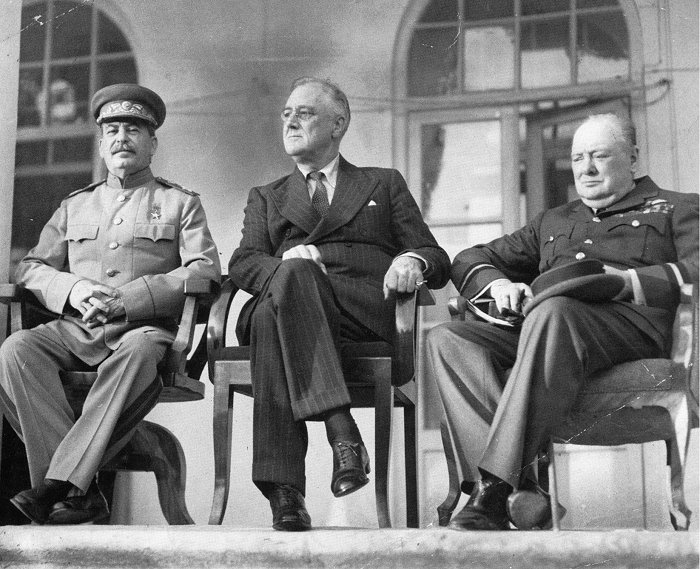
The “Big Three” meet at Tehran, 28 November-1 December, 1943.
Photo attributed to US Army photographer, via Wikimedia Commons.
Vladimir Putin fancies himself a great student of Russian history. He couched his justification for the invasion of Ukraine in a vision of Russia and the Soviet Union’s history that was paranoid, grandiose and incoherent, all at the same time. Ukraine needed to be subjugated by Russia because it was acting as a stalking horse for NATO and the West. At the same time, the West was declining and Russia had the strength to, in Putin’s mind, reincorporate Ukraine into its natural place within a Russian empire. Clearly, Putin has decided that this was the right moment to establish himself as one of the greatest Russian leaders of all time — an equal to Peter the Great, or Joseph Stalin.
As an obsessive student of Russian history, Putin has had an evolving view of Joseph Stalin over the years. Early in his authoritarian rule Putin kept Stalin somewhat at arm’s length, both praising and criticising Stalin’s record. More recently, as Putin has transitioned from autocrat to dictator, he has moved further and faster to identify himself with the greatest despot in Russian history. Stalin statues are now appearing in different places around the country, and respect for Stalin as a historical figure has risen strongly across Russia.
In the last few weeks, Putin has put this trend into overdrive and started behaving in a manner that apes Stalin almost perfectly. As Stalin in 1939 decided to invade the Soviet Union’s neighbour Finland, so has Putin today invaded his neighbour Ukraine. In both cases the decision for war was made by the dictator talking to a very small group of cronies, and in both cases the mass of the Russian people seemed indifferent or even hostile. Also, both invasions were disasters that revealed massive shortcomings in the Russian armed forces. In Stalin’s case, however, he was allowed time to rectify the problems, and his regime survived. It’s not clear that this will be the case for Putin.
The public meeting where Putin both embarrassed the other leaders in the Russian state security hierarchy, and forced them to publicly associate themselves with his decision to invade, was pure Stalin — if Stalin were alive today and could do it on television. As his rule became more bloody and despotic, Stalin increasingly forced his inner circle to endorse in writing his worst depredations, from signing the execution warrants of those slated for destruction, to publicly speaking in favour of policies that would force millions to starve. It both served his interest to humiliate his inner circle by reinforcing that they had to do his bidding no matter how onerous, and at the same time gave the impression to the outside world that his policies were strongly supported by the ruling circle. Putin is evidently doing the same, which is why he was so withering to the head of Russian intelligence, Sergey Naryshkin, when the latter seemed to waffle on the policy of recognizing the Russia puppet regimes in Donetsk and Luhansk.
A few days back, Theodore Dalrymple showed that there isn’t a Goldwater Rule when talking about Russian leaders:
When I watched Vladimir Putin, with what the Russians so graphically call his “tin eyes”, justify his invasion of Ukraine, I thought, as did many others, that he looked a little deranged. Denazification, indeed! Had he failed to appreciate that Ukraine, not noted throughout its history for its philo-Semitism, had elected a Jewish president, and that by a large majority, thereby suggesting a major cultural shift in the country?
It then occurred to me that Putin looked rather puffy in the face, and I wondered whether he could be taking steroids. These drugs are noted for their numerous side effects, not the least being psychological changes such as paranoia and elevation and depression of mood. Then there was the question, of course, as to why Putin would be taking them. Cancer, perhaps — a lymphoma? This brought to mind Evelyn Waugh’s somewhat uncharitable remark when Randolph Churchill underwent surgery for cancer: that it was characteristic of modern medicine to have removed the only part of him that was not malignant.
If Putin were taking steroids, his extreme and seemingly bizarre anxiety about contracting Covid-19 would be explained. Both the underlying condition of cancer itself and the drugs would have made him vulnerable to such anxiety, and the man who once liked to present himself as the Russian Crocodile Dundee, bare-chestedly wrestling bears and the like, has undergone a gestalt switch: invulnerability has been replaced by its opposite, unseen danger with every breath.
It is hazardous, however, to ascribe actions that we do not like to madness. This is for two reasons: first, the diagnosis may be wrong — the apparently mad may in fact be sane — and second, madness can have its own rationality. Indeed, the mad of strong character can often take others along with them: they can persuade others that their paranoid view of the world is correct. This is especially so when they possess levers of power over people of lesser character than themselves.
And finally, Ralph Berry offers a tiny bit of perspective on the almost universal condemnation heaped on the Russians for their use of artillery to attack Ukrainian targets with civilians nearby:
Of the real news, I select the serial bombing of Ukrainian targets by the Russians. Many civilians have been killed. This is presented as a war crime which must be pursued to the Hague. But the British have done it before. At the Normandy landings on D-Day, the plan was to take Caen on the first day. The landings on Juno beach were successful, but the following advance stalled and German resistance as so often made good the defences. As Anthony Beevor drily remarked, after noting that artillery was the arm on which the Allied commanders relied, “the French civilians, not surprisingly, felt that they did so to excess.” Caen did not fall, and Montomery changed the attack to bombing. This was merciless, and the French population suffered greatly. Not for six weeks were Caen and its environs controlled by the British and Canadians, by which time Caen was reduced to rubble. Some 3000 French civilians died during the bombing campaign. This fact should give pause to the widespread condemnation of what for the Russians is a regular practice of their system of warfare.
Comments Off on Duelling narratives on the fighting in Ukraine
March 3, 2022
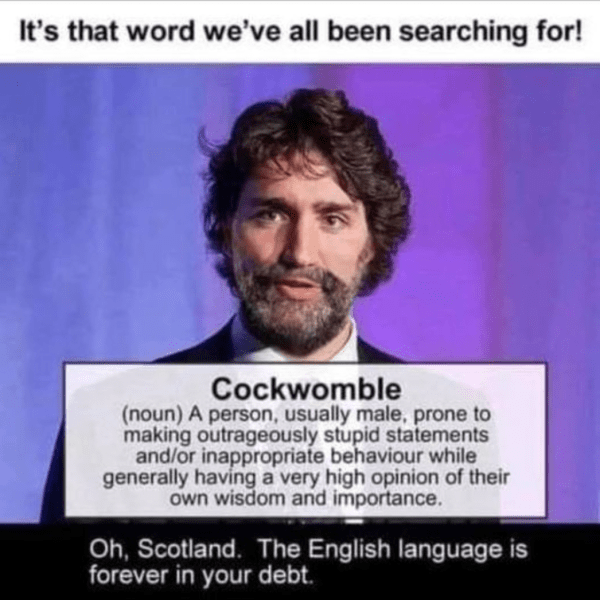
The amazing luck of Canada’s own cockwomble
Larry Correia in his monthly round-up post:
C. Okay, the big one. WW3. Last time I did an update post about this I said I’m not an expert on global geopolitics, and unlike most of the internet I’m not going to pretend to be one. And the only thing I know about military issues is how the contracts work and how to fix the DOD’s terrible spreadsheets. So, just personal opinion, while recognizing my strategic limitations so all the self anointed Von Clauswitzes don’t come yell at me AGAIN, real brief version … fuck Vladmir Putin. I’m rooting for the little guy and I hope the clock is ticking towards when some oligarchs get pissed off enough Putin “commits suicide” by thirty rounds of 5.45 to the back or drinks a polonium milkshake.
C2. By root for, I mean I think we should have a 4 for $10 Javelin missile blow out sale. We’ve got ATGMS! We’ve got Stingers! We’ve got bombs and more bombs! You’ve got Russians? NOT ANYMORE! Because at Crazy Lockeheeds, everything must go!
C3. By root for, what I don’t mean is that I’m going to be a hypocritical scumbag like Stephen King, and expect my countrymen to kill and die so I can proclaim my virtue because I Care So Hard. If you feel that strongly there’s a Ukranian Foreign Legion and they’re taking volunteers … Oh wait … No. He didn’t mean like that. He meant your sons need to “take those punches” (i.e. get shot or burned to death). Not him.
[…]
E. On propaganda and the fog of war. Duh. Of course it exists. Its always existed. Every side does it. The internet just makes it faster.
However all those “legends” the deboonkers are so smugly debunking … You kind of miss the point. That emotional manipulation exists for a reason, and it’s important. You just need to try and recognized when it is aimed at swaying YOU, rather than to motivate the people doing the fighting.
[…]
O. Justin Trudeau is really super lucky WW3 rolled around to push his stupid doughy face out of the news cycle. Justin Trudeau makes Mitt Romney look like a vertebrate. What a scummy little wannabe tyrant.
P. But for Americans, the real lesson there is the tactics that dirt bag used against the people who stood up to him. In the old days they’d just kill you to shut you up. Now they freeze your bank accounts and make it so you can’t work or feed your family, until you comply. They take away your voice and your legal ability to push back, taking options off the table until only the worst apocalyptical options are left … and if you use those, then they’ve got an excuse to kill you.
P1. All of these effeminate little sneering leftists are one bad day away from being Pol Pot. All of them. Never forget that. Once they reveal who they are they need to be driven from office and never let anywhere near any sort of authority ever again. They will happily destroy you and everyone you love.
Comments Off on The amazing luck of Canada’s own cockwomble
If wars could be won by propaganda alone, Ukraine would already be staging a virtual victory parade
I’ve gotten a bit tired of reminding people on social media that almost everything we think we know about the fighting in Ukraine is — to a greater or lesser extent — propaganda by one side or the other. That said, Ukraine’s propaganda efforts have been far more effective than the Russian equivalents. In The Line, Jen Gerson rounds up some of the best-known stories that have flashed across Twitter and other social media platforms since the combat began:
Perhaps it’s simply the inevitable consequence of protracted news overload, but the war in Ukraine feels surreal. Pulling up the news, following Twitter, none of it feels like reality, but rather like we’re all collectively remembering an event that was always destined to happen. Perhaps I’m the only one suffering from this dissociative state? Or perhaps not; is anyone else feeling as if our daily life has taken on this faded quality of a simulacrum?
Maybe this is the inevitable sensation of watching a war play out on Twitter and TikTok. It has a participatory quality that offers the sensation of being a part of the conflict without the dose of necessary, reality-evoking risk.
Did you see the viral video of the Ukrainian babushka demanding the Russian soldier keep sunflower seeds in his pocket so that he leaves behind flowers when he dies? Or the one of the soldiers on Snake Island telling the Russian warship to “go fuck yourself” when asked to surrender? Reportedly, 13 died after that ship blew the station apart — though it appears that this was false and they in fact were taken alive.
Did you watch the Twitter video of Ukrainian Volodymyr Zelensky filming himself on the streets of Kyiv to thwart rumours that he had fled? Or the guy who moved an anti-tank mine from the road with a cigarette drooping out of his mouth?
Did you hear about the Ghost of Kyiv, a mysterious fighter pilot who has allegedly scored more kills than any other in recent memory?
Or the TikTok video of the young woman teaching her contemporaries how to operate an abandoned Russian tank; the stranded artillery towed by Ukrainian farmers; the men stuffing polystyrene into Molotov cocktails to make peasants’ napalm?
Oh, and in case you missed it: an official music video lionizing the Ukrainian drone, Bayraktar.
I can’t assess the reality of any of this — and I presume some or all of it is staged. That’s what propaganda is, after all. All I can do is examine the transparent unreality of it all, to take note of the ephemeral, the narrative. And from here, the Ukrainians are absolutely crushing the propaganda war.

On Monday, David Patrikarakos also came to the same conclusion in UnHerd after viewing the online echoes of the war:
The internet is a chaotic place, but it is nonetheless ruled by a series of iron laws, especially when it comes to what we put on it. Perhaps the most important one is that whatever you post, try to make it visual. Once that’s established it’s about what sort of image will best hoover up those likes and shares and retweets. Well, that’s down to where you are and who your audience is. But as a rule of thumb there are two things that generally never fail: blondes and guns.
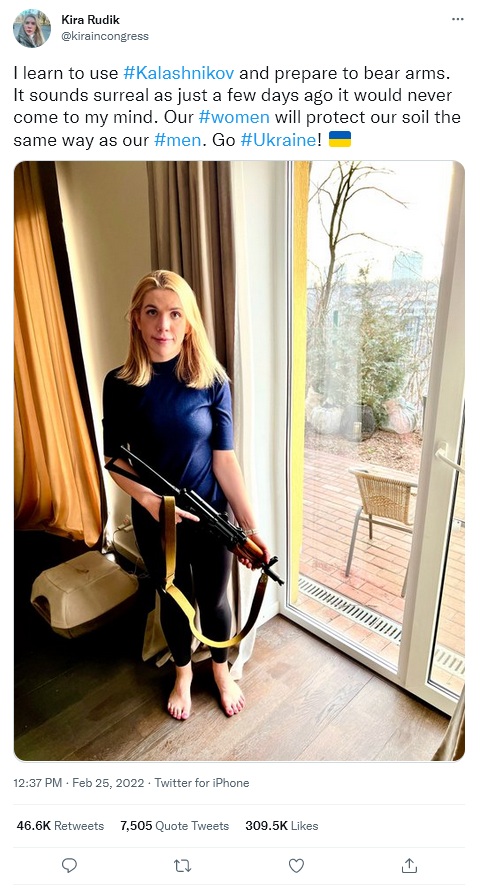
Over the past few days, the very brave and very blonde Ukrainian MP Kira Rudik has been tweeting various pictures of herself posing with an AK47. She began last Friday:
What is striking about the photos is not that Rudik posted them: she is a people’s representative in a time of war — it’s exactly the sort of thing she should be posting. What’s so interesting, and smart, is how she did it. Rudik does not pose in a uniform, or even in camouflage fatigues. She does not salute or lift the AK triumphantly; in fact, the way she holds it makes it clear that she’s not used to holding a weapon of any sort. The photo is taken not in a base or even in an office, but clearly in the living room of her home, just by a window that looks out onto a small patio.
The final touch though — and it’s a genius one — is that she doesn’t have shoes on; instead she stands barefoot, her toes painted a delicate pink.
In one sense, this all seems irretrievably amateurish — but that’s the point. Of the many things the internet craves, authenticity is sacrosanct. And this is a model of the genre. The tweet is designed to do two things: first, to show that Ukrainians will stand and fight for their homeland; and second, to humanise those whom we are told will be doing the fighting. And it does this by showing them to be the most ordinary of people; people standing in their bare feet, vulnerable and ordinary — just like civilians across the world. As such, they stand in total contrast to the stormtroopers invading their lands. It’s pink toenails versus mud-encrusted jackboots; smiling mothers versus bearded Chechens — all shorthand for the battle playing out between Ukraine and Russia.
As Kurt Schlichter said, “The first report is always wrong and nobody knows nothing”:
The battle in Ukraine seems to be one of the most covered and worst covered events in history. You cannot spend more than two minutes on social media without crossing paths with a snippet of shaky cell phone footage of a Russian tank burning or some heroic story of sturdy Ukrainian resistance. You have experts on TV trying to tell you what’s happening but no one is actually giving you any real information. Maybe you think the Ukrainians are winning, that their counterattacks are driving out the Russian invaders. There are plenty of sources saying 2800 or 5300 or some other oddly large and specific number of Russian soldiers are dead. All hail the coming victory!
Well, we’ll see.
Don’t believe a damn thing you see or hear right now. I’d like to. I want the Ukrainians to win. But I understand that I, like you, am a target of information operations by Ukrainians, Russians, and even Americans. Get woke to it.
All that exciting footage? What do you know about where it was shot, or when? Nada. Zip. Zero. We’ve seen people trying to pass off simulator footage as real battle footage. We’ve seen explosions and fires without context. What caused them? Who knows when all you have is the label on the video? All those Russian tanks on fire? Well, guess what kind of equipment the Ukrainians use.
I don’t know if the Ukrainians are winning or losing, but I know that a lot of people in the media want them to win. So do I, but simply because I would prefer they send the Russkies packing does not mean that I am blind to what is an obvious and effective propaganda campaign designed to keep the West in Ukraine’s corner. And it has worked, with a few sketchy, wacky exceptions. I am impressed by the information operation designed to get resonant stories out there, like the defiant guardians of Snake Island, the “Ghost of Kyiv”, or that Ukrainian marine who was forced to blow himself up to take out the bridge. It’s like they were designed to appeal to us.
In short, we don’t know what’s happening — for excellent military reasons on both sides — and much of what we’re being told is almost certainly pure fiction. Keep your bullshit filters up and re-calibrate ’em if and when you get genuine information, but good luck on finding any of that in the immediate future.
Comments Off on If wars could be won by propaganda alone, Ukraine would already be staging a virtual victory parade
March 2, 2022
“Somehow, the Ukrainians proceeded to launch the greatest PR operation of our times”
In The Critic, Ben Sixsmith on the plight of Ukraine under Russian attack and the rather surprising success they have been having on western social media and in legacy media coverage:
Soon after the Russians invaded Ukraine, President Zelensky released a video to the world. Filmed on his mobile phone, it looked as if he could have been anyone else in the 21st century. He was tired and sad, and the skin was red around his eyes. Whatever a strong leader looks like, President Zelensky looked like the opposite.
That feels like a long time ago now. Somehow, the Ukrainians proceeded to launch the greatest PR operation of our times. How many people had heard of Zelensky, a veteran comic actor whose most significant action on the world stage since his electoral triumph in 2019 had been listening to Donald Trump’s ramblings, until a few days ago? How many people even knew there had been fighting in Donbass?
You have to wonder if the Russians, having seen the capitulation of the Afghan government, thought a Western ally would hightail it at the first opportunity. Zelensky, on the other hand, announced that he was staying in Kiev. His speech, addressed to the Russian people, was measured, dignified and eloquent. His little updates from the Kiev streets were mischievous and bold.
A weak country invaded by a powerful aggressor is naturally sympathetic. But the Ukrainian cause projected a uniquely irresistible combination of victimhood and strength. Theirs is not a tale of mere persecution but of underdog resolve.
What happened on Snake Island, for example, remains mysterious. The Ukrainians reported that their soldiers were killed after delivering a “go fuck yourself” to a Russian warship. The Russians claim they are alive. Still, the emerging image of unbreakable defiance, spreading across the vortex of social media, has won hearts and minds across the world.
What has been crucial is that people are not just pitying. They are inspired. We have heard relatively few tales of atrocities, because the Russians were attempting to minimise casualties, but also because the Ukrainians have attempted to maximise their triumphs. Did the “Ghost of Kiev” exist? Almost certainly not. But when such urban legends were combined with undeniably tough Ukrainian resistance in cities like Kharkiv, foreign sympathisers were encouraged to think that the Ukrainians, while embattled, had a fighting chance. This has been translated into sanctions on Russia and massive donations of arms and equipment.
David Warren reports that the Chinese government has accused the Ukrainians of trouble-making in Hong Kong:
This did not happen yesterday, I should explain, but some months ago. How did those clever Ukrainians do this, my reader may ask, naïvely. They did it by secular inspiration, when they uttered the phrase, “Slava Ukraini!” — which they had been doing in their own nationalist cause since the nineteenth century — and more aggressively since they fought for independence from the Leninist regime of the Soviet Union, during 1917–21.
Since 2014, the phrase has been in the air again, just as truck horns are in the air here in the Canadas. The Hong Kongois, who tend to be well-informed to a fault, picked up on it in 2019. They began to declare, “Glory to Hong Kong!” in multiple languages, from Cantonese to English; or rather, to sing it, for this phrase and its variants are often set to music, in both countries. (The Canadian trucker’s “Honk Honk” makes its own music.)
Wi Jinping, Vladimir Putin, and little Justin Trudeau, all get quite offended by the use of such phrases; and all have gone to the trouble of manufacturing bare-faced lies to resist the respective sovereignty movements. Readers will gather that I am unsympathetic with any of these dictators, or Mr Would-Be.
Because I (or more exactly, my father) was also unfavourably inclined to the dictatorship of Mr Adolf Hitler, it may be incumbent upon me to specify of what my disapproval consists. For granted, Hitler was a nationalist of a sort. I have long been an enemy of nationalism, when it is rudely proclaimed, though with mysterious moments of enthusiasm for nationalisms of other sorts.
Comments Off on “Somehow, the Ukrainians proceeded to launch the greatest PR operation of our times”
March 1, 2022
Genocide in Ukraine: The Holodomor | Into Context | War in Ukraine 01
TimeGhost History
Published 28 Feb 2022What do you get when you combine vigorous grain-tax policies, bad harvests with Stalin’s fear and animosity for the rural population of Ukraine? A man-created murder famine, designed to kill millions of Ukrainian men, women and children.
(more…)
Comments Off on Genocide in Ukraine: The Holodomor | Into Context | War in Ukraine 01
Words of the day — “tribalism, jingoism and emotionalism”
Glenn Greenwald on the war propaganda being pushed by both sides in the Russian-Ukrainian conflict, and how after two full years of “war on Wuhan Coronavirus propaganda”, we’re seeing a smooth transition to more traditional war propaganda from our governments and media:
In the weeks leading up to the Russian invasion of Ukraine, those warning of the possible dangers of U.S. involvement were assured that such concerns were baseless. The prevailing line insisted that nobody in Washington is even considering let alone advocating that the U.S. become militarily involved in a conflict with Russia. That the concern was based not on the belief that the U.S. would actively seek such a war, but rather on the oft-unintended consequences of being swamped with war propaganda and the high levels of tribalism, jingoism and emotionalism that accompany it, was ignored. It did not matter how many wars one could point to in history that began unintentionally, with unchecked, dangerous tensions spiraling out of control. Anyone warning of this obviously dangerous possibility was met with the “straw man” cliché: you are arguing against a position that literally nobody in D.C. is defending.
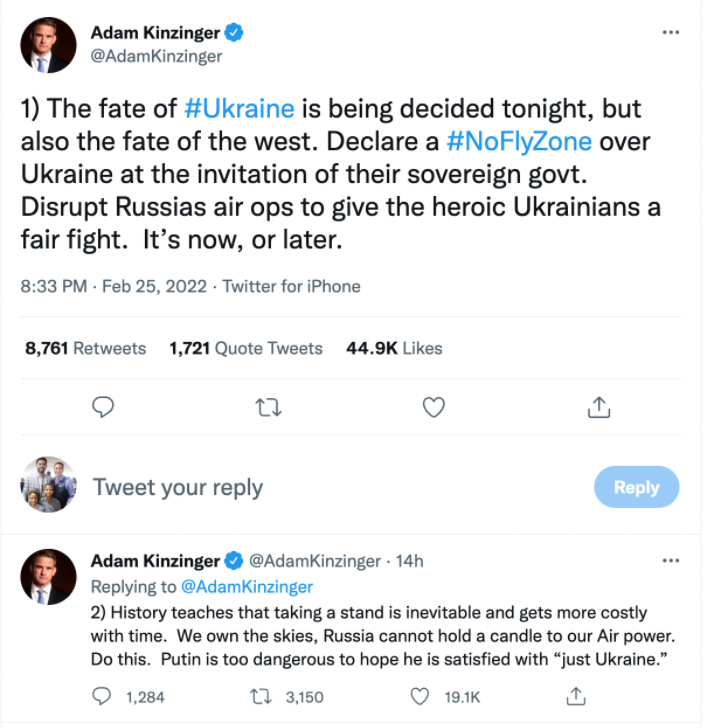
Less than a week into this war, that can no longer be said. One of the media’s most beloved members of Congress, Rep. Adam Kinzinger (R-IL), on Friday explicitly and emphatically urged that the U.S. military be deployed to Ukraine to establish a “no-fly zone” — i.e., American soldiers would order Russia not to enter Ukrainian airspace and would directly attack any Russian jets or other military units which disobeyed. That would, by definition and design, immediately ensure that the two countries with by far the planet’s largest nuclear stockpiles would be fighting one another, all over Ukraine.
Kinzinger’s fantasy that Russia would instantly obey U.S. orders due to rational calculations is directly at odds with all the prevailing narratives about Putin having now become an irrational madman who has taken leave of his senses — not just metaphorically but medically — and is prepared to risk everything for conquest and legacy. This was not the first time such a deranged proposal has been raised; days before Kinzinger unveiled his plan, a reporter asked Pentagon spokesman John Kirby why Biden has thus far refused this confrontational posture. The Brookings Institution’s Ben Wittes on Sunday demanded: “Regime change: Russia”. The President of the Council on Foreign Relations, Richard Haass, celebrated that “now the conversation has shifted to include the possibility of desired regime change in Russia.”
Having the U.S. risk global nuclear annihilation over Ukraine is an indescribably insane view, as one realizes upon a few seconds of sober reflection. We had a reminder of that Sunday morning when “Putin ordered his nuclear forces on high alert, reminding the world he has the power to use weapons of mass destruction, after complaining about the West’s response to his invasion of Ukraine” — but it is completely unsurprising that it is already being suggested.
In the reporting and opining on the conflict in Ukraine, Mark Steyn says the frequent rhetorical invocation of Neville Chamberlain in 1938 are unfair:
Which brings us to this last day of February 2022. Which is beginning to feel like late February 2020, don’t you think? That is, in the stampede to impose the suffocating blanket of “the narrative” to the exclusion of all else. There is certainly a real country called Ukraine, where real people are being killed by real missiles hitting their apartment houses. Just as there was a real virus called Covid-19, which emerged from a real lab in a real city in China and began killing real people all over the world. Yet “the narrative”, then as now, seems designed to obscure any serious consideration of the underlying causes.
Nevertheless, certain things should be capable of being grasped even by viewers of CNN and readers of The New York Times. Just as Covid revealed that China is now the planet’s dominant economic power, so Ukraine confirms that America’s post-Cold War unipolar moment is dead: over the weekend, the talk shifted (again very Corona-like) from fifteen days to flatten the Tsar to an acceptance that this is a long-term thing — that, for a while at least, “a gas station masquerading as a country” (in John McCain’s characteristically stupid sneer) has succeeded in rolling back the great European liberations of three decades ago.
These days Neville Chamberlain is too invoked and the comparison is unfair. In 1938, when Germany invaded Czechoslovakia, the Prime Minister went on the radio and described it as “a quarrel in a far-away country between people of whom we know nothing”. For America, Russia’s invasion of Ukraine is the precise opposite: a quarrel in a far-away country of which their leaders know everything. Because they’ve been up to their neck in it for years.
Ukraine is a beautiful place, its people are intelligent and agreeable, and its women are stunners. But it is a very poor country and, notwithstanding its many fine qualities, the most corrupt nation in Europe, and, per Ernst & Young, the ninth most corrupt in the world. As I pointed out regularly three years ago on Tucker and Rush, at a time when Hunter Biden was getting fifty grand a month plus seven-figure bonuses from Burisma, the average wage in Ukraine was $200 a month: The Biden family’s heist was “not a victimless crime”.
A far-away country of which we know nothing? Has there been any Washington scandal that has not involved Ukraine in recent years?
The Trump impeachments? Ooh, he telephoned … Ukraine!The “Russia investigation”? Putin wanted Trump to win why exactly? Oh, no problem: because he’ll roll back sanctions imposed for Moscow’s actions against … Ukraine!
Do we have any witnesses to any of this? Yeah, sure, the really good guy’s some Colonel Vindman. He’s an immigrant from … Ukraine!
On the other hand, Obama made Biden his point-man in … Ukraine!
Biden told the Ukrainians they had to clean up all the corruption. They took the hint and put Hunter on the board, and Joe, Jim and the rest of the mob family suddenly acquired extensive “business interests” in Ukraine.
Oh, and the biggest source of foreign donations to the Clinton Foundation is … Ukraine.
Comments Off on Words of the day — “tribalism, jingoism and emotionalism”
February 27, 2022
“Putin finally called our bluff. The question to me is when and if Xi will decide to do the same”
Andrew Sullivan on what Winston Churchill referred to as “the historic life-interests of Russia”, the inability (and unwillingness) of the western nations to do more than send hopes and prayers to Ukraine, and the parallels between the Russia-Ukraine situation and the China-Taiwan potential conflict:
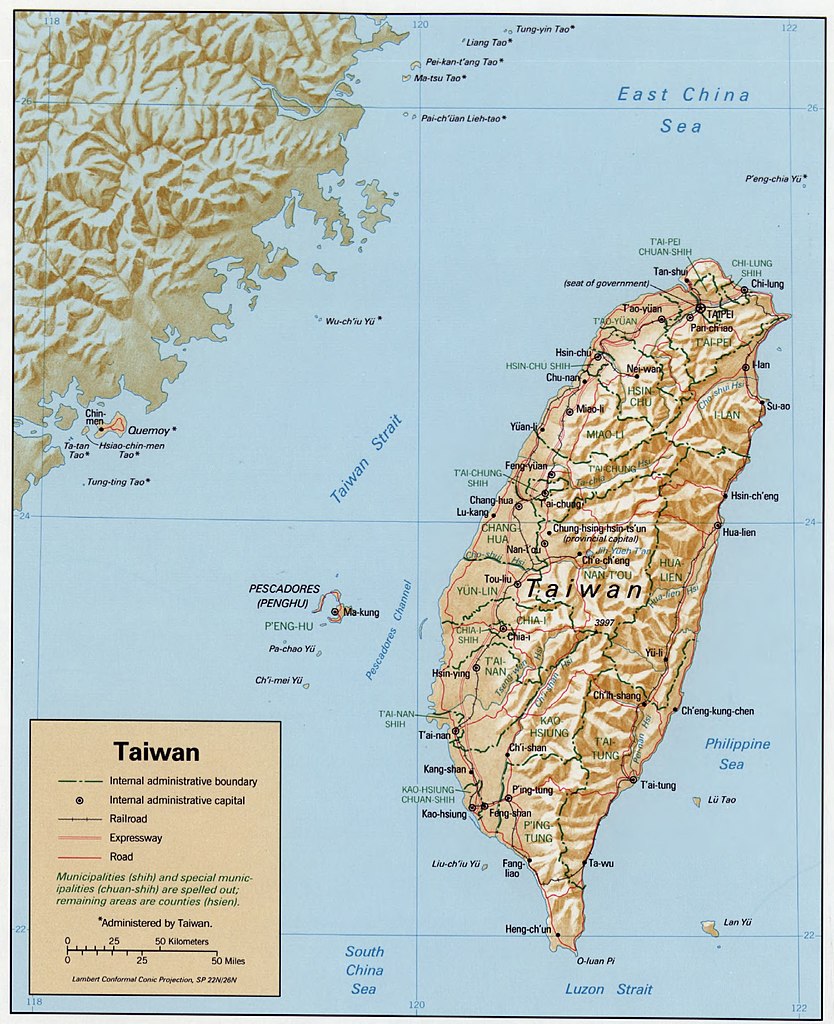
Taiwan relief map.
Library of Congress Geography & Map Division via Wikimedia Commons.
… in one crucial sense, Putin has already won a victory. A nuclear-armed great power has invaded and occupied a neighboring country in Europe, and there is nothing anyone else has been able to do to stop it. Many in the West assumed Putin wouldn’t go that far — surmising that international law, universal condemnation, economic sanctions, and the lack of any serious threat from Ukraine to Russia would restrain him. But he has called our bluff. He has even hinted at Russia’s nuclear capacity to intimidate other states from intervening. And so we have a precedent. Ukraine is a Russian possession. A fact on the ground. All we have been able to do is watch.
All of which brings us to what seems to me to be the larger dimension of this clash: how it will resonate in Beijing and Taiwan. With apologies to Mitt Romney, China is easily the greater geostrategic challenge. And the parallels with Russia are as striking as they are unnerving. China sees Taiwan as part of its national identity in a similar way to how Russia sees Ukraine as part of its. And we are committed to the defense of Taiwan the way we have committed to the defense of Ukraine: kinda, but not really. In the face of this underlying Western ambiguity, the fall of Kiev is news that Xi will be watching closely.
The parallels are not exact, but nonetheless striking. Taiwan is next door to and deeply entangled with China in its history and culture, just as Ukraine is uniquely entangled with Russia. Seeing Taiwan and China (like Ukraine and Russia) as simply random sovereign states with a right to self-determination under international law is correct, so far as it goes. It’s also moral — as majorities of both Ukrainians and especially Taiwanese want independence and have constructed nascent democracies in the wake of autocracy.
But the nationalist passion Russia feels about Ukraine and China feels about Taiwan is real, visceral, and hard for outsiders to understand intuitively. The sense of a rogue region that somehow got away from the homeland is vivid among Russian and Chinese nationalists. This kind of understanding — claiming a “sphere of influence” — is now deemed reactionary by the West’s foreign policy elites, as, perhaps, it should be. But that doesn’t mean that everyone, especially China and Russia, have actually moved past it. Even Americans have very different emotional responses to perceived threats in our own hemisphere compared with the rest of the world. So this is also a culture clash of sorts — globalism and the nation state vs nationalism and spheres of influence.
I’m not saying that this belief in a sphere of influence is a universal view in Russia or China — or that it is justifiable. I’m just saying it is real. And I’m not excusing Putin or Xi from taking a particularly zealous view of this irredentist nationalism, which they both do, for their own personal and political advantage. I’m just noting how national pride deeply informs them, that resentment of the West consumes them, that a sense of historical grievance spurs them on — and that they are not outliers among their compatriots. It is crazy to underestimate the power of this kind of revanchist nationalism — among rulers and ruled. And I fear we underestimated it in the case of Putin.
This means, as Barack Obama once insisted, that Russia will always care much more about Ukraine than we do; and China will always care much more about Taiwan than we do. In those cases, the last thing we should do is promise support that we do not seriously — truly seriously — intend to provide. The vague pledge by the Western powers not to rule out future NATO membership for Ukraine was the worst of all worlds: poking the bear, with no serious intention of fighting it.
The fall of Afghanistan was a margin call … and Ukraine is the point where airy western “guarantees” will have to be backed up with actual force. But western leaders have grown very comfortable in a world where gestures were taken seriously and few if any such gestures actually had to be followed-through with meaningful action. And now, the geopolitical pantomime is over and we’re back in a world where gestures are seen as signs of weakness and do nothing to deter adventurism.
Comments Off on “Putin finally called our bluff. The question to me is when and if Xi will decide to do the same”
February 25, 2022
Tsar Vlad begins the next stage in rebuilding the Russian empire
Niall Ferguson from The Spectator:
“War:, in Prussian military theorist Carl von Clausewitz’s most famous dictum, “is nothing but a continuation of politics with the admixture of other means.” A generation of Democrats — the American variety, but also European Christian and Social Democrats — have sought to ignore that truth. Appalled by the violence of war, they have vainly searched for alternatives to waging it. When Vladimir Putin ordered the annexation of Crimea in 2014, Barack Obama responded with economic sanctions. When Putin intervened in the Syrian civil war, they tried indignant speeches.
When it became clear that Putin intended a further and larger military incursion into Ukraine, Joe Biden and his national security team opted for sanctions once again. If Putin invaded Ukraine, they said, Russia would face “crippling” or “devastating” economic and financial penalties. When these threats did not deter Putin, they tried a new tactic, publishing intelligence on the likely timing and nature of the Russian assault. Cheerleaders for the administration thought this brilliant and original. It was, in reality, a species of magical thinking, as if stating publicly when Putin was going to invade would make him less likely to do so.
Those who dread war approach diplomacy the wrong way, as if it is an alternative to war. This gives rise to the delusion that, so long as talks are continuing, war is being averted. But unless you are prepared ultimately to resort to force yourself, negotiations are merely a postponement of the other side’s aggression. They will avert war only if you concede peacefully what the aggressor is prepared to take by force.
Putin decided on war against Ukraine some time ago, probably in July when he published a lengthy essay, “On the Historical Unity of the Russians and Ukrainians”, in which he argued tendentiously that Ukrainian independence was an unsustainable historical anomaly. This made it perfectly clear that he was contemplating a takeover of the country. Even before Putin’s essay appeared, Russia had deployed around 100,000 troops close to Ukraine’s northern, eastern and southern borders. The response of the United States and the European Union was to make clear that Ukraine was a very long way indeed from either Nato or EU membership, confirming to Putin that no one would fight on Ukraine’s side if he went ahead with his planned war of subjugation.
Over the past few months, Putin has used diplomacy in the classical fashion, seeking to gain his objectives at the lowest possible cost while at the same time carefully preparing for an invasion. Western leaders have achieved nothing more than to remain united in saying they will impose sanctions if he invades. But a Russian invasion of Ukraine beyond the Donbas will create an entirely new situation. Politicians on both sides of the Atlantic may express a common outrage, but it will not take long for their unity to be eroded by the altered reality and their fundamentally divergent interests. The US does not need Russia’s natural gas. At least in the short run, Europe does.
Arthur Chrenkoff offers what he calls “disjointed thoughts at a tragic time”:
Putin is invading Ukraine – not just sending “peacekeepers” into the breakaway pro-Russia regions in the east of the country – in order to “denazify” and “demilitarise” the country. The former is an outrageous slur in a long communist tradition from Stalin to today’s Western left of smearing anyone they don’t like and agree with as a Nazi. Ukraine is as Nazi as Australia or Greece, or Russia for that matter. “Demilitarisation” is the more pertinent excuse. What Putin wants is a cordon sanitaire separating Russia from the West (which now includes Poland and the Baltic states). His vision for Ukraine is a pro-Russia puppet state or at least a neutral and impotent non-entity. According to Putin, Russia’s got a legitimate security interest in not being bordered by hostile (read pro-Western) states. Why this should trump Ukraine’s (or any other country’s) legitimate security interest in its own security, territorial sovereignty and the choice of international friends is unknown, except that might makes right and Russia fancies itself as a special case on the basis of its past great power status.
No country has an obligation to send it troops to fight a conventional war with Russia in Ukraine. But countries have moral obligation to offer any and all assistance to the people of Ukraine, including military equipment, as they defend themselves against unprovoked aggression. Countries also have moral obligation to punish Putin and Russia with utmost severity, including – if only they had the guts – complete economic and trade sanctions. Not a drop of Russian oil or a cubic foot of its gas. Let Putin swim in his unsold carbohydrates. Sadly that won’t happen because the Western European governments have, despite numerous warnings, made themselves energy dependent on imports from Russia. Shutting down coal, closing nuclear power plants and praying to the sun and the wind are now coming home to roost.
At First Things before the invasion began, George Weigel explained what was being obscured by Russian propaganda and western media complaisance:
For months now, the world press has described Russian troop deployments along Ukraine’s borders as spearheads of a possible invasion. The truth, however, is that Russia invaded Ukraine seven years ago, when it annexed Crimea and Russian “little green men” ignited a war in eastern Ukraine that has taken over 14,000 lives and displaced over a million people. Whatever the current military developments, a Russian invasion of Ukraine has not been “imminent”; the invasion is ongoing.
That fact has been obscured by a massive Russian propaganda and disinformation campaign. So some truth-telling is imperative.
The first fact: This is a Russian crisis, not a “Ukraine crisis”. What is typically called the “Ukraine crisis” is entirely of Russian autocrat Vladimir Putin’s making. Ukraine did not create this crisis. The United States did not create it, and neither did NATO. The North Atlantic Treaty Organization, which is, was, and always will be a defensive alliance, is no more a threat to Russian national security than NATO is to Botswana’s national security. The claim that NATO threatens Russia is a Big Lie that obfuscates the security realities in central and eastern Europe: Former Soviet satellites (Poland, the Czech Republic, Slovakia, Hungary, Romania, Bulgaria) and the Baltic states (Lithuania, Latvia, Estonia) joined NATO because they fear Russia, not because they intend to invade Russia. The same rationale explains Ukraine’s NATO application.
The second fact: This artificially created crisis, aimed at Ukraine’s destabilization and subjugation, is one expression of Putin’s determination to reverse history’s verdict in the Cold War. Putin has been quite clear about this for twenty years, and only fools or those peering through the ideologically befogged lenses of the new “national conservatism” fail to grasp what is afoot here. Putin, the old KGB apparatchik, is bent on overturning the victory of imperfect democracies over pluperfect tyrannies in the Revolution of 1989 and the Soviet crack-up of 1991. That grand strategic goal is at the cold heart of the recently announced alliance of purpose between Putin’s kleptocratic regime in Russia and Xi Jinping’s genocidal regime in China — an announcement these two wicked men made just before the Winter Olympics. Putin and Xi want nothing less than a fundamental re-ordering of world affairs in which their oppressive regimes call the tune. In the tyrants’ bid for global hegemony, Ukraine and Taiwan are in the role played by Austria and Czechoslovakia in the late 1930s: If they fall to the tyrant-regimes, others will follow.
At Samizdata, Perry de Havilland notes that not every single thing that happens in the wider world is linked to or directed by American action:
Yes, the United States is the richest and most powerful nation on earth and it has been since World War II. And yes, it has interfered under presidents of all stripes for good or ill in a great many places, in pursuit of its perceived geopolitical interests, sometimes benignly, other times with a breathtaking lack of judgement.
But just as the leaders of that great nation have often overestimated the USA’s ability to impose its will in far away lands, many people in many places similarly overestimate America’s involvement everywhere. They largely deny that local people have agency, oblivious to the fact people everywhere are capable of organising politically in ways not directed and driven from an agency in Langley, Virginia. As a friend of mine who was deeply involved in the 2014 Maidan revolt in Kyiv said to me once:
“Woah! I’ve just heard we’re all CIA puppets on Washington’s payroll. There must have been an oversight as me and my friends never got a penny. You know people in America, so can you get me an address to apply for that lovely CIA money I’m apparently due?”
He was of course joking, but Maidan was a golden example of how something overwhelmingly driven and executed by Ukrainians, in Ukraine, in response to Ukrainian political and social pressures becoming intolerable, was nevertheless written off as CIA mischief-making.And whilst that was pushed hard by Russia when their pet oligarch was deposed, its entirely possible Putin himself believes it too. It is actually more supportive of his worldview than the notion it really happened because millions of Ukrainians loathed Putin, his Ukrainian’s puppet in Kyiv, and the malign influence of Russia generally.
But so many people seek a simpler world, a bipolar one in which everything is down to the Big Actors (with America still the biggest at the moment). Understanding that and feeding into it grants profound insight into Russian (and to some extent Chinese) propaganda. Add to that the rightly shattered confidence in Western institutions the last two years has wrought, and it is not surprising otherwise discerning folk fall for it.
And with bombs dropping and people being killed in Ukraine, John Kerry keeps his laser focus on the important issue — climate change:
Comments Off on Tsar Vlad begins the next stage in rebuilding the Russian empire


