Quotulatiousness

March 27, 2020

QotD: “Jesus was a socialist”

Filed under: Government, Politics, Quotations, Religion — Tags: , , , , — Nicholas @ 01:00

Christ taught giving. Giving means taking ones own property and passing it on to someone in need. Nowhere did he advocate taking from others by force and “redistributing” it. He certainly did not advocate taking from others, using what’s taken to fund a huge government bureaucracy, and pass out a pittance of the remainder to the poor (have to justify that bureaucracy somehow).

Nowhere in the Bible is there a passage similar to this:

    And I say unto you, take up your sword and shew it to the rich man and say unto him “give to me your wealth that it might care for the poor, lest I smite you to the Earth.”

    And when the wealthy man has given up his wealth, take it and pay for a multitude of scribes and pharisees and learned doctors of the law and say unto them, “use this wealth to provide for your hire, but only this, save a pittance thereof and give it unto the poor so that we may noise about this good work and stand in the marketplace speaking loudly of these alms we give.”

    And when this is done, say unto the people “Behold, we have cared for the poor. Now give us more of your wealth that we may continue to do so and to do other things.”

    And if any dare to resist you, lay your hands upon him and chain him and cast him into a dungeon.

    And in all this way shall you show unto the people your mercy and kindness.

When people advocate socialism enforced by government, they are advocating using force to take from some to give to others. Nowhere in his teachings did Christ advocate that. Nowhere.

This is where some people say “but Christ said Render unto Caesar.” Yes. He did. In response to a question intended to trap him. Context matters. Christ had rising popularity among the masses which concerned the Jewish leadership greatly. So they planted the question of whether they should give tribute to Caesar. If Christ had simply said “yes” he would have lost his popular audience and his ministry would have died right there. If he had said “no”, he would likely have been arrested (“we caught him forbidding tribute to Caesar” was one of the charges the Sanhedrin laid against him when handing him over to the Romans for execution). And his ministry would have died right there. Instead, he asked for an example of the tribute money, asked whose picture was on it, and gave his famous answer. And if people followed him in that, the Roman reprisal, destruction of Jerusalem, and diaspora would have occurred before much of Christ’s mission was fairly begun. If you accept his divinity, you have to accept that he knew this and gave the answer that allowed him to complete his mission.

But did “render unto Caesar” mean an endorsement of everything that tax funds were used for? Did he endorse gladiatorial games? Wars of conquest? The capture and importation of slaves? The use of government troops to put down slave revolts? Let’s not be absurd. Just because the Roman government did something with tax monies, or modern governments do something with it, “Render unto Caesar” is not an endorsement of that use.

Government is force, pure and simple. That’s essentially a definition of government: the legitimizing of the use of force. Socialism imposed by government has nothing to do with Christian charity. It is, in fact, very nearly the exact opposite, wearing a mask to confuse the unwary.

David L. Burkhead, “The “Christian Left”, The Writer in Black, 2018-01-08.

March 4, 2020

QotD: Tax cuts “for the rich”

Filed under: Americas, Economics, Politics, Quotations, USA — Tags: , , , , — Nicholas @ 01:00

I keep hearing about how tax cuts are “giveaways” for the rich. Never mind that some rich people will see their taxes go up. This is philosophically grotesque. The people saying it may be more civilized and restrained than the pro-government mobs in the streets of Caracas, but it’s still basically the same idea: “The People” or “the nation” own everything. The state is the expression of the peoples’ spirit or of the nation’s “will”, and therefore it effectively owns everything. Thus, taking less money from you is the same as giving you more money.

This is why populism and nationalism, taken to their natural conclusions, always lead to statism. The state is the only expression of the national or popular will that encompasses everybody. So, the more you talk about how the fundamental unit of society is a mythologized collective called “The People” or the nation, the more you are rhetorically empowering the state.

Sure, the Constitution begins with the words “We the People,” but that is not a populist sentiment — it’s a statement of precedence in terms of authority: The people come before the government (not the European notion of the state). The spirit of the Constitution is entirely about the fact that The People are not all one thing. It places the rights of a single person above those of the entire federal government! It assumes not only that the people will disagree among themselves, but that the country will be better off if there is such disagreement. No populist frets about the tyranny of the majority. American patriots do.

But if you recognize that humans create wealth with their brains and their industry and that it therefore belongs to them, you’ll be a little more humble about the state’s “right” to take as much as it wants to spend how it wants. Human ingenuity is the engine of wealth creation, and there is no other.

But that doesn’t mean government doesn’t play a role. Because, as I said, there will be no wealth creation if there is no rule of law. There will be no investment or ingenuity if there is no guarantee that you will be able to collect on that investment or reap the benefits of your innovation. Without such an environment, the biggest mob wins. And when the mob wins, children starve to death in what should be one of the richest countries in the world.

Jonah Goldberg, “America and the ‘Original Position'”, National Review, 2017-12-22.

February 12, 2020

“… perhaps the biggest Internet cash grab in the OECD with mandated payments and levies on thousands of Internet services with Canadian users”

Filed under: Bureaucracy, Business, Cancon, Government, Media — Tags: , , , , , — Nicholas @ 03:00

Michael Geist refutes the claim that the recent Broadcast and Telecommunications Legislative Review Panel report does not recommend a “Netflix tax”:

The reference to a Netflix tax in the overview is the only such reference in the 235 page report. It was likely included in the overview in the hope that media coverage would jump on the claim and seek to re-assure Canadians that there was no Netflix tax or higher prices likely for consumers as a result of the report’s recommendations.

Yet the reality for anyone that reads beyond the overview is that the panel’s report not only recommends what would widely be considered a Netflix tax but proposes perhaps the biggest Internet cash grab in the OECD with mandated payments and levies on thousands of Internet services with Canadian users. This includes online streaming services, social media companies, news aggregators, and online communications services such as Skype, WhatApp, and Viber. In the view of the panel, any service or site with Canadian users is part of the “Canadian system” and should be expected to contribute to the development of Canadian content, Canadian news organizations, or building broadband connectivity. Note that all of this is above and beyond sales taxes, which the panel also recommends should be implemented with respect to foreign services.

Some of the panel’s plans are admittedly somewhat confusing. For example, the panel states:

Media curation undertakings brought under the regime – including Netflix and other online streaming services – would be required to devote a portion of their program budgets to Canadian programs.

That statement, along with chair Janet Yale’s comment at the opening press conference that there was no need for Netflix to spend additional money on Cancon but rather merely divert existing on foreign location and service production spending in Canada, has been interpreted by some to mean that Netflix would not have to increase its Canadian programming budget. But that is apparently not what the panel means. I spoke with Yale who confirmed that the panel expects the CRTC to establish a minimum Cancon spend requirement on Netflix based on its Canadian revenues. In other words, the requirement has nothing to do with its existing spending on production in Canada. For Netflix, that could certainly represent an increase in spending costs in Canada with those costs likely passed along to consumers.

Yet the panel’s plan extends far beyond just online streaming services such as Netflix. It also envisions mandatory levies against social media services and news aggregators that would be used to fund Canadian news services. It similarly targets a myriad of communications services that would pay into funds to support broadband development.

February 11, 2020

QotD: Agriculture and the rise of the state

Filed under: Food, Government, History, Quotations — Tags: , , , , — Nicholas @ 01:00

Why should cereal grains play such a massive role in the earliest states? After all, other crops, in particular legumes such as lentils, chickpeas, and peas, had been domesticated in the Middle East and, in China, taro and soybean. Why were they not the basis of state formation? More broadly, why have no “lentil states,” chickpea states, taro states, sago states, breadfruit states, yam states, cassava states, potato states, peanut states, or banana states appeared in the historical record? Many of these cultivars provide more calories per unit of land than wheat and barley, some require less labor, and singly or in combination they would provide comparable basic nutrition. Many of them meet, in other words, the agro-demographic conditions of population density and food value as well as cereal grains. Only irrigated rice outclasses them in terms of sheer concentration of caloric value per unit of land.

The key to the nexus between grains and states lies, I believe, in the fact that only the cereal grains can serve as a basis for taxation: visible, divisible, assessable, storable, transportable, and “rationable.” Other crops — legumes, tubers, and starch plants — have some of these desirable state-adapted qualities, but none has all of these advantages. To appreciate the unique advantages of the cereal grains, it helps to place yourself in the sandals of an ancient tax-collection official interested, above all, in the ease and efficiency of appropriation.

The fact that cereal grains grow above ground and ripen at roughly the same time makes the job of any would-be taxman that much easier. If the army or the tax officials arrive at the right time, they can cut, thresh, and confiscate the entire harvest in one operation. For a hostile army, cereal grains make a scorched-earth policy that much simpler; they can burn the harvest-ready grain fields and reduce the cultivators to flight or starvation. Better yet, a tax collector or enemy can simply wait until the crop has been threshed and stored and confiscate the entire contents of the granary.

Compare this situation with, say, that of farmers whose staple crops are tubers such as potatoes or cassava/manioc. Such crops ripen in a year but may be safely left in the ground for an additional year or two. They can be dug up as needed and the reaminder stored where they grew, underground. If an army or tax collectors want your tubers, they will have to dig them up tuber by tuber, as the farmer does, and then they will have a cartload of potatoes which is far less valuable (either calorically or at the market) than a cartload of wheat, and is also more likely to spoil quickly. Frederick the Great of Prussia, when he ordered his subjects to plant potatoes, understood that, as planters of tubers, they could not be so easily dispersed by invading armies.

The “aboveground” simultaneous ripening of cereal grains has the inestimable advantage of being legible and assessable by the state tax collectors. These characteristics are what make wheat, barley, rice, millet, and maize the premier political crops. A tax assessor typically classifies fields in terms of soil quality and, knowing the average yield of a particular grain from such soil, is able to estimate a tax. If a year-to-year adjustment is required, fields can be surveyed and crop cuttings taken from a representative patch just before harvest to arrive at an estimated yield for that particular crop year. As we shall see, state officials tried to raise crop yields and taxes in kind by mandating techniques of cultivation; in Mesopotamia this included insisting on repeated ploughing to break up the large clods of earth and repeated harrowing for better rooting and nutrient delivery. The point is that with cereal grains and soil preparation, the planting, the condition of the crop, and the ultimate yield were more visible and assessable.

James Scott, Against The Grain: A deep history of the earliest states, 2017.

January 11, 2020

The bubbly 1720s

Filed under: Americas, Britain, Business, Economics, France, Government, History — Tags: , , , , , — Nicholas @ 03:00

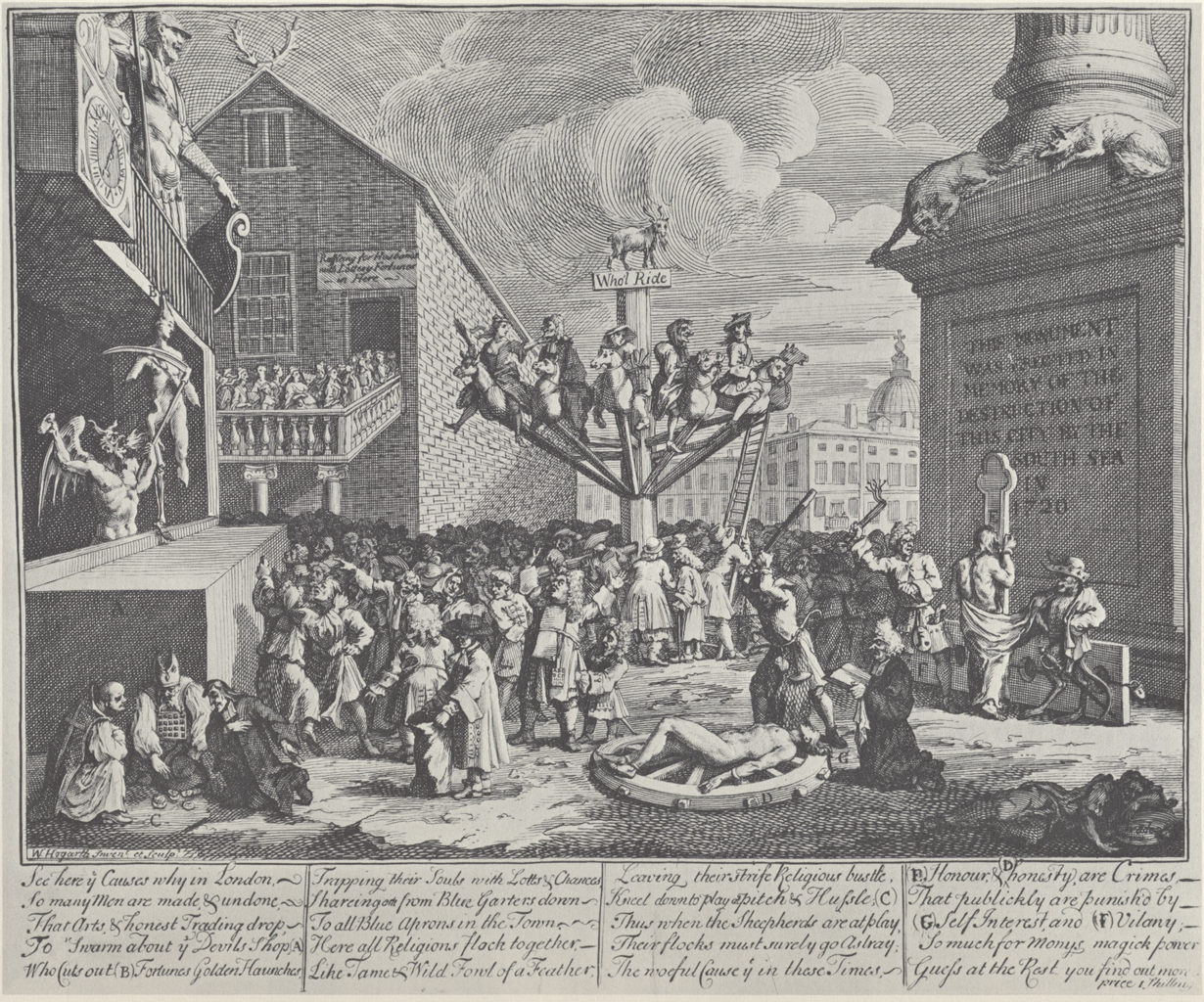
In the latest Age of Invention newsletter, Anton Howes looks at Britain’s volatile financial scene in the 1720s:

William Hogarth – The South Sea Scheme, 1721. In the bottom left corner are Protestant, Catholic, and Jewish figures gambling, while in the middle there is a huge machine, like a merry-go-round, which people are boarding. At the top is a goat, written below which is “Who’l Ride”. The people are scattered around the picture with a sense of disorder, while the progress of the well-dressed people towards the ride in the middle represents the foolishness of the crowd in buying stock in the South Sea Company, which spent more time issuing stock than anything else.
Scanned from The genius of William Hogarth or Hogarth’s Graphical Works via Wikimedia Commons.

Over in France, a Scottish banker named John Law had in the late 1710s overseen an ambitious scheme to reorganise the government’s finances. He ran the Mississippi Company, one of the many companies with monopolies on France’s international trade. His scheme was for the company to acquire all of the other similar monopolies, so that it could have a monopoly on all of the country’s intercontinental trade routes. By 1719, the Mississippi Company had swelled into a Company of the Indies, which in turn had purchased the right to collect French taxes, from which it took took its own cut. In exchange for acquiring these monopolies, Law’s new super-monopoly would buy up the French government’s accumulated war debts, allowing repayment on more generous terms. By allowing the state to borrow more cheaply, the scheme was to be a key plank in improving French military might.

Meanwhile, in Britain, a very similar project was afoot. Following the War of the Spanish Succession, one of the things Britain won from France was the asiento – the monopoly on supplying African slaves to Spain’s colonies in America. The asiento was given to the South Sea Company, which had the monopoly on British trade with South America, and which in 1720 began to follow a scheme similar to Law’s. Given developments in France, it would not do for the British state to be left behind in terms of its capacity to take on more debt for war. Thus, with political support, the South Sea Company began to buy up the government’s debt, persuading its creditors to exchange that debt for increasingly valuable company shares.

In 1720, both schemes came crashing down. In the case of Law’s scheme, he had printed paper currency with which people could buy his company’s shares, but in 1720 discovered he had printed too much. When he prudently tried to devalue the company’s shares to match the quantity of paper notes, the devaluation spun out of control. In the case of the South Sea Company, the causes of the crash were a little more mysterious, perhaps even verging on the mundane. One explanation is that too many wealthy investors simply tried to sell their shares so that they would have ready cash to spend on holidaying in Europe, precipitating a minor fall in the share price which then led to a more widespread panic. Regardless, it did not end well. The company itself continued for many years thereafter — it even got involved with whaling off the coast of Greenland — but the collapse of its share price ended its chance to restructure the government’s debts.

December 27, 2019

QotD: The perils of tax reform

Filed under: Economics, Government, Politics, Quotations, USA — Tags: , , , — Nicholas @ 01:00

Deductions are the Cheez Doodles of tax policy: Everyone likes them; everyone who studies the matter knows they are not good for us; and nonetheless, most people will get very indignant if you attempt to replace them with something more wholesome.

This is why deductions rarely go away, no matter how stupid and detrimental to the fiscal and economic health of the republic. For example, virtually every wonk in Washington, from radical libertarian to fervent socialist, can agree upon at least one thing: the tax deductibility of employer-sponsored health insurance is a terrible idea. On the one hand, it costs the government a packet of money every year, money that has to be raised by higher taxes on someone else. On the other hand, it encourages employers to load as much compensation as possible into the health benefit package, which distorts our economy and contributes to ballooning costs. There is nothing nice to be said about this particular tax deduction, except that it undoubtedly seemed like a good idea during World War II.

And yet, when it comes time to, say, pass a major health-care reform, or reform the tax code, do our nation’s legislators start with the obvious, and get rid of this egregiously stupid deduction? I regret that there is no way to convey my hollow, despairing laugh in pixel form. Of course they don’t touch it. The very egregiousness of its immense costs, the massive distortions it has induced in American consumption patterns, mean that getting rid of it would be far too disruptive.

Megan McArdle, “Republicans Turned the Tax Code Into a Weapon”, Bloomberg View, 2017-11-03.

December 12, 2019

“Socialism” and “Capitalism” in the United States

Filed under: Economics, Government, Politics, USA — Tags: , , , , , , — Nicholas @ 05:00

Antony Davies and James R. Harrigan look at the supposed conflict between sharing, caring socialism and raw, heartless capitalism in the context of the American political theatre:

These terms were once very clearly defined. Socialism is state control of the means of production. The intent is that these means are to be used for the public good. By contrast, capitalism is simply private ownership of the means of production. The intent is that these means are to be used to advance the interests of those who own them, which will in turn create conditions of general prosperity that can be enjoyed by all.

When polled, Americans express relatively well-defined views on both. And while nowhere near a majority of the American electorate favors a completely socialist system, a recent Gallup poll indicates that more than four in ten Americans think “some form of socialism” is a good thing. But what is “some form of socialism?” A society is either socialist or it isn’t. The state either owns the means of production or it doesn’t. There is no middle ground. Even our openly socialist politicians rarely advocate anything near as drastic as government control of the means of production.

[…]

And just as transferism is not actually socialism, the system against which transferists rail isn’t capitalism, either. When they think of “capitalism,” transferists imagine a monied class that defrauds customers, pollutes the environment, and maintains monopoly power, all because the monied class is in bed with government. But capitalism is simply the private ownership of the means of production. What people are actually describing is something more appropriately called “cronyism,” which can manifest in a socialist system as easily as in a capitalist one. Cronyism isn’t a byproduct of the economic system at all; it is a byproduct of politics.

For current examples, one need look no further than North Korea, Cuba, and Venezuela. Socialists say these aren’t examples of “real socialism,” and they’re not. There was a time when these countries were indeed socialist, just as there was a time when the United States was capitalist. But cronyism has overtaken these countries’ economic systems, just as it did in humanity’s grandest socialist experiment: the Soviet Union. Life was simply different for inner-party members than it was for workers. This is the real danger that all countries face, regardless of the animating principles of their economic and political structures.

[…]

We need to answer the core question: how much transferism do we want?

In order to figure this out, we need to come to terms with the fact that any transfer is a confiscation of wealth from the people who created it. That confiscation will decrease wealth creation in the long term by decreasing an important incentive to take the risks necessary for creating wealth. Second, we have to recognize that transferism is addictive. No matter how much we transfer, people will always want more. The United States’ $23 trillion debt, the largest debt the world has ever seen, has come about because of American voters’ voracious appetite for transfers combined with politicians’ obvious incentive to provide them.

The solution politicians have found is to pass off the cost of the transfers to taxpayers who haven’t yet been born by borrowing the money, thereby leaving to the next generation the problem of repaying the debt or enduring unending interest payments. It’s a house of cards to be sure, but from their perspective, it will be someone else’s house of cards.

In the end, we have polluted our political discourse with two words that no longer have much meaning: socialism and capitalism. In the process, we don’t call the animating principle of modern American politics what it actually is: transferism. The only winners have been the politicians who manage to gather votes by keeping the electorate in a near-constant state of friction. And they keep winning if people keep thinking in categories that ceased to have any real meaning years ago.

December 8, 2019

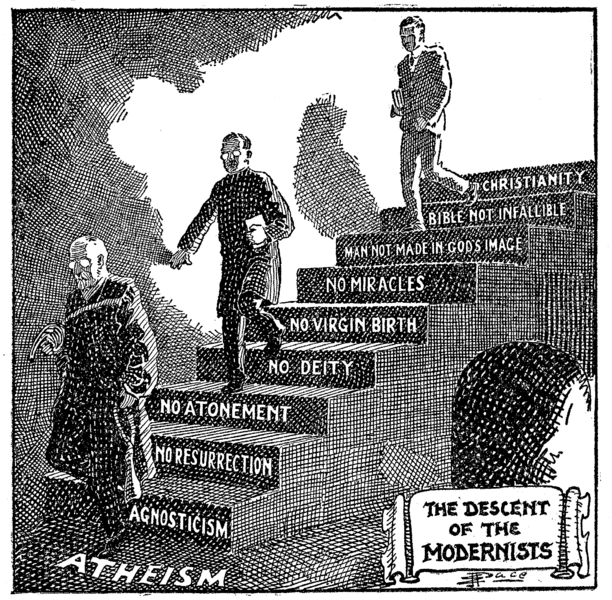
The “Church of Atheism” doesn’t get charitable status … this time

Filed under: Cancon, Law, Religion — Tags: , , , , , — Nicholas @ 03:00

Colby Cosh on the recent court decision on the Church of Atheism’s attempt to qualify as a church — and receive the tax benefits — under Revenue Canada’s rules:

“The Descent of the Modernists”, by E.J. Pace, first appearing in his book Christian Cartoons, published in 1922.
Public domain via Wikimedia Commons.

Last week the Federal Court of Appeal upheld Revenue Canada’s rejection of an application for charitable status made by a “Church of Atheism” tucked away in Ontario’s Lanark Highlands. The idea of making a gesture like this has probably occurred to every atheist who looks around at a world of tax-exempt churches and wonders why his kind is excluded from the gravy train. (Clergymen pay tax on their income, but they have access to a generous residential deduction, and any professional expenses covered by the church go untaxed.)

The fact is that the “Church’s” efforts were a bit amateurish and confused. But they may, like a doomed military reconnaissance, have revealed weaknesses in the anomalous exclusion of atheists from religious tax exemptions.

These weaknesses cannot be any big secret. You probably remember the Supreme Court’s Mouvement laïque québécois v. Saguenay decision of 2015 — that’s the case in which the Quebec Court of Appeal had ruled that a statue of Christ with an electrically illuminated Sacred Heart was “devoid of religious connotation.” The Supreme Court, perhaps suppressing a chuckle or two, proceeded to unanimously overturn the Quebec ruling and expound the concept that the Canadian state has a Charter-based “duty of religious neutrality” (except, of course, where the constitution explicitly specifies otherwise, as with Catholic schools). Government, the SCC insisted, “must neither favour nor hinder any particular belief, and the same holds true for non-belief.”

Given that this is our law, what can be the problem with a “Church of Atheism”? Good question! Justice Marianne Rivoalen, writing on behalf of a three-judge Federal Court panel, confirmed the general point that there is a state duty of religious neutrality; in fact, even Revenue Canada, acting as the respondent, conceded this.

But the court simply ruled, without any logical elucidation, that “the Minister (of Revenue)’s refusal to register the appellant as a charitable organization does not interfere in a manner that is more than trivial or insubstantial with the appellant’s members’ ability to practise their atheistic beliefs. The appellant can continue to carry out its purpose and its activities without charitable registration.”

November 25, 2019

QotD: The origins of the state

Filed under: Government, History, Quotations — Tags: , , — Nicholas @ 01:00

Taxation most likely began ten thousand years ago, when nomadic hunter-gatherers gave up their wandering ways — and the tools associated with them — settled down, and started growing crops and herding livestock, which requires an entirely different suite of tools than hunting. The hunter-gatherers’ tools could be used as weapons because that’s essentially what they were — ask any mastodon — the farmers’ could not. As a result, anti-productive marauders who had been held off by the hunters’ tools (or the ability of the hunters and their families to escape and evade) took advantage of those who were stuck to the plots of land they had learned to farm with clumsy agricultural implements (which could not be wielded as easily by females, relegating them to a subordinate role for fifty centuries), and forced to to pay tribute to the bandits. Go take another look at the 1960 movie masterpiece The Magnificent Seven for illustration. The thieves eventually learned to call themselves “government” and the goods they stole, “your fair share”.

L. Neil Smith, “What Would Real Tax Reform Look Like?”, Libertarian Enterprise, 2017-10-29.

November 3, 2019

Colby Cosh on the origins of carbon taxes

Filed under: Economics, Environment, Government — Tags: , , , , — Nicholas @ 05:00

In response to a column by Andrew Coyne in the National Post, Colby Cosh outlines the intellectual origins of carbon pricing:

As Andrew knows, the intellectual origins of carbon pricing are purely classical-liberal. Maybe you have to belong to our club to spot that he has carefully not called it an invention of the “left.” When I was an undergraduate, it was the unfashionable libertarian and Hayekian zanies, not the despondent post-Cold-War Marxists, who were preaching what would become mainstream environmental economics. The left has been slow rather than fast to accept the idea of putting a mere price on what they regard as an inherent evil.

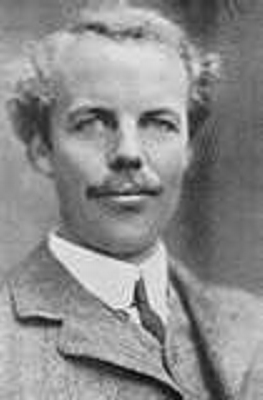
British economist Arthur C. Pigou (1877-1959).
Photo via Wikimedia Commons.

All of the foundations of carbon pricing were developed by economists that the left, in all varieties, now regards as cartoonish modern-day demonoids. The gentle Arthur Pigou, who developed the concept of economic externalities and the idea of taxing them, might still pass muster. But Pigou’s reformer-reviser Ronald Coase is deeply suspect, having pioneered an amoral analysis of externalities that tackles social-cost problems like environmental pollution without assigning blame to, or even necessarily acting against, the polluters.

In his paragraph Andrew almost explicitly outlines the theory of the “double dividend” from replacing bad, economically distorting taxes (like the one we impose on incomes) with taxes laid directly on externalities like carbon. The double dividend is pure Gordon Tullock, who is now a hate figure on the left for his role in creating public choice economics.

You can see that this analysis gets pretty complicated in a hurry. The idea of carbon taxation isn’t really of the right or the left. The best term for it might be “neoliberal,” although some people think there is no useful place for that word. To the degree that the left has accepted carbon pricing, they have done so as a (perhaps mostly unwitting) compromise with otherwise abominable thinkers like Coase and Tullock. Total state command-and-control of the economy isn’t an option in today’s Western world, and since there’s a neo-Malthusian crisis in the atmosphere around us, we had better try to solve it without having to execute a global socialist revolution first.

But if instinctive suspicion of the state is a feature of the conservative mind, carbon pricing doesn’t solve the problem completely. Canadian carbon tax designs have been given redistributive features, which makes them more acceptable politically to people who aren’t instinctive or innate conservatives, but creates confusion and distaste for those who are. And to the degree conservatives are inclined to doubt that the state will cut other taxes to make carbon prices revenue-neutral, they have been partly justified, so far, by the history of Alberta and B.C. The “double dividend” is a good idea: can governments be trusted to actually let us collect it?

In a nutshell, that lack of trust is why I’m generally opposed to the federal carbon tax system, even though the idea of carbon taxes (when properly implemented) are far less distorting to the economy than the hodge-podge of taxes and regulations we have now.

October 9, 2019

Election 2019 is “the most miserable, dishonest, venomous, pandering and altogether trivial exercise in multi-partisan misdirection since the last one”

Filed under: Cancon, Economics, Politics — Tags: , , , , , — Nicholas @ 03:00

Andrew Coyne curses both houses in his comparison between the Milk Dud’s Conservatives and Blackface Justin’s Liberals:

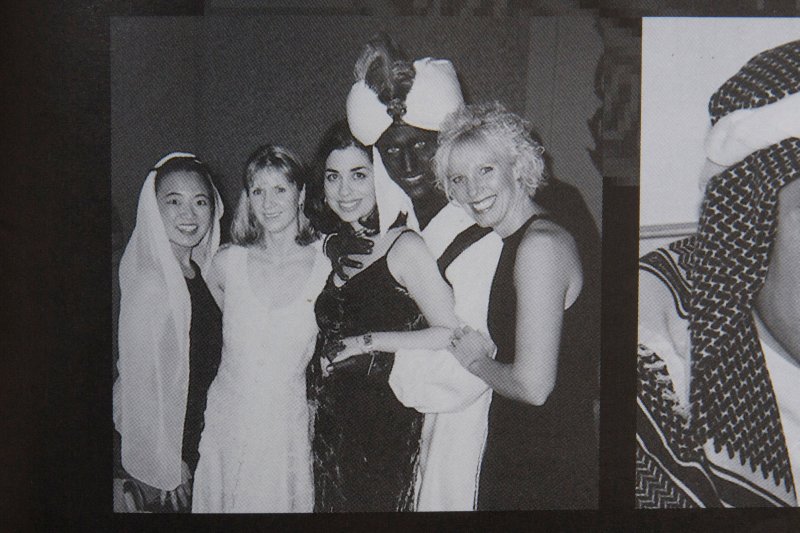
Justin Trudeau with dark makeup on his face, neck and hands at a 2001 “Arabian Nights”-themed party at the West Point Grey Academy, the private school where he taught.
Photo from the West Point Grey Academy yearbook, via Time

The platforms the parties have seen fit to put on public display — those of them that have deigned to present a platform — range from the absurdly unambitious (free museum passes, anyone?) micro-baubles of the Liberals and Conservatives to the utopian free-for-alls of the NDP and the Greens.

If the latter may be discounted as the fantasies of the unelectable, the former are scarcely to be taken more seriously, such is the record of broken promises of both parties once in office — of which the most damning evidence is surely the Liberals’ trumpeting of a book by two dozen academics, published shortly before the election, that found they kept roughly half of their promises from 2015. As defences of integrity go, “what about all the promises that weren’t broken” is not among the more convincing.

That credibility gap — the Liberal platform has the gall to include forecasts for the deficit — may explain why the parties have been less concerned with telling Canadians what they would do in power than with making up stories about what their opponents would do. The Liberals have spent much of the first part of the campaign suggesting a Conservative government would legislate on abortion; the Tories seem bent on spending the rest pretending the Liberals would tax the capital gains on people’s homes.

Or never mind the future. The parties seem unable to tell the truth even about the recent past. Conservative Leader Andrew Scheer has falsely claimed that British Columbia’s carbon tax “isn’t working” (studies estimate the province’s emissions are five to 15 per cent lower than they would be without the tax), that Canada gives $2.2 billion annually in foreign aid to “middle- and upper-income countries” (the correct figure is closer to $22 million) or that 95 per cent of Canadians already have prescription drug insurance (10 per cent have none, according to a report by the Commons health committee, while another 10 per cent are under-insured).

As for Justin Trudeau, he and his spokespersons have confined themselves to misleading the public about the Conservatives’ tax cuts (a cut in the 15 per cent base rate is hardly “for the wealthy,” even if the wealthy woulds get some benefit from it), or their record on health care transfers (transfers under the Harper government were not “cut” or “frozen,” but increased by nearly six per cent per annum). Oh, and about his part in the SNC-Lavalin affair, up to and including his muzzling of witnesses who might wish to tell their stories to the RCMP.

The Liberals, then, have failed to make a case for their re-election, while the Tories have failed to make the case for why they should replace them. To say this — or to note that their platforms have more in common than they have serious differences — is to risk the ire of partisans of both, who are heavily invested in the idea that this is an election of great import, as they are generally in the idea that politics is a noble calling filled with honourable men and women who keep at least half their promises.

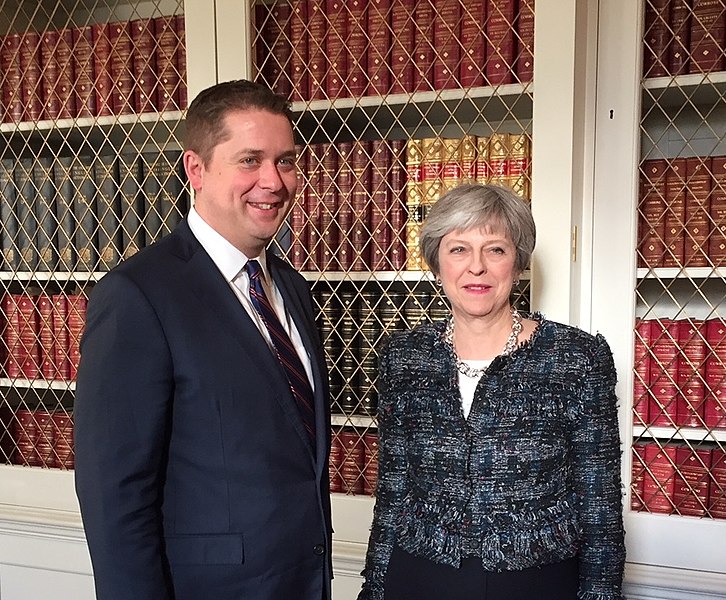
Andrew Scheer meets British Prime Minister Theresa May
Photo via Wikimedia Commons

October 2, 2019

In a crowded field, Election 2019 may be the worst we’ve seen so far

Chris Selley makes the case that this year’s federal election is the worst of all:

It has been widely suggested that this might be Canada’s Worst Election. Certainly it is dreary as all get-out. We began with interminable back-and-forth about abortion, which all party leaders pledge to do absolutely nothing about. If one or more of them are lying, it seems very unlikely they would admit to it at a press conference. The next mania was over Justin Trudeau’s blackface revues, which were radioactively damaging to whatever was left of his Most Enlightened Gentleman brand, but which mostly served as an opportunity for exhibitionist partisan insanity and cringeworthy journalism.

[…]

By rights the Conservatives should be mopping the floor. But they can hardly attack Trudeau’s social-engineer budgeting when they’re relaunching their flotilla of boutique tax credits for kids’ sports and arts programs and public transit. Why not just make their tax cut even bigger and let people spend their money how they please?

Similarly, the Conservatives would be on much firmer ground criticizing Trudeau’s housing-market interventions if they weren’t promising to review the mortgage stress test and bring back 30-year mortgages — something Stephen Harper’s government eliminated in 2012. Having decided carbon pricing was evil almost entirely because Justin Trudeau supports it, the Tories still struggle to defend any effective or efficient policy against climate change.

Any hope that Maxime Bernier might hold Scheer’s feet to the fire on free minds and free markets went up in flames ages ago as his People’s Party attracted far more authoritarian/nativist refugees from the Conservative Party of Canada than libertarian ones. Jagmeet Singh is bargaining hard to sell the NDP’s credibility down the river to appease all-but-totally uninterested Quebec nationalists — shamefully promising not to intervene against Bill 21, as if he would ever get the chance. Elizabeth May and her Green Party constantly remind us that they’re really quite odd: May insisting Longueuil candidate Pierre Nantel isn’t a separatist while Nantel shouts “I’m a separatist!” through a bullhorn is the weirdest thing she has done since the last weird thing.

The debates have worked out as badly as conceivably possible: The Leaders’ Debate Commission, created by the Liberals to solve a problem that didn’t exist — aieeee! Too many debates! — has reinvented the wheel, crushing both Maclean’s debate (which Trudeau declined to attend) and the Munk debate on foreign affairs (which has been cancelled due to Trudeau’s lack of interest) beneath it.

September 23, 2019

The “Global Climate Strike”

The big “let’s all play hooky from school” event’s Toronto organizers have been getting positive coverage from some of the local media, because of course they have. Here’s Tanya Mok for BlogTO, listing the totally reasonable and not in any way unrealistic “demands” of the movement:

FridaysForFuture Demonstration, 25 January 2018 in Berlin.
Photo by C. Suthorn via Wikimedia Commons.

The coalition has made a list of seven demands, which “reflect the rallying cries of the intersectional movements” they belong to. Some of those demands include:

  • Indigenous rights and sovereignty.
  • The protection of forests, land, and water sources.
  • A shift to publicly-owned renewable energy, and reducing national carbon emission by 65% by 203, reaching zero emissions by 2040.
  • A $15 minimum wage for all, and higher taxation on the rich.
  • Universal public services like health care and dental care, free university and college, housing as a human right, and free public transit.
  • Justice for migrants and refugees, allowing status for all. That includes putting an end to deportations and allowing for the full access to public services.

There will be a concert at Queen’s Park after the rally, as well as a follow-up benefit concert at the Tranzac Club in the evening. A giant street mural project run by Greenpeace will also be taking place prior to the rally, around 10 a.m., at the southern point of Queen’s Park.

September 20, 2019

The reason we don’t have – and will never have – an Economists Party

Filed under: Cancon, Economics, Politics — Tags: , , — Nicholas @ 03:00

Andrew Coyne points out that the study of economics probably disqualifies you from being an effective politician, because achieving success in the sausage factory of politics requires you to ignore or even work against economic facts:

A Mises Institute graphic of some of the key economists in the Austrian tradition (Carl Menger, Ludwig von Mises, Friedrich Hayek, Murray Rothbard, and Hans-Hermann Hoppe.
Mises Institute via Wikimedia Commons.

I believe I was the first to propose the creation of an Economists Party, a political movement that would advocate for the sorts of policies favoured by people who study economics for a living, based on the principles at its core.

It could not happen, of course, any more than the existing parties are likely to suddenly embrace the teachings of economists they have so cheerfully ignored until now, and for the same reason: because politics is, at its core, the opposite of economics.

The basic principle of economics is that everything is scarce. The basic principle of politics is that nothing is scarce. Economics teaches that more of one thing can only be had at the expense of less of another. Politics teaches that we can have more of both things, and of everything else besides.

Since more of one thing means less of another, economics tells us there is no point in favouring one part of the economy over another: the resources diverted to one firm, industry or region are simply resources denied to all the rest. Whereas politics is all about such transfers: a perpetual merry-go-round of redistribution, not from rich to poor, which is appropriate, but from everybody to everybody, which is impossible.

And if, for some reason, a politician were to resist this impulse, he would shortly find himself out of work. For whereas the benefits of a given intervention are typically concentrated on this or that group, the costs are spread widely; its beneficiaries, accordingly, have every incentive to organize and agitate on its behalf, while those footing the bill — consumers, taxpayers, or both — have comparatively little at stake as individuals. They may not even know who they are.

Thus it is that politics inclines, more or less inevitably, to prefer the narrow interest over the broad; producers over consumers; the present over the future. The only difference between the parties is whether this bias to the expedient is dressed up as a philosophy and celebrated as a positive good, or merely yielded to.

September 13, 2019

NDP leader Jagmeet Singh gets his tax plans vetted by the Parliamentary Budget Office

Filed under: Cancon, Economics, Politics — Tags: , , , , , — Nicholas @ 03:00

A recent innovation for political campaigns is that they can ask the Parliamentary Budget Office to provide an estimate for the impact of any taxation proposals, and NDP leader Jagmeet Singh was the first out of the gate to have his “super-wealth tax” evaluated. The PBO estimates that the levy would net out some $6 billion in the first full year of implementation. Sounds like a lot of money! Colby Cosh explains why it’s not quite what it might seem:

Federal NDP leader Jagmeet Singh taking part in a Pride Parade in June 2017 (during the leadership campaign).
Photo via Wikimedia.

Alas, the bean-counters always swoop in to spoil things. Singh’s wealth-tax scheme is instructive not only because he availed himself of PBO costing, but because it usefully reveals the limits of what the PBO or any other economic modeller can do. Look, in other words, at the fine print.

The PBO’s job was to estimate what you can extract from “an annual net wealth tax on Canadian resident economic families equal to one per cent of net wealth above $20 million.” In the PBO model this is a simple multiplication, but the roughly $6 billion take is arrived at only by reducing the revenue by 35 per cent to correct for “behavioural response” — that is, lawful (and unlawful) tricks employed to avoid the new tax by the rich targets. The net revenue is what’s left after you deduct another two per cent to cover administrative costs.

And, as the PBO immediately insists, “the estimate has high uncertainty” on both counts. This means they’re educated guesses. Jennifer Robson, a social policy prof at Carleton University’s Arthur Kroeger College, pointed out on Twitter that right now we don’t tax economic families per se and we don’t report assets and debts routinely to Revenue Canada. Ideas for pure wealth taxation (which is rare in practice) are predicated on the creation of, essentially, a new tax system — one which would have to detect and perpetually update how much, for example, the furniture in your house costs. The 35 per cent loss from behavioural response is at the high end of historic estimates from real-world examples. Even within our current tax system, Robson observes, we only get two extra dollars for every one we spend on expanding collections and compliance against the existing tax base.

As a practical matter, a wealth tax would mostly be, or would act most efficiently as, a tax on bank balances and investment accounts. Of course, there is always real estate. The super-rich seem to have a lot of that, and it is relatively easy to tax, and the resentment of Torontonians and Vancouverites who don’t own some is, for better or worse, a major reason the NDP is trying to weaponize envy.

But this reminds us that property taxes and taxes on property transfers perform a similar function, although they are not used primarily for income redistribution as such here — and in Canada ours are relatively high. The OECD does a little league table of tax structures, and compared with other industrialized countries Canada’s take from property taxes is about double the average. In a 36-country list we are near the bottom (33rd) in our dependence on taxing goods and services, and about average (12th) in dependence on corporate taxation, but fifth highest in dependence on personal taxation — and third in dependence on property taxes.

« Newer PostsOlder Posts »

Powered by WordPress